• 沒有找到結果。

Tissue distribution of naringenin conjugated metabolites following repeated dosing of naringin to rats

N/A
N/A
Protected

Academic year: 2021

Share "Tissue distribution of naringenin conjugated metabolites following repeated dosing of naringin to rats"

Copied!
21
0
0

加載中.... (立即查看全文)

全文

(1)

Original Articles

Tissue distribution of naringenin conjugated metabolites following repeated dosing of naringin to rats

Shiuan-Pey Lin

a,*

, Yu-Chi Hou

a, b, c

, Shang-Yuan Tsai

a

, Meng-Ju Wang

d

, Pei-Dawn Lee Chao

a,*

a

School of Pharmacy, China Medical University, Taichung 40402, Taiwan

b

Department of Medical Research, China Medical University Hospital, Taichung 40402, Taiwan

c

Department of Pharmacy, China Medical University hospital, Taichung 40402, Taiwan

d

Institute of Chinese Pharmaceutical Sciences, China Medical University, Taichung 40402, Taiwan

*

Corresponding author. School of Pharmacy, China Medical University, No.91

Hsueh-Shih Road, Taichung 40402, Taiwan.

E-mail: [email protected] ( Shiuan-Pey Lin )

ABSTRACT

(2)

Background: Naringin is a major antioxidant in Citrus fruits and herbs. In order to clarify the molecular forms distributed to various tissues, we investigated the tissue distribution of naringin and relevant metabolites in rats after repeated dosing of naringin.

Methods: Male Sprague-Dawley rats were orally administered naringin (210 mg/kg) twice daily for eight days. At 6 h post the 17

th

dose, various tissues including liver, kidney, heart, spleen and brain were collected and analyzed by HPLC method before and after hydrolysis with β-glucuronidase and sulfatase, individually.

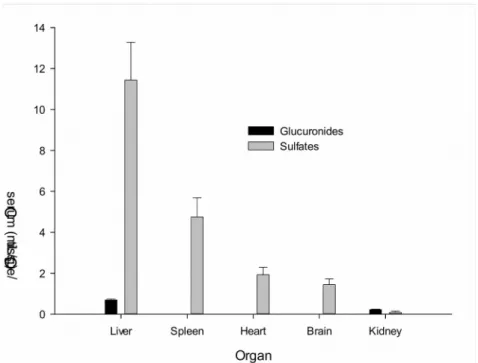
Results: The free forms of naringin and naringenin were not detected in all the tissues assayed. Liver contained the highest concentration of naringenin sulfates, followed by spleen, heart, brain and kidney. Naringenin glucuronides were present in liver and kidney, but not in spleen, brain and heart.

Conclusion: After repeated dosing of naringin, the free forms of naringin and naringenin were not detected in each tissue assayed. Naringenin glucuronides were predominant in the bloodstream, whereas naringenin sulfates were the major forms in liver, spleen, brain and heart.

Key words: naringin, naringenin, sulfates, glucuronides, tissue distribution

1. Introduction

Flavonoids, a major class of antioxidants, have attracted great interest to

(3)

pharmacologists because of various beneficial bioactivities . In addition, they have also attracted the attentions of pharmaceutical researchers due to their abilities to modulate P-glycoprotein (P-gp) and CYP 3A4 , which are important proteins

associated with the pharmacokinetics of most medicines .

Naringin (4’,5,7-trihydroxyflavanone 7-rhamnoglucoside) is one of the major flavonoids distributed in Citrus fruits such as grapefruit (C. paradisi), pomelo (C.

grandis) and in Chinese herbs such as C. aurantium and C. maxima . Numerous in vitro studies have reported that naringin and naringenin, the aglycon of naringin,

(chemical structures shown in Fig. 1) exhibited various beneficial activities including anticancer , superoxide scavenging, antioxidation and antimicrobial effects . Therefore, nowadays naringin-containing nutraceuticals were increasingly used as dietary supplements. However, based on our previous studies reporting the pharmacokinetics of naringin in rabbits and rats, naringenin sulfates and glucuronides were predominately present in the bloodstream, whereas no trace of naringin and naringenin had been detected . Therefore, whether the bioactivities of naringin and naringenin reported by previous in vitro study could be extrapolated to in vivo effects remained unanswered .

In regard to what are the major forms in various organs, although a few previous

studies have reported the tissue distribution of naringin or naringenin in rats , these

(4)

studies were conducted following single dose via intravenous or oral administration, and their results were not quite consistent. Therefore, this study analyzed the distribution of naringin and relevant metabolites in various tissues of rats following repeated dosing of naringin.

2. Materials and methods 2.1. Chemicals

Naringin (purity 95%), (±)-naringenin (purity 95%), β-glucuronidase (Type B-1,

(5)

666,400 units/g, from bovine liver), sulfatase (Type H-1, 20,000 units/g, from Helix pomotia, containing 498,800 units/g of β-glucuronidase) and vanillin were purchased

from Sigma Chemical Co. (St. Louis, MO, USA). 5,7-Dimethoxycoumarin (99%) was purchased from Aldrich (Milwaukee, WI, USA). Acetonitrile, methanol and ethyl acetate were of HPLC grade and were purchased from Mallinckrodt Baker, Inc.

(Phillipsburg, NJ, USA). L(+)-Ascorbic acid was obtained from RdH Laborchemikalien GmbH & Co. KG (Seelze, Germany). Other reagents were of analytical grade. Milli-Q plus water (Millipore, Bedford, MA, USA) was used throughout the study.

2.2. Instrumentation and HPLC conditions

The HPLC apparatus was equipped with a pump (LC-10AT, Shimadzu, Japan), an UV detector (SPD-10A, Shimadzu, Japan), an automatic injector (SIL-10A, Shimadzu, Japan) and a Cosmosil C18 column (5 µm, 150×4.6mm, Waters, MA, USA). The detection wavelength was set at 288 nm. The mobile phase consisted of acetonitrile – 0.1 % phosphoric acid (36:64, v/v) and the flow rate was 1.0 mL/min for naringenin assay in serum and tissue homogenate.

2.3. Drug administration and collection of blood and organs

Six male Sprague-Dawley rats weighing 300-350 g were used for this study. All rats

(6)

were purchased from the National Science Council, Taipei, R.O.C., and maintained in the Animal Center of China Medical University. Naringin was dispersed in warm water for oral administration and given at dose of 210 mg/kg twice daily for 17 doses via gastric gavage. Finally, rats were fasted overnight before the 17

th

dose, blood and various organs were collected at 6 h after dosing, which was based on the peak time of naringenin conjugates observed by our previous pharmacokinetic study . Immediately after blood collection, systemic perfusion was conducted by pumping normal saline to wash out the blood. The organs including liver, kidney, spleen, heart and brain were then dissected, blotted dry, accurately weighed, and frozen at –80℃. The animal study adhered to “The Guidebook for the Care and Use of Laboratory Animals (2002)” (Published by The Chinese Society for the Laboratory Animal Science, Taiwan, R.O.C.).

2.4. Preparation and quantitation of tissue samples

All tissue samples were lyophilized, then chopped into small pieces and milled with

normal saline (300 µL/g tissue) using a Potter-Elvehjem tissue grinder (Kontes Glass

Co., Vineland, NJ, USA). The homogenates (0.5 mL) were deproteinized with 3-fold

methanol. After centrifugation, the supernatant were evaporated to dryness under

vacuum and then dissolved with 0.5 mL of pH 5 acetate buffer to afford tissue extract.

(7)

For the quantitation of naringin, the tissue extract was analyzed prior to and after hydrolysis with β-glucuronidase and sulfatase, individually. For the quantation of naringin conjugated metabolites, the tissue extract (100 µL) was mixed with 100 µL of glucuronidase (1000 units/mL in pH 5 buffer) and/or sulfatase (containing 1000 units/mL of sulfatase and 24,940 units/mL of glucuronidase in pH 5 buffer), 100 µL of ascorbic acid (150 mg/mL) and incubated at 37℃ for 2 h. After incubation, the mixture was added with 900 µL of acetonitrile (containing 6 µg/mL of vanillin). For free form determination of naringin, the homogenate was treated with pH 5 acetate buffer without incubation with glucuronidase or sulfatase and processed as the procedure described above. The acetonitrile layer was evaporated under N

2

gas to dryness and reconstituted with an appropriate volume of acetonitrile then 20 µL was

subjected to HPLC analysis.

For the quantitation of free form naringenin, the tissue extract was determined before

hydrolysis with β-glucuronidase or sulfatase. Briefly, 100 µL of the deproteinized

tissue extract was acidified with 100 µL of 0.1 N HCl and partitioned with 500 µL of

ethyl acetate (containing 2.0 µg/mL of 5,7-dimethoxycoumarin as the internal

standard). The ethyl acetate layer was evaporated under N

2

gas to dryness and

reconstituted with an appropriate volume of acetonitrile, then 20 µL was subject to

HPLC analysis.

(8)

For the quantitation of naringenin glucuronides, 100 µL of the buffer containing tissue extract were mixed with 100 µL of β-glucuronidase (1000 units/mL in pH 5 buffer), 100 µL of ascorbic acid (150 mg/mL) and incubated at 37℃ for 2 h. For the quantitation of naringenin sulfates/glucuronides, 100 µL of the buffer containing tissue extract were mixed with 100 µL of sulfatase (containing 1000 units/mL of sulfatase and 24,940 units/mL of glucuronidase in pH 5 buffer), 100 µL of ascorbic acid (150 mg/mL), and incubated at 37℃ for 1 h. After hydrolysis, the later

procedure was the same as that described above for free form naringenin.

For calibrator preparation, 100 µL of tissue standards with various concentrations of naringenin were spiked with 100 µL of pH 5 acetate buffer, 100 µL of ascorbic acid (150 mg/mL), and then added with 100 µL of 0.1 N HCl. The later procedure followed that described above. The calibration graph was plotted by linear regression of the peak area ratios (naringenin to the internal standard) against concentrations of naringenin.

2.5. Data analysis

The concentrations of naringenin glucuronides and naringenin sulfates in each tissue

were expressed in μmol per gram of tissues (μmol/g). The ratios (mL/g) of

concentrations of naringin glucuronides and naringin sulfates in various organs

(9)

(μmol/g) to those in serum (μmol/mL) were calculated although the units were different.

3. Results

The quantitation method of naringenin in each tissue was established and optimized in

this study. Good linearities were obtained in the concentration range of 0.4–50.0

µg/mL of naringenin in each tissue. Validation of this assay method indicated that all

coefficients of variation (CVs) and relative errors of intra-run and inter-run analysis

(10)

were below 2.2 % and 18.1 %, respectively. The LLOQ and LOD of naringenin were 0.40 and 0.02 µg/mL, respectively, in all tissues.

Our results indicated that both naringin and naringenin were not detected in liver, spleen, heart, brain and kidney, whereas the molecular forms present in tissues were naringenin sulfates and naringenin glucuronides. The concentrations of naringenin sulfates and naringenin glucuronide in serum and various organs at 6 h post the 17

th

dose of naringin were listed in Table 1. The results indicated that liver contained the highest concentration of naringenin sulfates, followed by spleen, heart brain, and kidney. Naringenin glucuronides were present in liver and kidney, but not in spleen, brain and heart.

In regard to the analysis of serum collected 6 h post the17

th

dose of naringin, our quantitation result showed that naringenin glucuronides and naringenin sulfates were the major forms, whereas naringin and naringenin were not present, which was consistent with previous studies . Fig. 2 showed the ratios of the concentrations of naringenin glucuronides and naringenin sulfates in each tissue to those in serum.

Among the assayed organs, liver had the highest ratio of naringenin sulfates, which

was about 10.7 folds. Likewise, spleen, heart and brain had higher concentrations of

naringin sulfates than serum by 386, 100 and 57 %, respectively. In regard to the

(11)

distribution of naringenin glucuronides, conversely, liver and kidney contained lower concentrations than serum by 30 and 76 %, respectively.

4. Discussion

The quantitation method of naringenin glucuronides and sulfates in various tissues

were established and validated in this study. Due to considerable amount of β-

glucuronidase in the sulfatase (type H-1) used in this study, treatment with this

enzyme hydrolyzed both sulfates and glucuronides simultaneously. Comparison of the

results between hydrolysis with sulfatase and glucuronidase could provide the

individual concentrations of naringenin sulfates and naringenin glucuronides in each

tissue specimen.

(12)

Quantitation results of serum and collected tissues showed that after repeated dosing of naringin, the free forms of naringin and naringenin were not detected in both bloodstream and all assayed organ, whereas the major molecular forms were naringenin sulfates and naringenin glucuronides. In the serum, naringenin glucuronides were predominant, whereas in liver, spleen, heart and brain, narigenin sulfates was the major form, which implied that naringenin glucuronides had been

deglucuronidated and then sulfated in the organs.

Among the assayed organs, liver contained the highest concentrations of naringenin sulfates and naringenin glucuronides than other organs which was in good agreement with previous studies , indicating that these naringenin conjugates have higher protein

binding with liver proteins.

In the liver, the concentration of naringenin sulfates was higher than that of

naringenin glucuronides by 240%. In spleen, heart and brain, naringenin glucuronides

were not detected, therefore, the naringenin released through hydrolysis with sulfatase

in these organs were solely from naringenin sulfates. It can thus be assumed that when

naringenin glucuronides entered liver, spleen, heart and brain from the circulation,

they were hydrolyzed by glucuronidase and then sulfated by sulfotransferase in these

organs . In sum, liver, spleen, heart and brain contained narigenin sulfates as the

principle metabolites of naringin. Therefore, the bioactivities of naringenin sulfates in

(13)

liver, spleen, heart and brain warrant more investigations. In the kidney, naringenin glucuronides and naringenin sulfates were found at much lower concentrations than those in serum, indicating that only a little fraction of glucuronides or sulfates had entered the kidney. This finding was not consistent with a previous study reporting that moderate concentrations of naringenin glucuronides were detected in kidney, liver and brain at 2 h post an oral dose of naringenin in rats , which needed more

future studies to clarify.

Our present study revealing the absence of naringenin in all assayed tissues was not in good agreement with previous studies reporting that naringenin was detected in the tissues after single-dose administration of naringin . This discrepancy might be arisen from different dosage regimen of naringin or different detection method of naringenin. The present study treated rats with 17 doses of naringin, which might modulate the expression of UDP-glucuronosyltransferase or sulfotransferase and

resulted in more extensive metabolism .

In conclusion, repeated dosing of naringin to rats resulted in a wide distribution

of naringenin sulfates to various organs, whereas naringin and naringenin did not

reach any organ. This study has identified the chemical nature and concentrations of

naringenin conjugates in various tissues, which may help to disclose the

pharmacological roles of these putative active metabolites after chronic dosing of

(14)

naringin.

Acknowledgements

The work was in part supported by National Science Council (NSC 102-2320-B- 039-014-MY2, NSC 102-2320-B-039-008), and China Medical University, Taiwan, R.O.C. (CMU101-N2-08, CMU102-S-16).

REFERENCES

[1] CooK NC, Samman S. Flavonoids—Chemistry, metabolism, cardioprotective

effects, and dietary sources. J Nutr Biochem 1996; 7: 66-76.

[2] Middleton E, Jr., Kandaswami C, Theoharides TC. The effects of plant flavonoids on mammalian cells: implications for inflammation, heart disease,

and cancer. Pharmacol Rev 2000; 52: 673-751.

[3] Miniscalco A, Lundahl J, Regardh CG , Edgar B, Eriksson UG. Inhibition of

dihydropyridine metabolism in rat and human liver microsomes by flavonoids

found in grapefruit juice. J Pharmacol Exp Ther 1992; 261: 1195-1199.

(15)

[4] J Pharmacol Exp Ther. Modulation of adriamycin accumulation and efflux by flavonoids in HCT-15 colon cells. Activation of P-glycoprotein as a putative

mechanism. Biochem Pharmacol 1994; 48: 1437-1445.

5. Scambia G, Ranelletti FO, Panici PB, De Vincenzo R, Bonanno G, Ferrandina G, et al. Quercetin potentiates the effect of adriamycin in a multidrug-resistant MCF-7 human breast-cancer cell line: P-glycoprotein as a possible target.

Cancer Chemother Pharmacol 1994; 34: 459-464.

6. Zhang S, Morris ME. Effects of the flavonoids biochanin A, morin, phloretin, and silymarin on P-glycoprotein-mediated transport. J Pharmacol Exp Ther

2003; 304: 1258-1267.

7. Lin JH, Yamazaki M. Role of P-glycoprotein in pharmacokinetics: clinical

implications. Clin Pharmacokinet 2003; 42: 59-98.

8. Estudante M, Morais JG, Soveral G, Benet LZ. Intestinal drug transporters: an

overview. Adv Drug Deliv Rev 2013; 65: 1340-1356.

9. Lu Y, Zhang C, Bucheli P, Wei D. Citrus flavonoids in fruit and traditional Chinese medicinal food ingredients in China. Plant Foods Hum Nutr 2006; 61:

57-65.

10. Frydoonfar HR, McGrath DR, Spigelman AD. The variable effect on

proliferation of a colon cancer cell line by the citrus fruit flavonoid

Naringenin. Colorectal Dis 2003; 5: 149-152.

(16)

11. Harmon AW, Patel YM. Naringenin inhibits glucose uptake in MCF-7 breast cancer cells: a mechanism for impaired cellular proliferation. Breast Cancer

Res Treat 2004; 85: 103-110.

12. Heo HJ, Kim DO, Shin SC, Kim MJ, Kim BG, Shin DH. Effect of antioxidant flavanone, naringenin, from Citrus junoson neuroprotection. J Agric Food

Chem 2004; 52: 1520-1525.

13. Cavia-Saiz M, Busto MD, Pilar-Izquierdo MC, Ortega N, Perez-Mateos M, Muñiz P. Antioxidant properties, radical scavenging activity and biomolecule protection capacity of flavonoid naringenin and its glycoside naringin: a

comparative study. J Sci Food Agric 2010; 90: 1238-1244.

14. Celiz G, Daz M, Audisio MC. Antibacterial activity of naringin derivatives

against pathogenic strains. J Appl Microbiol 2011; 111: 731-738.

15. Hsiu SL, Huang TY, Hou YC, Chin DH, Chao PD. Comparison of metabolic pharmacokinetics of naringin and naringenin in rabbits. Life Sci 2002; 70:

1481-1489.

16. Wang MJ, Chao PD, Hou YC, Hsiu SL, Wen KC, Tsai SY. Pharmacokinetics and conjugation metabolism of naringin and naringenin in rats after single

dose and multiple dose administrations. J Food Drug Anal 2006; 14: 247-253.

17. Kroon PA, Clifford MN, Crozier A, Day AJ, Donovan JL, Manach C,

Williamson G. How should we assess the effects of exposure to dietary

(17)

polyphenols in vitro? Am J Clin Nutr 2004; 80: 15-21.

18. El Mohsen MA, Marks J, Kuhnle G, Rice-Evans C, Moore K, Gibson G, et al.

The differential tissue distribution of the citrus flavanone naringenin following

gastric instillation. Free Radic Res 2004; 38: 1329-1340.

19. Zou W, Yang C, Liu M, Su W. Tissue distribution study of naringin in rats by liquid chromatography-tandem mass spectrometry. Arzneimittelforschung

2012; 62: 181-186.

20. Peng HW, Cheng FC, Huang YT, Chen CF, Tsai TH. Determination of naringenin and its glucuronide conjugate in rat plasma and brain tissue by high-performance liquid chromatography. J Chromatogr B Biomed Sci Appl

1998; 714: 369-374.

21. Slaus K, Coughtrie MW, Sharp S, Vanhaecke T, Vercruysse A, Rogiers V.

Influence of culture system and medium enrichment on sulfotransferase and sulfatase expression in male rat hepatocyte cultures. Biochem Pharmacol

2001; 61: 1107-1117.

22. O'Leary KA, Day AJ, Needs PW, Mellon FA, O'Brien NM, Williamson G.

Metabolism of quercetin-7- and quercetin-3-glucuronides by an in vitro

hepatic model: the role of human beta-glucuronidase, sulfotransferase,

catechol-O-methyltransferase and multi-resistant protein 2 (MRP2) in

flavonoid metabolism. Biochem pharmacol 2003; 65: 479-491.

(18)

23. Moon YJ, Wang X, Morris ME. Dietary flavonoids: effects on xenobiotic and carcinogen metabolism. Toxicol In Vitro 2006; 20: 187-210.

TABLES

Table 1. Concentrations (nmol/mL for serum and nmol/g for tissues) of naringenin glucuronides (G) and naringenin sulfates (S) in serum and various organs at 6 h following the 17

th

dose of naringin (210 mg/kg) in six rats.

Metabolites serum liver spleen heart brain kidney

G Mean 3.7 2.6 0 0 0 0.9

  S.E. 0.1 0.1 0 0 0 0.1

S Mean 0.7 8.2 3.4 1.4 1.1 0.1

S.E. 0.0

4

1.5 0.7 0.2 0.3 0.0

4

(19)

FIGURES

O

OH

OH O O

O O CH

3

CH

2

OH

OH OH OH

OHOH

O

O

OH

OH HO

O

naringin naringenin

Fig. 1. Chemical structures of naringin and naringenin

(20)

Fig. 2. The relative mean (±S.E.) ratios of concentrations of naringenin glucuronides

and naringenin sulfates in various tissues to serum at 6 h after repeated

dosing of naringin (210 mg/kg) twice daily for 9 days to six rats.

數據

Table 1. Concentrations  (nmol/mL for serum and nmol/g for tissues) of naringenin glucuronides (G) and naringenin sulfates (S) in serum and various organs at 6 h following the 17 th  dose of naringin (210 mg/kg) in six rats.
Fig. 2. The relative mean (±S.E.) ratios of concentrations of naringenin glucuronides and naringenin sulfates in various tissues to serum at 6 h after repeated dosing of naringin (210 mg/kg) twice daily for 9 days to six rats.

參考文獻

相關文件

In 2007, results of the analysis carried out by the Laboratory of the Civic and Municipal Affairs Bureau indicated that the quality of the potable water of the distribution

In 2007, results of the analysis carried out by the Laboratory of the Civic and Municipal Affairs Bureau indicated that the quality of the potable water of the distribution

The ontology induction and knowledge graph construction enable systems to automatically acquire open domain knowledge. The MF technique for SLU modeling provides a principle model

Table 7: Resident population born outside Macao by total years of residence in Macao c (2001 ). Total

• To enhance teachers’ knowledge and understanding about the learning and teaching of grammar in context through the use of various e-learning resources in the primary

vs Functional grammar (i.e. organising grammar items according to the communicative functions) at the discourse level2. “…a bridge between

Wang, Solving pseudomonotone variational inequalities and pseudocon- vex optimization problems using the projection neural network, IEEE Transactions on Neural Networks 17

Define instead the imaginary.. potential, magnetic field, lattice…) Dirac-BdG Hamiltonian:. with small, and matrix