行政院國家科學委員會專題研究計畫 成果報告
建築排水橫主管污物搬送能力理論解析與實證研究 研究成果報告(精簡版)
計 畫 類 別 : 個別型
計 畫 編 號 : NSC 99-2221-E-011-087-
執 行 期 間 : 99 年 08 月 01 日至 100 年 07 月 31 日 執 行 單 位 : 國立臺灣科技大學建築系
計 畫 主 持 人 : 鄭政利
計畫參與人員: 碩士班研究生-兼任助理人員:曾頤誠 博士班研究生-兼任助理人員:廖婉茹
報 告 附 件 : 出席國際會議研究心得報告及發表論文
處 理 方 式 : 本計畫可公開查詢
中 華 民 國 100 年 09 月 07 日
Empirical study and theoretical analysis on solid deliver performance in building main drain
1. Introduction
Due to the consciousness of water shortage crisis, it is well known that water reservation is a crucial item on current global sustainable activity. Thus, water saving fittings and equipments are popularly adopted in existing buildings currently in many countries. According to the policy of green building and improving system recently in Taiwan, many types of water saving facilities are conducted in these periods for responding the water problem. The fact that low flash water closet can save lot of water is firmly understood nowadays. However, it is also known that the performance of solid transportation is one of the crucial issues in building drainage system. Water saving equipment directly reduces the volume of flowing water in the piping system which could affect the solid transportation distance. If this conflict was not considered in the building drainage system design, it would increase the risk of solid transportation problems in drainage system. Especially, the cases which were refitted by saving water closet in existing buildings with no checking the piping system conditions are mostly risky and complained in Taiwan recently. It is necessary to clarify the relation of solid transportation distance and conditions of drainage system including flash water volume and piping system. In the first stage of research results, we have already finished the investigation present piping situation in existing buildings and to category the parameters of solid transportation performance including piping size and length, elbow type, flash water volume and etc.. And we used experiments to clarify the solid transportation influence from these parameters. In the second stage, this research conducted estimation interface to validate the solid transportation performance which can offer an assessment tools for practical application. Finally, all research results will be contribution and guideline for the legalization procedure.
2. Technical Reviews
The air pressure phenomenon on the stack and the influence to trap seal water was schematically understood. This study mainly focuses on the transportation ability of main drain in ground level of buildings. As technical review of this research, M. Kamata studied the least necessary flow velocity in open channel and main drain performance in1986. Afterward, L. Galowin presented several papers which related transportation of drainage piping on CIB W62 annual symposium since 1990.
According to previous documents and technical reviews, it is obvious that the
transportation performance of main drain would be constrained by the volume of flash
from water closet. The relevant regulations and testing standards are arranged as the reference of this research. The national standards including CNS 3220 and CNS 3221 are current domestic regulations in Taiwan. The testing standard also includes ASME A112.19.6-1995 USA.
Due to the complexity of main drain fitting, there is not yet limitation for the length of main drain in Taiwan’s Building Code so far. Even the NPC of USA and HASS of Japan have no regulation in this issue. Current building designs are getting huge and complex. More and more open space is set into ground floor to make the function be more flexible recently in Taiwan. Consequently, the main drain design has to be fitted more complex in detail and longer for deliver the solid to the treatment device. Those changes increase the resistance of transportation and the risk of failure of main drain. The increasing problems of main drain reflect the importance of this issue.
Namely, the building code needs adequate tool to regulate the design of main drain in buildings.
8~9F
1~7F
B1F
GL RF
300@13=3900
10~12F
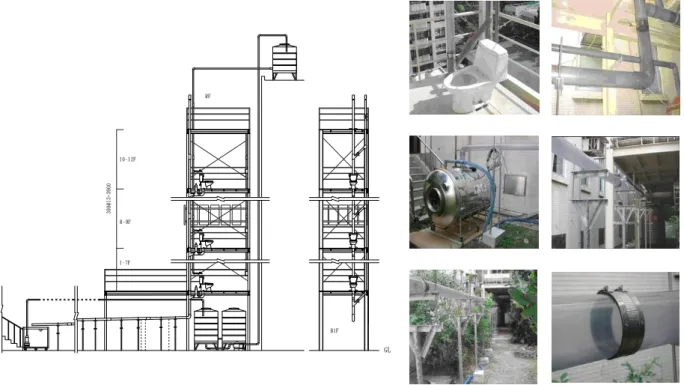
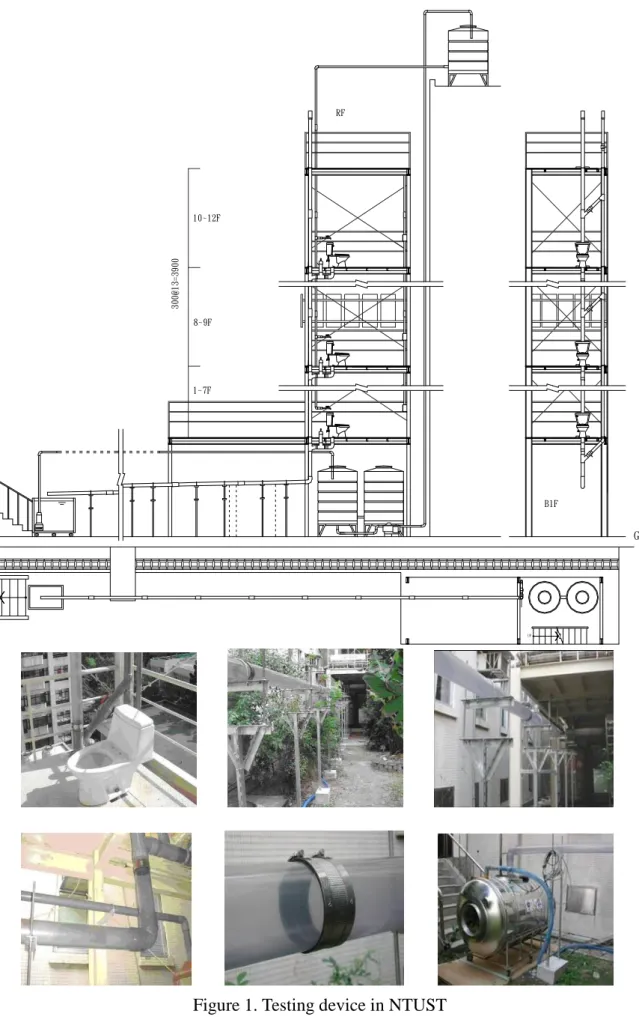
Figure 1. Testing device in NTUST
Experiment plan was set up for visual transportation phenomenon in main drain of
buildings and clarifying its feature. The testing rigs are offered by ABRI (Architecture
and Building Research Institute) and NTUST (National Taiwan University of Science
and Technology). Transparent PVC pips were used for the observation on the
transportation phenomenon in main drain of testing devices. The testing pipe is 18
meters in ABRI and 50 meters in NTUST for multiple conditions of experiments. The
pictures of testing rigs and devices of NTUST are shown in Figure 1. It is seen that the obvious different transportation ability between low flash water closet and traditional articles. That is to say, low flash water closet might diminish the transportation performance of building main drain and this issue should not be ignored.
3. Investigation and Experiment
This research aims to clarify the relationship of transportation performance and drainage system of buildings. Therefore, the situations of existing drainage system in buildings are the main issue and investigation objects of this study. The investigation items would include the primary data and details of drainage system. As the results, 89 cases of existing buildings are selected to be the objects of this research. Residential buildings are the majority of the investigation cases, the office buildings and some other types of constructions are included either. The slope of main drain with 1/100 is 60%, others include slope with 1/150 and 1/200. The size of main drain pipe is mainly ψ 125 mm and ψ 100 mm. The location of main drain of residential buildings is mostly in basement floor, some commercial and multi-utility buildings are set in ground or second floor to response the limitation of function plan.
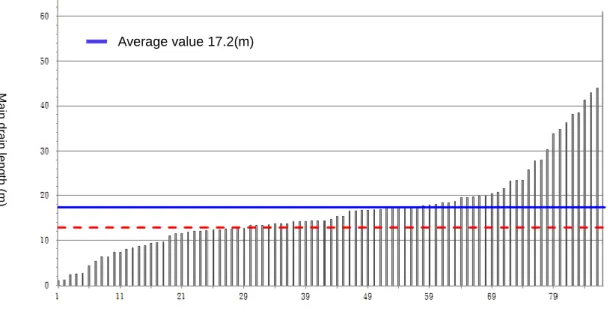
This research initially focuses on the total length of main drain of existing buildings. The updated result is shown as Figure 2 which reveals the distribution of main drain total length with average 17.2 meter and standard deviation 10.5 meter. The cases data shows almost a normal distribution and the length is between minimum of 1.1 meter and maximum of 61.5 meter.
Figure 2. The distribution of total main drain pipe length
Case number
Main drain length (m)
Average value 17.2(m)
The first point which is noticed as the transportation issue of main drain is the join connection from vertical stack to horizontal pipe. It is obviously that the solid delivery ability of main drain would be affected by the resistant of join connection. According to the investigation, there are single 90° join and double 45° join adopted in existing buildings, and very few cases use the special join in Taiwan. Therefore, the inference of join resistant needs to be clarified and confirmed. This study confirmed the effect of single 90° join and double 45° join by experiment to find the first parameter for transportation performance of main drain.
According to the initial investigation of existing building main drain, this paper concludes the parameters which would affect the transportation performance. Besides the flash volume of water closet, the parameters include pipe diameter, slope, vertical elbow and horizontal bend. In order to clarify the inference of the main drain conditions and to build a estimating model, these parameters need to be validated by experiment. A series of testing procedure was set up to confirm the index of these parameters.
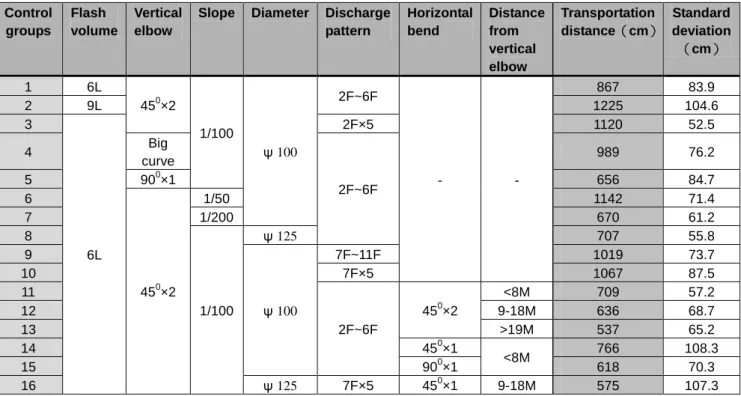
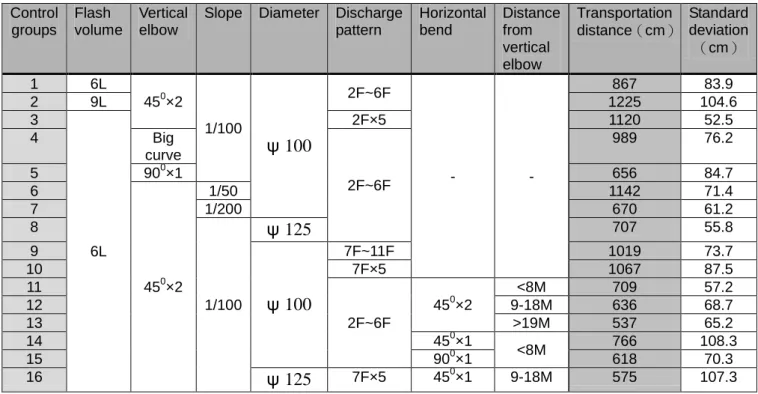
Due to the existing building main drain condition is complex and the limitation of experiment device, this study try to consider the maximum possibility of drain compositions to simulate the real situation. Therefore, 16 groups of compositions are concluded to simulate all possibility of main drain fitting in existing buildings in this paper. Two sponge testing body was used as the imitated solid and 5 times of repeat testing were executed in experimental tower. Thus, 10 experimental data can be recorded in each testing composition.
Table 1. The testing compositions and the experimental data of main drain transportation
Control groups
Flash volume
Vertical elbow
Slope Diameter Discharge pattern
Horizontal bend
Distance from vertical elbow
Transportation distance(cm)
Standard deviation
(cm)
1 6L
450×2
1/100
ψ 100
2F~6F
- -
867 83.9
2 9L 1225 104.6
3
6L
2F×5 1120 52.5
4 Big
curve
2F~6F
989 76.2
5 900×1 656 84.7
6
450×2
1/50 1142 71.4
7 1/200 670 61.2
8
1/100
ψ 125 707 55.8
9
ψ 100
7F~11F 1019 73.7
10 7F×5 1067 87.5
11
2F~6F
450×2
<8M 709 57.2
12 9-18M 636 68.7
13 >19M 537 65.2
14 450×1
<8M 766 108.3
15 900×1 618 70.3
16 ψ 125 7F×5 450×1 9-18M 575 107.3
As a result, 80 groups and 160 experimental data were collected in this paper to validate parameters and to build an estimating model. Table 1 shows all the testing compositions and the experimental data of imitated solid transportation distance which included average and standard deviation. According to the investigation and a reasonable requirement for main drain fitting, this study set a criterion condition which set with parameters of 6 liter flash volume, double 45° elbow, slope of 1/100, ψ 100 mm, simultaneous discharge closets under 4, and discharge floor height under 6. The imitated solid transportation distance of this criterion condition is 867 (±83.9) cm by experiment as shown as Table 1.
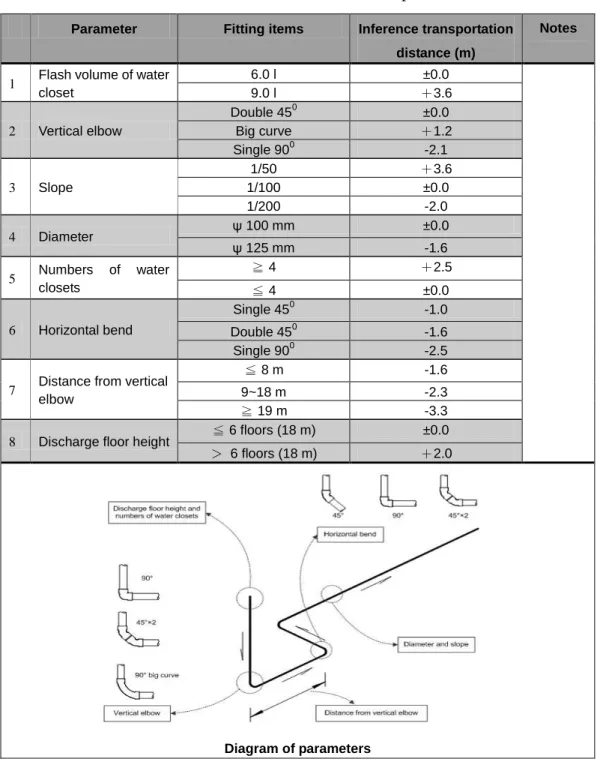
Table 2. The relative inference index of transportation distance
Parameter Fitting items Inference transportation distance (m)
Notes
1 Flash volume of water closet
6.0 l ±0.0
9.0 l +3.6
2 Vertical elbow
Double 450 ±0.0
Big curve +1.2
Single 900 -2.1
3 Slope
1/50 +3.6
1/100 ±0.0
1/200 -2.0
4 Diameter ψ 100 mm ±0.0
ψ 125 mm -1.6
5 Numbers of water closets
≧ 4 +2.5
≦ 4 ±0.0
6 Horizontal bend
Single 450 -1.0
Double 450 -1.6
Single 900 -2.5
7 Distance from vertical elbow
≦ 8 m -1.6
9~18 m -2.3
≧ 19 m -3.3
8 Discharge floor height ≦ 6 floors (18 m) ±0.0
> 6 floors (18 m) +2.0
Diagram of parameters
Consequently, each parameter compares to the criterion condition, the relative inference to solid transportation can be conversed quantitative index of distance. The relative inference index is concluded by experimental data and shown as Table 2.
Figure 3. Parameters of main drain and the inference transportation distance According to the empirical study above, 8 parameters are concluded to be the factors which affect the transportation performance of main drain in buildings. A simplified model was built to estimate an approximate solid transportation distance by statistic methodology. Accordingly, 2 additional parameters including second elbow condition within the drainage system are added into the estimation model. A single regression analysis was adopted to conduct the calculation equation as the following.
100
e n C
l D
n
t
………(1)
Herein D
t: the estimated transportation distance (m)
l
n: the affected length of individual parameter (cm)
C: the empirical constant distance 769.7 (cm)
e : the weighting factor
The estimated transportation distance is accumulated by the affected length of individual parameter. There are 8 parameters concluded in this research. Each affected length of individual parameter has a regression equation conducted from empirical validation.
4. Application tool and validation
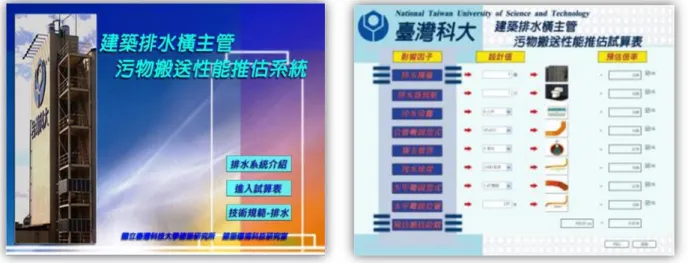
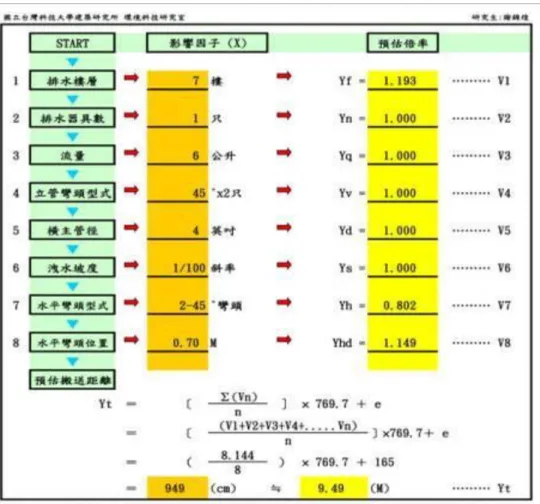
The transportation distance of main drain in building is a complex issue which includes uncertain interaction phenomena of water and solid. Physical solution of fluid theory is still not clear nowadays. This paper proposed an empirical approach with simplified regression methodology from experimental results. The parameters which affect the transportation distance are concluded as 8 regression equations from experimental validation. In order to enhance the practical application of transportation distance calculation and verification, this research also developed an interface of calculation software which can easily access by computer. The interface of calculation model is shown as figure 4 and a calculation case is shown in figure5.
It is known that the performance of solid transportation is one of the crucial issues in building drainage system. Water saving equipment directly reduces the volume of flowing water in the piping system which could affect the solid transportation distance.
The use of saving water facility would increase the risk of solid transportation problems in drainage system. Due to the consciousness of sustainability, more and more existing residential buildings are refitted by saving water closet to reduce the water demand of daily utility. However, it often happened that the process with no checking the piping system conditions and that would be risky for drainage problem. It is necessary to clarify the relation of solid transportation distance and conditions of drainage system including flash water volume and piping system.
Figure 4. The interface of calculation model
Figure 5. A calculation case in model
According to the investigation results, this paper found some existing residential buildings with problems of main drain block. The conditions of the problem cases and the transportation validations are arranged as shown in Table 3.
Table 3 .Problem cases and validation
Case
No. Age Floor height
Elbow (V*)
Piping
(D*) Slope Elbow (H*)
Main drain length(m)
Regulation length(m)
Calculation Distance(m)
1 1.6 13 45°x2 4" 1/100 45°x2 38.5 8.8 9.49
2 4 14 45°x2 5" 1/50 45°+Y 20.1 10.8 9.60
3 16 8 T 4" 1/50 T 12.2 9.4 9.33
4 20 12 90° 4" 1/50 45° 18.1 10.9 9.39
5 13 12 90° 6" 1/50 45°x2 18.0 8.7 9.14
6 5 10 90° 6" 1/100 45°x2 12.0 5.1 8.27
7 12 12 45°x2 8" 1/100 45° 18.6 7.8 8.69
8 23 11 45°x2 4" 1/100 T 34.8 7.9 9.39
*V: vertical, D: diameter, H: horizontal
The investigation obviously shows the crucial reason for the problem of main drain block. The main drain length of these cases is far longer than the regulation proposed length. Namely, it is proved that the ignored transportation performance of main drain really increased the risk of sanitation problem. On the other hand, the validation results also reveal that the calculation distance highly corresponds to the regulation length of main drain in building. Due to the difficulty of observation through real main drain function, this proposed estimation model and interface are practicable to confirm the drainage system design. Consequently, a regulation which can guide the designer and engineer to confirm the performance of drainage system and an empirical estimation model which can contribute the main drain confirmation are conducted and validated in this research.
5. Conclusion
This paper is one of the results from a long term research regarding transportation performance of main drain in residential buildings since 2006. The transportation distance of main drain is a complex issue which includes uncertain interaction phenomena of water and solid, however, the theoretical solution is still unavailable. As the results of this research, the current paper finished the investigation of present piping situation in existing buildings and the parameters category of solid transportation performance. Empirical approach was executed to clarify the solid transportation influence from these parameters. Eventually, this research conducted estimation interface to validate the solid transportation performance. This achievement can be used as an assessment tool for practical application. Therefore, a regulation which can guide the designer and engineer to confirm the performance of drainage system and an empirical estimation model which can contribute the main drain confirmation are conducted and validated in this research.
Reference
1. National Standard Plumbing Code/National Association of Plumbing-Heating- Cooling Contractors/1987.2
2. R.S. Wyly and H.N. Eaton, Capacities of Stacks in Sanitary Drainage System for Building, N.B.S. Monograph 31, 1961.
3. R.S.Wyly and H.N.Eaton, Capacities of Plumbing Stack in Building, BMS Repoet,132, 1952.
4. Lu Wen-Heng, Cheng Cheng-li, Chou Yen-Chun, Investigation and Development Analysis of Building Drainage System for Apartment House, CIB-W62 International Symposium, lasi, Romania, 2002.
5. L.B. Jack, J.A Swaffield, Developments in the simulation of the air pressure transient regime within single stack building drainage system, CIB-W62 International Symposium, Edinburgh, UK, 1999.
6. Swaffield, J.A., Jack, L.B., Campbell D.P., Control and suppression of air pressure transients in building fjrainage and vent systems, Building and Environment, 39(2004) 783-794.
7. Swaffield, J.A. and Campbell, D.P., Numerical modelling of air pressure transient propagation in building drainage system, including the influence of mechanical boundary condition. Building Envir. 27, (1992)
8. Campbell, D.P., Macleod, K.D., Detergents in drainage systems for buildings, Wat. Res.
Vol.35, No. 4, pp. 1086-1092, 2001.
9. Cheng, C.L., Yen, C.J., Ho, K.C., Ho, J.R., Study on transportation performance of main drain with low flash water closet in buildings, CIB-W62 International Symposium, Taipei, Taiwan, 2006.
10. C.L. Cheng, Ho, K.C., W.J. Liao, C.H. Hsieh, Research of main drain system and solid transportation performance in existing buildings, CIB-W62 International Symposium, Taipei, Taiwan, 2010.
11. C.L. Cheng, K.W. Mui, L.T. Wong, C.J. Yen, K.C. He, Characteristics of air pressure fluctuations in high-rise drainage stacks, Building and Environment, UK. Vol 45 Iss 3, pp 684-690, 2010. (SCI) (NSC97- 2221-E-011-112)
12. C.L. Cheng, W.J. Liao, K.C. He, J.L. Lin, Empirical study on drainage stack terminal water velocity, Building Services Engineering Research and Technology, UK, 32.2 (2011) pp. 171–181 (SCI) (NSC98- 2221-E-011-122)
計畫成果自評:
本研究計畫之內容已經於計畫期限內執行完畢,研究成果也已經發表於
CIBW62 建築國際研討會,研究之部分成果並彙整投稿於 SCI 國際學術期刊,目
前正受理審查中。自評計畫執行順利圓滿,研究成果良好,對國內建築專業學術
領域及建築實務有具體之貢獻。
1
國科會補助專題研究計畫項下出席國際學術會議 心得報告
日期: 99 年 11 月 30 日
計畫編號 NSC 99-2221-E-011-087
計畫名稱 建築排水橫主管污物搬送能力理論解析與實證研究
出國人員姓名 服務機關及職稱
1. 鄭政利/國立台灣科技大學建築系/教授
2. 廖婉茹國立台灣科技大學建築系/博士生
會議時間地點
自 2010 年 11 月 7 日至 2010 年 11 月 10 日/Sydney, Australia
會議名稱 (中文)
第 36 屆國際建築研究發展暨建築給排水國際研討會(英文)
36th International Symposium of CIB-W62, Water Supply and Drainage for Building發表論文題目
1.Research of main drain system and solid transportation performance in existing buildings
2.Investigation of public toilet facility in MRT station
一、 參加會議經過
CIB (International Council for Research and Innovation in Building and Construction)建築國際研討會,最初係由法國發起之國際性建築學術研究交流組織,
成立於 1953 年,以促進國際間最先進之建築科學新知交流與應用技術發展為宗旨,
至今已有七十個國家及六十個國際學術機構或研究組織正式參與。由於建築領域之 各部門研究學門相當龐大,舉辦統一之國際研討會或由單一組織來經營實際上已有 困難,目前係有四十二個常設領域工作委員會(Working Commissions)及十三個非 常設專題工作小組(Task Group),各自營運並定期舉辦研討會,再將成果納入 CIB 總會之資訊情報交流體系。每年研討會由不同之會員國輪流舉辦,建築給排水(Water Supply and Drainage for Buildings)研討會就是在此架構下之常設領域工作委員會
(CIB-W62),成立於 1971 年,每年定期召開學術會議,至今第三十六屆會議未曾 中斷。國內現在有三個研究機構,包括國立台灣科技大學、國立成功大學以及內政 部建築研究所,是目前 CIB 正式之團體會員。今年會議係由澳洲 (Australia) 承辦,
於澳洲的國際都市雪梨(Sydney)舉行一天之各會員國代表會議,以及為期三天之國 際學術研討會。筆者自 1996 年起於瑞士洛桑受邀發表論文之後,每年分別於日本橫 濱、荷蘭鹿特丹市、英國愛丁堡、巴西、斯洛維尼亞、羅馬尼亞、土耳其、法國、
比利時、捷克等國主辦,並受邀發表論文及擔任分科會議主持人,今年乃第十四
次受邀擔任會議主持人與發表論文。筆者研究團隊也於 2006 年,爭取到了承辦當年
2
度年會的主辦權,順利成功地在台北舉行了第三十二屆之國際學術研討會以及年度 會員國會議。
本次大會於十一月七日下午各國代表開始報到,並於當天下午六點舉行年度會 員國代表大會,傳達 CIB 總會的重要訊息與一般議程會員國事務討論,同時也慎重 討論了明年度 2011 年大會,主辦國葡萄牙(Portugal)的籌辦情況與會議地點。學術 研討會於八日上午正式開幕,展開為期二天之學術研討會及一天之技術參訪活動。
本次會期共接受口頭發表論文三十八篇,與會人數約百人,有許多國家代表與會,
並踴躍發表與參與討論。筆者今年仍然受邀擔任第 五個議程的分科會主持人 (Chairman),主持有關建築排水通氣設備議題之技術論文發表。本次的研討會主要 分八個議程進行論文發表與討論,議程首先就在簡單的開幕演講後展開。第一個議 題是有關建築給水系統議題 (ASession: Water supply, Demand)之相關研究論文發 表,共有 5 篇論文,提出相關研究論文之專家學者也相當廣泛,包括美國、巴西、
荷蘭、日本之專家學者。第二個議題是有關熱水系統之議題(B Session: Water supply, Hot water and drinking water quality) ,共有 5 篇論文。第三個議題仍是有關建築給 水設備之其他相關議題(CSession : Water supply, miscellaneous),共有 4 篇論文發 表。第四個議題是有關排水系統之議題(D Session : Drainage, modeling water and air flow),共有 6 篇論文發表,是本次會期討論最多最踴躍之議程,筆者研究團隊也在 此議題上有一篇論文發表,由於發表論文議題受到各國專家代表的關注與興趣,討 論相當踴躍熱烈,讓台灣在本議題上之研究成果獲得不少肯定與重視。第一天的議 程就在各國與會代表熱烈發言,以及會議綜合討論中結束。
第二天之議程,上午首先是第五個議題,仍是有關排水系統延續之相關議題(E
Session : Drainage, miscellaneous),筆者受邀主持了上午的第一場次發表,共有 6 篇
論文發表,討論也相當熱烈,特別是有關創新觀念之排水系統技術,更是受到與會
代表的關心與注意。第六個議題是有關衛生設備器具之議題(F Session: Sanitary
appliances),共有 4 篇論文發表,有兩篇來自台灣代表之研究成果發表,是關於捷
運車站公廁數量調查與輕隔間加裝衛生器具的結構安全性課題。第七個議題是有關
永續發展之相關議題(G Session: Sustainable construction),是本次研討會最長也是最
後的議程,共有 9 篇論文發表。兩天議程在各國與會代表高度關心與熱烈討論中結
束,最後在本會主席 Mr. K. Cuyper 總括結論中圓滿結束本次學術研討會。會後主辦
單位並於會場簡單設宴款待各國與會代表,並讓與會之各國代表自由親善交流與交
換意見。
3
二、 與會心得
澳洲(Australia)是目前世界上具影響力的現代化大國之一,具有堅強的經濟實 力與高度的專業水準,對於觀光產業與環境保護的議題上更是不遺餘力。由澳洲 主辦本年度會議,會議大致順利圓滿。筆者參與之後,也深刻體會到該國的社會 環境的確有許多值得我們台灣學習的地方。往年會中經常有與會學者及國際友人 輕鬆地詢問,是否也有機會由台灣來爭取舉辦,讓大家在台北見面。筆者的研究 團隊作為台灣代表,終於在 2006 年成功地主辦了一次國際年會,也獲得多方的好 評,也等於幫台灣完成一次成功的國民外交,這也是筆者研究團隊多年來努力成 果的肯定,未來我們也將繼續努力。
CIB 建築國際研討會的召開目的,除了研究成果的發表討論之外,最重要的 功能就在於國際間重要建築資訊情報的交換與研發技術成果的交流。今年的主要 研討議題中,有關排水系統之議題,以及非常容易引起恐慌的流行傳染病課題,
例如早期 1976 年的退伍軍人症,香港 2003 年 SARS 及之後的禽流感等,仍然受 到與會各國專家學者的注目與熱烈討論,同時也積極運作國際工作小組,針對全 球性問題進行有意義的跨國研究與資訊交流。另外,由德國專家學者提出的技術 報告,關於女性小便器的研發與使用調查,也引發了相當熱烈的回應與討論。關 於男女性廁所的先天使用差異與數量不平等問題,全世界各國都有不同程度的關 注與探討。由於國情環境的不同,各國對於兩性廁所問題的對應,以及採用之規 範與技術的發展差異也頗大。台灣近年來,由於兩性平權運動的盛行,加上婦權 團體與相關社會 NGO 機構組織,包括台灣衛浴文化協會等的努力下,台灣對於兩 性平等的公廁法令規範,已經是相當先進且受到各國的注目與肯定。德國則以其 嚴謹深厚的工業技術基礎,獨力開發研究讓女性可以站立小便,或與男性一樣可 以快速完成小便行為之輔助設備,令人耳目一新。雖然仍有不少社會面及心理面 之課題,受到與會各國專家學者的質疑與討論,我們也清楚看到此議題的未來發 展趨勢,的確需要受到重視與研究。整體而言,在新技術的研發成果上,確實有 不少重要之發現與成果持續被提出。因此,同步地保持與世界各先進國家研究發 展趨勢的聯繫交流,以及掌握國際間建築給排水研究領域未來的動向,並將此訊 息帶回國內乃是本次會議最大的收穫。
三、 考察參觀活動
第四天的行程,主辦國安排到澳洲雪梨奧林匹克公園(Sydney Olympic Park),
4
參觀在 2000 年雪梨市主辦奧林匹克是運會之後的運動設施園區及場館,在奧運會後 轉型為新市鎮之後之情況與新市鎮在水資源管理及給排水關鍵技術之發展,同時參 觀的新市鎮的污水下水道公共設施之相關技術部門與都市設施工程。目前雪梨市奧 林匹克公園(Sydney Olympic Park)已經發展成一個永續零碳新市鎮之典範城市,
不僅都市能源盡量採用再生潔淨之低碳或零碳能源,水資源的利用也做到完全的回 收再利用,不但雨水回收利用十分徹底,雜排水及中水再利用也幾乎完全克服技術 上及管理上之問題。雪梨市政府公務員及技術官員,對於整個新市鎮永續零碳發展 願景的堅持與努力,的確令人印象深刻由衷敬佩。參訪過程讓各國與會學者專家,
深刻地見識到澳洲現代化的建設,以及澳洲政府部門深具前瞻遠見之思維與成就,
確實收穫良多。
四、 建議
希望我們的政府機關今後能夠給予更多的鼓勵與支持,讓更多的國內有心之學 者專家,走出國外參加各專業重要國際會議,除了吸收新知與重要國際訊息,更重 要的是讓國際社會知道我們台灣中華民國的存在,並肯定我們的努力與成就。記得 筆者第一次參與此會議時,有許多與會之各國代表學者並不知道台灣在那裡,甚至 不知道有台灣的存在。如今,大部分的與會學者已經瞭解台灣的情況,同時大多也 逐漸關心台灣的處境,更重要的是逐漸接受並肯定我們的努力與成果,這是值得欣 慰的,也是我們的國家必頇努力走向國際舞台的重要意義。最後也要感謝國科會此 次參與研討會之經費輔助,使筆者得以不虛此行,收穫豐碩。
五、 攜回資料名稱及內容
1. Proceeding of 36
thInternational Symposium of CIB-W62, Water Supply and Drainage for Building
2. Minutes of the 35
thPlenary Meeting of CIB W062-Members and their Invitees
3. USB HD, Presentation and Full Paper in conference 2010CIBW62 4. Invitation and announcement for 2011CIBW62 , Water Supply and
Drainage for Building, Aveiro, Portugal,
5. Some catalogs of products of buildings water supply and drainage
六、 其他(本人發表論文)
5
Research of main drain system and solid transportation performance in existing buildings
(1) C.L. Cheng, Dr. (2) K.C. He, Dr. (3) W.J.Liao, Ms. (4) C.H. Hsieh, Mr.
(1) [email protected] (2) [email protected] (3) [email protected] (4) [email protected]
(1) (2) (3) (4) National Taiwan University of Science and Technology, Department of Architecture, 43 Keelung Road Sec.4, Taipei, Taiwan, R.O.C.
Abstract
This report investigated the present piping situation in existing buildings and categorized the parameters of solid transportation performance including piping size and length, elbow type, flash water volume and etc. in Taiwan. According to the survey results, a validation experiment was executed to clarify the solid transportation influence from these parameters. As the results, this research offers an evaluation tool by statistic methodology to estimate the solid transportation performance. Furthermore, a regulation which can guide the designer and engineer to confirm the performance of drainage system is conducted and will soon link to building code in Taiwan.
Keywords
Main drain, building drainage, solid transportation, saving water closet, regulation
1. Introduction
It is well known that water reservation is a crucial item on current global sustainable
activity. Due to the policy of green building and improving system recently in Taiwan,
many types of water saving facilities are conducted in these periods for responding the
water problem. However, the performance of drainage system must be ensured as the
volume of flash water is reduced. Otherwise, it might cause sanitary problem to indoor
environment and interrupt building function. People were beginning worry about the
performance of main drain in building couple years ago. Due to the consciousness of
water shortage crisis, water saving fittings and equipments are popularly adopted in
6
existing buildings currently in many countries. The fact that low flash water closet can save lot of water is firmly understood nowadays. However, it is also known that the performance of solid transportation is one of the crucial issues in building drainage system. Water saving equipment directly reduces the volume of flowing water in the piping system which could affect the solid transportation distance. If this conflict was not considered in the building drainage system design, it would increase the risk of solid transportation problems in drainage system. Especially, the cases which were refitted by saving water closet in existing buildings with no checking the piping system conditions are mostly risky and concerned in Taiwan recently. It is necessary to clarify the relation of solid transportation distance and conditions of drainage system including flash water volume and piping system.
Firstly, this paper would investigate the present piping situation in existing buildings and category the parameters of solid transportation performance including piping size and length, elbow type, flash water volume and etc.. The next is the validation experiment to clarify the solid transportation influence from these parameters. Finally, this research offers an evaluation tool by statistic methodology to estimate the solid transportation performance. Furthermore, a regulation which can guide the designer and engineer to confirm the performance of drainage system is conducted and will soon link to building code in Taiwan.
2. Reviews and Methodology
The air pressure phenomenon on the stack and the influence to trap seal water was schematically understood. This study mainly focuses on the transportation ability of main drain in ground level of buildings. As technical review of this research, M. Kamata studied the least necessary flow velocity in open channel and main drain performance in1986. Afterward, L. Galowin presented several papers which related transportation of drainage piping on CIB W62 annual symposium since 1990.
According to previous documents and technical reviews, it is obvious that the transportation performance of main drain would be constrained by the volume of flash from water closet. The relevant regulations and testing standards are arranged as the reference of this research. The national standards including CNS 3220 and CNS 3221 are current domestic regulations in Taiwan. The testing standard also includes ASME A112.19.6-1995 USA.
Due to the complexity of main drain fitting, there is not yet limitation for the length
of main drain in Taiwan’s Building Code so far. Even the NPC of USA and HASS of
7
Japan have no regulation in this issue. Current building designs are getting huge and complex. More and more open space is set into ground floor to make the function be more flexible recently in Taiwan. Consequently, the main drain design has to be fitted more complex in detail and longer for deliver the solid to the treatment device. Those changes increase the resistance of transportation and the risk of failure of main drain. The increasing problems of main drain reflect the importance of this issue. Namely, the building code needs adequate tool to regulate the design of main drain in buildings.
Experiment plan was set up for visual transportation phenomenon in main drain of buildings and clarifying its feature. The testing rigs are offered by ABRI (Architecture and Building Research Institute) and NTUST (National Taiwan University of Science and Technology). Transparent PVC pips were used for the observation on the transportation phenomenon in main drain of testing devices. The testing pipe is 18 meters in ABRI and 50 meters in NTUST for multiple conditions of experiments. The pictures of testing rigs and devices of NTUST are shown in Figure 1. It is seen that the obvious different transportation ability between low flash water closet and traditional articles.
That is to say, low flash water closet might diminish the transportation performance of
building main drain and this issue should not be ignored.
8
8~9F
1~7F
B1F
GL RF
300@13=3900
10~12F
UP
Figure 1. Testing device in NTUST
3. Investigation
9
This research aims to clarify the relationship of transportation performance and drainage system of buildings. Therefore, the situations of existing drainage system in buildings are the main issue and investigation objects of this study. The investigation items would include the primary data and details of drainage system. As the results, 65 cases of existing buildings are selected to be the objects of this research. Residential buildings are the majority of the investigation cases, the office buildings and some other types of constructions are included either. The slope of main drain with 1/100 is 67%, others include slope with 1/150 and 1/200. The size of main drain pipe is mainly ψ125 mm and ψ100 mm. The location of main drain of residential buildings is mostly in basement floor, some commercial and multi-utility buildings are set in ground or second floor to response the limitation of function plan.
This research initially focuses on the total length of main drain of existing buildings.
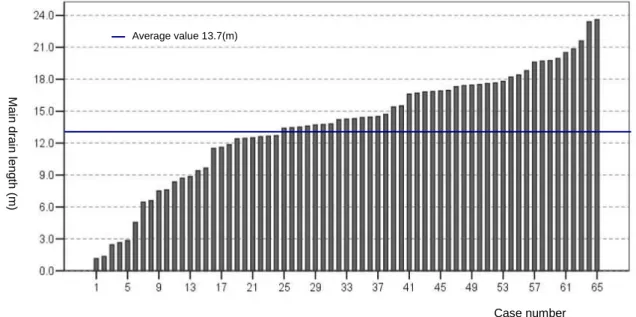
The result is shown as Figure 2 which reveals the distribution of main drain total length with average 13.7 meter and standard deviation 5.3 meter. The cases data shows almost a normal distribution and the length is between minimum of 1.1 meter and maximum of 23.5 meter.
Figure 2. The distribution of total main drain pipe length
The first point which is noticed as the transportation issue of main drain is the join
Case number
Main drain length (m)
Average value 13.7(m)
10
connection from vertical stack to horizontal pipe. It is obviously that the solid delivery ability of main drain would be affected by the resistant of join connection. According to the investigation, there are single 90° join and double 45° join adopted in existing buildings, and very few cases use the special join in Taiwan. Therefore, the inference of join resistant needs to be clarified and confirmed. This study confirmed the effect of single 90° join and double 45° join by experiment to find the first parameter for transportation performance of main drain.
In order to avoid some construction limitation and necessary function of space, the main drain has to change the direction or shift the way horizontally. Namely, the second parameter would be the effect of horizontal bend or elbow. As the real situation, the elbow of main drain is generally a composition join which includes single 45° join, single 90° join, double 45° join, big bend single 90° join and single 45° with T join.
4. Experiment and Validation
According to the initial investigation of existing building main drain, this paper concludes the parameters which would affect the transportation performance. Besides the flash volume of water closet, the parameters include pipe diameter, slope, vertical elbow and horizontal bend. In order to clarify the inference of the main drain conditions and to build a estimating model, these parameters need to be validated by experiment. A series of testing procedure was set up to confirm the index of these parameters.
As one of the testing conditions to clarify the inference of flash volume, the water closets include previous type with 9.0 liter and low flash type with 6.0 liter. The inference of discharge floor height is considered either to the estimating model. As the imitated solid for experiment, two sponge bodies are adopted for test proceeds.
Due to the existing building main drain condition is complex and the limitation of
experiment device, this study try to consider the maximum possibility of drain
compositions to simulate the real situation. Therefore, 16 groups of compositions are
concluded to simulate all possibility of main drain fitting in existing buildings in this
paper. Two sponge testing body was used as the imitated solid and 5 times of repeat
11
testing were executed in experimental tower. Thus, 10 experimental data can be recorded in each testing composition. Accordingly, 80 groups and 160 experimental data were collected in this paper to validate parameters and to build an estimating model. Table 1 shows all the testing compositions and the experimental data of imitated solid transportation distance which included average and standard deviation.
Table 1. The testing compositions and the experimental data of main drain transportation
Control groups
Flash volume
Vertical elbow
Slope Diameter Discharge pattern
Horizontal bend
Distance from vertical elbow
Transportation distance(cm)
Standard deviation
(cm)
1 6L
450×2
1/100
ψ 100
2F~6F
- -
867 83.9
2 9L 1225 104.6
3
6L
2F×5 1120 52.5
4 Big
curve
2F~6F
989 76.2
5 900×1 656 84.7
6
450×2
1/50 1142 71.4
7 1/200 670 61.2
8
1/100
ψ 125
707 55.89
ψ 100
7F~11F 1019 73.7
10 7F×5 1067 87.5
11
2F~6F
450×2
<8M 709 57.2
12 9-18M 636 68.7
13 >19M 537 65.2
14 450×1
<8M 766 108.3
15 900×1 618 70.3
16
ψ 125
7F×5 450×1 9-18M 575 107.3According to the investigation and a reasonable requirement for main drain fitting,
this study set a criterion condition which set with parameters of 6 liter flash volume,
double 45° elbow, slope of 1/100, ψ100 mm, simultaneous discharge closets under 4,
and discharge floor height under 6. The imitated solid transportation distance of this
criterion condition is 867 (±83.9) cm by experiment as shown as Table 1. Consequently,
each parameter compares to the criterion condition, the relative inference to solid
transportation can be conversed quantitative index of distance. The relative inference
index is concluded by experimental data and shown as Table 2.
12
Table 2. The relative inference index of transportation distance
Parameter Fitting items Inference
transportation distance (m)
Notes
1 Flash volume of water closet
6.0 l ±0.0
9.0 l +3.6
2 Vertical elbow
Double 450 ±0.0
Big curve +1.2
Single 900 -2.1
3 Slope
1/50 +3.6
1/100 ±0.0
1/200 -2.0
4 Diameter
ψ
100 mm ±0.0ψ
125 mm -1.65 Numbers of water closets
≧ 4 +2.5
≦ 4 ±0.0
6 Horizontal bend
Single 450 -1.0
Double 450 -1.6
Single 900 -2.5
7 Distance from vertical elbow
≦ 8 m -1.6
9~18 m -2.3
≧ 19 m -3.3
8 Discharge floor height
≦ 6 floors (18 m) ±0.0
> 6 floors (18 m) +2.0
Diagram of parameters
13
According to the relative inference index, it is seen that some parameters would reduce the resistance of transportation and increase the delivery distance as compare to the criterion condition. On the other hand, some parameters would increase the resistance and decrease the transportation distance of main drain. Consequently, this is the simplified model to derive the transportation distance for the most composition of main drain in buildings. Figure 3 shows the transportation distance of the concluded parameters compare to the criterion condition. Although this model is not a precise calculation for the transportation distance, it is effectively to estimate the approximate value for main drain. This approach would be adoptable for design management and guideline of regulation.
Figure 3. Parameters of main drain and the inference transportation distance
As a tool to regulate the main drain design, this paper proposes a simplified
14
quantitative model to clear the limitation of transportation distance. According to the results of investigation and experiment data, this study determine the transportation distance of criterion condition as 10 meter which can derive the relative transportation distance of the other simulated conditions.
Finally, this paper used 65 cases which were surveyed in this research to validate the proposed model and its practicability. The main drain total lengths of these existing cases are recalculated by the concluded inference index. The results are shown in Figure 4 and reveal as a normal distribution. If the permit length of main drain is determined as 10 meter, then there are 75% of these surveyed cases would be fail to this guideline. If the permit guideline is determined as 15 meter and 20 meter, then the failure rate would reduce to be 40% and 15%. Accordingly, the permit length of main drain is determined as 20 meter by empirical consideration and the practicability would be acceptable for an initial execution of proposed guideline.
0 5 1 0 1 5 2 0 2 5
l e n g h
0 1 2 3 4 5 6 7 8
次 數
M e a n = 1 3 .1 7 S td . D e v . = 5 .2 8 4 N = 6 5
橫主管長度
案例數
13%
75%
40%
Figure 4. The existing cases distribution of reversed transportation distance
Main drain length (m)
Case number
1
5. Conclusion
This research aims on the issue of main drain solid transportation and proposed a tool for the regulation of drainage system design. A simplified model was built to estimate an approximate solid transportation distance. Totally 65 main drain cases from existing buildings were surveyed and categorized. In order to validate the parameters of estimating model, a criterion condition is selected and 16 control groups are set up to determine the inference value of each parameters.
According to this proposed model, the main drain solid transportation distance is clearly estimated and the permitted piping length can be adequately determined for regulation of drainage system design.
Acknowledgements
The authors would like to thank the Architecture & Building Research Institute of the Ministry of the Interior of Taiwan (ABRI) and the National Science Council of the Republic of China (NSC99- 2221-E-011-087)for financially supporting this research.
6. Reference
1. National Standard Plumbing Code/National Association of Plumbing-Heating- Cooling Contractors/1987.2
2. R.S. Wyly and H.N. Eaton, Capacities of Stacks in Sanitary Drainage System for Building, N.B.S.
Monograph 31, 1961.
3. R.S.Wyly and H.N.Eaton, Capacities of Plumbing Stack in Building, BMS Repoet,132, 1952.
4. Lu Wen-Heng, Cheng Cheng-li, Chou Yen-Chun, Investigation and Development Analysis of Building Drainage System for Apartment House, CIB-W62 International Symposium, lasi, Romania, 2002.
5. L.B. Jack, J.A Swaffield, Developments in the simulation of the air pressure transient regime within single stack building drainage system, CIB-W62 International Symposium, Edinburgh, UK, 1999.
6. Swaffield, J.A., Jack, L.B., Campbell D.P., Control and suppression of air pressure transients in building fjrainage and vent systems, Building and Environment, 39(2004) 783-794.
7. Swaffield, J.A. and Campbell, D.P., Numerical modelling of air pressure transient propagation in building drainage system, including the influence of mechanical boundary condition. Building Envir.
27, (1992)
8. Campbell, D.P., Macleod, K.D., Detergents in drainage systems for buildings, Wat. Res. Vol.35, No. 4, pp. 1086-1092, 2001.
9. Cheng, C.L., Yen, C.J., Ho, K.C., Ho, J.R., Study on transportation performance of main drain with low flash water closet in buildings, CIB-W62 International Symposium, Taipei, Taiwan, 2006.
10. Cheng, C. L., Lu, W. H., Shen, M.D., An Empirical Approach: Prediction Method of Air Pressure Distribution on Building Vertical Drainage Stack, Journal of the Chinese Institute of Engineers, Vol 28.
2
Presentation of Authors
Cheng-Li Cheng is the Professor at National Taiwan University of Science and Technology, and ex-chairman of Department of Architecture.
He is a researcher and published widely on a range of water supply and drainage in building. He has published extensively on a range of sustainable issues, including the water and energy conservation for green building. Currently he also acts as coordinator of Taiwan Green Building Evaluation Committee and National Building Code Review Committee.
Kuen-Chi He is the researcher and Post Doctor at National Taiwan University of Science and Technology, Department of Architecture.
Wan-Ju Liao is the Ph.D student at National Taiwan University of Science and Technology, Department of Architecture.
Chin-Huang. Hsieh is the Master student at National
Taiwan University of Science and Technology,
Department of Architecture.
國科會補助計畫衍生研發成果推廣資料表
日期:2011/09/07
國科會補助計畫
計畫名稱: 建築排水橫主管污物搬送能力理論解析與實證研究 計畫主持人: 鄭政利
計畫編號: 99-2221-E-011-087- 學門領域: 建築都巿
無研發成果推廣資料
99 年度專題研究計畫研究成果彙整表
計畫主持人:鄭政利 計畫編號:99-2221-E-011-087- 計畫名稱:建築排水橫主管污物搬送能力理論解析與實證研究
量化
成果項目
實際已達成數(被接受 或已發表)
預期總達成 數(含實際已
達成數)
本計畫實 際貢獻百
分比
單位
備 註
(質 化 說 明:如 數 個 計 畫 共 同 成 果、成 果 列 為 該 期 刊 之 封 面 故 事 ...
等
)期刊論文 0 0 100%
研究報告/技術報告
1 1 100%
研討會論文 0 0 100%
論文著作 篇
專書 0 0 100%
申請中件數 0 0 100%
專利 已獲得件數 0 0 100% 件
件數 0 0 100% 件
技術移轉
權利金 0 0 100% 千元
碩士生 1 1 100%
博士生 1 1 100%
博士後研究員 0 0 100%
國內
參與計畫人力
(本國籍)
專任助理 0 0 100%
人次
期刊論文 0 1 50%
研究報告/技術報告
0 0 100%
研討會論文 2 2 100%
論文著作 篇
專書 0 0 100% 章/本
申請中件數 0 0 100%
專利 已獲得件數 0 0 100% 件
件數 0 0 100% 件
技術移轉
權利金 0 0 100% 千元
碩士生 0 0 100%
博士生 0 0 100%
博士後研究員 0 0 100%
國外
參與計畫人力
(外國籍)
專任助理 0 0 100%
人次
其他成果
( 無法以量化表達之成
果如辦理學術活動、獲 得獎項、重要國際合 作、研究成果國際影響 力及其他協助產業技 術發展之具體效益事 項等,請以文字敘述填 列。)
建築設備的內容包羅萬象也涉及各方面之專業領域知識,其中建築給排水設備 特別是建築排水通氣系統方面,國內極需要有體系之基礎研究與現況問題探 討。建築排水設備一般採用自然重力排水之設計方式,建築因為排水位能轉換 動能的增加,以及橫主管路污物搬送性能的不明確,加上不良的設計非常容易 產生排水性能的缺失,同時造成建築物在使用上之健康衛生環境問題。建築物 排水系統的重要性,因 2003 年香港淘大花園社區爆發集體感染事件已經被明確 地突顯出來。調查報中指出排水系統中的衛生器具存水彎水封破壞或散失,失 去其阻絕之功能而導致類似 SARS 病媒之傳染風險提高,世界衛生組織的報告中 更指出排水系統及衛浴空間之設備器具設計不良,透過浴廁管路通道使帶菌之 空氣進入其他單元空間而引發擴大感染。在台灣歷經慘痛的 SARS 傳染病媒衝 擊,以及香港淘大社區的擴大感染個案後,國人除了得到重要的啟示與教訓外,
也已深切體認健康衛生環境之重要性。
本研究團隊除應用先前累積研究成果外,亦將建立針對實際建築案例之排水系 統橫主管路污物搬送性能機制,以及建置模擬實體建築排水系統模型之實證檢 測流程。在國際上有關建築給排水專業領域,研究團隊十多年來持續的研究成 果發表與努力累積,已經建立我國在此專業領域之領先創新研發信譽。建築排 水橫主管掃流力理論以及污物搬送性能等相關課題,為國際上近年來相當關注 且期待有突破性進展之課題。本研究之成果預期將可以突破多年來國際在學理 探討之關鍵議題,具體成果之發表也必將引起國際專業學會之關注與重視,對 於維持國際上我國在此專業領域之領先創新研發能力將有重要貢獻。另一方 面 , 本 研 究 未 來 也 將 尋 求 國 際 合 作 機 會 , 近 年 來 , 香 港 理 工 大 學 及 英 國 Heriot-Watt 大學均有專業團隊進行相關研究,期望藉由國際合作研究與交流 之機會,除可解決台灣存在已久且涉及國人生活健康之排水衛生管路問題,同 時也可向國際社會證明台灣在此專業領域上之研發能力,以及宣示台灣願意善 盡國際義務之企圖心,亦為本計畫對於學術研究與國家發展及其他應用方面預 期之貢獻。
成果項目 量化 名稱或內容性質簡述
測驗工具(含質性與量性)
0
課程/模組
0
電腦及網路系統或工具
0
教材
0
舉辦之活動/競賽
0
研討會/工作坊
0
電子報、網站
0
科 教 處 計 畫 加 填 項
目 計畫成果推廣之參與(閱聽)人數