Synthesis and Characterization of Luminescent Poly(ester-imide) Derivatives Constituted of Alternating
Spirobifluorene Moiety
Ya-Lan Wen,b,c Yun-Hwei Shen,b Shaw-Bing Wen,c Kun-Lung Chen,c Mou-Yung Yeh,d Fung Fuh Wong*,a
aGraduate Institute of Pharmaceutical Chemistry, China Medical University, No. 91 Hsueh-Shih Rd., Taichung, Taiwan 40402, R.O.C.
bDepartment of Resources Engineering, National Cheng Kung University, No 1, Ta Hsueh Rd., Tainan, Taiwan 70101 R. O. C.
cDepartment of Nursing, Meiho Institute of Technology, No. 23, Ping Kuang Rd., Neipu Hsiang, Pingtung, Taiwan 912, R.O.C.
dDepartment of Chemistry, National Cheng Kung University, No 1, Ta Hsueh Rd., Tainan, Taiwan 70101 R. O. C.
Corresponding author. Email: [email protected], [email protected]
Key words: Conjugated polymers; Spirobiflouroene; Electroluminescence;
Poly(ester-imide); Photoluminescence
ABSTRACT
A new category of luminescent poly(ester-imide)s derivatives based on spirobifluorene rings in the main chain was synthesized from 2,6-bis(4-hydroxybenzylidine)cyclohexanone (BC) derivatives and diimide-dicarboxylic acid (DIDA) containing spirobifluorene moiety. The structure of the polymer was confirmed by elemental and spectral analyses. The various characteristics of the resulting polymers including optical properties, solubility, thermal analysis, and X-ray diffraction analysis were determined and discussed. The new polymers showed relatively high glass-transition temperatures (about 200 °C) and good thermal stability. Two polymers emitted blue-greenish light with
photoluminescence (PL) emission maxima around 400–600 nm and the electron affinity of new polymers was estimated as 2.75–2.84 eV. Cyclic voltammetry displayed that both conjugated polymers had reversible oxidation and irreversible reduction, making them n-type electroluminescent materials.
n N
O
O O
O
R N O
O
O O O
O
X = H or OMe, R = Spirobiflouroene
X X
R
1. Introduction
High-performance polymers have attracted much attention for their excellent thermal stability and solubility to be developed as various thermostable and processable polymers. Among them, poly(ester-imide)s (PEAs) attract scientific interest for they combine the excellent mechanical properties of polyimides and the biodegradability of polyesters [1]. PEAs have a wide range of applications including served as disposable bags, agricultural films, drug carriers, and matrix resins for biomedical materials [2].
Owing to spirobifluorene-based compounds possess the high thermal and morphological stabilities, high fluorescent quantum efficiencies, and anbipolar transporting properties [3–5], the spiro structure in the spirobifluorene is believed to be effective way to reduce interchain interaction which leads to broadening of emission spectrum [6–8]. As a result, spirobifluorene moiety is considered promising materials for blue light emitting materials in both small molecule and polymer devices [9–11], such as the active component in light emitting diodes, field-effect transistors,
photovoltaic cells, and plastic lasers [12]. In this work, we developed new poly(ester-imide)s based on spirobifluorene moiety in the main chain as the electroluminescent materials and provided a facile route for the synthesis and characterization of new poly(ester-imide)s. Two novel oligo-9,9′-spirobifluorene-based poly(ester-imide)s through para-linkage are constructed. Furthermore, the characteristics of these two new polymers, such as photophysical properties, thermal stability, solubility, and crystallinity, were discussed.
We also reported their photophysical properties and application as host material in phosphorescent organic light-emitting diodes as well as investigated the effect of the inclusion of cyclohexanone moiety on the polymer properties.
2. Experimental
General Procedure. All chemicals were reagent grade and used as purchased. All
reactions were carried out under nitrogen atmosphere and monitored by TLC. Flash column chromatography was carried out on silica gel (230–400 mesh).
Cyclohexanone, 4-hydroxybenzaldehyde, thionyl chloride, vanillin, p-xylene were purchased from Merck Chemical Co. Acetone, boric acid, concentrated hydrochloric acid, N-methyl-2-pyrrolidone, and palladium/carbon were purchased from Fluka &
Aldrich. Pyridine, trimellitic anhydride, and triphenyl phosphite were purchased from Acros Chemical Co. 9,9’-Bis(4-aminophenyl)fluorine, 3-nitrobenzoic acid, and phosphoryl trichloride were purchased from TCI Chemical Co.
Infrared (IR) spectra were measured on a Bomem Michelson Series FT-IR spectrometer. The wavenumbers reported are referenced to the polystyrene 1601 cm–1 absorption. Absorption intensities are recorded by the following abbreviations: s, strong; m, medium; w, weak. UV-visible spectra were measured with a HP 8452A diode-array spectrophotometer. Photoluminescence (PL) spectra were obtained on a Perkin-Elemer fluorescence spectrophotometer (LS 55). Proton NMR spectra were obtained on a Bruker AC-300 (300 MHz) spectrometer by use of DMSO-d6as the solvent. Carbon-13 NMR spectra were obtained on a Bruker AC-300 (75 MHz) spectrometer by used of DMSO-d6 as solvent. Carbon-13 chemical shifts are referenced to the center of the DMSO-d6 sextet (δ 39.6 ppm). Multiplicities are recorded by the following abbreviations: s, singlet; d, doublet; t, triplet; q, quartet; m, multiplet; J, coupling constant (hertz).
The UV-VIS spectra of the samples in NMP were measured by a Shimadzu Model UV-160 spectrophotometer. The fluorescence spectra were recorded by a Hitach F-4500 fluorescence spectrometer. Glass transition temperature and thermal gravimetric analyses were performed on a Perkin Elmer Pyris DSC-1 and TGA-7 under a nitrogen stream and with a heating rate of 30 °C/min. X-ray diffraction was measured by Shimadzu X-ray 6000 diffractometer. The current–voltage
characteristics were measured by a Keithely 2400 current/voltage source. All samples were dried in a vacuum oven at 100 °C for 48 h before data taking. All solid thin films of the polymers for optical characterization were prepared by spin coating onto quartz substrates from 3 wt% NMP solution and dried. Elemental analyses were carried out on a Heraeus CHN–O RAPID element analyzer.
Cyclic voltammetry measurements: Cyclic voltammetry (CV) and differential pulse voltammetry (DPV) measurements were performed on a PGSTAT 20 electrochemical analyzer. The oxidation and reduction measurements were carried out, in anhydrous CH2Cl2 and THF containing 0.1 M tetrabutylammonium hexafluorophosphate (TBAPF6) as the supporting electrolyte at a scan rate of 50 mVs−1. The potentials were measured against an Ag/Ag+ (0.01 M AgCl) reference electrode using ferrocene as the internal standard. The onset potentials were determined from the intersection of two tangents drawn at the rising current and background current of the cyclic voltammogram [13].
3. Result and discussion
3.1. Synthesis of 2,6-bis(4-hydroxyarylidene)-cyclohexanone 4 and 5
Diols 2,6-bis(4-hydroxybenzylidene)-cyclohexanone 4 and 2,6-bis(4-hydroxy-3-methoxybenzylidene)cyclohexanone 5 were synthesized by the method reported by Sakthivel and Kannan [14] and the synthetic route was shown in Scheme 1. To a mixture of 4-hydroxybenzaldehyde (4.9 g, 0.040 mol, 1.0 equiv) or 4-hydroxy-3-methoxybenzaldehyde (6.1 g, 0.040 mol, 1.0 equiv) with boric acid (2.5 g, 0.04 mol, 1.0 equiv.) in a 50 mL round-bottom flask equipped with a mechanical stirrer was added 20 mL of concentrated hydrochloric acid. The reaction mixture was cooled to 0 °C with cooling apparatus and added with cyclohexanone (2.0 g, 0.02 mol, 0.5 1.0 equiv.) was added dropwise in a period of 60 min. The reaction was
continuously stirred at room temperature for 24 h. After the reaction was completed, the mixture was poured into 1.0 L of cooled water and the precipitated blackish green product was filtered and washed with cooled water. Recrystallization was performed from an acetone/water mixture (50:50 v/v). The wet cake dried in vacuum oven for overnight to give the desired product 4 and 5 in 66% and 65% yields, respectively [15].
2,6-Bis(4-hydroxybenzylidene)cyclohexanone (BC, 4): 1H NMR (DMSO-d6, 300 MHz) δ 1.7 (m, 2 H, γ-CH2), 2.82 (t, 4 H, β-CH2), 6.80–7.39 (m, 8 H, ArH), 7.52 (s, 2 H, CH=), 9.97 (s, 2 H, –OH); IR (pellet, KBr) 3252 (b, OH), 1648 (m, C=O), 1593, 1505 cm–1.
2,6-Bis(vanillylidene)cyclohexanone (BVCH, 5): 1H NMR (DMSO-d6, 300 MHz) δ 1.70 (m, 2 H, γ-CH2), 2.88 (t, 4 H, β-CH2), 3.80 (s, 6 H, OCH3), 6.83–7.09 (m, 8 H, ArH), 7.54 (s, 2 H, CH=), 9.54 (s, 2 H, –OH); IR (pellet, KBr) 3370 (b, OH), 1639 (m, C=O), 1574, 1515 cm–1.
O
X X
HO OH
O
+
O H
OH X
H3BO3, HCl
1 2. X =H
3. X = OMe
4. X =H 5. X = OMe
Scheme 1 3.2. Synthesis of diacid chloride 9
The synthetic route of diacid chloride 9 is outlined in Scheme 2. At first, the diacid 8 was synthesized via a one-pot and two-stage procedure involving ring-opening addition and cyclodehydration. 9,9’-Bis(4-aminophenyl)fluorene (6, APF, 0.010 mol) and trimellitic anhydride (7, TMA, 0.20 mol) were mixed in 30 mL
of dry NMP at room temperature for 12 h. The cyclodehydration condensation was performed by means of xylene–water azeotropic distillation in a Dean–Stark trap [16].
About 5 mL of xylene was then added, and the mixture was heated at the reflux for about 5 h until the water was distilled azeotropically in a Dean–Stark trap. Heating was continued to remove the residual p-xylene. After cooling, the residue was precipitated with water to afford the crude product. The crude product was isolated by filtration and purified by recrystallization from NMP. The wet product was dried on a vacuum oven to give the corresponding diimide-dicarboxylic acid 8 in 83% yield: 1H NMR (DMSO-d6, 300 MHz) δ 7.37–8.38 (m, 22 H, Ar-H); IR (pellet, KBr) 3408 (b, OH), 1779 (m, C=O, imide), 1723 (m, C=O, acid), 1373, 732 cm–1. Furthermore, the diacid 8 was successfully converted to the diacid chloride 9 in the presence of SOCl2
(see Scheme 2).
NH2 H2N
+ O
O
O HO
O
N N O
O
O
O
6 7 8
N O
O 8
HO OH
O O
HO O
R N O
O
O
OH SOCl2
pyridine N
O
O 9 Cl
O
R N O
O
O Cl
Scheme 2 3.3. Synthesis of poly(ester-imide)s 10 and 11
The synthetic route of poly(ester-imide)s 10 and 11 is shown in Scheme 3. A solution of diimide-dicarboxylic acid (8, 0.50 mol), thionyl chloride (5.0 mL), and pyridine (5 mL) was heated at reflux for overnight. After the suspension reaction mixture became homogeneous, the solution was concentrated under reduced pressure to remove the
excess thionyl chloride and pyridine. The residue compound was added with fresh pyridine (5.0 mL) and NMP (5.0 mL) under ice-bath and added with 2,6-bis(4-hydroxyarylidene)-cyclohexanones (4 or 5, 0.5 mol). After one hour, NMP (0.20 mL) was dropwise added into the reaction mixture for dilution. The resulting solution was stirred at room temperature for 24 h. After the polymerization reaction was completed, 50 mL of water was dropped into the reaction mixture to precipitate the product. The crude product was filtered and washed with cool MeOH/water (10 mL). The wet cake was dried in vacuum oven for overnight to give the desired poly(ester-imide) products (10 and 11) in 78–83% yields [17].
Poly(ester-imide)s (10): 1.73 (m, 2 H, γ-CH2), 2.88 (t, 4 H, β-CH2), 6.83–8.61 (m, 32 H, ArH and CH=); IR (pellet, KBr) 1778 (m, C=O, imide), 1724 (m, C=O, acid), 1660, 1598, 1510, 1374, 1205, 1160, 724 cm–1.
Poly(ester-imide)s (11): 1.74 (m, 2 H, γ-CH2), 2.94 (t, 4 H, β-CH2), 3.82 (s, 6 H, OCH3), 6.80–8.63 (m, 30 H, ArH and CH=); IR (pellet, KBr) 1778 (m, C=O, imide), 1724 (m, C=O, acid), 1592, 1512, 1372, 1248, 1206, 1160, 726 cm–1.
n O
X X
HO OH
4. X =H 5. X = OMe
+ N
O
O 9 Cl
O
R N O
O
O Cl
N R O
O O
O
R N O
O
O O O
O
10. X =H 11. X = OMe
X X
Scheme 3
3.4. Optical properties
9,9′-Spirobifluorene derivatives has been known as light emitting materials [18].
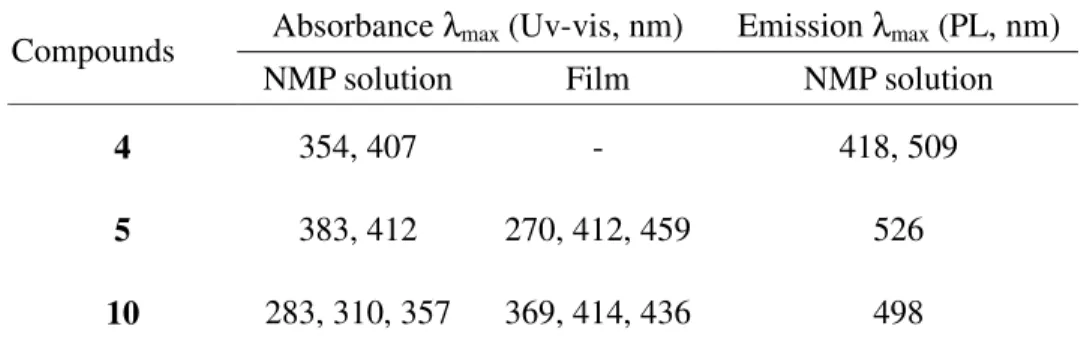
However, they have a poor solubility in generally organic solvents according to their high molecular weight. Therefore, the polar solvent NMP was used to dissolve the new poly(ester-imide)s 10 and 11 for the determination their optical properties. Table 1 and Figure 1 show the normalized UV/Vis spectra of 2,6-bis(4-hydroxyarylidene)-cyclohexanone monomers (4 and 5) and poly(ester-imide)s (10 and 11) in NMP solution. The new spirobifluorene-based poly(ester-imide)s 10 and 11 exhibited very similar UV absorption spectra as shown in Figure 1. They all showed three main strong absorption peaks: one in the visible range at about 355 nm and two peaks in the UV region at 280 nm and 305 nm.
Compared to that of 2,6-bis(4-hydroxyarylidene)-cyclohexanone monomers (4 and 5, the λmax value is 300 ± 5 nm in NMP solution), the UV absorption peak of the new poly(ester-imide)s (10 and 11) is complicate. The new forming visible absorption peak (~350 nm) is assigned to the π–π* transition of the cross-conjugated spirobifluorene segment, which is confirmed by the same absorption maxima of the monomer (5a–5b) [7]. Apparently, the absorption at about ~280 nm was assigned to the π–π* transition of the imidyl group moiety. The UV-vis absorption peaks of the new polymers 10 and 11 in the film are more complicate and displayed the blue shift.
Table 1. Characterization of the monomers 4 and 5 and spirobifluorene-based poly(ester-imide)s 10 and 11.
Absorbance λmax (Uv-vis, nm) Emission λmax (PL, nm) Compounds
NMP solution Film NMP solution
4 354, 407 - 418, 509
5 383, 412 270, 412, 459 526
10 283, 310, 357 369, 414, 436 498
11 281, 307, 354 371, 399 374, 486
0 0.2 0.4 0.6 0.8 1
200 300 400 500 600
Wavelength, (nm)
Normalization
10 11
Fig. 1. The UV-vis Spectra of 10 and 11 in NMP solution.
0 0.2 0.4 0.6 0.8 1
300 400 500 600 700 800
Wavelength, (nm)
Normalization
10 11
Fig. 2. The PL Spectra of 10 and 11 in NMP solution.
Table 1 shows the photoluminescence (PL) spectra of
2,6-bis(4-hydroxyarylidene)-cyclohexanone monomers (4 and 5) and spirobifluorene-based poly(ester-imide)s (10 and 11) in NMP solution. The poly(ester-imide)s 10 and 11 exhibited a broad emission at about 400–600 nm in NMP solution, especially for polymer 11 (about 350–600 nm, see Figure 2). Emissions of the 9,9′-spirobifluorene derivatives [19] at 400–500 nm and the 2,6-bis(4-hydroxyarylidene)-cyclohexanone unit at 450–600 nm are observed (see Figure 2). The absorption spectra of the new spirobifluorene-based poly(ester-imide)s 10 and 11 show almost identical maxima to their absorption spectra, indicating the existence of efficient energy transfer from the 9,9′-spirobifluorene moiety to the 2,6-bis(4-hydroxyarylidene)-cyclohexanone backbone.
3.5. Cyclic Voltammetry Measurements
The electrochemical properties of the new spirobifluorene-based poly(ester-imide)s 10 and 11 were investigated by cyclic voltammetry (see Figures 3 and 4), and the resulting data were summarized in Table 2. Upon the anodic sweep, 10 and 11 showed reversible reduction processes and irreversible oxidation. Compounds 10 and 11 were used as example and shown in Figures 3 and 4. The bandgap energies of spirobifluorene-based poly(ester-imide)s 10 and 11 are estimated from the onset wavelength (λonset) of the UV-vis absorption [20]. Compounds 10 and 11 have the high LUMO values about ≥ 3.94 eV and the high electron affinities were ≥ 2.75 eV.
Table 2. Electrochemical properties of monomers 4 and 5 and spirobifluorene-based poly(ester-imide)s 10 and 11.
Compounds Eonseta (V)
E’onsetb
(V) λonset Ipc,f = EHOMO
(eV)
Egd,f = Bandgap energy (eV)
Eae,j = ELUMO
(eV)
4 0.81 1.00 442 6.79 2.80 3.99
5 0.65 0.84 448 6.91 2.77 4.14
10 0.66 0.85 436 6.98 2.84 4.14
11 0.86 1.05 451 6.69 2.75 3.94
a Measured vs. ferrocene/ferrocenium.
b E’onset = Eonset + 0.19 eV (Measured vs. Ag/AgCl)
c Ip = - (E’onset + 4.8)
d Eg: the bandgap energy estimated from the onset wavelength of UV-vis absorption and the equation Y
= –0.033 * X + 11.141 (X = λonset)
e Ea = Ip + Eg
f 1 eV = 96.5 kJ/mol
-5.00E-05 0.00E+00 5.00E-05 1.00E-04 1.50E-04 2.00E-04
-2.5 -2
-1.5 -1
-0.5 0
Potential, (v)
Current, (A)
Fig. 3. Cyclic Voltammetry of spirobifluorene-based poly(ester-imide) 10.
-4.00E-05 0.00E+00 4.00E-05 8.00E-05 1.20E-04 1.60E-04
-2.5 -2
-1.5 -1
-0.5 0
Potential, (v)
Current, (A)
Fig. 4. Cyclic Voltammetry of spirobifluorene-based poly(ester-imide) 11.
3.5. Thermal properties
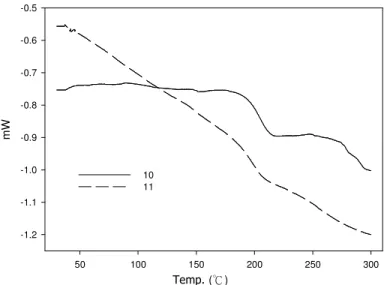
Thermal and thermomechanical characterization of the polymers were carried out by DSC and TGA. The glass-transition temperatures (Tg) of the new spirobifluorene-based poly(ester-imide)s 10 and 11 were determined by the DSC method. No phase transitions were recorded during the first and second heating in the DSC experiments. The absence of melting endotherm confirmed the amorphous nature of the polymers. The Tg was obtained from the onset temperature of the first inflection point that was recorded during the second heating (see Table 3, Figure 5).
Compounds 11 showed a slightly lower Tg (197 °C) than 10 (204 °C) that was attributed to the presence of the electrodonating group methoxy group in the 2,6-bis(4-hydroxyarylidene)cyclohexanone core backbone. The TGA thermograms of the polymers are summarized in Table 3 and Figure 6. The spirobifluorene-based poly(ester-imide)s 10 and 11 were stabled up to ~200–220 °C in the N2. They afforded a relatively low anaerobic char yield (ca. 46% and 52%) at 800 °C because of the thermally sensitive methoxyl side groups. Compound 11 was slightly more thermally stable than 10, and all its thermal properties were promoted by grafting 9,9′-spirobifluorene moiety in main core chain.
Table 3. Tg values and thermal stability of spirobifluorene-based poly(ester-imide)s 10 and 11 (heating and cooling rate: 10 °C/min).
Conjugated polymers Tga (°C) T1b
(°C) T10b
(°C) Ycc
(%)
10 204 188 356 46
11 197 208 364 52
a Tg: glass-temperature determined by the DSC method.
b T1, T10: temperature at which weight losses of 1 and 10 %, respectively, were observed by TGA.
c Yc: Char yield at 800 °C by TGA.
Temp. (℃)
50 100 150 200 250 300
mW
-1.2 -1.1 -1.0 -0.9 -0.8 -0.7 -0.6 -0.5
10 11
Fig. 5. DSC thermograms of the spirobifluorene-based poly(ester-imide)s 10 and 11
40 50 60 70 80 90 100
150 250 350 450 550 650 750
Temperature, (°C)
Weight (%)
10 11
Fig. 6. TGA thermograms of the spirobifluorene-based poly(ester-imide)s 10 and 11.
3.6. Solubility
Room temperature solubility characterization of spirobifluorene-based poly(ester-imide)s 10 and 11 were tested by using various solvents including acetone, chloroform (CHCl3), dichloromethane (CH2Cl2), MeOH, EtOH, THF, DMF, DMSO, and NMP. A 5% (w/v) solution was taken as criterion for solubility. Following the resulting data shown in Table 4, the spirobifluorene-based poly(ester-imide)s were
insoluble in most of the organic solvents such as alcohols, acetone, chloroform (CHCl3), dichloromethane (CH2Cl2), and THF. The poly(ester-imide)s 10 and 11 were partially or completely soluble in polar aprotic solvents including DMF, DMSO, and NMP. All the synthesized poly(ester-imide)s were freely soluble and gave reddish color. In comparison with the solubility of the polymers 10 and 11 based on the 2,6-bis(4-hydroxyarylidine)cyclohexanone moieties, polymer 11 was more soluble than polymer 10 in most solvents. This may be attributed to the higher flexibility of methoxy group on 2,6-bis(4-hydroxyarylidine)cyclohexanone moiety.
Table 4. Solubility characterization of the spirobifluorene-based poly(ester-imide)s 10 and 11.
Polymers acetone CH2Cl2 CHCl3 MeOH EtOH THF DMF DMSO NMP
10 – – – – – – ± ± +
11 – – – – – – ± ± +
3.7. X-ray analysis
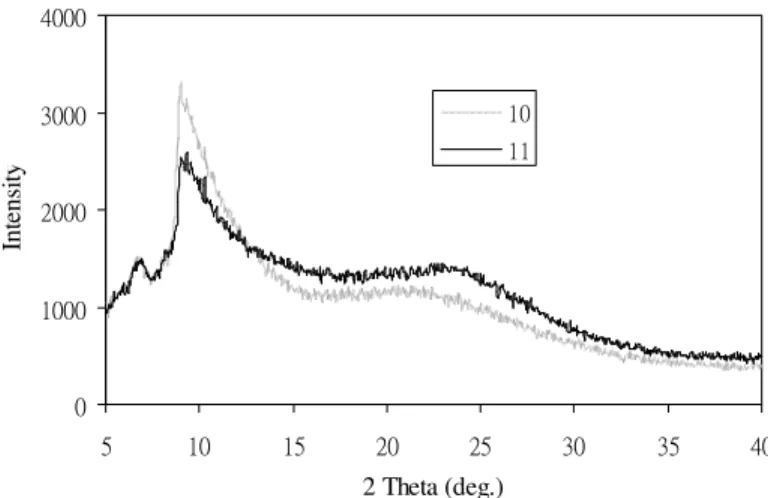
The X-ray diffractiongrams of the spirobifluorene-based poly(ester-imide)s 10 and 11 were shown in Figure 7. It can be clarified from the Fig. 7 that the majority of the new luminescent poly(ester-imide)s 10 and 11 showed few reflection peaks in the region 2θ = 5–40°, indicating that polymers are semicrystalline and amorphous patterns. This observation is reliable, because the presence of the mentioned bulky spirobifluorene group decreases the intermolecular forces between the polymer chains, causing a decrease in crystallinity. In comparison with polymers 10 and 11, it was found that the presence of methoxy group in the polymer backbone caused some hindering and enforced it to unsymmetrical orientation in the polymer chain and reduced the crystallinity.
0 1000 2000 3000 4000
5 10 15 20 25 30 35 40
2 Theta (deg.)
Intensity
10 11
Fig. 7. X-ray diffraction patterns of the spirobifluorene-based poly(ester-imide)s 10 and 11.
4. Conclusions
Two new poly(ester-imide)s containing cyclohexanone and spirobifluorene moieties in the main core were firstly synthesized as the new n-type electroluminescent materials. The spirobifluorene-based poly(ester-imide)s had moderate Tg (204 and 197 °C) and the good thermal stability. Compound 10 had a higher Tg and electron affinity than 11. The electron affinity of new polymers was estimated as 2.75–2.84 eV. The poly(ester-imide)s were emitted blue-greenish light with PL emission maxima around 400–600 nm in NMP solution or thin film. Cyclic voltammetry displayed that both poly(ester-imide)s had reversible reduction and irreversible oxidation, making them n-type electroluminescent materials.
Acknowledgments
We are grateful to the National Science Council of Republic of China for financial support (NSC-99-2320-B-039-014-MY3). This study is also supported in part by Taiwan Department of Health Clinical Trial and Research Center of Excellence (DOH100-TD-B-111-004).
References
[1] Okada M. Chemical Syntheses of biodegradable Polymers. Polymer Sci.
2002;27:87–133.
[2] Han SI, Kim BS, Kang SW, Shirai H, Im SS. Cellular interactions and degradation of aliphatic poly(ester amide)s derived from glycine and/or 4-amino butyric acid. Biomaterials 2003;24:3453–3462.
[3] Pudzich R, Fuhrmann-Lieker T, Salbeck J. Spiro Compounds for Organic Electroluminescence and Related Applications. Adv Polym Sci 2006;199:83–142.
[4] Saragi TPI, Fuhrmann-Lieker T, Salbeck J. Comparison of Charge-Carrier Transport in Thin Films of Spiro-Linked Compounds and Their Corresponding Parent Compounds. Adv Funct Mater 2006;16:966–974.
[5] Saragi TPI, Spehr T, Siebert A, Fuhrmann-Lieker T, Salbeck J. Spiro Compounds for Organic Optoelectronics. Chem Rev 2007;107:1011–1065.
[6] Lee JI, Lee H, Oh J, Chu HY, Kim SH, Yang YS, Kim GH, Do LM, Zyung T.
Organic blue light emitting materials based on spirobifluorene. Curr Appl Phys 2003;3:469–518.
[7] Etori H, Jin XL, Yasuda T, Mataka S, Tsutsui T. Spirobifluorene derivatives for ultraviolet organic light-emitting diodes. Syn Metals 2006;156:1090–1096.
[8] Jiang Z, Yao H, Zhang Z, Yang C, Liu Z, Tao Y, Qin J, Ma D. Novel oligo-9,9′-spirobifluorenes through ortho-linkage as full hydrocarbon host for highly efficient phosphorescent OLEDs. Org Lett 2009;11:2607–2609.
[9] Lupo D, Salbeck J, Schenk H, Stehlin T, Stern R, Wolf A. Spiro compounds and their use as electroluminescence materials. US Patent, 1998;5,840,217.
[10] Kreuder W, Lupo D, Salbeck J, Schenk H, Stchlin T. Conjugated polymers having spiro centers and their use as electroluminescence materials. US Patent, 1997;5,621,131.
[11] Yu WL, Pei J, Huang W, Heeger AJ. Spiro-Functionalized Polyfluorene Derivatives as Blue Light-Emitting Materials. Adv Mater 2000:;12:828–831.
[12] Wu CC, Liu TL, Hung WY, Lin YT, Wong KT, Chen RT, Chen YM, Chien YY. Unusual Nondispersive Ambipolar Carrier Transport and High Electron Mobility in Amorphous Ter(9,9-diarylfluorene)s. J Am Chem Soc 2003;125:3710–3711.
[13] Thelakkat M, Schmidt HW. Synthesis and properties of novel derivatives of 1,3,5-tris(diarylamino)benzenes for electroluminescent devices. Adv Mater 1998;10:219–223.
[14] Sakthivel P, Kannan P. Novel thermotropic liquid crystalline-cum-photocrosslinkable polyvanillylidene alkyl/arylphosphate esters.
J Polym Sci Part A polym Chem 2004;42:5215–5226.
[15] Khairou KS, Abdullah MA, Aly KI, Nahas NM, Al-Bonian AM. Synthesis and characterization of new poly(ester-imide)s containing diarylidenecyclohexanone in the main chain. Part: II. Arabian J. Chem. 2009;2:65–72.
[16] Shin MH, Huang JW, Huang MC, Kang CC, Chen WC, Yeh MY. Synthesis and characterization of organosoluble luminescent poly(amide-imide)s. Polymer Bull 2008;60:597–607.
[17] Yang CP, Liou GS, Chen RS, Yang CY. Synthesis and properties of new organo-soluble and strictly alternating aromatic poly(ester-imide)s from 3,3-bis[4-(trimellitimidophenoxy)phenyl]phthalide and bisphenols. J Polym Sci Part A Polym Chem 2000;38:1090–1099.
[18] Klärner G, Davey MH, Chen WD, Scitt JC, Miller RD. Colorfast blue-light-emitting random copolymers derived from di-n-hexylfluorene and anthracene. Adv Mater 1998;10:993–997.
[19] Vak D, Shun SJ, Yum JH, Kim SS, Kim DY. Blue electroluminescence from
spiro-configured polyfluorene derivatives with hetero-atoms. J Luminescence 2005;115:109–116.
[20] Peng ZH, Bao ZN, Galvin ME. Oxadiazole-containing conjugated polymers for light-emitting diodes. Adv Mater 1998;10:680–684.
Synthesis and Characterization of Luminescent Poly(ester-imide) Derivatives Constituted of Alternating Spirobifluorene Moiety
Ya-Lan Wen, Shaw-Bing Wen, Mou-Yung Yeh, Kun-Lung Chen, Yun-Hwei Shen, Fung Fuh Wong*
A new category of luminescent poly(ester-imide)s derivatives based on spirobifluorene rings in the main chain was synthesized from 2,6-bis(4-hydroxybenzylidine)cyclohexanone (BC) derivatives and diimide-dicarboxylic acid (DIDA) containing spirobifluorene moiety. The structure of the polymer was confirmed by elemental and spectral analyses. The various characteristics of the resulting polymers including optical properties, solubility, thermal analysis, and X-ray diffraction analysis were determined and discussed. The new polymers showed relatively high glass-transition temperatures (about 200 °C) and good thermal stability. Two polymers emitted blue-greenish light with photoluminescence (PL) emission maxima around 400–600 nm and the electron affinity of new polymers was estimated as 2.75–2.84 eV. Cyclic voltammetry displayed that both conjugated polymers had reversible oxidation and irreversible reduction, making them n-type electroluminescent materials.
n N
O
O O
O
R N O
O
O O O
O
X = H or OMe, R = Spirobiflouroene
X X
R