Abstract
Diabetes is a serious global health problem. Large-scale genome-wide association studies identified loci for Type 2 diabetes mellitus (T2DM), including adiponectin (ADIPOQ) gene and transcription factor 7-like 2 (TCF7L2), but few studies clarified genetic polymorphisms of ADIPOQ and TCF7L2 on risk of T2DM. We attempted to elucidate association between T2DM and polymorphic variation of both in Taiwan’s Chinese Han population, our retrospective case-control study genotyping single nucleotide polymorphisms (SNPs) in ADIPOQ and TCF7L2 genes both in 149 T2DM patients and 139 healthy controls from
Taiwan. Statistical analysis gauged association with these polymorphisms on risk of T2DM
to show ADIPOQ rs1501299 polymorphism variations strongly correlated with T2DM risk
(p=0.042), rs2241766 polymorphism not associated with T2DM (p=0.967). However, both
polymorphisms rs7903146 and rs12255372 of TCF7L2 were rarely detected in Taiwanese
people. This study avers ADIPOQ rs1501299 polymorphism contributing to risk of T2DM
in the Taiwanese population.
1. Introduction
Global prevalence of Type 2 diabetes mellitus (T2DM) is 6% but expected to rise due to aging population {Zimmet, 2001 #76}; 2012 saw some 1.6 million patients (~7% of total population) in Taiwan suffering from it, ~90% of these cases diagnosed as T2DM, non- insulin-dependent diabetes characterized by impaired insulin secretion in peripheral tissues.
It accounts for up to 11.5% of healthcare costs in Taiwan annually. Factors such as age, weight, diet, lifestyle and family history are linked therewith {Zimmet, 2001 #76}; higher concordance rate among monozygotic versus dizygotic twins and sibling risk manifested itself, and prevalence differs among racial groups {Rich, 1990 #77}, suggesting genetic
contribution to risk of T2DM.
Genome-wide studies identify diabetes susceptibility loci on chromosome 3q27 and 10q25.3, where adiponectin genes (ADIPOQ or APM1) and TCF7L2 are located, respectively {Ruchat, 2009 #38}. Human adiponectin, encoded by ADIPOQ gene, is an adipose-specific secretory protein involved in many metabolic processes: e.g., glucose modulation, fatty acid oxidation {Diez, 2003 #14}. Adiponectin level positively correlates with weight {Hotta, 2000 #3}, T2DM {Hotta, 2000 #3}, insulin resistance {Weyer, 2001
#5}, cardiovascular diseases {Kumada, 2003 #57; Hotta, 2000 #58} but negatively with
insulin level {Yu, 2002 #4}. Polymorphisms of ADIPOQ are linked with metabolic
syndromes: e.g., insulin resistance, abdominal obesity, impaired glucose tolerance,
dyslipidemia, hypertension, increased fasting glucose {Eckel, 2005 #67; Gao, 2013 #68}
and plasma adiponectin level {Hivert, 2008 #69; Heid, 2006 #70}. Also, haplotype analysis of ADIPOQ showed significant association with obesity and insulin resistance {Menzaghi, 2002 #17; Ramya, 2013 #84}. Two ADIPOQ SNPs, rs2241766 and rs1501299, showed significant association to risk of T2DM in Japanese {Hara, 2002 #18; Yamaguchi, 2007
#82}, yet this phenomenon did not appear in French populations {Vasseur, 2002 #19}.
Interestingly, persons without family history of diabetes revealed stark correlation of rs2241766 SNP, obesity and insulin sensitivity among German people {Stumvoll, 2002
#43}, making the role of ADIPOQ gene in T2DM controversial. Any relation between these SNPs and T2DM in Taiwanese remains unclear. Human transcription factor 7-like 2 (TCF7L2; a.k.a. TCF4) {Duval, 2000 #64} is involved in beta-catenin-dependent Wnt signaling pathway, playing roles in pancreatic and intestinal endocrine cells {Shu, 2008
#61;Liu, 2008 #62}. Polymorphism of TCF7L2 gene correlates with T2DM risk and progression in multiple ethnicities {Jin, 2008 #59; Hayashi, 2007 #29; Horikoshi, 2007 #30;
Lehman, 2007 #31; Helgason, 2007 #32}. Strongly associated variants rs12255372 and rs7903146 were cited as risk factors {Florez, 2006 #22}, while information about TCF7L2 and ADIPOQ on T2DM risk is scant in Taiwanese populations; we researched both genes.
2. Materials and Methods
2.1. Sample collection
We recruited 149 individuals with T2DM and 139 healthy controls, as diagnosed by Dr.
Ming-Kai Tsai, with basic characteristics of both groups summarized in Table 1; 3 ml blood samples with EDTA-anticoagulants were collected from Kaohsiung Armed Forces General Hospital with informed consent. Genomic DNA was isolated from blood samples using the
DNA isolation kit (QIAamp DNA Blood Mini kit, Qiagen, Valencia, Germany).
2.2. Marker selection and Genotyping of SNPs
In ADIPOQ and TCFL2, 33 and 84 SNPs were reported, respectively, from dbSNP database (http://www.ncbi.nlm.nih.gov/SNP). SNPs were based on genetic information for Chinese (CHB) and Japanese (JPT) in Hapmap (www.hapmap.org). Allele-specific polymerase chain reaction (AS-PCR) analysis was performed with allele-specific primer sets (Table 2) to genotype alleles of ADIPOQ (rs2241766 and rs1501299) and TCF7L2 (rs7903146 and rs12255372). In brief, forward primers specifically complementary to each SNP allele were designed and two PCR reactions conducted in parallel to determine the allele. PCR used Mycycle
TMthermal cycler (USA) containing 1.25 U of Taq DNA polymerase (TakaRa), 1X PCR Buffer, 200 umol/L dNTP, 100 ng of each primer and 10 ng of genomic DNA.
Amplification was through initial denaturation at 94°C for 5 min; 35 cycles of denaturation
at 94°C for 30s, annealing at 45°C for 30s, extension at 72°C for 30s, and final extension at
72°C for 5min. PCR products were analyzed by 2% agarose gel. We also confirmed
accuracy of AS-PCR via Sanger DNA sequencing.
2.4. Statistical analysis
Hardy-Weinberg equilibrium (HWE) was tested by online HWE program (http://linkage.
rockefeller.edu/ott/linkutil.htm) {Ott, 1999 #78}, allele and genotype frequencies examined
by Fisher’s exact (two-tailed) test, using SPSS version 10.0 software (SPSS for Windows, Inc., Chicago, IL). Odds ratios with 95% confidence intervals were derived for external variables, P value <0.05 constituting statistical significance. Correction for multiple comparisons used positive false discovery rate (FDR) statistics based on the method of Benjamini and Hochberg {Benjamini, 1995 #85}, with FDR<0.05 for significant association adopted as true positive result. Power was estimated by free power analysis
program, G*power 3.1 {Faul, 2009 #86}.
3. Results
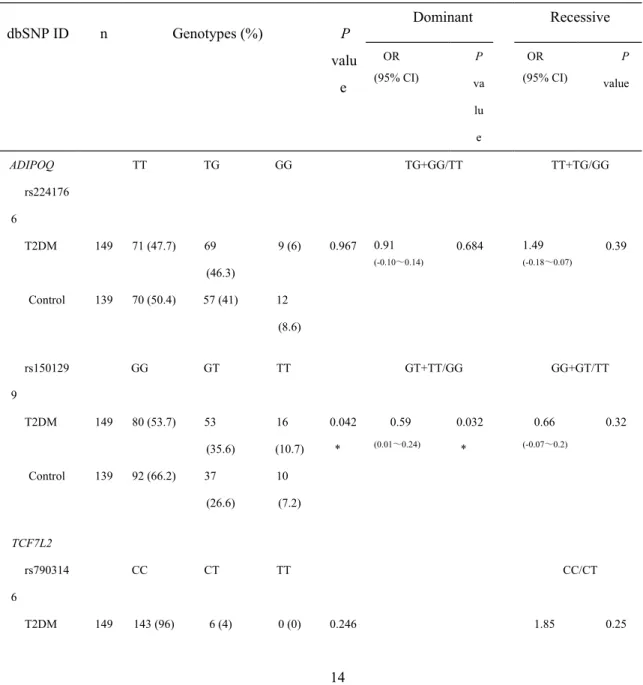
Two SNPs of ADIPOQ and two SNPs of TCF7L2 genes were genotyped in T2DM patients and controls, using allele-specific polymerase chain reaction analysis (Table 3).
Distributions of ADIPOQ and TCF7L2 genotypes are plotted in Table 4, genotype
frequencies evaluated by chi-square test. The method of Benjamini and Hochberg
(threshold=0.1) served to correct for multiple testing of each tested gene. Results showed
significant difference (P=0.042) in ADIPOQ (rs1501299 (G276T)) polymorphism after
Benjamini and Hochberg correction (FDR<0.05). Yet no differences of genotype
frequencies in ADIPOQ (rs2241766 (T45G)) and TCF7L2 (rs7903146) polymorphisms were detected. Surprisingly, genotypes of rs12255372 for TCF7L2 were the only GG genotype appearing in both healthy and T2DM subjects: i.e., rs12255372 is not informative among the Taiwanese population. Genotype distributions of all SNPs do not deviate from
HWE in either T2DM patients or controls (data not shown).
Similar results were observed in allele frequency: minor allele frequency of rs1501299 SNP in ADIPOQ 28.5% higher among T2DM patients compared to healthy controls (20.6%, P=0.028, FDR<0.05) (Table 5). The odds ratio (OR) showed T allele of rs1501299 SNP as the risk factor for T2DM in our subjects (OR=0.59, 95% confidence interval (CI):
0.01-0.24, P=0.032), no difference apparent in other polymorphisms. Collectively, these
results suggest genetic variation of ADIPOQ, in particular rs1501299 SNP, may have a role
in prevalence of T2DM among the Taiwanese population. We likewise compared
distribution of genotypes for ADIPOQ rs1501299 SNP among Taiwanese T2DM and
control subjects from the current study, plus other ethnic control groups: e.g., European
(CEU), Han Chinese (HCB), Nigerian (YRI) from HapMap database (Table 6). While GG
genotype in rs1501299 had prevalence in all control ethnic groups, TT genotype is
relatively higher in Taiwanese T2DM patients, such that T allele of rs1501299 in ADIPOQ
might play an important role in T2DM.
4. Discussion
Novel associated genetic diseases identified by genome-wide association studies are needed for further testing in different populations. Association study is the most important tool for identifying genes conferring susceptibility to complex disorders. Genetic studies for many complex disorders like diabetes and psychiatric traits confirm many risk-associated genetic variants contributing a subtle effect {Rich, 1990 #77;Rich, 1990 #77}. Our case-control study analyzed association of T2DM with ADIPOQ and TCF7L2 polymorphism in Taiwanese. Interestingly, significant correlation was noted between ADIPOQ rs1501299 polymorphism and T2DM subjects, with T allele shown as a risk factor for prevalence of
T2DM.
Polymorphisms of TCF7L2. TCF7L2 involves in beta-catenin-dependent Wnt signaling
pathway, which employs its physiological functions in pancreatic and intestinal endocrine cells {Shu, 2008 #61; Liu, 2008 #62}. Previous investigations correlated TCF7L2 with risk of T2DM in extensive populations {Grant, 2006 #74; Luo, 2009 #40}, though not including Taiwanese. We rated association of TCF7L2 polymorphisms rs7903146 and rs12255372, with T2DM prevalence in Taiwan. However, minor allele of rs7903146 and rs12255372 are 0.023 and unknown, inconsistent with prior study of the Chinese population {Chang, 2007
#75}. Data hinted these SNPs are not polymorphic in our population and were removed
from the final analyses. Although polymorphisms of TCF7L2 were rare in Taiwanese
population, it is noteworthy to observe linkage between rs7903146 in TCF7L2 and T2DM in ethnic groups {Grant, 2006 #25; Cauchi, 2006 #33; Parra, 2007 #34; Zhang, 2006 #35;
Saadi, 2008 #36}. Genetic markers well represented in one population but showing significantly different allele frequencies, even almost total absence in another allele across ethnicities, frequently surface {Chakraborty, 1991 #87}. These phenomena might result from heterogeneity among ethnic groups; their effects on susceptibility to T2DM are
unclear and merit follow-up study.
Polymorphism of ADIPOQ. Adiponectin, adipocytokine encoded by ADIPOQ, is central to
insulin sensitivity and resistance and other metabolic syndrome traits in diverse populations {Yang, 2002 #92;Zadjali, 2013 #83}. In addition, plasma level of adiponectin was proposed as a biomarker for T2DM, hypertension and obesity {Chow, 2007 #93; Daimon, 2003 #94};
ADIPOQ SNPs were linked with plasma adiponectin level among the Caucasian population
{Hivert, 2008 #69;Heid, 2006 #70} and metabolic syndrome {Eckel, 2005 #67;Gao, 2013
#72}. ADIPOQ polymorphisms and T2DM or diabetic nephropathy had also been evaluated
from many populations: e.g., European-derived {Vasseur, 2002 #19;Stumvoll, 2002 #43},
Asian {Yamaguchi, 2007 #82;Zadjali, 2013 #83;Ramya, 2013 #84}, non-European South
African {Olckers, 2007 #41}, African American {Ukkola, 2005 #42}. Still, no difference
appeared between these SNPs and T2DM in Taiwanese population {Liao, 2012 #71}. Gao
et al. indicated G allele frequency of ADIPOQ SNP (rs2241766) as prevalent in metabolic
syndrome patients versus control groups in the Chinese Han population {Gao, 2013 #68}, which demonstrably augments risk of T2DM in Chinese population {Gao, 2013 #68}. We analyzed genetic association between ADIPOQ polymorphisms and T2DM in 149 patients and 139 normal controls in Taiwan (study power=0.7); genotype frequency of SNP rs2241766 showed no difference between T2DM and controls. Since rs2241766 is a silent
mutation for Gly15, this SNP may link with other functional SNPs.
We focused on other SNP of ADIPOQ, rs1501299 to find rs1501299 SNP definitely associated with T2DM (P=0.045). High prevalence of T allele (P=0.028) and risk of T2DM in the Taiwanese population was observed (P=0.032), findings consistent with studies performed in population in southern India {Ramya, 2013 #84}, Japan {Hara, 2002
#18;Yamaguchi, 2007 #82} and Mainland China {Li, 2012 #88}. Also, Yang et al. reported SNP rs1501299 linked with obesity, metabolic syndrome, and diabetes in elderly Taiwanese {Yang, 2007 #73}, which suggest T allele of SNP rs1501299 increasing risk of diabetes among the Chinese population, consistent with our data. Still, these results conflicted with other studies of Chinese people {Wang K, 2009 #79; Hao JM, 2009 #81;Wang, 2009 #80;
Yang, 2006 #90}, suggesting that SNP rs1501299 may not be a functional SNP but most likely in linkage-disequilibrium with other functional variants {Yang, 2007 #73}.
Moreover, it suggests genetic background of Taiwanese may be unique compared to
Mainland Chinese. Prevalence of TT genotype in SNP rs1501299 noted among Taiwanese
was compared with controls from Europe, China and Nigeria in HapMap database. Results indicate most groups (Taiwanese, European, Japanese and Nigerian) retain high levels of GG content, albeit not Mainland China (Table 6), suggesting genetic background of Chinese people as heterogeneous {Li, 2012 #88}. This portends a greater number of subjects from
different populations to evaluate in the future.
Study limitation. One limitation of this study was small sample size due to cost
considerations. While genetic analysis of SNP rs1501299 proved significant, we could not entirely exclude a possibility of false-positives because of sampling limitations and other factors (confounders with other medical conditions, subject assessment lacking support by structured interviews). Yet we added statistics, FDR<0.05, as a true positive association to support our conclusions.
5. Conclusions
Our case-control study linked T2DM with ADIPOQ and TCF7L2 polymorphism in Taiwan’s Han Chinese population: strong correlation emerged between ADIPOQ rs1501299 and T2DM subjects in Taiwan. Taken together, this verifies ADIPOQ as associated with T2DM risk in Taiwanese population, which may prove useful clinically as a genetic marker.
Results suggest ADIPOQ as a key genetic contributor to T2DM that may serve as a clinical
biomarker.
Acknowledgments
We thank all persons participating in this investigation and Kaohsiung Armed Forces General Hospital for their support. We appreciate Asia-Pacific Biotech Developing, Inc. for assistance in gene polymorphism analysis, and Mr. XXX for the critical reading and editing
of the manuscript.
Funding
This work was funded by the National Science Council, Taiwan (NSC 102-2320-B-039- 053).
References
Table 1. Characteristics of participants
T2DM (n=149)
Controls (n=139) Age (years) 65.62±13.48 27.08±14.58
Sex: Male/Female 77/ 72 93/ 44 Values represented mean ± SD (Standard Deviation)
Table 2. Primers utilized in allele-specific PCR analysis
Gene/SNP Primers, 5’-3’ Product Size
ADIPOQ/
rs2241766
F: GCAGCTCCTAGCCGTAGACTCTGCTG R: GGAGGTCTGTGATGAAAGAGGCC FG: TGCTATTAGCTCTGCCCGAG
FT: TGCTATTAGCTCTGCCCGAT
372 bp 226 bp ADIPOQ/
rs1501299
F: CCTGGTGAGAAGGGTGAGAA R: AGATGCAGCAAAGCCAAAGT FG: TGATATAAACTATATGAATG
FT: TGATATAAACTATATGAATT
241 bp 168 bp TCF7L2/
rs7903146
F: GCCTCAAAACCTAGCACAGC R: GTGAAGTGCCCAAGCTTCTC
FC: GCTAAGCACTTTTTAGATGC FT: GCTAAGCACTTTTTAGATGT
220 bp 176 bp TCF7L2/
rs12255372
F: CTTGAGGTGTACTGGAAACTAAGGC R: CTGTCTATTTGGCATTCAAATGGA FG: GGAATATCCAGGCAAGAACG
FT: GGAATATCCAGGCAAGAACT
251 bp
130 bp
SNP: single-nucleotide polymorphism; F: forward; R: reverse
Table 3. Polymorphisms genotyped in this study
Alleles
Marker type dbSNP ID Position in genes DNA (major/miner) Amino acid
ADIPOQ
SNP rs2241766 Coding sequence T/G NAC
SNP rs1501299 Intron 2 G/T NAC
TCF7L2
SNP rs7903146 Intron 3 C/T NAC
SNP rs12255372 Intron 4 G/T NAC
NAC: no amino acid change
Table 4. Genotype frequencies (%) of SNPs: T2DM and controls
dbSNP ID n Genotypes (%) P
valu e
Dominant Recessive
OR (95% CI)
P
va lu e
OR (95% CI)
P value
ADIPOQ
rs224176 6
TT TG GG TG+GG/TT TT+TG/GG
T2DM 149 71 (47.7) 69
(46.3)
9 (6) 0.967 0.91
(-0.10~0.14)
0.684 1.49
(-0.18~0.07)
0.39
Control 139 70 (50.4) 57 (41) 12 (8.6)
rs150129 9
GG GT TT GT+TT/GG GG+GT/TT
T2DM 149 80 (53.7) 53
(35.6)
16 (10.7)
0.042
*
0.59
(0.01~0.24)
0.032
*
0.66
(-0.07~0.2)
0.32
Control 139 92 (66.2) 37 (26.6)
10 (7.2)
TCF7L2
rs790314 6
CC CT TT CC/CT
T2DM 149 143 (96) 6 (4) 0 (0) 0.246 1.85 0.25
(-0.09~0.22)
Control 139 129(92.8 )
10 (7.2) 0 (0)
rs12255372 GG GT GG
T2DM 149 149
(100)
0 (0) 0 (0) NA
Control 139 139 (100)
0 (0) 0 (0)