行政院國家科學委員會專題研究計畫 成果報告
研究連續式與脈衝式電漿聚合有機薄膜之性質與反應機制 並探討於生物感測器之應用(第 2 年)
研究成果報告(完整版)
計 畫 類 別 : 個別型
計 畫 編 號 : NSC 97-2221-E-011-011-MY2
執 行 期 間 : 98 年 08 月 01 日至 99 年 07 月 31 日 執 行 單 位 : 國立臺灣科技大學化學工程系
計 畫 主 持 人 : 王孟菊
計畫參與人員: 碩士班研究生-兼任助理人員:林珈民 碩士班研究生-兼任助理人員:吳家旺 碩士班研究生-兼任助理人員:陳兆廷 碩士班研究生-兼任助理人員:王怡絜
報 告 附 件 : 出席國際會議研究心得報告及發表論文
處 理 方 式 : 本計畫涉及專利或其他智慧財產權,2 年後可公開查詢
中 華 民 國 99 年 10 月 29 日
行政院國家科學委員會補助專題研究計畫 成 果 報 告
□ 期中進度報告
研究連續式與脈衝式電漿聚合有機薄膜之性質與反應 機制並探討於生物感測器之應用
計畫類別: 個別型計畫 □ 整合型計畫 計畫編號:NSC 97-2221-E-011-011-MY2
執行期間:2008 年 08 月 01 日至 2010 年 07 月 31 日
計畫主持人:王孟菊 共同主持人:
計畫參與人員:王怡絜、林珈民、陳兆廷、吳家旺
成果報告類型(依經費核定清單規定繳交):□精簡報告 完整報告
本成果報告包括以下應繳交之附件:
□赴國外出差或研習心得報告一份
□赴大陸地區出差或研習心得報告一份
□出席國際學術會議心得報告及發表之論文各一份
□國際合作研究計畫國外研究報告書一份
處理方式:除產學合作研究計畫、提升產業技術及人才培育研究計畫、
列管計畫及下列情形者外,得立即公開查詢
涉及專利或其他智慧財產權,□一年 二年後可公開查詢
執行單位:國立台灣科技大學化學工程系
中 華 民 國 99 年 10 月 12 日
Abstract
Plasma polymerization is an effective method to directly deposit ultra-thin film on substrates with advantageous properties such as good adhesion and biocompatibility. In this paper, the monomers containing amine groups with various unsaturated structures (propylamine, allylamine) were chosen to provide amine functionalities and to promote biocompatibilities for the polymerized thin films.
The deposition rates revealed by measuring the thickness of thin films were characterized by profilometer under various plasma conditions. FTIR and AFM were used to study the chemical structures and morphology of the deposited thin films. In order to examine the applicability of the deposited polymers for biosensors, the activities of the incorporated biomolecules on deposited thin films were analyzed. Both L-929 fibroblast cells and Chinese hamster ovary (CHO) cells were cultivated on the polymerized thin films. Both propylamine and allylamine polymerized thin films showed enhanced cell viability than on glass slide substrates.
1. Introduction
Plasma polymerization has demonstrated as a promising technique in preparing thin films for versatile applications in the fields of anticorrosive, electrical resistors, barrier coatings, immunosensors, and interfaces for biomaterials [1, 2]. The advantages of plasma polymerized thin films include pin-hole free, great homogeneity, mechanical, chemical, and adhesion properties [3]. Research works have been focused on investigating important parameters for polymerization such as the mode of power (continuous or pulsed) and structure of precursors [4, 5].
Considering the applications of plasma polymerized thin films in biomaterials, one of the critical requirements is the specific interaction between the thin films and biomolecules [6, 7].
Various monomers have been chosen to prepare polymer thin films in order to provide nitrogen-containing functionalities which is believed to promote cell adhesion and proliferation [1, 8]. However, few works have been done on investigating the biocompatibility of plasma polymerized thin films.
In this work, in order to introduce amine-containing functionalities, saturated propylamine and double-bond containing allylamine are deposited by plasma onto glass substrate for the growth of CHO cells. Physical-chemical analyses demonstrate that the plasma polymerization is a stable process to produce uniform thin films containing amine functions. The dissociation of unsaturated structure of allylamine can be clearly observed by FTIR characterizations. The CHO cell viability is promoted by both precursors up to 1.3 folds. The correlations of current studies with the plasma operational parameters and the functionalities of thin films play important roles for the applications in medical and sensor fields.
2. Materials and Methods
The precursors used for plasma polymerization, propylamine and allylamine (Sigma-Aldrich), are used without further purification. Figure 1 shows schematically the plasma configurations used in the present study. The plasma is composed by a reaction chamber, a radio-frequency generator, and vacuum systems. The precursors were introduced into the reaction chamber by a mass flow system. The gas flow was adjusted between 10-50 sccm depending on the conditions required for the polymerizations. The total pressure was controlled from 50~10010-3 Torr. For thin film characterizations, the thickness was determined by Quartz Crystal Microbalance (QCM) and profilometer (Alpha-stepper). The precursors resulted in thin films were deposited on KBr pellets for FTIR analyses. The morphology of thin films was analyzed by a Digital Instruments Nanoscope III Atomic Force Microscopy (AFM) in tapping mode (Veeco Ltd.).
Chinese hamster ovary cells were kindly provided by Laboratory of Professor Wen-Chi Tseng (NTUST). The cells were cultivated in a humidified incubator with temperature (37C) and CO2 (5%) control. All culture medium are purchased from Sigma: Dulbecco’smodified eagle medium (DMEM-high glucose) (56439C); Trypsin, lyophilized powder (T4799); EDTA(E6758);
Fetal Bovine Serum (F2442); Sodium bicarbonate (S5761); sodium pyruvate (P5280); and L-Glutamine (G8540). MTT tests were carried out to quantify the cell viability. The reduction of 3-(4,5-Dimethyl-2-thiazolyl)-2,5-diphenyl-2H-tetrazolium bromide by active cells can form purple formazan crystals and the solution absorbance can then be analyzed by UV-Visible spectrometer (UV-550) at 554nm.
Figure 1. Plasma apparatus, composed of (i) plasma reaction chamber; (ii) radio-frequency generator; (iii) vacuum system.
3. Results and Discussion
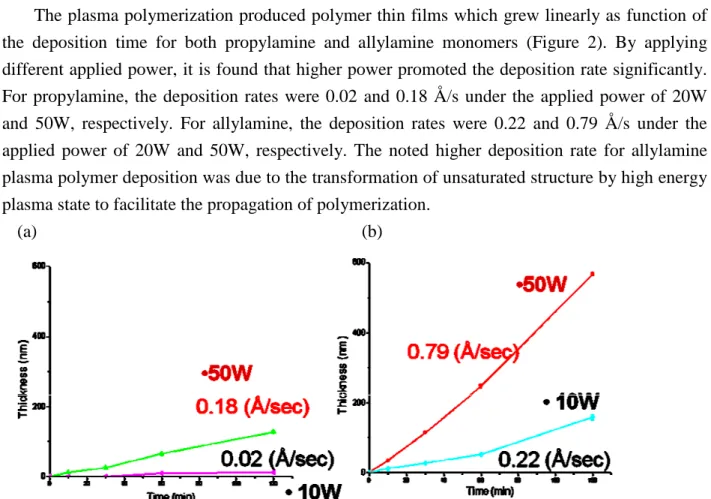
The plasma polymerization produced polymer thin films which grew linearly as function of the deposition time for both propylamine and allylamine monomers (Figure 2). By applying different applied power, it is found that higher power promoted the deposition rate significantly.
For propylamine, the deposition rates were 0.02 and 0.18 Å/s under the applied power of 20W and 50W, respectively. For allylamine, the deposition rates were 0.22 and 0.79 Å/s under the applied power of 20W and 50W, respectively. The noted higher deposition rate for allylamine plasma polymer deposition was due to the transformation of unsaturated structure by high energy plasma state to facilitate the propagation of polymerization.
(a) (b)
Figure 2. Deposition rates as function of the deposition time measured by profilometer (alpha-step) for: (a) propylamine; (b) allylamine. (pressure: 100 mtorr; flow rate: 10 sccm)
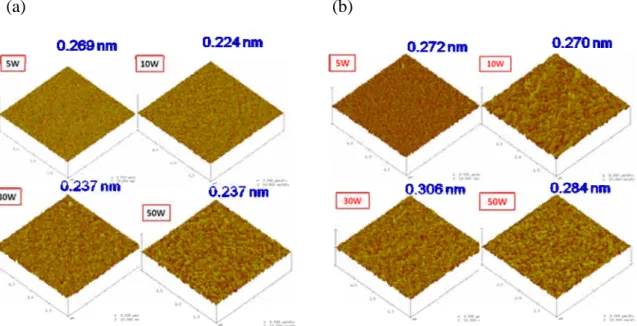
The plasma polymerization showed great ability of depositing polymer thin films linearly. Both propylamine and allylamine monomers were polymerized on the silicon wafer, with roughness of 0.082 nm, and the plasma polymerized revealed smooth and pin-hole free surface morphology as shown by the results of AFM characterization (Figure 3). It is also noted that the elevated applied power did not alter the surface roughness and proved that the plasma polymerization provided a effective method to prepare dense layer of polymer with uniform surface morphology.
The chemical properties of deposited polymers were studied by Fourier Transform Infrared (FTIR) spectroscopy. The results showed that, for propylamine, the thickness of the deposited polymer was too thin to be analyzed by FITR due to the very low deposition rate under the applied power of 5W and 10W (Figure 4). For plasma polymerized propylamine thin film, FTIR spectra showed a wide absorption band at 3390-3360 cm-1which is attributed to the combination of primary amine, secondary amine and imine functions. The multiple absorption peaks between 2960-2880 and 1460-1380 cm-1 are due to the methyl group stretches of aliphatic C-H components. The peak at 1640 cm-1was present on the spectra of the polymer and it is associated with C=C alkenes or from N=N imine stretches. It is noted that, for propylamine deposited under
3500 3000 2500 2000 1500 1000 500 (a) propylamine 30W
(c) allylamine 5W
Absorbance
Wavenumber (cm-1) (f) allylamine 50W
(e) allylamine 30W
(d) allylamine 10W
(b) propylamine 50W
50W, a band at 2200cm-1 was observed. This specific band is associated with the stretching vibration of nitrile groups and it was not found for propylamine deposition at 30 W.
(a) (b)
Figure 3. Surface morphology of the plasma deposited thin film under different applied power, characterized by AFM : (a) propylamine; (b) allylamine. The indicated number represents the surface roughness (pressure: 100 mtorr; flow rate: 10 sccm).
The effect of applied power was equally observed for the plasma polymerized allylamine by IR. Higher applied power can increase the peak formation of nitrile and methyl functions. As shown in Figure 4, a clear formation of nitrile groups can be observed for the applied power up to 30W and it increased further for the applied power at 50 W. Moreover, the absorption bands representing the vibration of methyl groups at range 2960-2880 cm-1 and 1460-1380 cm-1 increased significantly as the applied power increased. This suggests that plasma polymerization resulted in the transformation of the unsaturated groups into saturated ones. At the same time, higher applied power can facilitate functionalization during polymerization processes.
Figure 4. Surface functionality characterized by ATR-FTIR: (pressure: 100 mtor; flow rate: 10 sccm).
Table 1. Characteristic peaks of plasma polymerized propylamine and allylamine analyzed by FTIR
Wavenumber
(cm-1) Assignment Comments
3350 Asymmetric NHxstretching
amines, imines, amides 3270 Symmetric NHxstretching
3200 Assymetric NHxdeformation vibration
2929 Assymetric CHxstretching various structures CH3, CH2, CH 2855 Symmetric CHxstretching
2240 N(-R-C≡N),stretching ofR-C≡C-R nonconjugated triple-bond structures 2182-2100 N(>C=C=O), (-N=C=N-) stretching, conjugated nitriles
N(-R-C≡N),(R-C≡C-R) stretching and various unsaturated structures 1630 NHxdeformation vibration, and stretching
of C=C, C=N, and C=O
amines, amides, carboxyls
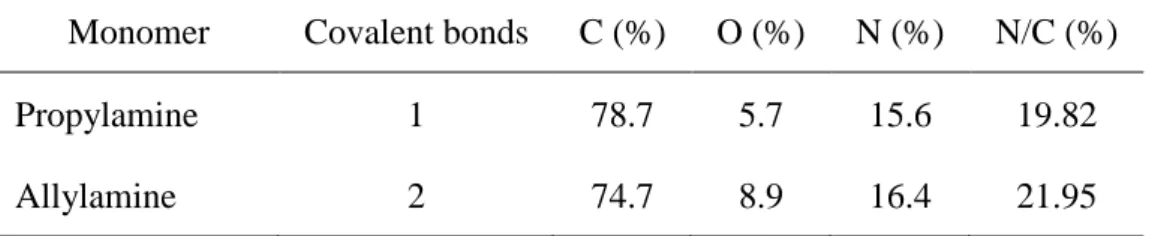
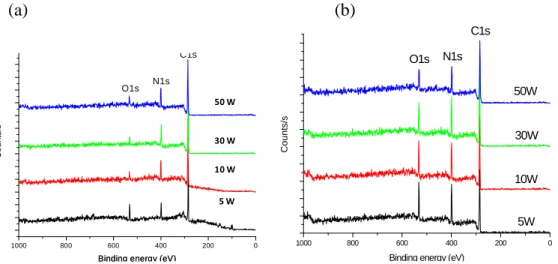
The chemical composition of the plasma polymerized propylamine and allylamine was examined by ESCA. The wide-scan spectra (Table 2, Figure 5) exhibited three main peaks corresponding to carbon (C1s at 284.6 eV), nitrogen (N1s at 398 eV), and oxygen (O1s at 533 eV). The existence of oxygen was due to oxidation reaction during the plasma polymerization caused by atmospheric exposure. The ESCA result showed that more than 15% of nitrogen was successfully incorporated. It is worthy to note that the polymerization of allylamine incorporated higher nitrogen content (16.4 %) with 0.22 N/C ratio than 15.6 % and 15.0 % for polymerization of propylamine.
Table 2. The chemical composition of plasma polymerized C3 amines analyzed by ESCA wide scan
Monomer Covalent bonds C (%) O (%) N (%) N/C (%)
Propylamine 1 78.7 5.7 15.6 19.82
Allylamine 2 74.7 8.9 16.4 21.95
To investigate the chemical bonding responsible to the formation of amine-containing
surfaces, the high resolution C1s spectra and the deconvolution were analyzed (Figure 6, Table 5).
The high resolution spectra of the plasma polymers were normalized to 284.6 eV (CIfor C-C binding) as the main carbonaceous backbone structure, while nitrogen-containing bonds were deconvoluted to be CII(C-N, at 285.5 eV), CIII(C=N; C=O; and C-CN, at 286.1 eV) and CIV
(CO-NH; C=O, at 287.6 eV). The results again showed clearly that the polymerized polymer possessed the highest nitrogen content which included the highest content of imine (C=N, 17.1 %) than that of propylamine plasma polymer (16.5 %).
(a) (b)
1000 800 600 400 200 0
1000 800 600 400 200 0
O1s N1s
C1s
5 W 10 W 50 W 30 W
Binding energy (eV)
Counts/s
Binding energy (eV)
1000 800 600 400 200 0
O1s N1s
10W C1s
30W
5W 50W
Counts/s
Binding energy (eV)
Figure 5. Surface morphology of the plasma deposited thin film under different applied power, characterized by AFM : (a) propylamine; (b) allylamine. The indicated number represents the surface roughness (pressure : 100 mtor; flow rate : 10 sccm).
The ratios of imine content originated from allylamine monomer, relative to that from propylamine, 103.6 %. Although plasma polymerization of propylamine incorporated similar amount of imine to that of allylamine, but as the N/C ratios of allylamine/propylamine and plasma polymers (Table 3, Figure 6) was 110.7%. It suggested that the imine incorporation, as well as the nitrogen introduction, from allylamine monomer is considered to be significantly higher than that of propylamine monomer.
Table 3. Deconvolution of ESCA high-resolution C1s peak for analysis of the chemical bonding on the propylamine and allylamine plasma polymers.
Monomer
CI CII CIII CIV
R2 284.6 eV 285.5 eV 286.1 eV 287.6 eV
C-C (%)
C-N (%)
C=N C-O C-CN
(%)
CO-NH C=O
(%)
Propylamine 72.0 9.2 16.5 2.3 0.99
Allylamine 68.5 8.7 17.1 5.7 0.99
290 288 286 284 282 280
proparylamine
allylamine CI
CII CIII
Intensity(a.u)
Binding energy (eV) CIV
propylamine
Figure 6. ESCA high-resolution C1s spectra of C3amines plasma polymers
The biocompatibility of amine-containing surfaces to promote cell was assessed by directly culturing L-929 fibroblast cells at 37 °C for 24 h (Figure 7) was observed that the cells demonstrated limited adhesion and elongations, where the cells density was counted to be ~22000 cells/cm2, closely to initial cell amount (20000 cells/mL, for 1 cm2 surface), where the shape of the cells are mostly spherical. On the propylamine plasma deposited surface (Figure 7b), L-929 cells grown rapidly, with about 150% higher than that on glass surface.
(a) (b) (c)
Figure 7. Cell morphology after 24h, Amine-containing functionalities promote cell spreading and growth; (a) glass; (b) propylamine; (c) allylamine.
Nonetheless, the cells cultivated on allylamine plasma polymer evidenced even more intensive elongation. Under the influence of allylamine plasma polymer (Figure 7c), the fibroblast cells elongated not just into two, but three directions which is rarely observed on
surface with propylamine plasma polymers. It is likely concluded that supportive environment created by allylamine plasma polymers accommodated cell doubling, thus preceded to the reproduction. This assumption was confirmed by the doubled cell density (~40000 cells/cm2) on allylamine plasma polymer compared to that of initial cells (20000 cells/cm2), or on glass.
4. Conclusion
This project demonstrated that it is possible to plasma polymerize propylamine and allylamine successfully in a deposition rate controllable manner. The fabricated thin films were uniform, pin-hole free with limited roughness. The conjugated containing monomer allylamine showed much higher deposition rate than propylamine monomer. Both FTIR and ESCA characterization revealed that the functionalities incorporated via plasma polymerization included amines, imines, amide, and nitriles functions. Most importantly, the plasma polymerized thin layer by using propylamine and allylamine monomers promoted the growth and spreading of both CHO cells and L-929 fibroblast cells which indicated excellent biocompatibility of the deposited plasma polymer films. The prepared propylamine and allylamine provided great potential for the application for biosensors.
References
[1] Hamerli, P.; Weigel, T.; Groth, T.; Paul, D., Surf. Coat. Tech. 2003, 174-175, 574-578
[2] Akdoğan,E.;Çökeliler,D.;Marcinauskas,L.;Valatkevicius,P.;Valincius,V.;Mutlu,M.,Surf. Coat.
Tech. 2006, 201, (6), 2540-2546
[3] Muguruma, H.; Karube, I., TrAC 1999, 18, (1), 62-68
[4] Llewellyn, I. P.; Rimmer, N.; Heinecke, R., Thin Solid Films 1990, 191, 135-145
[5] Elkin, B.; Mayer, J.; Schindler, B.; Vohrer, U., Surf. Coat. Tech. 1999, Volumes 116-119, 836-840 [6] Muguruma, H., TrAC 2007, 26, (5), 433-443
[7] Fally, F.; Doneux, C.; Riga, J.; Verbist, J. J., J. Appl. Poly. Sci. 1995, 56, (5), 597-614
[8] Zelzer, M.; Majani, R.; Bradley, J. W.; Rose, F. R. A. J.; Davies, M. C.; Alexander, M. R., Biomaterials 2008, 29, (2), 172-184.
行政院國家科學委員會計畫執行人 出席國際學術會議心得報告
2010 年 04 月 29 日 計畫編號 97-2221-E-011-011-MY2
計畫名稱 研究連續式與脈衝式電漿聚合有機薄膜之性質與反應機制並
探討於生物感測器之應用 出國人員姓名
服務機關及職稱 國立台灣科技大學化學工程系 王孟菊 助理教授
會議時間地點 2010 年 4 月 19-24 日,美國西雅圖
會議名稱 2010 Annual Meeting of the Society for Biomaterials 2010 年生醫材料學會年會
發表論文題目
1. Dave Mangindaan, Shu-Ling Wang , Meng-Jiy Wang*, “Novel Controllable-Wettability Gradients on Polypropylene Surfaces for Cell Screening”;
2. Chia-Wen Chang, Wei-Hsuan Kuo, Meng-Jiy Wang*, Wei-Bor Tsai*, “Blood Compatibility of Poly(ethylene
glycol)-methacrylate /Acrylic acid Copolymer Coated Surfaces”;
3. Wei-Hsuan Kuo, Meng-Jiy Wang, Wei-Bor Tsai*, Chiapyng Lee*, “Blood compatibility on poly (acrylic acid- sulfobetaine methacrylate) polyelectrolyte multilayers modified surface”.
參加會議經過:
This year, thank to the support from NSC, Taiwan, I selected the “2010 Annual Meeting of the Society for Biomaterials” meeting to present the recent results from my research group. The meeting was hold at Seattle, USA, from April 21-24, 2010.
The main topic of this year is: “For Biomaterials, Where Materials Meet Biology”
which is the main spirit of people who works on biomaterials from either material society or biology society. The idea is to bridge these two fields and create the solution for novel biomaterials and for better welfare of human being.
The SFB meeting is one of the most important meetings for the international
communities for Biomaterials. The SFB meeting has been hold every year since more
than 30 years ago and the attendee is still steadily increasing due to the focus of research and the development of novel techniques in this particular and
multi-disciplinary fields. The research topic of the symposia this year are:
1. Applications of Nanomaterials in Medicine 2. Biofilm-Material Interactions
3. Cardiovascular Materials and Polyurethane 4. Biomaterials
5. Cell Function in 2D vs 3D Culture
6. Multi-factor Drug Delivery for Musculoskeletal 7. Regeneration
8. Pluripotent Stem Cells in Regenerative Medicine 9. Self-Assembly in Tissue Engineering
10. Stem Cell-Biomaterial Interactions
11. Surface Modification and the Biological Response 12. Targeted Drug Delivery / Polymer Conjugates
There are three important reasons enable me to choose attending the SFB meeting this year: (1) I have been working on the interfaces between biomolecules and
materials for many years, instead of investigating the issues from the materials aspects, it is also important to approach from biomolecules side or in an integrated manner.
SFB meeting provides this particular possibility; (2) In my research group, we have been developing effective screening method to evaluate biomaterials, we would like to present our work in one of the most important international meeting; (3) as an assistant Professor, I consider research and education are equally important. After three and half years of training my Ph.D. students, I consider it is a good opportunity for my student to participate the SFB meeting, not only to gain the most advanced knowledge from the world but also to communicate with young scientists from different corners of the globe. There is one Ph.D. student came with me to attend the SFB meeting this time.
Moreover, in terms of sharing knowledge, we have present three different research works from three of my students, two Ph.D. students and one undergraduate student.
The research work of Winston is about an effective anti-thrombogenic surface modification coating. Similarly to Winston’s work but with different polymer materials, Chia-Wen has been worked on PEGMA and AA copolymers. The third work is associating the surface modifications of materials and create the surface gradient. The unique property of this research work is we have combined the
experimental results with mathematical modeling which integrates the training from
Chemical Engineering and Biomaterials
In terms of participation of the conference, my student and me, we started to join the opening ceremony from the first day until the very last presentation on the final schedule of the conference. It was fruitful and we have learnt the knowledge from at least the following fields:
1. synthesis of new materials
2. incorporation of different materials
3. pay attention to the interaction at molecular level 4. nano-particle
5. drug-delivery
6. carriers, degradable materials 7. biosensors
8. porous scaffolds
The panel meetings are quite impressive, especially the talk from Professor Allan Hoffman and Professor D. L. Cooper. Their talks are not only educational but also inspiring us to think the future direction about research as well as the real applications into the healthcare. One very special session of this year is the “Rapid Fire Sessions”.
By shortening the presentation time to only 5 minutes, and provide also poster for these works, it allows the audience to catch some ideas more rapidly and encourage the discussions during poster sessions due to the short presentation to public. I personally found this is a good way to stimulate the communication between participants of the conference.
Beside participating the meeting which is hold at Seattle this year, we have also visited the well-known research center of bioengineering: University of Washington.
We started by join the introduction seminar from Professor Jiang, in the past few years, the group of Prof Chiang was doing pioneer research on designing anti-fouling
surfaces and have applied to biomaterials and navel industries. We have also
anticipated the presentation from Professor Pat Stayton who focused on drug-delivery research by applying RNA. Finally, we have joined the seminar session of Department of Chemical Engineering at U of W. The seminar was given by Professor Xinqiao Jia from the Delaware University.
The first time participation of SFB meeting has been wonderful: my student and me have met many researchers, with many conversations and questions, series of presentation and numerous posters, we have definitely learnt more than we could have
imagined before we departed from the meeting. Moreover, it is precious that while sharing the scientific experiences with others, at the same time more new ideas were generated. I looked forward to participating another fruitful SFB meeting.
P.S.
Picture taken from three posters of my group and my Ph.D. student.
無衍生研發成果推廣資料
97 年度專題研究計畫研究成果彙整表
計畫主持人:王孟菊 計畫編號:97-2221-E-011-011-MY2
計畫名稱:研究連續式與脈衝式電漿聚合有機薄膜之性質與反應機制並探討於生物感測器之應用 量化
成果項目 實際已達成
數(被接受 或已發表)
預期總達成 數(含實際已
達成數)
本計畫實 際貢獻百
分比
單位
備 註 ( 質 化 說 明:如 數 個 計 畫 共 同 成 果、成 果 列 為 該 期 刊 之 封 面 故 事 ...
等)
期刊論文 0 0 100%
研究報告/技術報告 1 0 100%
研討會論文 11 5 100%
論文著作 篇
專書 0 0 100%
申請中件數 0 0 100%
專利 已獲得件數 0 0 100% 件
件數 0 0 100% 件
技術移轉
權利金 0 0 100% 千元
碩士生 6 0 100%
博士生 1 0 100%
博士後研究員 0 0 100%
國內
參與計畫人力
(本國籍)
專任助理 0 0 100%
人次
期刊論文 6 0 100%
研究報告/技術報告 0 0 100%
研討會論文 6 4 100%
論文著作 篇
專書 0 0 100% 章/本
申請中件數 0 0 100%
專利 已獲得件數 0 0 100% 件
件數 0 0 100% 件
技術移轉
權利金 0 0 100% 千元
碩士生 0 0 100%
博士生 0 0 100%
博士後研究員 0 0 100%
國外
參與計畫人力
(外國籍)
專任助理 0 0 100%
人次
其他成果
(
無法以量化表達之成果如辦理學術活動、獲 得獎項、重要國際合 作、研究成果國際影響 力及其他協助產業技 術發展之具體效益事 項等,請以文字敘述填 列。)
執行本計畫兩年期間,共發表國際論文十一篇,其中六篇為計畫主持人執行之 計畫以及研究結果之產出,另外五篇則為與國內外研究單位之合作成果。計畫 執行期間,由計畫支持參加國際會議兩次,發表六篇論文;並且共兩次應邀至 國外演講;共計培育六名碩士畢業生以及有一名博士生即將畢業。其中,應國 際期刊邀請審稿兩次;國科會計畫審查四次;舉辦兩次國際研討會;同時,本 計畫主持人在教學方面也獲得學校教學優良獎之榮譽。
成果項目 量化 名稱或內容性質簡述
測驗工具(含質性與量性) 0
課程/模組 0
電腦及網路系統或工具 0
教材 0
舉辦之活動/競賽 0
研討會/工作坊 0
電子報、網站 0
科 教 處 計 畫 加 填 項
目 計畫成果推廣之參與(閱聽)人數 0
國科會補助專題研究計畫成果報告自評表
請就研究內容與原計畫相符程度、達成預期目標情況、研究成果之學術或應用價 值(簡要敘述成果所代表之意義、價值、影響或進一步發展之可能性) 、是否適 合在學術期刊發表或申請專利、主要發現或其他有關價值等,作一綜合評估。
1. 請就研究內容與原計畫相符程度、達成預期目標情況作一綜合評估
■達成目標
□未達成目標(請說明,以 100 字為限)
□實驗失敗
□因故實驗中斷
□其他原因 說明:
2. 研究成果在學術期刊發表或申請專利等情形:
論文:■已發表 □未發表之文稿 □撰寫中 □無 專利:□已獲得 □申請中 ■無
技轉:□已技轉 □洽談中 ■無 其他:(以 100 字為限)
執行本計畫兩年期間,共發表國際論文十一篇,其中六篇為計畫主持人執行之計畫以及研 究結果之產出,另外五篇則為與國內外研究單位之合作成果。
3. 請依學術成就、技術創新、社會影響等方面,評估研究成果之學術或應用價 值(簡要敘述成果所代表之意義、價值、影響或進一步發展之可能性)(以 500 字為限)
本計畫之執行是研究利用連續式與脈衝式電漿聚合有機薄膜之性質與反應機制並探討於 生物感測器之應用,在薄膜的製備研究方面具有新穎性,因此論文可以順利發表於 impact factor 高於 3 以上、於前百分之十的期刊,同時感測器的製作可實際應用,具可產業化的 價值。