行政院國家科學委員會專題研究計畫 期中進度報告
以糖尿病鼠模式來探討綠藻對於抑制高血糖和降低動脈粥 狀硬化危險因子的作用及其改善病鼠抗氧化酵素之關聯性
(1/2)
計畫類別: 個別型計畫
計畫編號: NSC91-2320-B-041-015-
執行期間: 91 年 08 月 01 日至 92 年 07 月 31 日 執行單位: 嘉南藥理科技大學醫藥化學系
計畫主持人: 程中玉
計畫參與人員: 施美份
報告類型: 精簡報告
處理方式: 本計畫可公開查詢
中 華 民 國 92 年 5 月 29 日
NSC annual report
Aims/hypothesis. Chlorella, a type of unicellular fresh water growth algae, has been a popular foodstuff in Japan and Taiwan. There are many studies have shown some beneficial effects of Chlorella administration, including in decreasing blood glucose in alloxan-induced and streptozocin (STZ)-induced diabetic animals. However, the mechanisms in influencing blood glucose homeostatsis by Chlorella pyrenoidosa treatment have not been studied.
Methods. Streptozocin-induced mice (n=8) were treated with 100 mg/kg of Chlorella (oral) 60 min prior to soluble insulin (2.5 IU/kg, i.p.) and at 60 min intervals thereafter for insulin sensitivity test. Plasma insulin levels were determined by EIA.
Lipogenic rates were measured followed Chlorella or H2O 1 hr prior.
Results. Chlorella enhanced the hypoglycemic effects of exogenous insulin in STZ mice. This enhancement was maintained up to 240 min (176 ± 43, 317 ± 34 mg/dL at –60 min) after the insulin treatment.
Conclusion. The current results suggest that Chlorella enhances glucose tolerance and insulin sensitivity which are not through a mechanism of insulin release.
Introduction
Diabetes mellitus, both of insulin–dependent diabetes mellitus (IDDM) and non-insulin-dependent diabetes mellitus (NIDDM), is a common and serious disorder throughout the world (Keen, 1986, Harris et al., 1987). This metabolic disorder often leads to disability from the vascular complications of coronary artery disease and cerebrovascular disease, renal failure, blindness, and limb amputation in addition to neurological complications and premature death (Goldstein & Massry 1978;
Weidmann et al., 1993). Treatment of diabetes mellitus by insulin &/or oral drugs fails to prevent these complications in many patients indicating that additional treatment would be helpful.
Chlorella, a type of unicellular green algae, has been a popular foodstuff in Japan and Taiwan. It has a yield and a good quality of protein ( Morvimura & Tamiya, 1954), lipid soluble vitamins, choline, and all the minerals in an available form ( Shino et al., 1967). Administration of Chlorella has been shown to play some biochemical functions, such as promoting the growth rate of animals (Ishibashi, 1972), boosting immune function (Tanaka et al., 1984; Singh et al., 1998), preventing stress-induced ulcer ( Tanaka et al., 1997), and influencing the lipid contents of the liver and serum in ethionine treated rats (Wang et al., 1980) and in cholesterol contained diet treated rabbits (Sano & Tanaka, 1987; Sano et al., 1988). In addition, acute administration of Chlorella produced a significant hypoglycemic effect in alloxanized rats (Rodriguez-Lopez & Lopez-Quijada, 1971) and STZ mice (Shih, 2001). However, the involved mechanisms of its hypoglycemic effects have not been investigated.
Blood glucose is utilized, under the influence of insulin, by tissues or stored as glycogen in the liver and muscles. Excessive glucose can be also stored as triglyceride via a process of lipogenesis in adipose tissues. Thus the aims of this study are to investigate the primary mechanism(s) of hypoglycemic effects of Chlorella.
Mater ials and methods
Chlorella material
Spray-dried algal materials of Chlorella cultured in the outdoor cultivation pool at GONG BIH Enterprise Co., Ltd (Doo-Liu City, Taiwan) was prepared, suspended in distilled water prior to use.
Animals.
Male ICR mice (6-8 weeks) were purchased from National Science Council Animal Center of Taiwan. The number of experimental animals was kept to
a minimum and they were used only once. Mice (n=8-10, age 3 weeks old) received 60 mg/kg (i.p.) of Streptozocin (STZ) in citrate buffers (10 mM, pH 4.8) as STZ mice (Dresner et al 1997) or buffer only as sham STZ mice.
All animals were provided ad libilum access to tap water. Their housing was maintained at a temperature of 20 -22℃, relative humidity of 50-80%, and a 12 hours light/dark cycle of 07.00hr to 19.00hr with no twilight.
All animals were anaethetised briefly prior to be killed. All experimental procedures followed the principle of laboratory animal care and carried out according to a protocol approved by the local animal ethics committee.
Drugs.
Glybenclamide (Cat. G 0639, Sigma) was dissolved in distilled water to give a dose volume of 0.1 ml 10g-1 body weight. The insulin used was human Actrapid (Novo Nordisk 100 IU ml-1). Chlorella was provided by Gong-Bih Enterprice Co. Ltd (Taiwan) and prepared as suspension. Control mice received the equivalent volume of distilled water (oral) or saline (i.p.). Glybenclamide and Chlorella suspension were given 60 min prior to assessments. Mice were lightly anesthetized with diethyl ether prior to drug administration. The test dose for glybenclamide (as positive control) was 2.5 mg kg-1 according to previous work (Williams et al., 1999a) and insulin was 2.5 IU kg-1 (Williams et al., 1999b) based on previous work.
Procedure.
Acute experiments commenced between 09.00 and 10.00h using mice which had been housed in groups of eight in the same cage for at least 2 weeks. Standard diet and water were available ad libitum, except during the glucose tolerance test (GTT).
Blood samples, 20 µl, were taken by venesection of the tail vein following light either anaesthesia. To establish a minimal effective dose of Chlorella on GTT a dose of 50-125 mg kg-1 was administered orally 60 min prior to glucose tolerance test (GTT see below) in normal mice.
Glucose tolerance test (GTT).
Following an overnight fast, Chlorella or water was administered by oral gavage 60 min prior to the challenge dose of 1 mg kg-1 body weight glucose i.p. (zero time).
Mice were anaesthetized with ether and 20 µl blood samples taken by distal venesection of the tail vein. Blood samples were taken immediately prior to administration of the Chlorella or water and the glucose and subsequently at 30 min intervals for a period of 150 min. Measurement of blood glucose was carried out using a glucocheck strip (Accutrend mini, Boehringer Ltd.).
Basal blood glucose test (BGL).
Chlorella or water was given orally immediately after collection of an initial blood sample (-60 min) subsequent blood samples were taken at 30, 60, 120, 180, and 240 min after drug administration for blood glucose analysis. In order to examine whether there were additive effects of coadministration of Chlorella and glybenclamide, Chlorella was given 60 min after glybenclamide administration and blood samples were taken for assay as above.
Comparative insulin sensitive test (cIST).
Chlorella or water was administered orally 60 min prior to a single injection of soluble insulin, 2.5 IU kg-1 body weight i.p. Blood samples for glucose analysis were taken prior to the administration of Chlorella or water and the insulin and subsequently at 60 min intervals for a period of 240 min (Williams et al., 1999b).
Plasma insulin level.
Blood samples were taken 20 min after the drugs or saline. Plasma was stored at -20
℃ for further assay. Plasma insulin was determined by using EIA system assay kits (Amersham Life Science RPN 2567).
Statistical analysis.
Data from each group of animals (n≧ 8) were grouped from two at least different experimental days. A two-tailed student’s unpaired test was used to compare the mean values of two populations of continuous data which were part of a normal distribution.
Results
In normal mice
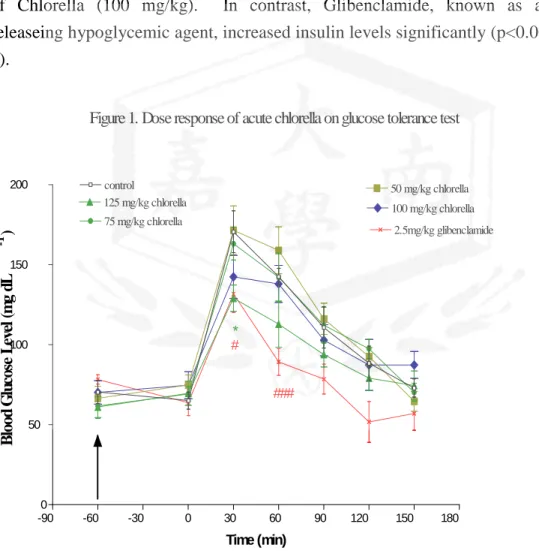
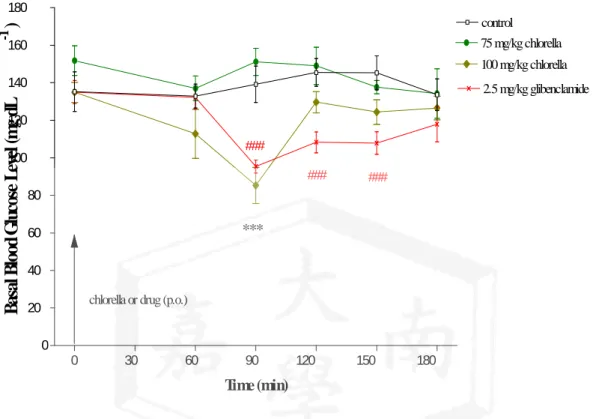
Conventional oral hypoglycemic drug (glybenclamide 2.5 mg/kg, as a positive control) prevented blood glucose raise after a single dose of glucose (1 mg/kg, i.p.) challenge at time of 30 min. Dose of 125 mg/kg of acute chlorella also significantly suppressed the glucose challenge (p<0.05, see figure 1). Glybenclamide produced a significant suppressed effect on BGL 90 min after the treatment and sustained for further 60 min in normal mice (p<0.005). Whereas chlorella only produced a transient decreasing effect on BGL at time 90 min in the dose of 100 mg/kg (figure 2.).
In STZ mice
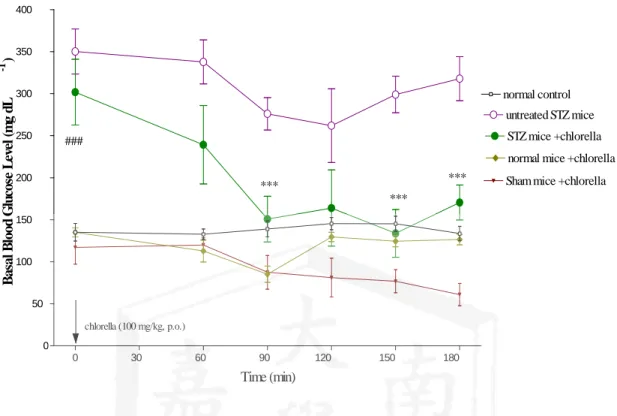
The basal glucose levels (BGL) in STZ mice were much higher than normal and sham STZ mice, expectantly (P<0.005, see figure 5). Acute Chlorella significantly lowered
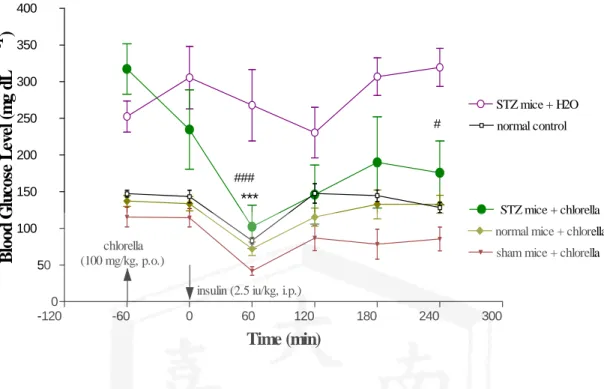
BGL levels in STZ mice 90 min after the challenge and this was sustained for further 90 min compared to those received H2O (p<0.005,). Exogenous insulin treatment alone did not produce adequately hypoglycemic effects in H2O-treated STZ mice, whereas in Chlorella-treated STZ mice produced a dramatically decrease in the blood glucose after the administration of exogenous insulin 60 min later (p<0.005, see figure 6). The enhancing hypoglycemic effects of insulin by Chlorella were sustained for further 180 min (from time 60 to 240 min).
Insulin assay
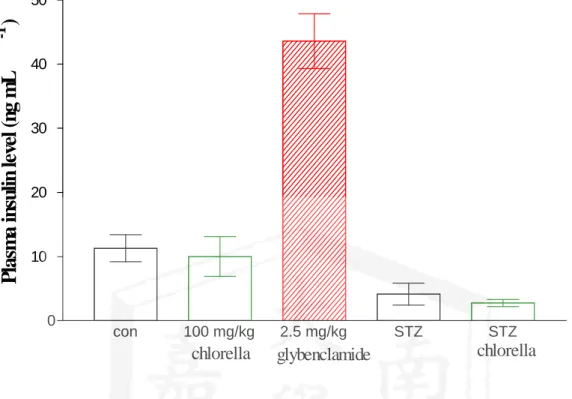
Plasma insulin neither in normal nor in STZ mice was affected by the administration of Chlorella (100 mg/kg). In contrast, Glibenclamide, known as an insulin releaseing hypoglycemic agent, increased insulin levels significantly (p<0.005, see fig.
5).
-90 -60 -30 0 30 60 90 120 150 180
0 50 100 150
200 control
75 mg/kg chlorella 125 mg/kg chlorella
50 mg/kg chlorella 100 mg/kg chlorella
2.5mg/kg glibenclamide
###
*
Figure 1. Dose response of acute chlorella on glucose tolerance test
#
Time (min) Blood Glucose Level (mg dL-1 )
Figure 1 Dose-response effect of Chlorella o glucose tolerance in normal mice (n=8).
Mice received H2O, 2.5mg/kg of glybenclamide, 50, 75, 100, or 125 mg/kg of Chlorella at time –60 min. Statistics are shown for 125mg/kg of Chlorella, * p<0.05, and 2.5mg/kg of glybenclamide # p<0.05, ### p<0.005 compared to H2O treated animals.
0 30 60 90 120 150 180 0
20 40 60 80 100 120 140 160 180
control 75 mg/kg chlorella
2.5 mg/kg glibenclamide
Figure 2. Effects of acute chlorella pyrenoidosa on basal blood glucose level in normal mice
chlorella or drug (p.o.)
100 mg/kg chlorella
***
###
### ###
Time (min) Basal Blood Glucose Level (mg dL-1 )
Figure 2. Effects of Chlorella and Glybenclamide on basal blood glucose levels in normal mice (n=8). Mice received H2O, 2.5mg/kg of glybenclamide, or 75, or 100 of Chlorella at time –60 min. Statistics are shown for 100mg/kg of Chlorella *** p<0.05 and for 2.5 mg/kg of glybenclamide ### p<0.005 compared to the controls
0 30 60 90 120 150 180 0
50 100 150 200 250 300 350 400
normal control
normal mice +chlorella Sham mice +chlorella STZ mice +chlorella
Figure 3. Acute effects of 100 mg/kg Chlorella on basal blood glucose in STZ mice
chlorella (100 mg/kg, p.o.)
untreated STZ mice
*** ***
###
***
Time (min) Basal Blood Glucose Level (mg dL-1 )
Figure 3. Effects of Chlorella on basal glucose test in STZ mice. Normal mice received H2O, 100 mg/kg of Chlorella, sham mice received 100 mg/kg of Chlorella, STZ mice received H2O or 100 mg/kg of Chlorella at time –60 min. Statistics are shown for STZ mice + H2O had significantly higher basal blood glucose level than their controls, ### p<0.005 and for STZ mice + chlorella, *** p<0.005, compared to H2O treated STZ mice at the same time points.
-120 -60 0 60 120 180 240 300 0
50 100 150 200 250 300 350 400
normal control
normal mice + chlorella sham mice + chlorella STZ mice + chlorella STZ mice + H2O
chlorella (100 mg/kg, p.o.)
insulin (2.5 iu/kg, i.p.)
Figure 4. Acute effects of 100 mg/kg Chlorella on comparative insulin sensitivity test in STZ mice
***
#
###
Time (min) Blood Glucose Level (mg dL-1 )
Figure 4. Effects of Chlorella on comparative insulin sensitive test in STZ mice.
Normal mice received H2O, 100 mg/kg of Chlorella, sham mice received 100 mg/kg of Chlorella, STZ mice received H2O or 100 mg/kg of Chlorella at time –60 min.
Insulin (2.5 IU/kg) was given at time zero indicated. Statistics are shown for STZ mice + chlorella, #p<0.05, ###p<0.005, compared to STZ mice + H2O at the same time points; *** p<0.005 compared to the time Chlorella was treated.
con 100 mg/kg 2.5 mg/kg STZ STZ 0
10 20 30 40 50
Figure 5. Effects of 100 mg/kg Chlorella on insulin release in STZ mice
chlorella glybenclamide chlorella
P la sm a ins uli n le ve l ( ng m L
-1)
Figure 5. Effects of Chlorella on insulin release in STZ mice. Mice received H2O, or 100 mg/kg of Chlorella normal mice received 2.5mg/kg of glybenclamide 20 min prior to sample collection. Insulin levels were then determined subsequently.
Discussion:
The data of Chlorella on GTT, BGL and cIST observed in normal mice suggest that Chlorella has the potential to lower blood glucose level. A similar effect was also shown in STZ mice in this study. The data obtained from insulin assay after chlorella treatment showed the consistent with early finding by Rodriguez-Lopez &
Lopez-Quijada (1971). In their study, allonxan-induced diabetic animals, which represented an IDDM mode, was used to test the hypoglycemic effects of Chlorella.
Thus, Chlorella seems to influence the blood glucose via pathways other than enhancing release of insulin from the pancreas. The future work will be focused on investigating the mechanisms of hypoglycemic effects of Chlorella.
Future wor k:
Blood glucose, under the work of insulin, is up-taken by tissues (e.g. the liver, muscles, or adipose tissues) as glycogen synthesis or used as fuel. Glucose can also be used for lipogenesis in adipose tissue, thus the next piece of will be investigating the glucose uptake and lipogenesis in adipose tissues in both normal and STZ mice.
References:
Bergman RN. Ader M. (2000) Free fatty acids and pathogenesis of type 2 diabetes mellitus. Trends in Endocrinology & Metabolism. 11(9):351-6
Ishibashi, H. (1972) Effects of Chlorella feeding on rats. Biological abstract 54:9694
Meszaros K, Lang CH, Bagby L, & Spitzer JJ (1987) Contribution of different organs to increased glucose consumption after endotoxin administration. J. Biol. Chem.
262:10965-10970
Morimura Y. & Tamiya N (1954) Preliminary experiments in the use of chlorella as human food. Food Technol. 8: 179-182
Okuda M., Hasegawa J., Sonoda M., Okabe T., Tanaka Y. (1975) The effects of chlorella on the levels of cholesterol in serum and liver. Japanese J. Nutrition 33:3-8
Rodriguez-Lopez M & Lopez-Quijada C (1971) Plasma-glucose and plasma-insulin in normal and alloxanized rats treated with chlorella. Life Sciences 10:57-60 Singh A, Singh SP, & Bamezai R (1998) Perinatal influence of Chlorella vulgaris
(E-25) on hepatic drug metabolizing enzymes and lipid. Anticancer Res.
18:1509-11514
Sano, T., Kumamoto Y., Kamiya N., Okuda M., & Tanaka Y. (1988) effect of lipophilic extract on Chlorella vulgaris on alimentary hyperlipidemia in cholesterol-fed rats. Artery 15:217-224
Shino K., Shimotomai A., Hayami H (1967) Studies on utilization of chhlorella: 1.
Chlorella as a source of micronutrients. Ann. Rep. Nat. Inst. Nutr. 45-46. Cited in Biological Abstracts 50:45916
Williams CA, Shih M-F, & Taberner PV (1999b) A simple acute in vivo comparative test for sensitivity to insulin in the mouse. Horm. Metab. Res. 31:580-582