Omni-directional band edge lasing emission from a dye-doped cholesteric liquid crystal infiltrated photonic crystal fiber
Chung-Yueh Chiu
1, Jia-De Lin
1, Ting-Shan Mo
2, and Chia-Rong Lee
1*
1
Department of Photonics and Advanced Optoelectronics Technology Center, National Cheng Kung University, Tainan, Taiwan 701, Republic of China
2
Department of Electronic Engineering, Kun Shan University of Technology, Tainan, Taiwan 701, Republic of China
*e-mail: [email protected]
Abstract
This work demonstrates a lasing emission based on dye-doped cholesteric liquid crystal infiltrated photonic crystal fiber (DDCLCIPCF) by selectively injection on the hollow core of the PCF. Experimental results indicate that the helical axis of the DDCLC will align perpendicularly to the fiber wall and thus the lasing emission of the DDCLC within the PCF can be pumped by a pulse laser and measured in radial direction. This work also discusses the factors, such as the pumping direction and the alignment condition in the PCF, influencing on the lasing performance of the DDCLCIPCF.
Key words: cholesteric liquid crystals, photonic bandgap, laser, photonic crystal fiber
1. INTRODUCTION
Liquid crystal laser is a burgeoning field because of its attractive characteristics, such as wideband tenability, high external field controllability and in some cases, multidirectional emission [1]. Generation of lasing emissions in liquid crystal can be attributed from the enhanced fluorescence as well as the spatial modulation of refractive index of liquid crystal. The spatial distribution of dielectric constant or refractive index of liquid crystal can determine the property of lasing emission. In medium with periodical modulation, such as the planar cholesteric liquid crystal (CLC), highly directional distributed feedback lasing emission can be generated [1, 2]. Since the planar CLC has a periodic helical structure, the planar CLC can be regarded as a one-dimensional (1D) photonic crystal and a mirrorless 1D microcavity. A low-threshold mirrorless lasing at the photonic band edge of DDCLCs can be realized [2] and emit along the direction of helical axis as it is optically pumped with a pulse laser.
Photonic crystal fiber (PCF) is a fiber with interesting guiding mechanisms and numerous peculiar possibilities, such as high nonlinearity, high numerical aperture, large mode area, and endlessly single mode [4]. These special properties are determined by the unusual structure of the PCF, a spatially periodic microstructure with air array voids in the silica cladding around the solid or hollow core. Light in a PCF with a solid core of high refractive index can be confined laterally via modified total internal reflection (mTIR) as in a conventional single mode fiber
(SMF) [4], whereas light in a PCF with a hollow core can be confined by the photonic band gap (PBG) effect [5].
The spatially periodic microstructure-sized air holes not only affect the optical properties of the PCF, but also open the opportunities of creating various tunable fiber-based devices by infiltrating high index materials such as liquid crystals in these air holes of core or claddings [6, 7].
In this paper, we selectively inject dye-doped cholesteric liquid crystal (DDCLC) into the hollow core of the photonic crystal fiber (PCF) to demonstrate a band edge lasing emission. Experimental results indicate that the helical axis of the DDCLC will align perpendicularly to the inner wall of the PCF and thus the lasing emission of the DDCLC within the PCF can be pumped by a pulse laser and measured in radial direction. Since the fluorescence from the DDCLC can be confined and thus enhanced in the PCF by the reflection band of the CLC and the mTIR between the core and the cladding, the lasing emission can be pumped with a low threshold. This work also discusses the factors, such as the pumping direction and the alignment condition in the PCF, influencing on the lasing performance of the DDCLCIPCF.
2. EXPERIMENTS
The DDCLC mixture employed in this work is composed of namatics MDA-98-1602 (from Merck), chiral dopant S811 (from Fusol Material), and laser dye P597 (from Exciton) in the weight ratio of 75.5 : 24 : 0.5. The planar DDCLC structure has a reflection band with a short wavelength edge (SWE) at around 582nm, which is near the maximum of the fluorescence of the laser dye P597.
The homogeneously mixed DDCLC mixture is then injected into the hollow core of the PCF (HC19-1550, from THORLABS), which has a core radius of 20 μm, cylindrical holes with a radius of 3.7 μm, and silica cladding diameter of 115 μm. To infiltrate the DDCLC into the hollow core of the PCF, the selectively injection method is used [8], as shown schematically in Fig. 1(a).
As demonstrated in Fig. 1(b), a SMA fiber with UV glue is employed to fill the cladding holes of the PCF. The filled holes will be darker than the open holes, as shown in Fig. 1(c). After all cladding holes are filled, as shown in Fig. 1 (d), the PCF will be illuminated with UV light to cure the glue. The DDCLC can thus be injected only into the hollow core.
Fig. 1. (a) Schematic of the selectively injection method.
And microscope images for the PCF (b) with no filled cladding holes, (c) with filled cladding holes in the outer region, and (d) with filled all cladding holes.
Figure 2 shows the experimental setup for measuring the lasing emission from the fiber. A Q-switched Nd:YAG SHG pulse laser (λ=532 nm, 8ns, 10Hz) is focused by a 10x objective lens on the DDCLCIPCF laterally or axially (as shown in the inset). A half-wave plate and a polarizer are placed in front of the objective lens for adjusting the incident pumped energy. A fiber-based spectrometer is placed in the radial direction of the PCF to receive the lasing emission.
Fig. 2. The experimental setup. The DDCLCIPCF is pumped laterally or axially (as shown in the inset).
3. RESULTS AND DISCUSSION
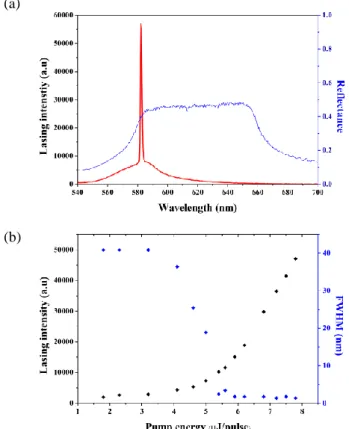
Figure 3 (a) shows the reflection band of the DDCLC and the lasing emission from the DDCLCIPCF pumped laterally. The wavelength of the lasing emission is 582.21 nm, which is consistent with the short wavelength edge of the reflection band of the DDCLC. The consistency of the lasing wavelength and the band edge wavelength
indicates that the lasing emission from the DDCLCIPCF is resulted from the fluorescence enhancement due to the photonic band edge of CLC [2]. The variations of the peak intensity of the fluorescence output and the corresponding full-width at half-maximum (FWHM) with the pumped energy of the band edge lasing is summarized in Fig. 3(b). Figure 3(b) indicates that when the incident pumped energy exceeds 4.5 μJ/pulse, the peak intensity of band edge lasing emission will increase obviously while the FWHM of the emission spectrum will decrease sharply. Therefore, the energy threshold for the band edge lasing emission with lateral pump is 4.5μJ/pulse.
Fig. 3. (a) Reflection spectrum and lasing spectrum of the DDCLCIPCF pumped laterally. (b) Variations of peak intensity of the fluorescence output and corresponding FWHM with laterally incident pumped energy.
The energy threshold for the lasing emission pumped laterally, 4.5 μJ/pulse, is not as low as expected. One possible reason for the high energy threshold is that the pumping pulse light might be scattered when it incident into the DDCLCIPCF laterally because of the distributed air holes in the fiber cladding region. To verify the assumption, we adjust the setup to pump the DDCLCIPCF in the axial direction, as shown in the inset of Fig. 2. The experimental result is demonstrated in Fig.
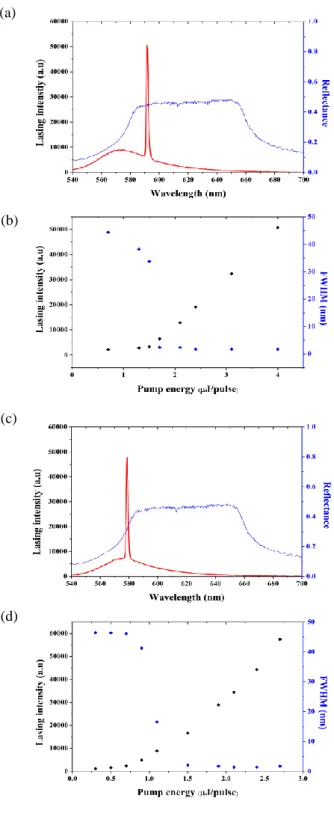
4. Figure 4 (a) indicates that the band edge lasing can also be generated if the pumping pulse light is focused on the DDCLCIPCF axially. From the data shown in Fig. 4(b), it can be easily determined that the energy threshold for the lasing emission of the DDCLCIPCF with axial pumping is about 1.5 μJ/pulse. The lower energy threshold for the
(a)
(b) (b)
(c)
(d) (a)
lasing emission in the axial pumping condition can verify that the cladding layer of the PCF can indeed restrict the pumping efficiency of the pulse light.
Fig. 4. (a) Reflection spectrum and lasing spectrum of the DDCLCIPCF pumped axially. (b) Variations of peak intensity of the fluorescence output and corresponding FWHM with axially incident pumped energy.
Besides the pumping condition, the orientation condition of the DDCLC in the PCF is also an important feature should be considered. Therefore, we prepare a specialized PCF which has an alignment film in the inner wall of the hollow core to align the LC near the inner wall homogeneously. For this purpose, the PCF is coated with 3-glycidoxypropyltrimethoxysilane prior to filling with the DDCLC [9]. Figure 5 shows the lasing performance and characteristic of the DDCLC in the PCF with alignment film. Figures 5 (a) and 5 (b) are obtained under the lateral pumping condition, while Fig. 5 (c) and 5 (d) are obtained under the axial pumping condition. Whether the PCF is pumped laterally or axially, the band edge lasing can be generated if the pumped energy exceeds the energy threshold. However, the energy thresholds measured under the lateral pumping condition and the axial pumping condition are 1.5 and 0.7 μJ/pulse, as shown in Fig. 5(b) and 5 (d), respectively. This result is similar to the case of PCF with no alignment layer. It is worthwhile to notice that the energy threshold of the lasing emission in the DDCLCIPCF with alignment layer is obviously lower than that with no alignment layer. The better performance of the PCF with alignment layer is supposed to the ordered orientation of LC molecules, which can provide a better photonic structure and thus
enhance the lasing efficiency.
Fig. 5. Lasing performance of the PCF with alignment layer. (a) Reflection spectrum and lasing spectrum of the DDCLCIPCF and (b) Variations of peak intensity of the fluorescence output and corresponding FWHM with laterally incident pumped energy. (c) Reflection spectrum and lasing spectrum of the DDCLCIPCF and (d) Variations of peak intensity of the fluorescence output and corresponding FWHM with axially incident pumped energy.
(a)
(b)
(c)
(d) (a)
(b)
4. CONCLUSION
This work demonstrates a lasing emission based on DDCLCIPCF by selectively injection method.
Experimental results indicate that the helical axis of the DDCLC will align perpendicularly to the fiber wall and thus the lasing emission of the DDCLC within the PCF can be pumped by a pulse laser and measured in radial direction. The DDCLCIPCF coated with alignment layer and pumped axially can have the optimal condition for lasing emission. The PCF-based DDCLC laser can provide a lot of applications, such as the light source in integrated photonic circuits and multi-directional or transparent display.
5. ACKNOWLEDGEMENT
The authors would like to acknowledge the financial support provided by the National Science Council of Taiwan (contract NSC 100-2112-M-006-012-MY3) and the Advanced Optoelectronic Technology Center in National Cheng Kung University under the projects of the Ministry of Education.
6. REFERENCES
[1] H. Coles and S. Morris, “Liquid-crystal lasers,” Nat.
photonics 4,676 (2010).
[2] C.-R. Lee, S.-H. Lin, H.-C. Yeh, T.-D. Ji, K.-L. Lin, T.-S. Mo, C.-T. Kuo, K-Y. Lo, S.-H. Chang, Andy Y.-G. Fuh, and S.-Y. Huang, “Color cone lasing emission in a dye-doped cholesteric liquid crystal with a single pitch,” Opt. Express 17, 12910 (2009).
[3] V. I. Kopp, B. Fan, H. K. Vithana, and A. Z. Genack,
“Low-threshold lasing at the edge of a photonic stop band in cholesteric liquid crystals,” Opt. Lett. 23, 1707 (1998).
[4] P. Russell, “Photonic Crystal Fibers,” Science 299, 358 (2003).
[5] J. C. Knight, J. Broeng, T. A. Birks, and P. St. J.
Russell, “Photonic band gap guidance in optical fibers,” Science 282,1476 (1998).
[6] S. Mathews, G. Farrell, and Y. Semenova, “All-fiber polarimetric electric field sensing using liquid crystal infiltrated photonic crystal fibers,” Sensors and Actuators A 167, 54 (2011).
[7] C.-R. Lee, J.-D. Lin, Y.-J. Huang, S.-C. Huang, S.-H.
Lin, and C.-P. Yu, “All-optically controllable dye-doped liquid crystal infiltrated photonic crystal fiber,” Opt. Express 19, 9676 (2011).
[8] Y. Huang, Y. Xu, and A. Yariv, “Fabrication of functional microstructured optical fibers through a selective-filling technique,” Appl. Phys. Lett. 85, 5182 (2004).
[9] A. Lorenz and H.-S. Kitzerow, “Efficient electro-optic switching in a photonic liquid crystal fiber,” Appl.
Phys. Lett. 98, 241106 (2011).