Omni-directional band edge lasing emission from a dye-doped cholesteric liquid crystal infiltrated photonic crystal fiber
Chung-Yueh Chiu1, Jia-De Lin1, Ting-Shan Mo2, and Chia-Rong Lee1,*
1 Department of Photonics and Advanced Optoelectronics Technology Center, National Cheng Kung University, Tainan 701, Taiwan
2 Department of Electronic Engineering, Kun Shan University of Technology, Tainan 701, Taiwan
Liquid crystal laser is a burgeoning field because of its attractive characteristics, such as wideband tenability, high external field controllability and in some cases, multidirectional emission [1]. Generation of lasing emissions in liquid crystal can be attributed from the enhanced fluorescence as well as the spatial modulation of refractive index of liquid crystal. The spatial distribution of dielectric constant or refractive index of liquid crystal can determine the property of lasing emission. In medium with periodical modulation, such as the planar cholesteric liquid crystal (CLC), highly directional distributed feedback lasing emission can be generated.[1] Since the planar CLC has a periodic helical structure, the planar CLC can be regarded as a one-dimensional (1D) photonic crystal and a mirrorless 1D microcavity.
A low-threshold mirrorless lasing at the photonic band edge of dye-doped CLC (DDCLC) can be realized [2] and emit along the direction of helical axis as it is optically pumped with a pulse laser.
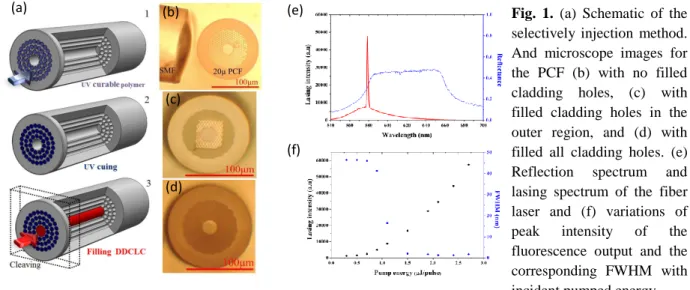
In this paper, we selectively inject DDCLC into the hollow core of the photonic crystal fiber (PCF), as shown in Fig. 1(a)-1(d), and successfully demonstrate an omni-directional band edge lasing emission.
Experimental results indicate that the helical axis of the DDCLC will align perpendicularly to the inner wall of the PCF and thus the lasing emission of the DDCLC within the PCF can be pumped by a pulse laser and measured in radial direction. Since the fluorescence from the DDCLC can be confined and thus enhanced in the PCF by the reflection band of the CLC and the mTIR between the core and the cladding, the lasing emission can be pumped with a low threshold, as shown in Fig. 1(e) and 1(f). A further work about controlling the direction of lasing emission optically based on the DDCLC infiltrated PCF is in progress.
References:
[1] H. Coles and S. Morris, Liquid crystal lasers, Nat. Photonics 4, 676 (2010).
[2] C.-R. Lee et al., Color cone lasing emission in a dye-doped cholesteric liquid crystal with a single pitch, Opt. Express 17, 12910 (2009).
_____________________________________________
Presenting author: Chung-Yueh Chiu; E-mail: [email protected]
* Corresponding author: Chia-Rong Lee; E-mail: [email protected] (b)
(c)
(d)
(a) (e)
(f)
Fig. 1. (a) Schematic of the selectively injection method.
And microscope images for the PCF (b) with no filled cladding holes, (c) with filled cladding holes in the outer region, and (d) with filled all cladding holes. (e) Reflection spectrum and lasing spectrum of the fiber laser and (f) variations of peak intensity of the fluorescence output and the corresponding FWHM with incident pumped energy.