1
行政院國家科學委員會補助專題研究計畫成果報告
※※※※※※※※※※※※※※※※※※※※※※※※※
※
嗜鹼性枯草桿菌株 K-1 的木質素水解酵素特性研究※
※
及基因選殖※
※ Characterization and Molecular Cloning of Xylanases from ※
※ Alkaliphilic Bacillus sp. Strain K-1 ※
※※※※※※※※※※※※※※※※※※※※※※※※※
計畫類別:
þ個別型計畫 □整合型計畫 計畫編號:NSC89-2311-B-038-001-
執行期間:88 年 08 月 01 日至 89 年 07 月 31 日
計畫主持人:曾 銘 仁 共同主持人:潘 扶 明
本成果報告包括以下應繳交之附件:
□赴國外出差或研習心得報告一份
□赴大陸地區出差或研習心得報告一份
□出席國際學術會議心得報告及發表之論文各一份
□國際合作研究計畫國外研究報告書一份
執行單位:台北醫學大學細胞及分子生物研究所
中 華 民 國 89 年 10 月 25 日
2
行政院國家科學委員會專題研究計畫成果報告
嗜鹼性枯草桿菌株 K-1 的木質素水解酵素特性研究及基因選殖
Char acter ization and Molecular Cloning of Xylanases fr om Alkaliphilic
Bacillus sp. Str ain K-1
計畫編號:NSC89-2311-B-038-001 執行期限:88 年 08 月 01 日至 89 年 07 月 31 日
主持人:曾銘仁 執行機構及單位名稱
:台北醫學大學細胞及分子生物研究所共同主持人:潘扶明 執行機構及單位名稱:
中央研究院生物化學研究所計劃參與人員:
蔡佳良,張文輝 執行機構及單位名稱:台北醫學大學細胞及分子生物研究所 一、中文摘要利用凝膠過濾及離子交換層析法可由嗜鹼性 枯草桿菌株 K-1 的培養液純化分子量為 23 及 45 kDa 的兩種木聚素水解酵素。在溫度 37 度,pH 5.8 及 10.5 之間,這兩種水解酵素具有活性。它們能水 解木聚素,產生木聚醣,木聚三醣,木聚六醣,表 示這兩種木聚素水解酵素主要作用於木聚素寡醣 的內在醣基鍵。但這兩種水解酵素有不同作用的方 式,且能相輔相成一起水解木聚素產生單醣與雙 醣。
關鍵詞:木聚素,枯草桿菌株,木聚素水解酵素 Abstr act
Two xylanases from Bacillus strain K-1 were purified to homogeneity by gel filtration and ion- exchange chromatography. These enzymes have molecular weights of 45 kDa and 23 kDa, respectively, and both show stability over the pH range of 5.8 -11.0 at 37°C. These enzymes rapidly hydrolyzed xylan from birchwood to release mainly the products of xylose, xylotriose and xylohexose, thus indicating that the xylanases act preferentially toward the internal glycosidic bonds of xylo-oligosaccharieds. However, the two xylanases show different modes of action, and a combination of both is likely to lead to concerted degradation of xylan down to the mono- and disaccharides.
Keywor ds: Xylan, Bacillus strain K-1, xylanase, enzyme purificationl
二、緣由與目的
Xylan is the most abundant of the hemicelluloses which are heteropolysaccharides having a chain of β- 1,4-linked xylopyranose residues. The complete hydrolysis of xylan requires the combined action of various enzymes such as endoxylanase, exoxylanase (β-D-xylan xylohydrolase), and β-D-xylosidase etc.
Xylanases randomly hydrolyze the β-1,4-glycosidic bonds of xylan to produce several xylo-oligomers. In
recent years, xylanases have received attractable research interest due to their potential industrial applications. However, such applications require xylanase(s) with particular properties, the bio- bleaching of paper pulp requires a xylanase that remains active even above pH 9.0 and lacks all cellulase activity.
The bacterium used in this study, Bacillus strain K-1, was previously isolated from a wastewater treatment plant of pulp and paper industry at Bang- Pre-In at Prankornsriayuttaya province, Thailand.
Bacillus strain K-1 is capable of growth at pH values, ranging from 10-12. Normally growth is at temperature of 370C; the cultures were thermolabile at temperatures above 550C. Moreover, this strain produces two major extracellular xylanases, with molecular weights of 45 kDa and 23 kDa, respectively. No other hemicellulose- degrading enzyme activities were detected in the culture medium with xylan, CMC or avicel as the sole carbon source, suggesting that this strain produces xylanase mainly. The mode of action of xylanase and cellulase has been reported. It was considered that the cellulose/xylan binding domain (CBD/ XBD) was an important factor in the degradation process of insoluble cellulosic materials. For xylanases the concept of substrate recognition and induction, i.e., the control of transcription by the cooperative actions of an activator and a repressor, have generally been accepted. Xylanase synthesis is induced by natural xylan and other β-1,4-xylo- oligosaccharides isomers.
Multiple xylanases are produced by a large number of microorganisms. Several explanations have been advanced to explain these dichotomous patterns: viz (1) they are derived from gene duplication(s) of a polycistron or the products of gene clusters that encode different forms; (2) they result by conversion events occurred during xylanase evolution; (3) they are artifacts arising from the degradation of xylanase in the microbial culture. Though various xylanases have been isolated and characterized none of these proposals satisfactory.
In this report, we describe the purification and characterization of two major xylanases from Bacillus strain K-1 bacteria. These enzymes are active over a wide range of pH. In addition other properties
3 presented here suggest that these xylanases could be of commercial interest.
三、結果與討論
A. Char acter ization of Bacillus str ain K-1: This isolated strain was an aerobic, Gram-positive, rod shape with a terminal spore and was positive for catalase test. Based on its characteristics, the isolate was identified as belonging to the genus Bacillus by the criteria of Bergey’s Manual of Systematic Bacteriology39 and it was also confirmed by CCRC, FIRDI (食品工業發展研究所,菌種保存及研究中心) with the Micro-IS System as Bacillus firmus.
B. Pur ification of xylanases: Bacillusstrain K-1 was grown in Berg’s mineral salts medium for 4 days. Solid ammonium sulfate was added to the culture supernatant to 65% saturation. The precipitate was recovered by centrifugation and dissolved in an appropriate volume of 10 mM Tris-HCl (pH 8.0). The final solution was dialyzed three times against 5 liters of the same buffer for overnight. The dialyzed solution was applied to a DEAE-Toyopearl 650F column previously equilibrated with 10 mM Tris-HCl buffer.
The column was first washed with 10 mM Tris-HCl buffer and then eluted with a linear gradient of 0 to 0.5 M NaCl in the same buffer at a flow rate of 1 ml/min.
The eluted fractions with xylanase activity were pooled, dialyzed to remove any salt contaminants and lyophilized into powder. This partially purified protein was dissolved in 2 ml of 10 mM Tris-HCl buffer and applied onto an TSK-Fractogel 55F column. Elution was carried out with the same buffer containing 0.3 M of NaCl. Two proteins corresponding to molecular weights of 45 kDa and 23 kDa with xylanase activity were purified.
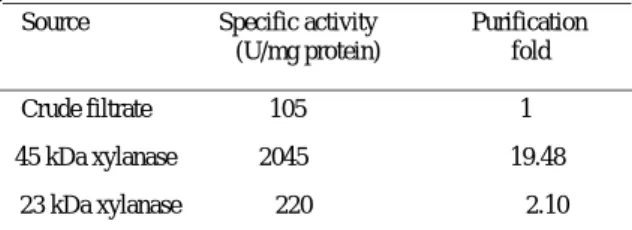
C. Xylanase assay: The assay mixture consisted of 40 µl of enzyme solution and 160 µl of 0.5% birchwood xylan suspension in 0.1 M Na2CO3-NaHCO3buffer (pH 9.0). The reaction was incubated at 37oC for 10 min and 0.4 ml of DNS reagent (1% dinitrosalicylic acid, 0.2% phenol, 0.05% sodium sulfite, 1% NaOH) was added. After boiling for 5 min and adding 2.4 ml water, the absorbance at 500 nm was measured. One unit was defined as the amount of enzyme required to produce reducing sugars equivalent to 1 µmol of xylose per min. The xylanase assay shown the following result: crude supernatant, 105 U/mg protein;
45 kDa xylanase, 2045 U/mg protein; 23 kDa xylanase, 220 U/mg protein (Table 1).
Table 1. Summar y of pur ification of xylanases .
Source Specific activity Purification
(U/mg protein) fold
Crude filtrate 105 1
45 kDa xylanase 2045 19.48 23 kDa xylanase 220 2.10
D. Char acter ization of the pur ified xylanases:
1) Isoelectric focusing of xylanases- Isoelectric focusing was done on PhastGEL IEF (pH 3 to 9) by automatically controlled of PhastSystem (Pharmacia) which shown that purified xylanase was homogeneous. The 45 kDa xylanase had a pI value of 5.8 whereas a pI value of 6.8 for the 23 kDa xylanase.
2) The pH stability of the purified xylanases- Both xylanases showed >50 % of their optimal activities over a wide pH range of 5.8-11.0 at 37°C. The 45 kDa xylanase was slightly more alkaline resistant than the 23 kDa enzyme. With this broad pH optimum, these two xylanases are satisfactory for the criteria in the pulp and paper industry.
3)Hydrolysis of native xylan- In order to better understand the mode of action of the purified xylanases, the hydrolytic products of the insoluble birchwood xylan incubated with xylanases were separated by HPLC and identified by xylose standards and mass spectrometry. As expected, both xylanases effectively hydrolyzed xylan but showed different modes of action. The hydrolysis by 45 kDa xylanase produced mainly the xylotriose and xylohexaose. Under prolonged incubations, a trace amount of xylose was detected. Whereas the 23 kDa xylanase produced only an oligosaccharide derivative of molecular mass of 386.3 which is presumed to be that of a xylo- oligosaccharide with side chains. These data indicating that these purified xylanases were both endoxylanases that randomly cleave xylan as a substrate. It was interesting that co-incubation of the two xylanases with the substrate resulted in the releasing of xylose and xylobiose, and an unknown product with a molecular mass of 375.3.
These hydrolyzed products quite different from the results of individual action of the xylanases, suggesting a cooperative relationship of the two xylanases in the degradation of the poly- saccharide into simple oligosaccharides.
4) Sequencing of N-terminal amino acids- Purified xylanases were subjected to N-terminal microsequencing using automated Edman degradation in an Applied Biosystem model 467A sequencer under standard conditions.
( i) The N-terminal amino acid sequence of 45 kDa xylanase is NDSPFAWSVAKLXXR which showed homology with the N-terminal amino acid sequences of xylanase A of Bacillus sp. C- 125 (10/15 identical) and alkaline thermo- stable xylanase of Bacillus sp NG-27 (9/15 identical) from on-line BLAST search with NCBI and EBI databases.
(ii) The N-terminal amino acid sequence of 23 kDa xylanase is GTYGQYXTDGQGXV.
This protein shown good homology with the N- terminal amino acid sequences following signal peptides of xylanases of Bacillus sp. YA-14 (8/14 identical, 23 kDa), Bacillus subtilis (8/14
4 identical, 23 kDa), Bacillus circulans (8/14 identical, 23 kDa), Bacillus stearothermophilus (8/14 identical, 9/14 similar) and Chaetomium gracile (8/14 identical, 9/14 similar). All these corresponding xylanases with 23 kDa xylanase belong to family G.
These results indicate that the two purified xylanases possess at least a common signal peptide of 28-35 amino acid residues long, as shown by the sequence comparison and the similarity of molecular weights of the xylanases from the compared bacteria. We, therefore, conclude that the purified enzymes were indeed xylanases.
E. Constr uction of genomic libr ar ies of Bacillus str ain K-1: The chromosomal DNA of Bacillus strain K-1 was purified and digested partially with EcoRI or HindIII and the 1-4 kb and larger DNA bands were isolated. Then ligated the purified DNA fragments into EcoRI- or HindIII-linearized pUC18, respectively, and transformed into E. coli XL10-Gold. The tansformants were selected on ampicillin LB plate and collected as genomic libraries. These two genomic libraries are using for the functional cloning of xylanase genes.
F. Char acter ization of a small extr acellular ser ine pr otease fr om Bacillus str ain K-1: In the process of purifying xylanases from the extracellular media of Bacillus strain K-1, we also identified a small protease. Using DEAE-Toyopearl chromatography and C18 HPLC column after ammonium sulfate fractionation purified this protein. The molecular mass of purified protein was estimated by SDS-PAGE and mass spectrometry to be approximately 14.5 kDa which also consisted with the corresponding clear zone on a casein zymogram gel. The enzymatic activity of this purified protease toward azocasein was 895 U/mg protein. The isoelectric point of this protease was determined to be about 6.2. It was stable at a broad pH range of 7.0 to 10.0 and showed its optimal pH of activity at 9.0. PMSF, a serine protease inhibitor, shown 70% inhibitory effect on the enzymatic hydrolysis of azocasein even with the concentration of 0.1 mM. Both the amino acid composition and N-terminal amino acid sequence (GEATYTANLTP WVWP) showed no significant similarity with other known proteases to date. As we know, it is the smallest serine protease that had been reported so far.
四、計劃成果自評
We isolated two xylanases with molecular weights of 45 kDa and 23 kDa from the culture supernatant of Bacillus strain K-1 to homogeneous on SDS PAGE and isoelectric focusing gel. In the past year, we have characterized the chemical and physical properties and the enzymatic activity toward xylan of these two xylanases. All the progress and expected results are in the pace of our proposal. A manuscript entitled “purification and characterization of two cellulase free xylanases from Bacillus firmus” has been finished and being submitted to Enzyme and
Microbial Technology. Another manuscript entitled
“isolation of an extracellular serine protease from an alkalophilic Bacillus sp.” also is in well preparation.
This paper described the isolation and characterization of the 14.5 kDa protease secreted by this bacterium during our preparation of xylanase sample. As we known, this protease was the smallest serine protease that had been reported so far. The DNA libraries of this bacterium were constructed and functional cloning of these two xylanases is being in hot pursuit.
We also used proteomic approach to analyze the secreted proteins from this bacterium with or without xylan induction. Our data have already published in Electrophoresis with the title of “A proteomic analysis of secreted proteins from xylan-induced Bacillus sp.
strain K-1” (see reference 1). This paper demonstrated the proteomic approach is a powerful tool to rapidly study the differential expression of the secreted proteins by Bacillus sp. strain K-1 grown in different culturing conditions.
Overall, we had a fruitful progress with three manuscripts and one of them has already been published. One small blemish is that the cloning of these two xylanase genes still lagged behind. We have already got two genomic libraries of this bacterium constructed and are confident to have these two xylanase genes in near future.
五、參考文獻
[1] Chu, P.-W., Yap, M.-N., Wu,C.-Y., Huang, C.-M., Pan, F.-M., Tseng, M.-J. & Chen, S.-T. (2000) A proteomic analysis of secreted proteins from xylan-induced Bacillus sp. strain K-1.
Electrophoresis, 21, 1740-1745.