國立臺灣大學管理學院企業管理碩士專班 碩士論文
Global MBA
College of Management
National Taiwan University
Master Thesis
印度輕型電動汽車電池交換網絡商業計劃 A business plan to setup battery swap network for
light electric vehicles in India
古安畢 Abhishek Kumar
指導教授:曹承礎 博士
Advisor: Professor Seng-Cho Chou, Ph.D.
中華民國 107 年 12 月 Dec 2018
Acknowledgement
This thesis is a reflection of an ongoing unfolding trend world over on increased awareness on more sustainable ways of living and leaving a better planet earth for future generations. I would like to thank my teachers at GMBA program for their thought provoking class discussions on not only business topics, but how a decision has to be taken in consideration of so many other things not immediately related but which may have significant impact later on. I would like to thank my class mates for many insightful discussions and sharing their experience from their respective industries. GMBA office have been immensely helpful in all aspects, from settling down to academic choices and many other minor aspects that made my life truly memorable and comfortable in NTU and Taipei. I would like to thank Professor Chou for mentoring me for a business plan and teaching how to consider diverse aspects of a business plan and how to make preparations ahead of any contingency. I am very thankful to R Shyam Shankar, Ray Wang and Harshendar Reddy for their fruitful discussion and taking this project in HULT prize competition. I would also like to thank my manager at tsmc, Tony Ku, for his words of encouragements and being kind to my work schedules and various assignments.
Suggestions from mentors in Entrepreneurship course, Dr. Ming Dao and Dr. Kevin for highlighting many real world scenarios to consider without losing focus on one’s own business idea. Last but not the least, this thesis would not have been possible without selfless support from my wife Sunaina who took sole responsibility of our daughter Ananya while I was pursuing GMBA. They will always inspire me to be a balanced individual and take on responsibilities for the greater good.
Abstract
We have been living in a world at a time when unprecedented innovation is happening in all fields of science and engineering. All this development had been possible because of easy and cheap access to fossil fuels, which is used in generation of electricity and fuel the various forms of locomotives for public and private transport. This immense burning of fossil fuels for almost 2 centuries and continual deforestation forever- expanding human footprint on planet earth has started to show visible impact on the climate and ecology in general. More and more people are living in cities and use gasoline based automobiles. Private vehicles like cars, scooters and three wheelers use petrol and diesel while larger vehicles burn diesel. This burning of fossil fuels in the arteries of modern cities have severely deteriorated the air quality in all the cities world over. The problem in Indian cities is even more acute due lack of rainfall for most part of the year except monsoons and presence of very old internal combustion engine vehicles plying for public transport. In recent studies of air quality, 8 out of 10 cities with worst air pollution are from India and the country ranking 177 out 180 nations in air quality metrics worldwide. This alarming situation has forced the government at various levels in India and its citizens to work together and improve the situation. Indians are among the worst affected population with respiratory diseases.
The solution to poor air quality in cities lies in moving from fossil fuel based transport vehicles to electric ones. However, few countries have been able to move away from fossil fuels so far owing to several reasons like unavailability of electric vehicles for the masses, non-existent battery supply and charging infrastructure and lack proper
incentives from government. On top of this, companies of advanced countries in Europe, US, Japan, hold a lot of major intellectual property on electric vehicles and battery technologies Korea etc. making the whole move to electrification of transport vehicles extremely expensive.
The scope of this thesis would be to propose a business plan based on a market study, recent trends in automotive industry in India, understanding pain-points of various stakeholders, develop a marketing strategy and also a financial plan and projections.
Table of Contents
Acknowledgement ... ii
Abstract ... iv
Table of Contents ... vi
List of Figures ... viii
List of Tables ... ix
1. Introduction ... 1
1.1 Recent happenings in EV space in India ... 2
1.2 Methodology ... 3
1.3 Challenges to implementation ... 4
1.3.1 High Cost of lithium ion battery pack ... 4
1.3.2 Poor distribution model ... 5
1.3.3 Trust deficit ... 6
1.3.4 Financial viability ... 6
2. Battery as a Service model discovery ... 8
2.1 Business opportunity Identification ... 10
2.2 Product and service definition ... 14
3. New technologies at a glance ... 17
3.1 Blockchain technology ... 17
3.2 Franchise model of operation in India ... 19
3.3 Fintech revolution in India ... 21
3.4 Cloud storage and computing ... 21
4. Market studies... 24
4.1 Key success factors for EV battery swap business ... 24
4.2 Power sector in India ... 26
4.3 SWOT analysis ... 28
4.4 Porter’s 5-force analysis ... 30
4.5 Comparing battery technologies ... 31
5. The battery as a service business plan ... 33
5.1 Operational plan ... 33
5.1.1 Operational plan with Lithium ion batteries ... 37
5.1.2 Operations based on existence of MRT system in city ... 37
5.1.3 Operation efficiency parameters ... 38
5.1.4 Battery swap kiosk goal with Lithium based batteries ... 40
5.2 Investment plan... 40
5.3 Sales and marketing plan ... 41
5.4 Technology development ... 42
5.5 Organizational structure ... 44
5.6 Economic and Financial plan and analysis ... 45
5.6.1 Profitability Analysis ... 46
5.6.2 Business expansion with cash from operations ... 50
5.6.3 5-Year financial projection ... 53
5.6.4 Calculating valuation of operations under different growth scenarios ... 54
5.6.5 Key Milestones ... 57
5.7 Business exit strategy... 58
6. Conclusion ... 61
Bibliography ... 66
List of Figures
Figure 1: Lean startup methodology for business model design ... 3
Figure 2: System dynamics of OM subscription based EV auto rickshaws in India market ... 9
Figure 3: Sales price prediction of Lithium-ion batteries in 2020 in USA ... 13
Figure 4: Business Model Canvas for OM battery swap for light EV ... 16
Figure 5: OM partners with Blockchain and cloud infrastructure ... 19
Figure 6: Legal framework for Franchising in India ... 20
Figure 7: Star networked central cloud connected Swap stations ... 23
Figure 8: Seasonal power plant load curves for north and south regions in India ... 26
Figure 9: North Indian states power surplus/shortfall situation in 2017-18 ... 28
Figure 10: Monthly Power availibility in Bihar and Jharkhand in 2017-18 ... 28
Figure 11: SWOT framework of OM ... 29
Figure 12: Porter's 5 force framework for battery swap for light EV industry in India . 30 Figure 13: Lead acid battery life enhancement using partial capacity utilization ... 32
Figure 14: Setting up first OM battery swap stations in Patna, Bihar in India ... 33
Figure 15: OM Lead acid battery swap station layout... 35
Figure 16: Typical chances of opening hours, swap load, electricity cost ... 36
Figure 17: Battery Swap station design with security for Li-ion batteries ... 40
Figure 18: Net income under different growth scenarios ... 56
Figure 19: Profit margin under different growth scenarios ... 56
Figure 20: Major milestone targets ... 57
List of Tables
Table 1: Comparison of OM proposal with real numbers ... 7
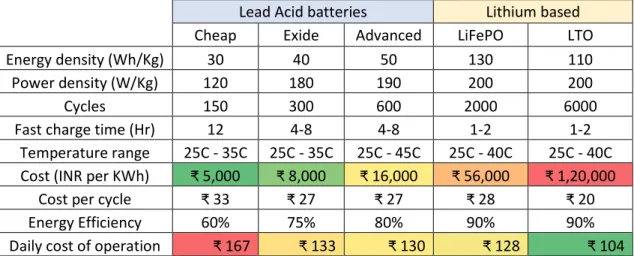
Table 2: Comparison of key battery technologies performance figures available in India ... 31
Table 3: Typical Weekly schedule of employees at battery swap station ... 36
Table 4: Organizational structure of OM Company ... 44
Table 5: Typical technical specifications of batteries to be used in OM ... 45
Table 6: Important survey data collected from current EV auto drivers in Delhi, Patna 46 Table 7: Profitability analysis with various battery types ... 48
Table 8: No. of auto EV subscribers needed to break-even with Li-ion battery ... 52
Table 9: Aggregate profitability computation over 36 months of Lithium based battery swap operations ... 52
Table 10 : Assumptions for Lead acid batteries for start of operations ... 53
Table 11: Forecast of financial performance for 5 years ... 54
Table 12: Swap station growth under different growth scenarios ... 55
Table 13: Calculating stock price based on net income ... 55
Table 14: New capital infusion plan ... 57
Table 15: Milestone details... 58
1. Introduction
There have been tremendous activity going on in the automobile industry owing to Tesla’s aggressive push of electric vehicles in US market. This has accelerated the development of electric vehicles from rest of internal combustion based automobile manufacturers. A very fundamental requirement of electric vehicles is efficient rechargeable battery bank in various aspects like cost of mass production, electrical performance, weight and safety. There are some key factors, which have led to strong push in this direction from private industry:
(a) Air pollution in large cities
(b) Stringent exhaust standards for new vehicles
(c) Geopolitical instability of crude oil producing countries
(d) Large crude oil import bill of developed and fast growing economies (e) Wider climate change acceptance among common public
(f) Rapid decrease in cost of electricity from solar, wind and other emerging renewable energy sources
All these factors have led to consensus among automotive industry players and various governments that everyone needs to work together for a sustainable development and be proactive in controlling greenhouse effect causing gas emissions from burning fuels. Intensity of storms have increased and so have wildfires increased in California [1] . Many glaciers have retreated to record altitudes in Chile, Nepal, on Himalayas and on Alps. When it rains, it causes flooding and landslides. But a lot of areas also face drought like situation. Russia and other Baltic nations are already making sea routes over Arctic
Circle in case the ice does not come back [2]. All these climate observations have also given rise to renewed investment in developing alternative solutions which may help in more sustainable living. Development of electric vehicles, from 2 wheel scooters to 16- wheel long-distance highway trucks as well as fuel cell based trains are in the right direction and need of the hour.
1.1 Recent happenings in EV space in India
India has been among the fastest growing nations in terms of GDP, averaging about 7% for the past 2 decades or so. Owing to its large population, this has very little effect on a per capita basis. There is huge migration of population from villages to small towns and respective capital cities [3]. This has put tremendous pressure on transport services.
Roads are chockful of public and private vehicles during office hours in morning and evening. Spending 2-3 hours in commute to and from office is not uncommon. And all these burn petrol or diesel. This has led to waste of fuel in commute traffic as well as increase in automobile exhaust gas inhalation leading to respiratory diseases. If left unchecked, it will lead to poor quality of life in cities [4] and huge public healthcare expenditure. The central government have vision to allow only electric vehicle sales by 2030. And it also wants to have faster adoption of electric vehicles. Following policy changes have been incorporated in that direction:
(a) Massive installation of solar and wind power all over India [5]
(b) Waiver of electricity transmission charges for wind and solar generated electricity till 2022 [6]
(c) Sharp reduction in of electricity demand and supply from 6% to 0.6% [5]
(d) Aggressive promotion of startups by many state governments in terms of seed funding, working space, mentoring and acceleration to full firm [7]
(e) ISRO licenses its Lithium ion battery patent for INR 1 Crore [8]
(f) Governments lifts license requirement for setting commercial charging stations for EV [9]
(g) India overtakes China in terms of on road electric vehicles in the form of EV auto rickshaws [10]
The above changes have given a lot of confidence in setting up innovative services in emerging technologies in fintech, electric vehicles, healthcare and so on.
1.2 Methodology
The thesis is based on methodologies taught in “Entrepreneurship in Practice”
course for lean startup. It takes following steps:
(a) Business opportunity Identification (b) Product/Service design
(c) Business model design
Figure 1: Lean startup methodology for business model design
The theses also propose stage wise setup and expansion plan along with other key planning in terms of
a. Operation plan b. Investment plan
c. Organizational structure d. Marketing plan
e. Sales plan
f. Economic and financial analysis
The author is also inspired by thesis of R Shyam Shankar titled “Battery as a service for Light Electric Vehicles - A Business case study” [11]. Author wish to highlight some key shortcomings in his proposal and offers a more implementable and financially sustainable business plan.
1.3 Challenges to implementation
The author has observed some key bottlenecks to implement the type of battery swap network as envisioned by [11]. They are elaborated below:
1.3.1 High Cost of lithium ion battery pack
Existing electric auto-rickshaw use 4 lead acid batteries connected in series. Each battery has a rating of at least 100 Ah at 12 volts, weighing 30 Kg. While the vehicle cost about INR 120,000, lead acid battery cost about INR 24,000. The cost of 48V 33 Ah lithium ion battery cost about USD 700 in Taiwan that supports about 3000 cycles of
operation. Government of India imposes 30% import duty and about 18% GST tax on lithium ion batteries. As a result of this, the cost of proposed lithium based battery will cost about INR 190,000 in the rickshaw. We can see that the battery pack cost 58% more than the vehicle itself. There is high possibility that anti-social elements in the society may target the vehicles or swapping stations to steal the batteries and disrupt our business.
1.3.2 Poor distribution model
Driving the batteries are currently envisioned as being charged and given on rent by local shop owners. The local shop owners may have following constraints:
(a) Limited space to keep batteries
(b) Limited electricity consumption allowance due to their location and size (c) Timing mismatch with rickshaw operators
(d) Risk of high heat due charging and high current draw
In addition to above, each ‘charging dock’ may not be able to support more than 10 autos. So there need to be huge network of charging docks. This will severely limit the control of operations and serviceability in the long run. The shop owners may potentially face some loss of business as well as loss of property due to high heat risk. Presence of large number of retail charging docks will also need a lot more redundant and expensive battery for the company. That way, a lot asset will remain idle and severely affect financial sustainability. Since not all EV auto will arrive at the same time to swap their discharged batteries, there is a fair chance to support more autos than no. of batteries in capacity. This will need the battery banks to be more centralized than distributed in small quantities at retails shops.
1.3.3 Trust deficit
In the renting business, one of the biggest issues is of trust. Who will be held responsible if the item being rented gets some damage? What if people take out genuine healthy batteries and replace it with fake and used ones? Who will be held responsible if the auto rickshaw is robbed of the expensive batteries? What if the vehicle motors get some problem due to current surge from the battery? What if there is some unwanted event happens like fire or accident due to slight negligence? What if the battery could not serve the customer due temperature or weather factors and the auto drivers lose their business for the day? All these questions and even more need to be answered before beginning of operations. One solution may be getting some form of insurance from 3rd party insurers. It will need wider ecosystem of independent auditors, insurers, service providers and government to come up with some acceptable solution.
1.3.4 Financial viability
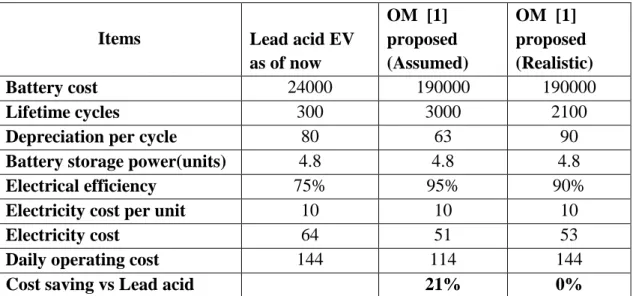
From above discussion, it is clear that a more thorough look into possible implementation is needed. A key variable in cost estimation is life of lithium ion battery in terms of number of charge-discharge cycles. Different manufacturers quote different numbers based on anything from 60% to 85% of full capacity. Also, the temperature variations in Indian cities are a lot more throughout the year. So any technical figure need to be taken with grain of salt and there should be reasonable safety margin in real world results from quoted ones. We have already seen that the proposed battery cost 90% more than the vehicle itself. It mainly due to import duties and shipping charges. Mass
production of local made lithium ion or similar technology batteries have not started yet.
Some are expected to start producing in 2019 onwards in small volumes. It is only in 2020 that we will be able to see large capacity batteries for EV application. Till then, there has to be a backup plan to test the market and justify the battery as service business model.
Items Lead acid EV
as of now
OM [1]
proposed (Assumed)
OM [1]
proposed (Realistic)
Battery cost 24000 190000 190000
Lifetime cycles 300 3000 2100
Depreciation per cycle 80 63 90
Battery storage power(units) 4.8 4.8 4.8
Electrical efficiency 75% 95% 90%
Electricity cost per unit 10 10 10
Electricity cost 64 51 53
Daily operating cost 144 114 144
Cost saving vs Lead acid 21% 0%
Table 1: Comparison of OM proposal with real numbers
As we can see from the table 1, battery lifetime cycles of 3000 corresponds to about 10 years of usage. This may be too aggressive considering that there is wide fluctuation in operating temperatures in India from 2-48 degree Celsius. Taking 2100 as more realistic number for lifetime cycles for lithium ion battery, the assumed cost saving of 21% against lead acid battery operation vanishes complete
2. Battery as a Service model discovery
There has been rapid change happening on the roads of India, particularly north India, in terms of mix of public transport vehicles. There is a big proportion of cars and auto rickshaws on road that cater to shared services like ola and uber. Among auto rickshaws, a big number of them are battery operated vehicles. This has been possible because of low cost of electric vehicles, especially those imported from China.
Furthermore, the government of India has easy loan policy under MUDRA scheme.
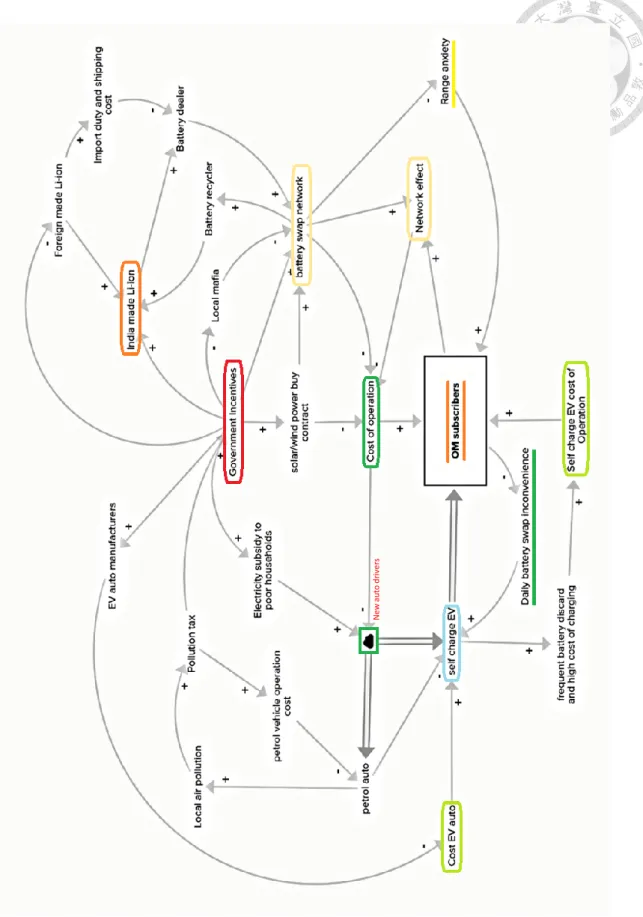
Furthermore, the EV auto buyers get Rs. 20000 rebate on electric vehicles. All this makes a win-win deal for a new auto driver. This also helps reduce carbon dioxide emission in the city to some extent. The interplay of various parties and effects have been captured in figure 2. The author of [11] has done a wonderful job in identifying battery as a service business model. To fully understand the dynamics of various stake holders in the game, we have to understand the system dynamics in EV market for auto-rickshaws. We can see that to get customers for battery subscription, the customer has to be provided with lower cost of operation than his own serviced one, has to see a positive benefit of battery swap network effect and should not feel inconvenience of daily battery swapping. In gist, the auto-rickshaw should not feel his daily business operation disrupted. Instead, he should feel a service that removes some of his pain points and bring reliability in his livelihood. A big factor is production of lithium-based battery in India and Indian government policy to tax foreign sources batteries at very high rate. Overall, there is lot of positive reinforcement going from various directions to make adoption and sustainability of EV based auto a success in the long run.
Figure 2: System dynamics of OM subscription based EV auto rickshaws in India market
New auto drivers
2.1 Business opportunity Identification
With fast growing number of electric vehicles in form of 3-wheel auto
rickshaws, there is a new ecosystem under development to serve them. It is in the form of EV vehicle manufacturing, creating manufacturing supply chain of various spare parts, energy storage in various forms of battery technologies like lead acid, lithium based batteries, even solid state ones. Unlike petroleum based energy storage, electric based solutions are extremely slow to replenish the vehicle with power when it is
“empty”. Hence these is a need of a customized solution or ecosystem to deliver power in a more efficient way. For now, almost all EV auto owners keep a big capacity battery in the vehicle that charge overnight. And they hope and pray that it will be sufficient for whole day of operation and sustain their earning. But all batteries have limited cycles of charging and discharge cycles. And high quality batteries cost a lot that these auto owners don’t have money to buy. As a result, they end up buying cheaper ones and this limits their duration of operation and hence their earning potential. Furthermore, they have to maintain some serious battery charging setup at their home. Most of these auto drivers come from very humble backgrounds. They barely have a house. And only recently, they have got electricity connections but they have limited allowed units of consumption as it is mostly meant for lightening and very low power electrical appliances like fans or computers. Hence, when these auto drivers try to charge their batteries at home, they end up with dispute with power companies. Some charging stations have come up to the auto drivers rescue but they charge a lot for auto parking and charging the batteries. Hence the solution of battery swapping for them. This idea of providing battery as a service is very timely in the context of changing landscape of
Indian automobiles. There are already about 1.5 million EV vehicles running all over India. Having the scale of economies will benefit all players especially in the electricity production, distribution and storage. I will later show how it is economically and ecologically attractive and it has the potential to be the backbone of city transport industry. The value proposition becomes even more attractive at a time when all cities in India have air pollution at a critical high. People are actively making choices that puts them in healthier situations. Many people have chosen to relocate to a city where they get better air quality and better office hour traffic conditions. Sharing cabs or cars has been in practice for more 5 years now in almost all major cities. Wherever possible, people choose to stay closer to their office so that they can either walk or use bicycles to their office. Even companies have offering more “work from home” job offers so that their employees have better time and health management and can spend more time with their families. All these are big changes happening in Indian social and working
mindsets. People are eagerly embracing changes to best suit them. In the same direction of change, EV auto have become very handy in proving last mile connectivity from major metro/train/bus stops to the respective homes or offices.
A key development that encourages the battery swap service model is
availability of electricity for 24 hours in all Indian cities. The central Indian government has managed to bridge the electricity peak hour demand and supply gap to less than 0.6% [5]. This is a huge improvement from more than 6%-12% just 4-7 years back.
Because of this, the batteries can be charged without much interruption and it should not act as bottleneck. To speed up the adoption, the government has also removed specific regulations on setting up of charging and sale of electricity for transport purposes. So
many enterprising individuals may be looking forward to serve in setting up charging or related services.
Economic forces: A key benefit of EV auto operation is freedom from daily fluctuating cost of petro or diesel. In addition, the electricity cost less than half on a per kilometer ride basis. Therefore, a clear economic advantage exists against existing solution. New auto rickshaw drivers are only limited by their available resource in terms of battery charging infrastructure. The reduced cost of operating electric auto rickshaw is highly desired. Moreover, the customer gets to enjoy a cost effective ride to his/her destination.
Social forces: The rapid urbanization has brought in huge population shift. The high population density demands high quality residential homes and neighborhoods.
However, the rapid increase in petroleum-based vehicles has significantly deteriorated the air quality of the cities. Furthermore, high air pollution has caused increase in respiratory related diseases. So all kinds of ecology related media news get disproportionate coverage and this has helped in raising awareness of ecological impacts of burning coal or petrol. People are ready to change their behaviors so that they add as little pollution contribution as possible. Cycling and walking or running to offices are a lot more common sight in many Indian cities now. There are groups who actively encourage and advertise their benefits on social media platform. Ride sharing, less use of private vehicles, increased use of public bus and local metro trains are much more prevalent.
Technological advances: The energy density of lead acid batteries are already able to provide full day ride for most EV based auto rickshaws. The cost of lithium-based
batteries are falling at a rapid pace. In the advanced countries, the cost of lithium ion based batteries are expected to hit $200 per KWh in very near future
Figure 3: Sales price prediction of Lithium-ion batteries in 2020 in USA
However, market prices will vary and be significantly more than this, hitting even $200 per KWh for Indian market will be nothing short of technological miracle. Its
lightweight and much higher energy density can significantly increase the speed, range and weight carrying capacity of the EV vehicle in the cities. As if there is crisis level situation, laboratories and researchers all over the world are constantly improving on energy density and safety of newer storage technologies to serve the electric
automobiles.
Political action and regulatory change: As discussed earlier, the government of India has lifted many regulations on sale of electricity in cities for electric vehicle battery charging purpose. The current government in India under leadership of Prime Minister Mr. Narendra Modi have set very high targets of setting solar and wind power farms all
over the country. They have lifted low powered electric vehicles related licensing and battery technologies from certification and safety audit requirements for less than 250 W motor capacity [12]. The cost of solar and wind power distribution from their source of production is completely being borne by state electricity transmission companies to enable deployment and consumption of green sources of electricity [6]. This loosening of critical regulatory requirements openly invites entrepreneurs to develop innovating solutions in the Indian auto industry and help reduce the pain points of customers and various industry players. All this is driven by acute situation of air quality in Indian cities.
2.2 Product and service definition
The key service being proposed to offer is fully charged batteries on rent to 3 wheel EV auto rickshaws at a reasonable cost with guaranteed state of charge and certain minimum runs in kilometers per day. In India, there are primarily 2 types of auto drivers:
(a) Self-owned EV auto drivers
(b) Auto drivers who rent the EV auto from a fleet operator
The two kinds of auto drives have very different responsibilities in terms of usage, revenue collection, vehicle maintenance and battery charging.
For the self-owned EV vehicle owner, he himself is responsible for raising money from bank loan to buy the vehicle. All costs on vehicles for its maintenance, battery charging, and battery replacement almost every 6 months, parking has to be borne by him.
However, he also gets to keep the full revenue from his customers. Customers mostly pay autos in cash. Some auto drivers have installed PayTm and other debit card or smartphone
payments bank based payment service. This got push due to cash ban of high denomination in 2016 [13] and removal of payment transaction fee for small amounts [14]. They will be the ideal target of battery as a service customer. These are the auto drivers who have to pay good amount of cash to charge and park their EV batteries overnight at high cost. They also face the risk of loss of battery charge holding capacity due to poor battery chargers that are not fully optimized for their battery brand.
For the second target group that rent the EV auto from fleet operators, the situation is very different. These auto drivers are generally the ones who have started running autos very recently and do not have means to buy their own vehicles. Therefore, they rent the EV auto from fleet operator on a daily basis. Major expenses like major vehicle maintenances like battery replacement, motor repair, tire replacement and other big items are borne by the fleet operator. Even battery charging cost is generally borne by the fleet owner. Therefore, there is very little incentive to get the battery charged at own cost as the auto driver has already paid for the cost of the charged battery. However, this is changing in some cities. Some fleet operators reserve the specific vehicle to specific driver if he regularly rents the vehicles. This segment will be potential future target. We also do not know the proportion of these auto drivers.
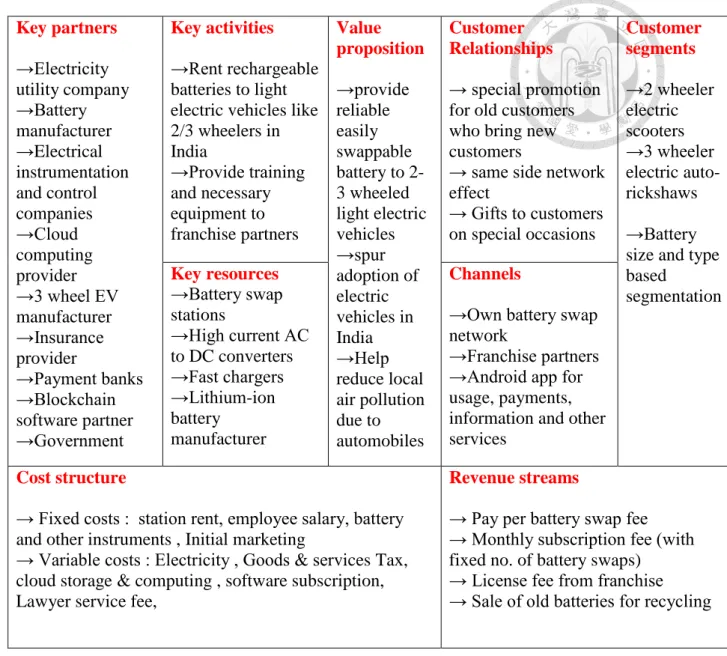
The following business model canvas captures the essence of various aspects of the proposed business plan.
Key partners
→Electricity utility company
→Battery manufacturer
→Electrical instrumentation and control companies
→Cloud computing provider
→3 wheel EV manufacturer
→Insurance provider
→Payment banks
→Blockchain software partner
→Government
Key activities
→Rent rechargeable batteries to light electric vehicles like 2/3 wheelers in India
→Provide training and necessary equipment to franchise partners
Value proposition
→provide reliable easily swappable battery to 2- 3 wheeled light electric vehicles
→spur adoption of electric vehicles in India
→Help reduce local air pollution due to automobiles
Customer Relationships
→ special promotion for old customers who bring new customers
→ same side network effect
→ Gifts to customers on special occasions
Customer segments
→2 wheeler electric scooters
→3 wheeler electric auto- rickshaws
→Battery size and type based
segmentation Key resources
→Battery swap stations
→High current AC to DC converters
→Fast chargers
→Lithium-ion battery
manufacturer
Channels
→Own battery swap network
→Franchise partners
→Android app for usage, payments, information and other services
Cost structure
→ Fixed costs : station rent, employee salary, battery and other instruments , Initial marketing
→ Variable costs : Electricity , Goods & services Tax, cloud storage & computing , software subscription, Lawyer service fee,
Revenue streams
→ Pay per battery swap fee
→ Monthly subscription fee (with fixed no. of battery swaps)
→ License fee from franchise
→ Sale of old batteries for recycling
Figure 4: Business Model Canvas for OM battery swap for light EV
They will be discussed in more detail in following chapters.
3. New technologies at a glance
Past 10 years have seen tremendous growth in the use of smartphone. They are all connected to 3G or better internet connections. The smartphone penetration is more than 80% in India. Even the poor people are able to afford feature smartphone. People are able to check their gps location, able to do online money transfer using smartphones, check wholesale prices of goods, order goods of daily use from E-commerce websites, do social networking. There is also a huge number of payment banks that enable fast payments using wallets. Blockchain is another emerging technology which is finding good traction among technocrats. In the same way, franchise way to expand a product or service to much bigger audience is also gaining momentum. Fintech related service offerings are finding huge acceptance in the Indian context. We will be discussing some of them in the sections below.
3.1 Blockchain technology
Bitcoin has been a known name in media for past few years mainly due sharp rise in value. To mimic them, many more companies, mainly startups, started offering crypto coins similar to bitcoins. Their market size is estimated to be close to US $300 billion.
The underlying technology behind them is called Blockchain [15]. Blockchain technology has following key characteristics that make it very attractive in any kind of electronic transaction like money, messages or even business contracts.
(a) All information is digital that eliminates need of manual documentation (b) It is based on distributed ledger. It means all information is stored on a
network of computers but there is no central authority.
(c) All changes in the ledger are simultaneously updated across the network.
(d) It is Consensus based. Any transaction can be successfully executed only if there is unanimous approval from all.
(e) All information is chronological and time stamped, kept in a form of blocks of data, chained using highly advanced cryptographic algorithms and making it irreversible once a block is added and chained. This is the key property that makes the technology stand apart. It is auditable and the technology can work in real time.
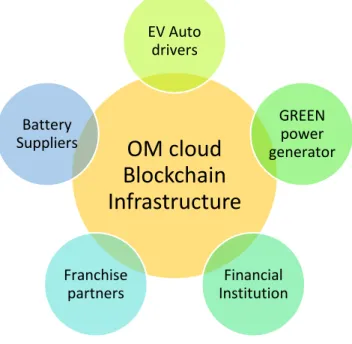
The motivation of using blockchain technology in our battery swap operation is to make it future proof and ability to make it an open platform for energy companies, battery charging stations, auto drivers and the government. This technology will bring transparency and trust for everyone and help the platform to grow faster and remain resilient to hacks and fraud in the long run. However, this will need significant investment for IT infrastructure in the backend and supporting computing hardware requirements at the swap station and each battery level, the author thinks this is way to enter the future.
IOTA is an emerging blockchain technology. There are many projects in trial in the field of payments for electric vehicles based in European countries. We will be in a good position to leverage many of these open source work to popularize the blockchain technology in general. The application of blockchain will enable the customer to be charged only for the portion of electrical energy stored in the battery that he has consumed.
Once this information is encoded in the blockchain, it will be mutually binding on the monetary equivalent for the service to be charged. Blockchain can also be used to track
rate of electricity price at particular time of the day from a specific producer when smart grid is up and running in India.
Figure 5: OM partners with Blockchain and cloud infrastructure
3.2 Franchise model of operation in India
Franchise model is a special type of licensing agreement where the right to use a market proven product or service model supported by intellectual property rights associated with the business model. It is a very good way of expanding a business in relatively short time frame and relatively small capital requirement. The franchisor, one who lends his trade name and the business model, to the franchisee. There is legal and binding agreement to lay royalty fees to the franchisor. The motivation behind this business model is sheer size and diversity of India. Another key factor is local political influence. A business cannot run without involving key local politically influential people.
With franchise, we can get the key people on board as partner, which will not only help
OM cloud Blockchain Infrastructure
EV Auto drivers
GREEN power generator
Financial Institution Franchise
partners Battery Suppliers
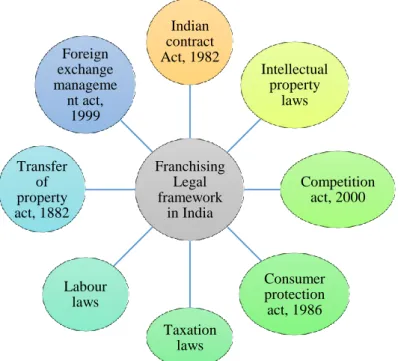
run the business but also help secure the property from local strongmen. This is also necessary, as India is very diverse in terms of language. It will help immensely to work in local language, and make customers feel like getting personalized service.
In India, franchising model of business operation governed by multiple allied legislations that affect the working relationship between franchisee and franchisor [16]. Before opening the business for franchise model, we will need to do these background works:
(a) Prove that battery as a service model works
(b) Secure battery health monitor and tracking intellectual property (c) Build detailed forecast of business expansion and financial returns
(d) Get in agreement with solar and wind power companies for long term electricity purchase in towns and cities
Figure 6: Legal framework for Franchising in India
Franchising Legal framework
in India Indian contract Act, 1982
Intellectual property
laws
Competition act, 2000
Consumer protection act, 1986 Taxation
laws Labour
laws Transfer
of property act, 1882
Foreign exchange manageme nt act,
1999
3.3 Fintech revolution in India
Fintech refers to technologies associated with finance in the space of digital banking and payments, investments in various assets and many more areas. With the democratization of smartphones and mobile internet, it is no longer necessary to visit a bank branch to get banking services [17]. There are ATM machines for cash deposits and withdrawal. All the retail shops accept payments with debit cards. India launched their own RuPay branded payment channel which is much cheaper in transaction cost that VISA/ MasterCard/ American Express cards. Furthermore, many companies are offering wallet and payment services at no transaction cost. PayTm, and almost all traditional banks offer E-wallet service. These new age services do not need cash to be carried and are very safe from hacking and cheating. Going cashless also enables banks to offer loans to customers based on their transaction history and help raise money for important life events. This is very important for self-employed individuals like EV auto rickshaw drivers who are generally at the bottom of social pyramid and have very tough time raising loans for their living. To this end, it is beneficial for both providers and customers of battery swap service to keep all transactions routed through official banking channels.
This will greatly reduce the risk of loss of cash to unscrupulous elements or some employee going rogue. Money at the banks will also help to instill confidence in business partners and battery and other equipment suppliers for long-term relationship.
3.4 Cloud storage and computing
With emergence of cloud based storage and computing, i.e. the computing and storage resources are located at a third party service provider instead of company’s local
premises. They are connected by high-speed internet connections, use state of the art encryption, information security policies, and technologies [18]. In the past 5 years, many large corporations are shifting their compute requirements to cloud so as to bring flexibility and satisfy diverse computing needs spread over large geographies. The cloud- based technologies have brought down the cost of computing and storage a lot more affordable for small companies to start operations and pay only for what they use. This makes it highly attractive for small as well as large companies who always struggle in forecasting their computing needs.
Battery as a service is inherently a retail shop chain spread over wide geographical region. Setting up a secure and large centralized IT infrastructure will be quite expensive and prone to obsoleting every few years due to expanding business and addition of more regions of operation. Since cost of internet communication has dropped down sharply, it makes sense to keep minimal computing hardware in respective battery swap stations, use the fast communication capabilities to store, and retrieve business information. Again, with cloud computing and storage system, the data can be accessed and analyzed from anywhere and should be lot more secure and capable to defend against hacks and disruption of operations. All the software license cost will be flexible and can increased depending upon newer requirements. It also free up a lot of capital from setting private secure networking infrastructure. This can be used to help invest in the core business operations.
Figure 7: Star networked central cloud connected Swap stations
OM Central
Cloud
City1 SWP1
City1 SWP2
City4 SWP1
City2 SWP1 City2
SWP2 City5
SWP1 City6 SWP1
4. Market studies
Automobile industry is undergoing tremendous shift from gasoline and diesel based vehicles to battery based. A key challenge is cost of the vehicle. But the immediate need and demand of general public is clean air in the cities and reduction in global greenhouse gas emissions. India is not completely unaffected with these changes happening in rest of the developed economies. Let us look at them in detail to understand the market for battery based vehicles. The case needs even more thorough understanding of the market as the “customer” in the business proposal lies at the bottom of social pyramid but he forms a very crucial part in mobility of residents of cities.
4.1 Key success factors for EV battery swap business
The first thing we have to understand is the key requirements of the customers. In our case, the auto rickshaw driver run battery-operated vehicle for his family’s sustenance.
The author can envision following key factors needed to serve this customer and make battery as a service a successful venture.
(a) Little difference in amount of time to “Full Tank” as against petrol vehicle (b) Least number of battery swaps
(c) Battery electrical power compatibility with electric vehicle (d) Safe and easy to operate
(e) Ability to monitor remaining battery capacity (f) Swap stations in neighborhood
(g) Mileage consistency on full battery charge (h) Light weight battery
(i) No modification in vehicle (j) Ability to pay in cash
(k) Ability to attract more passengers
(l) No impact of cold or hot weather in vehicle carrying capacity (m) Affordability of service
(n) Ability to raise loans from payments and transactions (o) No disruption in case of power failure on large scale
From operations perspective, the success of the firm has very different requirements.
They are mentioned below:
(a) Ability to negotiate competitive tariff rate from traditional power companies
(b) Ability to buy solar and wind power at affordable rate
(c) Ability to claim tax incentives, various fee waivers like electricity transmission waiver for green power distribution
(d) Provide reliable service standard
(e) Get best in class battery technology at reasonable cost
(f) Convince and redesign EV auto makers to make the vehicle battery swap friendly
(g) Design very reliable (mechanical and electrical), hack proof and cost effective battery monitoring system
(h) Execute corporate social responsibility plans
4.2 Power sector in India
Let us now look at the power situation in India [5]. From 2014 onwards, the government has made tremendous effort in making power plants run at full capacity. The coal fed thermal power plants access to coal from Indian sources have been prioritized.
New power plants based on natural gas and hydel power are under development. At the same time, there has been strong push to commercially install very large solar power farms all over the country. To reduce the consumption of electricity, the central government has freely distributed LED based bulbs to poor sections of society. There is strong push to use efficient water pumps used by farmers for irrigation as they consume free electricity for the most part. There have been campaigns in the media to keep air conditioner temperature to as high as possible to plug possible wastage of electricity. All these factors have led to sharp reduction in energy supply and demand gap. In November 2018, this gap stood at -0.6% which is a huge improvement from more than 4.5% just 4 years back. This has significantly reduced the electricity power cuts or load shedding prevalent in most parts of the country. On an average, cities used to get 20-24 hours of electricity supply while 2nd tier city and towns averaged 12-22 hours. This has been significantly pushed higher even in peak demand time in summers. A typical daily demand curve of electricity is presented below.
Figure 8: Seasonal power plant load curves for north and south regions in India
We can see that there is significant difference in consumption pattern between north and south regions. The pattern also has significant impact of seasons. This pattern has significant impact on pricing of available electricity rate, which varies throughout the day and throughout the year. As the cost of electricity will significantly affect the financial performance of the company, it is envisioned to control the charging of batteries when cost of electricity is least. If feasible, a large resident battery bank can be installed at each battery swap station, which charges itself at cheapest available electricity rate and charges the EV auto batteries when demanded. Though this setup will be expensive to imagine, it may be required in the long run to gain from very low and sometime negative cost of electricity. The key factor will be cost of cheap and efficient large capacity storage battery.
Furthermore, swapping station will be made intelligent enough to enable charging at varying rate depending upon rate of electricity on offer on the supply grid. An efficient algorithm need to be implemented to bring cost of electricity for charging while maintaining availability of fully charged batteries for end customers.
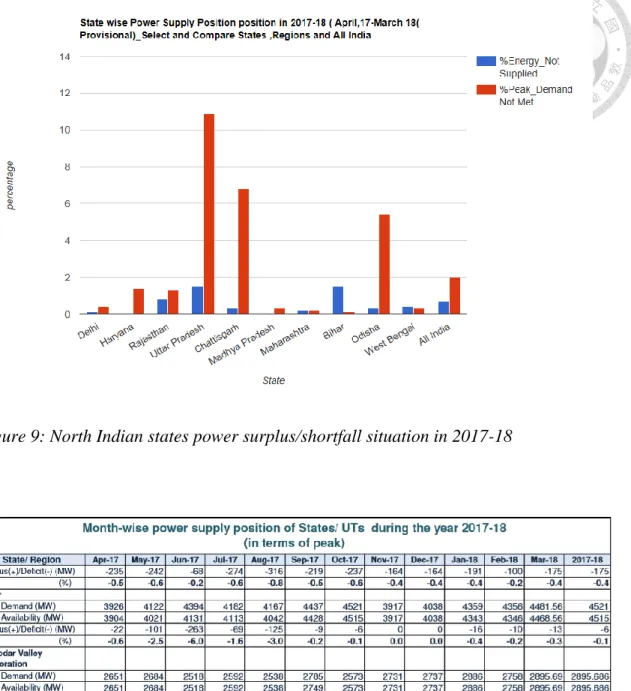
Looking at data from Central electricity authority in India, we can see power situation at state level. We can see that there is wide variation in power peak demand not met situation. Patna is the capital city of Bihar state where power situation looks very promising. The mismatch in demand and supply is less than 1%. For other cities that we will be targeting, we will need to study the exact situation locally and take a call if it is feasible to start the operation
Figure 9: North Indian states power surplus/shortfall situation in 2017-18
Figure 10: Monthly Power availibility in Bihar and Jharkhand in 2017-18
4.3 SWOT analysis
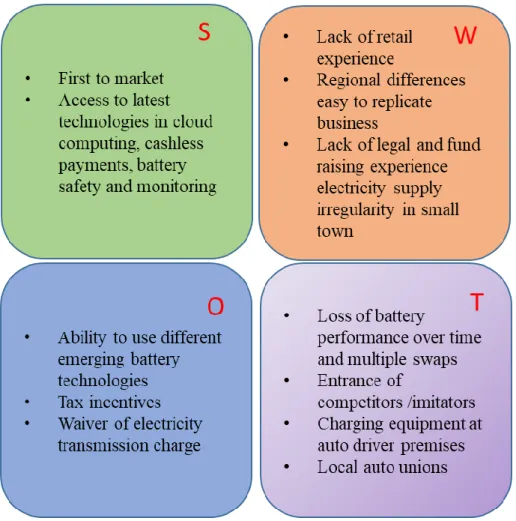
SWOT analysis is a very popular framework in strategic planning and is used to identify strength, weakness, opportunity and threats respectively. Opportunities and
threats are external factors while strength and weakness are internal factors to the firm.
Also, strength and opportunity are helpful factors while weakness and threats are harmful for the organization.
Figure 11: SWOT framework of OM
As we can see from the SWOT matrix, the weakness and threats have to be appropriately balanced with strengths to fully take advantage of first to the market and make way for sustainable and dominating market presence. A key threat is that once auto drivers rent battery, they can also continue to use it by setting up a battery charger system themselves.
This can wreak very significant negative implication on sustainability of our business
model. The auto drivers should be provided some incentive to keep using the subscription without gaming the service offered to them.
4.4 Porter’s 5-force analysis
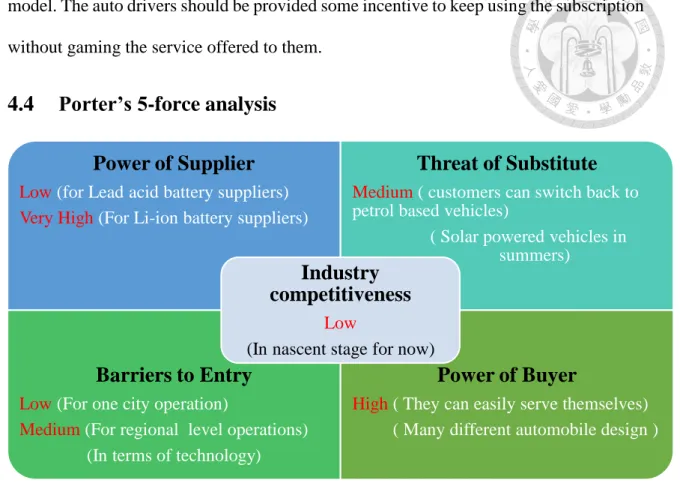
Figure 12: Porter's 5 force framework for battery swap for light EV industry in India
From porter’s 5 force analysis, we see that barriers to entry in this business is low. It is mainly due to the fact that the government has removed a lot of regulations that apply to gasoline based vehicles like safety certifications, pollution check, licenses to sell electricity in form of charged batteries or charging stations etc. Significant barriers exisit in the form of cost, technology and mass manufacturing capability of Lithium ion batteries or other high energy battery forms within India. Some companies like Exide and Munoth industries will start production in 2019 in small scale. Automotive grade lithium ion batteries are still expected to be imported from China, Japan , Taiwan or Korea well into 2020 or so. Because of large import duties, it becomes very expensive to make sense.
Power of Supplier
Low(for Lead acid battery suppliers) Very High (For Li-ion battery suppliers)
Threat of Substitute
Medium( customers can switch back to petrol based vehicles)
( Solar powered vehicles in summers)
Barriers to Entry
Low(For one city operation)
Medium(For regional level operations) (In terms of technology)
Power of Buyer
High( They can easily serve themselves) ( Many different automobile design )
Industry competitiveness
Low
(In nascent stage for now)
This acts as a natural barrier for large scale lithium ion battery based subscription business model in india.
4.5 Comparing battery technologies
Below is a table of conventional lead acid and lithium-based batteries available in India.
All figures are approximate as all available products perform around the figures in the table. Lithium batteries cost have import and shipping component into it. Lithium batteries will have significant cost per cycle advantage over lead acid based once they start being manufactured in India and match cost and quality.
Lead Acid batteries Lithium based
Cheap Exide Advanced LiFePO LTO
Energy density (Wh/Kg) 30 40 50 130 110
Power density (W/Kg) 120 180 190 200 200
Cycles 150 300 600 2000 6000
Fast charge time (Hr) 12 4-8 4-8 1-2 1-2
Temperature range 25C - 35C 25C - 35C 25C - 45C 25C - 40C 25C - 40C Cost (INR per KWh) ₹ 5,000 ₹ 8,000 ₹ 16,000 ₹ 56,000 ₹ 1,20,000
Cost per cycle ₹ 33 ₹ 27 ₹ 27 ₹ 28 ₹ 20
Energy Efficiency 60% 75% 80% 90% 90%
Daily cost of operation ₹ 167 ₹ 133 ₹ 130 ₹ 128 ₹ 104
Table 2: Comparison of key battery technologies performance figures available in India
The most important factors to look is daily cost of the respective battery technology. We can see that LTO is the most cost efficient available technology but it is also the most expensive one. Current cheap lead acid batteries used in the EV auto industry is cheap but very inefficient in terms of electricity utilization and cost per cycles. So there exist an
opportunity to offer cost saving by a big factor provided the cost associated with import of lithium based batteries can be overcome. Temperature of operation can play a significant role in India, as it is most hot weather except for 2-3 months. A strategy to overcome this limitation is to enclose the batteries within temperature-controlled environment. It should be a must requirement for Lithium based battery but no economical for lead acid battery because of their volume and poor energy density.
To enhance the life, we will restrict upper and lower 10% of battery charge capacity out of customer usage. This will not only add life to lead acid battery but also save lot of capital investment. A
Figure 13: Lead acid battery life enhancement using partial capacity utilization Typical operation conditions with existing Lead acid battery
Upper charge limit = 100% Lower charge limit = 2% to 5%
Battery life = 6 months
Upper margin
Lower margin
Upper margin
Lower margin
OM operation conditions with existing Lead acid battery
Upper charge limit = 90% Lower charge limit = 10%
Battery life = 7-9 months (Expected)
5. The battery as a service business plan
We now have almost all the information needed to come up with the various aspects of the battery as a service business plan. The figures provided in various sections are approximate figures obtained during one on one meetings to gather market data.
5.1 Operational plan
The most important aspect of the business plan is to start slow and small and learn the operational and customer issues in the real business environment. We plan to start the operation in a city with about 1000-5000 EV auto rickshaw in operation. Possible target cities may be Patna, Varanasi, Kanpur, Raipur etc. In the beginning, 2-3 battery swapping stations will be opened using Lead acid batteries.
Figure 14: Setting up first OM battery swap stations in Patna, Bihar in India
Initial target market share within 6 months is 10% i.e. about 100-500 customers in the form of EV auto rickshaws. This way, we will test the market of its potential as need of battery as service. The capital requirements will be minimal and loss of any battery can be tolerated. In addition, it is envisioned to have 1/3rd capacity of daily battery capacity requirement. We will learn the tradeoff between convenience and cost in this phase.
Having one third battery capacity will bring the battery weight to about 45 Kg. and its cost to about Rs. 12000. The reduction in weight will enable the auto to run more than 1/3rd of its expected full charge run or enable the auto to carry an extra passenger of extra weight in the vehicle. Each of the swap station should have enough batteries to support at least 50 autos. All payments will either be cashless, through payment wallets or debit cards. Long-term power buying agreements will be signed with power supply companies.
Preference will be given to green power generation companies to drive cost of electricity down and project a clean air future to potential customers riding the EV autos. Services of independent security provider will be taken to secure the battery swap stations on a 24X7 basis. To employ at these premises, young unemployed educated youth proficient in local language as well as proficient in English/Hindi will be chosen. He/She will be trained to be efficient in various aspects like – maintaining the premises, right way to put batteries for charging, installing charged batteries in EV auto, taking payments, various electrical and fire safety procedures in times of emergency etc. The minimum area of the swap station should be about 50 square meters. They will be rented for 1 year to begin with. Once it is found that the swapping station location suits the auto drivers, it can be converted into 3-5 years long contracts of tenancy. A typical floorplan of the swap station premises is shown below.
Figure 15: OM Lead acid battery swap station layout
The workday will start from 5 AM and last till 9 PM. In total of 16 hours of operating day, it will need to have two shifts of 8 hours each. Employees as per their convenience and timings of lean EV auto customer arrivals will set lunch, dinner and tea timings. It is expected that three employees should be enough to provide service for each shift. A security guard will accompany them at all times. One Security personnel will also be employed when the station has closed operations for the day. Security personnel will hold the keys of the premises. He will open the premises when support staff arrive at 5 AM, close it at 9 PM, keep the keys, and keep handing over it to the next security personnel on duty. A typical day’s operating hours are shown below. It is estimated that due to availability of wind and solar generated power, noon electricity cost will be somewhat cheaper than peak. However, overnight electricity cost will be much cheaper due little
residential demand. It may further vary based on local climate conditions and part of region in India.
Figure 16: Typical chances of opening hours, swap load, electricity cost
A weekly schedule employees working at swapping stations is shown as below:
Mon Tue Wed Thur Fri Sat Sun(OT) weekly
Emp1 1 0 1 0 1 0 1 0 1 0 1 0 1 0 7
Emp2 1 0 1 0 1 0 1 0 1 0 1 0 1 0 7
Emp3 1 0 1 0 1 0 1 0 1 0 1 0 1 0 7
Emp4 0 1 0 1 0 1 0 1 0 1 0 1 0 1 7
Emp5 0 1 0 1 0 1 0 1 0 1 0 1 0 1 7
Emp6 0 1 0 1 0 1 0 1 0 1 0 1 0 1 7
Sec1 1 0 1 0 1 0 1 0 1 0 1 0 1 0 7
Sec2 0 1 0 1 0 1 0 1 0 1 0 1 0 1 7
Table 3: Typical Weekly schedule of employees at battery swap station
0 0.2 0.4 0.6 0.8 1 1.2
1:00 AM 2:00 AM 3:00 AM 4:00 AM 5:00 AM 6:00 AM 7:00 AM 8:00 AM 9:00 AM 10:00 AM 11:00 AM 12:00 PM 1:00 PM 2:00 PM 3:00 PM 4:00 PM 5:00 PM 6:00 PM 7:00 PM 8:00 PM 9:00 PM 10:00 PM 11:00 PM 12:00 AM
Chance
Time of the day
A typical operating day
OM swap station opening slots Auto rickshaw busniess hours Battery charging Normalised Electricity cost
Each day is divided into 2 shifts. Each employee will work for 6 days or as mandated by labor laws. For simplicity, the schedule has been developed with applicability of over- time labor. Security will be provide even in non-operating hours.
5.1.1 Operational plan with Lithium ion batteries
The operational plan with lithium ion batteries remains similar except for a few things:
(a) 2-3 times more autos can be supported from 1 station (b) Each battery will get lighter and compact
(c) Cost of electricity will get 2-3 times than lead acid operations (d) Manpower can be reduced to 1 for operation and 1 for security
Hence, it may be required to invest in some cheap energy storage technology that stores electricity at hours of cheap availability. This can be operationalized when the lithium based efficient batteries start being manufactured in India for electric vehicles segment.
Furthermore, since lithium based batteries are a lot more compact and lighter than lead acid based, it may be desirable to design a kiosk of special EV batteries. Gogoro swappable batteries at kiosk are a good example in that regard.
5.1.2 Operations based on existence of MRT system in city
Most of the Indian cities are connected by Indian railways train network. Most of the large cities with population bigger than 10 million usually have their own intra-city metro or local train system. These cities include Delhi, Mumbai, Kolkata, Chennai etc. However, most other cities only have local bus public bus network for transportation. Because of this difference, the operational plan need to be different if it has a metro system.
City with MRT operational plan: In this city type, most people will commute long distance using metro rail system or long distance buses due to their cost efficiency.
Almost nobody will travel on an auto rickshaw from one part of the city to another. Hence, in this type, the MRT train station will be a very important nodal point to set up battery swap station, as people will need auto for last mile connectivity to their home or offices.
A few battery swap stations will be opened between two MRT stations to enable service in interior parts of the city. Ideally, each MRT battery swap station will be supported by 4-6 more swap station in the interiors parts to complete the presence. It is to be noted here that operational cost in this type of city will be higher due to prime location.
City with no MRT operational plan: In this type of city, we will need to identify major transit points within the city. It can be major traffic junctions, railway station, business districts or some tourist hotspot. In this type of city, the battery swapping stations can be more evenly distributed around the city. It would be possible to find a spot which good visibility for auto drivers as well as not expensive in real estate rent. EV auto will need full city coverage for battery swap operation.
5.1.3 Operation efficiency parameters
There will be a number of operational parameters that will be closely tracked for company’s efficiency of operations. Some of them are listed below:
I. Time to exchange battery (Take discharged battery from auto -> scan in to swap station -> pay for charged battery -> verify battery charge status -> Put charged battery in auto)
II. Subscribers per swap station
III. Average revenue per subscriber IV. Revenue per swap station
V. Battery swaps per subscriber VI. Battery swaps per swap station VII. Electricity units per subscriber
VIII. Revenue per Electricity units for a swap station IX. Average battery capacity per swap station
X. Ratio of subscribers to battery per swap station
XI. No. of New subscriber, total subscribers, active subscribers, subscribers leaving per city
XII. No. of battery failures per station XIII. Reasons of battery loss of performance XIV. Average remaining life of battery in a station
XV. Average remaining state of charge of returned batteries
XVI. No. of calls from stalled vehicles with no remaining battery charge while in operation
XVII. Average cost of battery pack + monitoring electronics XVIII. Average cost of electricity per units
5.1.4 Battery swap kiosk goal with Lithium based batteries
Figure 17: Battery Swap station design with security for Li-ion batteries
5.2 Investment plan
The initial investment outlay has to be done on a personal capacity. However, it will be only 20% of capacity needed to start operations. The major fixed assets that need to procured are battery 33Ah-12V lead acid battery, 0.3C Lead acid battery charger of very high efficiency, Point of Sale (POS) devices, air conditioner for humidity and temperature control in summers, trolleys to transport batteries, high quality battery SOC (state of charge) meters, safety electrical power switches, fire extinguishers, computers for premise security and IT requirements, security camera etc.
For 2-3 premises, the quantum of investment is detailed in financial planning section.
All equipment will be bought on volume contract basis with at least 1-3 months of no interest payment period. Recently, the central and state governments are ready to provide seed capital for innovative startups. We hope to get support from government. However, it is understood that any investment from governments will seriously affect the private operation of the company in future in terms of shifting head office, raising funds from private equity firms or venture capital houses.
A key decision in investment is stage wise investment in 6 months to 3 years. A rough plan is scheduled as below:
(a) Start: Invest in 2 stations at 20% of full capacity with Lead acid batteries of 33 Ah capacity
(b) 3-6 months -: Raise station capacity to 100%
(c) 1-2 years: Start operations in 10 more cities. Start looking for franchise partners. Start transition from lead acid to India made lithium ion batteries after at least 1 year of operation in the city with franchise partners.
(d) 2-5 years: Expand to all India operations
5.3 Sales and marketing plan
A key pain point of existing EV based auto drivers is loss of battery charge capacity every 6 months. We will target those drivers who are about to buy a new battery for their auto. They will need to pay a caution deposit to get the membership of battery subscription. The company will have a logo sticker with hologram and RFID. This will bear company brand image and service offering. It will be put on front of auto rickshaws