國立臺灣大學管理學院資訊管理學系 碩士論文
Department of Information Management College of Management
National Taiwan University Master Thesis
大規模開放式線上課程之定價與多元化策略 Pricing and Diversification of
Massive Open Online Course Platforms
李維哲 Wei-Che Lee
指導教授:孔令傑 博士 Adviser: Ling-Chieh Kung, Ph.D.
中華民國 106 年 7 月 July, 2017
謝辭
很榮幸能夠在極富熱誠和抱負的指導教授孔令傑老師的引領了我享受充實 的碩士班生活。這段日子裡,我學到的不僅是老師課堂上的資訊經濟和統計資料 分析以及老師推薦的最佳化和賽局理論,更是在每次大大小小的開會中老師對研 究的認真執著和努力不懈的態度。老師對我們的期許也成為我一路成長最大的支 持和能量,讓我突破自我挑戰自己。碩一時的資訊經濟讓我們投稿決策分析研討 會並且上台發表,累積我的研究能力,也開啟了碩士班研究的第一步。碩二開始 研究論文,很感謝老師在研究架構上的指引、推導過程的指點,以及耐心地逐字 審閱論文語句,帶領我一路從論文口試走到 PACIS 亞太資訊系統年會,開拓我 的視野。另外也很感謝老師讓我有機會參與臺大開放式線上課程和 Coursera 的資 料分析專案,讓我對開放式線上課程這個熱門的議題,不僅有論文上的研究,也 有對資料的分析和實作呈現的學習。此外也特別感謝我的口試委員,工管所郭佳 瑋教授和國企所陳聿宏教授,在口試時給予我許多讓論文更臻完善的建議。
當然,也要謝謝我的家人,支持我就讀碩士班,在背後給我最大鼓勵和能量。
感謝臺大給予我豐富的環境,讓我接觸到許多珍貴的人事物,豐富我碩班的學習 生活。感謝冠宇學長、何禾學姊、偉宏學長與騏瑋學長,幫我指引出碩班研究之 路的明燈。感謝同屆的實驗室夥伴們,在研究的路上互相扶持和成長。謝謝珮瑜 和千瑜在我們碩一時一起征服 PACIS 研討會。謝謝怡安在碩一時當助教時的協 助。謝謝韋志、柏宣和宸安的各種帶領,讓日子過得快樂又有深度。感謝學弟妹 敬傑、佩蓉、子翔和鑑霖,每次的互動都讓我有所學習。在這個即將揮別校園生 活的時刻,特別要感謝一路走來重要夥伴,珮瑜。謝謝妳這些年的陪伴,很開心 我們能相互扶持一起順利地完成碩士班。讓我們繼續一起奮鬥,一起成長。
李維哲 謹致 于臺大資訊管理研究所 民國一百零六年七月
中文摘要
近年來大規模開放式線上課程(MOOCs)在高等教育領域受到極大的關注。
此類型的平台在這幾年如雨後春筍般的蓬勃發展,提供全球各所知名大學傳授高 品質學習內容至世界各地。然而,平台的生存必須確保其財務的持續性,故其定 價策略值得我們探討。我們好奇定價策略是否會損害課程的多樣性,例如:證書 購買率較低的課程是否會被排擠而消失。因此,我們採用賽局理論來研究平台之 定價策略,探討學習者和大學之間的互動和策略選擇。大學會考慮競爭強度,並 根據證書價格和平台決定之證書收入分潤比例,決定課程品質以吸引學習者。
在本篇研究中,我們發現,無論是高證書購買率或是低證書購買率之課程,
在平台發展的整個生命週期中,無論平台發展成熟度和大學之間競爭強度如何,
都將會存在,而其中一個原因是因為平台為了獲取收益會給予大學足夠誘因開設 所有類型的課程。我們還發現,當大學之間發生競爭時,高品質課程的數量會隨 著平台發展成熟度的上升先增後降,這是因為當平台發展進入成熟期時,其中一 所大學會因為競爭過度激烈而沒有誘因提供高品質的課程。我們還發現,大學的 製課成本和聲譽的差異將導致不同類型的課程的高品質課程數量出現落差。我們 還探討學習者時間有限的狀況之大學的最佳策略選擇,並且發現如果低證書購買 率課程的支付意願與高證書購買率課程的支付意願夠接近,能減輕不同課程類型 之間的競爭造成的損失,增加大學在平台上開設高品質的課程的誘因。
關鍵字:大規模開放式線上課程、定價策略、多元化、多邊平台、賽局理論
Thesis Abstract
Massive Open Online Courses (MOOCs) have recently received a great deal of attention in higher education. MOOCs demonstrate universities’ efforts in offering high-quality digital learning materials to everyone in the world, which should be encouraged. Nevertheless, as a MOOC platform must ensure its financial sustainability, it is questionable whether a platform’s profit-seeking pricing strategy will hurt the diversity of courses, such as eliminating courses with low certificate purchasing rates. To address this question, we adopt a game-theoretic framework to model the interaction and strategic choices of a MOOC platform, learners, and universities. Based on the certificate prices and revenue sharing ratios chosen by the platform for courses with various certificate purchasing rates, universities consider the competition intensity and decide their course quality levels to attract learners.
We conclude that all types of course in terms of certificate purchasing rates will exist in equilibrium throughout the lifecycle of a MOOC platform, regardless of the technology maturity and competition intensity. We also find that the number of excellent courses first increases then decreases in technology maturity when there is competition among universities. This is because the intense competition in the mature period makes one of the universities find herself suboptimal to offer an excellent course. We also find that the difference in effort level and reputation between different course types on the platform will lead to the gaps of equilibrium quality level among different types of courses. We also investigate the presence of busy learners and observe that a large willingness-to-pay of low-conversion-rate courses can somehow alleviates the disadvantages of competition between different course types brought by the presence of busy learners.
Keywords: Massive Open Online Courses (MOOCs), Pricing, Diversification, Multi-sided Platforms, Game Theory
Contents
1 Introduction 1
1.1 Background and motivation . . . 1 1.2 Research objectives . . . 3 1.3 Research plan . . . 4
2 Literature review 5
2.1 Massive Open Online Courses . . . 5 2.2 Network externality . . . 8 2.3 Market of higher education . . . 10
3 Model 13
3.1 Players and decision sequence . . . 13 3.2 Market segmentation and assumptions . . . 16 3.3 Lifecycle of MOOCs . . . 17
4 Analysis 21
4.1 Equilibrium analysis . . . 22
4.1.1 Start-up period . . . 22
4.1.2 Expansion period . . . 23
4.2 Discussions and implications . . . 24
5 Competition between two heterogeneous universities 27 5.1 Players and decision sequence . . . 27
5.2 Market segmentation and assumptions . . . 28
5.3 Lifecycle of MOOCs and the four periods . . . 31
5.4 Equilibrium analysis . . . 33
5.4.1 Start-up period . . . 35
5.4.2 Growth period . . . 36
5.4.3 Expansion period . . . 37
5.4.4 Mature period . . . 38
5.5 Discussions and implications . . . 40
6 Presence of busy learners 45 6.1 Players and decision sequence . . . 45
6.2 Market segmentation and assumptions . . . 47
6.3 Extended expansion period of MOOCs . . . 49
6.4 University’s best responses . . . 50
6.5 Discussions and implications . . . 51 6.5.1 Impact of revenue sharing ratios . . . 51 6.5.2 Impact of the proportion of busy learners . . . 54
7 Conclusions and future works 59
7.1 Conclusions . . . 59 7.2 Future works . . . 60
A Proofs of Lemmas and Propositions 63
Bibliography 73
List of Figures
3.1 Decision sequence. . . 16
3.2 Market segmentation under partial coverage with one university. . . 17
3.3 Lifecycle of MOOCs for the type-j course. . . . 18
5.1 Market segmentation under partial coverage. . . 29
5.2 Market segmentation under full coverage. . . 29
5.3 Lifecycle of MOOCs for the type-j course assuming θ1jα2j > θ2jα1j. . . . 31
5.4 Corner solutions in the expansion period. . . 38
5.5 Corner solutions in the mature period. . . 39
5.6 The change of the number of excellent course in t (case 1). . . . 41
5.7 The change of the number of excellent course in t (case 2). . . . 42
5.8 The gaps of equilibrium quality level between types H and L when αiL > αiH. 42 5.9 The gaps of equilibrium quality level between types H and L when θiH > θiL. 43 6.1 Extended expansion period of MOOCs with busy learners. . . 50
6.2 Impact of wH and wL: θH> θL with relatively large θL. . . 52
6.3 Impact of wH and wL: θH> θL with relatively small θL. . . 53
6.4 Impact of wH and wL: θH< θL. . . 54
6.5 Impact of r: θH> θL with relatively large θL. . . 55
6.6 Impact of r: θH> θL with relatively small θL. . . 56
6.7 Impact of r: θH< θL. . . 57
List of Tables
3.1 List of decision variables and parameters. . . 20
Chapter 1
Introduction
1.1 Background and motivation
Massive Open Online Courses (MOOCs) have recently received a great deal of attention in higher education. The scale and openness provide a new approach for expanding access to higher education and allow higher education institutions to enhance their reputation internationally. It has grown into a thriving battleground for prestigious universities com- peting with each other regarding reputation and course quality by putting elite courses on MOOC platforms. The rapid expansion of MOOCs has sparked considerable inter- est in the higher education market, leading to springing emergence of MOOC platform providers such as Coursera, edX, and Udacity.1
Coursera is one of the most popular MOOC platforms in the world. As a for-profit company founded in 2012 by two Stanford Computer Science professors Daphne Koller
1https://www.coursera.org/; https://www.edx.org/; https://www.udacity.com
and Andrew Ng, it currently has over 1600 courses in 10 subjects from over 140 insti- tutions, including computer science, mathematics, business, humanities, social science, medicine, engineering. edX is a non-profit and open source MOOC platform founded by Massachusetts Institute of Technology and Harvard University in 2012. It offers online courses from worldwide universities and institutions. Currently, there are a total of 30 subjects and over 950 courses including computer science, biology, engineering, architec- ture, data science, literature, social science, and more from about 106 institutions. Udac- ity is another for-profit initiative founded by Sebastian Thrun, David Stavens, and Mike Sokolsky with investment from venture capital offering computer science, programming, and related courses by industry giants Google, AT&T, Facebook, Salesforce, Cloudera, etc. Nevertheless, these three platforms all provide free access or audit alternatives.2
The most common revenue stream for a MOOC platform is to charge fees for cer- tificates. Some other sources include selling learner information to potential employers or advertisers, fee-based assignment grading, access to the social networks, etc. As for cooperating universities, they may receive a proportion of revenue from the certificate fee and other value-added services for learners. For example, Young (2012) reports that Coursera shares 20% of gross revenue from certificates to partners. Partners may receive 6% to 15% of revenue for each career introduction by Coursera Career Services. edX also shares a proportion of revenue to their partners when total revenue goes beyond a threshold (Kolowich, 2013).
Currently, by November 2016, Coursera earned over 600 thousand course certificates,
2https://www.coursera.org/; https://www.edx.org/; https://www.udacity.com. Retrieved on June 13, 2017.
and edX reached over 840 thousand certificates (Coursera, 2016a; edX, 2016). However, the profit models of these platforms are yet to be confirmed. Most of them are still following the common approach of Silicon Valley start-ups by receiving investment from venture capital. The sustainability issue and profit model are still big concerns for most MOOC platforms. Moreover, it is also questionable whether a platform’s profit-seeking pricing strategy will hurt the diversity of courses, such as eliminating the courses with low certificate purchasing rates throughout the lifecycle of MOOCs.
1.2 Research objectives
As far as we know, there are quite a few studies discussing the business model of MOOCs, but rare of them adopt a theoretical framework to investigate the platform strategy. In this study, we present a game-theoretic model of the market for MOOCs. We assume that there are multiple types of course on the platform, some types are more attractive for learners to buy certificates while some types are not. In other words, we assume that the conversion rates of some types are naturally higher than the conversion rate of low type.
The conversion rate somehow implies the spirit of free access of MOOCs. The learners do not need to pay for auditing the MOOCs, but only need to pay for the certificates.
There may be multiple universities competing with each other, and there may be learners who are different in the amount of time to be spent on taking MOOCs. The platform decides the revenue sharing ratio and certificate price for each type of course. Universities then choose the quality of each type of course to maximize its utility. Under this setting, we investigate the platforms strategic pricing choice, platforms profit, and the induced
course offering strategies of universities and course quality levels in equilibrium.
1.3 Research plan
In the next chapter, we review some related works with respect to MOOCs, network externality, and market of higher education. In Chapter 3, we develop a game-theoretic model to describe the competitive relationship among universities with different compo- sitions of the course in terms of quality and effort level. The platform’s strategic choice of certificate prices and revenue sharing ratios for coordinating supply and demand is also formulated. Analysis is discussed in Chapter 4. In Chapters 5 and 6, we extend our model to discuss the competition between two heterogeneous universities and the presence of busy learners. Conclusions are in Chapter 7. All proofs are in Appendix.
Chapter 2
Literature review
2.1 Massive Open Online Courses
Massive Open Online Courses (MOOCs) are online courses aiming at unlimited partic- ipation and open access via the web (Kaplan and Haenlein, 2016). Introduced in 2008 and emerged as a popular mode of learning in 2012, MOOCs have become a popular ap- proach to learning nowadays. In addition to traditional course materials, many MOOCs provide interactive in-video quizzes and forums to support community interactions among students, professors, and teaching team. Yuan and Powell (2013) point out that the de- velopment of MOOCs is rooted within the ideals of openness in education, knowledge should be shared freely, and the desire to learn should be met without demographic, eco- nomic, and geographical constraints. Yuan and Powell (2013) show that there are many factors which influence learners’ motivation to participate in MOOCs. These include the future economic benefit, development of personal and professional identity, challenge and achievement, enjoyment, and fun. Surveys conducted by researchers at Duke University
show that fun and enjoyment were selected as important reasons for enrolling by a large majority of learners, followed by relevance to study subject and benefits to job career, etc. (Belanger and Thornton, 2013). By October 2013, Coursera enrollment surpasses 5 million, while edX had independently reached 1.3 million (Fowler, 2013). Dellarocas and Van Alstyne (2013) indicate that education is the latest industry to face digital dis- ruption. Industries like music, movies, and news have already built platforms that offer free service and information to attract users and their activity. These digital platforms monetize eyeballs, comments, referrals, and relationships based on two key ideas: charge for complements and charge a different group with interdependent demand. The former stressed value-added services, technical support, and consultancy to teach people how to fish so that people are willing to pay for the services; the latter explains that digital plat- forms would charge the group with interdependent demand. For example, TripAdvisor offers free advice to travelers and charges airlines and hotels. LinkedIn offers many free services to job seekers and charges recruiters. They expect that the digital revolution in the education industry will produce new business models and enormous social value in our increasingly connected world.
There are several studies discussing the business models and value propositions of MOOCs. Most of them hold the skeptical attitude towards the monetization of their busi- ness model. Baker and Passmore (2016) propose four pricing strategies: cross-subsidy, third-party, freemium, and nonmonetary. Under the cross-subsidy strategy, the costs of the platform are paid by using revenue earned from some other products or services.
Under the third party strategy, the third party, i.e., commercial radio or advertiser, cov- ers some or all costs of the platform. Under the freemium strategy, MOOC enrollment
is free. However, to receive a premium, the MOOC participant must pay. Under the nonmonetary strategy, MOOCs can be viewed as gifts, freely given. However, such an act of altruism is difficult to imagine in a climate of cost-consciousness. Belleflamme and Jacqmin (2016) propose five potential monetization strategies: certification model, freemium model, advertising model, job matching model, and subcontractor model sus- tained based on the theory of multisided platforms. The most sustainable approach seems to be the subcontractor model which allows MOOC platforms to deliver innovative educa- tion to universities, and sell made-to-measure training programs to the private company.
Burd et al. (2015) state that MOOCs potentially challenge the traditional dominance of higher education providers. The benefits for students include reduced education costs and global access to exclusive institution courses and instructors.
However, the benefits for institutions are less clear as there is a financial overhead required to develop and deliver content that is suitable for mass student consumption.
The opportunities could be linking students to employers, offering certificates, blending face-to-face courses, and targeting future students. In addition, this paper holds that prestigious universities will retain the traditional degree and offer certificates of comple- tion on a course-by-course basis, while other universities will trade these certificates of completion for course credits in long-term survivability. Nevertheless, the feasibility of monetization of MOOC business is still in the air where opportunities and challenges coexist.
2.2 Network externality
In general, network externality, also called network effect, can be defined as a effect that there are many products for which the utility that a user derives from consumption of the good increases with the number of other agents consuming the good (Katz and Shapiro, 1985). In Armstrong (2006) and Rochet and Tirole (2006), we can see two forms of network externality: same-side and cross-side. Same-side network externality indicates that an increase in usage or increase of the group size on the platform benefits the users on the same side. This usually happens in a one-sided market where the volume of transactions realized on the platform depends only on the aggregate price level. As for cross-side network externality, the net utility on the one side increases with the number of users on the other side. This usually happens in a two-sided market as one in which the volume of transactions between groups depends not only on the overall price level but on the size of another group. Therefore, cross-side network externality is considered to be an important property of a two-sided market.
When it comes to monopoly platform cases, Armstrong (2006) develops an optimal pricing function similar to the Lerner index to depict how the price elasticity of demand and the network externality affect the platform’s pricing strategy. When the price elas- ticity of demand is high, or the effect of network externality is strong, the platform will lower its price at any cost to attract agents as more as possible to join the platform. Hagiu (2009) introduces the consumer preferences for variety and finds that higher consumer preferences for variety lead to less substitutable among producers and greater market power of producers. The platform can then obtain more surplus from the bilateral in-
teraction. The optimal pricing strategy is able to extract a larger share a profit from the producer than the consumer. Jing (2007) discusses how network externality affects the pricing of monopoly platform regarding vertical differentiation in quality. This paper shows that when there is network externality, the best vertical differentiation strategy is to provide the highest and the lowest quality products. The lowest-quality products are used to amplify the market base, while the highest-quality products are the main- stream of profit. When the network externality is stronger, the platform should reduce the price of the lowest-quality product even lower than the cost, and improve the price of the highest-quality product for profit. Rochet and Tirole (2006) develop a mixed model combined with these two types of charging method. In the beginning of this paper, they define the two-sided market in which they consider a platform charging per-interaction charges to the buyer and seller sides, and making the aggregate price level as a constant value. If the volume of transactions realized on the platform varies with the price for the buyer, then the market is two-sided. Similar to Armstrong (2006), the pricing function is also analogous to Lerner index. Finally, given that the market is two-sided, this pricing function could be applied to the pure membership charges, the pure usage charges or mixed of them. That is, the platform could maximize its profit by manipulating the prices for buyer and seller.
When it comes to duopoly platform cases, Armstrong (2006) depicts a duopoly plat- form with a two-sided single-homing environment. It concludes that neither of the two platforms would like to price too high in case of agents join the rival platform. Further- more, they even find that the platform can increase its profit by using two-part tariffs charging method (charge fixed and per-transaction fees at the same time) so that there
is no incentive for the platform to undercut its rival on either side of the market. Hagiu (2009) points out that there exists an additional motivation for lowering prices to con- sumers. Undercutting the rival platform and thereby stealing some of its consumers drives some producers away from it, resulting in even more consumers stolen, and so on.
However, if consumers possess a higher preference for product variety, which means that producers possess higher market power, or producers have higher economies of scale in multi-homing, which means that the indirect competitive efficiency operating through price for consumers, it is possible that that platform will have smaller consumer price cut in equilibrium.
Despite the fact that there are different conclusion regarding different network exter- nality settings, there is no doubt that network externality plays a crucial part to study the rapid proliferation of platform economy. In order to better clarify the competition be- tween the types of course to produce by two universities, we leverage network externality to explain universities decisions in our study.
2.3 Market of higher education
Since that the sustainability of the business model of MOOCs remains unknown, we look to the profit model and tuition settings for traditional higher education.
Arcidiacono (2005) addresses how changing the admission and financial aid rules at colleges affects future earnings. The author constructs a structural model of the following decisions by individuals: where to submit applications, which school to attend, and what field to study. The model allows the monetary returns to different majors to vary with
college quality and observed and unobserved ability. In the model, college quality serves as a consumption good so that high ability individuals may have preferences for particular majors independent of effort costs. The model also includes decisions by schools as to which students to accept and how much financial aid to offer. This paper provides the first step to understand how both admissions and financial aid rules affect colleges’ expected future earnings. Epple et al. (2006) present an equilibrium model of the market for higher education. Their model simultaneously predicts student selection into institutions of higher education, financial aid, educational expenditures, and educational outcomes.
Their model gives rise to a strict hierarchy of colleges that differ by the educational quality provided to the students. Their model defines the quality of college as a function of student ability level, expenditure per student, and mean income of student, and then defines college cost function as a function of the size of the college and expenditure per student. The decision problem of a college is to maximize their quality subject to their profit constraints and budget Constraints. Colleges seek to maximize the quality of course in consideration of its reputation. In equilibrium, the reservation price functions of each college and their beliefs about student matriculation must be consistent with utility maximization and the actions of the other colleges.
These studies have disclosed the decision procedure for the higher education market.
The spirit of pursuit of quality is consistent throughout these papers. They provide comprehensive study about the higher education market competition. However, to our best knowledge, there is no research adopts a theoretic model to study MOOC business.
We plan to deliver new managerial insights to complement the study in the management of modern higher education.
Chapter 3
Model
3.1 Players and decision sequence
University and courses. Consider an MOOC platform (it) and a university (she),
offering MOOCs. We assume that there are two types of courses on the MOOC platform, the high type and low type, where the high-type one has a higher conversion rate and the low-type one has a lower conversion rate. The high and low type will also be denoted by types H and L, respectively. She may offer both types of courses. The two type-j courses, j ∈ {H, L}, differ in their conversion rate, i.e., the proportion of auditing learners that will purchase the certificate. We assume that the conversion rate of the type-j course is aj − bjpj, where aj > 0 and bj > 0 are all exogenous parameters for j ∈ {H, L}. We assume that under the same price p, the conversion rate of the high-type course is higher than that of the low one, i.e., aH− bHp > aL− bLp for all p≥ 0.
University’s decisions. University needs to determine the quality of its type-j
course to find a balance between the benefit and cost. The benefit consists of two parts, the reputation earned from learners who audit the course and revenue shared by the platform from learners purchasing the certificate. We represent the reputation as njqj, the number of auditing learners nj times the course quality qj. This captures the fact that more reputation can be earned if more learners audit the course, but the reputation is really high only if the course quality is high. The revenue earned by the platform is (aj − bjpj)pjnj, where pj is the certificate price of the type-j course and aj− bjpj is the corresponding conversion rate. Given the revenue sharing ratio wj set by the platform, the university’s revenue from certificate sales is (aj − bjpj)pjwjnj. Finally, as quality is costly, the university pays a cost αjq
2 j
2 , where α > 0 is an exogenous parameter scaling the cost, and the quadratic form is chosen for tractability.1 Collectively, the utility function of the university is
uUj = njqj + (aj− bjpj)pjwjβnj −αjqj2
2 , (3.1)
where the parameter β adjusts how the university weighs the reputation and revenue.
Upon observing wjs and pjs, the university then chooses its course quality levels qj ∈ [0, 1]
to maximize its utility, where qj = 0 means not offering the course and qj = 1 means offering the best possible course.
Learners’ decisions. We model the preference attitudes with a Hotelling line (Hotelling, 1929). Consider the type-j course. Let the university locates at 0, the end- point of a line segment [0, 1], and xj be a learner’s location in respect to course j, his
1It can be shown that our major findings will be qualitatively unchanged as long as the cost is an increasing and convex function of qij.
utility of taking type-j course is
uSj = θjqj− txj (3.2)
where t > 0 is the “transportation cost” in the Hotelling line model, measuring learners’
preference over the course, and θj is the learners’ willingness-to-pay for a unit of quality of the type-j course. As higher θj makes type-j course attract more learners, θj is also considered as the university’s authority in the field of the course of type-j. The type- xj learner will choose to audit the type-j course, or not to audit the type-j course to maximize his utility, where the utility of the last option is normalized to 0. For high-type courses, we adopt the same setting.
Platform’s decision. To optimize its decision about the certificate prices pjs and revenue sharing ratios wjs, the platform must first conduct an equilibrium analysis to predict the consequence of its decision. After the prediction about the course qualities qj and learner size nj is done, the platform’s problem is to maximize its profit.
πPj = (1− wj)(aj − bjpj)pjnj, (3.3)
subject to the constraints wj ∈ [0, 1] and pj ≥ 0, j ∈ {H, L}. Note that nj depends on the university’s choices of qj, which depends on the authority of the university θj, the course development cost αj, and competition intensity (the smaller the t, the stronger the competition), etc. The platform would take these factors into consideration to set the two pricing variables wj and pj to induce desirable equilibrium behaviours chosen by the universities.
Decision sequence. The sequence of events is depicted in Figure 3.1. First, the platform determines the revenue sharing ratio w and the certificate price p for the type-j
course, j ∈ {H, L}. Second, the university observes p and w and chooses its qj. At the end, each learner makes his course auditing choice, the sizes of learners nj are realized, and the platform earns its profit.
Figure 3.1: Decision sequence.
3.2 Market segmentation and assumptions
Market segmentation. After the courses are offered by the university at various quality
levels, each learner independently decides which course(s) to audit. In this subsection, we will derive the learner size of type-j course, nj, as a function of qj, θj, and t.
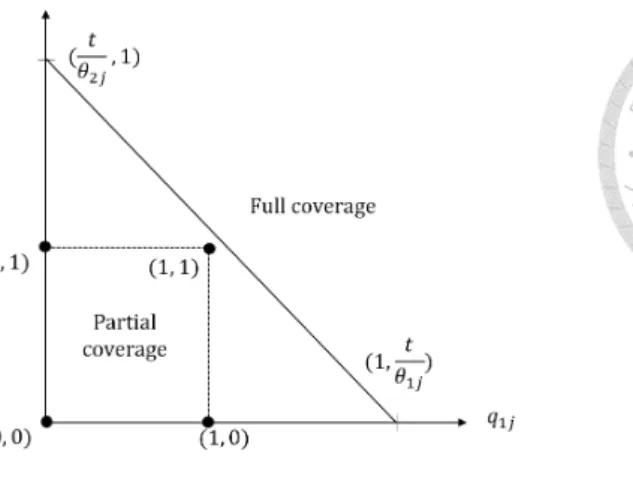
Consider the type-j course. As a type-xj learner sees the two type-j courses, he will be willing to take the course if θjqj − txj ≥ 0, i.e., xj ≤ θ1jtqj. Let ¯xj = θjtqj be the cutoff value. We assume that one university cannot cover all the market, which is ¯xj < 1.
In other words, the market is partially covered, some learners do not take any type-j courses, and nj = θjtqj. See Figure 3.2 for a depiction.
Assumptions. We consider the partial coverage scenarios under some mild assump- tions. We assume that the universities cannot take the whole market even with the best possible course qj = 1. As nj = θjtqj under partial coverage, this means to assume
Figure 3.2: Market segmentation under partial coverage with one university.
t > max(j){θj}.
To facilitate a better understanding, we explain the model by an example. First of all, we can find that the certificate of some types of courses (like machine learning or artificial intelligence) are more popular than some other types of courses (like classic literature or history) on the platform naturally. It has nothing to do with course quality but intrinsic popularity. Therefore, we say that the type with higher certificate purchasing conversion rate is type-H and the type with lower conversion rate is type-L. The learners will choose to audit type-H course like machine learning or type-L course like classic literature independently in the basic model.
3.3 Lifecycle of MOOCs
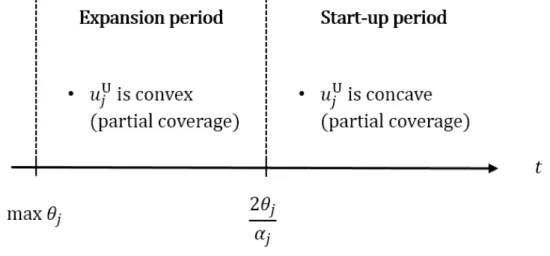
As we mentioned above, the relationship between t and θj has an impact on the equilib- rium market segmentation. Moreover, the value of t also determines whether a university’s utility function with respect to a course is convex or concave. In the basic model, we consider a period called “expansion period” where the utility function of the university is convex, and a period called “start-up period” where the utility function of the univer- sity is concave. the university cannot take the whole market even with the best possible
course qj = 1 (cf. Figure 3.3).
1. In the start-up period, the transportation cost is so high (t > 2θαj
j) that the learner base does not contribute too much for the university. The market is partial covered.
The utility function of each university is concave.
2. In the expansion period, we have max(j){θj} < t ≤{
2θj
αj
}
: The cost is small enough so that MOOCs are accessible to most of the learners, and the university find its utility function convex. However, the market is still partially covered.
Figure 3.3: Lifecycle of MOOCs for the type-j course.
Because of the evolvement of technology and the popularity of MOOC platform, the transportation cost decreases over time, and the lifecycle of MOOCs transits from the start-up period to the expansion period. Continuing from the previous example, as the transportation cost decreases to be less than 2θαH
H, the university’s utility function of offering type-H courses like machine learning changes from concave to convex. Similarly, as the transportation cost decreases to be less than 2θαL
L, the university’s utility function of offering type-L course like classic literature changes from concave to convex.
In the next section, we will first analyze the platform’s pricing decisions in the period and then characterize the equilibrium certificate prices, revenue sharing ratios and course qualities. In Chapter 5, we extend the model to consider two heterogeneous universities competing in offering MOOCs. In Chapter 6, we consider one university in the market where some learners are free and some are busy, and focus on the extended expansion period to avoid tedious analysis. We assume that a busy learner can audit at most one of the type-j course at the same time, while a free learner may audit different type-j course simultaneously. We then combine the analysis of extensions to deliver our main messages.
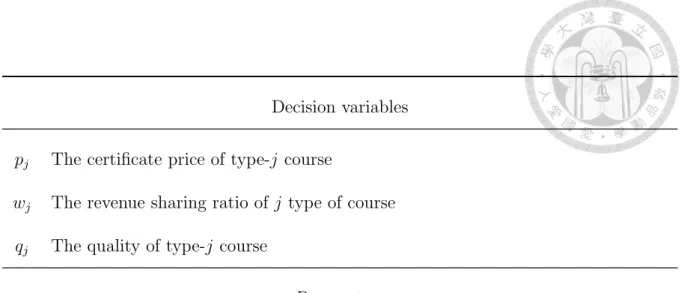
Decision variables
pj The certificate price of type-j course
wj The revenue sharing ratio of j type of course qj The quality of type-j course
Parameters
H High type course (the certificate of this type of course is more attractive) L Low type course (the certificate of this type of course is less attractive) θj The preference of learners of type-j course
θij The preference of learners of type-j course offered by university i
r The proportion of busy learners who can audit at most one of the type-j course t The transportation cost, measuring learner’s preference over the course
nj The number of learners taking type-j course
nij The number of learners taking type-j course offered by university i aj The intercept (base) of the conversion rate of certificate purchase
bj The slope (price sensitivity) of the conversion rate of certificate purchase αj The effort level making type-j course
αij The effort level of university i making type-j course βi The importance level for university i value its revenue
Table 3.1: List of decision variables and parameters.
Chapter 4
Analysis
We characterize the quality qj, revenue sharing ratio wj, certificate price pj, and profit of the platform πjP in equilibrium where j ∈ {H, L}. The implications about market equilibrium and the platform’s strategic choice will then be drawn.
As we mentioned in the model, the learner’s utility taking type-j can be formulated as uSj = θjqj−txj. Under partial market coverage, the size of learner taking type-j course can be calculated as nj = θjtqj. Therefore, the utility of university can be formulated as
uUj = q2j(θj
t −αj
2 ) + qj((aj − bjpj)pjwjβθj
t ) (4.1)
If 2θj − αjt > 0, the university’s utility function is convex; if 2θj − αjt < 0, the utility function is concave.
4.1 Equilibrium analysis
4.1.1 Start-up period
In the start-up period, the transportation cost is so high (t > 2θαj
j) that the learner base does not contribute too much for the university, and the university find its utility function concave. The first-order condition leads to the optimal course quality
qj∗(wj) = max
{(aj − bjpj)pjwjβθj αjt− 2θj
, 1 }
(4.2)
as a function of the revenue sharing ratio. Then, the size of learners nj can be calculated.
The platform’s problem is to maximize its profit by determining wj. Since that qj ∈ [0, 1], we can find out the constraints of wj ∈ [0, 1] accordingly in equilibrium.
Lemma 1. Consider the type-j course. In the start-up period, let B = (a αjt−2θj
j−bjpj)pjβθj. We have
wj∗ =
1
2, if 12 < B B, if B ≤ 12
as the platform’s optimal revenue sharing ratio. The equilibrium qualities are
qj∗ =
qj∗(12), if 12 < B 1, if B ≤ 12 where qj∗(12) < 1.
As not many learners have adopted MOOCs (t is large), the platform should always choose a positive revenue sharing ratio wj to encourage the universities to participate in
the market in the start-up period. In fact, in this period, the demand is so small so that the platform’s optimal revenue sharing ratio may goes up to 12. Half of the revenues may be given to the university. We may also observe that it is impossible for both universities to offer the courses to the highest possible quality. Fortunately, the university will quit and offer nothing. The concavity of her utility function drives them to offer a course, even if the optimal quality is low.
4.1.2 Expansion period
In the expansion period, the university’s utility function is convex, and the market is partially covered because university cannot take the whole market even with the best possible course qj = 1. Therefore, the university will only consider qj ∈ {0, 1} in course offering. It can be proved that qj = 1 will always be the case in equilibrium: As long as the university finds it profitable to offer the course, she will offer the best possible course.
This is summarized in Lemma 2.
Lemma 2. Consider the type-j course. In the expansion period, we have wj∗ = 0 and q∗j = 1 if wj ≥ 0 for all j ∈ {L, H}.
In Lemma 2, even though the platform set the optimal revenue sharing ratio w∗j to zero, the university will still offer the qualities to one because the transportation cost t is low so that it is easy for a university to offer a course to attract many learners.
The university will drive itself to offer the best course regardless of the revenue sharing ratio because the high reputation earned through course offering is good enough, and the platform takes away all the certificate revenues.
4.2 Discussions and implications
Having the equilibrium quality characterized in the previous section, we snow examine the relationships between the transportation cost and the optimal qualities in the lifecycle.
Proposition 1. Regarding the relationship between the transportation cost t and the revenue sharing ratio w∗j in equilibrium:
(a) In equilibrium, wj∗ decreases when t decreases. As the transportation cost decreases, learners adopt MOOCs increases, the platform can decrease the revenue sharing ratio wj∗, and enjoy more revenue itself.
(b) Eventually, as the progress of technology, the transportation cost t decreases, the university can easily attract enough learners. She is comfortable with having no certificate income because the high reputation earned through course offering, and the platform takes away all the certificate revenues w∗j = 0.
Our first finding is regarding how the revenue sharing ratio changes in transportation cost.When t is large, the immaturity of technology development and the unpopularity of MOOCs enforce the platform to adjust the revenue sharing ratio to induce course offering because the platform earns revenue only when universities offer courses. When t is small, the benefit of reputation offering a course is large enough to offer the best possible course, and the maturity of technology development and the popularity of MOOCs allows the platform to decrease the revenue sharing ratio to zero. It is worth mentioned that the university should be aware of the situation when t is small. She cannot count on the revenue sharing from the platform anymore because the platform would take away all the
certificate revenues when the maturity of technology development and the popularity of MOOCs reach a certain level.
Proposition 2. In equilibrium, we have qj∗ > 0 for all j, t. The optimal qualities of both high and low type throughout the lifecycle are positive in equilibrium.
Proposition 3. In equilibrium, q∗j increases when t decreases. As the transportation cost decreases, it is more profitable for the university to offer an excellent course.
Our second and third findings are regarding the whether the diversity of the courses exists and how the course quality changes throughout the lifecycle in equilibrium. As the high transportation cost in the initial period lowers the university’s intention to offer the course, it seems that under some periods some types of course will not be offered. Somewhat surprisingly, we find out that both types of course exist throughout the lifecycle. There is always enough incentives for the university to offer a course given that the platform earns revenue only when the university offer courses. However, as the transportation cost t increases, the number of learners decreases, the university may find it suboptimal to offer an excellent course anymore, and decide to decreases the quality accordingly as the period of lifecycle changes.
Proposition 4. The certificate price p∗j in equilibrium remains the same no matter it is decided by the platform or the university.
As aforementioned, the utility function of the university can be formulated as (4.1).
The utility function is concave in the certificate price pj. After the first derivatives, we can find that p∗j = 2baj
j is always the case. On the other hand, the platform’s profit function can be formulated as Equation 3.3. We can tell that both the university’s and
the platform’s incentives of pricing certificate are aligned with each other in terms of the certificate price term of the university’s utility function and the platform’s profit function, so the certificate price remains the same regardless who the decision maker is.
Chapter 5
Competition between two heterogeneous universities
Consider two heterogeneous universities competing in offering MOOCs. We will remodel the interaction and strategic choices of a MOOC platform, learners, and universities, and elaborate players and decision sequence, market segmentation and assumptions, and lifecycle of MOOCs and the four periods under competition.
5.1 Players and decision sequence
Universities and courses. Consider two heterogeneous universities (for each of them,
she), university 1 and university 2, competing in offering MOOCs. We assume that there are two types of courses on the MOOC platform, the high type and low type, where the high-type one has higher conversion rate and the low-type one. The high and low type will also be denoted by types H and L, respectively. Both universities may offer both
types of courses. To facilitate discussion, we will sometimes call the type-j course offered by university i the course (i, j), i ∈ 1, 2, j ∈ {H, L}. The two courses differ in their conversion rate, i.e., the proportion of auditing learners that will purchase the certificate.
We assume that the conversion rate of the type-j course is aj − bjpj, where aj > 0 and bj > 0 are all exogenous parameters for j ∈ {H, L}. We assume that under the same price p, the conversion rate of the high-type course is higher than that of the low one, i.e., aH− bHp > aL− bLp for all p≥ 0.
Universities’ decisions. The universities’ decisions are almost the same as in the
basic model except that each of the university i needs to determine the quality of its type-j course.
Learners’ decisions. The learners’ decisions are almost the same as in the basic
model except that there are universities 1 and 2 locates at 0 and 1, the two endpoints of a line segment [0, 1], and xL is a learner’s location in respect to course j. We assume that a learner will audit at most one course of each type and may audit two courses of different types simultaneously.
Platform’s decision. The platform’s decision is similar to the one in basic model.
Decision sequence. The sequence of events is the same as in the basic model.
5.2 Market segmentation and assumptions
Market segmentation. After the courses are offered by different universities at various quality levels, each learner independently decides which course(s) to audit. In this section, we will derive the learner size of course (i, j), nij, as a function of qij, θij, and t.
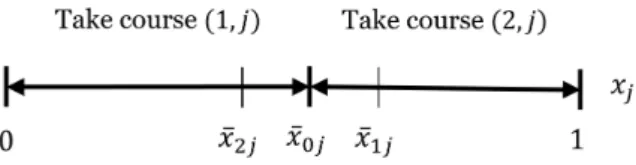
Consider the type-j course. As a type-xj learner sees the two type-j courses, he will be willing to take course (1, j) if θ1jq1j − txj ≥ 0, i.e., xj ≤ θ1jtq1j. Similarly, if θ2jq2j − t(1 − xj) ≥ 0, i.e., xj ≥ 1 − θ2jtq2j, he will be willing to take course (2, j). Let
¯
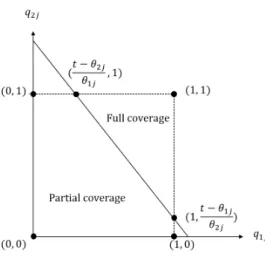
x1j = θ1jtq1j and ¯x2j = 1− θ2jtq2j be the two cutoff values, their relationship determines the equilibrium market segmentation. If ¯x1j < ¯x2j, the market is partially covered, some learners do not take any type-j course, and nij = θijtqij. See Figure 5.1 for a depiction.
On the contrary, if ¯x1j ≥ ¯x2j, the market is fully covered, all learners take a type-j course from one university, and n1j = ¯x0j = 1− n2j, where the type-¯x0j learner is indifferent in taking the course from either university. It then follows that ¯xoj is the unique value satisfying θ1jq1j− t¯x0j = θ2jq2j− t(1 − ¯x0j), i.e., ¯x0j = θ1jq1j−θ2t2jq2j+t. Figure 5.2 illustrates this scenario.
Figure 5.1: Market segmentation under partial coverage.
Figure 5.2: Market segmentation under full coverage.
According to the derivations above, it can be observed that when the market will be partially or fully covered depends on the value of t. When t is large, which means the cost of taking a MOOC is high, it is more likely that the market will be partially covered. As
technology improves and an MOOC platform is more accessible to learners, t will become smaller, and it is more likely for the market to be fully covered. More precisely, the market is fully covered if and only if ¯x1j ≥ ¯x2j, which is equivalent to θ1jq1j + θ2jq2j ≥ t.
Because qij ≤ 1, if θ1j + θ2j < t, the market must be partially covered regardless of the course qualities; if θ1j + θ2j ≥ t, it is then possible for the two universities to fully cover the market of the type-j course.
Assumptions. We consider both the full coverage and partial coverage scenarios
under some mild assumptions. First, under partial coverage, we assume that none of the universities can take the whole market even with the best possible course qij = 1. As nij = θijtqij under partial coverage, this means to assume t > max(i,j){θij}. Second, as the providers of MOOCs are usually prestigious universities and institutions, the cost of offering a course is typically an insignificant part in their annual budgets. Moreover, modern technology has diminished the difficulties to digitalize a course, which also implies that the course development cost is low. As αij is believed to be small, we assume θ1j+θ2j < min
{θij
αij
}
to avoid tedious comparisons that do not generate useful managerial insights.
Continue from the previous example in the basic model, now we have two universities competing in offering a type of course. Consider a type-H course as an example first.
Suppose both university 1 and university 2 offer a type-H course like machine learning. We say that the two universities stand at point 0 and 1 on a Hotelling line. The learners will choose to take university 1’s machine learning course or university 2’s machine learning course depending on the learners’ preference over the two machine learning courses offered by the two universities. Similarly, suppose both university 1 and university 2 offer a
type-L course like classic literature. The learners will choose to take university 1’s classic literature course or university 2’s classic literature course depending on the learners’
preference over the two classic literature courses offered by the two universities. Notice that we consider the competition between the universities offering the same type but not the competition between the two types of courses in this chapter.
5.3 Lifecycle of MOOCs and the four periods
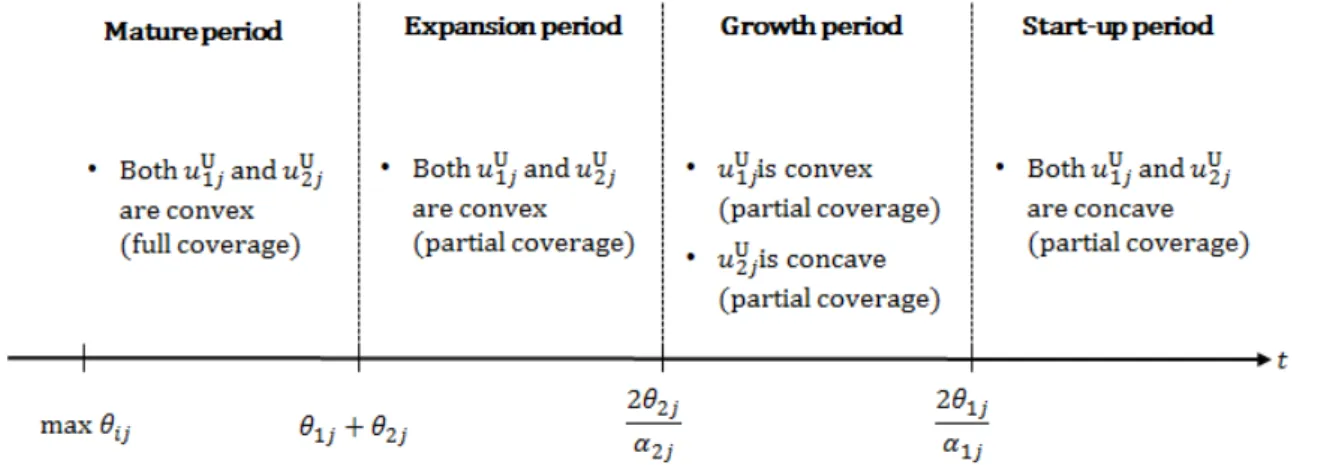
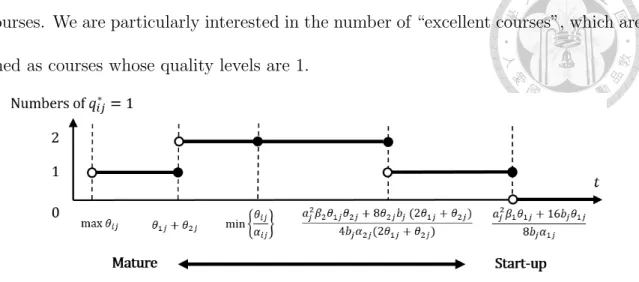
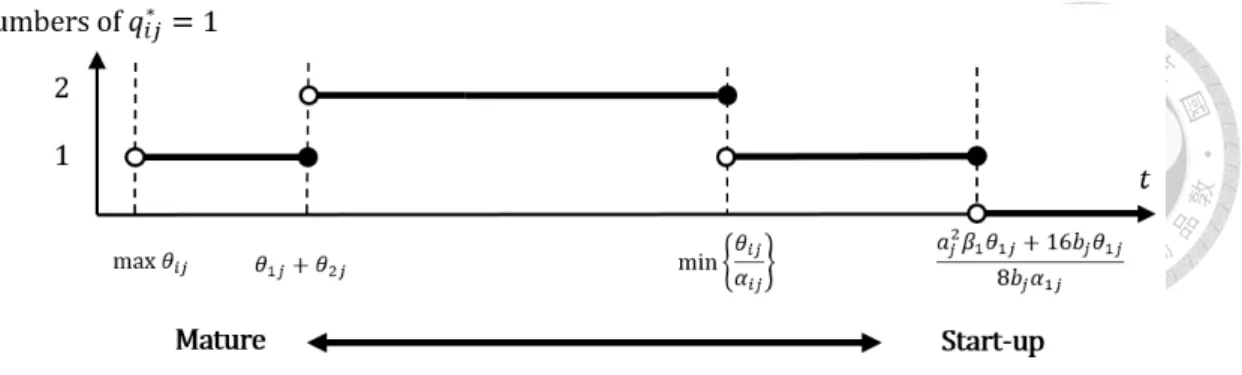
As we mentioned above, the relationship between t and θ1j + θ2j has an impact on the equilibrium market segmentation. Moreover, the value of t also determines whether a university’s utility function with respect to a course is convex or concave (to be detailed below). These two factors drive us to divide the lifecycle of MOOCs into four periods depending on the value of t (cf. Figure 5.3):
Figure 5.3: Lifecycle of MOOCs for the type-j course assuming θ1jα2j > θ2jα1j.
1. In the start-up period, we have max {2θij
αij
}
< t: The cost of taking a MOOC is quite large, both universities find their utility functions concave (and thus are less
willing to offer the course to the highest possible quality level by setting qij = 1), and the market is partially covered.
2. In the growth period, we have min {2θij
αij
}
< t≤ max{
2θij
αij
}
: The cost is still high, but one of the university’s utility function becomes convex. This university will either offer the best possible course (qij = 1) or offer nothing. The market is still partially covered.
3. In the expansion period, we have θ1j + θ2j < t ≤ min{
2θij
αij
}
: The cost becomes lower, MOOCs are accessible to more learners, and both universities find their utility functions convex. However, the market is still partially covered.
4. In the mature period, we have t ≤ θ1j + θ2j: The technology is well developed, platform is robust enough, and universities may attract learners easily. Both uni- versities have convex utility functions, and it is possible for the market to be fully covered.
Because of the evolvement of technology and the popularity of MOOC platform, the transportation cost decreases over time, and the lifecycle of MOOCs transits from the start-up period to the mature period. Continuing from the previous example in the basic model, as the transportation cost decreases to be less than 2θα1H
1H, university 1’s utility function of offering type-H course like machine learning course changes from concave to convex; as the transportation cost decreases to be less than 2θα1L
1L, university 1’s utility function of offering type-L course like classic literature course changes from concave to convex. Similarly, as the transportation cost decreases to be less than 2θα2H
2H, university 2’s utility function of offering type-H course like machine learning course changes from
concave to convex; as the transportation cost decreases to be less than 2θα2L
2L, university 2’s utility function of offering type-L course like classic literature course changes from concave to convex. Finally, as the transportation cost decreases to be less than θ1H+ θ2H, the lifecycle of type-H course like machine learning course transits into the mature period, and the market of type-H course changes from partial coverage to full coverage. Similarly, as the transportation cost decreases to be less than θ1L+θ2L, the lifecycle of type-L course like classic literature course transits into the mature period, and the market of type-L course changes from partial coverage to full coverage.
Obviously, the platform’s optimal pricing decisions may be different from period to period. Therefore, the platform needs to conduct a separate equilibrium analysis for each of the four periods. In the next section, we will first analyze the platform’s pricing decisions in the four periods and then characterize the equilibrium certificate prices, revenue sharing ratios, and course qualities. We then combine the analyses for the four periods to deliver our main messages in this extension.
5.4 Equilibrium analysis
We characterize the quality pair (q1j, q2j), revenue sharing ratio wj, certificate price pj, and profit of the platform πPj in equilibrium under the four periods where j ∈ {H, L}.
We investigate the transportation cost cut-offs between the high type and the low type and their respective quality levels. The implications about market equilibrium and the platform’s strategic choice will then be drawn.
As we mentioned in the model, the utility of learner taking university 1 and university