國立臺灣大學文學院語言學研究所 博士論文
Graduate Institute of Linguistics College of Liberal Arts
National Taiwan University Doctoral Dissertation
泰雅語之事件的概念化與動詞分類
Event conceptualization and verb classification in Squliq Atayal
葉郁婷
Maya Yuting Yeh
指導教授:黃宣範 博士 Advisor: Shuanfan Huang, Ph.D.
中華民國 102 年 8 月
August 2013
誌謝
在這漫長的博士班旅途中,除了知識之外,我更獲得了許多無價的人生經驗,
它們取得自師長們傳授知識時的極為嚴謹、無私卻也願意寬容的態度裡,以及親 人們的溫暖與理解中。
敬愛的黃宣範教授,溫文儒雅的氣質外,更有著淵博的知識,時常提出深具 啟發性的觀點,讓有幸成為他學生的我進行寬廣且深入的思想活動。在其總是細 膩與鍥而不捨的求知態度背後,黃老師讓我理解到每一細微的語言分子都藏有溫 度。雖然非常嚴格,並時時要求我用精準的語言與文字去描述語言現象外,他願 意包容、給予時間等待、願意傾聽並以有溫度的話語鼓勵,讓我深深感謝。每每 閱讀到以上的任一特質,都會讓我心中求知的火苗繼續旺盛著。
敬愛的齊莉莎教授,在接觸語言學之初時,齊老師嚴格地訓練我必須正確地 分析語料,也同樣是採取對待任一語言小分子都得分析正確的訓練方法;這之間,
她給了我很大的空間去經驗無數次的自我訓練,包括其中挫敗,我從這樣的訓練 裡成長許多。除此之外,無論是在知識或是生活方面,齊老師都無私地分享經驗 給我,也確實讓我在快要放棄之際給我繼續前進的能量。
台大語言所的師長們。宋麗梅所長,除了在課堂上有耐心地回答問題外,宋 老師還時時給所上學生打氣並傾聽我們在生活上所遭遇的困難;此外,宋老師也 是我的論文口試老師,她細心地指出論文裡的問題,並給予我明確的修改方向。
蘇以文教授,嚴格地教授知識外,她也用其總是很雍容尊貴的口吻鼓勵著我用自 己的步調紮實前進。張顯達教授,在其很細緻、很有方法地一步步指導學生完成 任一份研究外,過去在所裡的午餐時間,與學生共進午餐,在他的紳士風範前,
讓我們隨興地和他聊聊,此外,他體貼地提醒著我們,做研究之外,也不要忘了 規律運動,讓身心得以健全。江文瑜教授,在立論要有根據的前提下,她鼓勵著 我們做無盡的聯想,這讓學生有機會遇見有趣的議題與靈感,又,其親切的問候 與關心總讓我感到溫暖。呂佳蓉教授,像是姐姐一樣地分享知識與傾聽心聲。馮 怡臻教授,在陽光透進的綠長廊裡給充滿精神的問候。
南島語言學的老師們。黃美金教授老師,對於研究南島語言的後輩總有很深 的期待,除了帶領後輩群進行語言研究的工作之外,更花費很多心力在族語傳承 的社會責任上,那種熱情與精神讓是族人的我深深感謝;此外,她也同樣是我的 口試老師,在百忙之中,細心地閱讀我的論文,並給予我許多可以再進步的批評 與指導,這讓我看到論文的延展性。廖秀娟教授,理性與嚴厲的批評背後只是為 了讓後輩的我成長,除此之外,她還分享了讓人豁然開朗的人生智慧。葉美利教
授,是我的論文提案口試老師,她給予我的許多寶貴建議讓我的論文有機會進入 妥善的境界。其他優秀的師長,吳靜蘭教授、鄧芳青教授、李佩容教授以及湯愛 玉教授等,認真與嚴謹的研究與治學態度之外,還擁有著女性學者的纖細特質,
總是理性地給予我指正與鼓勵。
語言所的學長們。謝富惠教授與 Michael Tanangkingsing 教授,在組裡討論裡 分享成熟的觀點以及謙卑的研究態度,鼓舞了我不少;他們也同樣是我的論文口 試老師,在短促的審閱論文的時間裡,仍提出不少有意義的問題,讓我進行深入 的思辯。黃惠如教授,認真與細心地面對並解決語言學問題的態度,也激勵著我,
是一位很願意分享想法與生活的難得夥伴。
以上,以及我所閱讀過其著作的其他南島語或非南島語語言學學者,都是我 學習的典範,我有幸能感受他們嚴謹且正確的研究精神,讓不成熟的我繼續朝向 智識與心靈上的完滿,並期將他們的精神傳承下去。
除了嚴謹的研究生活外,在台大語言所中,還有許多珍貴的生命體。美玲助 教,擁有美麗的聲音與工整的字跡,在學生事務上協助我逐一完成外,她還會在 適切的時機點給予我受用且理性的智慧。劉姐以及白小姐爽朗的聲音總為語言所 的週間每日帶來朝氣。萱芳與盈潔,成熟豁達的處世態度,是我望塵莫及的。其 他還有見到面就會彼此相互打氣、願意分享生活的學弟妹們,人鳳、國樹、智凱、
Sophia、承諭、玥彤、聖富…等無數,都讓樂學館三樓的曾經與現在充滿生命力。
還有三位因語言學而認識的好朋友,中研院的志憲,年輕卻沉穩,在空閒時輔助 我解決電腦上偶遇的難題。靜靜聽我說話、給我打氣的 Okay。很願意分享經驗給 我的 Eve。
回到生活裡, Lavai、Kiku、Zeze 與 Ludjem 等親密的朋友,對我有所期待外,
也如家人一般地,隨著我的有所得而歡欣,在我沮喪時給予鼓勵。
敬愛的長輩們。Ici’ Tali’姨丈雖早在進入博士班之初就回去做了天上的星星,
與他近五年深入研究泰雅知識時,他溫文謙卑的態度是我學習的典範。Mama’ Yakas 也已化作一顆星,在繁雜的台北街頭熱心地接送我做田調,並熱切地分享泰雅知 識給我。Mama’ Sehu’ Tana’,即使疾病纏身,常告訴我要回家,用其僅剩微弱的語 氣將泰雅的知識與精神傳給我;他疼惜著晚輩,時時提醒我要照顧好身體,雖在 我拿取學位數月前離去化作明亮的星,他仍持續地指引著我。Yata’ Ciwas Batu’,
耐心地教我泰雅語。還有其他在這漫長田調旅途裡,遇到或是相認的長輩,也同 樣用溫和謙卑的態度分享許多知識給我。
敬愛的家人。因我的歡欣而歡欣,因著我的愁而愁、但卻又立即地轉而給予
我心靈與實質的幫忙。公婆、大伯與小叔,願意體諒之外,也會為我任何的求援 而待命。姐姐們/弟弟,有緊密的情感聯繫網,他們在盡心於工作與各自家庭之餘,
願意保留空間疼惜我。敬愛的母親—Hama’ Ihil,除了無時無刻地惕勵我前進,也 給予我心靈上最堅韌與深邃的支持,總是對我說:laxi’ koyey!m’uy=su lga’, usa’
hngaw cikay ha’!敬愛的父親—Hilo’ Tali’給予深遠的關心。敬愛的先生與孩子,一 直陪伴著我,理解、等待與鼓勵著,在取得學位之前的數月身體狀況極不佳時,
盡可能地協助我,無論是用歡笑或是醫療協助。
這是一條讓我理解生命裡自己不可能是孤單一人的漫漫長路,一個個體的茁 壯是無時無刻地都需要來自其他個體的協助。能與以上種種緣的結識,特別是有 幸讀得每一緣裡最美麗的部分,都是讓我得以成長的珍貴養分,在日後因之能更 加精進。感謝這一路上的所有緣。
摘要
這篇論文的目的在於,透過在一個新架構之建立後,對泰雅語賽考利克方言 的動詞進行分類,而這新的架構是根據在 Fillmore (1975, 1976, 1977, 1982, 1985)的框架理論(Frame Theory)、Johnson(1987)的圖示理論(Schema Theory)
以及 Talmy(2000) 的「圖-底」(Figure-Ground)之二分理論上。這些理論都屬於
認知語言學的知識。
如同多數菲律賓語類型的語言,泰雅語的主語可以透過四種語態結構來標示
出,諸如,「主事語態」(AV)結構中要突顯的多是行動者角色的主語;在「受事語
態」(PV)結構中,則是受事者主語;在「處所語態」(LV)結構中,則是要突顯處 所主語;在「傳達語態」(CV)結構中,其主語則是工具或受益者論元;後三種結
構通常一併被歸類在「承受者」(undergoer)語態結構之下。然而,透過自然言談
語料的觀察,我們注意到這些語態結構的諸多複雜性,其複雜性可以從至少兩個 事實中看出:其一,並不是任一動詞的所有三種「承受者標記形式」(UV form),
亦即-un, -an 與 s-等形式,都以相同的認知過程進入所謂的發展成熟之四分語態 系統中;其二,不同的動詞有選用不同承受者來標記承受者主語的傾向。針對第 一個面向,我們發現到,任一承受者形式位置之被填入,至少是要為了表達三種 功能裡之任一或任二種使能進行,包括:(一)、能呈現動詞語意所投射出之「內 在承受者 」(intrinsic undergoer) 與突顯這承受者之 「 承受形式之假定值 」
(default UV form)兩者間之固有關係的功能,(二) 、能反映事件事實性(reality)
之差異或因應不同情境需求去表達所談論之承受者之細微差異等的功能,以及
(三) 、為了標記應用語態(applicative voice)之主語承受者的功能。在這三 種功能之中,第二種功能需要在任一動詞之第一與第三種較基本的功能都確定好 之後,使能進行確認。承此,這份動詞分類研究終究是建立在第一與第三功能之 互有關係的結果上,並且是一份以 UV 形式為根基的分類;此外,我們會發現,動 詞的語意才是決定任一動詞的四種動詞形式之獲得的關鍵因素。
於是,透過檢驗三百餘動詞所反映之事件參與者的空間與概念的相互關係以 及其所呈現的詞法行為(morphosyntactic behavior) ,我將論證,任一動詞的
「內在承受者」(intrinsic undergoer)可以被賦予「圖」(Figure)或是「底」(Ground)
的概念值,並且,這概念值確實會借助各自動詞的「承受形式之假定值」(default
UV form)去顯示其在中性語境裡最為顯著之參與者的地位,這「承受形式之假定 值」(default UV form)與「內在承受者」(intrinsic undergoer)所具備的概念 值之搭配得到的結果,正是任一動詞所屬的類別;因此,在這樣的研究中,我們 區辨出如下五個主要的動詞類別:
第一類:-un 形式動詞類別 (The -un verb class) 第二類:-an 形式動詞類別 (The -an verb class)
第三類:s-形式動詞類別 (The s- verb class)
第四類:s-/-an 形式混成動詞類別 (The s-/-an composite verb class) 第五類:s-/-un 形式混成動詞類別 (The s-/-un composite verb class) 更進一步地,因應著事件在本質上是可以進行抽象的圖示化,我們依據圖示,
再在每一個主要類別之下區分出一至八不等之次類,因此,我們目前得到二十個 圖示;任一的動詞即為所屬圖示的例子。
透過這冗長的研究,我們或能感受或是理解認知語言學學者(諸如,Fauconnier (1985, 1999) 、Lakoff (1982, 1987, 1990) 、Langacker (1976, 1987, 2002) 、Johnson (1987) 、Johnson-Laird (1983) 、 Talmy (1975, 1983, 1985, 1988, 2000) 等等)所堅 持的觀點,亦即,語言是,語言使用者根據其具象的生活經驗後,將這些經驗經 由認知機制的作轉化後、並包含著認知過程中可能做的解釋等種種結果之集合 體,而並不是ㄧ個自我包含、置外於情境的封閉系統。
關鍵字: 底、圖、圖示、動詞類別、內在承受者、承受形式之假定值
ABSTRACT
A central goal of the present study is to develop a novel framework for classifying verbs in Squliq Atayal into various types in terms of Charles Fillmore’s (1975, 1976, 1977, 1982, 1985) Frame Theory, Mark Johnson’s (1987) notion of schemas and Leonard Talmy’s (2000) Figure-Ground distinction-- concepts that are now familiar in cognitive linguistics.
As in many Philippine-type languages, Squliq Atayal has four ways to encode the subject of a verb. That is, Actor Voice (AV) is usually used to encode an actor subject, Patient Voice (PV) a patient subject, Location Voice (LV) a location subject and Conveyance Voice (CV) an instrument or a beneficiary subject. The last three voice types are further grouped into Undergoer Voice (UV). However, a closer scrutiny of naturally occurring data shows that there is a complex reality in the way voice constructions are employed in two aspects. Firstly, not all three UV forms of a verb, i.e.
-un, -an, and s-, are found to fill their respective slots in a so-called full-fledged four-way voice system via equal processing. Secondly, different verb types prefer different UV forms to code subjects. Filling in any UV form slot is contingent on meeting one or two of the three functions: (i) the encoding of an inherent relationship between a verb’s intrinsic undergoer and its default UV form, (ii) the encoding of an intrinsic undergoer for signaling the reality distinction or for exhibiting subtle semantic differences, and (iii) the encoding of an applicative undergoer. Of the three functions, (ii) is far more complex, since all possible conditions are not identified until a decision is made on (i) and (iii). That is, the nature of verb classification investigated in the present study ultimately hinges on interrelated results that derive from (i) and (iii), which is an UV-based classification. Besides, it is now commonplace that the availability of all the four voice forms for a given verb is lexically specific.
It is argued that, based on an examination of the spatio-conceptual relationship of participants in the event a verb encodes and the morphosyntactic behavior of over 300 verbs, the intrinsic undergoer of a verb is assigned either the Figure or the Ground, and a verb has a default UV voice form typically used to make either the Figure or the Ground participant the subject of a clause and thus more prominent. The pairing of the default UV form and the default status of the intrinsic undergoer determines the class of a verb. Five major verb classes are then identified:
(I) The -un verb class: Undergoer as the Figure (e.g., hkani’ ‘search for’, lamu’ ‘pick’, and naga’ ‘wait for’)
(II) The -an verb class: Undergoer as the Ground (e.g., gyah ‘open’, wayaw ‘choose’, and ’luy ‘find’)
(III) The s- verb class : Undergoer as the Figure (e.g., gihu’ ‘turn’, ruruw ‘push’, and tbaziy ‘sell’)
(IV) The s-/-an composite verb class: Undergoer as the Figure specified by the s- form and Undergoer as the Ground specified by the -an form of a verb (e.g., biq ‘give’, paqut ‘ask’, and qapax ‘paste’)
(V) The s-/-un composite verb class: Undergoer as the Figure specified by the s- form and Undergoer as the Figure specified by the -un form of a verb (e.g., kal ‘discuss;
talk about’, and syuk ‘act in turn; retaliate; answer’)
Furthermore, for each of the five major classes identified, further subtypes can be distinguished, depending on the nature of the schematization of events. Specific verbs can be thought of as instantiating specific event schema type. A total of 20 schemas have been identified.
The bulk of the dissertation study is devoted to justifying the ways events are schematized and verbs are classified. To cognitive linguistics (e.g. Fauconnier (1985, 1999), Lakoff (1982, 1987, 1990), Langacker (1976, 1987, 2002), Johnson (1987), Johnson-Laird (1983), Talmy (1975, 1983, 1985, 1988, 2000), and among others),
grounded in embodied experiences, rather than as a self-contained, context-independent system. We hope to demonstrate that the typing of verbs in Squliq Atayal can be shown to be largely grounded in embodied experiences that underpin the various schema types identified above.
Key words: default UV form, Figure, Ground, intrinsic undergoer, schema, verb class
TABLE OF CONTENTS
口試委員會審定書………. i
誌謝………. ii
摘要………. v
Abstract……… vii
Table of Contents………. x
List of Figures……….. xiv
List of Tables………... xv
List of Abbreviations………... xx
Chapter 1: Introduction…..………..……… 1
1.1 Introduction……….………….. 1
1.2 The Squliq Atayal profile………... 3
1.3 The organization of this dissertation ………...…….. 5
Chapter 2: A sketch of Atayal grammar ………... 6
2.1 Introduction……….…………... 6
2.2 Phoneme inventory, syllables structure and stress in Squliq Atayal ... 6
2.3 Morphosyntax in Squliq Atayal …..……….. 9
2.3.1 Word classes………... 10 2.3.2 Constituent order of a basic clause……….………. 17
2.3.3 The Squliq Atayal case-marking system……….………… 21
2.3.3.1 An overview of the previous studies on the case-marking system in Squliq Atayal……….. 23
2.3.3.2 qu’ as a nominative marker………..…………... 23
2.3.3.3 na’/ni’/nqu’ as genitive markers……... 29
2.3.3.4 sa/squ’ as locative markers……... 33
2.3.4 The Squliq Atayal personal pronoun system……….………... 40
2.3.5 Voice and tense/aspect/mood paradigm……….……….. 49
2.3.6 Verb formation processes………. 65
2.3.6.1 Categories and verb-forming affixes………. 67
2.3.6.2 Type 1: Verbal derivatives with a verbal base………... 69
2.3.6.3 Type 2: Verbal derivatives with an adjective-like verbal base... 73
2.3.6.4 Type 3: Verbal derivatives with a nominal base……... 78
2.3.7 Atayal verbal clause patterns………... 84
Chapter 3: The main issues addressed in this study…...………... 100
3.1 Introduction………... 100
3.2 A query about a full-fledged four-way voice marking system... 101
3.3 Verb classification in Atayal based on AV verbs... 107
3.4 Egerod (1965), Rau (1992), and L. Huang (1993): UV verbs in Atayal……… 112
3.5 Chen (2007): Are all -an and s- constructions applicative constructions?... 118
3.6 L. Huang (1993): -un vs. -an………... 122
3.7 Proposal………...…... 128
Chapter 4: Theoretical framework………... 132
4.1 Introduction ………... 132
4.2 Meanings relativized to scenes: Fillmore’s (1976) Frame Semantics... 132
4.3 Language as a schematic system: Johnson’s (1987) Image Schema……... 133
4.4 Grammar as an inventory of symbolic units: Talmy’s Figure-Ground dichotomy……... 139
Chapter 5: Methodology: Event framing and four types of constructions used for verb classification….……….… 148
5.1 Introduction………... 148
5.2 Event framing………... 148
5.3 The blaq UV qu’ O construction…... 149
5.3.1 A constructional analysis of the blaq UV qu’ O construction: A demonstration……….. 151
5.3.2 What the blaq UV qu’ O construction is not……… 156
5.3.2.1 Blaq UV qu’ O construction not serial verb construction (SVC).. 156
5.3.2.2 Blaq UV qu’ O construction not adverbial verb construction (AVC)... 157
5.3.2.3 Blaq UV qu’ O construction not auxiliary verb construction (AuxVC)... 158
5.3.3 The function of the blaq UV qu’ O construction... 160
5.4 Four types of constructions……….... 164
Chapter 6: The -an class………... 170
6.1 Introduction………... 170
6.2 -an verb type (1): [Undergoer as Ground in Placement (Ⅰ) schema]…….…. 170
6.3 -an verb type (2): [Undergoer as Ground in Removal schema] ... 185
6.4 -an verb type (3): [Undergoer as Ground in Indivisibility schema] ... 197
6.5 -an verb type (4): [Undergoer as GroundFigure in Possession schema] ... 204
6.6 -an verb type (5): [Undergoer as Ground in Mediation schema] ... 210
6.7 -an verb type (6): [Undergoer as Ground in Fixedness schema]………... 216
6.8 -an verb type (7): [Undergoer as Ground in Placement (Ⅱ) schema] ………. 221
6.9 Concluding remarks on the seven verb types in the –an class.……….. 226
Chapter 7: The -un class……….……… 229
7.1 Introduction……….………... 229
7.2 -un verb type (1): [Undergoer as Figure in Transformation schema] ………... 229
7.3 -un verb type (2): [Undergoer as Figure in Taking schema] ………. 235
7.4 -un verb type (3): [Undergoer as Figure in Gathering schema]……… 243
7.5 -un verb type (4): [Undergoer as Figure in Causative motion schema] …….... 248
7.6 -un verb type (5): [Undergoer as Figure in Self-moving schema]………..…… 253
7.7 -un verb type (6): [Undergoer as Figure in Cognition schema] ……… 260
7.8 -un verb type (7): [Underger as Figure in Stimulus schema] ……… 265
7.9 -un verb type (8): [Undergoer as Figure in Triggering schema] ………….….. 271
7.10 Concluding remarks on the eight verb types in the –un class……….. 278
Chapter 8: The s- class……….……… 281
8.1 Introduction………...……….……… 281
8.2 s- verb type (1): [Undergoer as Figure in Pushing schema] ………. 281
8.3 s- verb type (2): [Undergoer as Figure in Generation schema] ……… 290
8.4 s- verb type (3): [Undergoer as Figure in Cause schema] ……….… 295
8.5 Concluding remarks on three verb types in the s- class……….… 303
Chapter 9: The composite class: the s-/-an and the s-/-un composite verb type…………. 305
9.1 Introduction……….……….….. 305
9.2 s-/-an composite verb type: [Undergoers as Figure and Ground in Conveyance schema]………. 305
9.3 s-/-un composite verb type: [Undergoers as Figures in Reciprocation schema]………. 313
9.4 Concluding remarks on two composite classes………... 320
Chapter 10: Conclusion………..…..……….……….. 321
10.1 Recapitulation………..………... 321
10.2 Further studies………….………... 321
References……… 334
Appendix II……….. 359
LIST OF FIGURES
Figure Page
2.1 Components at a layered structure of a predication………. 13
2.2 A remodeled, hierarchy-based case marking system in Squliq Atayal…. 23 3.1 Dynamic-stative continuum in Mayrinax Atayal (L. Huang 2000:371).. 109
3.2 Dynamic-stative continuum in Squliq Atayal……….. 111
4.1 The OUT Schema (Johnson 1987:32 (Figure 4))………. 134
4.2 Three types of force structures (Langacker (2002:245 (Figure 11)))…... 137
6.1 Placement (I) schema………... 171
6.2 Removal schema………... 186
6.3a Visual representation of a door and its assemblies………... 198
6.3b Indivisibility schema………. 198
6.4 Possession schema……… 205
6.5 Mediation schema………. 211
6.6 Fixedness schema………. 217
6.7 Placement (Ⅱ) schema………. 221
7.1 Transformation schema……… 230
7.2 Taking schema……….. 236
7.3 Gathering schema………. 243
7.4 Causative motion schema………. 248
7.5 Self-moving schema……….. 254
7.6 Cognition schema………. 261
7.7 Stimulus schema……… 268
7.8 Triggering schema……… 273
8.1 Pushing schema……… 283
8.2 A variant of Pushing schema……… 284
8.3 Generation schema………... 291
8.4 Causal chain for a Complex Event (adapted from Talmy 1976, 1985, 1988, Croft 1991)………. 297
8.5 Cause schema………... 299
9.1 Conveyance schema……….. 306
9.2 Reciprocation schema………... 314
10.1 All possible links connecting voice form and subject for verbs in three UV classes……… 331
LIST OF TABLES
Table Page
1.1 The Squliq Atayal informants consulted in this research………... 5
2.1 Squliq Atayal consonant phonemes (Practical orthography)………. 7
2.2 Squliq Atayal vowel phonemes (Practical orthography)……… 7
2.3 Assignment of lexical items to a part of speech………. 12
2.4 Category assignment of lexical items in clause (2.3) in Squliq Atayal….. 15
2.5 Three main sets of case markers in Squliq Atayal (based on Rau (1992), Rau and Grime (1994), L. Huang (1993, 1995), Li (1994), and Liao (2004))………. 23
2.6 Four types of function and use of the case markers sa/squ’ in Squliq Atayal………. 40
2.7 The personal pronoun system in (Jianshih) Squliq Atayal………. 41
2.8 The Atayal voice system as its interaction with tense, aspect, and mood (Ⅰ)………. 62
2.9 The Atayal voice system as its interaction with tense, aspect, and mood (Ⅱ) ………. 64
2.10 Categories for verb-forming affixes and their meanings in Squliq Atayal.. 68
2.11 Verbal roots……….. 70
2.12 Adjective-like verbal roots……….. 74
2.13 Derived verbs with nominal bases………... 80
2.14 Verbal clause patterns in Squliq Atayal (slightly adapted from Table 4.5 in Liao (2004:335)) ……… 84
2.15 Argument profiles for clause patterns in Squliq Atayal……….. 86
3.1 Four-way voice systems of three Philippine-type languages……….. 104
3.2 Occurrences of four voice types for qaniq ‘eat’ in the corpus……… 106
3.3 Occurrences of four voice types for kita’ ‘see’ in the corpus………. 106
3.4 A tentative voice marking for verbs for perceptual and consuming verb types……… 107
3.5 Definitions of the -an voice marker provided in Egerod (1965), Rau (1992), and L. Huang (1993) and verb examples……… 113
3.6 Definitions of the -un voice marker provided in Egerod (1965), Rau (1992), and L. Huang (1993) and verb examples……… 115
3.7 Definitions of the s- voice marker provided in Egerod (1965), Rau (1992), and L. Huang (1993) and verb examples……… 117
3.8 Two-way voice system (Chen (2007: 38, Table 2.3))………. 119
3.9 A tentative voice system for verbs in -un class in Squliq Atayal………… 129
3.10 A tentative voice system for verbs in -an class in Squliq Atayal………… 130
3.11 A tentative voice system for verbs in s- class in Squliq Atayal………….. 130 4.1 Results for the parings of force structure and schemas………... 138 4.2 Characteristics for Figure and Ground (Adapted from Talmy 2000:315
(9))………... 140
5.1 Four types of function and use of the case markers sa/squ’ in Squliq
Atayal………... 165
5.2 Argument profiles for clause patterns in Squliq Atayal………... 166 5.3 Correspondences between three voice constructions in (5.23) and clauses
patterns………... 168
6.1 Examples of nominal derived verbs for Placement schema and their respective event structure template………... 174 6.2 Examples of Placement (1) schema with precategorical based involved… 177 6.3 Examples of verbal base derivatives for the Placement (1) schema…... 180 6.4 The interaction of concepts, undergoers, case-making, and four
construction types for -an verb type (1): [Undergoer as Ground in
Placement (I) schema]………. 183
6.5 A syntactico-semantic template for the relationship between verbs in -an verb type (1) and their (non-)intrinsic undergoer arguments………... 184 6.6 Some examples for verbs constructing the Removal schema and their
respective event structure template………. 188 6.7 The interaction of concepts, undergoers, case-making, and four
construction types for -an verb type (2): [Undergoer as Ground in
Removal schema] ………. ………. 195
6.8 A syntactico-semantic template for the relationship between verbs in -an verb type (2) and their (non-)intrinsic undergoer arguments…. ………… 196 6.9 The interaction of concepts, undergoers, case-making, and four
construction types for -an verb type (3): [Undergoer as Ground in Indivisibility schema] ………. ……… 202 6.10 A syntactico-semantic template for the relationship between verbs in -an
verb type (3) and their (non-)intrinsic undergoer arguments…. …………. 203 6.11 The interaction of concepts, undergoers, case-making, and four
construction types for -an verb type (4): [Undergoer as GroundFigure in Possession schema] ………. ……….. 208 6.12 A syntactico-semantic template for the relationship between verbs in -an
verb type (4) and their (non-)intrinsic undergoer arguments…. ………… 209 6.13 The -an verb type (5): [Undergoer as Ground in Mediation schema]……. 215 6.14 A syntactico-semantic template for the relationship between verbs in -an
6.15 The interaction of concepts, undergoers, case-making, and four construction types for -an verb type (6): [Undergoer as Ground in
Fixedness schema]………... 219
6.16 A syntactico-semantic template for the relationship between verbs in -an verb type (6) and their (non-)intrinsic undergoer arguments……….. 220 6.17 The interaction of concepts, undergoers, case-making, and four
construction types for -an verb type (7): [Undergoer as Ground in
Placement (Ⅱ) schema]……….. 224
6.18 A syntactico-semantic template for the relationship between verbs in -an (7) class and their (non-)intrinsic undergoer arguments………. 225 6.19 Important characteristics of seven schemas/verb types………... 228 7.1 The interaction of concepts, undergoers, case-making, and four
construction types for -un verb type (1): [Undergoer as Figure in Transformation schema] ………. 233 7.2 A syntactico-semantic template for the relationship between verbs in -un
verb type (1) and their (non-)intrinsic undergoer arguments………... 234 7.3 Context examples for the use of events encoded by the -un form of verbs
in this type………..… 237
7.4 The interaction of concepts, undergoers, case-making, and four construction types for -un verb type (2): [Undergoer as Figure in Taking
schema] ………..……. 241
7.5 A syntactico-semantic template for the relationship between verbs in -un verb type (2) and their (non-)intrinsic undergoers………... 242 7.6 The interaction of concepts, undergoers, case-making, and four
construction types for -un verb type (3): [Undergoer as Figure in
Gathering schema]……….. 246
7.7 A syntactico-semantic template for the relationship between verbs in -un verb type (3) and their (non-)intrinsic undergoer arguments……….. 247 7.8 The interaction of concepts, undergoers, case-making, and four
construction types for -un verb type (4): [Undegoer as Figure in Causative motion schema]………... 252 7.9 A syntactico-semantic template for the relationship between verbs in -un
verb type (4) and their (non-)intrinsic arguments……… 253 7.10 -un verb type (5): [Undergoer as Figure in Self-moving schema]………... 258 7.11 A syntactico-semantic template for the relationship between verbs in -un
verb type (5) and their (non-)intrinsic arguments……… 259 7.12 -un verb type (6): [Undergoer as Figure in Self-moving schema]………... 264
7.13 A syntactico-semantic template for the relationship between verbs in -un verb type (6) and their (non-)intrinsic arguments……… 264 7.14 Some instances of verbs under the -un type (7) and the paraphrase for
their respective event………... 267
7.15 The interaction of concepts, undergoers, case-making, and four construction types for -un verb type (7): [Undergoer as Figure in
Stimulus schema]………. 270
7.16 The interaction of concepts, undergoers, case-making, and four construction types for -un verb type (8): [Undergoer as Figure in
Triggering schema]……….. 277
7.17 A comparison for eight -un verb types in Squliq Atayal………. 279 8.1 Examples for the event structure template for Pushing verb type……….. 282 8.2 The interaction of concepts, undergoers, case-making, and four
construction types for s- verb type (1): [Undergoer as Figure in Pushing
schema]……… 288
8.3 The interaction of concepts, undergoers, case-making, and four construction types for s- verb type (2): [Undergoer as Figure in
Generation schema]………. 294
8.4 The interaction of concepts, undergoers, case-making, and four construction types for s- verb type (2): [Undergoer as Figure in
Generation schema]………. 302
9.1 The interaction of concepts, undergoers, case-making, and four construction types for s-/-an verb type: [Undergoers as Figure and
Ground in Conveyance schema]………. 311
9.2 A syntactico-semantic template for the relationship between verbs in s-/-an composite verb type and their (non-)intrinsic undergoer arguments. 312 9.3 The interaction of concepts, undergoers, case-making, and four
construction types for s-/-un verb type: [Undergoers as Figures in
Reciprocation schema]……… 318
9.4 A syntactico-semantic template for the relationship between verbs in s-/-an composite verb type and their (non-)intrinsic undergoer arguments. 319 9.5 A summary of two types of verb composite class……….. 320 10.1 Five classes of verbs in Squliq Atayal………. 323 10.2a A voice system for verbs in the -un class in Squliq Atayal (1)…………... 324 10.2b A voice system for verbs in the -un class in Squliq Atayal (2)…………... 324 10.3a A voice system in the -an class in Squliq Atayal (1)………... 325
10.4 A voice system for verbs in the s- class in Squliq Atayal………... 326
10.5 A voice system for verbs in the s-/-an composite class in Squliq Atayal... 326
10.6 A voice system for verbs in the s-/-un composite class in Squliq Atayal... 327
10.7 Seven types of -an verbs in Squliq Atayal………... 328
10.8 Eight types of -un verbs in Squliq Atayal……… 328
10.9 Three types of s- verbs in Squliq Atayal……….. 329
10.10 One type of s-/-an verbs in Squliq Atayal………... 329
10.11 One type of s-/-un verbs in Squliq Atayal………... 329
10.12 A description of all possible uses for the three voice markers……… 332
LIST OF ABBREVIATIONS
1 2
3
ACTRNMZactor nominalizer
AF
Agent focus
APPL1 applicative marker 1
APPL
2 applicative marker 2
ASPaspectual marker
AV
Actor voice
BVBeneficiary voice
CA
Ca-reduplication
CAUScausative
CV
Conveyance voice
DEMdemonstrative
DET
determiner
DMdiscourse marker
DUR
durative
EXTexistential marker
EXCL
exclamation
FILfiller
FP
final particle
FUTfuture
FR
free form
GENgenitive
HORT
hortative
IMMImmediate
IMP
imperative
IVInstrumental voice
LOC
Locative case
LOCNMZLocative nominalizer
LV
Locative voice
MODModal
NAV
Nonagentive voice
NEGnegator
NEU
neutral
NGTVnegative
NOM
nominative
NPIVNon-pivot (=neither
pivot nor agent)
OBJNMZ
Object nominalizer
OBLoblique
PE
plural exclusive
PIPlural inclusive
PL
plural
PNpersonal name
PRF
perfective
PRGOprogressive
PST
past
QUOTquotative
RED
reduplication
REMremote
RF
referential
RVReferential voice
SG
singular
S.
Gsingular genitive
SN
singular neutral
SPECspecific (phrase marker)
STAT
stative
STATNMZState nominalizer
TOP
topic
TP.
LKTopic linker
1
CHAPTER 1 INTRODUCTION
1.1 Introduction
The central goal of this dissertation is to develop a novel framework for classifying verbs in Squliq Atayal into various types in terms of Johnson’s (1987) notion of schemas and Talmy’s (2000) figure-ground distinction-- concepts that are now familiar in cognitive linguistics.
As in many Philippine-type languages, Squliq Atayal has four ways to code the subject of a verb. The Actor Voice (AV) is usually used to code an actor subject, the Patient Voice (PV) a patient subject, the Location Voice (LV) a location subject and the Conveyance Voice (CV) an instrument or a beneficiary subject. The last three voices are further grouped into Undergoer Voice (UV).
However, it is now commonplace that the availability of all the four voice forms for a given verb is lexically specific. A careful examination of the syntax of verbs in Squliq shows that (i) for verbs like kita’ ‘see’, ranga’ ‘feed’, gyah ‘open’ etc., the subjects coded by the PV and LV forms are found to be identical in category; both refer to the intrinsic undergoer of a verb; on the other hand, verbs like qaniq ‘eat’, ’agal
‘take’, naga’ ‘wait for’ and so on are, as expected, found to use their PV and LV forms to encode two distinct subject types, i.e., a patient subject and an applicative location subject, respectively; (ii) for verbs like biq ‘give’, buling ‘throw’, and paqut ‘ask’, their intrinsic undergoer is specified by their CV form and is categorized as a theme, instead of an instrument; in contrast, other verbs (e.g., kita’ ‘see’, ranga’ ‘feed’, qaniq ‘eat’ etc.), as expected, use their CV form to specify an instrument subject; (iii) depending on the context, the LV forms of most verbs have another, expected function, one that is used to
specify an applicative locative; likewise, nearly all verbs employ a CV form to code a beneficiary subject.
It will be argued that, based on an examination of the syntactic behavior of over 300 verbs, the intrinsic undergoer of a verb is assigned either the Figure or the Ground, and a verb usually has only one default UV form that is typically used to make either the Figure or the Ground participant the subject of a clause and thus more prominent.
The pairing of the default UV form and the default conceptual status of the Undergoer determines the class of a verb. Five major verb classes are then identified:
(I) The -un verb class: Undergoer as the Figure (e.g., hkani’ ‘search for’, lamu’ ‘pick’, and naga’ ‘wait for’)
(II) The -an verb class: Undergoer as the Ground (e.g., gyah ‘open’, wayaw ‘choose’
and ’luy ‘find’)
(III) The s- verb class: Undergoer as the Figure (e.g., gihu’ ‘turn’, ruruw ‘push’, and tbaziy ‘sell’)
(IV) The s-/-an composite verb class: Undergoer as the Figure specified by the s- form and Undergoer as the Ground specified by the -an form of a verb (e.g., biq ‘give’, paqut ‘ask’, and qapax ‘paste’)
(V) The s-/-un composite verb class: Undergoers as the two separate Figures respectively specified by the s- and the -an form of a verb (e.g., kal ‘discuss; talk’
and syuk ‘respond; answer’)
Furthermore, for each of the five major classes identified, further subtypes can be distinguished, depending on the nature of the schematization of events and the conceptualization of participants in events as well. Specific verbs can be thought of as instantiating specific event schema type. A total of 20 schemas have been identified and they are:
(A) Schemas for events encoded by verbs in the -an class include (1) the Placement (I)
3
schema, (5) the Mediation schema, (6) the Fixedness schema, and (7) the Placement (II) schema.
(B) Schemas for events encoded by verbs in the -un class include (1) the Transformation schema, (2) the Taking schema, (3) the Gathering schema, (4) the Causative motion schema, (5) the Self-removing schema, (6) the Cognition schema, (7) the Stimulus schema, and (8) the Triggering schema.
(C) Schemas for events encoded by verbs in the s- class include (1) the Pushing schema, (2) the Generation schema, and (3) the Cause schema.
(D) The schema for events encoded by verbs in the s-/-an composite class is the Conveyance schema.
(E) The schema for events encoded by verbs in the s-/-un composite class is the Reciprocation schema.
Verbs under each verb type are regarded as instances of one respective schema. Besides, since event conceptualization or schematization occurs before linguistic representation, the basis of the aforementioned five major verb classes is the result of schematization.
The bulk of the dissertation study will be devoted to justifying the ways events are schematized and verbs are classified. For cognitive linguistics (e.g., Fauconnier (1985, 1999), Lakoff (1982, 1987, 1990), Langacker (1976, 1987, 2002), Johnson (1987), Johnson-Laird (1983), Talmy (1975, 1983, 1985, 1988, 2000), and among others), language is regarded as the result of general cognitive mechanisms and processes grounded in embodied experiences, rather than as a self-contained, context-independent system. I hope to demonstrate that the typing of verbs in Squliq Atayal can be shown to be largely grounded in embodied experiences.
1.2 The Squliq Atayal profile
Atayal is one of Austronesian languages spoken in Taiwan, also known as Formosan languages. Following Ferrell (1969), Formosan languages can be further divided into three independent groups-- Atayalic (Atayal and closely related languages), Tsouic
(Tsou and closely related languages), and Paiwanic group (Paiwan and closely related languages). According to Li (1980), Atayal is the most widespread Formosan language, covering eight prefectures. It ranges from I-lan County in the northeast of Taiwan to Wu-lai Hsiang in New Taipei City and to Tao-yuan County and southward to Hsin-chu County, Miao-li and Tai-chung City to Nan-tou and eastward to Hua-lien. The current population of Atayal is estimated around 83,800.1 Based on Wei (1955:9), Li (1980, 1985, 1995, 1998, 2000), L. Huang (1995a, 1995b, 2000) and Rau (1992), Atayal consists of two major subgroups, namely Squliq and C’uli’.2 As Tsuchida (1980, 1983), Li (1982, 1985) and L. Huang (1995a) observed, Squliq is the prestige dialect group and its dialects are homogeneous, while the C’uli’ dialects are spoken in marginal areas and are rather heterogeneous. The Squliq dialects are the more innovative, whereas the C’uli’ dialects are regarded more conservative because they retain more useful information for reconstruction.
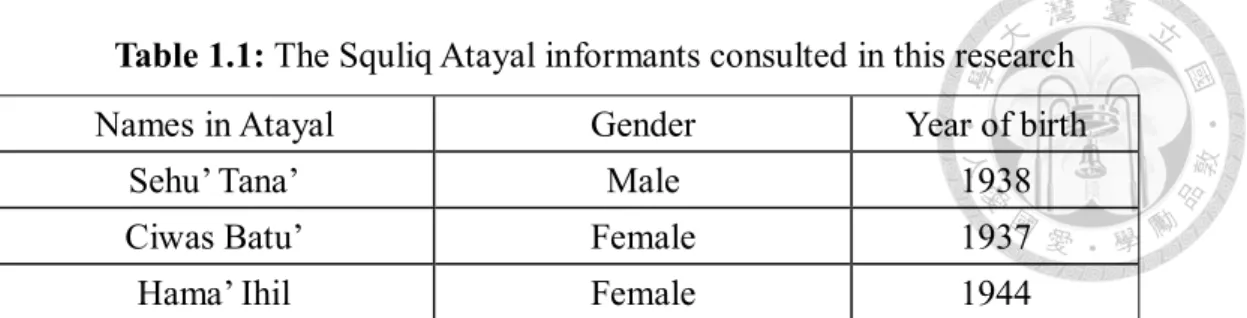
The dialectal variant that is investigated in this study is Jian-shih Squliq Atayal, spoken in Jian-shih Hsiang, Hsin-chu County. All my three informants come from Hsin-le village, Jianshih Hsiang. Their background information is presented in the table below:
1 Statistics is from the data of Council of Indigenous Peoples, Executive Yuan (http://www.apc.gov.tw/portal/portal/chart/chartIndex.html?CID=7E2F2903CAF78E0298FDB51D8D47 D979&ccateID=745A81AD372960C7D0636733C6861689&chartID=26667CF447F2AF64D0636733C6 861689)
2 As pointed out by Li (1982), the most famous distinction between Squliq and C’uli’ is the latter showing certain distinctions between the male and the female forms of speech, but the former not making the distinctions. For more detailed research on the comparison between the two subgroups, please refer to
5
Table 1.1: The Squliq Atayal informants consulted in this research
Names in Atayal Gender Year of birth
Sehu’ Tana’ Male 1938
Ciwas Batu’ Female 1937
Hama’ Ihil Female 1944
The data analyzed in this dissertation include both elicited and natural data. Since my goal of this study is verb classifying, elicited data is taken as the primary data; as for natural data, its function is a two-sided coin, namely, it is not only the origin for me to initiate the present study but also the reflection of my arguments.3 In this study, I examine around 300 verbs, each further taken into around 10 constructions to define every verb’s category (Chapter 6 to 9).
1.3 The organization of this dissertation
The remainder of this dissertation is organized as follows. Chapter 2 gives a grammatical sketch of the Squliq Atayal language, Chapter 3 is to address main issues to be examined in the present study by means of a review on some studies of Squliq Atayal and other Philippine-type languages, Chapter 4 provides the theoretical framework for this study, Chapter 5 is my methodology, Chapter 6 to 9 discuss five verbs classes, and Chapter 10 is the conclusion.
3 There are two sources for natural discourse data: one is from my own field notes and the other, Academia Sinica Formosan Language Archive (abbreviated as Sinica Archive henceforth), which can be accessed at http://formosan.sinica.edu.tw/.
CHAPTER 2
A SKETCH OF ATAYAL GRAMMAR
2.1 Introduction
In this chapter, I will provide a sketch of the essentials of Atayal grammar. This sketch consists of two parts: the first is concerned with basic phonological information, and the second is concerned with the morphosyntax of the language. Issues to be addressed in the second part include the word classes, the order of clausal constituents, the case-marking system, the pronominal system, the voice and tense/aspect/mood paradigm, the verb formation processes, and the verbal clause patterns. I begin with a discussion of the phonological system.
2.2 Phoneme inventory, syllables structure, and stress in Squliq Atayal
There are nineteen phonemic consonants and five phonemic vowels in Squliq Atayal, as illustrated in Table 2.1 and Table 2.2, respectively:4
4 The orthographic system adopted here is the same as the version published by the Council of Indigenous Peoples and the Ministry of Education in December 2005, which can be accessed at
7
Table 2.1: Squliq Atayal consonant phonemes (Practical orthography)
Place/Manner Bi- labial
Alveolar Alveo- palatal
Palatal Velar Uvular Glottal
Stop Voiceless p t k q ’
Voiced
Fricative Voiceless s x h
Voiced b z g
Affricative Voiceless c
Liquid Voiced l
Nasal Voiced m n ng
Trill Voiced r
Glide Voiced w y
Table 2.2: Squliq Atayal vowel phonemes (Practical orthography)
Frontness\Height Front Central Back
High i u
Mid e o
Low a
In Table 2.1, seven symbols are observed different from IPA symbols: “b” represents the voiced bilabial fricative //, “c” the voiceless alveopalatal affricative /ts/, “y” the palatal glide /j/, “g” the velar fricative //, “ng” the velar nasal //, “’” the glottal stop //, “h”
the glottal fricative //. Besides, as observed by Li (1980), the lateral fricative /l/ in word-final position is pronounced as a nasal /n/ in the speech of the younger speakers.
As Li (ibid.) indicated, the word-initial “’” (//) is left un-transcribed (e.g., /’a/ ‘Filler’ is written as a and /’abi’/ ‘sleep’ as abi’).
The five vowels in the inventory are /i, e, a, o, u/, as shown in Table 2.2. According to Li (1980:354), the mid vowels /e/ and /o/, derived from the diphthong /aj/ and /aw/
respectively, are less common in Squliq Atayal, as opposed to the three primary vowels /i, u, a/.
Another point regarding the orthography is the distribution of schwa //. In the IPA, schwa // is often subsumed under the vowel inventory; however, as pointed out in Egerod (1966), Li (1980), Rau (1992), Lin (2004), and many others, unlike the five vowels in Table 2.2, // is non-phonemic, often heard between consonants, and is prohibited from the stressed syllable(s); moreover, since // is inserted between consonants, consonant clusters are not allowed in the language; the CC (e.g., qhuniq
‘tree’) or CCC (e.g., krryax ‘everyday’) sequence only occurs in the orthography.
In addition to the phonemes shown in Table 2.1 and Table 2.2, Squliq Atayal has six diphthongs (/aw, ay, uy, iw, iy, uw/), each taking the final syllable of a word as their only position (Li 1980: 356).
All syllables in the language have onsets; the most common syllable structures are as shown in (2.1):
(2.1)
Syllable Type Example
One Syllable a. CV (su ‘2nd singular genitive/nominative’) b. CVC (qa’ ‘demonstrative’)
b. CGVC (syan ‘put’)
Two Syllables c. CV.CVC (tu.nux ‘head’) d. C.CGVC (q.sya’ ‘water’) Three Syllables e. C.CV.CVC (h.gi.nik ‘waist’)
f. CVC.CV.CVC (lin.lu.ngan ‘mind; thought’) Four Syllables g. C.C.C.CVC (s.t.n.xan ‘privy’)
h. CVC.C.CV.GVC (qin.p.zi.wan ‘former’)
In (2.1), “.” is used to mark the syllable boundary and C, G, and V are abbreviations for consonant, glide, and vowel, respectively.
Stress falls on the last syllable (Li 1980:356; Rau 1992:26). Note that if words undergo suffixation, stress remains falling on the last syllable of the derived words.
9
2.3 Morphosyntax in Squliq Atayal
In this section, I will provide a description of the morphosyntax of the language.
As mentioned previously, there are six issues to be addressed, each stemming from three distinct levels, as shown in (2.2):
(2.2) Seven issues regarding the information in a verbal clause a. Word class
b. Constituent order of a basic clause c. The case-marking system
d. The pronominal system e. Voice types and TAM f. Verb formation processes g. Clause types
With regard to word class and constituent order of a basic clause, I will show below that a verbal predicate and its argument(s) are the two central components of the clause, and each entails important syntactic functions. Any discussion of the last five issues in (2.2) revolves around a basic understanding of the nature of word class and constituent order.
The case-marking system and the pronominal system are associated with arguments. Arguments often occur with a case marker, and the case-marking system needs to be examined for its important role in the grammatical structure of the language.
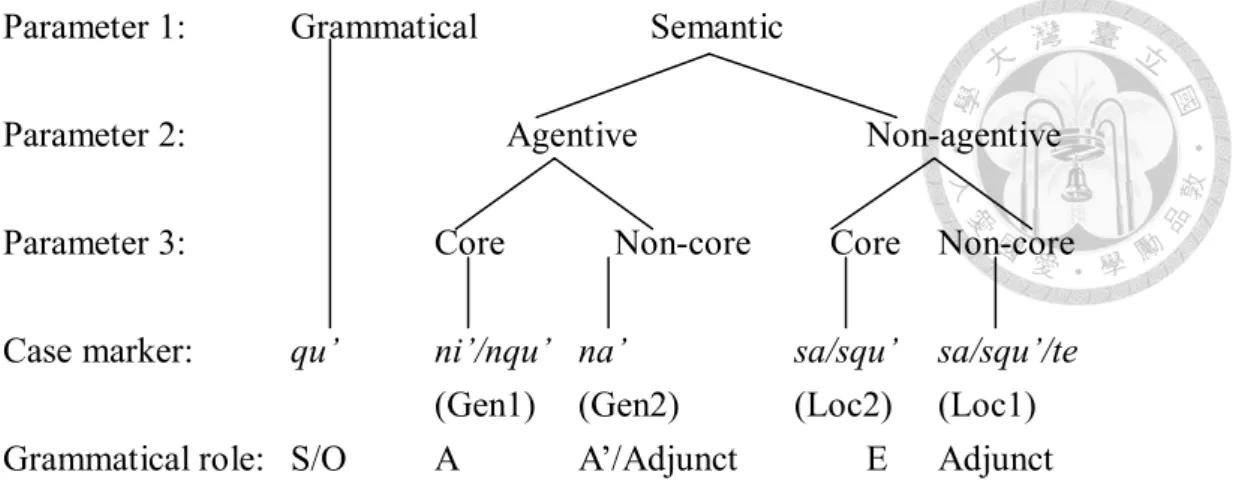
Case markers have three types: qu’, na’/ni’/nqu’, and sa/squ’; qu’ is used for marking the clause subject; na’/ni’/nqu’ are used for marking an agentive argument and are further divided into Gen1 and Gen2, with Gen2 denoting the adjunct argument; sa/squ’
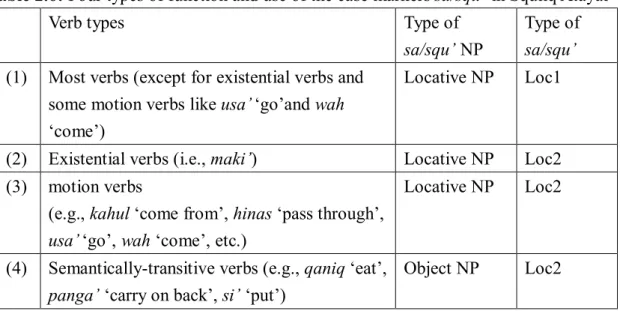
are used to introduced a non-agentive argument and are further divided into Loc1 and Loc2, with Loc2 denoting the intrinsic undergoer of a semantically transitive verb. Like the case-marking system, the pronominal system is also concerned with the syntax of
arguments.
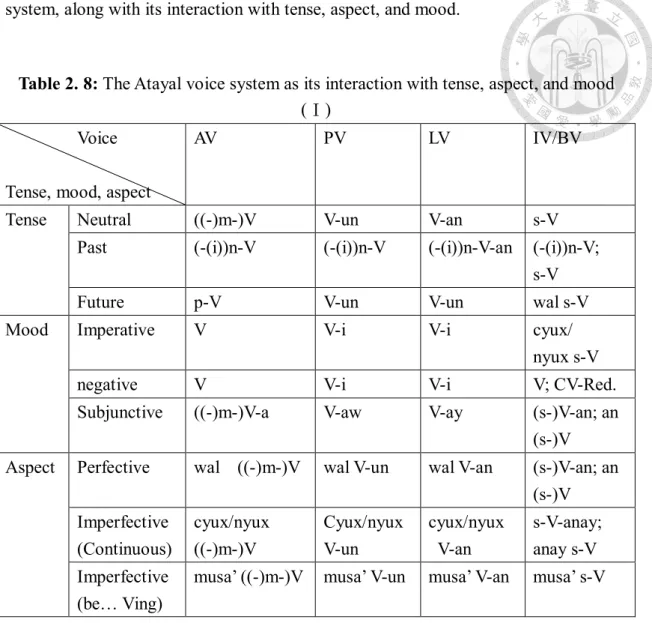
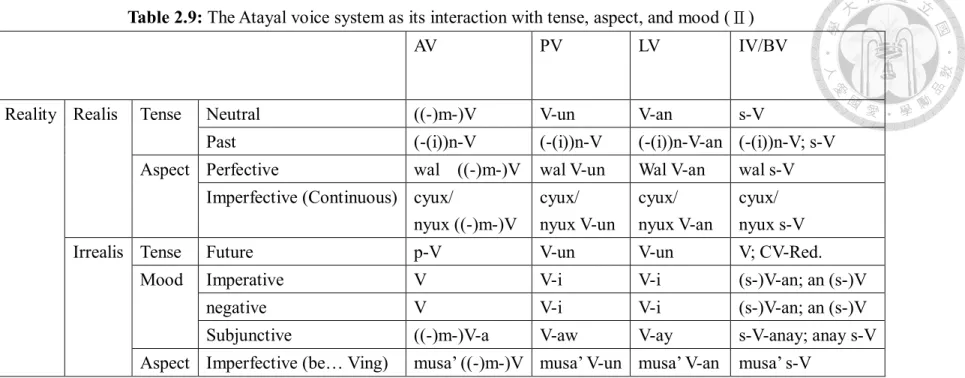
For a verbal predicate, I provide a careful discussion on the interface between the four-way voice system and the tense/aspect/mood system. Next, I undertake an examination on verb formation processes for showing that the semantic components entailed by the base of a derived verb can be realized as clausal adjunct arguments, which though associated with the schematization of the event a verb encodes, they cannot take the role of the default undergoer argument on the determination of which a Squliq Atayal verb’s class at the level of morphosyntax. Last, I identify verbal clause patterns for the purpose of showing a correlation between a verb and the morphosyntactic behavior of its arguments.
From a more integrated perspective, this “sketch” of the morphosyntax of the language can be taken as the presage of my claim for the thesis: the voice-marking system is lexically-specific.
2.3.1 Word classes
Let’s first consider the following excerpt comprised of eight sequential utterances:
(2.3)
a. (Sinica Archive: 01-001-a)
a maki’ qutux mit ga’.
FIL exist.AV one ass5 FP
‘There was an ass.’
b. (Sinica Archive: 01-001-b)
mit qani’ ga’, m-qilang balay.
ass this TOP AV-lazy true
‘As for the ass, it was quite lazy.’
5 The exact meaning of mit is ‘goat’; however, the storyteller provides the meaning ‘ass’ in the story he
11
c. (Sinica Archive: 01-001-c)
“mit qilang” so-n=naha’.
ass lazy say.thus-PV=3PL.GEN
‘People said, “The ass is lazy.”’
d. (Sinica Archive: 01-002-a)
swa’ =naha’ so-n mit qilang ga’?
why=3PL.GEN say.thus-PV ass lazy FP
‘Why did people say that the ass was lazy?’
e. (Sinica Archive: 01-002-b)
kryax sasan ga’, a ras-un nqu’ q<m><n>ayat
everyday morning TOP FIL take-PV GEN <ACTRNMZ><PST>raise hya’.
3SG.NEU
‘Every morning, the one who reared it brought it (to carry the goods).’
f. (Sinica Archive: 01-002-c)
m-usa’ h<m>akut squ’ bwax.
AV-go <AV>carry LOC husked.rice
‘(It) went to carry rice.’
g. (Sinica Archive: 01-002-d) h<m>akut squ’ cimu’.
<AV>carry LOC salt
‘(It) went to carry salt.’
h. (Sinica Archive: 01-002-d)
h<m>akut ana’ nanu’ ga’, baq balay
<AV>carry no.matter what TOP MOD true
m<k>kusa’ qu’ m-qilang na’ mit qani’.
AV<RED>attitudinize NOM ACTRNMZ-lazy LIG ass this
‘(However,) no matter what the goods were, the lazy ass was used to attitudinizing.’
In (2.3), it can be seen that each utterance is comprised of several lexical items and grammatical markers. Most lexical items can be assigned a separate lexical category by some criteria. The first criterion is, these lexical items can be described in terms of part of speech, a traditional grammatical class of lexical items. Table 2.3 shows the result of the assignment of lexical items to a part of speech:
Table 2.3: Assignment of lexical items to a part of speech
Part of speech Examples
Adverbs balay, ana’
Case marker nqu’, squ’
Discourse marker
a (filler)
Noun mit, kryax, sasan, q<m><n>ayat, bwax, cimu’, m-qilang (in m-qilang na’ mit)
Particle ga’ (final particle), ga’ (topic marker), na’ (ligature in m-qilang (in m-qilang na’ mit))
Possessives =naha’
Pronoun swa’, hya’, nanu’, qani’
Verb maki’, mqilang, qilang, ras-un, m-usa’, h<m>akut, baq, m<k>kusa’
Other parts of speech not occurring in the excerpt, but in other natural Atayal discourse are conjunctives (i.e., ru ‘and’), interjectives (e.g., talagay used in a situation when people highly praise or are surprised at something or ay used when people sigh with emotion), ideophones (e.g., the sound of beast barking kyaw in cyux iy kyaw kyaw para’
qasa’ lga’ ‘The Formosan barking deer was barking’ or is, which is used in a situation where people are disgusted at something), and so on.
In general, parts of speech are further divided into open and closed class. The open-vs.-closed distinction is the second criterion. The open parts-of-speech classes may be the classes of nouns, verbs, adjectives, and adverbs, as in English. However, as
13
remarked by Dixon (1982:12), “major parts of speech vary from language to language-- all languages appear to have Noun and Verb but some lack a major class Adjective”.
Dixon’s point applies to the case in Atayal. The class of adverbs, for example, doesn’t belong to the open class in Atayal, since its membership is relatively limited. Therefore, Atayal has only two open word classes, Noun and Verb.
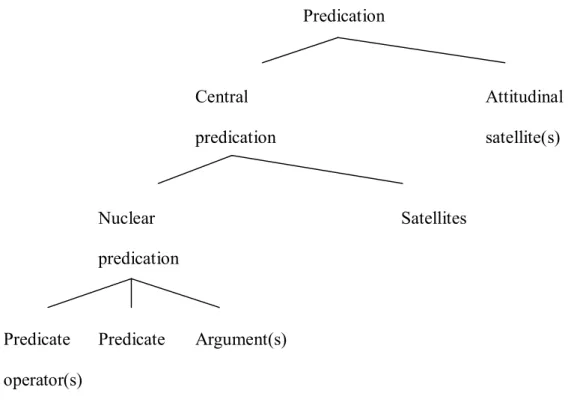
Third, lexical items can also be defined in terms of the level of predication or clauses. From the perspective of Functional Grammar (Dik 1978; 1983; 1984:89; 1989), lexical items in (2.3) can be realized as components of the predication. The components of the predication are represented in the following diagram (Dik 1984:89):
Predication
Central predication
Attitudinal satellite(s)
Nuclear predication
Satellites
Predicate operator(s)
Predicate Argument(s)
Fig. 2.1: Components at a layered structure of a predication
Among the components, the predicate is central to the predication of the clause structure;
moreover, as in many languages of the world, it is usually the verb that functions as the predicate; furthermore, since the predicate usually must co-occur with argument(s), a
complete predication is then formed. Thus, the idea that a combination of a predicate and a meaningful argument structure construction forms a single predication is also advocated by Goldberg (2010:39). The term ‘argument’ is cross-linguistically assigned to the class of words which includes names of persons, places, and things and are designed to refer to objects. It is a combination of a verbal predicate and at least one argument that constitutes a simple clause.
Predicate operators and satellites do not determine the semantic-role or argument structure of a verbal predicate. Predicate operators specify tense, voice, mood, and the positive/negative polarity, and they are placed before the predicate in Atayal. Satellites are used for providing such information, as time, location, cause, reason, manner, etc., but note that, in the case of Atayal, they may occupy an argument position.
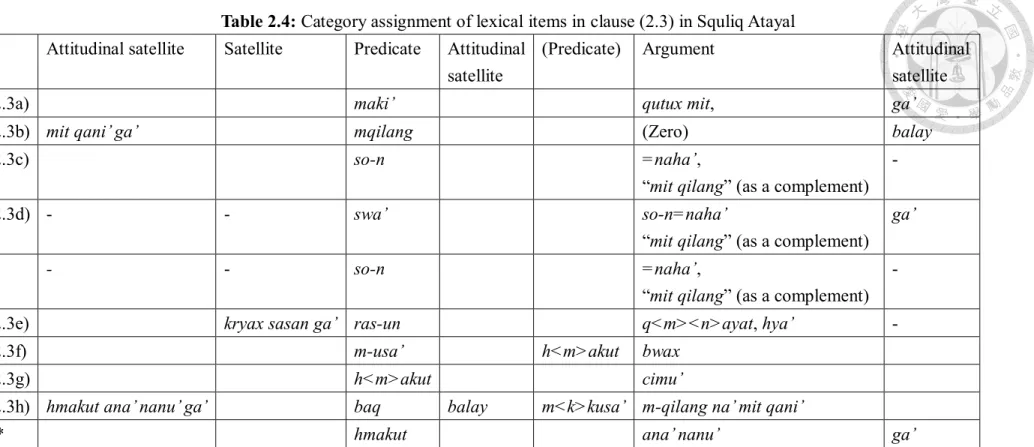
At the level of predication, then, the result of the assigning lexical categories to lexical items in (2.3) is as shown in Table 2.4:
15
Table 2.4: Category assignment of lexical items in clause (2.3) in Squliq Atayal
Attitudinal satellite Satellite Predicate Attitudinalsatellite
(Predicate) Argument Attitudinal
satellite
(2.3a) maki’ qutux mit, ga’
(2.3b) mit qani’ ga’ mqilang (Zero) balay
(2.3c) so-n =naha’,
“mit qilang” (as a complement) -
(2.3d) - - swa’ so-n=naha’
“mit qilang” (as a complement) ga’
* - - so-n =naha’,
“mit qilang” (as a complement) -
(2.3e) kryax sasan ga’ ras-un q<m><n>ayat, hya’ -
(2.3f) m-usa’ h<m>akut bwax
(2.3g) h<m>akut cimu’
(2.3h) hmakut ana’ nanu’ ga’ baq balay m<k>kusa’ m-qilang na’ mit qani’
** hmakut ana’ nanu’ ga’
* is the complement of swa’ in (2.3d). Since it is a structurally complete enough to be a clause, its constituents can be further analyzed in this way.
**, same to the case *. The clause hmakut ana’ nanu’ ga’ stems from (2.3h) and is its topic. It is a complete clause, so that its constituents can be categorized into their respective component roles in a predication.
A serial verb construction (SVC) occurs in (2.3e) and (2.3h). But since it is usually the first verb used to determine the important morphosyntactic structure of a clause (i.e., the voice type of a clause and the host to which a clitic is attached), it is treated as the main verb of a SVC construction, but it is the second or last verb in a SVC that specifies the argument structure of the SVC construction. This can explain why in (2.3h), an attitudinal satellite balay immediately follows the first verb baq to modify the verb, but not the second verb m<k>kusa’; however, the attitudinal satellite doesn’t influence the morphosyntactic structure of a clause.
The ordering of other components is not fixed. Attitudinal satellite can be positioned either clause-initially or clause-finally, like satellites. (2.3e) illustrates a satellite denoting time information about the narrated event placed in the clause’s initial position.
A more precise description can be obtained from the definition of lexical items in terms of the level of predication or clauses is on the ordering of components of an Atayal predication can be stated in this way: a predicate is more closely ordered
next to its argument(s), while distribution of the others is relatively flexible.
Following the “subject predicate analysis” in which a clause is divided into two parts (Palmer 1994), the simplest clause consists of a verbal predicate and subject. Atayal is a language with a predicate-subject order.
A verbal predicate in Atayal can also take more than one argument. As in (2.3c), one (i.e., the content of a saying event mit qilang) is the subject, while the other, which is assigned the semantic role of Actor, is excluded from being the object, either.
But what is its grammatical role? Actually, in some cases, there are more than one argument occurring in between a verbal predicate and the subject. The same question may also be raised with respect to the argument: what is the grammatical role of the
17
As stated, how a verb is classified in Atayal is determined by the kind of nominal arguments the verb has and how they are linearized in surface structure. In the following discussions, I will investigate the ordering of arguments and other issues regarding the structure of nominal arguments, i.e., the pronominal and the case marking systems, and the morphosyntax of the verbal predicate. All these issues are associated with the goal of this dissertation, which is to classify verbs in Atayal.
2.3.2 Constituent order of a basic clause
As mentioned, the basic word order of Atayal can be analyzed as a predicate-subject structure, as exemplified below:
(2.4) Equational sentence (gaga’ na’ Atayal: 104-106)
Nominal predicate Subject
piaojie=maku’ qu’ sayun qasa’
elder.daughter.of.one’s.uncle.or.aunt=1SG.GEN NOM PN that
‘That (person), Sayun, is the elder daughter of (my) aunt.’
(2.5) Existential sentence (repeated from (2.3a) (Sinica Archive: 01-001-a)) Verbal predicate Subject
a maki’ qutux mit ga’.
FIL exist.AV one ass FP
‘There was an ass.’
(2.6) AV (Sinica Archive: 01-009-b)
Verbal predicate Subject
m-qas balay qu’ mit qani’ ma’.
AV-happy true NOM ass this QUOT
‘This ass was quite happy.’
(2.7) EIC
Verbal predicate
nanu’ a, obeh tehuk balay squ’ a, tanux=myan what FIL ASP arrive true LOC FIL courtyard=1PE.GEN
Subject
la’ qu’ a, qsya’ qasa’ uzi’ lga’.
FP NOM FIL water that also FP:FP
‘Water (i.e., the flood) nearly reached our courtyard.’
(2.8) UV (Sinica Archive: 10-002-a)
Verbal predicate Subject ...hwah-un=myan a m-sqluq ngasal; ...
let.drop-PV=1PE.GEN FIL AV-loose house
‘…we (had no choice but to) destroy our houses and took them apart; ...’
As can be easily observed from (2.4) to (2.8), predicate and subject form two conspicuous “chunks” or, in a traditional analysis, two major constituents of a basic Atayal sentence.
Subject is commonly realized as the perspective, or the point of view for the utterance to be interpreted (Siewierska 1988:108); as a result, once a participant or an entity is introduced into a discourse (usu. through an existential sentence as (2.5)), its referent turns into readily accessible information to the hearer in sequent discourse.
The participant or entity is henceforth the subject in the discourse. As mentioned, the clausal final position of a basic sentence in Squliq Atayal is exclusively reserved for subject. As a result, in most utterances, from the perspective of Functional Grammar (Dik 1978, 1984:89, 1989), the left to the subject of a sentence is designed for the presentation of the predicate, along with other obligatory constituents other than the subject, and optionally predicate operators and satellites (see Section 2.3.1).
19
Other obligatory constituents are tied to the semantic specification of the predicate. There are two types of semantic specification. One concerns the valency of a verbal predicate. Take the English sentence Tom gave his wife a ring as an example.
Since the sentence specifies an active mood, the actor argument Tom takes the role of subject, while the recipient his wife and the theme a ring then are considered obligatory constituents of the predicate gave. Another example can be seen from the sentence Many species exist in the island. In this sentence, the location verb exist requires a location nominal phrase to anchor the existence of a theme subject. The arguments his wife/a ring in Tom gave his wife a ring and the island in Many species exist in the island are subcategorized for by their respective verbal predicate. This is the first type of semantic specification. The second type involves the notion of entailment. For example, hammer and enshrine respectively entail an instrument and a location argument whose specification depends on the context. In terms of Dik’s Functional Grammar (1978, 1984, 1989), entailed arguments like a hammer and a holy place are categorized as satellites.
Going back to the case of Squliq Atayal. In a plain UV clause, the non-actor argument is taken as the clausal subject, and then placed at the right side of a clause, as in (2.4). The remaining question is to solve the relative ordering of satellites.
According to the literature (Pinkster 1972; Enkvist 1976; Bybee 1985a, 1985b;
Siewierska 1988, 1993; etc.), the degree of their semantic bondness to the predicate is an important factor for the relative order of constituents. Items closely tied to the semantics specification of the verb tend to occur closer to it than those lacking such ties. In addition to the arguments that the valency of a verb sanctions, satellites are also relevant, the notion of entailment straightforwardly evidences this. The instrument (e.g., tekan kwayux ‘vine chair’ in (2.9a)) and the location argument (e.g., m-nkungm ‘(a) dark place’ in (2.9b), and qsya’ ‘water’ in (2.9c)) are satellites: