中國作為逐漸開放經濟的人民幣匯率:短期解決方案與長期
的戰略
計畫類別: 個別型計畫 計畫編號: NSC94-2415-H-004-011- 執行期間: 94 年 08 月 01 日至 95 年 07 月 31 日 執行單位: 國立政治大學國際關係研究中心 計畫主持人: 童振源 計畫參與人員: 王國臣、張華維 報告類型: 精簡報告 處理方式: 本計畫可公開查詢中 華 民 國 95 年 7 月 10 日
The Renminbi Exchange Rate in the Increasingly Open Economy of China:
A Long-Term Strategy and a Short-Term Solution
C
HEN-
YUANT
UNG Assistant ProfessorSun Yat-Sen Graduate Institute of Social Sciences and Humanities National Chengchi University
E-mail: [email protected] Tel: 886-2-2938-7291
Abstract:
This paper begins by providing two theoretical perspectives on the Renminbi exchange rate issue: the principle of the impossible trinity and self-fulfilling balance-of-payments crises models. Based on theoretical perspectives, the paper elaborates on China’s economic external and internal imbalances. Finally, the paper argues that a practical approach for the Chinese government to consider would be to allow the RMB to immediately appreciate by 10-15 percent, expand the floating band of the RMB exchange rate from ±0.3 percent to 5-7 percent, and maintain central parity based on a new RMB rate until it is again in disequilibrium by a wide margin.
Nevertheless, there is no timetable for an adjustment of the RMB exchange rate as long as the Chinese government can tolerate the economic bubble and increasing financial risks, resulting from the undervalued RMB. However, as long as China’s economy remains overheated and expectations of an RMB revaluation persist, the awesome power of the international financial market will most likely create a “self-fulfilling prophecy” RMB appreciation in the future.
JEL classification: F31, F41.
Keywords: Renminbi exchange rate; exchange rate regime; impossible trinity; balance-of-payment crises models; hot money.
I.
Introduction
On January 1, 1994, China adopted a managed float regime with the Renminbi (RMB) exchange rate at 8.7 per US dollar (USD) and a narrow band of 0.25 percent from the previous day’s rate. Under the regime, the RMB/USD exchange rate began to appreciate to 8.3 in May 1995 and 8.28 in October 1997. During the Asian financial crisis, the trading band was narrowed further and the exchange rate of 8.28 RMB/USD was maintained until July 21, 2005. Thus, despite official claims of a managed float exchange rate regime, China essentially operated in a system of a de-facto fixed peg to the dollar from early 1994 to mid-2005.
A stable currency regime has served China well, routinely cited by Chinese policy makers and foreign pundits alike as an important factor in facilitating China’s growth miracle over the past decade, particularly attracting foreign direct investment (FDI) and facilitating trade. In the wake of the Asian financial crisis of 1997-98, China’s commitment to a fixed exchange rate was widely praised as a key anchor for the global financial system.
However, the generally supportive global consensus regarding China’s stable exchange-rate regime has evaporated over the past four years. From early January 2002 to early January 2004, the US dollar depreciated against the Euro by approximately 40 percent, against the Japanese Yen by 25 percent, against the Taiwan dollar, the Singaporean dollar, and the Korean Won by 5-12 percent. In 2004, the US dollar continues to depreciate against these currencies by 4.1-15.6 percent. Under China’s de-facto fixed exchange rate regime, the RMB has depreciated against the above currencies by the same margins in nominal terms. From 2002 to 2004, the nominal effective exchange rate of the RMB depreciated by 11.6 percent.1
The nominal depreciation of the RMB has resulted in widespread complaints that China is unfairly manipulating its currency to gain a competitive trade advantage. Nevertheless, the Chinese government has firmly insisted on the de-facto fixed RMB/USD exchange rate in
1
The nominal effective exchange rate is calculated as a weighted average of nominal exchange rates against main trade partner countries’ currencies. This figure is cited from the International Financial Statistics by the International Monetary Fund.
order to protect export competitiveness and avoid further unemployment pressure. (Governor Zhou Xiaochuan 2003) The Chinese government argued that the stable RMB exchange rate is in the best interest for both China and the international community. (Hung 2004)
Mainly responding to the international political pressure (Tung 2005), on July 21, 2005, the Chinese government re-adopted a managed float exchange rate regime based on market supply and demand with reference to a basket of currencies. In addition, the RMB was revalued by 2.1 percent against the US dollar, i.e., the exchange rate of the US dollar against the RMB was adjusted to 8.11 RMB/USD. Third, the daily trading price of the US dollar against the RMB in the inter-bank foreign exchange market will continue to be allowed to float within a band of ±0.3 percent around the central parity published by the People’s Bank of China (PBoC), while the trading prices of the non-US dollar currencies against the RMB permitted to move within a band of ±1.5 percent.
Why did China adjust its RMB level and exchange rate regime? Would China’s current approach succeed resuming both external and internal balance of the Chinese economy in the near future? Is there any more effective solution to resuming China’s external and internal imbalances? This paper would like to address these questions. This paper begins by providing two theoretical perspectives on these issues: the principle of the impossible trinity and self-fulfilling balance-of-payments crises models. Based on the theoretical perspectives, the paper elaborates China’s economic external and internal imbalances. Finally, the paper provides an alternative solution to the RMB exchange rate issue.
II.
Theoretical Perspectives
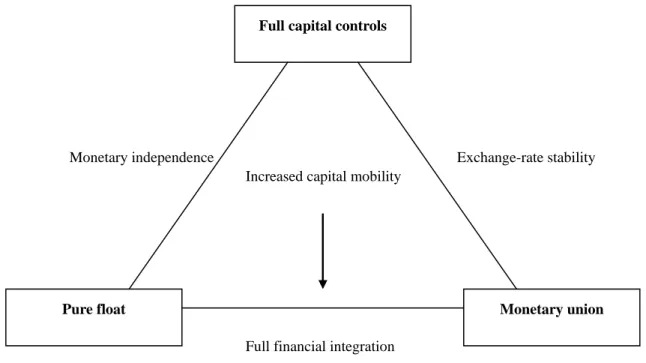
1 is a simple schematic illustration of the impossible trinity. Each side has its own compelling aim – the respective allure of monetary independence, exchange-rate stability, and full financial integration. Any pair of attributes can be attained: the first two at the apex marked “capital controls,” the second two at the vertex marked “monetary union,” or the first and third at the vertex marked “pure float.” It is impossible to simultaneously attain all three.
Figure 1. The Impossible Trinity
Source: Frankel 1999: 7.
However, the gradual integrated global capital market has forced economic entities to choose either monetary union or a pure float for their exchange rate regime. It is perilous for a country to fix its exchange rate without institutional commitment (such as dollarization or monetary union). To avoid attacks on exchange rates by international speculators, fewer and fewer economic entities tend to choose other systems. Monetary union and a pure float are the two regimes that by construction cannot be subjected to speculative attack. (Frankel 1999: 5-7; Fisher 2001) Nevertheless, developing countries have been uncomfortable with free float
Full capital controls
Pure float Monetary union
Full financial integration
Monetary independence Exchange-rate stability
regimes. As a result, even countries claiming to “float” their currencies may display a “fear of floating” and instead limit currency fluctuations over long periods. (Calvo and Reinhart 2002)
Due to the closed capital account, the Chinese government had been able to remain autonomous over its monetary policy and maintain a de-facto fixed peg to the dollar by 2002. However, with the increased openness of the Chinese economy, the problem of capital account leakage has worsened. According to the International Monetary Fund (IMF) estimate, during 1994-2002, the error and omissions line item in China’s balance of payment amounted to a negative US$ 14 billion a year, and the capital flight during the nine years totaled US$ 122 billion. With the surging inflow of speculative hot money after 2002, the error and omissions account has dramatically reversed, posting a US$ 7.8 billion surplus in 2002, US$ 18.4 billion in 2003 and US$ 27.1 billion in 2004. Furthermore, Gunter (2004) estimates, based on both balance of payments and residual measures for China, the capital flight was US$ 69 billion per year during 1994-2001 and reached over US$ 100 billion per year during 1997-2000. He estimates that about US$ 900 billion has fled China or has been converted to dollars or gold within China since 1984 until 2001.
Based on the impossible trinity, China will gradually be forced to choose either monetary union or a pure float in the long-term. Nevertheless, China can maintain an intermediate regime with a relatively closed capital account in the short-term. Furthermore, it is in China’s best interest to maintain capital account controls in the short-term due to weaknesses in China’s financial system. (Prasad, Rumbaugh and Wang: 2005) More complicated yet, China’s situation is not simply whether to open its capital account in the short-term, but how China, as an increasingly open economy, responds to its exchange rate level and regime given current huge capital account leakages, which may lead to self-fulfilling depreciation or
In the short-term, the increasingly large loopholes in capital account controls may shake the de-facto fixed exchange rate regime in China by speculative hot money. Existing three generations of models of speculative attacks and balance-of-payments crises fall into two broad categories, those where a collapse is an inevitable consequence of some fundamental imbalances and those where a collapse results from self-fulfilling expectations. (Krugman 2000)
The first category originates from the Krugman (1979) model where a balance-of-payments crisis is generated by a monetary authority which operates a policy of domestic credit expansion while simultaneously fixing the exchange rate. Foreign exchange reserves inevitably run out and the fixed rate has to be abandoned. Krugman shows that, with forward-looking exchange markets, the final stage of the crisis involves a sudden discrete loss of reserves in a speculative attack. Eichengreen, Rose, and Wyplosz (1996) emphasize that a currency crisis might occur when the currency is speculated to devalue and the government is reluctant to defend a fixed exchange rate with a high interest rate.
The second category of models arises from the Obstfeld (1986 and 1996) studies. Obstfeld asserts that balance-of-payments crises may, indeed, be purely self-fulfilling events rather than the inevitable result of unsustainable macroeconomic policies. He points out that the economy possesses a continuum of equilibria, each corresponding to a different subjective assessment of the likelihood of an exchange rate collapse. If speculators believe that a currency will come under attack, their actions in anticipation of this precipitate the crisis itself; while if they believe that a currency is not in danger of imminent attack, their inaction spares the currency from attack, thereby vindicating their initial beliefs. (See also Cole and Kehoe 1996; Calvo and Mendoza 1996)
Although the above models explain the currency crises of speculative attacks only on a possible devaluation of exchange rates, McKinnon (2004) provides an explanation of a “self-fulfilling prophecy” appreciation as the syndrome of conflicted virtue. Countries that are
virtuous by having a high saving rate tend to run surpluses in the current account of their international balance of payments. But, with the passage of time, as the stock of dollar claims cumulate, domestic holders of dollar assets worry more about self-sustaining runs on domestic currency, forcing an appreciation and thus switch dollar assets into domestic currency assets. In addition, foreigners start complaining that the country’s ongoing flow of trade surpluses is unfair and the result of having an undervalued currency. Of course, these two effects mutually reinforce each other and thus may trigger a “self-fulfilling prophecy” appreciation.
Based on studies of six episodes of appreciation pressures involving Chile, Hungary, Indonesia, and Singapore since the dissolution of the Bretton Woods system, sterilization cannot be effective in an environment of burgeoning inflows and expectations of foreign exchange rate appreciation that drive these inflow can only be stopped when the exchange rate actually rises. Historical experience indicates that market forces eventually coerce policy into accommodation. Past experience also shows that conflicts between the exchange rate arrangement and inflation targets are eventually solved in favor of the latter. (Bond etc. 2004: 14-16; Christensen 2004)
Moreover, in virtually all these cases, there has been a swift, significant and unannounced shift toward revaluation. There is little point in a gradualist approach with an existing undervalued exchange rate since it only invites speculative pressure and inflows, as speculations of a bigger exchange rate adjustment in the future heighten. A crawling peg would have to be quickly abandoned under such circumstances, a move that will be negative for policy credibility. (Bonds etc. 2004: 14-19; Christensen 2004: 7-10)
large scale, and a series of economic problems ensued, including economic overheating, inflation, rising wages, and the worsening of the international current account. In the end, the Koruna exchange rate was forced to adjust, leading to a financial crisis and a 3-year economic recession. (Christensen 2004)
In order to avoid a currency crisis, one country would need an exit strategy, which is a strategy from a fixed rate to a more flexible regime: the experience of other emerging markets suggests that it is better to exit from a peg when times are good and the currency is strong, than to wait until times are bad and the currency is under attack. The alternative of waiting for a time of balance of payments deficit often turn out to mean exiting the peg under strong downward speculative pressure, with the result that confidence is undermined and the national balance sheet is weak. (Eichengreen and Masson 1998)
These points are drawn largely from the experience of emerging markets such as Colombia and Korea in the early 1990s. Those countries were able to sterilize capital inflows only for a year or two, before it became too difficult, due to high interest rates on the sterilization bonds and prolonged strong capital inflows. As Asia’s pre-crisis experience showed, persistent under-valuation may generate economic overheating, asset market bubble, and strong credit growth that threatens the future health of the financial system.
Balance-of-payments crises models provide important implication for speculative capital inflows on China’s external imbalances. In spite of the insistence on the de-facto fixed RMB/USD exchange rate by the Chinese government, the general expectation of an RMB appreciation in the market resulted in the dramatic accumulation of foreign exchange reserves and surging inflows of speculative hot money to China. The surging hot money inflows increased pressure on RMB appreciation and would probably cause “self-fulfilling prophecy” appreciation, which will be analyzed in the following sections.
1. Rapid Accumulation of Foreign Exchange Reserves
In order to maintain a de facto peg rate, the PBoC has been forced to purchase US$ 13.5 billion foreign exchange every month in 2003 and US$ 17.3 billion every month in 2004-2005. Including the injection of US$ 45 billion into the Bank of China and the China Construction Bank by the Chinese government at the end of 2003, China’s foreign exchange reserves increased by US$ 161.9 billion or 56.5 percent in 2003. China’s foreign exchange reserves increased by US$ 206.6 billion or 27.7 percent in 2004 and US$ 209.0 billion or 1.2 percent in 2005. By the end of March 2006, China’s foreign exchange reserves reached US$ 875.1 billion, increasing by US$ 56.2 billion or 32.8 percent year on year. In particular, the proportion of yearly increase of China’s foreign exchange reserves to its GDP increased from average 2.3 percent in 1995-2001 to around 10 percent in 2003-2005. (See Table 1)
Table 1. Foreign Exchange Reserves in China: 1994-2005 Year 1994 1995 1996 1997 1998 1999 2000 2001 2002 2003 2004 2005 Amount (US$ billion) 51.6 73.6 105.0 139.9 145.0 154.7 165.6 212.2 286.4 403.3 (448.3) 609.9 818.9 Yearly increase (US$ billion) / 22.0 31.4 34.9 5.1 9.7 10.9 46.6 74.2 116.9 (161.9) 206.6 209.0 Percentage of GDP (%) / 3.0 3.7 3.7 0.5 0.9 0.9 3.5 5.1 7.1 (9.9) 10.7 9.5 Growth rate (%) / 42.6 42.6 33.2 3.6 6.7 7.0 28.1 35.0 40.8 (56.5) 27.7 1.2 Note:
1. The number in parentheses in 2003 includes the injection of US$ 45 billion into two state-owned banks by the Chinese government at the end of 2003.
2. China’s GDP figures are adjusted based on China’s economic survey result in late 2005. Source: China’s State Administration of Foreign Exchange (http://www.safe.gov.cn).
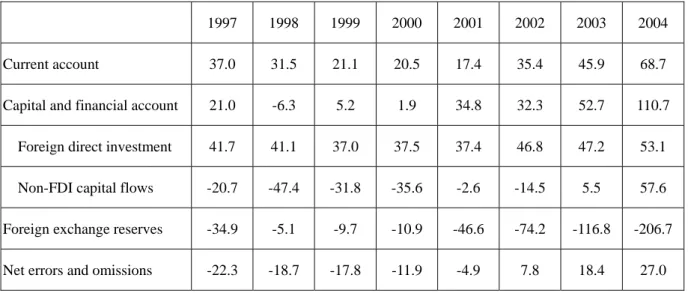
As a matter of fact, the rapid increase of foreign exchange reserves between 2001 and 2004 was mainly attributed to the surging speculative hot money. Between 1995 and 1999, the error and omissions line item in China’s balance of payments was negative US$ 18.4 billion on average. The error and omissions line item rapidly reversed from negative US$ 11.9 billion in 2000 and negative US$ 4.9 billion in 2001 to positive US$ 7.8 billion in 2002. This was the first positive number since 1989, indicating that the overseas speculative hot money began to enter China through illegal channels. While China’s current account balance remained around US$ 20-70 billion and net foreign direct investment (FDI) maintained at around US$ 40-50 billion, non-FDI capital flow increased from negative US$ 35.6 billion in 2000 to positive US$ 57.6 billion in 2004. Consequently, China’s foreign exchange reserves increased from
US$ 10.9 billion in 2000 to US$ 206.7 billion in 2004. (See Table 2)
Table 2: Balance of Payments Summary of China: 1997-2004
Unit: US$ billion 1997 1998 1999 2000 2001 2002 2003 2004
Current account 37.0 31.5 21.1 20.5 17.4 35.4 45.9 68.7
Capital and financial account 21.0 -6.3 5.2 1.9 34.8 32.3 52.7 110.7 Foreign direct investment 41.7 41.1 37.0 37.5 37.4 46.8 47.2 53.1 Non-FDI capital flows -20.7 -47.4 -31.8 -35.6 -2.6 -14.5 5.5 57.6 Foreign exchange reserves -34.9 -5.1 -9.7 -10.9 -46.6 -74.2 -116.8 -206.7 Net errors and omissions -22.3 -18.7 -17.8 -11.9 -4.9 7.8 18.4 27.0 Source: China State Administration of Foreign Exchange (http://www.safe.gov.cn).
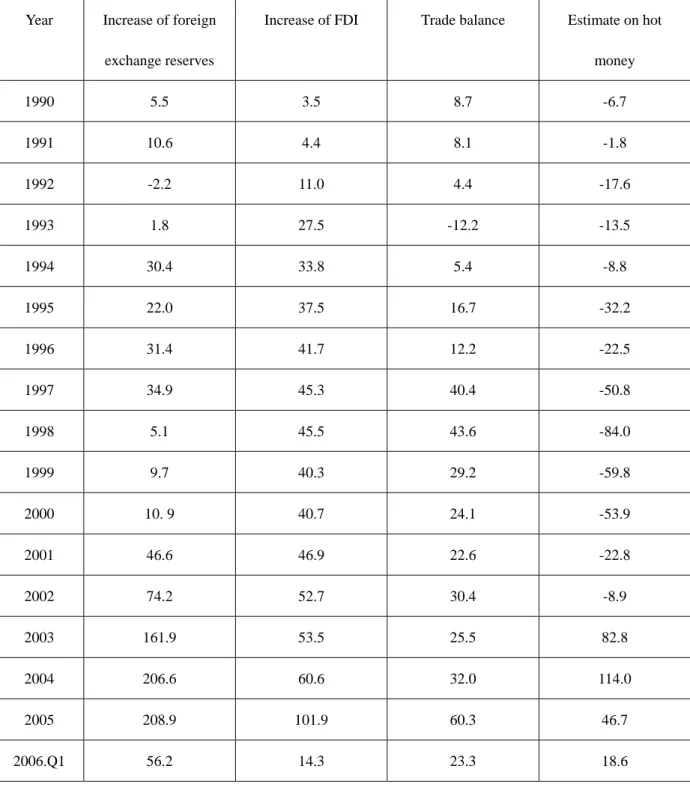
Chinese officials estimated that the international hot money pouring into China amounted to at least US$ 100 billion in 2004. (Xiaobo Wang 2004; Chuozhong Wang 2004; Xu 2005) Basically, the hot money can be estimated from China’s foreign exchange reserves subtracted by the amount of FDI and trade balance. Based on this formula, the hot money flowing out of China (capital flight) was US$ 62.1 billion annually in average between 1997 and 2000, declining to US$ 22.8 billion in 2001 and US$ 8.9 billion in 2002. After 2002, China has been receiving enormous hot money inflow – US$ 82.8 billion in 2003, US$ 114.0 billion in 2004, US$ 46.7 billion in 2005, and US$ 18.6 billion in the first quarter of 2006. (See Table 3)
Table 3. Estimates on International Hot Money into China
Unit: US$ billion Year Increase of foreign
exchange reserves
Increase of FDI Trade balance Estimate on hot money 1990 5.5 3.5 8.7 -6.7 1991 10.6 4.4 8.1 -1.8 1992 -2.2 11.0 4.4 -17.6 1993 1.8 27.5 -12.2 -13.5 1994 30.4 33.8 5.4 -8.8 1995 22.0 37.5 16.7 -32.2 1996 31.4 41.7 12.2 -22.5 1997 34.9 45.3 40.4 -50.8 1998 5.1 45.5 43.6 -84.0 1999 9.7 40.3 29.2 -59.8 2000 10. 9 40.7 24.1 -53.9 2001 46.6 46.9 22.6 -22.8 2002 74.2 52.7 30.4 -8.9 2003 161.9 53.5 25.5 82.8 2004 206.6 60.6 32.0 114.0 2005 208.9 101.9 60.3 46.7 2006.Q1 56.2 14.3 23.3 18.6
Note: Estimated hot money = increase of foreign exchange reserves – increase of FDI – trade balance Source: Calculated by the author.
the beginning and thus pour speculative hot money into China? The following section will discuss the equilibrium exchange rate of the Renminbi.
2. Estimates on the Equilibrium Exchange Rate of the Renminbi
The number of studies attempting to estimate the “equilibrium” exchange rate of China’s RMB has proliferated in recent years. Generally speaking, two broad approaches can be employed to estimate the equilibrium exchange rate of the RMB: a macroeconomic balance approach or an extended purchasing power parity (PPP) approach. Dunaway and Li (2005) examined a sample of these studies, with estimates of RMB undervaluation ranging from zero to nearly 50 percent. They attribute the wide variation in these estimates to the influence of such factors as different methodologies used, explanatory variables included, subjective judgments of the various researchers in deriving their results, and instability in underlying economic relationships, especially in a rapidly developing economy like China.
The bottom line is that there is no consensus among economists on the equilibrium level of the RMB exchange rate based upon the econometric models, but there is a consensus among most studies that the RMB exchange rate is undervalued to some extent. More studies show that the RMB exchange rate was undervalued by 15-30 percent by mid-2004. (Dunaway and Li 2005: 3; Zhang and Pan 2004; Frankel 2004; Anderson 2003; Goldstein 2004; Bond etc. 2004)
Even within a given approach, estimates for undervaluation of the RMB range widely. The numerous studies done thus far have stoked further debate, rather than contributed to a consensus on the issue. A definitive answer is not likely to be forthcoming any time soon.
Renminbi exchange rate might play a more important role in understanding the trend of the Renminbi spot rates.
3. The Expectation of the Renminbi Exchange Rates
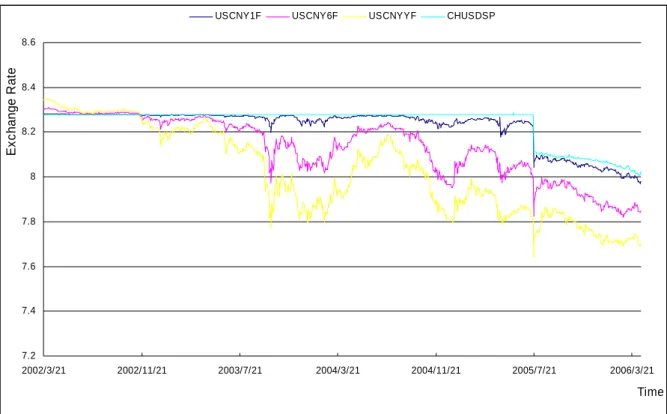
The expectation of the RMB exchange rates is reflected by the RMB forward rates. Figure 2 shows the RMB/USD spot rates, one-month RMB/USD forward rates, six-month RMB/USD forward rates, and one-year RMB/USD forward rates. After November 2002, all three forward rates showed that the RMB exchange rates were expected to appreciate. As a matter of fact, the RMB spot rates were highly influenced by the RMB forward rates. Between February 11, 2002 and April 13, 2006, the correlations between the RMB/USD spot rates and the one-month RMB/USD forward rates, the six-month RMB/USD forward rates, and the one-year RMB/USD forward rates were 98.4 percent, 76.9 percent, and 61.4 percent, respectively.
Figure 2. Renminbi Spot and Forward Rates: 2002-2006
7.2 7.4 7.6 7.8 8 8.2 8.4 8.6 2002/3/21 2002/11/21 2003/7/21 2004/3/21 2004/11/21 2005/7/21 2006/3/21 Time E x c hang e R a te
Note: USCNY1F refers to RMB to US$ 1 month forward; USCNY6F refers to RMB to US$ 6 month forward; USCNYYF refers to RMB to US$ 1 year forward; CHUSDSP refers to RMB to US$ spot rate.
Source: Datastream.
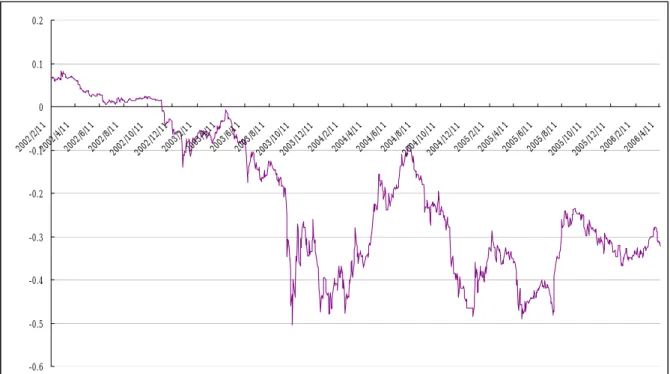
In the long-term, the one-year RMB forward rates should generally reflect the expectation of the RMB exchange rates. From September 23, 2003, to April 23, 2004, the one-year RMB/USD forward rate was 7.9063 on average, while the RMB/USD spot rate maintained at 8.2770. The expected appreciation rate of the Renminbi against the USD was 4.5 percent within one year. From October 25, 2004 to July 20, 2005, the one-year RMB/USD forward rate was 7.8818 on average, while the RMB/USD spot rate maintained at 8.2766. The expected appreciation rate of the Renminbi against the USD was 4.8 percent within one year. After the Chinese government adopted a new exchange rate level and regime, between July 21, 2005, and April 13, 2006, the one-year RMB/USD forward rate was 7.7646 on average, while the RMB/USD spot rate maintained at 8.0721. The expected appreciation rate of the Renminbi against the USD was 3.8 percent within one year. (See Figure 3)
Figure 3. Difference between One-year RMB/USD forward rates and RMB/USD Spot Rate: 2002-2006 -0.6 -0.5 -0.4 -0.3 -0.2 -0.1 0 0.1 0.2 2002 /2/11 2002 /4/11 2002 /6/11 2002 /8/11 2002 /10/11 2002 /12/11 2003/ 2/11 2003 /4/11 2003 /6/11 2003 /8/11 2003/ 10/11 2003/ 12/11 2004 /2/11 2004 /4/11 2004/ 6/11 2004 /8/11 2004 /10/11 2004 /12/11 2005 /2/11 2005 /4/11 2005 /6/11 2005 /8/11 2005 /10/11 2005 /12/11 2006 /2/11 2006/ 4/11 Source: Datastream.
There has been no sign that the RMB exchange rate will reach its equilibrium level and thus China’s foreign exchange reserves will stop rapid accumulation in the near future. With increasing external imbalances, the following section will elaborate on the impact of China’s external imbalances on its macroeconomic fundamentals.
IV.
China’s Internal Imbalances
1. Rising Sterilization Costs
Sterilization can be a good response to a huge capital inflow, for a period of time. In order to reduce the impact of increasing foreign exchange reserves on the domestic money supply, the PBoC conducted open market operations through issuing central bank bills of RMB 722.7 billion (5.3% of GDP) in 2003, RMB 1,507.2 billion (9.4% of GDP) in 2004, and RMB 2,788.2 billion (15.3% of GDP) in 2005. But it may become increasingly difficult over
time as foreign exchange reserves rapidly accumulated at an accelerated pace. Moreover, it may prolong, not solve, the balance of payments disequilibrium.
2. Losing Monetary Autonomy
More troublesome yet, China’s central bank sterilized only part of the excess foreign exchange inflow, seriously undermining its monetary policy independence. From 2003 to 2005, the PBoC has had no choice but to throw in RMB 4,409.1 billion of base currency to purchase the unimpeded flow of foreign exchange into China. This is reserve coverage of money supply. After PBoC sterilizes through open market operations, Chinese foreign exchange deposits contributed to net RMB 328.6 billion of base money or 53.8 percent of increased base money in 2003, net RMB 2,097.9 billion of base money or 367.7 percent of increased base money in 2004, and net RMB 344.9 billion of base money or 62.9 percent of increased base money in 2005. Between 2003 and 2005, Chinese foreign exchange deposits contributed to net RMB 2,826.3 billion of base money or 139.7 percent of increased base money. (See Table 4)
Table 4. Reserve coverage of money supply: 2003-2005
Year 2003 2004 2005 2003-2005
Reserve increase (US$ billion) 116.9 206.6 208.9 532.5
Reserve coverage of money supply (RMB billion) 967.9 1,710.6 1,729.7 4,409.1 Net sterilization (RMB billion) -585.3 387.3 -1,384.8 -1,582.8 Net reserve contribution to base money increase
(RMB billion)
328.6 2,097.9 344.9 2,826.3
Increase of total base money (RMB billion) 611.1 570.6 548.7 2,023.0 Proportion of net reserve contribution to total base
money increase (%)
53.8 367.7 62.9 139.7
Note: Reserve coverage of money supply is calculated based upon 8.28 of RMB/US$ exchange rate. Source: Calculated by the author.
As a result, the money supply is heavily influenced by foreign reserve accumulation. Broad money M2 amounted to RMB 13.2 trillion (133.5 percent of GDP) at the end of 2000 and increased to RMB 29.9 trillion (163.9 percent of GDP) at the end of 2005, more than doubling within five years. The average growth rate of M2 was 18.2 percent between 2002 and 2005, up from 14.1 percent between 1998 and 2001. It further increased to 18.8 percent in the first quarter of 2006. Meanwhile, the outstanding balance of RMB loans from financial institutions increased from RMB 9.9 trillion (100.2 percent of GDP) at the end of 2000 to RMB 19.5 trillion (106.7 percent of GDP) at the end of 2005, almost doubled within five years. It amounted to RMB 20.6 trillion in the first quarter of 2006.
3. Rising Investment Rate
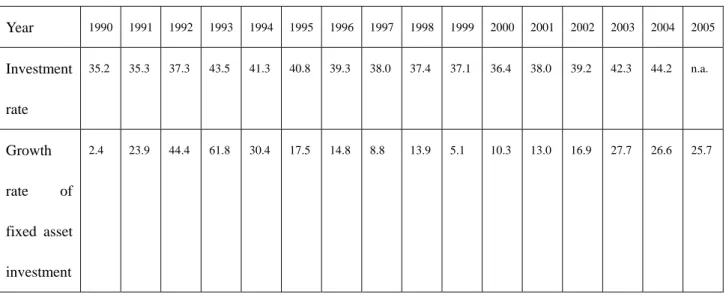
Rising money supply and loan provision have led to very high investment rates. The rate of investment in 2002, 2003, and 2004 was 39.2 percent, 42.3 percent, and 44.2 percent,
respectively. The average rate of investment between 2002 and 2004 was 41.8 percent, which was even higher than 40.7 percent on average between 1992 and 1994, when China gravely suffered from economic overheating. The growth rate of Chinese fixed asset investment reached 27.7 percent in 2003, the highest point in recent years, and was maintained at 25.7 percent in 2005. That is, the investment rate in 2005 should be the highest figure in the reform era, higher than 44.2 percent in 2004, and 37.5 percent between 1979 and 2004. (See Table 5)
Table 5. China’s Investment Rate: 1990-2005
Unit: % Year 1990 1991 1992 1993 1994 1995 1996 1997 1998 1999 2000 2001 2002 2003 2004 2005 Investment rate 35.2 35.3 37.3 43.5 41.3 40.8 39.3 38.0 37.4 37.1 36.4 38.0 39.2 42.3 44.2 n.a. Growth rate of fixed asset investment 2.4 23.9 44.4 61.8 30.4 17.5 14.8 8.8 13.9 5.1 10.3 13.0 16.9 27.7 26.6 25.7
Source: National Bureau of Statistics of China (http://www.stats.gov.cn).
4. Understated Inflation with an Asset Market Bubble
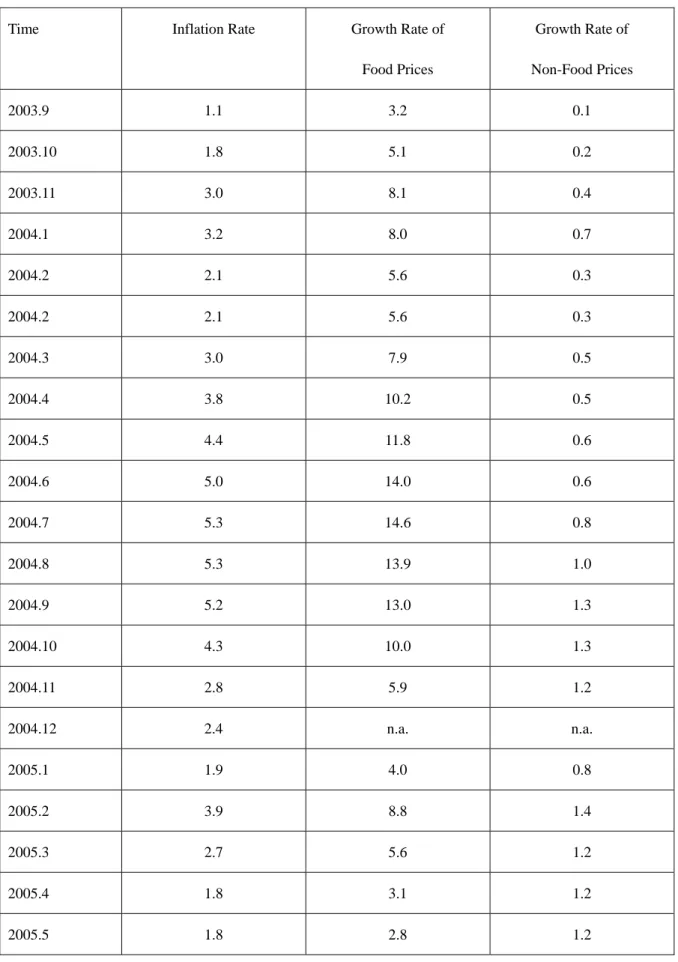
Surprisingly, rising money supply, loan provision and investment in China did not result in high inflation. Affected by rising prices of food and production materials, the consumer price index (CPI) in China increased from negative 1.3 percent in April 2002 to positive 5.3 percent in July-August 2004, reaching the highest point over the past seven years. The
0.9 percent in September 2005 and slightly rose to 1.8 percent in December 2005 due to a moderate rise in food prices. Between September 2003 and December 2005, the correlation between the monthly CPI and growth rate of food prices was 98.1 percent. (See Table 6)
Table 6: Inflation Rates in China from 2003-2005
Unit: %
Time Inflation Rate Growth Rate of
Food Prices Growth Rate of Non-Food Prices 2003.9 1.1 3.2 0.1 2003.10 1.8 5.1 0.2 2003.11 3.0 8.1 0.4 2004.1 3.2 8.0 0.7 2004.2 2.1 5.6 0.3 2004.2 2.1 5.6 0.3 2004.3 3.0 7.9 0.5 2004.4 3.8 10.2 0.5 2004.5 4.4 11.8 0.6 2004.6 5.0 14.0 0.6 2004.7 5.3 14.6 0.8 2004.8 5.3 13.9 1.0 2004.9 5.2 13.0 1.3 2004.10 4.3 10.0 1.3 2004.11 2.8 5.9 1.2 2004.12 2.4 n.a. n.a. 2005.1 1.9 4.0 0.8 2005.2 3.9 8.8 1.4 2005.3 2.7 5.6 1.2
2005.6 1.6 2.1 1.3 2005.7 1.8 2.3 1.5 2005.8 1.3 0.9 1.5 2005.9 0.9 0.3 1.2 2005.10 1.2 1.3 1.2 2005.11 1.3 1.6 1.2 2005.12 1.8 2.9 1.2
Source: National Bureau of Statistics of China (http://www.stats.gov.cn).
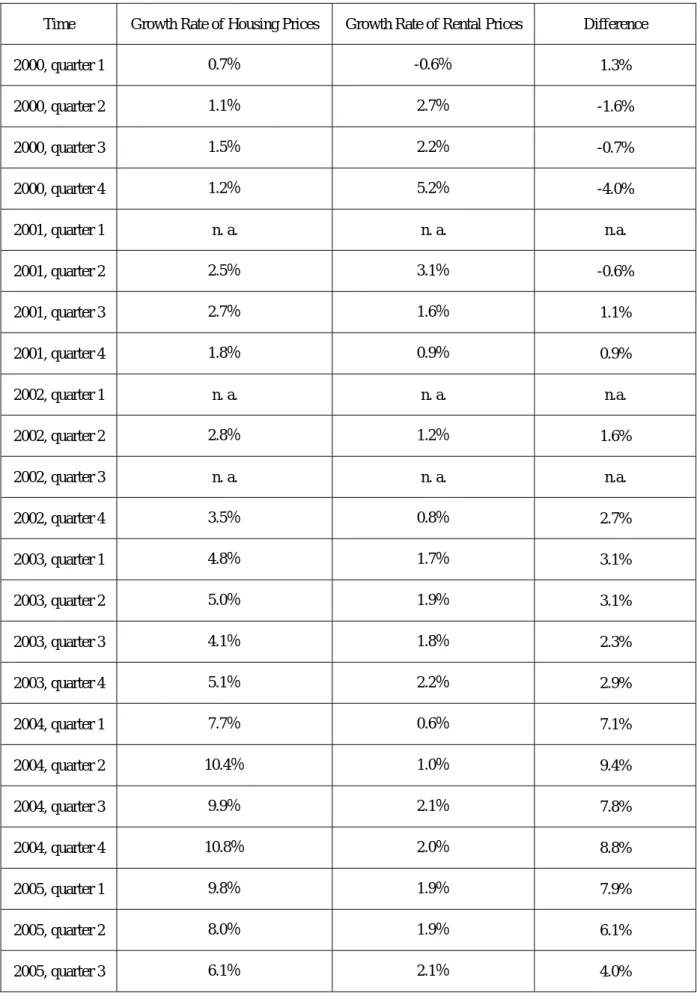
Nonetheless, China’s inflation is understated by the CPI. The low weights assigned to several goods and services included in China’s CPI – in particular housing, medical care, and education - are no longer realistic. (Bottelier 2005: 2) In particular, the market price of real estate in China has been increasing rapidly since 2003. According to surveys on 35 medium and large cities conducted by the Chinese government, the growth rate of housing prices increased from 1.6 percent in 2000-2001, to 3.2 percent in 2002, 4.8 percent in 2003, 9.7 percent in 2004, and 7.6 percent in 2005.
The asset market bubble was evident with the expanding difference between the growth rates of housing prices and the growth rates of rental prices. The difference was negative 0.5 percent during 2000-2001, increasing to 2.2 percent in 2002, 2.9 percent in 2003, 8.3 percent in 2004, and 5.7 percent in 2005. (See Table 7) The still overheated real estate market was the primary factor contributing to investment expansion in real estate and other sectors, including iron and steel, cement, and electrolytic aluminum.
Table 7: Growth Rate of Housing Prices and Rental Prices: 2000-2005
Time Growth Rate of Housing Prices Growth Rate of Rental Prices Difference
2000, quarter 1 0.7% -0.6% 1.3% 2000, quarter 2 1.1% 2.7% -1.6% 2000, quarter 3 1.5% 2.2% -0.7% 2000, quarter 4 1.2% 5.2% -4.0% 2001, quarter 1 n. a. n. a. n.a. 2001, quarter 2 2.5% 3.1% -0.6% 2001, quarter 3 2.7% 1.6% 1.1% 2001, quarter 4 1.8% 0.9% 0.9% 2002, quarter 1 n. a. n. a. n.a. 2002, quarter 2 2.8% 1.2% 1.6% 2002, quarter 3 n. a. n. a. n.a. 2002, quarter 4 3.5% 0.8% 2.7% 2003, quarter 1 4.8% 1.7% 3.1% 2003, quarter 2 5.0% 1.9% 3.1% 2003, quarter 3 4.1% 1.8% 2.3% 2003, quarter 4 5.1% 2.2% 2.9% 2004, quarter 1 7.7% 0.6% 7.1% 2004, quarter 2 10.4% 1.0% 9.4% 2004, quarter 3 9.9% 2.1% 7.8% 2004, quarter 4 10.8% 2.0% 8.8% 2005, quarter 1 9.8% 1.9% 7.9%
2005, quarter 4 6.5% 1.6% 4.9% Note:
1. Since July 2005, the Chinese government has expanded its survey coverage from 35 medium-large cities to 70 medium-large cities.
2. n.a. means data not available.
Source: China National Development and Reform Commission (http://www.sdpc.gov.cn).
5. Interest Rate Dilemma
To cool down economic overheating and prevent an asset market bubble, the Chinese government has primarily been relying on administrative measures rather than monetary policy. The government raised the deposit-reserve ratio by 1 percentage (from 6 percent to 7 percent) on September 21 of 2003 and by 0.5 percentage (from 7 percent to 7.5 percent) on April 11, 2004. In addition, the PBoC decided to raise the central bank benchmark rates on October 29, 2004, for deposit and lending by 0.27 percentage, remove the ceiling of lending rates and allow financial institutions to lower RMB deposit rates. On April 28, 2006, the PBoC further raised the benchmark lending rates by 0.27 percentage.
Nevertheless, China does not want to dramatically raise interest rates for three reasons. First, the Chinese government worries that an across-the-board increase in interest rates will affect the economic growth rate, leading to high unemployment and social instability. During 2004-2005, official registered urban unemployment rate was 4.2 percent on average, which was much lower than the real urban unemployment rate. For instance, in September 2002, Chinese premier Zhu Rongji admitted to a 7 percent urban unemployment rate, while the official rate was just 3.8 percent. In 2004, the Chinese economy would have needed to provide 29 million employment opportunities for the urban labor force, which would require at least an 8 percent economic growth rate to maintain a modest increase in the urban unemployment rate.
Second, no problem will be solved if the Chinese government attempted to raise interest rates to reduce credit expansion without the same effort by the U.S. government. For instance, in March 2004, the interest rate for the PBoC loans to Chinese financial institutions was 3.33 percent, whereas the interest rate of the US Federal funds was 1.0 percent. Therefore, the rate difference was already 2.33 percent. Raising interest rates would draw more speculative hot money, resulting in an increase in the money supply in China which, in the absence of sterilization, risks intensifying the problem of overheating.2
Third, rising interest rates will tend to reduce overall consumption and investment growth, which will worsen deflation in most industrial sectors. China’s current macroeconomic controls aim to both cool down and heat up different parts of the economy. This is far more difficult than simply cooling down the economy as a whole. The following section discusses the underlying deflation pressure in China.
6. Deflation Pressure
According to surveys on market conditions of the supply and demand of 600 commodities conducted by the Chinese Ministry of Commerce, 527 items or 86.5 percent of total commodities were in a status of excess supply, while only 4 items or 0.7 percent were in the status of excess demand in the first half of 2001. From the second half of 2001 to the first half of 2006, no single item held the status of excess demand, although the proportion of total commodities held the status of excess supply declined from 86.5 percent in the first half of 2001 to 71.7 percent in the first half of 2006. That is to say, while most industries have been in a state of deflation, a handful of sectors (such as the real estate sector) have been overheated, leading to serious imbalances among sectors in the economy. (See Table 8)
Table 8. The Market Condition of Supply and Demand of 600 Commodities:2001-2006
Unit: item, %
Time Excess supply Balanced Excess demand
2001, first half 527(86.5%) 78(12.8%) 4(0.7%) 2001, second half 500(82.9%) 103(17.1%) 0(0.0%) 2002, first half 518(86.3%) 82(13.7%) 0(0.0%) 2002, second half 528(88.0%) 72(12.0%) 0(0.0%) 2003, first half 513(85.5%) 87(14.5%) 0(0.0%) 2003, second half 473(78.8%) 127(21.2%) 0(0.0%) 2004, first half 462(77.0%) 138(23.0%) 0(0.0%) 2004, second half 446(74.3%) 154(25.7%) 0(0.0%) 2005, first half 439(73.2%) 161(26.8%) 0(0.0%) 2005, second half 428(71.3%) 172(28.7%) 0(0.0%) 2006, first half 430(71.7%) 170(28.3%) 0(0.0%) Note: The amount of surveyed commodities were 609 items in the first half of 2001, 603 items in the second half
of 2001, and 600 items for other years.
Source: Department of Market Operation Regulation, Ministry of Commerce of China (http://scyxs.mofcom.gov.cn).
7. Increasing Financial Risks
With the current RMB exchange rate level and regime, China’s financial risks are increasing in terms of four aspects: increasing sterilization bonds, increasing short-term foreign debts, increasing mismatch of assets and debts maturity structure, and emerging non-performing loans.
issuing central bank bills of RMB 5,018.1 billion (27.5 percent of GDP in 2005). The Chinese government is able to force its enormous sterilization bonds down the throats of Chinese state-owned banks without paying market interest rates, a form of financial repression. This just weakens the balance sheets of banks and raises the odds of a banking crisis somewhere down the road.
Second, China’s short-term foreign debts have been rapidly increasing since 2001. Between 1998 and 2001, China’s short-term foreign debts were US$ 15.2 billion on average and the share of short-term foreign debts in total foreign debts was 10.3 percent on average. Then, both figures jumped to US$ 50.6 billion and 29.7 percent in 2001, US$ 77 billion and 39.8 percent in 2003, and US$ 156.1 billion and 55.6 percent in 2005. Although the amount of China’s short-term foreign debts is still moderate compared to its immense foreign exchange reserves, the rapid increase would entail risks for the Chinese financial system. (See Table 9)
Table 9. The Share of Short-Term Foreign Debts in Total Foreign Debts: 1998-2005
Unit: US$ billion; %
Time Balance
Medium- and long-term debt balance
Share Short-term debt balance Share
1998.12 146.0 128.7 88.1 17.3 11.9 1999.12 151.8 136.7 90.0 15.2 10.0 2000.12 145.7 132.7 91.0 13.1 9.0 2001.12 170.1 119.5 70.3 50.6 29.7 2002.12 168.5 115.6 68.6 53.0 31.4 2003.12 193.6 116.6 60.2 77.0 39.8
Exchange (http://www.safe.gov.cn).
Third, in the past five years, Chinese commercial banks tended to have short-term debts and carry long-term assets, increasing mismatch of debts and assets maturity structure. The proportion of short-term savings deposits in the total household savings deposits in financial institutions increased from 28.3 percent at the end of 2000 to 34.6 percent at the end of 2005. Meanwhile, the proportion of medium- and long-term loans in the total loans increased from 29.8 percent at the end of 2000 to 50.0 percent at the end of 2005.
Fourth, the rapid expansion of investment under the guidance of local governments can easily lead to blind investing and redundant construction and may result in new non-performing loans (NPLs), further aggravating financial risks. (NPLs 2004) The proportion of fixed asset investment conducting by local governments increased from 76.5 percent in 2001 to 80.6 percent in 2002, 86.4 percent in 2003, 87.6 percent in 2004, and 88.5 percent in 2005. This figure further increased to 89.7 percent in the first two months of 2006. Particularly, once the asset market bubble bursts, NPLs will increase sharply and thus exacerbate the already serious financial risks in China. During the period from 1992 to 1994, 40 percent of the new loans became NPLs. (Goldstein and Lardy 2004: 6) If only one-third of the new loans extended between 2002 and 2005 resulted in NPLs, the stock of NPLs would have increased by RMB 2.7 trillion (15 percent of GDP in 2005) during this period.
V.
Suggestions on China’s Renminbi Exchange Rate Policy
1. A Long-Term Strategy and a Short-Term Solution
In the long-term, with gradual financial integration, China should transform its exchange rate regime to a pure float or monetary union. Monetary union should not be the priority of such a large economic entity as China in the long-term; because in doing so, China must give up its monetary independence. Nevertheless, it is now premature for China to introduce a pure
float exchange rate regime, because a pure float regime might cause an undershooting or overshooting in China’s fragile financial system, dramatically impacting overall economic development. In addition, due to the lack of an appropriate risk-prevention mechanism, free floating exchange rates will have an adverse impact on international trade and investment.
Furthermore, it is in China’s best interest to maintain capital account controls in the short-term due to weaknesses in China’s financial system. It is very perilous that the Chinese government has been expanding its capital account in order to encourage capital outflow and thus reduce rapid accumulation of foreign exchange reserves. It will be very difficult to close Chinese capital account when massive capital inflow turns into sudden outflow, which might trigger a balance-of-payments crisis and a hard landing of the Chinese economy. (Calvo 2000)
Obviously, Chinese current gradualist approach can not reverse increasing economic internal and external imbalances. This approach will not stop the huge capital inflows and the associated vast reserve accumulation. Indeed, the go-slow approach may actually invite more hot-money inflows since speculators will assume that these small policy adjustments are only precursors to a large exchange rate appreciation. That is, the go-slow approach may well create a “one way bet” for speculators and thereby increase speculation on an RMB appreciation.
In dealing with the expanding loopholes in capital account controls, the Chinese government should consider expanding the floating band of the RMB exchange rate in order to adapt to integration trends in the international capital market. This could serve well as an exit strategy from a fixed rate to a more flexible regime during a transitional period into the long-term. In addition, the sharp devaluation of the US dollar against other major currencies between 2002 and 2004 has resulted in persistent expectations of a RMB appreciation since
(1) Allow the RMB to appreciate immediately by 10-15 percent (the estimated minimum margin of an RMB appreciation);
(2) Expand the floating band from ±0.3 percent to 5-7 percent around a central parity; and
(3) Maintain the central parity based on the new level of the RMB exchange rate until the rate is again out of equilibrium by a wide margin.
These steps will reduce the speculative expectation on the disequilibrium of the RMB exchange rate in the market, and reduce the need for frequent adjustment of the RMB exchange rate. By widening the currency band, China can gain valuable experience with managing greater currency flexibility, at the same time as it improves institutional structures and the depth of the foreign exchange market.
If the Chinese government does not allow for full appreciation of the RMB, the net inflow of international capital, especially speculative hot money, and the dramatic increase of foreign exchange reserves will continue. The external imbalances will result in China’s ballooned sterilization costs, loss of monetary autonomy, growing asset market bubble and increased financial risks. Meanwhile, it is important to convince market participants that the change of exchange rates is complete, not the first step; the mechanism of the RMB exchange rate formation is reasonable, and the RMB exchange rate will not lose equilibrium in the short-term.
2. Address Chinese Concerns of the Negative Impacts
Chinese policy makers have two major concerns about a 10-15 percent revaluation of the RMB: causing deflation and undermining export competitiveness, which thus reduce economic growth and increase unemployment pressure. However, these concerns are overstated.
half of the raw materials or intermediate goods will be re-exported after processed. In 2003-2005, around 55 percent of China’s exports were processing exports, whereas the processing imports accounted for around 40 percent. The impact of an RMB appreciation on domestic prices would not completely reflect the range of nominal appreciation.
Second, an RMB revaluation would reduce the import costs, thus balancing part of the negative influence of the currency appreciation on China’s export competitiveness. Labor costs and domestic materials accounted for only 30 percent of China’s processed exports and 50 percent of the total exports. (Anderson 2003: 16) Therefore, if the RMB were to appreciate by 15 percent, the total price of China’s exports, denominated in foreign currencies, would either maintain the same or even drop by 6 percent, making China’s exports more competitive.3
Third, previous experience shows that changes in the nominal exchange rate of the RMB do not adversely affect China’s export competitiveness. During 1992-2004, the correlation rate between the nominal effective exchange rate (NEER) of the RMB and China’s export growth was negative 17.5 percent, while that between the RMB/USD exchange rate and the growth of China’s exports to the United States was negative 71.8 percent. Moreover, China’s market share in the global export market increased from 2.3 percent in 1992 to 6.5 percent in 2004. China’s market share in the global export market is still expanding, despite the fact that the RMB has appreciated against Asian currencies by around 40 percent in the aftermath of the Asian financial crisis in 1997 and 15 percent by late 2003. (Anderson 2003: 40) After China’s revaluation of the RMB exchange rate after July 2005, China’s exports continued to increase by 25.7 percent on average between August 2005 and March 2006. That is to say, China’s export competitiveness is primarily based on cheap labor in China, rather than on
maintaining a cheap RMB. (See Table 10)
Table 10. The RMB Exchange Rate and China’s Export Competitiveness: 1992-2004
Year 1992 1993 1994 1995 1996 1997 1998 1999 2000 2001 2002 2003 2004 Nominal effective exchange rate 119.27 95.75 86.68 85.63 89.25 95.11 99.45 97.31 100 104.49 103.59 96.48 92.01 Export growth (%) 18.1 8.0 31.9 23.0 1.5 21.0 0.5 6.1 27.8 6.8 22.4 34.6 35.4 RMB/US dollar exchange rate 5.51 5.77 8.45 8.32 8.30 8.28 8.28 8.28 8.28 8.28 8.28 8.28 8.28 Growth of export to the U.S. (%) 36.7 102.2 26.2 15.5 8.0 22.5 16.0 10.7 24.1 4.2 28.8 32.2 35.1 Market share in the global export market (%)
2.3 2.4 2.8 2.9 2.8 3.3 3.3 3.4 3.9 4.3 5.0 5.8 6.5
Note:
1. Nominal Effective Exchange Rate is calculated as a weighted average of nominal exchange rates against main trade partner countries’ currencies. Nominal Effective Exchange Rates are presented as indices. The growth of the index means appreciation of the local currency. The reduction indicates depreciation.
2. The data of China’s export to the U.S. comes from the Chinese official statistics.
Source: The International Financial Statistics by the International Monetary Fund, World Trade Organization (http://www.wto.org) and Chinese Ministry of Commerce (http://www.mofcom.gov.cn).
Finally, the experience of the 1990s does not suggest that real appreciation of the RMB will cause China’s growth performance to unduly fall. Between 1994 and 2001, the NEER of the RMB rose by 17.8 percent, while the average growth rate of the Chinese economy from
1994 through 2001 was 9.4 percent and in no single year did the growth rate fall below 7.5 percent. In 2004-2005, the overheated Chinese economy grew at 10 percent, with the increasing asset market bubble and escalating financial risks. The sustainable growth rate is clearly less than that. It is hard to imagine that a 10-15 percent real appreciation of the RMB would propel China’s growth much below the desired rate.
VI.
Conclusion
In the long term, with gradual financial integration, China must transform its exchange rate regime to a pure float or monetary union. Nevertheless, it is premature now for China to introduce a pure float or monetary union. In addition, China should not open up capital account controls in the short-term, but needs to face the hard reality of the increasing capital account leakage. Furthermore, the sharp devaluation of the US dollar against other major currencies between 2002 and 2004 has resulted in the undervalued RMB and invited considerable foreign capital (hot money) inflows to China. In turn, mounting economic external imbalances have been leading to growing economic internal imbalances characterized by the asset market bubble and ever-increasing financial risks.
Based on the above trends, a practical approach for the Chinese government to address the RMB exchange rate issues is to allow the RMB to immediately appreciate by 10-15 percent, expand the floating band of the RMB exchange rate from ±0.3 percent to 5-7 percent, and maintain the central parity based on a new level of the RMB exchange rate until the rate is again out of equilibrium by a wide margin.
Nevertheless, there is no timetable for the adjustment of the RMB exchange rate as long as the Chinese government can tolerate the expanding economic bubble and escalating
financial risks, further exacerbating the pressure on the RMB to appreciate and attracting more hot money into China, until the point where the RMB is appropriately revalued. In the future, the awesome power of the international financial market will most likely create a “self-fulfilling prophecy” RMB appreciation.
References
Anderson, Jonathan, 2003, “The Complete RMB Handbook,” Asian Economic Perspectives, UBS Securities Asia Ltd., October 27.
Bond, T.J., Marcel Kasumovich, Yianos Kontopoulos, and Vincent Low, 2004, “China’s FX Regime: Moving the Great Wall,” Merrill Lynch, March 3.
Bottelier, Pieter, 2005, presentation note at the China Seminar, sponsored by the American Enterprise Institute, January 10.
Calvo, Guillermo A., 2000, “Balance-of-Payments Crises in Emerging Markets,” in Paul Krugman (ed.), Currency Crises (Chicago: The University of Chicago Press), pp. 71-104. Calvo, Guillermo A., and Enrique G. Mendoza, 1996, “Mexico’s Balance-of-Payments Crisis:
A Chronicle of a Death Foretold,” Journal of International Economics, vol. 41, pp. 235-264.
Calvo, Guillermo A., and Carmen M. Reinhart, 2002, “Fear of Floating,” Quarterly Journal of Economics, vol. 117, no. 2, pp. 379-408.
Chang, Gene Hsin and Qin Shao, 2004, “How Much Is the Chinese Currency Undervalued? A Quantitative Estimation,” China Economic Review, no. 15, pp. 366-71.
Christensen, Jakob, 2004, “Capital Inflows, Sterilization, and Commercial Bank Speculation: The Case of the Czech Republic in the Middle-1990s,” International Monetary Fund, IMF Working Paper, WP/04/218.
Dunaway, Steven, and Xiangming Li, 2005, “Estimating China’s ‘Equilibrium’ Real Exchange Rate,” IMF Working Paper, WP/05/202.
Eichengreen, B., A. Rose, and C. Wyplosz, 1996, “Speculative Attacks on Pegged Exchange Rates: An Empirical Exploration with Special Reference to the European Monetary System,” in M. Canzoneri, W. Ethier, and V. Grilli (eds.), The New Transatlantic Economy (New York: Cambridge Press), pp. 191-235.
Eichengreen, Barry, and Paul Masson, 1998, “Exit Strategies: Policy Options for Countries Seeking Greater Exchange Rate Flexibilities,” Occasional Paper no. 168, International Monetary Fund, Washington DC.
Fischer, Stanley, 2001, “Exchange Rate Regimes: Is the Bipolar View Correct?,” Journal of Economic Perspectives, vol. 15, no. 2, pp. 3-24.
Frankel, Jeffrey A., 1999, “No Single Currency Regime Is Right for All Countries or at All Times,” Princeton University, Essays in International Finance, No. 215.
---, 2004, “On The Renminbi: The Choice between Adjustments under a Fixed Exchange Rate and Adjustment under a Flexible Rate,” revised version of the paper presented at the High-Level Seminar on Foreign Exchange System held by the International Monetary Fund and the People’s Bank of China, Dalian, China, May 26-27, 2004.
Goldstein, Morris, 2004, “Adjusting China’s Exchange Rate Policies,” Revised version of the paper presented at the International Monetary Fund’s seminar on China’s Foreign Exchange System, Dalian, China, May 26-27.
Goldstein, Morris, and Nicholas R. Lardy, 2004, “What Kind of Landing for the Chinese Economy,” Institute for International Economics, Policy Briefs, no. PB04-7.
“Governor Zhou Xiaochuan Answers Questions on RMB Exchange Rate,” People’s Bank of China, September 3, 2003, accessed August 21, 2004, at <http://www.pbc.gov.cn/english/xinwen/>.
American Economy,” Gongshang Shibao [Commercial Times], March 31.
Krugman, P.R., 1979, “A Theory of Balance of Payments Crises,” Journal of Money, Credit and Banking, no. 11, pp. 311-25.
Krugman, Paul, 2000, “Introduction,” in Paul Krugman (ed.), Currency Crises (Chicago: The University of Chicago Press), pp. 1-6.
McKinnon, Ronald I., 2004, “The East Asian Dollar Standard,” China Economic Review, no. 15, pp. 325-30.
“NPLs of China’s Commercial Banks Continue to Decrease During the 3rd Quarter of 2004” (in Chinese), 2004, China Banking Regulatory Commission, October 28.
Obstfeld, Maurice, 1986, “Rational and Self-Fulfilling Balance-of-Payments Crises,” American Economic Review, vol. 76, no. 1, pp. 72-81.
---, 1996, “Models of Currency Crises with Self-Fulling Features,” European Economic Review, vol. 40, no. 3-5, pp. 1037-47.
Prasad, Eswar, Thomas Rumbaugh, and Qing Wang, 2005, “Putting the Cart before the Horse? Capital Account Liberalization and Exchange Rate Flexibility in China,” IMF Policy Discussion Paper, PDP/05/1.
Tung, Chen-yuan, 2005, “Renminbi Huilu zhi Guoji Zhengzhi Jingji Fengxi [The International Political Economic Analysis on the Renminbi Exchange Rate],” Wenti yu Yanjiu [Issues and Studies], vol. 44, no. 6, pp. 133-156.
Wang, Xiaobo, 2004, “Premier Wen Warns against Speculators” (in Chinese), Gongshang Shibao [Commerce Daily], December 1.
Wang, Chuozhong, 2004, “Expectation on RMB Appreciation Draws More Hot Money” (in Chinese), Zhongguo Shibao [China Times], December 2, p. A13.
Xu, Sichia, 2005, “International Speculative Money Bids for RMB appreciation,” Zhonghua Gongshang Shibao [Chinese Commerce Times] (Beijing), May 13, 2005.