Fairness Improvement on the Distributed Coordination Function of IEEE
802.11 Networks
Yueh-Hsiung Lee, Jonathan Chun-Hsien Lu*, and Hsin-Hung Lin
Dept. of Computer Science and Information Engineering
Fu Jen Catholic University, Taipei, Taiwan
*[email protected]
Abstract
It has been known that using IEEE 802.11 as the link layer protocol in ad hoc networks causes serious performance and fairness problems. In this paper, we propose an improved coordination mechanism to handle the fairness problems by asking each wireless device to maintain a neighbor list. Each device can determine when it should transmit or receive a frame by first probing if any neighbor wishes to transmit, then trying to share the bandwidth evenly with the neighbors. We compare our mechanism with IEEE 802.11 using ns-2 to show that all the fairness issues in these known topologies can be improved at the cost of slight drop in the total throughput.Keywords: Fairness issue, IEEE 802.11, MAC protocol, performance evaluation
1. Introduction
The IEEE 802.11 standard [1] was originally designed for infrastructure-based networks, which applies one-hop communication. However, it has been known that IEEE 802.11 suffers from poor performance and unfairness problems when applied to ad hoc networks because each data frame may need to travel multiple hops before reaching its destination. Three possible situations that cause fairness problems are listed as follows: (i) The node cannot transmit or receive for a long time. (ii) The random backoff time a node waits following a busy medium condition is too long. (iii) The node waits an EIFS time rather than a DIFS time in regular condition. Both the first two situations often result in long-term fairness issues, while the third one usually results in short-term fairness issue.
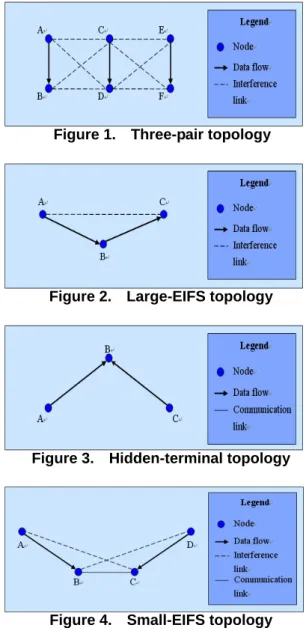
Several known elementary topologies suffering from the fairness issues were shown in [2], which are presented again in figures 1 to 4. The fairness issues those topologies are involved with can be classified into three main categories: long-term fairness issues, short-term fairness issues, and overall throughput decrease. In those figures a solid line between two nodes means that they are within direct transmission range to each other. A dashed line represents that the two nodes are within the sensing range, which means that they are too far away to exchange frames, but still close enough
to sense each other. Typically, the sensing range is twice the transmission range in wireless networks [3]. A node out of the transmission range can still sense the signal and interpret that a collision has occurred. This is the main reason why the interfered node is forced to wait an EIFS time.
The topologies suffering from long-term fairness Figure 1. Three-pair topology
Figure 2. Large-EIFS topology
Figure 3. Hidden-terminal topology
issue are shown in figures 1 and 2. In these topologies certain nodes can only consume much lower bandwidth than the others because either they have a higher chance of sensing the medium busy or their RTS/CTS frames encounter a higher chance of collision. In figures 3 and 4 only short-term fairness issues occur since these topologies are symmetric. In these topologies a successful transmitter will reset its contention window size and wait a shorter backoff time in the next round and transmit consecutive frames in a short time, while the other transmitter will be blocked by the absence of a CTS response. This situation is bursty for both transmitters. In this paper, we propose a new MAC protocol, called the ANF mechanism, to solve both the long-term and short-term fairness issues mentioned in this section. The rest of this paper is organized as follows: Section two summarizes the related work. Section three presents our proposed improved method, while section four evaluates the fairness and performance improvement of our method. Finally, we conclude the thesis in section five.
2. Related Work
Many approaches have been proposed to improve the performance or the fairness issues of IEEE 802.11 since it was established. These approaches, however, address certain issues specifically, and none of them seems to be general enough to handle all the topologies mentioned before at the same time.
The approaches in the literature can be classified into the three categories according to the approach employed: Contention window based, IFS based, and frame exchanged based. To solve the short-term fairness issue, the authors in [4] suggest penalizing the wireless device which transmits too much with a penalty progression curve in the random backoff period. However, it would result in reduction of the total available bandwidth, and the unstable throughput would cause problems for real-time applications. Authors in [5] propose a different backoff scheme in which each wireless device adapts its contention window to control its own throughput. Nonetheless, it is not easy to set appropriate thresholds for the contention window. The authors in [6] modify the random backoff algorithm by using a backoff copying scheme in order to achieve a fair allocation of throughput. In [7], a dynamic medium access control is adopted by estimating the probabilities with which its neighbors would transmit. Each wireless device then decides whether to transmit based on its probability estimate. Nonetheless, this scheme could decrease the entire throughput.
The authors in [8] identify two problems called the small-EIFS problem and the large-EIFS problem, which are involved with the short-term fairness and the long-term fairness, respectively. To solve these problems, all of the wireless devices wait a flexible EIFS time instead of fixed duration based on the type and length of the received erroneous frame. Thus, each kind of frame type corresponds to a different IFS value.
Among the frame exchange based methods, the
authors in [6] add two new frame types: data-sending (DS) and request-for-request-to-send (RRTS) to solve some contention problems. Before sending data, a short 30-byte DS frame is used to announce that the RTS/CTS handshake is successful, and an RRTS frame is sent during the next contention period. In [9], different frame-exchange handshake mechanisms are employed according to the distance between the source and the destination. The receiver can also send a negative CTS (NCTS) frame to block transmitting, or send CTSR frame to resume transmitting. Although the total throughput is improved by these frames exchanges, the fairness issues are only partially solved. The authors in [7] propose to modify the RTS/CTS handshake mechanism, where a wireless device only responds to the CTS frame when the receiving power of the RTS frame is larger than a given threshold to prevent potential interference.
3. Ask Neighbors First (ANF) Polling
We propose a mechanism called Ask Neighbors First (ANF), which is designed to handle all the short-term and the long-term fairness issues mentioned previously. The major idea of ANF is as follows: Each wireless device must learn and record a list of the MAC addresses of its one-hop neighbors by overhearing those frames which contains the TA field, including the RTS frame, CTS frame, data frame, and the two new frames (ANF frame and RANF frame) that we will introduce later. Before transmitting a data frame, each wireless device has to poll its one-hop or two-hop neighbors about whether they wish to transmit in the next round or not.
A. Frame Type
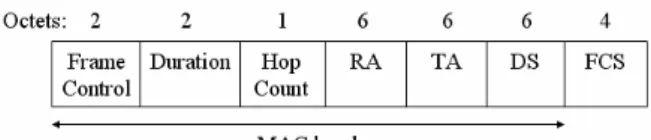
In order to poll the neighbors, we propose to modify the original CTS frame by adding three more fields (Hop Count, TA, and DS) as shown in figure 5. The Destination (DS) field is used by the wireless device which has sent an RTS frame and is waiting for this CTS frame. When a wireless device receives a CTS frame whose DS field contains its physical address, it is then permitted to send a data frame immediately. The RA field indicates the intermediate device which should help forward this CTS frame to the destination. The TA field records the address of the transmitter. In addition, any wireless device can update its neighbor list by consulting the TA field in any CTS frame it has received or overheard. The initial value of the hop count field is set to one for one-hop polling and two for two-hop polling, respectively. Upon receiving a CTS frame, a device decrements the hop count by one, and forwards the CTS frame if the hop count has not reached zero.
We also propose to add two new types of control frames: the Ask Neighbors First (ANF) frame and the Reply to ANF (RANF) frames, both of which share the same format as the modified CTS frame. Different bit settings in the frame control field are used to differentiate the frame types. Before sending an ANF frame, a device puts the broadcast address into the RA field. Upon receiving an ANF frame, a device ignores it if it does not wish to send any data frame. Otherwise, the device checks if the address in the TA field exists in its neighbor list, and replies an RANF frame if it does. The hop count field serves the same purpose as in the modified CTS frame. The wireless device decides to receive or forward these frames according to the RA and the DS fields.
B. One-hop Polling
We use one-hop polling to solve the short-term fairness issues. In one-hop-polling, each device must first establish its neighbor list by copying the TA fields from the various frames it has received. Now suppose a wireless device X receives an RTS frame destined for it. If some other device has made reservation to transmit in the next round, device X should remain silent until its NAV reaches zero. Otherwise, instead of replying with CTS directly, it would issue an ANF frame to poll all its neighbors. If a neighbor Y wishes to transmit a data frame to X, device Y will respond with an RANF frame and X records in the reservation queue to note that Y has been successful in reserving the next round to transmit to X. Regardless of whether an RANF frame comes back or not, the device waits a short period only and then replies a CTS frame back to the source.
After completing the reception of a data frame, X checks the reservation queue immediately. If it is not empty, it then issues a CTS frame to the device at the head of the queue. Therefore, any device that has succeeded in reserving a transmission does not need to send an RTS frame again. The processing of the CTS frame in one-hop polling is the same as in IEEE 802.11. After receiving the corresponding CTS frame, a wireless device can begin transmitting a data frame.
C. Two-hop Polling
We propose a two-hop polling mechanism to handle the long-term fairness issues, where the CTS, ANF and RANF frames will be forwarded to the neighbors two hops away. In one-hop polling, both the RA field and the DS field of the CTS frame always contain the same physical address. A wireless device will process a CTS frame only if its address is shown in the DS field. However, in two-hop polling, a wireless device has to consult both the RA and DS fields. Assume device X just receives a CTS frame. If the hop count equals two and the RA field contains X but the DS field does not, this means that device X, acting as an intermediate node, should decrement the hop count and forward it to all its neighbors. If both the DS and the RA fields match X, then device X is allowed to send a data frame, and it does not need to forward this CTS frame.
The rules of processing the ANF or RANF frame are the same as for the CTS frame. A wireless device X will process an ANF or RANF frame only if the DS field contains X. In the same way, the wireless device forwards the ANF or RANF frame to its neighbors when the RA fields matches but the DS does not. After receiving an ANF frame, the device can reply an RANF frame to reserve the next transmission. The initial value of hop count field in an RANF frame is always set to two.
4. Performance Evaluation
A. Simulation Environments
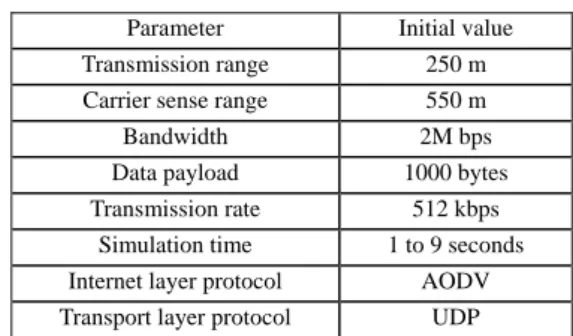
We use a modified version of the ns-2 network simulator [10] to evaluate our fairness improvement compared with IEEE 802.11. The transmission range is limited to 250 meters, and the carrier sense range is 550 meters. The channel bandwidth is 2 Mbps, the payload of each data frame is 1000 bytes, and the data frame is sent in a constant bit rate (CBR) of 512 kbps. We use AODV as the routing protocol and UDP instead of TCP for the transport layer to minimize the complexity in analysis. Table 1 lists the parameters used in our simulation.
Table 1. Simulation parameters
Parameter Initial value
Transmission range 250 m Carrier sense range 550 m
Bandwidth 2M bps
Data payload 1000 bytes Transmission rate 512 kbps
Simulation time 1 to 9 seconds Internet layer protocol AODV Transport layer protocol UDP
We measure the end-to-end throughput and the average end-to-end response time in our simulation to investigate the four topologies mentioned previously. The average end-to-end response time of a data frame is from the instance of sending the RTS or RANF frame to the moment of receiving the ACK frame. The end-to-end throughput is divided into the per-pair throughput and the aggregate throughput. The per-pair throughput can be observed to evaluate the fairness on each link, while the overhead of the ANF mechanism can be found from the aggregate throughput.
B. Simulation Results The Three-pair Topology
The three-pair topology shown in figure 1 suffers from long-term unfairness. The middle pair is interfered by the other two data flows which can transmit and receive at the same time. Figure 6 shows that the end-to-end throughputs of the three pairs under ANF are much closer than those of IEEE 802.11, which significantly improves the fairness issue. Figure 7 shows that the aggregate throughput under ANF is about 114
kbps lower than IEEE 802.11 due to the exchange of more control frames. Although these three pairs are too far away to exchange control messages to each other, the ANF mechanism is successful in providing a higher chance to transmit for the middle C-D pair.
Throughput 0 200 400 600 800 0 2 4 6 8 Time (Sec.) Kb / S ec . ANF A-B ANF C-D ANF E-F 802.11 A-B 802.11 C-D 802.11 E-F
Figure 6. End-to-end throughputs for three-pair topology Throughput 0 400 800 1200 1600 0 2 4 6 8 Time (Sec.) Kb / S ec . ANF 802.11
Figure 7. Aggregate end-to-end throughputs for three-pair topology
Large-EIFS Topology
The large-EIFS topology has a long-term fairness problem where the successful pair will cause the other pair to wait a larger EIFS time. With ANF, the end-to-end throughputs of the two pairs shown in figure 8 are brought closer than IEEE 802.11, while the aggregate throughput with ANF is a little bit higher than IEEE 802.11 shown in figure 9.
Throughput 0 200 400 600 0 2 4 6 8 Time (Sec.) Kb / S ec . ANF A-B ANF B-C 802.11 A-B 802.11 B-C
Figure 8. End-to-end throughputs for large-EIFS topology Throughput 0 300 600 900 0 2 4 6 8 Time (Sec.) Kb / S ec . ANF 802.11
Figure 9. Aggregate end-to-end throughputs for large-EIFS topology
Hidden-terminal Topology
The hidden-terminal topology shown in figure 3 suffers from the short-term fairness issue because the successful transmitter can keep accessing the medium continuously until a collision occurs. Figure 10 and 11 show that with ANF the average throughputs of these two pairs become more balanced and stable, while the aggregate throughput is dropped by roughly 40 kbps.
Throughput 0 100 200 300 400 500 0 2 4 Time (Sec.) Kb / S ec . ANF A-C ANF B-C 802.11 A-C 802.11 B-C
Figure 10. End-to-end throughputs for hidden-terminal topology Throughput 0 300 600 900 0 1 2 3 4 5 Time (Sec.) Kb / S ec . ANF 802.11
Figure 11. Aggregate end-to-end throughputs for hidden-terminal topology
Small-EIFS Topology
The small-EFIS topology in figure 4 is involved in the short-term fairness issue. This situation is similar with the three-pair topology where two transmitters are unconnected and the winner transmitter has a higher chance to transmit again. Figure 12 shows that ANF improves fairness very well by making the throughputs of the two pairs more equal and stable from early on. Figure 13 shows that the aggregate throughputs with and without ANF are roughly the same.
Throughput 0 200 400 600 0 2 4 6 8 Time (Sec.) Kb / Se c. ANF A-B ANF D-C 802.11 A-B 802.11 D-C
Figure 12. End-to-end throughputs for small-EIFS topology Throughput 0 300 600 900 0 2 4 6 8 Time (Sec.) Kb / Se c. ANF 802.11
Figure 13. Aggregate end-to-end throughputs for small-EIFS topology
In table 2 we compare the average end-to-end response times for all the four topologies under the original IEEE 802.11 and our ANF algorithm. It can be seen that the response times under ANF are about three times higher than IEEE 802.11 because of the exchange of the ANF/RANF control frames. Since the response times are around 0.03 second only, it should not present serious impact on most applications.
Table 2. Average end-to-end response time Time (microseconds) Topology IEEE 802.11 ANF Three-pair 9534 9597 Large-EIFS 9515 29693 Hidden terminal 9534 28763 Small-EIFS 9531 30849
5. Conclusion
Both long-term and short-term fairness issues arise more often in IEEE 802.11 ad hoc networks when a large amount of data is transmitted since those wireless devices share the same resource. Furthermore, contention and collisions occur more often than in the infrastructure mode due to lack of coordination. In order to solve these problems, in this paper we propose a new ANF algorithm to help coordinate the data transmission of the wireless devices in a neighborhood. Each device sends out ANF frames to inquire if any other device in the neighborhood wishes to transmit, and records the outcome in the reservation queue. A device then shares the bandwidth with its neighbors by holding its own CTS reply such that the neighbors in the reservation
queue can have an even chance to transmit data. Our simulations verify that the ANF scheme can significantly improve the fairness on the DCF of IEEE 802.11 without exchanging extensive information. In addition, the overhead of ANF is only a slight drop in the aggregate throughput and higher response time. Therefore, ANF is useful and provides a stable link layer for ad hoc networks.
References
[1] “IEEE Standard for Information Technology - Telecommunications and Information Exchange between Systems - Local and Metropolitan Area Networks - Specific Requirements Part II: Wireless LAN Medium Access Control (MAC) and Physical Layer (PHY) Specifications,” 2003. [2] C. Chaudet , D. Dhoutaut , I. G. Lassous,
“Performance issues with IEEE 802.11 in ad hoc networking,” IEEE Communications Magazine, Volume 43, Issue 7, July 2005, Pages:110-116. [3] G. Anastasi, M. Conti, and E. Gregori, “Mobile
Ad Hoc Networking,” Chapter 8, IEEE 802.11 Ad Hoc Networks: Protocols, Performance and Open Issues, IEEE and Wiley-interscience, 2004, pages 69-116.
[4] D. Dhoutaut and I. G. Lassous, “Impact of Heavy Traffic Beyond Communication Range in Multi-Hops Ad Hoc Networks,” 3rd International Network Conference, Plymouth, U.K., July 2002. [5] B. Bensaou, Y. Wang, and C. C. Ko, “Fair
Medium Access in 802.11 Based Wireless Ad-Hoc Networks,” 1st Annual Workshop on Mobile and Ad Hoc Networking and Computing, 2000, pages 99-106.
[6] V. Bharghavan, A. Demers, S. Shenker, and L. Zhang, “MACAW: a Media Access Protocol for Wireless LAN’s,” Proceedings of the Conference on Communications Architectures, Protocols and Applications, London, U.K., Aug. 1994, pages 212-225.
[7] K. Xu, M. Gerla, and S. Bae, “Effectiveness of RTS/CTS Handshake in IEEE 802.11 based Ad Hoc Networks,” Ad Hoc Networks Journal, Volume 1, Jul. 2003, pages 107-123.
[8] Z. Li, S. Nandi, and A. Gupta, “Improving MAC Performance in Wireless Ad Hoc Networks Using Enhanced Carrier Sensing,” Communications, IEE Proceedings, Volume 151, Issue 5, 24 Oct. 2004, Pages 467-472.
[9] H. Zhai, and Y. Fang, “Distributed Flow Control and Medium Access in Multihop Ad Hoc Networks,” IEEE Transactions on Mobile Computing, Volume 5, Issue 11, Nov. 2006, pages 1503-1514.
[10] The Network Simulator - ns-2: http://www.isi.edu/nsnam/ns/