A comparative study of the electronic structures of oxygen- and
chlorine-treated nitrogenated carbon nanotubes by x-ray absorption and
scanning photoelectron microscopy
S. C. Ray, C. W. Pao, H. M. Tsai, J. W. Chiou,a兲and W. F. Pongb兲 Department of Physics, Tamkang University, Tamsui 251, Taiwan
C. W. Chen
Department of Material Science and Engineering, National Taiwan University, Taipei 106, Taiwan M.-H. Tsai
Department of Physics, National Sun Yat-Sen University, Kaohsiung 804, Taiwan P. Papakonstantinou
NRI, School of Electrical and Mechanical Engineering, University of Ulster at Jordanstown, Newtownabbey, County Antrim, BT37OQB Northern Ireland, United Kingdom
L. C. Chen
Center for Condensed Matter Sciences, National Taiwan University, Taipei 106, Taiwan K. H. Chen
Institute of Atomic and Molecular Sciences, Academia Sinica, Taipei 106, Taiwan
共Received 24 September 2007; accepted 19 October 2007; published online 13 November 2007兲 The electronic structures and bonding properties of oxygen- and chlorine-treated nitrogenated carbon nanotubes共N-CNTs兲 were studied using x-ray absorption near-edge structure 共XANES兲 and scanning photoelectron microscopy. Features in the C K-edge XANES spectra are shifted by ⬃0.3 eV toward higher energies and by ⬃1.1 eV toward lower energies relatively to those of the more symmetrical pyridinelike and graphitelike structured N-CNTs upon chlorination and oxidation, respectively. Increases in N K-edge XANES intensities for both chlorination and oxidation reveal substitution of C–C bonds by C–N bonds consistent with the observed valence-band photoemission spectra of the decrease of the C 2s bond and the increase of the N 2s bond. © 2007 American
Institute of Physics. 关DOI:10.1063/1.2807275兴
The chemical modification of carbon nanotubes共CNTs兲 is of great interest as related changes in their mechanical, electrical, and electronic properties are useful for various ap-plications from nanoelectronic and nanoelectromechanical systems to nanocomposites.1Among the numerous chemical modifications/treatments of CNTs; functionalization, disper-sion, and chemical doping with various functional groups yield many opportunities for tuning the structural and elec-tronic properties.2 Ago et al.3 examined various oxidative treatments of CNTs based on the density of states of valence bands and work function. Recently, Watts et al.4 found increases/decreases in the conductivity of CNTs upon oxy-gen treatment. Weglikowska et al.2 observed a similar in-crease in the conductivity and change in the Fermi level共Ef兲 during the chemical modification of CNTs. Upon chlorine treatment using dichlorocarbene, the surfaces of CNTs are modified with the presence of other functional forms of carbon.5However, upon oxidation and chlorination, not only surface modification but also changes in the structural and electronic properties occur.2–6 More recently, x-ray absorp-tion results and theoretical calculaabsorp-tions have revealed that chlorine-bonded compounds共C–Cl bond兲 formed on the
ni-trogenated carbon nanotubes 共N-CNTs兲 and their electronic properties changes during the functionalization of N-CNTs in a chlorine plasma atmosphere共N-CNTs:Cl兲.7 In the present work, the electronic properties of oxygen-treated N-CNTs 共N-CNTs:O兲 were investigated using C and N K-edge x-ray absorption near-edge structure 共XANES兲, scanning photo-electron microscopy共SPEM兲, and theoretical calculation of the partial density of states 共PDOSs兲; the results are com-pared with those of N-CNTs:Cl presented elsewhere.7
The C and N K-edge XANES, SPEM images, and valence-band photoemission spectra were performed at the National Synchrotron Radiation Research Center in Hsinchu, Taiwan. The preparation of the vertically oriented multiwall N-CNTs and N-CNTs:Cl were described elsewhere.7,8 N-CNTs:O are herein prepared under air-atmospheric plasma conditions using a dielectric barrier discharge system.9
Figure 1 displays the normalized C K-edge XANES spectra of N-CNTs, N-CNTs:O, N-CNTs:Cl, and highly ori-ented pyrolytic graphite共HOPG兲. The*features at⬃286.4,
285.3, 286.7, and 285.5 eV are associated with sp2 bonding
configuration. The positions of the * feature for oxygen/ chlorine treated N-CNTs are shifted away from that of un-treated N-CNTs because of surface modification and the for-mation of differently structured N-CNTs. The* feature of
N-CNTs:O is quite close to that of HOPG and lies below that of N-CNTs by⬃1.1 eV. The shift of this feature is due to the charge transfer process and the formation of a more graphi-telike layered structure.4,10 Since oxygen/nitrogen has a a兲Permanent address: Department of Applied Physics, National University of
Kaohsiung, Kaohsiung, Taiwan.
b兲Author to whom correspondence should be addressed. On leave at Ad-vanced Light Source, Lawrence Berkeley National Laboratory, Berkeley, CA. Electronic mail: [email protected]
APPLIED PHYSICS LETTERS 91, 202102共2007兲
0003-6951/2007/91共20兲/202102/3/$23.00 91, 202102-1 © 2007 American Institute of Physics
greater Pauling electronegativity than carbon 关O共3.44兲 ⬎N共3.04兲⬎C共2.55兲兴, the ionic content of the C–N/C–O bond causes electrons to transfer from the tube wall. In the N-CNTs:Cl case, the*feature at⬃286.7 eV is higher than those of HOPG and N-CNTs and has an additional feature at ⬃289.2 eV 共indicated by an arrow兲. These features corre-spond to the 1s→*transition like that of the pyridine
struc-ture with two unfilled*orbitals, namely, e
2u共an
antibond-ing state in which wave functions are antisymmetric兲 and b2g 共a bonding state in which wave functions are symmetric兲.10 However, theoretical calculations in the previous work sug-gested that the feature at⬃289.2 eV is due to the formation of the C–Cl bond upon chlorination,7 which was also ob-served by Unger et al.11 in an x-ray photoelectron spectro-scopic共XPS兲 analysis of Cl-functionalized multiwall CNTs. Chen et al. also observed two features at 286.5 and 289.6 eV in the XPS spectrum following the reaction of single-wall CNTs with dicholorocarbene, which are assigned to 共–CH2– C*HCl–兲xand C*HCl3, respectively.
12
In the*
re-gion, the center of the maximum feature in the N-CNTs:O spectrum is located at⬃292.0 eV, revealing a graphite struc-ture similar to that of HOPG and of N-CNTs:Cl. The feastruc-ture at⬃293.6 eV is associated with the pyridine structure.10 In-terestingly, the intensities of * 共at 286.7 eV兲 and * 共at
293.6 eV兲 features decrease while that of the additional fea-ture at 289.2 eV, indicated by the arrow, increases for N-CNTs:Cl relative to those for N-CNTs. This trend is not observed for N-CNTs:O, suggesting that N-CNTs:Cl adopts a more symmetric bonding state in the pyridine structure as Cl-bonded compounds. For N-CNTs:O, a very weak shoul-der 共centered at ⬃288 eV兲 is observed between * and * features similar to HOPG and N-CNTs cases, suggesting the presence of interlayer graphite states similar to the band structure of graphene bilayer13 or can be the formation of oxygen-bonded carbon atoms. The features in the C K-edge XANES spectra of chlorinated and oxidized samples are shifted by ⬃0.3 eV rigidly toward higher energy and by ⬃1.1 eV toward lower energy, respectively, relative to that of untreated N-CNTs, as clearly shown in the inset of Fig.1, that may also associate with upward and downward band bendings,14 respectively. To identity these features, the PDOSs of treated共N-CNTs:Cl and N-CNTs:O兲 and untreated N-CNTs and CNTs are calculated using theCASTEPcode,15 which is a plane-wave pseudopotential method based on the density functional theory and the local density approximation 共shown in Fig.2兲. The benzene, pyridine, pyridine-Cl, and pyridine-O cluster models represent the local bonding con-figurations of CNTs, N-CNTs, N-CNTs:Cl, and N-CNTs:O, respectively, whereas hydrogen atoms are used to saturate
the dangling bonds of carbon atoms. Insets共a兲–共d兲 in Fig.2 display the bonding configurations of these four CNTs using blue共N兲, green 共Cl兲, and red 共O兲 colors which represent the bonding atoms in pure CNTs. Details of the calculations us-ing the cluster models of these CNTs with various geom-etries can be found elsewhere.16In Fig.2, the first feature in the calculated PDOSs has been aligned with the first feature 共*兲 in the XANES spectra and the unit of intensity has been
arbitrarily normalized. The feature at⬃2.6 eV between * and * is obtained from PDOSs of the cluster model of pyridine-Cl with small shift of*at higher energy that
cor-responds to the C–Cl bond feature observed in C K-edge XANES spectra, as indicated by the arrow in the inset of Fig. 1. According to the cluster model of pyridine-O in Fig.2, the * feature is shifted toward lower energy, as also shown in
Fig. 1, due to the formation of more sp2-bonded graphitic
carbon in the N-CNTs:O observed by Nevidomskyy et al., who found that the sp2-bonded carbon feature shifted toward
the lower energy in PDOSs calculation of N-CNTs.17 Figure 3 displays the N K-edge XANES spectra of treated共N-CNTs:Cl and N-CNTs:O兲 and untreated N-CNTs. The two main features centered at ⬃403.2 and 409.5 eV correspond to the transition to unoccupied*and*orbitals,
respectively, which are similar to those of the pyridine structure.10,18 The increase and decrease of the * and *
intensities, respectively, for both N-CNTs:Cl and N-CNTs:O are due to the substitution of C atoms in N-CNTs by N and O atoms. The difference between the intensities of the*and * features in the N K-edge XANES spectra of both treated
N-CNTs suggests that different atoms were embedded in N-CNTs. The intensity of the * feature at ⬃409.5 eV of
N-CNTs:Cl markedly exceeds that of N-CNTs:O, which can be clearly seen in the N K-edge spectra difference. This is because chlorination increases the ordering of the crystal
FIG. 1. 共Color online兲 C K-edge XANES spectra of N-CNTs, N-CNTs:Cl, and N-CNTs:O and reference HOPG. The inset highlights the*region.
FIG. 2.共Color online兲 PDOSs of various CNTs. Insets 共a兲–共d兲 show cluster models, which represent local bonding configurations of CNTs, N-CNTs, N-CNTs:Cl, and N-CNTs:O respectively. Blue-, green-, and red-colored balls represent N, Cl, and O atoms, respectively.
FIG. 3. 共Color online兲 N K-edge XANES spectra of N-CNTs, N-CNTs:Cl, and N-CNTs:O. The Inset共a兲 highlights the*region. The Inset共b兲 shows spectra difference between treated共N-CNTs:Cl and N-CNTs:O兲 and un-treated共N-CNTs兲.
202102-2 Ray et al. Appl. Phys. Lett. 91, 202102共2007兲
structure,19 which can be verified by the formation of the symmetric b2g bonding state revealed in the C K-edge
XANES spectra.
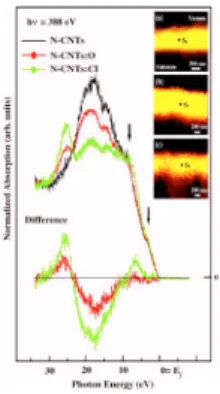
Figure4displays spatially resolved valence-band photo-emission spectra of N-CNTs, N-CNTs:Cl, and N-CNTs:O with their corresponding maximum intensity of C 1s SPEM bright cross-sectional images. The spectra in Fig. 4 exhibit photoelectron yields from the bright regions S1, S2, and S3
corresponding to the sidewalls of the respective N-CNTs, N-CNTs:Cl, and CNTs:O. The zero energy refers to Ef, which is the threshold of the emission spectrum. The spectra reveal two weak structures at binding energies of⬃3.5 and 8.2 eV共marked by downward arrows兲 associated with the C 2p and bonds,3,7,20,21 respectively. Features centered at ⬃15 eV 共mixed s and p characters of the C–N bond兲 and 18 eV共C 2s兲 are typically observed from nitrogenated car-bon films with a graphitic structure.20The intensities of these two features 共15 and 18 eV兲 decrease for both N-CNTs:Cl and N-CNTs:O relative to the untreated N-CNTs. A new fea-ture in the spectra of both N-CNTs:Cl and N-CNTs:O ap-pears in the range of 24– 30 eV共centered at ⬃25 eV兲 and is attributable to N 2s states. This result reflects the increase/ decrease in the numbers of C–N/C–C bonds and the forma-tion of nitrogen-based carbon with a pyridine structure, as described by Bhattacharyya et al. for a-CNx films.
22 The increase in the intensity of the feature in the range of 24– 30 eV for both N-CNTs:Cl and N-CNTs:O is also con-sistent with the increase of * intensity in the N K-edge
XANES spectra. Apparently, the spectra of N-CNTs:Cl re-veal increases in the intensity of thebond associated with chlorine-derivedstates and can be caused by the formation of C–C and/or C–N–Cl bonds.7 There is no significant change in the region共0–9 eV兲 for N-CNTs:O. The pectrum difference between N-CNTs:O/N-CNTs:Cl and N-CNTs shown in the lower inset of Fig.4 elucidates the effects of oxidation/chlorination. The positive feature centered at ⬃25 eV for N-CNTs:Cl is associated with the formation of chlorine-bonded carbon and/or nitrogen atoms and the pres-ence of a nitrogen lone pair with the enhancement of the N 2s band. The spectrum difference is negative in the region 共⬃9 and 24 eV兲, which indicates a reduction of the C 2s-band states associated with the highly negative intensity at⬃18 eV.7,22 For N-CNTs:O the spectrum difference indi-cates that the intensity difference is essentially 0 in the re-gion, 0 – 9 eV resulted from a small curvature of the graphitic
N-CNTs:O, as observed by Chen et al. in multiwall CNTs.23 The shallow dip at 17 eV in the negative spectrum difference of N-CNTs:O is caused by the decrease共increase兲 in carbon 共nitrogen兲 concentration, while the positive intensity differ-ence at 26 eV may be contributed to the N 2s band and/or the O 2s band. Furthermore, the difference in SPEM spectra indicates that the magnitude of the negative共positive兲 inten-sity in the range of 9 – 24 eV共24–30 eV兲 is smaller 共larger兲 for N-CNTs:Cl than for N-CNTs:O, suggesting that the num-ber of C–C bonds that were substituted by C–N bonds and the formation of N 2s bonds were more for N-CNTs:Cl. The reduction共9–24 eV兲/enhancement 共24–30 eV兲 of feature in-tensity between treated and untreated N-CNTs may be due to the greater delocalization of C 2p electrons by coupling with neighboring N-CNTs, as observed by Choi et al.24 for double-walled CNTs and the related formation of oxygen/ chlorine-bonded carbon and/or nitrogen atoms, which change the electronic/bonding structures.
1M. S. Dresselhaus, G. Dresselhaus, and P. Avouris, In Carbon Nanotubes: Synthesis, Structure, Properties and Applications, Topic in Applied
Phys-ics Vol. 80共Springer, New York, 2001兲.
2U. D. Weglikowska, V. Skákalová, R. Graupner, S. H. Jhang, B. H. Kim, H. J. Lee, L. Ley, Y. W. Park, S. Berber, D. Tománek, and S. Roth, J. Am. Chem. Soc. 127, 5125共2005兲.
3H. Ago, T. Kugler, F. Cacialli, W. R. Salaneck, M. S. P. Shaffer, A. H. Windle, and R. H. Friend, J. Phys. Chem. B 103, 8116共1999兲. 4P. C. P. Watts, N. Mureau, Z. Tang, Y. Miyajima, J. D. Carey, and S. R. P.
Silva, Nanotechnology 18, 175701共2007兲.
5W. H. Lee, S. J. Kim, W. J. Lee, J. G. Lee, R. C. Haddon, and P. J. Reucroft, Appl. Surf. Sci. 181, 121共2001兲.
6S. S. Roy, P. Papakonstantinou, T. I. T. Okpalugo, and M. Murphy, J. Appl. Phys. 100, 053703共2006兲.
7S. C. Ray, C. W. Pao, H. M. Tsai, J. W. Chiou, W. F. Pong, C.-W. Chen, M.-H. Tsai, P. Papakonstantinou, L. C. Chen, K. H. Chen, and W. G. Graham, Appl. Phys. Lett. 90, 192107共2007兲.
8L. C. Chen, C. Y. Wen, C. H. Liang, W. K. Hong, K. J. Chen, H. C. Cheng, C. S. Shen, C. T. Wu, and K. H. Chen, Adv. Funct. Mater. 12, 687共2002兲. 9T. I. T. Okpalugo, P. Papakonstantnou, H. Murphy, J. Mclaughlin, and N.
M. D. Brown, Carbon 43, 2951共2005兲.
10S. Bhattacharyya, M. Lübbe, and F. Richter, J. Appl. Phys. 88, 5043 共2000兲.
11E. Unger, A. Graham, F. Kreupl, M. Liebau, and W. Hoenlein, Curr. Appl. Phys. 2, 107共2002兲.
12Y. Chen, R. C. Haddon, S. Fang, A. M. Rao, P. C. Eklund, W. H. Lee, E. C. Dickey, E. A. Grulke, J. C. Pendergrass, A. Chavan, B. E. Haley, and R. E. Smalley, J. Mater. Res. 13, 2423共1998兲.
13D. A. Fischer, R. M. Wentzcovitch, R. G. Carr, A. Continenza, and A. J. Freeman, Phys. Rev. B 44, 1427共1991兲.
14S. H. Lim, H. I. Elim, X. Y. Gao, A. T. S. Wee, W. Ji, J. Y. Lee, and J. Lin, Phys. Rev. B 73, 045402共2006兲.
15M. C. Pyane, M. Teter, D. C. Allan, and J. D. Joannopoulos, Rev. Mod. Phys. 64, 1045共1992兲.
16C.-W. Chen and M.-H. Lee, Nanotechnology 15, 480共2004兲.
17A. H. Nevidomskyy, G. Csányi, and M. C. Payne, Phys. Rev. Lett. 91, 105502共2003兲.
18I. Jimènez, W. M. Tong, D. K. Shuh, B. C. Holloway, M. A. Kelly, P. Pianetta, L. J. Terminello, and F. J. Himpsel, Appl. Phys. Lett. 74, 2620 共1999兲.
19I. Shimoyama, G. Wu, T. Sekiguchi, and Y. Baba, Phys. Rev. B 62, R6053 共2000兲.
20S. Suzuki, Y. Watanabe, T. Kiyokura, K. G. Nath, T. Ogino, S. Heun, W. Zhu, C. Bower, and O. Zhou, Phys. Rev. B 63, 245418共2001兲. 21J. W. Chiou, C. L. Yueh, J. C. Jan, H. M. Tsai, W. F. Pong, I. H. Hong, R.
Klauser, M.-H. Tsai, Y. K. Chang, Y. Y. Chen, C. T. Wu, K. H. Chen, S. L. Wei, C. Y. Wen, L. C. Chen, and T. J. Chuang, Appl. Phys. Lett. 81, 4189 共2002兲.
22S. Bhattacharya, C. Spaeth, and F. Richter, J. Appl. Phys. 89, 2414共2001兲. 23P. Chen, X. Wu, X. Sun, J. Lin, W. Ji, and K. L. Tan, Phys. Rev. Lett. 82,
2548共1999兲.
24H. C. Choi, S. Y. Kim, W. S. Jang, S. Y. Bae, J. Park, K. L. Kim, and K. Kim, Chem. Phys. Lett. 399, 255共2004兲.
FIG. 4. 共Color online兲 Valence-band photoemission spectra obtained from selected bright spots S1, S2, and S3of C 1s SPEM cross-sectional images of N-CNTs, N-CNTs:Cl, and N-CNTs:O at an excitation photon energy of 388 eV. The inset shows spectra difference between treated共N-CNTs:Cl and N-CNTs:O兲 and untreated 共N-CNTs兲.
202102-3 Ray et al. Appl. Phys. Lett. 91, 202102共2007兲