Effects of an Os layer on the magnetic properties of CoFe IrMn
Tai-Yen Peng, C. K. Lo, San-Yuan Chen, and Y. D. Yao
Citation: Journal of Applied Physics 99, 08C907 (2006); doi: 10.1063/1.2170053 View online: http://dx.doi.org/10.1063/1.2170053
View Table of Contents: http://scitation.aip.org/content/aip/journal/jap/99/8?ver=pdfcov Published by the AIP Publishing
Articles you may be interested in
Effect of oxidation and annealing on tunnel barrier structure and composition in IrMn / CoFe / TiO x / CoFe magnetic tunnel junctions
J. Appl. Phys. 106, 123915 (2009); 10.1063/1.3243230
Enhancement of exchange field in Co Fe Ir Mn by Os Cu buffer layer J. Appl. Phys. 101, 09E514 (2007); 10.1063/1.2670324
Stability enhancement of nanopillar structure for spin transfer magnetization switching using IrMn buffer layer J. Appl. Phys. 99, 08G517 (2006); 10.1063/1.2175726
Thermal stability of Ir - Mn Co - Fe - B Al - O Co - Fe - B tunnel junctions J. Appl. Phys. 98, 113710 (2005); 10.1063/1.2137888
Bias-voltage dependence of magnetoresistance in magnetic tunnel junctions grown on Al 2 O 3 (0001) substrates
Appl. Phys. Lett. 86, 102506 (2005); 10.1063/1.1870104
[This article is copyrighted as indicated in the article. Reuse of AIP content is subject to the terms at: http://scitation.aip.org/termsconditions. Downloaded to ] IP: 140.113.38.11 On: Thu, 01 May 2014 02:02:48
Effects of an Os layer on the magnetic properties of CoFe/ IrMn
Tai-Yen Penga兲
Department of Materials Science and Engineering, National Chiao Tung University, Hsinchu 30010, Taiwan
C. K. Lo
Electronics and Optoelectronics Research Laboratories, Industrial Technology Research Institute, Hsin Chu 310, Taiwan, and Nanotechnology Research Center, Industrial Technology Research Institute, Hsin Chu 310, Taiwan
San-Yuan Chen
Department of Materials Science and Engineering, National Chiao Tung University, Hsinchu 30010, Taiwan
Y. D. Yao
Institute of Physics, Academia Sinica, Taipei 11529, Taiwan, and Department of Materials Science and Engineering, National Chiao Tung University, Hsinchu 30010, Taiwan
共Presented on 3 November 2005; published online 25 April 2006兲
The uses of Os as an antidiffusion and buffer layer in IrMn exchange coupled CoFe film were investigated. For the purpose of antidiffusion, the inserted Os layer showed a distinct improvement of S⬎0.9, with HCslightly increasing by 1.6 times for the CoFe/ Os/ MnOs multilayer after 400 °C
annealing, even though the Os thickness was as thin as 0.3 nm. Furthermore, with a 0.3 nm Os barrier, the 350 °C annealed CoFe/ Os/ IrMn/ CoFe showed almost the same magnetic behavior as the as-deposited state, while the Hexof the upper part of the CoFe/ Os/ IrMn changed from 100 to 190 Oe. In addition, as a buffer layer, the Os buffer layer could enhance the diffraction peak intensities of IrMn共111兲/Os共002兲 and CoFe 共111兲, and the Hexof CoFe/ IrMn was proportional to the Os thickness. A 120 Oe of Hex was achieved by using an 11 nm Os buffer layer in a CoFe 10 nm/ IrMn 15 nm bottom type film. These results show that Os has the potential to be an antidiffusion and buffer layer in a magnetic multilayer. © 2006 American Institute of Physics. 关DOI:10.1063/1.2170053兴
I. INTRODUCTION
For high density data storage and nonvolatile memory applications, much work has been done on the basic unit in magnetic devices, such as spin valve共SV兲 and magnetic tun-neling junction共MTJ兲 structure. Many kinds of compositions of Mn with other metals exhibiting antiferromagnetic behav-ior have been used to pin the ferromagnetic layer in these element structures mentioned. However, the diffusion of Mn atoms into another layer ruins the thermal stability.1 There-fore, it is important to find a suitable element that can elimi-nate this problem. Many reports have demonstrated methods by which the thermal stability of the MTJ or SV system can be increased.2–4 The noble metal osmium 共Os兲 has also drawn attention due to the possibilities of its use in improv-ing thermal properties in magnetic films.5,6In this article, the Os layer was investigated as a possible addition to CoFe/ MnOs and CoFe/ IrMn magnetic films for two uses: one as a diffusion barrier of Mn atoms, and the other as a buffer layer for IrMn共111兲 texture. The results of this study may suggest new ideas for designing the element film struc-ture in magnetic devices.
II. EXPERIMENT
The magnetic multilayer samples were rf and dc magne-tron sputtering deposited on 1 cm⫻1 cm SiO2/ Si substrates
as the following three series. The first series, with Ta/ CoFe共10 nm兲/Os共d兲/MnOs共20 nm兲/SiO2 structure 共T
series兲, was used to characterize the thermal properties, where d stands for the thickness varying from 0 to 2 nm, and the Os in the MnOs layer was doped slightly to prevent the Mn atoms from diffusing. Another series共Hex兲 was used to demonstrate that the Os layer enhanced the thermal stability of the exchange field of the Ta/ CoFe共10 nm兲/ Os共t兲/IrMn共30 nm兲/CoFe共10 nm兲/SiO2 structure, where t
was 0 and 0.3 nm, respectively. The third series was Ta/ CoFe共10 nm兲/IrMn共15 nm兲/Os/Ta/SiO2 共bottom
se-ries兲, in which the thickness of the Os buffer varied from 1 to 11 nm, and in which the Ta on the SiO2 was to form the
atomic surface to improve the Os deposition. The top Ta layer used in all samples was intended to protect the CoFe and IrMn layer from oxidation during annealing. All films were deposited under 200 Oe of external magnetic field at about a 4⫻10−3Torr pressure of pure Ar gas. The T and Hex
series were annealed for 30 min at 400 and 350 °C, respec-tively, below 1⫻10−3Torr pressure in a vacuum chamber under an applied filed of 1 kOe along the direction of the applied magnetic field during film deposition. The focus of the bottom series was to determine the proper conditions for CoFe to be exchange coupled by IrMn in the as-deposited state. The magnetization curves of all samples were mea-sured by magnetic optical Kerr effect共MOKE兲 and vibrating sample magnetometer 共VSM兲 at room temperature. Film structure was analyzed by an x-ray diffractometer 共XRD兲 with a Cu k␣ source.
a兲Author to whom correspondence should be addressed; electronic mail:
JOURNAL OF APPLIED PHYSICS 99, 08C907共2006兲
0021-8979/2006/99共8兲/08C907/3/$23.00 99, 08C907-1 © 2006 American Institute of Physics
[This article is copyrighted as indicated in the article. Reuse of AIP content is subject to the terms at: http://scitation.aip.org/termsconditions. Downloaded to ] IP: 140.113.38.11 On: Thu, 01 May 2014 02:02:48
III. RESULTS AND DISCUSSION
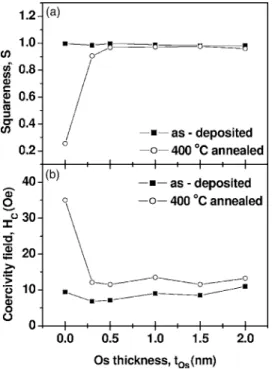
The Os interlayer thickness dependence of the magneti-zation curve squareness共S兲 and the coercivity field 共HC兲 for
the annealed T series is shown in Fig. 1. All samples showed that the S of the as-deposited state was very close to 1, which indicated that the magnetization curve was very square. After 400 °C annealing, the samples with the Os diffusion barrier kept their S⬎0.9, even though the Os thickness was as thin as 0.3 nm, while the S for the non-Os sample was only 0.25. Furthermore, the same behavior could be found when focus-ing the HC, which varied as the Os thickness increased. All
samples showed roughly the same HC of 10 Oe as the
as-deposited. The HC of the annealed sample without Os
changed from 9.5 to 35 Oe共became nearly four times larger兲, while the HCfor the annealed samples with Os only slightly
increased in the neighborhood of 12.5 Oe 共became 1.2–1.6 times larger than as-deposited for each thickness of Os兲. Ac-cording to our previous work, the depth profile results also indicated that a thin Os layer could prevent the diffusion of the Mn atoms into the ferromagnetic layer after annealing at temperatures greater than 300 °C.6The improvements of Os on the S and HC of the annealed T series are distinct.
Be-cause the insertion of the metal layer in the ferromagnetic/ antiferromagnetic 共FM/AFM兲 interface decreased the FM/ AFM exchange coupling,7 the optimal Os barrier thickness that could not only retain the magnetic properties of the mag-netic layer after annealing but also slightly decrease FM/ AFM exchange coupling was an important factor in deter-mining the barrier thickness. The inserted Os layer of 0.3 nm could not only maintain the S of the sample at larger than 0.9 but also increase the HCto 1.6 times larger, and thus it seems
to be a suitable interlayer for FM/AFM magnetic film. Since the improvement of the Os layer on thermal
prop-erties was verified, a thin Os layer was added into the IrMn exchange coupled magnetic film to check the influence on the exchange field共Hex兲. Figure 2 shows the VSM measure-ments for Ta/ CoFe/ IrMn/ CoFe/ SiO2 共a兲 without and 共b兲 with the 0.3 nm Os interlayer, respectively. The smaller Hex共Hex,S兲 was contributed by the bottom CoFe seed layer, which was also exchange coupled by IrMn. In general, 350 °C was too high for the IrMn base magnetic multilayer due to the higher diffusion tendency of the Mn atoms. The Hex,L 共which resulted from exchange coupling of the upper
part of the CoFe/ IrMn兲 of as-deposited and 350 °C annealed states were 100 and 190 Oe for the sample with Os, respec-tively. However, the sample without the Os barrier showed an Hex,Lof 55 Oe after 350 °C annealing, while that of the
as-deposited state was 105 Oe. These indicated that the Os stopped the Mn atoms from diffusing from IrMn into the upper CoFe and caused the Hex,Lto increase at such a high
temperature. Furthermore, the Os layer also seemed to de-crease the tendency of Mn to diffuse to the bottom CoFe layer due to the retention of the Hex,Sof the sample with Os,
which was almost the same as that before annealing. The enthalpy of Mn in the Os and Co interfaces was −39 and −21 kJ/ mole, respectively.8 It indicated that the Mn had a higher tendency to remain in the Os/ IrMn than in the CoFe/ IrMn interface. From this, it could be found that the annealed sample with the inserted Os layer made the overall magnetic behavior almost the same as that of the as-deposited state. However, the sample without the Os layer not only lost the Hex,S but also showed a smaller Hex,L. In addition, a diffusion model states that diffusion occurs when one small atom in a vacancy jumps to another vacancy across a neighboring large atom. Considering the sizes of the Mn and Os atoms, the smaller Mn atoms in the Os/ IrMn interface could be seen as being positioned in the vacancy between the Os atoms. However, the Os atom was too large for the Mn atoms to jump from one side of the Os to the other. The lower enthalpy for Mn remaining in the Os inter-face also indicated that the Mn and Os formed a stable and cohesive layer, thus making it harder for other Mn atoms to move. This also proves that Os has strong possibilities as a diffusion barrier.
FIG. 1. The Os barrier thickness dependence of:共a兲 the magnetization curve squareness and 共b兲 the coercivity field in the Ta/CoFe/Os 共d nm兲/MnOs/SiO2multilayer before and after annealing. The annealing
conditions are 400 °C for 30 min at 1 kOe external field.
FIG. 2. The VSM measurement of the Ta/ CoFe/ IrMn/ CoFe/ SiO2 multilayer:共a兲 without and 共b兲 with a 0.3 nm Os barrier inserted in the upper part of the CoFe/ IrMn interface. The Hexof the annealed sample with the
0.3 nm Os barrier共䊊兲 was larger than that of the as-deposited state 共䊏兲.
08C907-2 Peng et al. J. Appl. Phys. 99, 08C907共2006兲
[This article is copyrighted as indicated in the article. Reuse of AIP content is subject to the terms at: http://scitation.aip.org/termsconditions. Downloaded to ] IP: 140.113.38.11 On: Thu, 01 May 2014 02:02:48
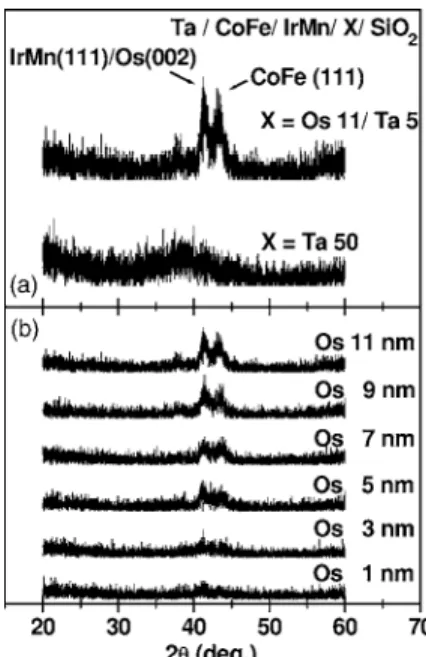
The buffer layer with hcp structure was reported to en-hance the IrMn 共111兲 texture, resulting in exchange coupling.9,10 Os, like Ru and Zr, is a hcp structure, and the IrMn 共111兲 texture enhancement was found in the bottom series from the XRD analysis, as shown in Fig. 3共a兲. The 50 nm Ta layer did not result in IrMn 共111兲 and CoFe 共111兲 texture, and only the broadened and weak peak of Ta共110兲 could be found by XRD measurement. However, the buffer layer consisting of Os 11 nm/ Ta 5 nm enhanced the IrMn 共111兲 and the CoFe 共111兲 texture can be found clearly. The IrMn共111兲 and Os 共002兲 diffraction peaks were hard to dis-tinguish because they had roughly the same spacing distance. Figure 3共b兲 shows that the IrMn共111兲/Os共002兲 and CoFe 共111兲 diffraction peaks could be clearly found when the thickness of the Os was greater than 5 nm. In addition, MOKE analysis showed that the exchange coupling was pro-duced even when the Os buffer was as thin as 1 nm, as shown in Fig. 4. A 120 Oe of Hexwas achieved by using 11
nm of Os as a buffer layer. Although the IrMn共111兲/Os共002兲 and CoFe共111兲 peak intensities were weak in the thinner Os inserted samples, the Hexwas still produced after deposition.
With increases in the thickness of the Os buffer, these dif-fraction peak intensities became increasingly clear. The Hex
and diffraction peak intensities of IrMn共111兲/Os共002兲 and CoFe 共111兲 are proportional to the thickness of the Os. This means that the Os buffer not only enhances the IrMn 共111兲 and CoFe 共111兲 texture but also results in a clear Hex in
magnetic film.
According to the above, Os has the potential to act as an antidiffusion and buffer layer in a magnetic film structure. The unit material for the antidiffusion and buffer layer would make the deposition system with a limited source more ef-fective and efficient to use.
IV. CONCLUSION
Two applications of Os in magnetic film were investi-gated. As an antidiffusion layer, the 0.3 nm Os layer showed a distinct improvement of S⬎0.9, with the HC slightly
increasing by 1.6 times after 400 °C annealing. With 0.3 nm Os barrier, the CoFe/ Os/ IrMn/ CoFe showed almost the same magnetic behavior after 350 °C annealing, while the Hex even increased. As a buffer layer, the Os layer could
enhance the diffraction peak intensities of IrMn共111兲/ Os共002兲 and CoFe 共111兲, and the Hex of CoFe/ IrMn was
proportional to the thickness of the Os. A 120 Oe of Hexwas
achieved by using an 11 nm Os buffer layer in
CoFe 10 nm/ IrMn 15 nm bottom type film. The results of this study indicate that Os may have great potential for ap-plication in magnetic films.
ACKNOWLEDGMENTS
The authors would like to express their gratitude for the technical support from the Nano Technology Research Cen-ter共NTRC兲, Industrial Technology Research Institute 共ITRI兲, and are grateful for financial support from ROC MOEA un-der Grant No. A341XSFI10, Academia Sinica, and National Science Council of Taiwan共NSCT兲 under Grant No. NSC94-2120-M-001-004.
1S. Cardoso, P. P. Freitas, C. De Jesus, P. Wei, and J. C. Soares, Appl. Phys.
Lett. 76, 610共2000兲.
2S. Cardoso, R. Ferreira, P. P. Freitas, P. Wei, and J. C. Soares, Appl. Phys.
Lett. 76, 3792共2000兲.
3T. Ochiai, N. Tezuka, K. Inomata, S. Sugimoto, and Y. Saito, IEEE Trans.
Magn., 39, 2797共2003兲.
4Y. Fukumoto, K. Shimura, A. Kamijo, S. Tahara, and H. Yoda, Appl. Phys.
Lett. 84, 233共2004兲.
5S. S. P. Parkin and M. G. Samant, US Patent No. 6, 326, 637,共4 December
2001兲.
6T. Y. Peng, C. K. Lo, T. C. Tien, S. Y. Chen, and Y. D. Yao, Proceedings
of Intermag ASIA, April 4–8, 2005, Paper No. BT-06.
7L. Thomas, A. J. Kellock, and S. S. P. Parkin, J. Appl. Phys. 87, 5061
共2000兲.
8F. R. de Boer, R. Boom, W. C. M. Mattens, A. R. Miedema, and A. K.
Niessen, in Cohesion in Metals: Transition Metal Alloys,共edited by F. R. de Boer and D. G. Pettifor兲 共Elsevier, New York 1988兲, Chaps. 1 and 2.
9R. Nakatani, K. Hoshino, S. Noguchi, and Y. Sugita, Jpn. J. Appl. Phys.,
Part 1 33, 133共1994兲.
10K. Hoshino, R. Nakatani, H. Hoshiya, Y. Sugita, and S. Tsunashima, Jpn.
J. Appl. Phys., Part 1 35, 607共1996兲. FIG. 3. The XRD measurements of the Ta/ CoFe/ IrMn/ Os/ Ta/ SiO2
multilayer:共a兲 the influence of the IrMn exchange coupled CoFe films with and without the Os buffer and共b兲 enhancement of the diffraction peaks varied as increasing of the Os thickness.
FIG. 4. The diffraction peak intensities of the IrMn共111兲/Os共002兲 and CoFe 共111兲, and Hexvaried as a function of the Os buffer thickness.
08C907-3 Peng et al. J. Appl. Phys. 99, 08C907共2006兲
[This article is copyrighted as indicated in the article. Reuse of AIP content is subject to the terms at: http://scitation.aip.org/termsconditions. Downloaded to ] IP: 140.113.38.11 On: Thu, 01 May 2014 02:02:48