Intelligent Call Admission Control for Wideband
CDMA Cellular Systems
Scott Shen, Student Member, IEEE, Chung-Ju Chang, Senior Member, IEEE, ChingYao Huang, Member, IEEE,
and Qi Bi, Senior Member, IEEE
Abstract—In this paper, we propose intelligent call admission
control for wideband code-division multiple-access (CDMA) cel-lular systems to support differentiated quality-of-service (QoS) re-quirements, guarantee the forced termination probability of hand-offs, and maximize the spectrum utilization. The intelligent call admission controller (ICAC) contains a fuzzy call admission pro-cessor to make admission decision for a call request by considering QoS measures such as the forced termination (drop call) proba-bility of handoff, the outage probaproba-bility of all service types, the predicted next-step existing-call interference, the link gain, and the estimated equivalent interference of the call request. The pipeline recurrent neural network (PRNN) is used to accurately predict the next-step existing-call interference, and the fuzzy logic theory is applied to estimate the new/handoff call interference based on knowledge of effective bandwidth method. Simulation results indi-cate that ICAC achieves system capacity higher than conventional CAC schemes by an amount of more than 10% in both low and high moving speed cases. Moreover, ICAC can cope with the un-predictable statistical fluctuation of wireless multimedia traffic; it always fulfill QoS requirements for all service types and keep the forced termination probability satisfied, while the CAC of multi-media calls (MCAC) and SIR-based CAC with intercell interfer-ence prediction (PSIR-CAC) fail to adapt to the variation of traffic conditions.
Index Terms—Call admission control, equivalent interference,
fuzzy logic, handoff, neural network.
I. INTRODUCTION
W
ITH desired features such as high system capacity (soft capacity), low power transmission, soft handoff, mul-tipath mitigation, and interference suppression [1], code-divi-sion multiple access (CDMA) has been adopted for third-gen-eration wireless communication systems. The third genthird-gen-eration wideband CDMA cellular system must be able to support inte-grated services with differentiated quality-of-service (QoS) re-quirements. Thus, a sophisticated call admission control (CAC) is needed so that the system can satisfy various QoS constraintsManuscript received June 21, 2002; revised July 24, 2003. This work was sup-ported by the National Science Council, Taiwan, R.O.C., under Contract NSC 90-2219-E-009-006 and Lee and MTI Center Q.528, NCTU, Taiwan. This work was carried out when C.-J. Chang visited Lucent Technologies, Whippany, NJ, for three months.
S. Shen and C.-J. Chang are with the Department of Communication Engi-neering, National Chiao Tung University, Hsinchu 300, Taiwan, R.O.C. (e-mail: [email protected]).
C. Huang is with the Department of Electrical Engineering, National Chiao Tung University, Hsinchu 300, Taiwan, R.O.C. (e-mail: cyhuang@faculty. nctu.edu.tw).
Q. Bi is with Lucent Technologies, Whippany, NJ 07054 USA (e-mail: [email protected]).
Digital Object Identifier 10.1109/TWC.2004.834702
such as the forced termination (drop call) probability for hand-offs and the outage probabilities for different services, and max-imize the spectrum utilization.
Liu and Zarki [2] proposed an uplink signal-to-interfer-ence (SIR)-based CAC, which adopted a residual capacity algorithm, for a direct sequence code-division multiple-access (DS-CDMA) cellular system with pure voice traffic. However, the QoS requirement was not guaranteed. Kim et al. [3], and Ishikawa and Umeda [4] extended and developed the admission control work in [2], but integrated traffic and differentiated QoS requirements were not studied.
Evans and Everitt [5] utilized an effective bandwidth concept [10] to transform the traffic generated by a user into an equiv-alently occupied bandwidth in an integrated services system. The per class outage requirement was not supported, and the system state dimensions grew with an increasing number of cells, making the computational complexity intractable. Kim and Han [6] also proposed a CAC scheme that considered dual classes of services. This scheme measured the received inter-ference and estimated the power requirement for the new user to predict the resulting SIR. The outage probability might over-whelm in some traffic load region.
Also, there were literatures working on the CAC problem with further consideration of handoff protection. Shin et al. [7] proposed to reserve a number of radio channels to protect handoff calls in DS-CDMA cellular systems, where the amount of interference of a connection is quantized as one radio channel. The number of reserved channels for handoff was derived as it was done in TDMA systems. The interference to the destination cell before and after the handover in the CDMA air interface was not correctly considered. Jeon and Jeong [8] utilized the property of soft capacity in CDMA systems, and designed prioritization by setting SIR threshold of handoff calls lower than that of new calls.
The wideband CDMA systems will turn out to be within a
dynamic, imprecise, and bursty environment because of the un-predictable statistical fluctuations in the flow of wireless
multi-media traffic. To that end, we here adopt intelligent techniques such as fuzzy logic systems and neural networks to cope with the traffic uncertainty. The fuzzy logic systems have replaced conventional technologies in many scientific applications and engineering systems, especially in control systems. They ap-pear to provide a robust mathematical framework for dealing with real-world imprecision; and they can also provide deci-sion support and expert systems with powerful reasoning ca-pabilities bound by a set of fuzzy rules. When a mathemat-ical model of a process does not exist, it is appropriate to use fuzzy logic systems. On the other hand, neural networks are 1536-1276/04$20.00 © 2004 IEEE
information processing systems that are constructed to charac-terize the human brain. They are able to learn arbitrary non-linear input–output mapping directly from training data; they can automatically adjust their connection weights to achieve op-timality for controllers, predictors, etc. Both fuzzy logic and neural networks are numerical model-free and dynamical es-timators. They can improve systems working in uncertain and unstationary environments.
Therefore, the paper proposes an intelligent call admission
control (ICAC) method for wideband CDMA cellular systems
to support differentiated QoS requirements such as the forced termination probability of handoffs and the outage probability for all service types, and maximize the spectrum utilization. The ICAC contains fuzzy call admission processor together with fuzzy equivalent interference estimator and pipeline
recur-rent neural network (PRNN) interference predictor. It decides
whether to accept the new or handoff call based on not only the estimated equivalent interference and the predicted mean interference of existing calls but also the QoS measures such as the outage probabilities of all service types and the forced termination probability as system feedbacks. In addition, the link gain of the call request, denoting a good or bad user, is further considered.
The ICAC is justified by comparing it with some conventional CAC schemes such as the SIR-based CAC with intercell inter-ference prediction (PSIR-CAC) proposed in [3] and the CAC of multimedia calls (MCAC) proposed in [8]. Simulation results indicate that ICAC can always fulfill the multiple QoS require-ments under all traffic load conditions, while these conventional CAC schemes fail in heavy traffic load condition. In particular, ICAC achieves system capacity higher than the PSIR-CAC and MCAC by more than 10% in traffic ranges where the QoS re-quirements are kept. Effects of adoption of PRNN interference predictor and the link gain of new call request on the capacity are also investigated. It can be found that PRNN can facilitate ICAC in a highly variant interference environment, and the con-sideration of the link gain can benefit ICAC in low mobility case. Moreover, from the proposed fuzzy rule structure of fuzzy call
admission processor, QoS measures acts as feedbacks to ICAC
indicating current system conditions, and ICAC is more adap-tive and stable than PSIR-CAC and MCAC.
The rest of the paper is organized as follows. Section II de-scribes the system model of a wideband CDMA cellular system and functional blocks within ICAC. Section III gives the designs for the fuzzy equivalent capacity estimator, the PRNN interfer-ence predictor, and the fuzzy call admission processor contained in ICAC. Simulation results and discussions are presented in Section IV. Finally, conclusions are remarked in Section V.
II. SYSTEMMODEL
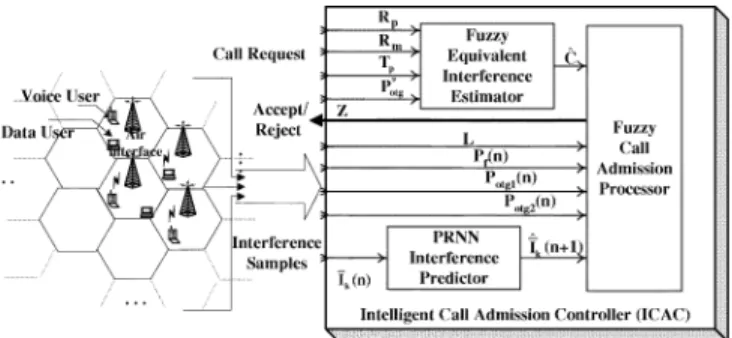
Fig. 1 depicts the system model of a wideband CDMA cel-lular system with ICAC. The model considers cells, where mobile users communicate with each other via air interface to base station (BS), and BSs are connected to a base station con-troller (BSC) or a radio network concon-troller (RNC) containing the ICAC.
Input traffic generated within mobile users is categorized as real-time voice (type-1) and nonreal-time data (type-2). New voice and data calls arrive at the system according to Poisson
Fig. 1. System model.
distributions with average arrival rates of and , respec-tively. Herein, the voice source is characterized by a two-state discrete-time Markov chain traffic model and generates an air-interface packet in each frame duration of duringON state (talkspurt) but none duringOFFstate (silence). The mean dura-tions of talkspurt and silence periods are assumed to be expo-nentially distributed with and , respectively. The data source is characterized by a batch Poisson process with an av-erage message arrival rate of . The size of data message is assumed to be a positive-valued random variable which is gener-ally distributed. The data message will further be segmented into a number of air-interface packets according to the processing gain set for the service. Each terminal supports two finite sepa-rate buffers for voice and data services.
For differentiated bit-error-rate (BER) requirements set for the type-1 and the type-2 traffic, we define their individual pro-cessing gains, denoted by and . The and are chosen to be the closest integer greater than the required spreading factor. Corresponding to each specific BER requirement and processing gain, the signal-to-interference ratio (SIR) threshold values of type-1 and type-2 traffic, denoted by and , can be obtained. Two basic transmission rates (basic channels) are supported: 1) , which is dedicated to active voice users and is equal to the voice coding rate and 2)
, which is dedicated to active data users. If a data user re-quires a transmission rate higher than the basic transmission rate , this rate will be quantized into times of , where and denotes the smallest integer greater than or equal to the argument, and each is encoded with a dif-ferent pseudonoise (PN) code. Under this circumstance, the data connection transmits with basic channels simulta-neously for communications, and the total transmission power is times to the power of single code channel.
In the radio propagation, the significant loss is assumed to contain the path loss and the shadowing. The short-term fading is averaged out by a window to form the interference measure-ment samples, and thus, we here ignore the effect of short-term fading for the CAC. The generally accepted radio propagation (link gain) model is then the product of the th power of the distance and a correlated shadowing random variable of log-normal distribution with standard deviation dB [1], which is given by
(1) where is the distance between the mobile user and the base station. The has an auto-correlation function given as
TABLE I
RULESTRUCTURE FOR THEFUZZYCAPACITYREQUIREMENTESTIMATOR
, where denotes the decay of the correlation [9]. All users in their home cell are assumed to be perfectly power-controlled. During the connection, as the user detects the pilot strength of another cell stronger than that of original cell by dB, the handoff procedure is performed.
The proposed ICAC mainly consists of a fuzzy equivalent
interference estimator, PRNN interference predictor, and fuzzy call admission processor. The fuzzy equivalent interference es-timator estimates the equivalent interference of a call request,
denoted as , from its claimed traffic parameters: peak rate , mean rate , peak rate duration , and its outage probability requirement . The PRNN interference predictor takes the interference mean of cell at the present time instant , as an input variable to accurately predict the interference mean
at the next time instant . The is
ob-tained by , where is the size of time
window, and is the received interference power at time instance . And the fuzzy call admission processor chooses the forced termination probability for handoffs measured at present time , denoted by , the outage probabilities of type-1 and type-2 services measured at the present time , denoted by and , the link gain in (1), , and as input variables to determine the acceptance for the call request. In the paper, the required outage probability for type- traffic, denoted by , is set to be the system QoS requirements, instead of . Furthermore, in order to protect the handoff connection against forced termination, the required probability of forced termination, denoted by , is also set to be the QoS requirement.
III. INTELLIGENTCALLADMISSIONCONTROLLER A. Fuzzy Equivalent Interference Estimator
Assume there is a call request with traffic parameters: the peak rate , the mean rate , the peak rate duration , and the required outage probability , in the cell . Similar to the effective bandwidth method used in high-speed networks [10], [11], the equivalent interference of call request (type-1 or type-2), denoted by ( for type-1, for type-2) can be obtained by Gaussian approximation given in the Appendix.
Since the fuzzy approach exhibits a soft behavior that means having a great ability to deal with the real-world imprecise, un-certain traffic, we here adopt fuzzy implementation of the fuzzy
equivalent interference estimator. The equivalent interference
estimator takes , and , claimed by a call request, as four input linguistic variables. The link gain variable is not considered here, but considered in the fuzzy call admission
pro-cessor. This is because in this paper, equal received power
con-trol is assumed, and the link gain variable affects only the adja-cent cell interference but not the home cell interference.
A fuzzy logic system contains fuzzifier, inference engine, and defuzzifier. To design the fuzzy logic controller, a set of input and output variables are first selected, and each variable has its term set to cover all corresponding situations. Several fuzzy in-ference rules are then established, based on the knowledge ob-tained from the numerical results of above derivations, to asso-ciate the decision to the current input values. First, the fuzzifier maps each input values to the values of corresponding term sets. The inference engine then obtains the output terms according to the input terms from fuzzifier and the rule base. Finally, the de-fuzzifier converts the output terms into a crisp value presenting the decision result. The design of the fuzzy equivalent
interfer-ence estimator is as follows [12].
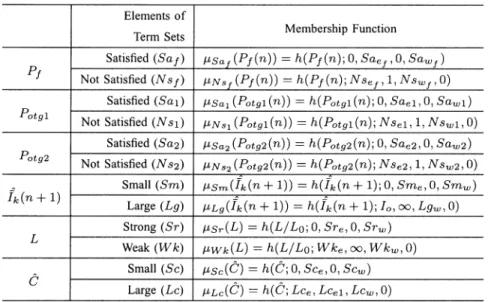
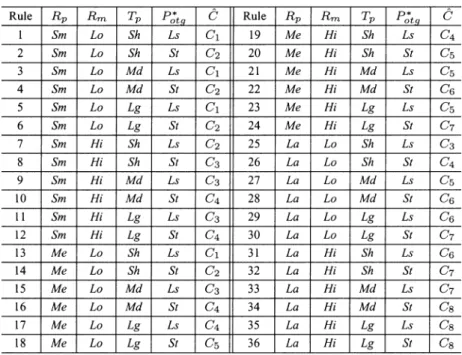
Term sets for , and and membership func-tions for these term sets are defined in Table I, in which triangular function and trapezoidal function are chosen to be the membership functions, where in is the center of the triangular function, in is the left (right) edge of the trapezoidal function, and
is the left (right) width of the triangular or the trapezoidal function. In the parameters setting for membership functions, , and , are the minimum and the maximum possible values for and , respectively; and are the desired QoS requirements of outage probability for type-1 and type-2 traffic; and are the two boundaries for the membership function of and such that these two membership function are mutu-ally mirrored. Since , and vary widely from different traffic sources, a logarithm function is employed. According to numerical results, proper boundary values of the member-ship functions are set to characterize , and . Also,
TABLE II
TERMSETS ANDTHEIRMEMBERSHIPFUNCTION FORINPUTVARIABLES
, and are set and fine-tuned. The output linguistic variable is the equivalent interference ( or );
its term set is defined as . The
mem-bership function of is denoted by
, where , and
, and .
According to the fuzzy set theory, the fuzzy rule base forms a fuzzy set with dimensions
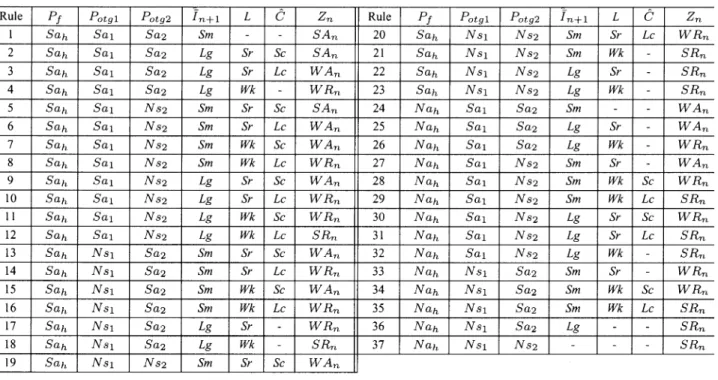
( denotes the number of terms in ). There-fore, there are a total of 36 fuzzy inference rules. Table II lists these fuzzy inference rules, which are set based on knowledge described by examples as follows. In rule 31, rule 32, and rule 35, the peak rate is large and the mean rate is high. The resulting interference in rule 31, which has a short peak rate duration, is thus expected to be less than that in rule 35, which has a long peak rate duration. And rule 31, which has a loose QoS require-ments, is considered to have lower resulting interference than rule 35, which has a strict QoS requirement.
In the inference process, the – inference method is adopted. The – inference method initially applies the operator on membership values of terms of all input lin-guistic variables for each rule and then applies the operator to yield the overall membership value, for each output term. For example, there are rule 2, rule 4, rule 6, rule 7, and rule 14 which have the same term . Results of the operator for rule 2, rule 4, rule 6, rule 7, and rule 14, denoted as , and
, are expressed as (2) (3) (4) (5) (6)
Then, the result after the operator, for the term , denoted as , can be obtained by
(7) The center of area defuzzification method is used for the de-fuzzifier owing to its computational simplicity. This defuzzifica-tion method obtains the equivalent interference by combining
, and as
(8)
B. PRNN Interference Predictor
Many adaptive filtering algorithms were proposed for one-step prediction, e.g., Kalman filter [13], recursive least-squares
algorithms [14], and neural networks. Among those techniques,
neural networks belong to nonlinear adaptive filtering class, and neural networks have the learning capability and can dynam-ically adjust connection weights to achieve optimality for pre-diction [14]. The interference process is assumed to be in a non-linear auto-regressive moving average (NARMA) model. Ap-proximating the NARMA model in the least mean square error sense allows us to express the one-step prediction of the mean interference as a function of measured interference powers and
previously predicted interference powers. That is,
(9) where is the previously predicted mean interference
sample at time , in cell is the
mea-sured mean interference sample at time ,
Fig. 2. Structure of the PRNN interference predictor.
Fig. 3. Theith small RNN module in the PRNN interference predictor. Applying PRNN to the NARMA prediction yields a high pre-diction accuracy, fast convergent speed, and low computation complexity [17]. Thus, PRNN is adopted herein to approximate the function.
Fig. 2 shows the architecture of PRNN interference predictor, which involves a total of levels of processing. Each level has an identical neural module and a subtractor. For level , two external inputs are fed into the module: the delayed version of the measured interference sample and the first output of the preceding level , and the output of this module subtracted from forms an error signal . The error signal is used to adjust the synaptic weights in the th neural module. Consequently, the output of the first module is the desired next-step interference prediction
.
Fig. 3 depicts the detailed structure of module , which is constituted by a two-layer recurrent neural network. The output
vector, , consists of elements,
among which, outputs are fed back to the input, and the first output, , is applied directly to the next module
. The input vector consists of three parts: the -tuple
external input vector , a
bias input whose value is always maintained at , a feedfor-ward input from the preceding level , and the -tuple
feedback vector . The details can
be referred to [15]–[17].
To adjust the synaptic weights, we define a cost function based on these error signals, which is given by
(10)
where is an exponential weighting factor of the range [15]. The factor weighs the memory of
module in the PRNN. Notably, .
Because is limited in amplitude within the range (0, 1) due to the characteristics of sigmoidal activation function, is normalized before being actually put into the PRNN predictor.
TABLE III
TERMSETS ANDTHEIRMEMBERSHIPFUNCTION FORINPUTVARIABLES
The synaptic weights are adjusted by using an RTRL algo-rithm [16], [17]. For a synaptic weight , the incremental change at time according to the steepest descent method is expressed as
(11)
The training of PRNN consists of two stages. During the
off-line training phase, interference samples using typical system
parameters and traffic load are generated. The PRNN, fed with these samples, adjusts the synaptic weights recursively until the root mean square error (RMSE) of the desired prediction output is lower than the criteria. During the on-line training phase, the PRNN interference predictor obtains the interference predic-tions for existing calls at time instant , from the output of the first neuron of the first module, and measures the interference sample ; then it adjusts the synaptic weights using the RTRL algorithm. Due to the on-line learning capability, PRNN can adapt its wights to the current load con-ditions other than those set in off-line training phase.
C. Fuzzy Call Admission Processor
The fuzzy call admission processor is responsible for the determination of the acceptance of a new or handoff call request. For the new call request, the processor considers the , and as its input linguistic variables which indicate the system performance measures, the predicted system load, the link quality, and the estimated equivalent interference generated by the call. For the handoff call request, the processor considers the same input variables as for the new call request except that the link quality is not taken into account since the handoff call is definitely on the cell boundary.
According to the domain knowledge from simulations, term sets and membership functions of input linguistic variables , and are defined in Table III,
where is the trapezoidal function as defined in Table I. As for the parameter setting for these membership functions, is set to be minus a safety margin, and is a value less than by a safety amount for separating the satisfactory region and the violation region; is set
to be minus a safety margin, and is
also set to a value less than for the same reason as the safety amount for ; is the tolerable interference power corresponding to the minimal signal-to-interference power ratio , and would be set to be a fraction of is the reference link gain within which the mobile user is regarded as to be far from the base station and the interference to the adjacent cells is greater, and and . We also set
to simplify the design of fuzzy logic parameters. The other endpoints of , and the widths of the membership
function of , and
must be fine-tuned to proper values during simulations. The term set for the output linguistic variable of
new call request Straightly Accept
Weakly Accept Weakly Reject Straightly Reject
. Membership functions for are
de-noted by , where
, and is , or
. A new call request can be accepted if the output of the fuzzy call admission processor is greater than an acceptance threshold . Without a loss of generality,
, and let
. Similarly, the term set for the output lin-guistic variable of handoff call request
, and membership functions for
are denoted by , where
, and is , or
. A handoff call request can be accepted if the output of the fuzzy call admission processor is greater than
an acceptance threshold . Similarly,
we set , and
TABLE IV
RULESTRUCTURE OF THEFUZZYCALLADMISSIONPROCESSOR FORNEWCALLREQUEST
TABLE V
RULESTRUCTURE OF THEFUZZYHANDOFFADMISSIONPROCESSOR FORHANDOFFCALLREQUEST
Tables IV and V present the rule structure of fuzzy call
admis-sion processor for the new (handoff) call request. It can be found
from Table IV that the more (less) satisfied the
are and the smaller (larger) the is, the higher (lower) like-lihood the system can accept the new call request. As is not satisfied but , and indicate the light system load, the system will tend to accept the new call request to en-hance the utilization since the relief from a temporary conges-tion may happen. At any specific system load condiconges-tion, the system will tend to reject the bad users with poor signal quality and the more heavy loaded users according to and . Also, it can be found in Table V that the system tends to accept the
handoff call as the is not satisfied more likely than as is satisfied to protect the ongoing call anyway except the condition that the traffic load is very heavy. And the larger , and imply the heavier traffic load, then the system tends to reject the handoff call request. Notice that these system QoS
per-formance measures such as , and act
as a metric to reflect system performance and play as feedback signals for ICAC. Consequently, ICAC is a closed-loop control system in which system stability can be ensured and QoS re-quirements can be satisfied.
Similarly, the – inference method is employed herein to calculate the membership value for each term of
and the center of area method is then applied for defuzzification.
IV. SIMULATIONRESULTS ANDDISCUSSION
In the simulations, hexagonal cells, of type-1 connection dB, of type-2 connection
dB, the spreading factor of each basic code channel , and the frequency spectrum bandwidth MHz are se-lected. The QoS requirements of outage probability are set to be
and , and the QoS constraint
of forced termination probability is defined as . To achieve the required outage requirement of type-2 connec-tions, the processing gain ratio is chosen to be , and therefore the SIR threshold before despreading are set to be dB, dB. The filtering factor (the exponential decay factor) to obtain the interference mean esti-mation is 0.02. The voice source model is assumed to be with s and s, while the data source model is assumed to be with and the size of data message is in a geometric distribution with mean 2 and maximum length 10. The mean holding times for both voice and data services are 90 s. The moving speed of each mobile user has two simula-tion cases. In the low mobility case, the speed of a mobile user is randomly selected from 0 km/h or 5 km/h. In the high mo-bility case, the speed of mobile users is either km/h or km/h with equal probability. The moving direction is modeled by the angle with uniform distribution. The radio propagation parameters of and are set to be 4 and 8 dB [1], and the handoff margin is set to be 3 dB.
The effectiveness of the proposed ICAC is tested by com-paring it with the SIR-based CAC with intercell interference prediction (PSIR-CAC) proposed in [3] and the CAC for mul-timedia calls (MCAC) proposed in [8]. For PSIR-CAC [3], the call request is accepted if the minimum residual capacity of each cell among the active sets is positive. The SIR threshold is set to be 14 dB. For MCAC, threshold values for the type-1 and type-2 services, denoted by and , are set to be 7 and 10 dB, respectively. This algorithm accepts a call request of type
or , if the condition for type connection satisfies
(12)
where or for new or handoff call request, is the admission margin parameter to give different priorities for new or handoff call requests of type- class, and is the measured mean of type is the number of code channels, and is the spreading factor of channel for the call request of type . We set
, and . In the original scheme [8], single code and variable spreading factor transmission was used. Here, we extend it to a multicode transmission system, using the same design concept. Thus, of each code is 256, but multicode channels are used to carry the information bits.
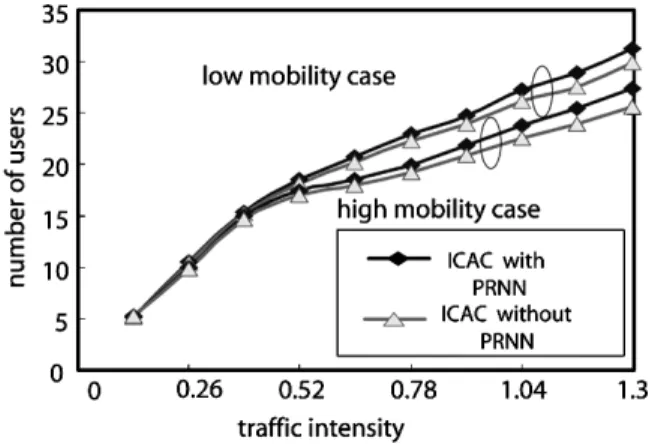
We first demonstrate the effects of the adoption of PRNN in-terference prediction and the link gain on the system capacity. Fig. 4 shows the mean number of accommodation users versus
Fig. 4. Mean number of accommodation users versus traffic intensity for ICAC with and without PRNN interference predictor.
Fig. 5. Mean number of accommodation users versus traffic intensity of ICAC with and without link gainL variable.
the traffic intensity for ICAC with and without PRNN inter-ference predictor. It can be found that in the low mobility case, the ICAC equipped with PRNN interference predictor can attain maximal 5% gain of system capacity at , compared with the ICAC without PRNN interference predictor. In the high mo-bility case, the gain of system capacity achieved by ICAC with PRNN interference predictor is above 5% after 0.91. The gain of system capacity increases along with the increment of traffic load, and the gain of system capacity in high mobility case is more than that in low mobility case. The larger the vari-ance of interference power received at the base station is, the more significantly the PRNN interference predictor can facili-tate the estimation.
Fig. 5 shows the mean number of accommodation users versus traffic intensity for ICAC with and without link gain variable. In the low mobility case, the system capacity of ICAC with link gain achieves improvement by above 5% more than that of ICAC without link gain as . In the high mobility case, the gains of system capacity are 2.5% as and about 5% as . And the capacity gain increases as the traffic load becomes heavy in both low and high mobility cases. It is because the ICAC scheme with can reject bad users and accept good users at heavy traffic conditions, while the ICAC scheme without variable has no such information to make a decision. But in the high mobility case, the capacity gain is reduced since good users are more likely to become
Fig. 6. Mean number of accommodation users versus traffic intensity of ICAC with and without FEIE.
bad users and the interference will deteriorate. Moreover, the ICAC with the link gain variable can implicitly avoid over interfering adjacent cells. As noted, the predicted interference received at base station reflects partly the traffic load of the adjacent cells; and ICAC rejects the highly interfered users (bad users) to avoid serious interference to the adjacent cells if the predicted interference is large. We have simulated the case of hot spot. The result shows that the hot spot cells are not too aggressive to suppress the accommodation users in the adjacent cells. Therefore, ICAC with the link gain variable has taken the interference of adjacent cells into considerations.
Fig. 6 show the number of accommodation users versus traffic intensity for ICAC with and without fuzzy equivalent interfer-ence estimator (FEIE). The ICAC without FEIE is simulated by feeding the equivalent interference obtained in the Appendix to the fuzzy call admission processor. It can be found that they have the similar performance. However, the former uses simple logic to get the equivalent interference, while the later obtains the equivalent interference by complicated computation.
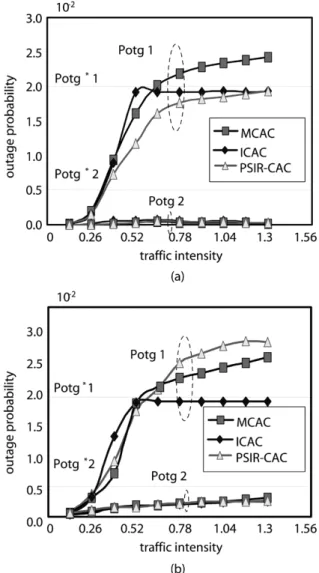
Fig. 7 illustrates the outage probabilities versus traffic inten-sity for ICAC, MCAC, and PSIR-CAC in (a) low and (b) high mobility cases. It can be seen that ICAC can always guarantee QoS requirements of outage probabilities for all traffic types and all traffic load conditions; PSIR-CAC cannot keep the type-1 outage probability guaranteed in the high mobility case due to the more unpredictable change of interference received at the base station; and MCAC cannot guarantee the type-1 outage probabilities as traffic load gets heavier in both low and high mobility cases. It can also be found that the outage probability of ICAC is the highest in the QoS-guaranteed region
than those in other two schemes, and is almost kept constant at 0.02 after . It is because that ICAC adopts intelligent techniques such as fuzzy logic systems and neural networks, which have powerful reasoning capabilities and learning ability, respectively, to cope with the variant interference of uncertain traffic; and ICAC adopts measures of the outage probabilities of each type of traffic as input linguistic variables. But MCAC and PSIR-CAC do not take the outage probability and system load variation into account. ICAC can adapt to fluctuating traffic load situations and fulfill the requirements.
Fig. 8 shows the forced termination probability of handoff call requests versus traffic intensity for ICAC, MCAC, and PSIR-CAC in low mobility case. It can be found that ICAC can
Fig. 7. Outage probabilities versus traffic intensity (a) low mobility case and (b) high mobility case.
Fig. 8. Forced termination probabilities versus new call arrival rate.
always keep the forced termination probability of handoff calls under the constraint no matter how the traffic load is; MCAC, which simply sets the priority for handoff call over new call, cannot always guarantee the forced termination probability requirement except that the admission margin parameter for
Fig. 9. (a) Number of accommodation users and (b) new call blocking probability versus traffic intensity in low mobility case.
handoff calls in MCAC is adjusted for different traffic condi-tions; and PSIR-CAC extremely violates the constraint because it does not take this constraint into consideration.
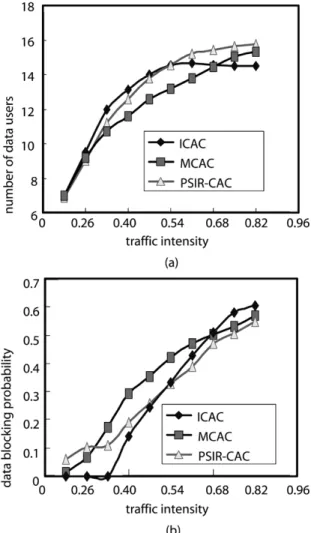
Fig. 9 illustrates (a) the number of users and (b) the new call blocking probabilities of voice and data users versus traffic in-tensity for ICAC, MCAC, and PSIR-CAC in low mobility case. It can be found that ICAC accepts users more than PSIR-CAC and MCAC by an amount of around 13% and 10%, respectively. And in the region where all these three schemes can keep QoS guaranteed, the blocking probability of ICAC is the lowest; but out of the region, say , the blocking prob-ability of data users for ICAC is the largest, while that of voice users for ICAC is still the smallest. This is because, as , ICAC can precisely predict the system load condition and thus fully utilize the resource; but in the heavy-load condition, ICAC tends to reject bad users, hence the adjacent cell interference is significantly reduced and the system capacity grows up continu-ously. Notice that the equivalent interference of data connection is larger due to the higher burstiness and the stricter require-ment, and they are likely to be bad users. In the high mobility case, similar phenomena are observed.
Fig. 10 shows (a) the number of accommodation data users and (b) the blocking probability of data users versus traffic inten-sity of data users where the voice arrival rate is fixed to be 0.1 per frame time and no voice users are allowed to be blocked. It can be seen that the mean number of accommodation data users of
Fig. 10. (a) Number of accommodation data users and (b) blocking probability of data users versus the new call arrival rate of data users where voice arrival rate is fixed at 0.1 per frame time.
ICAC is 7% and 11% more than those of MCAC and PSIR-CAC at where all these three schemes can guarantee the re-quirements of outage probabilities. As where MCAC and PSIR-CAC begin to violate the QoS requirements, ICAC still attains more number of data users by the amount 5% and 9% than MCAC and PSIR-CAC, respectively. After , the accommodation data users of ICAC remains constant in order to keep QoS requirements guaranteed and the blocking probability of ICAC grows higher than those of MCAC and PSIR-CAC, while the numbers of data users of MCAC and PSIR-CAC continue increasing but their QoS requirements keep deteriorating. Therefore, it can be concluded that ICAC can precisely estimate the system condition to admit more users than MCAC and PSIR-CAC as these three schemes satisfy the QoS requirements; and ICAC accepts reasonable users into the system to keep the requirement guaranteed while the MCAC and PSIR-CAC violate the requirement.
V. CONCLUSION
This paper presents an intelligent call admission controller (ICAC) for wideband CDMA cellular systems to support differ-entiated QoS provisioning, satisfy the system QoS constraints, and maximize the spectrum utilization. ICAC is applied with both fuzzy logic control and PRNN techniques, thus contains a fuzzy equivalent interference estimator, a PRNN interference
predictor, and a fuzzy call admission processor. The fuzzy equivalent interference estimator determines the interference power caused by the new call request, based on the domain knowledge on effective bandwidth method. The PRNN inter-ference predictor forecasts the system interinter-ference mean at the next time period, and it can achieve additional gain in system ca-pacity by an amount of 5%. The fuzzy call admission processor considers the system QoS performance measures of each traffic type and the link gain of the call request to determine whether to accept the call request, based on the estimated equivalent interference generated by the call and the predicted next-step interference caused by existing calls. The further consideration of the variable of link gain of the new call request can make ICAC capable of rejecting bad users and accepting good users to improve the system capacity. Therefore, ICAC can achieve system capacity higher than PSIR-CAC and MCAC by an amount of more than 10% in regions where QoS requirements are guaranteed. ICAC is indeed effective for differentiated QoS provisioning for wireless multimedia CDMA systems.
APPENDIX I DERIVATION OF AND
Let be the aggregation traffic process of voice and data calls in the cell , which can be expressed as
, where denotes the type-1 (type-2) traffic activity factor,
is the number of type-1 (type-2) users, is the number of basic code channels needed by type-2 user , in home cell for communication, and . In order to fulfill the QoS requirements of outage probabilities, the process should satisfy the following constraints:
(I.1) (I.2) (I.3) Assume that possesses Gaussian property; its mean and the variance are the summation of the mean and the variance of each individual connection,
respec-tively, given by , and
. The and
are the mean and the variance of the rate generated by a type-1 (type-2) call. Since the type-1 and type-2 source models are herein assumed to be an ON–OFF process and a batch Poisson process, respectively, the and can be obtained
by ,
where is peak rate of a voice call and is the peak rate duration of a data call. By normalizing the variable , (I.1) can
be written as ,
where is a normalized Gaussian random variable. Let be a constant such that , and the condition
must be satisfied. By substi-tuting and into the above condition, the constraint for type-1 traffic becomes
(I.4)
Similarly, the constraint for type-2 traffic can be obtained by
(I.5) where is a constant such that . Consequently, and can be obtained from the four constraints as given in (I.4), (I.5), and (I.3).
To derive in the case of more traffic types, bandwidth allo-cation is required to define the resource partition policy among different types of connections, and linear or nonlinear program-ming techniques can be used.
ACKNOWLEDGMENT
The authors would like to thank the anonymous reviewers for their comments to improve the presentation of the paper.
REFERENCES
[1] K. S. Gilhousen, I. M. Jacobs, R. Padovani, A. J. Viterbi, L. A. Weaver, Jr., and C. E. Wheatley III, “On the capacity of a cellular CDMA system,” IEEE Trans. Veh. Technol., vol. 40, pp. 303–312, May 1991. [2] Z. Liu and M. E. Zarki, “SIR-based call admission control for
DS-CDMA cellular systems,” IEEE J. Select. Areas Commun., vol. 12, pp. 638–644, May 1994.
[3] I. M. Kim, B. C. Shin, and D. J. Lee, “SIR-based call admission con-trol by intercell interference prediction for DS-CDMA systems,” IEEE
Commun. Lett., vol. 4, pp. 29–31, Jan. 2000.
[4] Y. Ishikawa and N. Umeda, “Capacity design and performance of call admission control in cellular CDMA systems,” IEEE J. Select. Areas
Commun., vol. 15, pp. 1627–1635, Oct. 1997.
[5] J. S. Evans and D. Everitt, “Effective bandwidth-based admission control for multiservice CDMA cellular networks,” IEEE Trans. Veh.
Technol., vol. 48, pp. 36–45, Jan. 1999.
[6] K. Y. Kim and Y. N. Han, “A call admission control with thresholds for multi-rate traffic in CDMA systems,” in Proc. IEEE VTC’2000, pp. 830–834.
[7] S. M. Shin, C. H. Cho, and D. K. Sung, “Interference-based channel assignment for DS-CDMA cellular systems,” IEEE Trans. Veh. Technol., vol. 48, pp. 233–239, Jan. 1999.
[8] W. S. Jeon and D. G. Jeong, “Admission control of multimedia calls in CDMA mobile systems,” in Proc. IEEE VTC’2001, pp. 886–890. [9] M. Gudmundson, “Correlation model for shadow fading in mobile radio
systems,” Electron. Lett., vol. 27, pp. 2145–2146, Nov. 1991. [10] R. Guèrin, H. Ahmadi, and M. Naghshineh, “Equivalent capacity and
it’s application to bandwidth allocation in high-speed network,” IEEE J.
Select. Areas Commun., vol. 9, pp. 968–981, Sept. 1991.
[11] G. Kesides, J. Walrand, and C. S. Chang, “Effective bandwidth for mul-ticlass Markov fluids and other ATM sources,” IEEE/ACM Trans.
Net-working, vol. 1, pp. 424–428, Aug. 1993.
[12] R. G. Cheng and C. J. Chang, “Design of a fuzzy traffic controller for ATM network,” IEEE/ACM Trans. Networking, vol. 4, pp. 460–469, June 1996.
[13] Z. Dziong, M. Jia, and P. Mermelstein, “Adaptive traffic admission for integrated services in CDMA wireless-access networks,” IEEE J. Select.
Areas Commun., vol. 14, pp. 1737–1747, Dec. 1996.
[14] S. Haykin, Adaptive Filter Theory, 3rd ed. Englewood Cliffs, NJ: Pren-tice-Hall, 1996.
[15] S. Haykin and L. Li, “Nonlinear adaptive prediction of nonstationary sig-nals,” IEEE Trans. Signal Processing, vol. 43, pp. 526–535, Feb. 1995. [16] R. J. Williams and D. Zipser, “A learning algorithm for continually running fully recurrent neural networks,” Neural Comput., vol. 1, pp. 270–280, 1989.
[17] P. R. Chang and J. T. Hu, “Optimal nonlinear adaptive prediction and modeling of MPEG video in ATM networks using pipelined recur-rent neural networks,” IEEE J. Select. Areas Commun., vol. 15, pp. 1087–1100, Aug. 1997.
Scott Shen (S’99) received the B.S. degree in elec-tronics engineering from National Tsing Hua Uni-versity, Hsing-Chu, Taiwain, in 1996 and the M.A. degree in communication engineering from National Chiao Tung University, Hsing-Chu, Taiwain, in 1998. His interest area includes wireless networks, mobile communications, high-speed networks, communications protocol design, and network performance evaluation. He is currently focusing the research areas on resource management for cellular networks.
Chung-Ju Chang (S’81–M’85–SM’94) was born in Taiwan, R.O.C., in August 1950. He received the B.E. and the M.E. degrees in electronics engineering from National Chiao Tung University (NCTU), Hsinchu, Taiwan, in 1972 and 1976, respectively, and the Ph.D. degree in electrical engineering from National Taiwan University (NTU), Taipei, Taiwan, in 1985.
From 1976 to 1988, he was with Telecommunica-tion Laboratories, Directorate General of Telecom-munications, Ministry of ComTelecom-munications, Republic of China, as a Design Engineer, Supervisor, Project Manager, and then Division Director. There, he was involved in designing digital switching system, RAX trunk tester, ISDN user-network interface, and ISDN service and technology trials in Science-Based Industrial Park. In the meantime, he also acted as a Sci-ence and Technical Advisor for Minister of the Ministry of Communications from 1987 to 1989. In August 1988, he joined the faculty of the Department of Communication Engineering and Center for Telecommunications Research, College of Electrical Engineering and Computer Science, NCTU, as an Asso-ciate Professor. He has been a Professor since 1993. He was Director of the Institute of Communication Engineering from August 1993 to July 1995 and Chairman of Department of Communication Engineering from August 1999 to July 2001. Now, he is the Dean of Research and Development Office at NCTU. He had served as an Advisor for the Ministry of Education to promote the edu-cation of communiedu-cation science and technologies for colleges and universities in Taiwan since 1995. He is also acting as a committee member of the Telecom-munication Deliberate Body. His research interests include performance evalu-ation, wireless communication networks, and broadband networks.
Dr. Chang is a member of the Chinese Institute of Engineers (CIE).
ChingYao Huang (M’02) received the B.S. degree in physics from National Taiwan University, Taipei, Taiwan, R.O.C., in 1987, the M.S. degree in elec-trical and computer engineering from the New Jersey Institute of Technology (NJIT), Newark, NJ, in 1991, and the Ph.D. degree in electrical and computer engineering from Rutgers University (WINLAB), Newark, NJ, in 1996.
He joined AT&T, Whippany, NJ, and then Lucent Technologies in 1995, and was a system engineer (Member of Technical Staff) for AMPS/PCS Base Station System Engineering Department until 2002. In 2001 and 2002, he was an Adjunct Professor at Rutgers University and NJIT. In 2002, he joined the Electronic Engineering Department, National Chiao Tung University, Hsinchu, Taiwan, R.O.C., as an Assistant Professor. His research areas include wire-less medium access controls, radio resource management, scheduler control algorithms for wireless high-speed data systems, end-to-end performance, and provisioning strategies. He has published more than 50 technical memoran-dums, journal papers, and conference papers and is a chapter author of the book
Handbook of CDMA System Design, Engineering and Optimization. Currently,
he has five U.S. and International patents and 14 pending patents.
Dr. Huang has been actively involved with IEEE conferences, Wireless and Optical Communications Conference and Multi-Media and Networking Tech-nologies Conference, where he has served as an organizer, planning committee member and session chair. He has also served multiple positions, including member of executive committee and the board director of the Chinese Institute of Engineers of Great New York Chapter (CIE-GNYC).
Qi Bi (SM’92) received the B.S. and M.S. degrees from Shanghai Jiao Tong University, Shanghai, R.O.C., in 1978 and 1982, respectively, and the Ph.D. degree from the Pennsylvania State Univer-sity, University Park, PA.
He joined AT&T Bell Labs as a Member of Technical Staff in 1988 and became a Distinguished Member of Technical Staff in 1995. He is currently a Bell Labs Fellow for his pioneering contributions in the areas of analysis, design and optimization of CDMA wireless mobile communication systems. He holds 25 U.S. patents.
Dr. Bi received many honors, including the Bell Labs President’s Gold Award of 2000 and 2002, and the guest professor of Shanghai Jiao Tong University in 2000. He was a feature editor of IEEE Communications Magazine, and is an ed-itor for IEEE TRANSACTIONS ONWIRELESSCOMMUNICATIONS. He also served as the technical chairman for many IEEE symposia including the Wireless Sym-posium in IEEE Globecom 2000, 2001, and 2002, and Wireless 3G 2000, 2001, and 2002. He also served as the Technical Vice Chair for the IEEE Wireless Communications and Network Conference 2003.
![Fig. 3. The ith small RNN module in the PRNN interference predictor. Applying PRNN to the NARMA prediction yields a high pre-diction accuracy, fast convergent speed, and low computation complexity [17]](https://thumb-ap.123doks.com/thumbv2/9libinfo/7654997.139711/5.891.207.693.279.738/interference-predictor-applying-prediction-accuracy-convergent-computation-complexity.webp)