Enhancement of the field emission properties of low-temperature-growth
multi-wall carbon nanotubes by KrF excimer laser
irradiation post-treatment
Chia-Hung Li
a,⁎
, Han-Chi Liu
a, Shih-Chun Tseng
c, Yi-Ping Lin
b, Shih-Pu Chen
b,
Jung-Yu Li
b, Kwang-Hsiung Wu
a, Jenh-Yih Juang
aaDepartment of Electrophysics, National Chiao Tung University, Hsinchu, Taiwan bAdvanced Energy Technology Laboratory, ERL, ITRI, Chutong, Hsinchu, Taiwan c
Mechanical and Systems Research Laboratories, M500, MSL/ITRL, Chutong, Hsinchu, Taiwan Available online 7 November 2006
Abstract
Multi-wall carbon nanotube (CNT) films were fabricated by microwave plasma chemical vapor deposition at low temperatures (∼500 °C). The films when properly post-treated by laser irradiation exhibited a factor of 2–3 enhancement in the emission current, while the turn-on field (Eon) was reduced from 4.89–5.22 to 2.88–3.15 V/μm. The introduction of excessive oxygen during laser irradiation, however, degrades the performance of field emission properties drastically. Raman spectroscopy measurements revealed the intimate correlation between the parameter ID/IG(intensity ratio between the two representative Raman peaks seen in carbon nanotubes) and the field emission performance. The scanning electron microscopy (SEM) and transmission electron microscopy (TEM) analyses showed that the irradiation-induced modification of the tube morphology and crystallinity might be responsible for the observations.
© 2006 Elsevier B.V. All rights reserved.
Keywords: Carbon nanotube; Field emission; Laser irradiation; Post-treatment
1. Introduction
Carbon nanotubes (CNTs) [1] are one-dimensional (1-D) nano-materials with excellent technological application poten-tial, including field emission[2], microelectronic devices[3]and micro-gun[4], due to their high field emission current density, low turn-on field and stable currents. Colbert and Smalley [5]
observed the enhancement of field emission of CNTs by using laser irradiation and they interpreted this effect as being due to the presence of localized plasma induced by instant vaporization of CNTs and ionization of the species. In this study, the microwave plasma chemical vapor deposition (MP-CVD) sys-tem was used to synthesize carbon nanotubes. We then used a KrF excimer laser to practice the post-treatment on the obtained CNTs. The effects of the post-treatment parameters such as laser power density, count number of the delivered laser pulses, and
precursor atmosphere on the field emission characteristics of the CNTs are discussed.
2. Experiments
For fabricating CNTs, we first prepared a fully cleaned p-(100) Si substrate, and then layers of 40 nm Ti and 20 nm Ni were deposited sequentially on the Si substrate using E-gun vapor deposition at a base pressure of 10− 6Torr. The coated substrate was then immediately loaded into the MP-CVD chamber for hydrogen plasma pre-treatment. The pre-treatment was conducted by applying microwave with the power of 800 W to the chamber with a 90 sccm flowing hydrogen gas (corresponding to a background pressure of 24 Torr) while keeping the substrate temperature at 500 °C for 15 min. Finally, a continuous process was practiced for growing the multi-wall carbon nanotubes (MWNTs) by raising the microwave power to 1200 W and switching the reaction gas to mixed H2/CH4with a ratio of 9:1. The substrate temperature remained at 500 °C and no bias was intentionally applied to the substrate.
⁎ Corresponding author. Tel.: +886 3 5712121 56187. E-mail address:[email protected](C.-H. Li).
0925-9635/$ - see front matter © 2006 Elsevier B.V. All rights reserved. doi:10.1016/j.diamond.2006.09.017
Fig. 1. SEM images of MWNT films: (a) as-grown films; (b) after irradiated with laser power density of 9 mJ/cm2, and (c) 14 mJ/cm2.
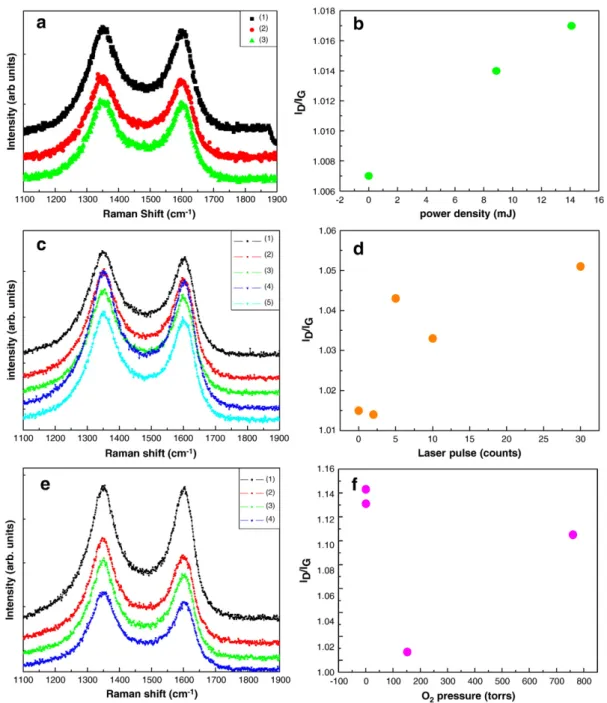
Fig. 2. The Raman spectra for MWNT films treated with different parameters. (a) The influence of laser power density; curves (1)–(3) show the spectra for the as-grown film, laser irradiated in air at 8.87 mJ/cm2, and 14.23 mJ/cm2, respectively. (b) The I
D/IGvariation with the irradiated laser power density. (c) Effects of delivered
laser pulse counts (n); curves (1)–(5) represent the result for as-grown, n=2, n=5, n=10, and n=20 cases. (d) The corresponding ID/IGfor the conditions depicted in
(c). (e) Effects of oxygen pressure (PO2) during irradiation; curves (1)–(4) are for the as-grown, PO2= 5 × 10− 5, 5 × 10− 1, and 760 Torr, respectively. (f) The ID/IGfor
For post-treatment, the MWNT films were irradiated by a KrF (248 nm) excimer laser with power density and pulse counts being varied from 8 to 15 mJ/cm2and pulse counts from 2 to 40 counts, respectively. Unless specified, the irradiation was carried out in air with the incident laser beam being defocused. In some cases, oxygen was intentionally introduced during irradiation. Three background pressures were studied, namely 5 × 10− 5, 0.5, and 760 Torr. For field emission measurements, the 180 μm-spacer diode structure was made on the ITO-coated glass sub-strate. The emission characteristics were obtained in a vacuum chamber under a pressure of 10− 5Torr. The Keithley 237 source unit was used for measuring the current of emitted electrons with the voltage varying from 1 to 1100 V. The JEOL 7000F FE-SEM was employed to investigate the morphologies of the MWNT films. The excitation source of the Raman spectrometer is a Nd: YAG laser with the wavelength of 532 nm. For Raman spectroscopy the intensity of the two characteristic Raman shifts ID (defect-mode) and IG (graphite-mode) was measured. The high-resolution transmission electron microscopy (HRTEM) analysis was performed on Philips Tecnai 20 operated at 200 keV to examine the microstructure of CNT films.
3. Results and discussion
Fig. 1shows the SEM images of the CNT films prior to and after the laser irradiation. There is no noticeable difference between these images. The results suggest that while laser irradiation might damage the individual CNT body, it does not alter the film morphology. We note here that changing the atmosphere during irradiation did not introduce noticeable film morphology modifications, either.
Fig. 2(a) shows the intensity of Raman shifts for MWNT films irradiated by different laser powers. The ID/IG as a function of laser power is plotted inFig. 2(b). Since the ratio indicates the relative density of dangling bonds and defects to the more crystalline graphite structure[6–9], the increased ID/IG ratio with increasing laser power, thus, reflects the increase in the density of dangling bonds and crystal defects due to the energetic incident photons. It appears that the effect of the incident energetic photons, though may be inadequate to cause changes to the MWNT films in a macroscopic sense (e.g. mor-phology and distribution of the tubes), may induce some changes microscopically (e.g. graphite structure of CNTs body). The effect of delivered laser pulses on the ID/IGratio also shows a similar trend, as evidenced inFig. 2(c) and (d). However, the effects of oxygen introduced during irradiation displayed rather scattered results, as can be seen inFig. 2(e) and (f). We suspect that, in addition to the physical bombardments, the latter cases may also involve some complicated chemical reactions.
To correlate these spectroscopic evidences with the emission properties, the current density vs electric field (J–E) curves were measured.Fig. 3(a) shows the J–E curve for MWNT films
prior to and after laser irradiation treatment. As is evident from the results, for film treated with 14.1 mJ/cm2 laser intensity, the emission current density increases from 0.98 mA/cm2 at an applied voltage of 1100 V to 2.46 mA/cm2 at the same applied voltage, while the turn-on field decreases from 4.98
to 3.15 V/ìm. The turn-on electrical field is defined as the applied field strength at which the current density reaches J = 0.1 mA/cm2. Comparing the ID/IGcorrelation with the field emission performance indicates that increasing ID/IGresults in lower turn-on field and higher emission current density. Both effects are considered to be beneficial to the field emission properties of MWNT films.
Comparing Fig. 2(d) with Fig. 3(b) indicates that the more incident laser pulse counts delivered resulted in more damages (reflected in the increasing ID/IGratio), which, in turn, gives rise to an enhancement of emission current density from 0.7 mA/cm2to 1.8 mA/cm2at an applied voltage of 1100 V. Our results agree with those reported by Zhao et al.[8], wherein they use UV laser to improve the field emission characteristics.
Fig. 3. J–E curves for MWNT films treated with the different parameters described in the captions ofFig. 2.
Similar to the previous results, the turn-on field reduced from 5.2 to 2.9 V/μm. It appears that the delivered laser pulses have effects similar to laser energy density in enhancing the film emission performance. Moreover, these enhancements, unlike those obtained previously by applying either a bias voltage to the substrate or by adding other gases, are having rather different natures. In the previously practiced method, the microstructure and morphology of the films may have changed simultaneously and were difficult to control. On the other hand, the laser irra-diation treatment appears to be more viable in modifying the ID/IG ratio in a systematic manner. In particular, the correlation be-tween ID/IGratio and emission performance has also been clearly demonstrated.
The above point can be further elaborated by comparing the values of ID/IG of the MWNT films after irradiation (1.143, 1.131, and 1.105) to that of the as-grown films (ID/IG= 1.007) shown inFig. 2(e) and (f). It implies that laser irradiation can induce damages to the MWNTs regardless of atmospheric condi-tions (e.g. from 5 × 10− 5to 760 Torr), except that the extent of
damage might be reduced by dynamic recovery occurring at some particular oxygen pressure. This could be due to the fact that more oxygen burns out more amorphous carbon and the heat arising from inflammation brings about the annealing effect to make a better crystallite structure [8]. However, a further increase of oxygen partial pressure may induce further damage to the MWNT structure again. The J–E curve displayed inFig. 3(c), nonetheless, showed overall degradation in emis-sion performance for irradiation under pure oxygen atmosphere. The current density at V = 1100 V changes from 2.62 mA/cm2 for the as-grown film to 1.23, 0.92. and 0.39 mA/cm2for the film irradiated at oxygen pressure of 5 × 10− 5, 0.5, and 760 Torr, respectively. Similarly, the turn-on field (Eon) changes from 4.33 V/μm for the as-grown film to 4.7, 5, and 5.6 V/μm for films irradiated under the corresponding oxygen pressures mentioned above.
Finally, in order to confirm the conjectures on the correlations between the post-treatment parameters and the emission performance, it is necessary to seek for direct support from
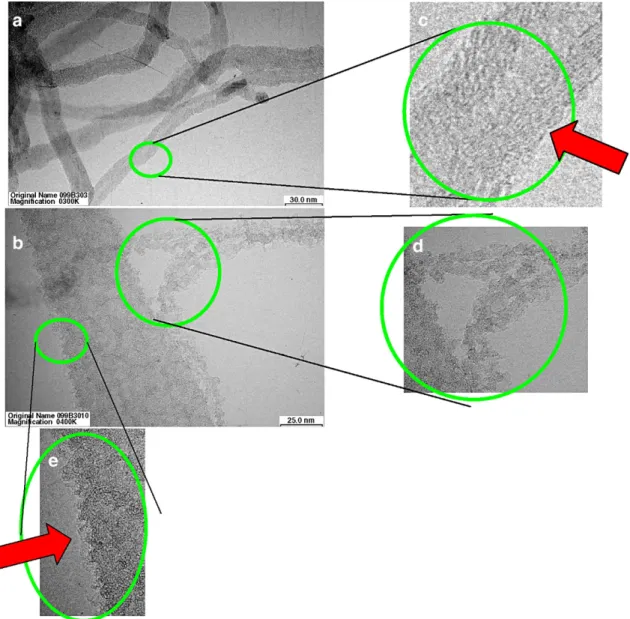
Fig. 4. HRTEM images for MWNT films (a) before, and (b) after laser irradiation. (c)–(e) Displays the enlarged view of the corresponding circled areas (see text) (For interpretation of the references to colour in this figure legend, the reader is referred to the web version of this article.)
microscopic structure analyses.Fig. 4shows the high-resolution transmission electron microscopy (HRTEM) images for MWNT films prior to (a) and after laser irradiation (b), respectively.
Fig. 4(c)–(e) demonstrates the enlarged view of the circled
corresponding areas. It is evident fromFig. 4(c) that the multi-wall structure (indicated by the red arrow) of the as-grown film is clearly observable. However, after laser irradiation, not only the tube edge lost its smoothness and became rather irregular, but also the wall structure has been largely destroyed. This is quite consistent with our view of attributing the increased ID/IGratio to the increased broken-bonds and structural damages caused by the bombardment of incident energetic photons. The enhance-ment of the emission performance could arise from either the increase of emission site or the enhancement of emission effi-ciency of particular sites or even both after laser treatment. At present, however, we are unable to reach the definite conclusion on this particular issue, and further investigations are needed. 4. Summary
In summary, we have demonstrated in this report that the post-treatment by KrF excimer laser could effectively enhance the field emission properties of the multi-wall carbon nanotube films fabricated by low-temperature microwave plasma chem-ical vapor deposition. We obtained a factor of 2–3 enhancement in emission current density, and a significant reduction in the turn-on field for the MWNT films by the current process scheme. Introduction of oxygen during irradiation, however,
was found to degrade the performance of field emission proper-ties. The improvement in the emission characteristics induced by the irradiation as revealed by the corresponding modifica-tions in the ID/IGratios suggested that the primary reason was probably due to the degenerating of the graphite structure induced by the photon bombardments [5,8,9]. The HRTEM images provide some direct evidences for the abovementioned conjectures.
Acknowledgement
This research was financially supported by the National Science Council of Taiwan under grant no. NSC94-2112-M-009-007.
References
[1] S. Iijima, Nature 354 (1991) 56.
[2] W.A. de Heer, A. Chatelain, D. Ugate, Science 270 (1995) 1179. [3] S. Tans, A. Verschueren, C. Dekker, Nature 393 (1998) 49.
[4] S.C. Tseng, Chia-Hung Li, Y.Y. Lin, C.H. Tsai, Z.P. Wang, K.C. Leou, C.H. Tsai, S.P. Chen, J.Y. Lee, B.C. Yao, Diamond Relat. Mater. 14 (2005) 2064. [5] D.T. Colbert, R.E. Smalley, Carbon 33 (1995) 921.
[6] A. Sawada, M. Iriguchi, W.J. Zhao, C. Ochiai, M. Takai, J. Vac. Sci. Technol., B 21 (2002) 362.
[7] W.J. Zhao, A. Sawada, M. Takai, Jpn. J. Appl. Phys. 41 (2002) 4314. [8] W.J. Zhao, N. Kawakami, A. Sawada, M. Takai, J. Vac. Sci. Technol., B 21
(2003) 1734.
[9] Hsiu-Fung Cheng, Yun-Shuo Hsieh, Yi-Chun Chen, I-Nan Lin, Diamond Relat. Mater. 13 (2004) 1004.