Simultaneous mode locking in a diode-pumped
passively Q-switched Nd:YVO
4
laser with a GaAs
saturable absorber
Yung-Fu Chen, K. F. Huang, S. W. Tsai, Y. P. Lan, S. C. Wang, and J. Chen
Simultaneous mode locking and Q switching is accomplished in a diode-pumped Nd:YVO4兾GaAs laser.
The average output power is⬃2.0 W at 10.6-W absorbed pump power, and the repetition rate of the
Q-switched pulse is⬃120 kHz. The mode-locked pulse inside the Q-switched pulse has a repetition rate
of⬃148 MHz, and its average duration is estimated to be ⬃100 ps. © 2001 Optical Society of America
OCIS codes: 140.3480, 140.3540, 140.3580, 140.4050.
1. Introduction
Simultaneous Q switching and mode locking is of great interest for the generation of high peak power and ultrashort pulses. The nonlinear absorption of saturable absorbers was first successfully employed for simultaneous Q switching and mode locking of solid-state lasers in 1965.1,2 Unlike cw mode
lock-ing,3 to generate a Q-switched and mode-locked
pulse, the intensity fluctuation must be sufficiently strong and the build-up time of the Q-switched pulses must be sufficiently short because of the limited round-trip time of the intensity fluctuation. In early technologies, dyes were commonly employed in pulsed mode-locked solid-state lasers. Recently, the generation of passively Q-switched and mode-locked pulses was performed in diode-pumped solid-state la-sers with Cr4⫹:YAG.4,5 Semiconductor GaAs was
first used for passive mode locking by Zhang et al.6
and by Kubecek et al.7in a flash-lamp-pumped
solid-state laser and for passive Q switching by Kajava and Gaeta8 for a diode-pumped Nd:YAG laser. Kajava
and Gaeta8 concluded that two-photon absorption
and free-carrier effects play an important role in the pulse formation in GaAs. Recently, Jiang et al.9 used an antireflection-coated semiconductor
saturable-absorber mirror to generate cw mode lock-ing. In addition to semiconductor materials, other solid-state saturable absorbers such as colored glass filters10and semiconductor-doped glasses11were also
used for mode-locked lasers. Here we report that GaAs can be used for simultaneous Q switching and mode locking in a diode-pumped Nd:YVO4laser.
The fluctuation mechanism is believed to be re-sponsible mainly for the generation of ultrashort pulses in lasers Q switched by nonlinear absorb-ers.12,13 According to this mechanism, the picture of
ultrashort pulse formation is the following. During the linear stage of generation, the intensity fluctua-tions arise because of the interference of a great num-ber of modes having a random phase distribution so that the radiation consists of a chaotic collection of ultrashort peaks. In the nonlinear stage, where bleaching of the absorber takes place, the most inten-sive fluctuation peaks are compressed and amplified faster than all the weaker ones. Kryukov and Le-tokhov13 used the fluctuation mechanism to prove
that the ratio of peak pulse power to the mean back-ground power can be given by
Pm
Pbackground
⬵ 共ln m兲, (1)
where m is the number of axial modes at the end of the build up of the linear stage and is the nonlinear parameter related to the pulse compression in the nonlinear stage of development. To obtain a high
Y.-F. Chen共[email protected]兲, K. F. Huang, S. W. Tsai, Y. P. Lan, and S. C. Wang are all with National Chiao Tung University, 1001 TA Hsueh Road, Hsinchu 30050, Taiwan. Y.-F. Chen and K. F. Huang are with the Department of Electrophysics; S. W. Tsai, Y. P. Lan, and S. C. Wang are with the Institute of Electro-Optical Engineering. J. Chen is with the Materials and Electro-Optics Research Division, Chung-Shan Institute of Science and Technology, Tao-Yuan, Taiwan.
Received 16 February 2001; revised manuscript received 3 July 2001.
0003-6935兾01兾336038-04$15.00兾0 © 2001 Optical Society of America
pulse-to-background ratio, m and should be as large as possible.
During the linear stage of the intensity fluctuation build up, the number of axial modes decreases be-cause of the natural gravitation toward the center of the amplification line as given by13
m⫽ m0
关 g0共tb兾tr兲兴1兾2
, (2)
where m0is the initial number of axial modes, g0is
the threshold gain, tris the round-trip time, and tbis
the pulse build-up time. In most cases the nonlinear parameter is given by13
⫽ 1⫺ T0
tb共dg兾dt兲
, (3)
where T0is the initial transmission of the saturable
absorber and dg兾dt is the speed of the gain increase that is due to threshold pumping. From Eqs.共1兲–共3兲 it can be found that a shorter pulse build-up time generally leads to a larger m and a larger, and then a higher pulse-to-background ratio.
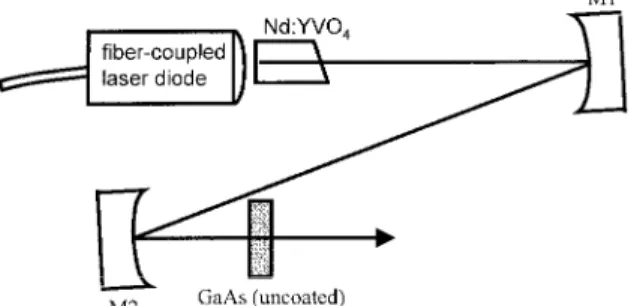
We designed a 1-m-long cavity to have a large num-ber of axial modes for a high pulse-to-background ratio in pulsed mode-locking performance. Figure 1 outlines the basic laser setup. The pump power is a 20-W fiber-coupled diode-laser array共Coherent FAP-81-20C-800-B兲 with an output wavelength at 25 °C in the 807– 810-nm range. The fibers were drawn into round bundles of 0.8-mm diameter with a numerical aperture of 0.18. A focusing lens with 20-mm focal length and 85% coupling efficiency was used to reim-age the pump beam onto the laser crystal. The waist diameter of the pump beam was approximately 400m. The a-cut 0.3-at. % Nd3⫹, 10-mm-long Nd: YVO4 crystal was a 0.5° wedge and was coated for high reflectivity at 1064 nm共R ⬎ 99.9%兲 and for high transmission at 808 nm共T ⬎ 95%兲 on one side. The other side was antireflection coated at 1064 nm. We used a Nd:YVO4crystal with a low doping concentra-tion to avoid thermally induced fractures.14 The
la-ser crystal was wrapped in indium foil and was mounted in a water-cooled copper block. The water temperature was maintained at 20 °C. We designed the cavity to allow for easy mode matching with the pump beam and to provide the proper spot size in the
saturable absorber. An uncoated 0.3-mm-thick GaAs wafer was used as the saturable absorber. The GaAs wafer also served as an output coupler in the cavity because the uncoated GaAs forms a Fabry– Perot cavity. Use of a GaAs wafer as a saturable absorber and as an output coupler has been demon-strated in a passively diode-pumped Q-switched la-ser.15 The effective reflectivity of the GaAs output
coupler is approximately 70%. The resonator con-sisted of two spherical highly reflective共at 1064 nm兲 mirrors, M1 and M2, with radii of curvature of 50 and 10 cm, separated by 60 cm. Since a short pulse build-up time is of benefit to the generation of Q-switched and mode-locked pulses, the GaAs satu-rable absorber was placed at a tight focusing position to allow for a short build-up time. For this purpose, the distance between the GaAs and mirror M2 was fixed at between 5.4 and 5.6 cm.
Figure 2 shows the average output power with re-spect to the incident pump power. The average out-put power was ⬃2.0 W at 10.6-W absorbed pump power and the repetition rate of the Q-switched pulse was ⬃120 kHz. The lasing threshold and optical slope efficiency were 3.2 W and 26.5%, respectively.
The experimental results showed that the
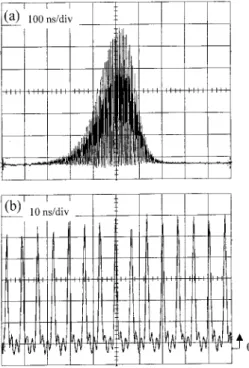
Q-switched pulse train became irregular when the pump power exceeded 11 W because the modulation depth of the present GaAs absorber was not high enough. Even so, the output power can be scaled up to 4.2 W at a 17-W absorbed pump power. This result indicates that the unsaturable loss of the GaAs wafer is not significant. The pulse temporal behav-ior was recorded with a LeCroy 9362 oscilloscope 共500-MHz bandwidth兲 and a high-speed InGaAs pho-todiode with a rise time of⬃0.1 ns. A typical oscil-loscope trace is presented in Fig. 3, showing a train of Q-switched pulses. The pulse-to-pulse amplitude fluctuation of the Q-switched pulse train was found to be less than⫾10%. The Q-switched pulse envelope
Fig. 1. Configuration of a passively Q-switched mode-locked Nd: YVO4laser with an uncoated GaAs.
Fig. 2. Average output power and repetition rates of a passively
Q-switched mode-locked pulse train with respect to pump power.
has a temporal duration of 200 –300 ns and the mode-locked pulses inside the Q-switched pulse have a rep-etition rate of⬃148 MHz, as shown in Figs. 4共a兲 and 4共b兲. The temporal duration of the mode-locked pulses was estimated to be ⬃100 ps. The peak power of a single pulse near the maximum of the Q-switched envelope was between 1 and 3 kW. This peak power is several times higher than a passive Nd:YVO4兾GaAs laser without mode locking.15
Dur-ing the experiment, the temperature rise of the GaAs wafer was not significant, and we did not observe any optical damage to the GaAs wafer.
Based on the fact that the mode radius inside the GaAs is 30m and the energy of the average mode-locked pulse in the cavity is 180 nJ, the fluence inside the GaAs can be estimated to be 6.4 mJ兾cm2. The
intensity-dependent absorption coefficient is given by ␣ ⫽ ␣0兾共1 ⫹ I兾Isat兲, where ␣0is the absorption
coef-ficient and Isatis the saturation fluence. Using␣0⫽
1.1 cm⫺1 and Isat ⫽ 1.6 mJ兾cm2,8 we found the
double-pass small-signal transmission to be 98.7%, which means that the GaAs is strongly saturated. Note that an uncoated GaAs serves as a narrow-band Fabry–Perot filter that has a direct effect on pulse formation. The effective bandwidth of an uncoated GaAs is
⌬ ⫽ c
2nd
冉
1⫺ R
冑
R冊
, (4)where c is the speed of light in vacuum; n and d are, respectively, the refractive index and the thickness of the GaAs; and R is the Fresnel reflection. With Eq. 共4兲, the effective bandwidth is found to be ⬃60 GHz. The gain bandwidth of the Nd:YVO4crystal is⬃250
GHz. Therefore, the narrow-band Fabry–Perot fil-ter that results from the uncoated GaAs has a direct effect on pulse formation.
In conclusion, we have, for the first time to our knowledge, demonstrated the use of uncoated GaAs to obtain a high-power diode-pumped Q-switched and mode-locked Nd:YVO4 laser. The laser provided Q-switched pulses of 200 –300-ns duration, an ⬃100-ps mode-locked pulse train, and 1–3-kW peak power. With further optimization of the modulation depth in the GaAs wafer, this laser can be of consid-erable interest for a variety of applications.
References
1. H. W. Mocker and R. J. Collins, “Mode competition and self-locking effects in a Q-switched ruby laser,” Appl. Phys. Lett. 7, 270 –274共1965兲.
2. A. J. DeMaria, D. A. Stetser, and H. Heynau, “Self mode-locking of lasers with saturable absorbers,” Appl. Phys. Lett. 8, 174 –176共1966兲.
3. F. X. Kartner, I. D. Jung, and U. Keller, “Soliton mode-locking with saturable absorbers,” IEEE J. Sel. Top. Quantum Elec-tron. 2, 540 –556共1996兲.
4. T. M. Jeong, C. M. Chung, H. S. Kim, C. H. Nam, and C. J. Kim, “Generation of passively Q-switched and modelocked pulse from Nd:YVO4laser with Cr
4⫹:YAG saturable absorber,”
Elec-tron. Lett. 36, 633– 634共2000兲.
5. Y. F. Chen, S. W. Tsai, and S. C. Wang, “High-power diode-pumped Q-switched and mode-locked Nd:YVO4laser with a
Cr4⫹:YAG saturable absorber,” Opt. Lett. 25, 1442–1444
共2000兲.
6. Z. Zhang, L. Qian, D. Fan, and X. Deng, “Gallium arsenide: a new material to accomplish passively mode-locked Nd:YAG laser,” Appl. Phys. Lett. 60, 419 – 421共1992兲.
7. V. Kubecek, S. Kumazaki, Y. Takagi, G. C. Reali, and K. Yo-shihara, “Actively and passively mode-locked Nd:YAP共YAlO3兲
laser with negative feedback using CdSe and GaAs,” Jpn. J. Appl. Phys. 30, L1889 –L1891共1991兲.
8. T. T. Kajava and A. L. Gaeta, “Q-switching of a diode-pumped Nd:YAG laser with GaAs,” Opt. Lett. 21, 1244 –1246共1996兲. 9. M. Jiang, G. Sucha, M. E. Fermann, J. Jimenez, and D. Harter,
“Nonlinearly limited saturable-absorber mode locking of an erbium fiber laser,” Opt. Lett. 24, 1074 –1076共1999兲. 10. N. Sarukura, Y. Ishida, T. Yanagawa, and H. Nakano, “All
solid-state cw passively mode-locked Ti-sapphire laser using a colored glass filter,” Appl. Phys. Lett. 57, 229 –230共1990兲. 11. I. P. Bilinsky, R. P. Prasankumar, and J. G. Fujimoto,
“Self-staring mode locking and Kerr-lens mode locking of a Ti:Al2O3
Fig. 3. Oscilloscope traces of a train of Q-switched pulses.
Fig. 4. 共a兲 Expanded temporal shape of a single Q-switched pulse. 共b兲 Oscilloscope traces of a train of mode-locked pulses.
laser by use of semiconductor-doped glass structures,” J. Opt. Soc. Am. B 16, 546 –549共1999兲.
12. J. A. Fleck, “Ultrashort-pulse generation by Q-switched la-sers,” Phy. Rev. B 1, 84 –100共1970兲.
13. P. G. Kryukov and V. S. Letokhov, “Fluctuation mechanism of ultrashort pulse generation by laser with saturable absorber,” IEEE J. Quantum Electron. 8, 766 –782共1972兲.
14. Y. F. Chen, “Design criteria for concentration optimization in scaling diode end-pumped lasers to high powers: influence of thermal fracture,” IEEE J. Quantum Electron. 35, 234 –239 共1999兲.
15. G. Q. Gu, F. Zhou, G. Zhang, and M. K. Chin, “Passive
Q-switched single-frequency Nd:YVO4laser with GaAs
satu-rable absorber,” Electron. Lett. 34, 564 –565共1998兲.