On The Domatic Number of Bipartite Permutation Graphs
Kai Wen Tsui1 and William Chung-Kung Yen2 and Chuan Yi Tang3 1Department of Computer Science, National Tsing Hua University, Hsinchu, Taiwan. [email protected].
2Department of Information Management, Shih Hsin University,Taipei, Taiwan. [email protected]. 3
Department of Computer Science, National Tsing Hua University, Hsinchu, Taiwan. [email protected].
Abstract
This paper studies the problem of partitioning the vertices of a graph G into disjoint set V1, …, Vq such that V1, …, Va are all
dominating sets of G. The objective is to find the largest q. We first propose a 0-1 matrix representation of bipartite permutation graphs. Then, a linear-time algorithm for domatic number problem on bipartite permutation graphs is designed.
Key words : domatic number, domatic partition, dominating set, bipartite permutation graph.
1 Introduction
A graph G = (V,E) is bipartite if V(G) is the union of two disjoint independent sets of G. A Graph G is permutation graph if there exists a permutation π of {1,2,3,…,|V|} such that (i,j)
∈
Eif and only if (i-j)(π-1
(i) -π-1(j)) < 0. A set D
⊆
Vis a dominating set if every vertex in V-D is adjacent to at least one vertex in D. Let GP =
{P|P is a partition of V and every set is a dominating set of G}. The domatic number dm(G) is defined as dm(G) = max{size(P)|P
∈
GP},where size(P) denotes the number of sets in P. A
domatic partition is a partition in GP whose size equals dm(G).
Finding domatic partition on general
graphs is NP-Hard [6]. For this problem, Peng and Chang gave an linear-time algorithm on strongly chordal graphs. Bertossi [1] proposed an O(n2.5
) for interval graphs and O(n log n) for proper interval graphs. Later, [10] and [2] gave
O(m+n) algorithms for interval graphs, and [8] gave an O(n) algorithm for interval graphs with sorted intervals. In [5], Bonuccelli showed that this problem remained NP-hard for circular-arc graphs and gave an O(n2
log n) time algorithm for proper circular-arc graphs. In [3], Haim and Ron showed that it remained NP-hard for chordal and bipartite graphs.
The rest of this paper is organized as follows. In section 2, we give some properties of bipartite permutation graphs and their 0-1 matrix representation. In section 3, we provide a linear time algorithm for this problem.
2 Bipartite Permutation Graphs
In [9], Peng and Chang gave biclique structure of bipartite permutation graphs. A biclique or complete bipartite graph is a simple bipartite graph such that two vertices are adjacent if and only if they are in different partite sets. A bipartite permutation graph G can be partitioned into Gr = B1 1 1 k l ⊕ B2 2 2 k l ⊕ ... 1 1 − − ⊕r r k l Br,where B1,B2,...,Br are bicliques, called generating
from X and Y partite between any two bicliques. We make use of this structure and refine it in our algorithm. For the sake of simplicity, proof detail can be referenced in [9].
Lemma 2.1 [9] Gr is a bipartite permutation
graph.
Theorem 2.1 [9] G is a bipartite permutation
graph if and only if there exists a generating base for G.
Lemma 2.1 shows that Gr and bipartite
permutation graph are equivalent. Theorem 2.1 show that every bipartite permutation graph can be converted into Gr = B1⊕lk11B2⊕kl22... 11 − − ⊕r r k l Br.
The matrix representation in this paper can be easily seen that is equivalent to Gr.
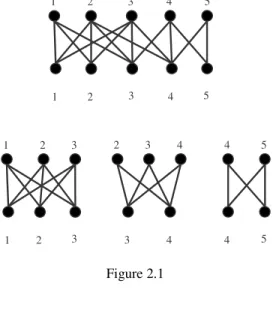
Figure 2.1
Figure 2.1 shows that a bipartite permutation graph can be decomposed into bicliques. It is natural to represent a graph with 0-1 matrix, when we use 0-1 matrix to represent bipartite permutation graphs, it can be easily
observed that it has consecutive 1s’ property, In Figure 2.2, we show that this two kinds of representation are equivalent.
Y\X 1 2 3 4 5 1 1 1 1 2 1 1 1 3 1 1 1 1 4 1 1 1 1 5 1 1 Figure 2.2
These three rectangles in Figure 2.2 represent three bicliques in Figure 2.1 respectively, and the generating base in Figure 2.1 (In this example, 2
1
⊕ , 1
1
⊕ ) mapping to Figure 2.2 which is the width and height of the intersection region of any two rectangles.
Now, we give this representation a formal definition, Let G = (X,Y,E), be a bipartite permutation graph, X = {1,...,m}, Y = {1,...,n}, construct a m by n 0-1 matrix T where
Tij = 1 , if (i,j)
∈
E, Tij = 0 , otherwise. 1 2 3 1 2 3 4 4 5 5 1 2 3 1 2 3 2 3 4 3 4 4 5 4 53 Algorithm
Let G=(X,Y,E)=B1⊕kl11B2 2 2 k l ⊕ ... 1 1 − − ⊕ r r k l Br,be a bipartite permutation graph, define X(Bi)
(respectively, Y(Bi)) be number of nodes of
biclique Bi in X (respectively, Y) partite.
Let P = {p0,p1,...,pr-1} and Q = {q0,q1,...,qr-1} where pi = (pix,piy) = ( i j j j k B X −
∑
=1 ) ( +1, i j j j l B Y −∑
=1 ) ( +1) and qi = (q ,ix qiy) = ( 1 1 ) ( − = −∑
j i j j k B X +1 , 1 1 ) ( − = −∑
j i j j l B Y +1), for1
≤
i ≤
r
. define p0 = (0,0) and q0 = (0,0).The set P and Q indicate left-top and bottom-right of these intersection regions of two rectangles. In Figure 2.2, the set P =
{(2,3),(4,4)}, Q = {(4,4),(5,5)}.
For set P = {p0,p1,...,pr-1}, Q =
{q0,q1,...,qr-1}, define region(pi) be the induced
subgraph of G, where V(region(pi)) =
{ x i p , x i p +1,...,m}∪{ y i p , y i p +1,...,n}, define
ds(i) be the set of nodes label i, 1≤i ≤dm(G), define #stages be the size of generating base.
Algorithm DP
Input : a bipartite permutation graph G = B1 1 1 k l ⊕ B2 2 2 k l ⊕ ... 1 1 − − ⊕ r r k l Br. Output : a domatic partition of G.
BEGIN FOR i := 0 label ( 1, 1) y r x r p p− − to i + 1; i ++ ; UNTIL (px i m r−1+ > or p i n y r−1+ > )
IF (the remainder nodes of Br dominate region(gr-1) ) label these nodes to i + 1;
i ++ ;
END IF
FOR j := r - 2 DOWNTO 0
FOR k := 1 TO i
IF ( ds(k) cannot dominate region(pj) )
pick two vertices u,v where u,v come from first unlabeled vertex of region(pj) in X and Y partite respectively, if no such u,v vertices exits, set u = 0 or v = 0.
IF ( ds(k)∪{u} dominate region(pj) ) label u to k;
END IF
ELSE IF ( ds(k)∪{v} dominate region(pj) ) label v to k;
END IF
ELSE IF ( ds(k)∪{u,v} dominate region(pj) ) label u,v to k; END IF ELSE unlabeled ds(k); i -- ; END ELSE ENDIF
merge unlabeled nodes to any dominate set;
4 Correctness of Algorithm DP
We can prove this by induction on #stages. Basis step #stages = 1, which is the following case :Figure 4.1
And we define A, B, C region according to p1
and q1. Algorithm DP first will disjoint partition
B maximally such that each partition dominates A (suppose the size of this partition is
m). Because only B can dominate A, m will be the upper bound of dm(G).
Second, algorithm DP will assign nodes of
B to these partitions such that there are maximum dominating sets of G (say dm(G)).
We prove this by contradiction. In the first step, let the size of disjoint partition be m’, where m’ < m, This will obtain a larger domatic number dm’(G), dm’(G) > dm(G). In another, after the first step, the total nodes needed from B is: βm’ - ( 1 1) ( 1 1) y y x x p q p q − + − , where β is a constant only depending on region B, then we have : βm’ - ( 1 1) ( 1 1) y y x x p q p q − + − < βm - ( 1 1) ( 1 1) y y x x p q p q − + −
Because nodes of region B are the same, i.e.,
dm’(G) ≤ dm(G). It means that we need fewer nodes to generate larger dominating sets. A
contradiction occurs.
For #stages = n, the previous n-1 stages satisfy induction hypothesis, show in Figure 4.2 :
Figure 4.2
We can prove this case the same way as we do in the basis step.
It is easy to verify that Algorithm DP scans each vertex and each edge constant times. Therefore, the following Theorem can be obtained.
Theorem 4.1 The time complexity of Algorithm
DP is O(n+m).
5 Conclusions
Domatic number problem is so essential and fundamental to graph theory and its applications. It has been known that the problem is NP-Hard on bipartite graphs. This paper has proposed a linear-time algorithm for the problem on bipartite permutation graphs. It is worthy to extend the result of this paper to the super classes of bipartite permutation graphs such as double convex bipartite graphs, convex bipartite graphs, and permutation graphs. Meanwhile, it is
B A C G n-1th stage nth stage . . .
a practical issue to derive efficient approximation algorithms for bipartite graphs by modifying our algorithm. We are now working this issue.
Reference
[1] A.A. Bertossi, “On the domatic number
of interval graphs”, Inform. Process. Lett. 28 (1988) 275-280.
[2] A. Srinivasa Rao and C. Pandu Rangan, “Linear algorithm for domatic number
problem on interval graphs”, Inform. Process. Lett. 33 (1989) 29-33. [3] Haim Kaplan and Ron Shamir, “The
domatic number problem on some perfect graph families”, Inform. Process. Lett. 49 (1994) 51-56.
[4] J. SPINRAD and A. BRANDSTÄDT and L. STEWART “BIPARTITE
PERMUTATION GRAPHS”, Discrete Applied Mathematics 18 (1987) 279-292 [5] M.A. Bonuccelli, “Dominating sets and
domatic number of circular arc graphs”,
Discrete Appl. Math. 12 (1985) 203-213 [6] M.R. Garey and D.S. Johnson,
“Computers and Intractability: A Guide
to the Theory of NP-Completeness”
Freeman, San Francisco, CA, 1979. [7] S.L. Peng and M.S. Chang, “A simple
linear time algorithm for the domatic partition problem on strongly chordal graphs”, Inform. Process. Lett. 43 (1992) 297-300.
[8] S.L. Peng and M.S. Chang. “A new
approach for domatic number problem on interval graphs”, Proc. National
Computer Symp. 1991, Taipei, Republic of China, pp. 236-241.
[9] S.L. Peng, J.H. Lee, J.R. Lin, C.S. Liu
“On the C4-destroying of Bipartite Permutation Graphs”, Proc. Workshop on Combinatorial Mathematics and Computation Theory 2004 p.86-90 [10] T.L. Lu, P.H. Ho and G.J. Chang, “The
domatic number problem in interval graphs”, SIAM J. Discrete Math. 3 (1990) 531-536.