Polarizer-free and fast response microlens arrays using polymer-stabilized blue
phase liquid crystals
Yi-Hsin Lin, Hung-Shan Chen, Hung-Chun Lin, Yu-Shih Tsou, Hsu-Kuan Hsu, and Wang-Yang Li
Citation: Applied Physics Letters 96, 113505 (2010); doi: 10.1063/1.3360860
View online: http://dx.doi.org/10.1063/1.3360860
View Table of Contents: http://scitation.aip.org/content/aip/journal/apl/96/11?ver=pdfcov Published by the AIP Publishing
Articles you may be interested in
A low voltage and submillisecond-response polymer-stabilized blue phase liquid crystal Appl. Phys. Lett. 102, 141116 (2013); 10.1063/1.4802090
Improved Kerr constant and response time of polymer-stabilized blue phase liquid crystal with a reactive diluent
Appl. Phys. Lett. 102, 071104 (2013); 10.1063/1.4793416
Extended Kerr effect of polymer-stabilized blue-phase liquid crystals Appl. Phys. Lett. 96, 071105 (2010); 10.1063/1.3318288
A liquid crystalline polymer microlens array with tunable focal intensity by the polarization control of a liquid crystal layer
Appl. Phys. Lett. 91, 221113 (2007); 10.1063/1.2813638
Polarization-independent and fast-response phase modulation using a normal-mode polymer-stabilized cholesteric texture
J. Appl. Phys. 98, 043112 (2005); 10.1063/1.2037191
This article is copyrighted as indicated in the article. Reuse of AIP content is subject to the terms at: http://scitation.aip.org/termsconditions. Downloaded to IP: 140.113.38.11 On: Wed, 30 Apr 2014 11:56:03
Polarizer-free and fast response microlens arrays using polymer-stabilized
blue phase liquid crystals
Yi-Hsin Lin,1,a兲Hung-Shan Chen,1Hung-Chun Lin,1Yu-Shih Tsou,1Hsu-Kuan Hsu,2and Wang-Yang Li2
1
Department of Photonics, National Chiao Tung University, Hsinchu 30010, Taiwan
2
Chimei Optoelectronics Corp., Tainan 74147, Taiwan
共Received 14 January 2010; accepted 22 February 2010; published online 15 March 2010兲 We demonstrate polarizer-free and fast response microlens arrays based on optical phase modulation of polymer-stabilized blue phase liquid crystal共PSBP-LC兲. Polarization-independent optical phase shift is because the propagation of an incident light is along the optic axis of PSBP-LC, and birefringence of PSBP-LC induced by Kerr effect results in electrically tunable optical phase shift. The measured optical phase shift of a PSBP-LC phase modulation is aroundradian at 150 Vrms
for the cell gap of 7 . The response time is about 3 ms. The focal length is around 13.1 cm at 100 Vrms. © 2010 American Institute of Physics. 关doi:10.1063/1.3360860兴
Liquid crystal 共LC兲 phase-only modulations are electri-cally controllable without any mechanical moving parts, low cost, light weight, and low power consumption of LC phase modulations; as a result, LC phase modulations are widely used in adaptive optics, optical cross-connect switching, la-ser beam steering, and low-cost electro-optic sensors. The applications include self-adjusted eyeglasses, tunable-focus microlens arrays, electrically tunable gratings and prisms, and spatial light modulators.1–4 However, the optical effi-ciency is limited due to utilizing a linear polarizer. Thus, to develop polarization-independent phase modulators is an ur-gent task. Two types of polarization independent phase modulators are developed.5One is the residual phase type.6–8 All the LC directors have the same tilt angle except random orientations; as a result, all the polarizations of an incident light experience the same optical phase shift. The other type is double-layered structure.9–11The underlying principle is to stack two identical homogeneous LC layers together in or-thogonal directions. An unpolarized light can be decomposed into two linear eigenpolarized lights. After propagating through the two stacked LC layers, both of eigenpolarized lights experience the same optical phase shift. The mecha-nisms of two types of polarization-independent phase modu-lations are based on the orientational change of LC directors. Recently, polymer-stabilized blue phase liquid crystals 共PSBP-LCs兲 within wide temperature range attract many at-tentions, especially in the application of in-planed switching liquid crystal displays 共IPS-LCDs兲 owning to fast response time, alignment-free, and wide viewing angle. Such IPS-LCDs require two polarizers because of optical anisotropy induced by the electric fields.12–15 In this paper, we demon-strate a polarizer-free and fast response microlens arrays based on the phase-only modulation of PSBP-LC. Polarization-independent optical phase shift is because the propagation of an incident light is along an optic axis of PSBP-LC, and the birefringence of PSBP-LC induced by Kerr effect results in electrically tunable optical phase shift. We discuss and measure the polarization-independent optical phase shift of the PSBP-LC. Then we measure the focusing properties of microlens arrays of PSBP-LCs.
Figure1 illustrates the effective optical index-ellipsoids of the lens of PSBP-LC. The PSBP-LC is confined between two Indium Tin Oxide 共ITO兲 glass substrates. At V=0, the effective optical index-ellipsoid of PSBP-LC is sphere which also means optical isotropic.12,15 When the applied voltage exceeds the critical voltage 共Vc兲,16 the effective optical index-ellipsoid of PSBP-LC turns out ellipsoidal due to Kerr effect; moreover, the direction of the optic axis is parallel to z-direction. To obtain a lensing effect using PSBP-LC, we can apply an inhomogeneous electric field by patterned elec-trode with a circular aperture size共W兲 as shown in Fig.1. In Fig.1, the voltage is lower in the middle of the aperture and higher in the edge of the aperture. 共i.e., V3⬎V2⬎V1兲 The
Kerr-effect-induced optic axes are parallel to z-direction and the effective optical index-ellipsoid turns out more elongated ellipsoid with higher voltage. PSBP-LC is optically isotropic for the unpolarized incident light propagating along the di-rection of the optic axis共or z direction兲. The refractive index of PSBP-LC is lower in the edge of the aperture; therefore, PSBP-LC forms a lensinglike phase profile due to the spatial distribution of refractive indices. Such a lensing effect of PSBP-LC is polarization independent and electrically tun-able. We can assume that, the refractive index of PSBP-LC is naveat V1= 0 for the unpolarized light. The refractive index
of PSBP-LC is no,eff共V兲 under applied voltage 共V⬎Vc兲. The optical phase shift共⌬␦兲 between a high voltage 共V兲 and V = 0 can be expressed as,
a兲Electronic mail: [email protected].
FIG. 1. 共Color online兲 The effective optical index-ellipsoids of PSBP-LC under an inhomogeneous voltage distribution: V1= 0, V2共⬎Vc兲, and
V3共⬎V2兲 The incident light propagates along z-direction.
APPLIED PHYSICS LETTERS 96, 113505共2010兲
0003-6951/2010/96共11兲/113505/3/$30.00 96, 113505-1 © 2010 American Institute of Physics
This article is copyrighted as indicated in the article. Reuse of AIP content is subject to the terms at: http://scitation.aip.org/termsconditions. Downloaded to IP: 140.113.38.11 On: Wed, 30 Apr 2014 11:56:03
⌬␦=2⫻⫻ d
⫻ 兩no,eff共V兲-nave共0兲兩, 共1兲
where d is cell gap and is wavelength of the incident light. The incident light propagates along z-direction. The aver-aged refractive index at 0 Vrms for the small birefringence
approximation can be expressed as,14,17
nave共V = 0兲 =
2⫻ no+ ne
3 , 共2兲
where nois ordinary refractive index of the host LC and neis extraordinary refractive index of the host LC. At VⰇVc,
no,eff共V兲 is closed to no. Therefore, the optical phase shift
between V3 and V1 from Eq.共1兲 turns out,
⌬␦=2⫻⫻ d
⫻
冏
no− ne
3
冏
. 共3兲The phase shift of PSBP-LC depends on the cell gap, wave-length and birefringence 共ne− no兲 of host LC of PSBP-LC.
The relation between the phase shift and the focal length 共f兲 can be expressed as,2
f = ⫻ w
2
4⫻ ⫻ 兩⌬␦兩. 共4兲
To prepare the sample of PSBP-LC phase modulation, we mixed a positive nematic LC 共⌬n=0.142兲 with two UV-curable monomers, EHA共2-Ethylhexyl, Fluka兲 and RM257 共Merck兲, a chiral molecules CB15 共Merck兲, and photoinitia-tor DMPAP 共Aldrich兲 at 56.9:3.33: 3.42: 35.85: 0.5 wt % ratios. The mixture was prepared in Chimei Optoelectronics Corp. The mixture at isotropic state was filled into an empty LC cell consisting of two ITO glass substrates without any alignment layers and without circular pattern of ITO layers. The cell gap was 7 m. We then cooled down the cell at the cooling rate of 0.1 ° C/min, and the blue phase appeared at the temperature T⬍30 °C. The cell was then exposed by UV light at 28.5 ° C with intensity ⬃1.5 mW/cm2 for 30
min for photopolymerization. After photopolymerization, the PSBP-LC appeared blue phase when the temperature is be-tween 20 and 41 ° C.
In order to ensure the thermal stability and temperature range of PSBP-LC, we observed the morphologies of PSBP-LC with the temperature under a reflective polarizing microscopy without an applied voltage. Figure 2 shows the typical morphologies of PSBP-LC. In Fig. 2, the mosaic structures of PSBP-LCs at 26 and 38 ° C are similar, but the color shifts slightly because the pitch and the birefringence of PSBP-LC are temperature-dependent. By the selective Bragg reflection and the Mozaic platelet structure, the do-main size of PSBP-LC is around 20– 50 m. The PSBP-LC reflects light strongly in blue regime owning to the Bragg reflection. To avoid the blue regime for designing a
PSBP-LC phase modulation, we can either change the pitch of PSBP or shift the operating wavelength. In this paper, the operating wavelength of the following PSBP-LC phase modulation is set at 633 nm.
To evaluate the scattering properties of PSBP-LC, we measured voltage-dependent transmittance of PSBP-LC un-der an unpolarized He–Ne laser 共JDSU Model 1122, = 633 nm兲. The detector 共New Focus Model 2031兲 was placed at 20 cm behind the PSBP-LC. To calibrate the sub-strate reflection losses, the transmittance of the BPLC at the isotropic state with the same cell gap is defined as unity. The measured results are shown in Fig.3. In Fig.3, the averaged transmittance is around 95% and the transmittance fluctuates slightly because of interference of multiple beams between two glass substrates. Hence, the PSBP-LC is almost scattering-free for the unpolarized red light.
To characterize the optical phase shift of the PSBP-LC, we used a Mach–Zehnder interferometer.9 The unpolarized He–Ne laser 共=633 nm兲 was used as a light source. The PSBP-LC cell was driven by a square-wave voltage at fre-quency f = 1 kHz. Figure 3plots the measured optical phase shift as a function of an applied voltage under the unpolar-ized light 共black dots兲. The optical phase shift increases when the voltage exceeds Vc⬃20 Vrms. This is because the
birefringence induced by Kerr effect increases with voltages; as a result, the difference of refractive indices between the high voltage and zero voltage increases. The shift of optical phase when we applied voltage is optical phase shift. The optical phase shift saturating at 150 Vrmsis around ⬃
ra-dian. In order to prove the optical phase modulation of PSBP-LC is indeed polarization independent, we placed a polarizer in front of the unpolarized laser and measured the optical phase shift by rotating the polarizer 共P兲. The results are plotted in Fig. 3 共red squares, blue triangles, and gray diamonds兲. When we rotated the polarizer, we measured the same optical phase shifts. That means the phase shift is in-deed independent of the polarization of the incident light. According to Eq. 共3兲, 兩⌬␦兩 can be calculated as ⬃1.047 radian which is closed to the experimental result⬃radian. To increase the optical phase shift, high birefringence of host LC is preferred. Large cell gap can also enlarge the accumu-lation of the phase shift while maintaining the fast response time. However, larger cell gaps may result in the scattering and the non-uniform domains of PSBP-LC. To reduce the driving voltage, we can adopt the host BP-LC with high birefringence, large Kerr constant, large dielectric anisotropy FIG. 2. 共Color online兲 The morphologies of PSBPLC observing under a
reflective polarizing optical microscopy at共a兲 26 and 共b兲 38 °C.
FIG. 3.共Color online兲 The transmittance 共pink line兲 of PSBP-LC as a func-tion of applied voltage under an unpolarized light. The optical phase shift of PSBP-LC as a function of an applied voltage under an unpolarized light 共black dots兲, 0° linearly polarized light 共red squares兲, 45° linearly polarized light 共blue triangles兲, and 90° linearly polarized light 共gray diamonds兲. T = 26 ° C and=633 nm.
113505-2 Lin et al. Appl. Phys. Lett. 96, 113505共2010兲
This article is copyrighted as indicated in the article. Reuse of AIP content is subject to the terms at: http://scitation.aip.org/termsconditions. Downloaded to IP: 140.113.38.11 On: Wed, 30 Apr 2014 11:56:03
共⌬兲, and large ratio of bend elastic constant 共K33兲 to splay
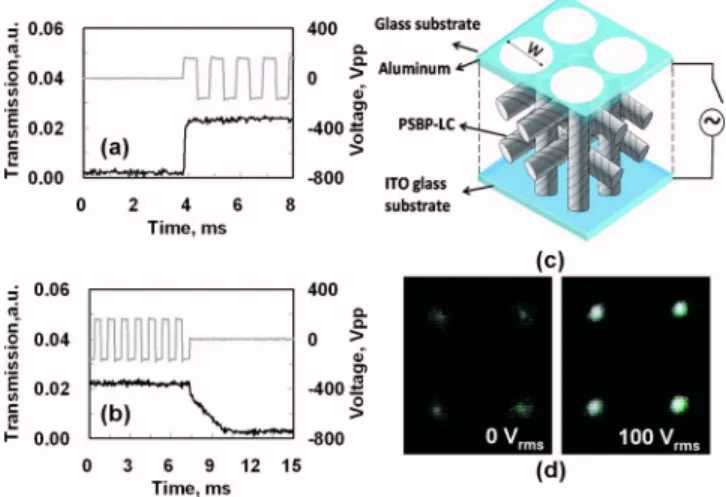
elastic constant 共K11兲.18–20The response time is also impor-tant for phase modulators. The measured response times are shown in Figs.4共a兲and4共b兲. The rise time is⬃0.91 ms and decay time is ⬃2.3 ms. Compared to the conventional pure-LC phase modulation whose response time 共⬃200 ms兲 共Ref. 9兲 proportional to d2, the faster response
time of PSBP-LC is because of orientation of local LC di-rectors within the unit lattice rather than the transition be-tween two nematic orientations of LC directors with higher order parameters.12,13Compared to the typical response time of PSBP-LC less than 1 ms, the slower response time of our PSBP-LC is because the pitch length of PSBP-LC is long.21 To demonstrate a two-dimensional共2D兲 microlens arrays using PSBP-LC as an electro-optics medium, we prepared the microlens arrays consisting of one ITO glass substrate, one glass substrate coating with an aluminum layer which was etched hole-patterns of 250 m in diameter and PSBP-LC, as shown in Fig. 4共c兲. The cell gap was 20 m. To characterize the focusing properties, a collimated unpolar-ized light at=532 nm was used to illuminate the PSBP-LC microlens arrays. The transmitted light was recorded by a charge-coupled device 共CCD兲. The recorded images at V = 0 and V = 100 Vrms are shown in Fig. 4共d兲. At V = 0, no
focus was observed. At V = 100 Vrms, PSBP-LC microlens
arrays showed clear focal spots. The tunable focal length was measured from infinity at V = 0 to 13.1 cm at 100 Vrms. When we placed a polarizer in front of the microlens arrays, the measured focal length did not change with the rotation of polarizer. In Fig. 3, ⌬␦ is ⬃0.2 radian at 5 Vrms/m
at =633 nm. As a result, ⌬␦ is ⬃0.238 radian at = 532 nm. The calculated focal length is 12.34 cm which is closed to the measured focal length of 13.1 cm. The operat-ing voltage is high and focal length is quite long ownoperat-ing to the small Kerr constant of PSBP-LC共⬃10−10 m/V2兲. Due to
the Bragg reflection and the scattering, the transmittance is around 86% for =532 nm. To improve the transmittance, we can shift the pitch of PSBPLC or use the incident light with the wavelength of 633 nm.
In conclusion, we have demonstrated polarizer-free, fast response, and alignment-layer-free microlens arrays based on phase modulation of PSBP-LC. The optical phase shift of PSBP-LC is polarization independent and electrically tun-able. The focal length is around 13.1 cm at 100 Vrms with
the response time of⬃3 ms. To enlarge the tunable focusing range, we can increase the optical phase shift by enlarging the essential birefringence of host BPLC. Unlike the nematic LC based phase modulation, the increase of cell gap of PSBP-LC can accumulate optical phase shift, but do not in-crease response time dramatically. We believe the polariza-tion independent phase modulapolariza-tion of PSBP-LC opens a window for photonic microdevices.
The authors are indebted to Dr. Yung-Hsun Wu共Innolux Display Corp.兲, Mr. Tsung-Han Chiang, Mr. Chun-Hung Wu for discussions, Professor Hung-Chou Lin 共MSE,NCTU兲, and Ms Hsiao-Ping Fang 共MSE, NCTU兲 for the measure-ment of Differential Scanning Calorimetry. This research was supported by Chimei Optoelectronics Corp. and by the National Science Council 共NSC兲 in Taiwan under the Con-tract No. 98-2112-M-009-017-MY3.
1D. K. Yang and S. T. Wu, Fundamentals of Liquid Crystal Devices共Wiley,
New York, 2006兲.
2H. Ren, Y. H. Fan, S. Gauza, and S. T. Wu,Appl. Phys. Lett. 84, 4789
共2004兲.
3Y. H. Lin, H. Ren, K. H. Fang-Chiang, W. K. Choi, S. Gauza, X. Zhu, and
S. T. Wu,Jpn. J. Appl. Phys., Part 1 44, 243共2005兲.
4H. Ren, Y. H. Fan, and S. T. Wu,Appl. Phys. Lett. 82, 3168共2003兲. 5Y. H. Lin, H. Ren, and S. T. Wu,Liq. Cryst. Today 17, 2共2009兲. 6H. Ren, Y. H. Lin, Y. H. Fan, and S. T. Wu,Appl. Phys. Lett. 86, 141110
共2005兲.
7Y. H. Lin, H. Ren, Y. H. Fan, Y. H. Wu, and S. T. Wu,J. Appl. Phys. 98,
043112共2005兲.
8H. Ren, Y. H. Lin, C. H. Wen, and S. T. Wu,Appl. Phys. Lett. 87, 191106
共2005兲.
9Y. H. Lin, H. Ren, Y. H. Wu, Y. Zhao, J. Y. Fang, Z. Ge, and S. T. Wu, Opt. Express 13, 8746共2005兲.
10H. Ren, Y. H. Lin, and S. T. Wu,Appl. Phys. Lett. 88, 061123共2006兲. 11Y. Huang, C. H. Wen, and S. T. Wu,Appl. Phys. Lett. 89, 021103共2006兲. 12H. Kikuchi, M. Yokota, M. Hisakado, H. Yang, and T. Kajiyama,Nature
Mater. 1, 64共2002兲.
13Y. Hisakado, H. Kikuchi, T. Nagamura, and T. Kajiyama,Adv. Mater. 17,
96共2005兲.
14H. S. Kitzerow,Proc. SPIE 7232, 723205共2009兲.
15Y. Haseba, H. Kikuchi, T. Nagamura, and T. Kajiyama,Adv. Mater. 17,
2311共2005兲.
16K. M. Chen, S. Gauza, H. Xianyu, and S. T. Wu,J. Disp. Technol. 6, 49
共2010兲.
17J. Li, S. Gauza, and S. T. Wu,J. Appl. Phys. 96, 19共2004兲.
18S. W. Choi, S. I. Yamamoto, Y. Haseba, H. Higuchi, and H. Kikuchi,Appl. Phys. Lett. 92, 043119共2008兲.
19Z. Ge, S. Gauza, M. Jiao, H. Xianyu, and S. T. Wu,Appl. Phys. Lett. 94,
101104共2009兲.
20L. Rao, Z. Ge, S. T. Wu, and S. H. Lee,Appl. Phys. Lett. 95, 231101
共2009兲.
21P. R. Gerber,Mol. Cryst. Liq. Cryst. 116, 197共1985兲.
FIG. 4.共Color online兲 The transmission of PSBP-LC 共black solid lines兲 and the corresponding squared ac voltage共gray lines兲 as a function of time. 共a兲 The rising time is around 0.91 ms.共b兲 The decay time is around 2.3 ms. T = 26 ° C and =633 nm. 共c兲 The structure of polarization independent microlens arrays using PSBP-LC.共d兲 Measured CCD images of 2D micro-lens arrays at 0 and 100 Vrms. T = 26 ° C and=532 nm.
113505-3 Lin et al. Appl. Phys. Lett. 96, 113505共2010兲
This article is copyrighted as indicated in the article. Reuse of AIP content is subject to the terms at: http://scitation.aip.org/termsconditions. Downloaded to IP: 140.113.38.11 On: Wed, 30 Apr 2014 11:56:03