0021-8502(95)00035-6
Printed in Great Britain. All rights reserved 0021-8502/95 $9.50 + 0.00
A M O D E L F O R P R E D I C T I N G P E R F O R M A N C E O F A N A N N U L A R D E N U D E R S Y S T E M
Chungsying Lu, * * Hsunling Bai : and Yann Ming Lin *
t Department of Environmental Engineering, National Chung Hsing University, Taichung, Taiwan 40227 : Institute of Environmental Engineering, National Chiao-Tung University, Hsin-Chu, Taiwan
(First received 5 January 1995; and in revised form 21 April 1995)
Abstract--A mathematical model for simultaneous gas diffusion, aerosol diffusion and evaporation is presented to predict performance of the annular denuder system. Approximating the aerosol size distribution by a lognormal function and using the statistical method of moment, the evolution of the three aerosol moments and the mass balance equations for the two associated gases in the annular denuder system are obtained. The governing equations were cast into dimensionless form and the performance of the model was validated by the existing data available in the literature. The effects of governing dimensionless groups on the model performance were evaluated in the sensitiv- ity analysis. The model was then applied for sampling nitric acid gas using a typical range of atmospheric aerosol and gas properties to derive the performance equation of the annular denuder system. The methodologies presented herein are helpful in providing design and operational criteria of the annular denuder system for a real sampling of atmospheric reactive gases that minimizes measurement artifacts. h i A 2 Aa B1 B2 Ba B4 B5 B6 B7 Cj Dj Dp E1 E2 E3 f(k, r) G Kn k ks Kp L Mq m 1 mf n s Nay Pl Pd Q r r o r l Sl N O T A T I O N dimensionless parameter, Uavr2/D1L
dimensionless parameter, ns/CtiNav dimensionless parameter, D2/Dj
particle diffusivity constant, kBT/(162n2)l/3# slip correction constant for diffusion, 3.3142(n/6) 1/3
evaporation constant (free molecule), (36n) 1/3 vl n,(k~T/2~ml) 1/2 evaporation constant (continuum), (48n2)1/3/3 2vl n,(8kBT/nml) 1/2 constant ( = r 2 / D : ) constant ( = kBT/6n#rlD1) constant ( = 1.657 Kn) concentration of gas j diffusivity of gas j diffusivity of particle * 1/3 2 * 1/3 2
constant {=B6v s - exp(1/21n ag)ll + BTV I - exp(3/21n as)]}
*2/3 2 * 1/3 2
constant {=B6v, exp(21n aB)[1 + BTVl - exp(--3/21n a,)]}
. 5 t 3 2 * 1/3 2
constant {=B6v * exp(25/21n as)rl + BTvg- e x p ( - 9 / 2 1 n al)]} flow parameter term
evaporation rate
Knudsen number for monomer, 2/rl ratio of inner to outer radius of the denuder Boltzmann constant
equilibrium constant denuder length
qth aerosol moment with respect to particle volume monomer mass
mass fraction of evaporating species contained in the aerosol particles monomer concentration at saturation
Avogradro's number vapour pressure of monomer
vapour pressure of monomer in equilibrium with the surface sampling flow rate
radial distance denuder outer radius monomer radius monomer surface area
*Corresponding author.
1118 C. Lu et al.
S saturation ratio
T ambient temperature in K Uav average gas velocity
v particle volume v~ monomer volume
vg geometric mean particle volume vM molar volume of evaporating species Vdj deposition rate of gas j
z axial distance
Greek letters
A
accommodation coefficient
coefficients for performance equation of the annular denuder system
dimensionless parameter for calculating the sampling efficiency of the annular denuder system,
~D1L(1 + k)/4Q(1 - k)
e evaporation coefficient for second moment, 1/e = 1/eFM + 1/ec,
eFM = B3 v 2/3 exp(8 In 2 og), ec = n 4 v 1/3 exp(7/2 In 2 trg) e* dimensionless evaporation coefficient for second moment,
I/s* = 1/e~u + l/s*, e~u = B s v 2/3 exp(8 In 2 as), e~ = 4/3 K ~ a B s v ~ 1/3 exp(7/2 In 2 az) q evaporation coefficient for first moment, I/q = I/qFM + I/~/3,
= I:/ .2/3 exp(2 In 2 tr,), qc = B4v~/3 exp(1/2 In 2 ag) ~ F M u 3 v B
q* dimensionless evaporation coefficient for first moment,
l/q* = 1/r/~ M + 1/q~, q~M = B5 v~ 2/3 exp(2 In 2 trs), ~/* = 4/3 Kn B5 v .1/3 exp(1/2 In 2 as) 2 mean free path of gas molecules
/t viscosity
a B geometric standard deviation
z characteristic time for particle growth, 1/nssl(kBT/2nml) 1/2 Subscripts
i inlet condition
Superscripts
dimensionless quantity
I N T R O D U C T I O N
In recent years, annular denuders have become the most widely employed instruments for sampling and collecting reactive gases such as SO2, NH3, H N O 3 and organic vapors in the atmosphere (Koutrakis et al., 1988; C o u t a n t et al., 1989; Benner et al., 1991; Lee et al., 1993). They have advantages of allowing higher sampling velocities as well as having larger sampling capacities as compared to hollow tube denuders and parallel plate denuders.
Possanzini et al. (1983) proposed design equations for gas collection in annular denuders by fitting experimental data to a modified form of the G o r m l e y - K e n n e d y equation (Gormley and Kennedy, 1949). Koutrakis et al. (1988) used this equation to evaluate performance of the H a r v a r d - E P A annular denuder system for sampling pollutant gases and associated aerosols. The differences between measured and calculated collection efficiencies were small in their studies. Winiwarter (1989) derived a mathematical expression for describing the sampling efficiency in an annular denuder and indicated a general agreement of calculated and measured sampling efficiencies.
However, as the pollutant gases are adsorbed at the denuder walls, the state of equilib- rium between gas and particle phases is disturbed, which results in evaporation of aerosols and release of additional pollutant gases. Therefore it is possible that excessive amounts of pollutant gases are being sampled. This p h e n o m e n o n may particularly be true for volatile aerosols such as N H 4 N O 3 and NH4CI containing aerosols and their associated gases (Durham et al., 1987; Harrison et al., 1990). In addition, the diffusional deposition of particles which contain compounds similar to the sampling gases may also introduce measurement artifacts (Durham et al., 1987). Clearly, these important mechanisms which m a y significantly influence performance of the annular denuder system cannot be described by the equations of Possanzini et al. (1983) and Winiwarter (1989).
The performance of annular denuders for sampling reactive gases in the presence of evaporating particles has been theoretically studied by Pratsinis et al. (1989) and Biswas
et al. (1990). As a result of their studies, significant measurement artifacts from evaporating aerosols may occur during gas sampling in the denuder system. However, in their theoret-
ical studies, the gas stream was assumed to contain monodisperse aerosols. As indicated by
Bai et al. (1995), particle polydispersity plays an important role in the evaporation of dry
NH4NO3 and NH4C1 aerosols in the annular denuder system. An increase in the particle polydispersity leads to a significant reduction in the evaporation rate for particles with a mass median diameter of about 0.5 #m.
Therefore the goal of this study is to develop a mathematical model that modifies the theory of Pratsinis et al. (1989) and Biswas et al. (1990) to include the effects of evaporation and diffusion of polydisperse particles. The shape of the particle size distribution is approximated by a lognormal function and the statistic method of moment is employed to obtain the evolution of the three aerosol moments and the mass balance equations for the two associated gases. The performance of the model is validated by comparing its predic- tions with the analytical and experimental data available in the literature. The effects of governing dimensionless groups on the model performance are evaluated and the deriva- tions of performance equations using a typical range of the atmospheric aerosol and gas properties are demonstrated. The optimal operating conditions of the annular denuder system for sampling reactive gases and aerosols can be achieved from the performance equations.
T H E O R Y
When particles in equilibrium with two associated gases 1 and 2, Cl(g) +
C2(g) ~ C3(s),
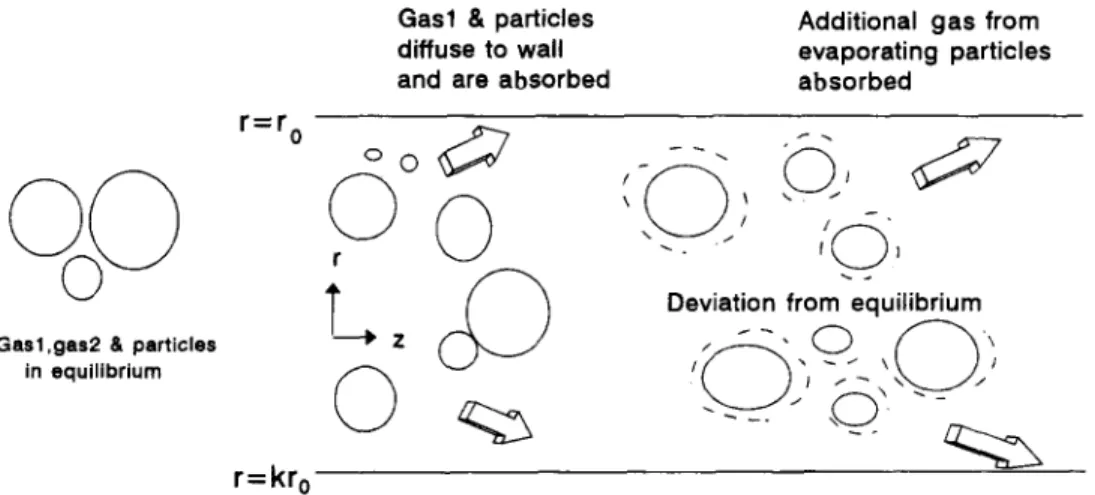
enter an annular denuder system, gas 1 is removed by diffusional absorption at the denuder wall with which equilibrium is distorted. At the same time the aerosol stream may undergo simultaneous diffusion and evaporation processes. The physical concept of this phenom- enon that occurs in the annular denuder system is shown schematically in Fig. 1.
Basic assumptions
The following major assumptions are made in developing a mathematical model to predict the performance of an annular denuder system:
(1) The system is in a steady-state operating condition.
(2) The flow field in the system is a fully developed laminar flow.
(3) No production or reaction of the gas or aerosol occurs in the system. (4) The sticking efficiency of aerosols is 100% on the collector wall surface.
(5) A gas-particle equilibrium is assumed at the interfaces of solid particles and their surrounding gases, which is independent of the denuder residence time.
Gas1 & particles diffuse to wall and are absorbed
Additional gas from evaporating particles absorbed
r = r o ~ .
T Deviation from equilibrium
Gasl,ges2&particles ' Z ~ . ~ ~( ~ ~ \ \
in equilibrium ~ /~, ) ; / ~ . \ ~ . /
L_;
r = k r o
Fig. 1. A schematic diagram of the annular denuder system showing simultaneous gas diffusion, aerosol diffusion and evaporation.
1120 C. Lu
et al.
(6) The size distribution is approximated by a lognormal function. This is because an impactor with a cutoff diameter of around 2.5 #m is usually installed before aerosols entering the annular denuder system. It removes the coarse mode of the usually appearing atmospheric log-bimodal aerosol size distribution.
(7) The effect of diffusion in the direction of flow is neglected as compared to convection. This is a valid assumption since the Peclet number of the annular denuder system is much greater than unity in all tests.
(8) The lognormal size distribution should be preserved throughout the annular denuder system since the residence time is very short.
(9) Only dry aerosols are considered in this study, that is, the relative humidity of the annular denuder system is below the deliquescent humidity.
(10) A mole of gas 1 and a mole of gas 2 are formed when a mole of particle is evaporated.
Model development
For aerosols undergoing simultaneous diffusion and evaporation processes in an annular denuder, the steady-state general dynamic equation is expressed as (Friedlander, 1977)
~n
1 0 I ~(Dpn)]
~(Gn)
Uavf(k,
r)
~z r t~r Lr t?r J + t ~ ' (1)where Uav is the average gas velocity through the denuder, f(k, r) is the flow parameter, k is the ratio of inner to outer radius of the denuder, r is the radial distance, n is the aerosol size distribution function, z is the axial distance, Dp is the particle diffusivity, G is the evapor- ation rate, and v is the volume of a particle. The left-hand-side (LHS) term accounts for convection of particles. The first and second terms on the right-hand-side (RHS) account for particle losses by Brownian diffusion and evaporation, respectively. The fully developed flow parameter in the annular denuder is written as (Bird
et al., 1960)
2[-(1 --
k2)ln(r/ro) + In(I/k)(1 -
r2/r2)]
f(k,
r) -- (1 +k2)ln(1/k) -
(1 - k 2) ' (2)where ro is the outer radius of the annular denuder.
The evaporation of aerosols leads to the release of two gases, C1 and C2. The mass balance equation of the gaseous species j under consideration is expressed as
Uavf(k,r) t~Cj Dj t~ (
t~Cj~
if[
~z
r ~r r Or ]--~M
Gndv,
(3)where Cj is the concentration of gaseous species j (j = 1 or 2), D~ is the diffusivity of gaseous species j, and VM is the molar volume of the evaporating species. The LHS term accounts for convection of gaseous species j. The first RHS term accounts for the diffusional loss of gaseous species j onto the,denuder wall while the second RHS term accounts for the gain of gaseous species j by aerosol evaporation at rate G.
Since the aerosol size distribution is approximated by a lognormal function, combining the method of moments with the lognormal distribution has the advantage of simplicity while evaluating the evolution of polydisperse aerosols (Pratsinis, 1988). The qth moment of an aerosol size distribution is given by (Friedlander, 1977)
= f o vqn(v)dv'
(4)Mq
while the size distribution function,
n(v), for lognormally distributed aerosols is defined as
ln2(v/v,)~
N exp 18 In 2 ag d" (5)
n(v) -
3 x / ~ v l n asThree parameters that completely describe a lognormal size distribution are the total number concentration, N, the geometric mean particle volume, Vg, and the geometric
standard deviation based on particle radius, ag. The values of v s and tr s can be expressed in terms of the first three moments as (Lee
et al.,
1984)Mr
VS = 7t.4"3/2 l A 1 / 2 ' (6)
z c a 0 ~ v z 2
1 / MoM2"~
In2 as = ~ In ~---M2-~---1 ), (7) where Mo is the zeroth moment which represents the total particle number concentration ( = N), Mx is the first volume moment which denotes the total particle volume, and M2 is the second volume moment which indicates the amount of light scattered due to the particles. Thus, Mo, M1 and M2 are sufficient to describe the behavior of lognormally preserving particles and the qth moment of the distribution can be written in terms o f M o , vg, and a s as
M~ = Mov~
exp(4.5q 2 In 2 as). (8)Multiplying equation (1) by v q dv on both sides, integrating over all particle sizes, and using the lognormal function as an approximation of the entire size spectrum, the evolution of the three aerosol moments and the mass balance equations for the two associated gases inside the annular denuder are written as
Ua'f(k'r) OM°
0---~- = rB1 O[ f- r
Or r (M_I/3 q- B2M_2/3)]
, (9)U~f(k,r) OMx
O---z- = -~- Or rB1 O [ ~__~
(M2/3 +B2M1/3) + ~l(S -
]
1)Mo, (10)Ua'f(k'r) OM2 B1 O I O
Oz
= r Or r-~r (ms/a +B2M4/3) +
]
2 e ( S -1)M1,
(11)
Ua,f(k,
r)OCx _ Ox O (r OC,~ _ q (S -
1)Mo, (12)Oz
r Or \ Or ]
VM
Uavf(k, r)OC2 _ D2 O (rOC2 "] _ rl (s _
i)Mo, (13) Oz r O r \ O r / vMwhere Ba and B 2 a r e the particle diffusivity constant and the slip correlation constant for diffusion, r/and ~ are the evaporation coefficients for the first and second moments, and S is the system saturation ratio. The parameters of r/and e were derived for particles in the free molecular and continuum regimes, respectively. A harmonic average of the two regimes is then employed for the entire particle size range. The detailed derivations of Bx, B2, q, and can be seen in Kim and Pratsinis (1988) and Pratsinis (1988), and their definitions are listed in the Notation.
The initial conditions for equations (9)-(13) are: at z = 0, Mo = N i , M1 = Nivgiexp(4.5 In2 o'gi),
M 2 = N i v 2 i exp(18 In 2 agO, (14)
C 1 = C l i , C 2 -~ K p / C l i ,
where subscript i represents the inlet condition, and Kp is the equilibrium constant of particles with the two associated gases. The boundary conditions at both inner and outer denuder walls for three aerosol moments and gases 1 and 2 are:
at
r = kro and r = ro,
Mo = M1 = M 2 -= 0 ,(15)
DIOCI/Or = - VdlC1, D2OCE/Or
= - - Vd2C2,where Vdx and Vd2 a r e the deposition rates of gases 1 and 2, which are proportional to the degree of absorptivity of the denuder surface (Seinfeld, 1986). Three different wall conditions
1122 C. Lu et al.
may be used depending on the wall characteristics: (a) total absorption (Vd ~ oO or C = 0); (b) total reflection (V~ = 0 or OC/Or = 0); (c) partial absorption (lid is some finite value).
F o r mathematical simplicity and to combine model parameters into a smaller set of governing dimensionless groups, equations (9)-(13) are nondimensionalized as
aM*
a (
A l f ( k , r*) az---- T = r-*-Or ~ ,r* Or* ]' (16)
0M*
a ( aM ' I
A l f ( k , r * ) t?z~ - r* ar* r* Or* ] + q*(S-- 1)M*, (17) Axf(k, r*) aM~ E 3 8 ( a M ' d )
Oz---g- = r-- ~ Or-- ~ r* Or* J + 2e*(S - 1)M*, (18) 8C* 1 8 f . OC*'~
A l f ( k , r*) Oz ~ r* ar* ~r -~r* ; - A2q*(S - 1)M*, (19)
A3 a
(
oct)_
Alf(k,r*)
~ Oz - r* ar t r* Or* J A 2 t t * ( S - -1)M~,
(20)
where r * = r/ro, z * = z/L, C* = C 1 / C l i , C ~ . = C 2 / C l i , L is the denuder length, M~, M* and M~ are the dimensionless zero, first and second moments, El, E2 and E 3 a r e the dimensionless particle diffusivities for zero, first and second moments, q* and e* are the dimensionless evaporation coefficients for first and second moments, and A1, A2 and A3 are the dimensionless parameters that govern the performance of the model. A1 is the para- meter that determines what fraction of the gas or particle is absorbed in the annular denuder system. If particle evaporation is neglected, the primary design parameter is A1. As is the parameter that appears in the source term of equations (19) and (20), and is inversely proportional to the inlet concentration of the absorbed gaseous species, Cli. If the particle evaporation is taken into account then A2 is an effective design parameter. A 3 is the ratio of the diffusivities of gas 2 to gas 1. The definitions of the above dimensionless parameters are also listed in the Notation.
The initial conditions for equations (16)-(18) are M * = N i / n s , M ~ = N i v g i exp(4.51n 2 trgl)/ns/Vl, M2 = Niv2iexp(18 In 2 agi)/ns/v 2 at the inlet of the annular denuder system, where ns is the saturated m o n o m e r concentration, and v~ is the molecular volume of monomer. The boundary conditions at both inner and outer denuder walls are M* = M* = M~ = 0. The initial conditions for equations (19) and (20) are C* = 1, C'~ = Kp/C2i, while the boundary conditions at both inner and outer denuder walls are Oc*/ar* = - II'1CT and aC*/ ar* = - - V~d2C2 ~, where V*x = Vdl ro/D~, V~ = Vd2ro/D 2.
Equations (16)-(18) describe simultaneous aerosol diffusion and evaporation while equations (19) and (20) describe diffusion of gases 1 and 2 and the source term from aerosol evaporation in the annular denuder system. These equations along with the appropriate boundary conditions constitute a set of coupled partial differential equations (PDEs). Using an explicit-finite difference scheme at P radial points across the denuder, the five PDEs are transformed to ordinary differential equations (ODEs). These ODEs are then solved by a stiff ordinary differential equation solver, D I V P A G (IMSL, 1987). The cup-mixing average (X'v) is used to evaluate effects of process parameters on the evolution of the three aerosol moments and the gaseous concentrations and is calculated by
X *v = ~ X*(r*, z*) f (k, r* )r* dr*
~ f ( k , r*)r* dr* ' (21)
where X* = M*, M*, M*, C*, or C*.
R E S U L T S AND D I S C U S S I O N Model verification
Prior to analysis of the performance of an annular denuder system, the numerical scheme of the present model is systematically validated. The present model for gas sampling in the
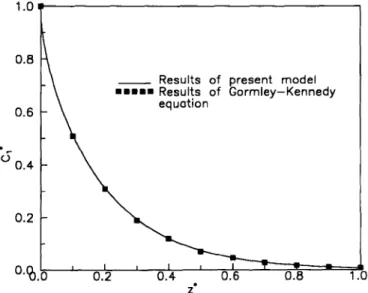
absence of evaporating particles was first examined by comparing its numerical solutions with those predicted by the G o r m l e y - K e n n e d y equation (Gormley and Kennedy, 1949) which is based on the assumption of zero concentration (Vd ~ ~ ) of the diffusing species at the tube wall. Equation (19) is solved to determine the cup-mixing average concentration of C* as a function of z* by removing the source term, that is setting A2 -- 0. The fully developed flow parameter for a tubular pipe is expressed as f ( k , r ) = 2(1 - r 2 / r 2 ) . The results are plotted in Fig. 2. It is seen that excellent agreement between the two models was obtained.
The numerical solutions of the present model in the absence of evaporating particles were also compared with the experimental data of sampling SO2 gas by an annular denuder system documented by Possanzini et al. (1983). The experimental conditions of Possanzini
et al. (1983) are summarized as: the annular denuder was 20 cm long with an inner diameter
of 1.0 cm and an outer diameter of 1.32 cm which provided a value of the inner-to-outer radius ratio (k) equal to 0.76. The sampling flow rates were between 4 and 40 lpm. The diffusivity of SO2 in air was assumed to be 0.136 cm 2 s - 1. Assuming that the flow profile is fully developed, Possanzini et al. (1983) introduced a correlation equation for predicting the performance of their annular denuder system as
C~', = ? exp(--/~A), (22)
where CI, is the ratio of the concentration of the absorbed gas at the exit to that at the entrance, A = n D , L ( 1 + k)/4Q(1 - k ) , Q is the sampling flow rate, and ? and /Y are the coefficients of the correlation equation which can be determined either from the experi- mental measurements or from the theoretical calculations.
Possanzini et al. (1983) applied this correlation equation to their experimental data at different denuder geometries and different sampling flow rates. However, a fully developed laminar flow is not reached in some of the experimental conditions of Possanzini et al. (1983). Therefore only the experimental results of the fully developed laminar flow were employed as a comparison basis.
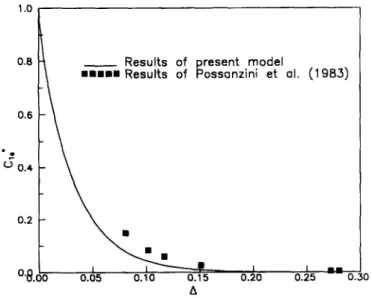
A regression of 200 points of numerical data obtained from the present model was performed and the correlation equation is
C*e = (0.923 -t- 0.002)x e x p [ ( - 3 0 . 4 7 8 _+ 0.086)A]. (23) The dimensionless SO2 concentration profiles at the exit of the annular denuder system as a function of A obtained from Possanizi et al. (1983) and calculated from equation (23) are
1.0 0.8 0.6 0.4 0.2
o. .b
Results of present model m m m m m Results of O o r m l e y - K e n n e d y
I l { l n I T~-'-"~ s~ --
0.2 0.4 0.6 0.8
z"
.0
Fig. 2. Comparison of the numerical results predicted by the present model with the Gormley- Kennedy equation in a tubular denuder (A, = 0.122).
1124 C. Lu et al.
shown in Fig. 3. As can be seen, close agreement was obtained between the measured and predicted results. The slight discrepancies may be attributed to experimental inaccuracies which have been encountered, especially when measuring low gas concentrations (Possan- zini et al., 1983). In addition, the assumptions of perfect sink (Vd --* oo) of diffusing species at the denuder wall may also lead to the overprediction of the outlet concentrations.
The performance of the present model considering evaporating particles was validated by simultaneously solving equations (16)-(20). The numerical solutions were compared well with known solutions at certain limiting cases for pure particle diffusion and pure particle evaporation by both monodisperse and polydisperse aerosols (Gormley and Kennedy, 1949; Friedlander, 1977; Pratsinis, 1988).
The present model was then applied to simulate experimental data documented by Harrison et al. (1990) for the change of particle radii of dry NH,C1 aerosols due to their evaporation in the annular denuder system. The experimental conditions are summarized as: the denuder was 100 cm long with an inner diameter of 3.7 cm and an outside diameter of 4 cm. The inner tube was coated with a 5% methanolic solution of citric acid or phosphorous acid for collecting NH3, whilst the outside tube was coated with 5% N a O H in methanol for HC1 collection. The coating length was 88 cm; the first 12 cm of the denuder was left uncoated to establish a laminar fully developed air flow. Since the flow rate through the denuder was less than 0.1 lpm, the Reynolds number is well within the laminar flow regime. The experimental system was operated at 20 -t- 2°C. The initial geometric mean particle radius and geometric standard deviation were equal to 0.53/~m and 1.67, respec- tively. The initial particle number concentration was selected as 105 c m - 3 (Bai et al., 1995) and the accommodation coefficient (ct) was set to unity (Raes et al., 1990). The diffusivities of NH3 and HCI were chosen as 0.227 (Winiwarter, 1989) and 0.117 cm 2 s- ~ (Reid et al., 1988).
The equilibrium constant of dry N H , C I particles with the two associated gases, NH3 and HC1, is taken from Pio and Harrison (1987):
2.13204 x 10⁴
In Kp = 2.2358 In T T + 65.4375
-- 8.167 × 1 0 - 3 T + 4.644 x 10-TT 2 - 1.105 x 1 0 - 1 ° T 3. (24) The vapor pressure of NH4C1 m o n o m e r in the bulk phase (Pl) can be written as pl = S x pd, where Pd is the vapor pressure of N H , C I m o n o m e r in equilibrium with particle surface and is commonly expressed as Pd = P~n3 + P~Cl----2K~/2 (Harrison and MacKenzie, 1990), where superscript e denotes the state of equilibrium. The system saturation ratio S is defined
1.0 0.8 0.6 * ~ (-~ 0.4 0.2
o8.6o
Results of present model
esults of Possonzini eL ol. (1983)
0.05 0.10 0.15 0.20 0.25 - - 0.30 A
as (Kodas et al., 1986)
S = CNH3CHcl (25)
Kp
When the value of saturation ratio is unity, the system is in an external state of equilibrium. The driving force of the evaporation process of NH4CI aerosols is determined by (1 - S). The walls are considered perfect sinks (Va --* ~) in the simulation.
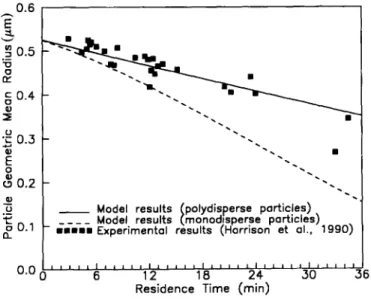
Figure 4 shows the measured and simulated results on the change of particle radius of dry NH4C1 aerosols as a function of residence time in the annular denuder system. As can be seen, good agreement between the simulated results using a polydisperse distribution and the experimental data is obtained. The simulated results using a monodisperse distribution is also shown in Fig. 4. The calculations were based on a harmonic average of evaporation rates of monodisperse aerosols in the continuum and free molecular regimes [Friedlander, 1977, equations (9.23) and (9.24)]. It is seen that significant departures from experimental data are observed using a monodisperse distribution. This indicates that particle polydis- persity plays a very important role in the overall evaporation rate.
It must be noted that the experimental conditions of Harrison et al. (1990) were used for studying the evaporation of ammonium-containing aerosols; therefore, they were taken at an extremely low flow rate not typical of that for the annular denuder system employed in the field.
Sensitivity study
Having established the accuracy and consistency of the present model, a sensitivity analysis was carried out to investigate the effects of the three governing parameters (A1, A2, A3) on the performance of an annular denuder system. A1 and A2 were identified to strongly influence the model performance and the effect of A3 can be neglected.
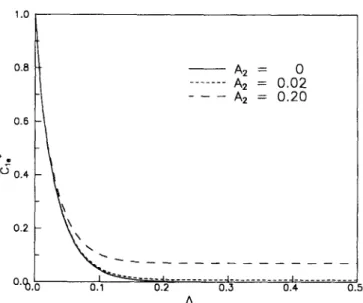
Figure 5a and b shows plots of C*e and mass median diameter of evaporating particles at the exit of the denuder for different values of Az as a function of design parameter, A (= 1/4A~(1 - k)2), respectively. The values of A2 and A examined herein are the typical range for the annular denuder system used in the field. The variations of C*e and mass median diameter in the absence of evaporating particles (A2 = 0) are also shown in Fig. 5. As can be seen, an increase of A produces an increase of the collection efficiency of the annular denuder and a reduction of the mass median diameter of evaporating particles. This
0.6 E =L
"•0.5
~= 0.4 (J ~. o.~ E 0o.2
u ~ 0 . 1 13_ 0.0Model results (polydisperse particles) . . . . Model results (monodtsperse particles) . maamm Experimental results (Harrison et al., 1990)
0 ' ' ' ' 6 ' ' ' ' '112 .. . . . ll8 . . . 2# . . . 30 . . . ~I6
Residence Time (rain)
Fig. 4. Comparison of the measured and simulated results on the change of particle radius of dry ammonium chloride aerosols in the annular denuder system.
1126 C. Lu e t al. 1.0 0.8 0.6 • • ¢3 0.4 0.2 0
.00.
i - - A 2 = 0 . . . A2 = 0 . 0 2 - - - A2 = 0 . 2 0 I - - --~-===---- - 4 . . . 4 . . . 4 . . . 0.1 0.2 0.3 0.4 0.5 &Fig. 5(a). Plots of C* at the exit of the a n n u l a r d e n u d e r for different v a l u e s of A 2 as a f u n c t i o n of 4.
0 . 4 4 8 8 3 0 E , - ~ 0 . 4 4 8 8 2 8 E 0 ~5 0.448825 C 0 0 . 4 4 8 8 2 4 - - A 2 = 0 . . . A2 = 0 . 0 2 - - - A2 = 0 . 2 0 0"4488220.10 0.11 O. / 0.13 0.14 0.5 &
Fig. 5(b). Plots o f m a s s m e d i a n d i a m e t e r o f e v a p o r a t i n g particles at the exit o f the a n n u l a r d e n u d e r for different v a l u e s o f A2 as a f u n c t i o n of A.
can be attributed to a long residence time or a large ratio of inner to outer radius. It is also seen that due to particle evaporation, additional gases are released in the denuder; hence the value of C*~ is higher for a larger value of A2. This can be explained by the fact that for a larger value
Az
implies that the inlet concentration of gas 1 is smaller and the driving force for evaporation of particles and release of additional gases is higher. A similar reasoning can be used to explain the increase of change of mass median diameter of evaporating particles for a larger value of A2 due to a higher particle evaporation rate.Practical application
From a design or operational perspective, one would like to reach a relatively high gas sampling efficiency and minimize the particle evaporation effects in the annular denuder system. Therefore, the performance equation is necessary for selecting an optimal operating
condition. A performance equation for sampling HNO 3 gas using a typical range of the atmospheric aerosol and gas properties is derived as follows.
The employed denuder is the Harvard-EPA annular denuder system (HEADS) (Vossler
et al., 1987). The system is composed of an impactor followed by two annular denuders,
a filter pack, a pump and a flow controller. The flow rate through the system is operated at 10 lpm, and the cutoff diameter for the impactor is 2.5 #m. The denuder was 20 cm long with an outer diameter of 1.2 cm. The inner diameter was determined by a given value of k. Both outer and inner denuder walls were coated with a suspension of MgO power in methanol for collecting HNO3 gas (Harrison et al., 1990). The walls can be also considered perfect sinks (Va --* oo) in the following predictions (Bai et al., 1995). The diffusivity of HNO3 gas is selected as 0.118 cm 2 s- 1 (Winiwarter, 1989).
The equilibrium constant of dry NH4NO 3 particles with the associated gases, HNO3 and NH3, is taken from Mozurkewich (1993):
24084
lnKp = 118.87 T 6.0251n T. (26)
It must be noted that the above relationship would only be valid for the ambient relative humidity below the deliquescent point of NH4NO3 aerosols. For the ambient relative humidity above the deliquescent point, the equilibrium constant is affected by the relative humidity over a wide range (Seinfeld, 1986). Furthermore, the presence of other species in the particle could also affect the equilibrium.
The atmospheric aerosol and gas properties are adopted from a typical value available in the literature (Benner et al., 1991; Lin et al., 1993; Lee et al., 1993). The inlet total particle number concentration, the mass median diameter of aerosols and the HNO3 gas concentra- tion were selected as 105 cm-3, 0.45 #m and 0.77 ~g m-3, respectively. The inlet geometric standard deviation of aerosols (as) and the mass fraction of NH4NO3 contained in the aerosol particles (me) are evaluated within a typical range.
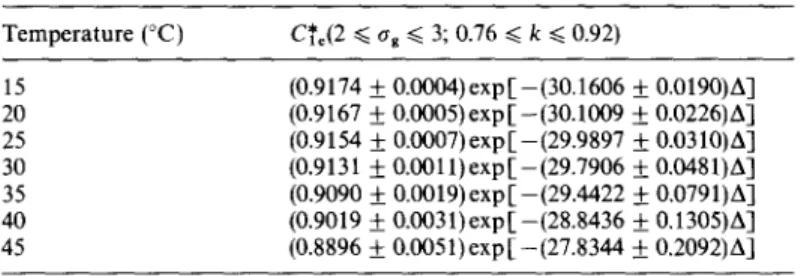
Equation (22) was employed to obtain the performance equations which contain a range of ag from 2 to 3 and k from 0.76 to 0.92. Tables 1-3 list the performance equations of mf of 1%o, 2% and 4°/5, respectively, under different ambient temperatures (T). It is seen that the coefficients of 7 and fl are relatively small for higher values of T and inf. This implies that the collection efficiencies of HNO3 gas by the annular denuder system are lower and sampling artifacts may be significant under these conditions.
The comprehensive performance equation which includes a range of T from 15 to 45°C and my from 1 to 4% is derived from Tables 1-3 as
C*e = (0.9076 + 0.0008)x exp[-(29.3305 + 0.0327)A]. (27) Applications of equation (27) are demonstrated as follows: for 98% HNO3 gas removal, A must be greater than or equal to 0.13 (determined by substituting C*e = 0.02 in equation (27), and calculating A). Thus (Q/L)d~sign should be less than or equal to 6.038D1(1 + k)/(1 - k). If the denuder length is 40 cm, DI = 0.118 cm2s -1 and k = 0.76, then the optimal operating value of Q must be less than or equal to 12.54 lpm. If k = 0.84
Table 1. Performance equations of the Harvard-EPA annular denuder sys- tem for a 1% mass fraction of NH4NO3 contained in the aerosol particles at
different ambient temperatures Temperature (°C) C'e(2 ~< a s ~< 3; 0.76 ~< k ~< 0.92) 15 20 25 30 35 40 45 (0.9178 _+ 0.0004) exp[-(30.1943 _+ 0.0177)A] (0.9175 _+ 0.0004)exp[-(30.1644 _+ 0.0190)A] (0.9168 _+ O.0005)exp[-(30.1089 _+ 0.0222)A] (0.9156 _+ 0.0007)exp[-(30.0096 + 0.0295)A] (0.9136 _+ 0.0010) exp[--(29.8350 __+ 0.0443)A] (0.9074 _+ 0.0028)exp[-(29.7322 _+ 0.1120)A] (0.9040 _+ 0.0027) exp[-(29.0287 _+ 0,0150)A]
1128 C. Lu et al.
Table 2. Performance equations of the Harvard-EPA annular denuder sys- tem for a 2% mass fraction of NH4NOa contained in the aerosol particles at
different ambient temperatures Temperature (°C) C*~(2 ~ trg ~< 3; 0.76 ~< k ~< 0.92) 15 20 25 30 35 40 45 (0.9174 + 0.0004)exp[-(30.1606 + 0.0190)A] (0.9167 + 0.0005)exp[-(30.1009 + 0.0226)A] (0.9154 + 0.0007)exp[-(29.9897 + 0.0310)A] (0.9131 + 0.0011)exp[-(29.7906 + 0.0481)A] (0.9090 +__ 0.0019)exp[-(29.4422 + 0,0791)A] (0.9019 + 0.0031)exp[-(28.8436 + 0,1305)A] (0.8896 _+ 0.0051)exp[-(27.8344 + 0.2092)A]
Table 3, Performance equations of the Harvard-EPA annular denuder sys- tem for a 4% mass fraction of NH4NO3 contained in the aerosol particles at
different ambient temperatures Temperature (°C) C*~(2 ~< ag ~< 3; 0.76 ~< k ~< 0.92) 15 20 25 30 35 40 45 (0.9166 +_ 0.0005)exp[-(30.0955 + 0.0230)A] (0.9152 _+ 0.0008)exp[-(29.9751 + 0.0323)A] (0.9126 _,r_ 0.0012)exp[-(29.7528 _+ 0.0515)A] (0.9079 ___ 0.0020)exp[-(29.3557 +_ 0.0868)A] (0.8996 + O.0035)exp[-(28.6589 _+ 0.1456)A] (0.8851 _+ 0.0057)exp[-(27.4653 +_ 0.2354)A] (0.8600 _+ 0.0090)exp[-(25.4708 +_ 0.3558)A]
a n d 0.92, the o p t i m a l o p e r a t i n g values of Q m u s t be less than or equal to 19.66 and 39.0 lpm, respectively.
C O N C L U S I O N S
A m o d e l that a c c o u n t s for simultaneous gas diffusion, aerosol diffusion a n d e v a p o r a t i o n has been developed to predict p e r f o r m a n c e of the annulai" d e n u d e r system. T h e g o v e r n i n g e q u a t i o n s were cast into dimensionless f o r m a n d the p e r f o r m a n c e of the model was validated by the analytical a n d experimental d a t a available in the literature. The effects of g o v e r n i n g dimensionless g r o u p s on the p e r f o r m a n c e of the m o d e l were evaluated in the sensitivity analysis. T h e p a r a m e t e r s that a c c o u n t for what fraction of the gas or particle is a b s o r b e d (A1) a n d particle e v a p o r a t i o n ( A : ) are identified to strongly influence model performance.
Practical application of the present m o d e l was d e m o n s t r a t e d for sampling a t m o s p h e r i c H N O 3 gas. A p e r f o r m a n c e e q u a t i o n of the a n n u l a r d e n u d e r system was derived for a typical range of a m b i e n t temperature, ratio of inner to outer a n n u l a r radius, a n d a t m o s p h e r i c aerosol a n d gas properties. It was then applied to o b t a i n the optimal o p e r a t i n g c o n d i t i o n which maximizes the collection efficiency of H N O 3 gas a n d minimizes the sampling artifact at the same time. U s i n g similar a p p r o a c h e s to those presented in this study, a n a l o g o u s p e r f o r m a n c e e q u a t i o n s for sampling other gas species can also be derived.
Ultimately, it m u s t be recognized that the m o d e l predictions are valid for the inlet section when l a m i n a r flow is fully developed. I n addition, the i n f o r m a t i o n of gas deposition rate at the d e n u d e r wall for each c o a t i n g a n d each a b s o r b a t e would also require extensive empirical s u p p o r t in an effective modelling.
Acknowledgements--Partial support from the National Science Council, R.O.C., through a grant number NSC 83-0410-E-009-024 is gratefully acknowledged. The authors also wish to thank Drs P. Biswas and S. Pratsinis at the University of Cincinnati, U.S.A., for initiating this study.
R E F E R E N C E S
Bai, H., Lu, C. S. and Lin, Y. M. (1995) A theoretical study on the evaporation of dry ammonium chloride and ammonium nitrate aerosols. Atmos. Envir. 29A, 313-321.
Benner, C. L., Eatough, D. J., Eatough, N. L. and Bhardwaja, P. (1991) Comparison of annular denuder and filter pack collection of H N O a ~ , HNO2t~, SO2ts), and particulate-phase nitrate, nitrite and sulfate in the south-west desert. Atmos. Envir. 25A, 1537-1545.
Bird, R. B., Stewart, W. E. and Lightfoot, E. N. (1960) Transport Phenomena. Wiley, New York.
Biswas, P., Lu, C. S:, Xu, M. and Pratsinis, S. E. (1990) Design equations for gas sampling in diffusion denuders and the effects of particle dissociation. In Transactions on Visibility and Fine Particles (Edited by Mathai, C. V.), pp. 131-145. AWMA, Publication No. TR-17.
Coutant, R. W., Callahan, P. J., Kuhlman, M. R. and Lewis, R .G. (1989) Design and performance of high-volume compound annular denuder. Atmos. Envir. 23, 2205-2211.
Durham, J. L., Spiller, L. L. and Ellestad, T. G. (1987) Nitric acid - - nitrate aerosol measurements by a diffusion denuder: a performance evaluation. Atmos. Envir. 21, 589-598.
Friedlander, S. K. (1977) Smoke, Dust and Haze. Wiley, New York.
Gormley, P. G. and Kennedy, M. (1949) Diffusion from a stream flowing through a cylindrical tube. Proc. R. Irish Acad. A52, 163-169.
Harrison, R. M. and MacKenzie, A. R. (1990) A numerical simulation of kinetic constraints upon achievement of the ammonium nitrate dissociation equilibrium in the troposphere. Atmos. Envir. 24A, 91-102.
Harrison, R. M., Sturges, W. T., Kitto, A.-M. N. and Li, Y. (1990) Kinetics of evaporation of ammonium chloride and ammonium nitrate aerosols. Atmos. Envir. 24A, 1883-1888.
IMSL (International Mathematics and Statistics Libraries) (1987) Contents Document, Vol. 2, Version 1.0, Houston, Texas.
Kim, K. S. and Pratsinis, S. E. (1988) Manufacture of optical waveguide preforms by modified chemical vapor deposition. A.I.Ch.E.J. 34, 912-921.
Kodas, T. T., Pratsinis, S. E. and Friedlander, S. K. (1986) Aerosol formation and growth in a laminar core reactor.
J. Colloid Interface Sci. 111, 102-111.
Koutrakis, P., Wolfson, J. M., Slater, J. L., Brauer, M., Spengler, J. D., Stevens, R. K. and Stone, C. L. (1988) Evaluation of an annular denuder/filter pack system to collect acidic aerosols and gases. Envir. Sci. Technol. 22, 1463-1468.
Lee, H. S., Wadden, R. A. and Scheff, P. A. (1993) Measurement and evaluation of acid air pollutants in Chicago using an annular denuder system. Atmos. Envir. 27A, 543-553.
Lee, K. W., Chen, H. and Gieseke, J. A. (1984) Log-normally preserving size distribution for Brownian coagulation in the free molecule regime. Aerosol Sci. Technol. 3, 53-62.
Lin, J. M., Fang, G. C., Holsen, T. M. and Noll, K. E. (1993) A comparison of dry deposition modeled from size distribution data and measured with a smooth surface for total particle mass, lead and calcium in Chicago.
Atmos. Envir. 27A, 1131-1138.
Mozurkewich, M. (1993) The dissociation constant of ammonium nitrate and its dependence on temperature, relative humidity and particle size. Atmos. Envir. 27A, 261-270.
Pio, C. A. and Harrison, R. M. (1987) Vapour pressure of ammonium chloride aerosol: effect of temperature and humidity. Atmos. Envir. 21, 2711-2715.
Possanzini, M., Febo, A. and Liberti, A. (1983) New design of a high-performance denuder for the sampling of atmospheric pollutants. Atmos. Envir. 17, 2605-2610.
Prastinis, S. E. (1988) Simultaneous aerosol nucleation, condensation, and coagulation in aerosol reactors.
J. Colloid Interface Sci. 124, 416-427.
Pratsinis, S. E., Xu, M., Biswas, P. and Willeke, K. (1989) Theory for aerosol sampling through annular diffusion denuders. J. Aerosol Sci. 20, 1597-1600.
Raes, F., Kodas, T. T. and Friedlander, S. K. (1990) Aerosol formation by a reversible chemical reaction: laser-induced NH4NOa aerosol formation in a tubular reactor. Aerosol Sci. Technol. 12, 856-868.
Reid, R. C., Prausnitz, J. M. and Poling, B. E. (1988) The Properties of Gases and Liquids, 4th Edition. McGraw-Hill, New York.
Seinfeld, J. H. (1986) Atmospheric Chemistry and Physics of Air Pollution. Wiley, New York.
Vossler, T. L., Stevens, R. K. and Baumgardner, R. E. (1987) Proc. 1987 EPA/APCA Syrup. on Measurement of Toxic Air Pollutants, pp. 168-171.
Winiwarter, W. (1989) A calculation procedure for the determination of the collection efficiency in annular denuders. Atmos. Envir. 23, 1997-2002.