行政院國家科學委員會專題研究計畫 成果報告
精神分裂症 DISC1 基因的突變與移位偵測
計畫類別: 個別型計畫 計畫編號: NSC91-2314-B-002-216- 執行期間: 91 年 08 月 01 日至 92 年 07 月 31 日 執行單位: 國立臺灣大學醫學院精神科 計畫主持人: 胡海國 計畫參與人員: 劉智民 劉玉麗 報告類型: 精簡報告 報告附件: 出席國際會議研究心得報告及發表論文 處理方式: 本計畫可公開查詢中 華 民 國 92 年 10 月 30 日
行政院國家科學委員會補助專題研究計畫
; 成 果 報 告
□期中進度報告
精神分裂症 DISC1 基因的突變與移位偵測
計畫類別:
;
個別型計畫 □ 整合型計畫
計畫編號:NSC 91 - 2314 -B002 - 216
執行期間: 91 年 8 月 1 日至 92 年 7 月 31 日
計畫主持人: 胡海國
共同主持人:劉智民
計畫參與人員: 劉玉麗
成果報告類型(依經費核定清單規定繳交):
;
精簡報告 □完整報告
本成果報告包括以下應繳交之附件:
□赴國外出差或研習心得報告一份
□赴大陸地區出差或研習心得報告一份
;
出席國際學術會議心得報告及發表之論文各一份
□國際合作研究計畫國外研究報告書一份
處理方式:除產學合作研究計畫、提升產業技術及人才培育研究計畫、
列管計畫及下列情形者外,得立即公開查詢
□涉及專利或其他智慧財產權,□一年□二年後可公開查詢
執行單位:國立台灣大學
中 華 民 國 92 年 10 月 27 日
研究報告中英文摘要:
關鍵詞: 精神分裂症的斷裂基因-1, 精神分裂症,第一對染色體長臂,基因多型性偵測,關 聯性研究,平衡式移位, 變性高壓色層分析
本研究團隊在過去精神分裂症的分子遺傳連鎖(genetic linkage study)研究中發現, 染色
體標記D1S251(位於染色體 1q42.1 位址)與台灣的精神分裂病患有相當的連鎖證據 (NPL Z
score = 2.18, p=0.01), 此標記距離 DISC1 (disrupted-in schizophrenia gene 1)約 4.8 kb,此基因 最早在追蹤五代的一個蘇格蘭大家族中發現,當家族成員帶有第一對染色體與第十一對染 色體平衡移位[Balance translocation t(1;11)(q42.1;q14.3)]時,其罹患精神疾病的比率高達 87%,這個移位的斷裂點恰好在 DISC1 exon8 與 exon9 之間,造成 DISC1 功能障礙。這個 區域在其他種族的研究中也有顯著的連鎖證據,因此,DISC1 是相當具有潛力的精神分裂 症的區位候選基因 (positional candidate gene),非常值得進行進一步的研究探討。
本研究計畫的主要目的有:(1) 探討約 661 位台灣精神分裂症患者中帶有第一對與第十
一 對 染 色 體 平 衡 移 位 斷 裂 基 因 體 的 比 率 。(2) 以變性高壓色層 分析[Denaturing High Performance Liquid Chromatography (DHPLC)]的方法找尋 DISC1 promoter region 是否存在 有基因多型性(polymorphism)並進一步以各約 123 位精神分裂症患者及 115 位正常對照組進 行相關性研究 (case-control association study),期望能找到與此疾病相關的基因多型性,進 一步分析此特定基因型個案的臨床特徵,以了解此基因在精神分裂症的病理機轉中所扮演 的角色。 本研究計畫結果如下: (1) 本研究構建了一個可快速篩檢病人 DNA 檢體的質體帶有染色體位移前段的第一對 染色體 DNA 片斷, 此片斷結合有染色體位移後段的第十一對染色體 DNA 片斷, 以致於使 用第一對染色體的一個引子和第十一對染色體一個引子就可以快速的利用PCR 的方法檢測 出 病 人 是 否 帶 有 第 一 對 染 色 體 與 第 十 一 對 染 色 體 平 衡 移 位[Balance translocation t(1;11)(q42.1;q14.3)]的情況 (詳細建構步驟請見附件一)。目前發現約有 4% 的病患可能具 有位移需要進一步證實。倘若此類病患人數比率升高, 此質體將具有臨床檢驗的價值, 值得 申請專利。
(2) 在 DISC1 promoter region 的變異多型性研究中, 我們發現一具有危險指標(risk index)的單核酸多型性 single nucleotide polymorphism (SNP), 存在於 DISC1 基因的 TATA box 附近, 以生物資訊學的方法偵測發現, 此 SNP 的 C allele 可被 Interleukine-6 (IL-6) 的轉 譯因子(transcription factor) 辨識, 而 IL-6 有報告指出, 在精神分裂症患者血中發現有意義 的偏高, 這項新的 SNP 發現將有助於了解 DISC1 基因在精神分裂症的病理發展機轉中所扮 演的角色。(附件二)
Keywords: DISC1, Schizophrenia, Chromosome 1q, Polymorphism detection, Association study, Balanced translocation, DHPLC
Our research team using genetic linkage studies has found a strong linkage (NPL Z score = 2.18, p=0.01) between the D1S251 marker and schizophrenia disease. This marker is about 4.8 kb away from DISC1 (disrupted-in-schizophrenia 1) gene. DISC1
gene was first found from a five generations follow up of a Scottish family, family members who carried the balanced translocation [t(1;11) (q42.1;q14.3)] has 87% incidence rate of developing psychiatric illness. The breakpoint of the translocation is located at the intron area between exon 8 and exon 9 of DISC1 gene. This translocation disrupted the gene and caused its malfunction. This region has also been searched from other ethnic groups and proved significant linkage evidences. All these findings have indicated that DISC1 gene is a potential positional candidate gene and worth for further study.
The main purposes of this proposal include: (1) To evaluate the incidence rate of the balanced translocation between the chromosome 1q42.1 and 11q14.3 in approximately 661 schizophrenic patients in Taiwan. (2) To search for the genetic polymorphisms in the promoter region of the DISC1 gene with the method of denaturing high performance liquid chromatography (DHPLC). Case-control association study was performed further in 123 schizophrenic patients and 115 normal controls to evaluate the relationship between the gene and the disease characteristics. This may provide the information of the DISC1 gene in the progress of schizophrenia.
The research results are as following: (1) The current project has constructed a rapid human genomic DNA screening E.coli plasmid carried a DNA fragment from chromosome 1 before the breakpoint and a DNA fragment from chromosome 11 after the breakpoint. Using primer pair of a chromosome 1 and a chromosome 11, one could use PCR method and rapidly screen all the genomic samples of all patients for whether they have carried the balanced translocation t(1;11)(q42.1;q14.3) (Attached appendix 1). There are 4% patients shown positive in PCR product mimics the exact balance translocation. Further identification need to be verified. If the prevalence rate is high in the population, this plasmid may have clinical diagnosis value and worth to apply for a patent. (2) The promoter region of the DISC1 gene searching for novel polymorphisms have found a risk index of single nucleotide polymorphism (SNP). This SNP is located around the TATA-box region. Using bioinformatics searching for transcriptional factor recognition sequences in this region, it was found the C allele of the SNP could be recognized by the transcriptional factor of interleukine 6 (IL-6). IL-6 has been found significantly elevated in the plasma of schizophrenic patients. This novel SNP finding may help in understanding the role of DISC1 gene in the pathophysiological progress of the disease (Attached appendix 2).
前言、
One of the promising chromosome regions linking to schizophrenia is located at chromosome 1q 42. A genome-wide scanning of a Finnish family sample has reported suggestive linkage evidence in chromosome 1q31-42 (Hovatta et al., 1999). Further fine mapping of this chromosome region using the same family sample revealed strong linkage evidence (Zmax = 3.21) to the marker (D1s2709), where it is located between the exon 4 and exon 5 of DISC1 at chromosome 1q42.1 (Ekelund et al., 2001). Our study has also found suggestive linkage evidence of marker (D1S251) at chromosome 1q42.1 with schizophrenia (NPL Z score = 2.18, p=0.01) (Hwu et al., 2003).
Chromosome abnormalities, especially balanced translocation, bring new insights into the candidate locus in patients with schizophrenia (Kato T., 2001). The balance translocation (1; 11)(q42.1; q14.3), associated with major mental illness including schizophrenia in a large Scottish family pedigree, has suggested the importance of 1q42.1 (St Clair et al., 1990).
The balance translocation affected the expression of two genes, disrupted in schizophrenia 1 (DISC1) and disrupted in schizophrenia 2 (DISC2), in the 1q 42.1. The exon/intron structure of DISC1 gene has been found to consist of thirteen exons extending across at least 300 kb of genomic DNA. A putative CpG island (70% GC) has identified at the 5’end with 758 nucleotides (nt) and two potential promoters 55 and 359 nt upstream. The breakpoint is located at the intron between exon 8 and exon 9 (Millar et al., 2001). The disruption may produce a truncated DISC1 protein. It would lack the C-terminal 257 amino acids, including a predicted coiled-coil forming potential, and retaining an unidentified function of the globular N-terminus. DISC2 is overlapping with DISC1 in an opposite direction of transcription. No significant ORF has been identified within 15178 nt. It is predicted that the DISC2 maybe a non-coding structural RNA gene.
Disrupted in Schizophrenia 1 (DISC 1; 1-13 exons) D1S251 D1S1621 CpG island
Start BREAKPOINT stop poly(A) 54 2616 6892
1 2 3 4 5 6 7 8 9 10 11 12 13 AB C DEFG HI J K L M DISC 2 (A-M exons)
CENTROMERE TELOMERE
研究目的、
plasmid carried an approximately 1.5 kb of DNA sequences from each around 750 bps of the chromosome 1q42.1 and 11q14.3 around the breakpoint. Using this positive control probe as a reference to adjust the optima PCR condition, this condition was then applied for all the genomic DNA samples to screen for patients who might carry the translocation. The second goal was establishing the denaturing high performance liquid chromatography (DHPLC) methods to screen the mutations or polymorphisms in the TATA box promoter region of DISC1 gene. Any polymorphism related to the expression of the DISC1 protein may predict the role of the gene in the psychopathological process of the disease.
文獻探討、
Ekelund J, et al. 2001. Chromosome 1 loci in Finnish schizophrenia families. Human Mol Genet. 10:1611-1617.
Hovatta I, Varilo T, Suvisaari J, Terwilliger TD, Olikainen V, Arajarvi R, Juvonen H, Kokko-Sahin M-L, Vaisanen L, Mannila H, Lonngvist J, and Peltonen L. 1999. A genome-wide search for schizophrenia genes in an isolated Finnish subpopulation suggesting multiple susceptibility loci. Am J Hum Genet 65:1114-1124.
Hwu HG, Liu CM, Lin MW, Ou-Yang WC, Lee SFC, Fann CSJ, Hsieh SH. 2003. Linkage of Schizophrenia with Chromosome 1q Loci in Taiwanese Families. Revision submitted to Molecular Psychiatry.
Kato T. Molecular genetics of bipolar disorder. Neuroscience Research - Supplement. 40(2):105-13, 2001
Millar JK. Christie S. Anderson S. Lawson D. Hsiao-Wei Loh D. Devon RS. Arveiler B. Muir WJ. Blackwood DH. Porteous DJ. Genomic structure and localisation within a linkage hotspot of Disrupted In Schizophrenia 1, a gene disrupted by a translocation segregating with schizophrenia. Molecular Psychiatry. 6(2):173-8, 2001
St. Clair D, Blackwood D, Muir W, Carothers A, Walker M, Spowart G, Gosden C, and Evans HJ. 1990. Association within in a family of a balanced autosomal translocation with major mental illness. Lancet 336:13-16.
研究方法、
Translocation (1q42.1;11q14.3)-Carried Plasmid DNA Construction
1. PCR Amplification of 1q42.1 and 11q14.3 DNA Sequences 2. Cloning the PCR Product into E.coli Plasmid
3. Plasmid Transformation into E.coli 4. Colony and Plasmid Selection
5. Constructed Plasmid Verification
Denaturing high performance liquid chromatography (DHPLC) the TATA box promoter region of DISC1 gene
1. Sample Population
2. PCR Amplification of the TATA box promoter region 3. Cloning the PCR Product into E.coli Plasmid
4. Plasmid Transformation into E.coli 5. Colony and Plasmid Selection 6. Denaturing HPLC analysis 7. DNA Sequencing 8. Data Analysis
結果與討論(含結論與建議)
Translocation (1q42.1;11q14.3)-Carried Plasmid DNA Construction
In this study, human genomic DNA fragment of either the chromosome 1 (738 bps) or the chromosome 11 (719 bps) besides the breakpoint was amplified by polymerase chain reaction (PCR) and cloned into E.coli (DH5α), respectively. E.coli colonies carrying either DNA fragments were selected by EcoR I reaction. The chromosome 1 DNA fragment (838 bps) was selected and ligated with the chromosome 11 DNA fragment-carried plasmid (3505 bps). The correctly constructed plasmid was verified by plasmid size selection (4343 bps), by PCR product size (1457 bps) amplification with the chromosome 1-chromosome 11 primer pair, and by the EcoR I removal of the chromosome 1 DNA fragment. The sequence of either DNA fragment has 99% matched with the sequence on National Center for Biotechnology Information (NCBI) (AF222981 for chromosome 1 and AP000684.4 for chromosome 11). Similar PCR product sizes have been found in both the constructed plasmid and the translocation-carried human genomic DNA. This constructed plasmid suggests that the PCR method may be applicable in translocation screening for the collected genomic samples.
Using the constructed chromosome 1-chromosome 11 plasmid probe as a positive control, we screened 661 people, including 541 patients and 120 normal controls. There are twenty patients and 2 normal controls showed positive PCR products when using chromosome 1-chromosome 11 primer pair. Two families have demonstrated segregation phenomena. These
results need further identification from the fluorescence in situ hybridization research project to make sure that these positive patients do carry the exact translocation of (1; 11)(q42.1; q14.3). The detail result of the patients who might carry the translocation is as following, and the construction process has attached as a preparative manuscript (appendix 1).
The PCR products were compared between the constructed chromosome 1-chrmosome 11 plasmid and the human genomic DNA sample obtained from an individual carrying the t(1;11)(q42.1;14.3), a gift from Dr. Millar, J. Kirsty of the University of Edinburgh. Their research group first reported Scottish family members carried this translocation with high incidence rate of mental illness. The PCR was carrying out at the same condition (Fig. 1). Using the primer pair of chromosome 1-chromosome 11 to perform PCR on our collected human genomic DNA samples, we found 4% of schizophrenic patients and 2% of normal controls having similar PCR product sizes (1457 bps) as the constructed chromosome 1-chromosome 11-containing plasmids (Fig. 2).
1 2 3 4 5 6
1.5 kb
1 2 3 4 5
1.5 kb
Fig. 1. (Left)PCR amplification of the constructed plasmid DNA (lane 2), the one without DNA template (lane 3), and the one with genomic DNA carried the t(1;11)(q42.1;q14.3) translocation at 17.5 ng, 35 ng, and 52.5 ng of concentrations (lane 4-6, respectively) by the chromosome 1-chromosome 11 primer pair. Lane 1 is the ladder marker. Fig. 2. (Right) Comparison of the PCR product sizes (1457 bps) of the constructed chromosome 1-chromosome 11-containing plasmid (lane 2), the one without DNA templates (lane 3), and the genomic DNA of two patients (lane 4 and lane 5) when using the primer pair of chromosome 1 and chromosome 11. Lane 1 is the ladder marker.
Denaturing high performance liquid chromatography (DHPLC) the TATA box promoter region of DISC1 gene
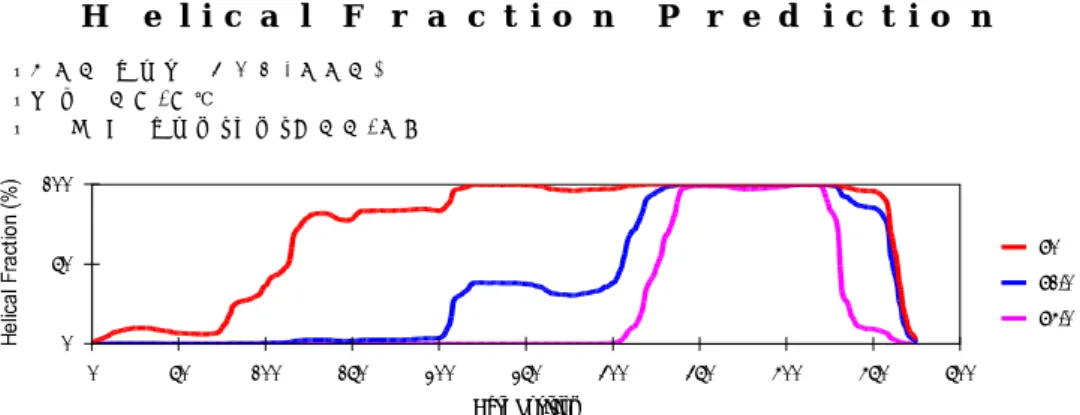
Three denaturing temperatures (60℃, 61℃, and 64℃) were suggested by the Wave software of the denaturing high performance liquid chromatography (DHPLC) system to screen for the mutations in the TATA box region of DISC1 gene (Fig. 1). A PCR product of 475 bps covering 144 bps upstream the TATA box and 325 bps downstream the TATA box was cloned and used as reference for each control and each schizophrenia case. Two SNPs were found among 115 controls and 123 patients; a C/T allele located at 109 bps downstream the TATA box region was found from temperature 61℃ (Fig. 2). The chromatogram profiles in C/C, C/T and T/T genotype are distinguishable from the analysis of DHPLC and matching the sequence. One fourth of the samples were further sequenced for existence of the SNP (Fig. 3).
H e l i c a l F r a c t i o n P r e d i c t i o n 0 50 100 0 50 100 150 200 250 300 350 400 450 500 Base Position 60 61.0 64.0 • 4 7 5 b p s ( 3 0 1 - 7 7 5 ) • T m 5 9 . 9 ℃ • % G C c o n t e n t : 5 5 . 7 8
Fig. 1. Three different temperatures were predicted from the software of Wave system for mutation detection in different regions of the 475 bps PCR product. 1 2 3 4 5 6 7 8 9 1 0 1 1 1 2 1 3 T A T A b o x C p G i s l a n d ( s t a r t 5 4 ) D 1 S 2 5 1 D 1 S 1 6 2 1 B r e a k p o i n t C E N T R O M E R E T E L O M E R E T h e T A T A b o x s e q u e n c e a n d t h e C 1 0 9 T S N P 4 2 1 c t c c t c c c c c c c g c c c c c a c t t t gT A T A A A t g a g c c c c t c a c a t c c c t c c a t c t t c t c c a 4 8 1 t c a c t g t g t g g t c a c t t c t t a a a t c a t g c g t c t g g a a g g c g c c c t c c t g t a c c c c a t c c t 5 4 1 g g a g g c t t c c t g c a c t t cCc c t c t t g t t t c t t c c a g a a a t g a g t c a g a g t g a a a g c a a a c
Fig. 2. The novel single nucleotide polymorphism C109T (C in capitalization) located downstream the TATA box (TATAAA sequence) region of the disrupted-in-schizophrenia gene (13 exons).
N o v e l S N P a t T A T A - C 1 0 9 T o f D I S C 1 G e n e A f t e r S e q u e n c e A l i g n m e n t
Fig. 3. Sequencing the TATA box region for the C109T single nucleotide polymorphism.
value of the undegraded and the adjusted d’ value of the degrade were compared between the C/C genotype and the C/T genotype of patients. Patients carrying the C/C genotype group have more severe impairment in sustained attention than the patients carrying the C/T genotype (Z=-4.1 in C/C genotype vs. Z=-2.97 in C/T genotype, p=0.044) in the adjusted d’ value of the undegraded Continuous Performance Task (CPT). There is a marginally significant difference of adjusted d’ value of the degrade CPT (Z=-3.7 in C/C genotype vs. Z=-2.9 in C/T genotype, p=0.079) between these two genotypes (Table I).
T a b l e I . A v e r a g e a n d s t a n d a r d d e r i v a t i o n o f a g e a t o n s e t a n d c o n t i n u o u s p e r f o r m a n c e t a s k ( C P T ) p h e n o t y p e s ( A d j - D p r i m e u n m a s k e d a n d A d j - D p r i m e m a s k e d ) w e r e e v a l u a t e d a c c o r d i n g t o t h e g e n o t y p e s o f T A T A - C 1 0 9 T D I S C 1 g e n e i n p a t i e n t s w i t h s c h i z o p h r e n i a . 2 1 8 9 N = - 3 . 6 8 ± 1 . 7 * - 2 . 9 1 ± 1 . 8 A d j - D p r i m e m a s k e d ( ± S . D . ) 2 3 9 5 N = - 4 . 0 9 ± 2 . 8 * - 2 . 9 7 ± 2 . 3 A d j - D p r i m e u n m a s k e d ( ± S . D . ) 2 1 9 6 N = 2 1 ± 4 . 7 2 2 ± 5 . 7 A g e o f o n s e t ( ± S . D . ) C / C C / T G e n o t y p e s * S y m b o l r e p r e s e n t s t h e s i g n i f i c a n t l e v e l o f i n d e p e n d e n t t - t e s t f o r e q u a l i t y o f m e a n s b e t w e e n C / T a n d C / C g e n o t y p e s ; p - v a l u e = 0 . 0 4 4 f o r A d j - D p r i m e u n m a s k e d a n d p v a l u e = 0 . 0 7 9 f o r A d j D p r i m e m a s k e d . T h e a g e o f o n s e t p -v a l u e i s 0 . 3 1 2 .
The allele frequencies in C are 49.1% in normal controls and 50.9% in the schizophrenia cases. The allele frequencies in T are 47% in normal controls and 53% in the schizophrenia cases. The C109T SNP has a very strong non-equilibrium genotypic distribution (P=1.95x10⁻⁹ in control group, and P=3.2x10⁻¹⁵ in patients) due to the excess numbers of heterozygous genotypes; the heterozygosity is 83 in control group and 98 in schizophrenia cases (Table II). There is no significant association between the genotypes and the gender (Pearson Chi-Square test, χ2= 1.161, P=0.56). T a b l e I I . D i s t r i b u t i o n o f a l l e l e s a n d g e n o t y p e s o f t h e T A T A -C 1 0 9 T D I S -C 1 g e n e p o l y m o r p h i s m b e t w e e n s c h i z o p h r e n i a a n d c o n t r o l s . 5 3 % 9 8 4 7 . 0 % 8 7 5 0 . 9 % 1 4 8 4 9 . 1 % 1 4 3 C T A l l e l e 0 % 0 1 0 0 % 2 4 5 . 5 % 5 4 . 1 % 2 5 9 8 S c h i z o p h r e n i a 5 4 . 5 % 4 5 . 9 % 3 0 8 3 C o n t r o l C / C T / T C / T G e n o t y p e s F i s h e r ’ s E x a c t T e s t f o r t h e g e n o t y p e a n a l y s i s , p - v a l u e = 0 . 1 7 0 6 P e a r s o n ’ s C h i s q u a r e T e s t f o r t h e a l l e l e t y p e a n a l y s i s , x 2 = 0 . 1 2 7 , d f = 1 , p -v a l u e = 0 . 7 2 2 .
The transcription factor scanning was performed by input the sequence of the 475 bps PCR product into the TFSCAN (http://bioweb.pasteur.fr/seqanal/interfaces /tfscan.html). The C109T SNP has a recognition sequence on the C allele (Fig. 4).
I L - 6 T r a n s c r i p t i o n F a c t o r B i n d s t h e T A T A - C 1 0 9 T o f D I S C 1 G e n e
Fig. 4. The transcription factor scanning result indicating a IL-6 recognition site relating to the C109T single nucleotide polymorphism.
In this study, we found no significant association between the C109T SN P genotype and the age of onset in the schizophrenic patients of Taiwan. This suggests the role of DISC 1 gene may be not a factor involved in the onset of the disease. Although using a single SNP to predict the role of a gene may be not enough evidence, however, this inference can be supported by the clinical phenotype described on the large Scottish family in which the DISC1 gene was first found. It took over 20 years of follow-up study on this five generations of a large Scottish family to find out that an increase incidence of major psychiatric disorder, including schizophrenia, in the family members who carried the t(1;11)(q42.1;q14.3) translocation and disrupted the DISC1 gene (Blackwood et al., 2001). This suggests that the DISC1 gene may be play a role in the psychiatric illness after the onset of the disease instead of an initiation risk factor for the disease.
The elevations of blood plasma IL-6 level have been noted in schizophrenic patients of different ethnic groups (Akiyama, 1999; Naudin et al., 1996; van Kammen et al., 1999; Zhang et al., 2002). IL-6 is a pleiotropic cytokine releasing from peripheral immune cells of the monocyte/macrophage and acting as a mediator of peripheral acute-phase response; including T- and B-cell activation or proliferation (Maes et al., 1994; van Kammen et al., 1999). It is also produced by both neurons and microglia, and acts as a neurotrophic factor in the central nervous system (Ringheim et al., 1995; Zhao and Schwartz, 1998). The elevated IL-6 is thought to be one of the etiological factors involved in the autoimmune response developed in schizophrenia (Schwartz and Silver, 2000; Zhang et al., 2002). The detail psychopathological mechanism of how IL-6 involved in schizophrenia is not clear. In this study, the C allele of the C109T SNP can be recognized by the transcription factor of IL-6. Meanwhile, patients who carried the C/C genotypes of this SNP demonstrate sever impairment in the CPT phenotype. This suggests that
the IL-6 may have a role in regulating the expression of DISC1 gene, and this regulatory mechanism may involve in the psychopathological process in deteriorating the attention capability of schizophrenic patients. As the DISC1 gene has been found mainly expressed in the limbic region, it includes the dentate gyrus of the hippocampus, the septum, the amygdala, cerebral cortex, paraventricular nucleus of the hypothalamus, interpeduncular nucleus, and cerebellum of previously associated with schizophrenia in primate (Austin et al., 2003). We suspect that regulating the expression of DISC1 gene in this region may be triggered by IL-6 and causing the consequence of attention deficits. Even interestingly, this signal is predisposed in the TATA box regions of DISC1 gene. This makes this SNP a possible diagnosis indicator for the disease. Further experiment is necessary to test whether the C allele enhances or suppresses the expression of DISC1 gene. This would explain more about the role of DISC1 gene in the psychopathological process.
文獻探討、
Akiyama K (1999) Serum levels of soluble IL-2 receptor alpha, IL-6 and IL-1 receptor antagonist in schizophrenia before and during neuroleptic administration. Schizophr Res 37:97-106. Austin CP, Ma L, Ky B, Morris JA and Shughrue PJ (2003) DISC1 (Disrupted in Schizophrenia-1)
is expressed in limbic regions of the primate brain. Neuroreport 14:951-4.
Blackwood DH, Fordyce A, Walker MT, St Clair DM, Porteous DJ and Muir WJ (2001) Schizophrenia and affective disorders--cosegregation with a translocation at chromosome 1q42 that directly disrupts brain-expressed genes: clinical and P300 findings in a family. Am J Hum Genet 69:428-33.
Maes M, Meltzer HY and Bosmans E (1994) Immune-inflammatory markers in schizophrenia: comparison to normal controls and effects of clozapine. Acta Psychiatr Scand 89:346-51. Naudin J, Mege JL, Azorin JM and Dassa D (1996) Elevated circulating levels of IL-6 in
schizophrenia. Schizophr Res 20:269-73.
Ringheim GE, Burgher KL and Heroux JA (1995) Interleukin-6 mRNA expression by cortical neurons in culture: evidence for neuronal sources of interleukin-6 production in the brain. J Neuroimmunol 63:113-23.
Schwartz M and Silver H (2000) Lymphocytes, autoantibodies and psychosis--coincidence versus etiological factor: an update. Isr J Psychiatry Relat Sci 37:32-6.
van Kammen DP, McAllister-Sistilli CG, Kelley ME, Gurklis JA and Yao JK (1999) Elevated interleukin-6 in schizophrenia. Psychiatry Res 87:129-36.
Zhang XY, Zhou DF, Zhang PY, Wu GY, Cao LY and Shen YC (2002) Elevated interleukin-2, interleukin-6 and interleukin-8 serum levels in neuroleptic-free schizophrenia: association with psychopathology. Schizophr Res 57:247-58.
Zhao B and Schwartz JP (1998) Involvement of cytokines in normal CNS development and neurological diseases: recent progress and perspectives. J Neurosci Res 52:7-16.
計畫成果自評、
達成了。唯DISC1 disruption 之 positive probe 之 validity 仍有待進一步之研究。未來當另 外撰寫計畫來進行。本研究之研究成果可以發表在精神醫學之學術性刊物。目前正整理論
文文稿,計畫投稿Molecular Psychiatry 之雜誌,本研究計畫應是成功的研究計畫。
附錄、