Dynamical behavior of a bistable chiral quasihomeotropic liquid crystal cell
Chih-Yung Hsieh and Shu-Hsia Chen
Citation: Applied Physics Letters 83, 1110 (2003); doi: 10.1063/1.1600506
View online: http://dx.doi.org/10.1063/1.1600506
View Table of Contents: http://scitation.aip.org/content/aip/journal/apl/83/6?ver=pdfcov Published by the AIP Publishing
Articles you may be interested in
Dual-frequency addressed hybrid-aligned nematic liquid crystal Appl. Phys. Lett. 85, 3354 (2004); 10.1063/1.1809282
Electro-tunable laser action in a dye-doped nematic liquid crystal waveguide under holographic excitation Appl. Phys. Lett. 83, 422 (2003); 10.1063/1.1593827
Microwave liquid crystal wavelength selector
Appl. Phys. Lett. 79, 3717 (2001); 10.1063/1.1419240
Photoinduced in-plane switching of a photochromic nematic liquid crystal J. Appl. Phys. 89, 7730 (2001); 10.1063/1.1371944
Electrically assisted self-confinement and waveguiding in planar nematic liquid crystal cells Appl. Phys. Lett. 77, 7 (2000); 10.1063/1.126859
This article is copyrighted as indicated in the article. Reuse of AIP content is subject to the terms at: http://scitation.aip.org/termsconditions. Downloaded to IP: 140.113.38.11 On: Thu, 01 May 2014 05:26:27
Dynamical behavior of a bistable chiral quasihomeotropic liquid crystal cell
Chih-Yung Hsieha) and Shu-Hsia Chen
Institute of Electro-Optical Engineering, National Chiao Tung University, 1001 Ta Hsueh Road, Hsinchu 300, Taiwan, Republic of China
共Received 31 March 2003; accepted 10 June 2003兲
The dynamical behavior of the directors in a bistable chiral quasihomeotropic共BCQH兲 liquid crystal cell has been investigated. This cell can be switched from the initial quasihomeotropic configuration state at zero field to two static twisted states at 14 V by different switching processes. We studied the dynamic behavior of the BCQH cell based on the general nematohydrodynamic theory, and the detailed dynamical mechanism was illustrated by analyzing the director and velocity profiles obtained from the numerical simulation. We found that, in addition to the flow effect, the asymmetric polar-alignment condition is another important factor to achieve the switching bistability of our BCQH cell. The experimental and numerical results are reported in this letter. © 2003 American Institute of Physics. 关DOI: 10.1063/1.1600506兴
Homeotropic liquid crystal共HLC兲 cells1are widely used in transmissive and reflective displays due to its excellent optical properties such as high contrast ratio.2,3Recently, our group4 has demonstrated a chiral doped HLC device which can be switched into two different configuration states by controlling the switching process. However, the detailed dy-namical mechanism of this device has not been well under-stood. In order to expand the application of this device, fur-ther studies on the configuration and dynamical transition of these states are necessary. For convenience, because the boundary directors are not precisely normal to the substrates, we named the devices bistable chiral quasihomeotropic
共BCQH兲 devices.
In this letter, we studied the dynamical behavior of di-rectors in the BCQH cell experimentally and numerically. The switching bistability of this cell was demonstrated. The initial quasihomeotropic state could be switched into two different static states by controlling the switching process. In addition, we also observed the appearance of another static state from the nucleation of a defect while we held the ap-plied voltage about few minutes later. Furthermore, we stud-ied the dynamical mechanism of our BCQH cell based on the Ericksen–Leslie theory by using a numerical method. We found that the switching bistability of this cell is realized by the fluid flow effect of directors together with the asymmetri-cal polar-alignment condition, which was usually ignored for a quasihomeotropic cell. Our simulation also indicated that the two static states are all twisted states whose effective helical axis tilted downward to different directions.
To study the dynamical mechanism of the BCQH cell, we made several samples to observe its transient behavior. The substrates were coated with a JALS-2021共JSR Co.兲 alignment layer, and the rubbing direction (x-axis兲 of top and bottom substrates was antiparallel. The liquid crystal mate-rial was ZLI-2806 共Merck Co.兲 and the cell gap was 5.88
m. We added about 1 wt % of S811共Merck Co.兲 as chiral dopants to obtain a suitable helix pitch length. The light source was a 632.8-nm He-Ne laser, and the optical
proper-ties were measured under a cross-polarizer condition. The angle between the front polarizer and the rubbing axis was 45°, and the transient transmittance was detected by a pho-todiode and recorded by an oscilloscope.
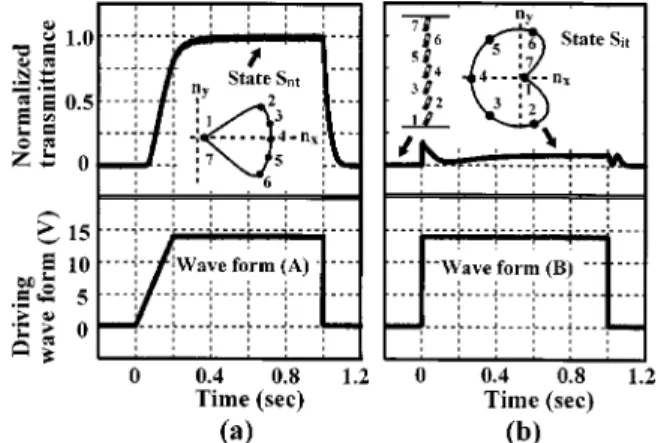
Figure 1 shows the measured transient transmittance of the BCQH cell with two different driving wave forms whose amplitudes are both 14 V. According to the final transmit-tance, it is obvious that this cell can be switched from the quasihomeotropic state into two different static director states by controlling the switching process. In Fig. 1共a兲, wave form A has a gradual slew rate (dV/dt⫽70 V/s) and produces weak fluid flow. This weak flow effect drives the cell into the high-transmittance state. However, wave form B of Fig. 1共b兲, with a rapidly rising voltage, results in the strong flow effect of the directors and switches the cell into the low-transmittance state. This behavior occurs as long as the slew rate (dV/dt) is larger than 2.8 V/ms. Consequently, it can be found that the flow effect is the most important factor on the switching bistability in this cell. Besides, if we turn off the voltage 1 s after turn-on, both states will relax back to the quasihomeotropic state smoothly and continu-ously. However, it is worth noting that, if we hold the bias voltage for about 30 min, both states will transfer into
an-a兲Electronic mail: [email protected]
FIG. 1. Measured transient transmittance of BCQH cell with different driv-ing wave forms.共a兲 The slew ratio of the wave form is dV/dt⫽70 V/s. 共b兲 The wave form has rapidly rising voltage. The insets are the director con-figurations for quasihomeotropic state Sntand Sitstate.
APPLIED PHYSICS LETTERS VOLUME 83, NUMBER 6 11 AUGUST 2003
1110
0003-6951/2003/83(6)/1110/3/$20.00 © 2003 American Institute of Physics
This article is copyrighted as indicated in the article. Reuse of AIP content is subject to the terms at: http://scitation.aip.org/termsconditions. Downloaded to IP: 140.113.38.11 On: Thu, 01 May 2014 05:26:27
other state by the nucleation of a defect and the subsequent motion of a disclination line. Once we turn off the applied voltage, the new state does not relax back to the initial quasi-homeotropic state immediately, and the transition to the ini-tial quasihomeotropic state is also caused by the same pro-cess as that of the appearance of this state. We believe the new state is a twisted 180° state. However, the mechanism of the state-transition process is not well understood.
By comparing the final transmittance of experimental and numerical results, we obtained the director configura-tions for these states; details of the simulation will be de-scribed later. The calculated static director profiles projected on the xy plane were plotted in the insets of Fig. 1. For easier imagining, one can regard these configurations as a conic helical structure with the effective helical axis of directors tilted downward toward the substrate, not normal to the sub-strate. Around the effective helical axis L the directors rotate a full turn from the bottom substrate to the top one. There-fore, the effective chiral property of LCs is consistent to the boundary condition of substrates. In the high-transmittance state, because the direction of the projection of L on the x-axis is the same with that of the boundary directors, we name this state the normal twisted state, denoted by Snt..
However, in the low-transmittance state, the direction of the projection of L on the x-axis is inverse to the easy direction on the substrate, we name this state the inverse twisted state, denoted by Sit. The transmittance of both Snt and Sitstates
can be understood by the transmittance equation, T
⫽0.5 sin22 sin2(␦/2), for an uniaxial phase retarder
be-tween crossed polarizers, where is the azimuthal angle between its optical axis and front polarizer, and ␦ is the phase retardation. When the phase retardation ␦is fixed, the amplitude T is proportional to sin22and the maximum T happens at⫽45° or 135° due to sin22⫽1. Therefore, the director configurations in the states Snt and Sit can be
re-garded as the combination of a stack of subretarders with fixed␦and different. Since the directors in the state Sntare concentrated toward to the xz plane and the most azimuthal angles are close to 45°, the state Snt has high
transmit-tance. However, in the state Sit, there are only a few
direc-tors whose close to 45° or 135°, and thus leading to low transmittance.
To analyze the dynamical switching mechanism of BCQH cells, we solved the hydrodynamic equations of LC from the Ericksen–Leslie theory5– 8 by using relaxation method and neglected the inertial term of directors. We as-sumed the surface as having rigid anchoring and neglected the surface divergence term for K13and K24. After
calculat-ing the transient director configuration, the transient trans-mittance was obtained by using Jones’ matrix method. Table I shows the parameters used in our simulation for the cell with symmetric boundary conditions.
The calculated transient transmittances of our BCQH cell with different boundary conditions for driving wave forms A and B are shown in Fig. 2. Figure 2共a兲 indicates the results with wave form A, which can only induce a weak flow, for the symmetric and asymmetric polar-alignment cells. The top and bottom pretilt angles of the symmetric cell are both 85°, but the bottom one in the asymmetric cell is 84°. It is obvious that, as depicted in Fig. 2共a兲, the weak flow
effect results in the symmetric and asymmetric cells driven into the Snt state. Nevertheless, the asymmetric boundary
condition will increase the final transmittance a little for the asymmetric cell. On the other hand, wave form B can induce a strong flow, as shown in Fig. 2共b兲, such that the asymmetric cell can be switched into the Sit, and the calculated
transmit-tance curve agrees with the measured results qualitatively. However, the symmetric cell cannot be switched into the Sit
state and its final transmittance corresponding to the static state Snt. Therefore, the switching bistability cannot be
achieved for the symmetric cell by controlling the flow effect of directors. This result indicates that there is an extra key factor, the asymmetric polar-alignment condition, for the switching bistability of our BCQH cell, except the flow ef-fect. In our experiment, because it is very difficult to avoid the deviation between the top and bottom tilt angles the switching bistability cell can be observed.
The physical pictures of the switching dynamics for the symmetric and asymmetric cells with strong flow effect, as shown in Figs. 3 and 4, are described in the following. In the quasihomeotropic cell, the flow effect is induced by the ex-ternal electric torque and depends on the initial director configuration.9,10 The simulated velocity profiles at 0.5 ms after turn-on of the applied voltage for the symmetric cell are plotted in Fig. 3. The initial polar angle, that is,/2 minus the tilt angle, of directors for the symmetric cell are the same to minimize the free energy. When the electric field is ap-plied, the initial electric torqueelec⫽0.5⌬⑀Ez
2sin 2, where
Ez is the z-component of electric field, is the same for all
directors owing to the same polar angle. Nevertheless, due to the rigid surface anchoring, the rotation of the directors re-sults in an elastic deformation. The largest deformation oc-curs near the surfaces, and the smallest one is at the midplane
TABLE I. Parameters used in the simulation. Kiiare the elastic constants. ne
and⑀储are the extraordinary refractive and dielectric constants, respectively.
⌬n and ⌬⑀ are the optical and electric anisotropies, respectively. The six Leslie coefficients␣iare taken from MBBA.
Pitch ⫺11.0m Tilt angle 85.0°
K11 14.9 pN Twist angle 0.0° K22 7.9 pN ␣1 ⫺21.5 mPa s K33 15.4 pN ␣2 ⫺153 mPa s ne 1.5183 ␣3 ⫺0.7 mPa s ⌬n 0.0437 ␣4 109.5 mPa s ⑀储 3.3 ␣5 107 mPa s ⌬⑀ ⫺4.8 ␣6 ⫺46 mPa s
FIG. 2. Calculated transient transmittance of BCQH cell with symmetric and asymmetric cell for different driving wave forms.共a兲 Wave form A. 共b兲 Wave form B.
1111
Appl. Phys. Lett., Vol. 83, No. 6, 11 August 2003 C.-Y. Hsieh and S.-H. Chen
This article is copyrighted as indicated in the article. Reuse of AIP content is subject to the terms at: http://scitation.aip.org/termsconditions. Downloaded to IP: 140.113.38.11 On: Thu, 01 May 2014 05:26:27
because of the symmetric boundary condition. This deforma-tion produces an elastic restoring torque to suppress the ro-tation of directors by the electric torque. Therefore, the mid-director has the fastest rotation because of the smallest restoring elastic torque, but the directors near the surface have the slowest rotation. This nonuniform rotation acts on the fluid element with different stress forces through viscous interaction and the net force causes a translational motion of the fluid elements. Meanwhile, the gradient of the flow ve-locity imposes a viscous torque on the director, where
⫽(x,y,z)⬇(⫺兩␣2兩nz
2
vy ,z,兩␣2兩nz
2
vx,z,0) as a result of nz
Ⰷnx,ny and 兩␣2兩Ⰷ兩␣3兩, vx,z and vy ,z are the gradient of
velocity, (nx,ny,nz) are the components of director n. Near the surface, at points 2 and 8 in Fig. 3共a兲, the viscous torque
y is negative, and that makes the director rotate in a
direc-tion opposed to the original one due to the elastic torque. This phenomenon is usually called the kickback effect. How-ever, on the central part of the cell, the viscous torque y is
positive and speeds up the rotation of directors to tilt down-ward to the positive x-axis. At the same time, because the velocity gradient vy ,z of the mid-director is zero, as
illus-trated in Fig. 3共b兲, the viscous torquexhas no influence on
it; but near the top and bottom substrates, since the viscous torquexhas the inverse direction, it rotates the director near
the surface out of the xz plane, causing a large elastic defor-mation. This large deformation introduces a restoring elastic torque, which pulls the director backward to the xz plane. Finally, the director profile reaches its static state Snt, as
shown in Fig. 3共c兲.
Figure 4 shows the simulated results of the asymmetric cell with a small polar angleat the top substrate that is less than the bottom one. The difference of polar angles causes a very small bend and twist distortion such that the initial di-rector profile can be regarded as a helical structure with a very small conical angle. At the presence of the external field, the directors at the bottom boundary with the largest polar angle experience the biggest electric torque. In other words, the initial electric torque is asymmetric. It has to be emphasized that this cell is very different to the situation of the symmetric cell whose initial electric torque is symmetric. The asymmetric torque results in the peculiar director and velocity profiles. The simulated velocity distribution at 0.5 ms is illustrated in Fig. 4. As shown in Fig. 4共a兲, the velocity extreme of vx happens near the midplane, and the viscous
torque y is negative on its upper side, but positive on the
other side. Meanwhile, in Fig. 4共b兲, thexis positive in the
middle part of the cell, but negative in the region near two substrates. The resultant torque ofxandydrives the
direc-tors in the bottom- and top-half parts into the first and second quadrants, respectively, and the mid-director into the fourth quadrant 关see the 0.7-ms and 1.0-ms curves in Fig. 4共c兲兴 to form a large heart-shaped loop. When the flow velocity of the fluid elements becomes small via viscous interaction, the director profile gradually swings clockwise into the state Sit
by the twisted restoring elastic torque. Therefore, we con-cluded that the asymmetric polar-alignment condition is an-other important factor, in addition to the flow effect, for the switching bistability in our BCQH cell.
In summary, the switching bistability of the BCQH cell has been studied experimentally and numerically. From our numerical results, the realization of the switching bistability of our BCQH cell is achieved by the flow effect of directors together with the asymmetric polar-alignment condition. The two static states are all twisted states whose effective helical axis tilted downward in two different directions. Further-more, we also observed the appearance of another state by nucleation of a defect. However, the detailed mechanism of the state transition is not understood and needs further inves-tigation.
This work was partially supported by the National Sci-ence Council, R.O.C., under Contract No. NSC 91-2112-M-009-025. The authors are indebted to Dr. Li-Yi Chen for useful discussions.
1M. F. Schiekel and K. Fahrenschon, Appl. Phys. Lett. 19, 391共1971兲. 2K. Ohmuro, S. Kataoka, T. Sasaki, and Y. Koike, Soc. Inform. Display
Tech. Digest, 1997, p. 845.
3
H. Kurogane, K. Doi, T. Nishihata, A. Honma, M. Furuya, S. Nakagaki, and I. Takanashi, Soc. Inform. Display Tech. Digest, 1998, p. 33.
4L. Y. Chen and S. H. Chen, Appl. Phys. Lett. 74, 3779共1999兲. 5J. L. Ericksen, Trans. Soc. Rheol. 5, 23共1961兲.
6F. M. Leslie, Arch. Ration. Mech. Anal. 28, 265共1968兲. 7
C. Z. van Doorn, J. Appl. Phys. 46, 3738共1975兲.
8D. W. Berreman, J. Appl. Phys. 46, 3746共1975兲.
9L. Y. Chen and S. H. Chen, Jpn. J. Appl. Phys. 39, L368共2000兲. 10C. Y. Hsieh and S. H. Chen, Jpn. J. Appl. Phys. 41, 5264共2002兲. FIG. 3. Calculated flow velocity distribution at 0.5 ms after switching on the
voltage for the symmetric cell.共a兲 vx. 共b兲 vy. 共c兲 Transient director con-figuration projected onto the xy plane.
FIG. 4. Calculated flow velocity distribution at 0.5 ms after switching on the voltage for the asymmetric cell.共a兲 vx.共b兲 vy.共c兲 Transient director con-figuration projected onto the xy plane.
1112 Appl. Phys. Lett., Vol. 83, No. 6, 11 August 2003 C.-Y. Hsieh and S.-H. Chen
This article is copyrighted as indicated in the article. Reuse of AIP content is subject to the terms at: http://scitation.aip.org/termsconditions. Downloaded to IP: 140.113.38.11 On: Thu, 01 May 2014 05:26:27