Improvement On Thermal Performance Of A Disk-Shaped
Miniature Heat Pipe With Nanofluid
Hsin-Tang Chien, Chien-In Tsai, Ping-Hei Chen' and Po-Yeh Chen
Mechanical Engineering Department, National Taiwan University,
No. 1, Roosevelt Road Sec.
4,Taipei 10617, Taiwan.
Asia Vital Components Co..Ltd.
Tel:886-2-23670781 Fax: 886-2-23631 755
Email: [email protected]
. .
ABSTRACT ..
The present study used nanofluid as the working medium for a disk-shaped miniature'heatpipe (DMHP). The nanofluid is n suspension with gold nanoparticles of an avernge diameter of 17 nm in an aqueous solution. An experimental system was set up to measure the thermal resistonce of the disk-shaped miniahrre heat pipe (DMHP) with both nnnofluid and Dl-water. A mounting base is designed and integrated with th> DMHP as a heat spreader for laver diode T O can package. The present mounting base is made of aluminum (6061 T6). The measured results show that the thermal resislance of D M H P varies with the charge volume
and the type of the working medium. At a same charge volume, a significon1 reduction in thermol resistance OJ
D M H P can befound ifnanofluid is used instead of DI-water.
KEWORJJS: micro groove heat pipe, heat spreader, nanoparticle, thermal enhance, nanofluid
. .
'
2.
PREPARATION
OF
NANO-GOLD
1 .INTRODUCTION
The demand for low cost and high performance packages is increasing in recent years. One of the choices is to use heat pipe to dissipate the heat generated by CPU and optical components. Many studies have been conducted to reduce the thermal resistance of heat pipe by choosing different working medium and geometrical configuration of microgrooves or meshes.
In
this study, a nanofluid is usedas
a working medium in the heat pipe. Fluid with suspended nanoparticlesis termed
as
nanofluid in this study.Huang et a/., 1998[1] showed that heat transfer in pool boiling of water in a heated stainless steel horizontal plate was significantly enhanced by adding glass, copper and stainless steel solid particles of 500 pm into the DI water. However, fluids with suspended microparticles are impractical in applications of miniature heat pipes. it
is
expected that the nanoparticles in working medium can significantly improve the boiling performance of fluid at the evaporator's side of heat pipe. Since nanofluid has better thermal properties than pure fluid in many aspects, the present study aims to improve the thermal performance of DMHP by replacing DI-water with nanofluid.Gold nanopanicles were ynthetized by a citrate reduction
of
aqueous hydrogen tetrachloroaurate (HAuC14). An amount of 0.008mg HAuC14 (Sigma Chemical, St. Louis, MO) was dissolved in 80 mL distilled wateras
a primer solution. An additional 4mL
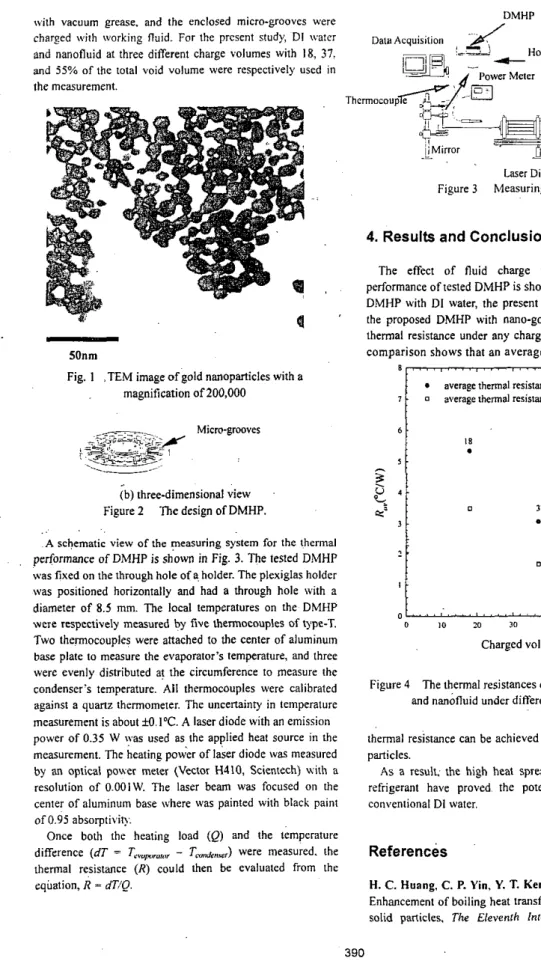
mixture of3.4 mM citric acid. 0.1 mL 5.8 mM tannic acid and 15.9mL distilled water were used as a reducing solution. The reducing solution was preheated to 60 OC. After primer solution was heated to the boiling temperature, the reducing solution was added into the primer solution. Figure I shows a T E M (Hitachi 8100) image ofgold nanopanicles with a diameter of 17 nm and a concentration was about I1 nM.3. EXPERIMENTAL MEASUREMENT
Figures 2(a) and 2(b) respectively show the prototype and a three dimensional view of the present DMHP. Micro-grooves were fabricated on aluminum base by a precise metal forming process. The diameter and thickness of aluminum base are 9mm and 2 mm respectively. The material of the base is aluminum alloy (6061 T6). A total number' of eighteen micro-grooves were evenly distributrd on the aluminum base. The depth and width of micro-groovcs are 0.4 mm m d 0.35 mm respectively.
A silicone rubber was sealed on the top of the aluminum base
DMHP with vacuum grease, and the enclosed micro-grooves were
charged with working fluid. For the prcsent study, D1 water and nanofluid at three different charge volumes with 18, 37. and 55% of the total void volume were respectively used in
~ ~ ~ ~
-,/
~ ~ ~ ~ i ~ i t i ~ ~IF.=) Holder
m'
a
-
+====L$
;-Power ~ e t e r pow.& SUDDIV . . .the measurement. - ii Mirror .- 7 S0nm
Fig. 1 .TEM image o f gold nanoparticles with
a
magnification of 200,000ib) three-dimensional view Figure 2 The design of DMHP.
. .
A schematic view of the veasuring system for the thermal performance of DMHP is shown in Fig.
3.
The tested DMHP was fixed on the through hole of a. holder. The Plexiglas holder was positioned horizontally and hada
through hole with a diameter of 8.5 mm. The local temperatures on the DMHP were respectively measured by five thermocouples of type-T. Two thermocouples were attached to the center of aluminum base plate to measure the evaporator's temperature, and three were evenly distributed at the circumference to measure the condenser's temperature. Ail thermocouples were calibrated against a q u a m thermometer. The uncenainty in temperature measurement is about i0 IOC. A laser diode with an emission power of 0.35 W \\as used as the applied heat source in the measurement. The heating power of laser diode was measured byan
optical power meter (Vector H410, Scientech) with a resolution of 0.001W. The laser beam was focused on the center of aluminum base where was painted with black paint of 0.95 absorptivityOnce both the heating load (Q) and the temperature difference (dT =
TetVp,,
_,,
-
T,, ,_,) were measured. the thermal resistance ( R ) could then be evaluated from the equation, R = d V Q .Laser Diode Figure 3 Measuring system.[?]
4.
Results and Conclusion
The effect of fluid charge volume on the thermal performance of tested DMHP
is
shown in Fig. 4. As compared DMHP with DI water, the present measured data verify that the proposed DMHP with nano-gold particles have a lower thermal resistance under any charge volume. Meanu,hile, the comparison shows that an average decrease of 40% in theaverage thermal resistance of DI water average thermal resistance ofNanofluid
0 IO 30 10 40 SO 60
Charged volume (%)
0
Figure 4 The thermal resistances compare between DI water and nanofluid under different charge volume
thermal resistance can be achieved by DMHP with nano-gold particles.
As a result; the high heat spreading features of the new refrigerant have proved the potential as a substitute for conventional DI water.
References
H. C. Huang, C. P. Yin,
Y.
T. Ker and and T.E
Lin, (1998) Enhancement of boiling heat transfer in water through adding solid particles. The Eleventh lnrernalional Symposium onTransport Phenomena, ISTP-I I , no. 44. pp. 264-272. H. T. Chien, D. S. Lee, P. P. Ding, S. L. Chiu, and P. H. Chen, Disk-Shaped Miniature Heat Pipe (DMHP) with Radiating Micro Grooves for a TO