www.elsevier.com / locate / chroma
Optimizing separation conditions for polycyclic aromatic
hydrocarbons in micellar electrokinetic chromatography
*
Ming-Mu Hsieh, Yui-Chun Kuo, Pei-Ling Tsai, Huan-Tsung Chang
Department of Chemistry, National Taiwan University, P.O. Box 23 –34, 1 Roosevelt Road Section 4, Taipei 10764, Taiwan
Abstract
We report the separation of polycyclic aromatic hydrocarbons (PAHs) using 0.1% poly(ethylene oxide) (PEO) in micellar electrokinetic chromatography (MEKC). In the presence of PEO, adsorption of PAHs on the capillary wall was reduced, leading to better resolution and reproducibility. Effects of tetrapentylammonium iodide (TPAI), dextran sulfate (DS), methanol, and sodium lauryl sulfate (SDS) on the separation of PAHs were elucidated. In terms of resolution and speed, DS, compared to TPAI, is a better additive for separation of PAHs. When using 0.1% PEO solution containing 45% methanol, 50 mM SDS, and 0.02% DS, separation of 10 PAHs containing 2 to 5 benzene rings was accomplished in less than 12 min at 15 kV in a commercial CE system. The method has also been tested for separating seven PAHs with high quantum yields when excited at 325 nm using a He–Cd laser. Unfortunately, separation of the seven PAHs was not achieved and sensitivity diminished under the same conditions. To optimize sensitivity, resolution and speed, a stepwise technique in MEKC has been proposed. The seven PAHs were resolved in 35 min at 15 kV when separation was performed in 0.1% PEO solution containing 35 mM SDS, 40% methanol and 0.02% DS for 2 min, and subsequently in 0.1% PEO solution containing 20 mM SDS, 50% methanol, and 0.02% DS. 2001 Elsevier Science B.V. All rights reserved.
Keywords: Background electrolyte composition; Polynuclear aromatic hydrocarbons
1. Introduction adverse health effects to which they have been
linked, the analysis of polycyclic aromatic hydro-Micellar electrokinetic chromatography (MEKC) carbons (PAHs) is of interest and importance [6]. has been frequently chosen for separations of MEKC is one of the most important techniques for charged or neutral compounds, such as phenol and this purpose [7–9]. It however is difficult to achieve hydrophobic hydrocarbons, based on their relative any degree of selectivity using micelles alone be-affinity for the lipophilic interior and / or the ionic cause binding to the micelle is so strong. Irrep-exterior of a micellar pseudostationary phase [1–5]. roducibility and loss of resolution due to adsorption Although MEKC is very promising for separation of of PAHs on the capillary wall is also a common neutral compounds, a narrow separation window and problem [10,11]. As concentrations and types of a limited stability of micellar pseudostationary detergents, organic solvents, and other additives are
phases are problematic. important determinants for the capacity factors (k9)
Due to the abundance in the environment and the of PAHs, controlling these factors is typical to solve those problems in MEKC [12].
The separation of PAHs by MEKC has been
*Corresponding author. Tel. / fax: 1886-2-2362-1963.
E-mail address: [email protected] (H.-T. Chang). successfully achieved using micelles, such as sodium
0021-9673 / 01 / $ – see front matter 2001 Elsevier Science B.V. All rights reserved. P I I : S 0 0 2 1 - 9 6 7 3 ( 0 1 ) 0 0 7 9 4 - 4
lauryl sulfate (SDS) micelles, along with modifiers and speed were carefully evaluated. We also pro-such as cyclodextrins [13], urea [14], and organic posed a stepwise technique based on changes in solvents [15]. The use of organic solvent is generally concentration of SDS and methanol using a He–Cd effective to improve solubility, to optimize capacity laser for optimum resolution, speed and sensitivity. factors of PAHs, to control electroosmotic flow
(EOF), and to minimize adsorption of PAHs on the
capillary wall. For example, selectivity is improved 2. Experimental using micelles commonly prepared in 40 to 60%
acetonitrile or methanol [16]. Alternatively,
selectivi-2.1. Apparatus ty for separating PAHs can also be improved by
carefully choosing hydrophobic alkylammonium ions
A commercial electrophoresis instrument from because the magnitude of the alteration of the
Bio-Rad (BioFocus CE 2000, Hercules, CA, USA) migration mobilities of PAHs is related to the chain
was used for analysis of PAHs with absorbance length, structure, and concentration of ammonium
detection. The fused-silica capillaries (Polymicro ions [17]. Problems associated with the use of
Technologies, Phoenix, AZ, USA) were 38 cm375 ammonium ions include changes in EOF and poor
mm I.D. At 33 cm from the injection end, the reproducibility as a result of adsorption on the
polyimide coating was burned off to form the capillary wall. Planar organic cations that form
detection window. The absorbance was obtained at charge-transfer complexation with PAHs have been
254 nm. used for separation of PAHs in nonaqueous capillary
The basic design for analysis of PAHs in MEKC electrophoresis (CE) [18]. Recently, separation of
with LIF has been previously described [25]. Briefly, PAHs in monomolecular pseudostationary phase
a high-voltage power supply (Gamma High Voltage formed from ionic polymers has been demonstrated
Research, Ormond Beach, FL, USA) was used to in MEKC [19–21]. Advantages of the alternative
drive electrophoresis. The entire detection system over conventional micelles include its stability in
was enclosed in a black box with a high-voltage organic phase and providing a wider separation
interlock. High-voltage end of the separation system window. Capillary electrochromatography (CEC) is
was put in a laboratory-made Plexiglass box for also useful for separation of PAHs [22–24]. In CEC,
safety. A 35-mW He–Cd laser with 325-nm output PAHs migrated through stationary phase by EOF,
from Melles Griot (Carlsbad, CA, USA) was used while, like in high-performance liquid
chromatog-for excitation. The emission light was collected with raphy, the separation is determined by its partition
a 103 objective (numerical aperture50.25). One between stationary phase and mobile phase.
Al-cutoff filter (GG 395) was used to block scattered though reasonable resolution is obtained,
polymeri-light before the emitted polymeri-light reached the phototube zation of small particles inside capillaries or packing
(Hamamatsu R928). The amplified currents were the small particles into small diameter of capillaries
transferred directly through a 10-kV resistor to a is not so easy.
24-bit A / D interface (Borwin, JMBS Developments, Poor sensitivity is one of problems commonly
Le Fontanil, France) at 10 Hz and stored in a associated with analysis of PAHs in environmental
personal computer. and biological samples via MEKC with absorbance
detection. To increase sensitivity, laser-induced
fluo-rescence (LIF) using UV lasers has been developed 2.2. Materials [25–27]. By taking the advantage of high sensitivity
with LIF, this paper is devoted to provide a new All PAHs and TPAI were of reagent grade and approach for analysis of PAHs in MEKC with high were obtained from Acros (Pittsburgh, PA, USA). resolving power, speed, and sensitivity. Effects of Sodium hydroxide was from Fisher (Fair Lawn, NJ, SDS pseudostationary phase, methanol, tetra- USA). Dextran sulfate [molecular mass (M ) 5000],r
pentylammonium iodide (TPAI), dextran sulfate PEO (Mr 4 000 000), tris(hydroxymethyl)amino-(DS), and poly(ethylene oxide) (PEO) on resolution methane (THAM), and SDS were from Sigma (St.
Louis, MO, USA). More details about buffers are refreshed after treatment with 0.1 M NaOH [28,29]. shown in the Results and discussion section. The electrophoretic mobility of PAH–SDS micelle complexes decreased in PEO, leading to changes in 2.3. Capillary equilibrium and separation the k9 for PAHs. As a result, differential migration times between any two adjacent peaks were changed, Capillaries were pre-equilibrated with 0.1 M which in turn led to variations of resolution. De-NaOH overnight before use for electrophoretic sepa- creases in diffusion and adsorption of PAHs on the ration. Between runs using the commercial CE capillary wall also contributed to changes in res-system, the capillary was equilibrated with 0.1 M olution. For example, naphthalene and azulene, and NaOH via high pressure (689 476 Pa) for 4 min, and 2,3-benzofluorene and fluoranthene were further subsequently washed out remaining base with run- separated apart and the peak corresponding to ben-ning buffers in the absence of PEO via high pressure zo[a]pyrene was comparatively sharper in the pres-for 20 s. Between runs using the laboratory-made CE ence of PEO. Although resolution may be further system with LIF, the capillary was equilibrated with optimized using high concentrations of PEO, a 0.1 M NaOH at 1 kV for 10 min. Subsequently, the greater baseline shift and small bulk EOF are remaining base was washed out with running buffers problematic.
by pressure injection for 1 min. Electrokinetic in- To conveniently evaluate effects of methanol and jections at 4 kV for 2 s and hydrodynamic injections SDS on separation of PAHs, the differential migra-at 30 cm for 3 s were performed in the commercial tion times between the most hydrophilic analytes CE system and laboratory-made CE system, respec- (mesityl oxide) and hydrophobic analytes (ben-tively. Separations were performed in 0.1% PEO zo[a]pyrene) among our selected compounds vs. solution containing different concentrations of concentration of methanol and SDS were plotted in
methanol, SDS, DS and TPAI. Fig. 1A and B, respectively. Because of these two
compounds are highly hydrophilic and hydrophobic, the magnitude of the differential migration time
3. Results and discussion should be very close to the width of the separation
window (tmc2t , in which t0 mc and t are the migra-0
3.1. Effects of buffer additives tion time for micelles and the analyte that are not
partitioned in micelles), which is commonly used to To minimize adsorption of PAHs on the capillary evaluate selectivity in MEKC. At a constant con-wall, the separations were performed in the presence centration of SDS (50 mM ) and DS (0.02%), the of methanol and PEO. After sample injections, 0.1% separation window increased dramatically when PEO solution (neutral) entered the capillaries by using PEO solutions containing less than 50% EOF. With a greater migration mobility (equal to methanol (Fig. 1A). At methanol concentrations EOF mobility) toward the cathode, PEO (in the higher than 50%, resolution was poor, presumably anodic vial) traversed sample zones that are par- because SDS did not form micelles at high methanol titioned in SDS pseudostationary phase during sepa- concentrations. In other words, partial separation is ration. Because of increases in viscosity and slight most likely due to interactions with SDS monomers adsorption of PEO on the capillary wall, bulk EOF and / or DS. When using buffers containing less than mobility gradually decreased during separation. Al- 40% methanol, not only were separations slow and though bulk EOF slightly decreased during sepa- irreproducible, but also the peak corresponding to ration, reproducibility was not an issue, which was benzo[a]pyrene was very broad. It is also interesting supported by the fact that the relative standard to note that, with increasing methanol concentrations, deviation (RSD) value for bulk EOF mobility was mesityl oxide migrated more closely to the interface reduced from 3.5% to less than 1.0% in presence of (caused an indirect peak) between PEO and buffers 0.1% PEO and 50% methanol. This indicates that filled in the capillary prior to analysis. At 60% adsorption of PAHs decreased in the presence of methanol, the indirect peak disappeared, which sup-PEO and methanol and the capillary wall was ported our suggestion that 50 mM SDS did not form
3.2. Effect of TPAI and DS
In order to clarify the effect of DS (polysaccharide containing sulfate) on separation of PAHs, we per-formed separations in 0.1% PEO solution containing 50 mM SDS, 50% methanol, and DS with con-centrations ranging from 0.00 to 0.03%. Over this range, the migration times for benzo[a]pyrene changed from 17.1 to 10.1 min. Fig. 2A shows that the differential time between mesityl oxide and benzo[a]pyrene decreased with increasing DS. This is because DS, with a small electrophoretic mobility (EPM), competed with SDS micelles to form com-plexes with PAHs. The decreasing trend is in good agreement with the suggestion that glucose
effective-Fig. 1. Effects of methanol and SDS on the separation of five selected PAHs at 15 kV. (A) Effect of methanol in a buffer containing 5 mM THAM, 0.1% PEO, 50 mM SDS, and 0.02% DS; (B) effect of SDS in a buffer containing 5 mM THAM, 0.1% PEO, 50% methanol, and 0.02% DS. Capillary: 35 cm (30 cm effective length), filled with buffers as in A and B without PEO, respectively. Migration windows are the differential migration times between benzo[a]pyrene and mesityl oxides.
micelles in 60% methanol. Thus, the migration time of mesityl oxide was used to calculate EOF mobility
24 2 21 21
and the result was 2.59?10 cm V s (RSD,
1.0%). In an attempt to find a suitable SDS con-centration, we performed separation of PAHs in 0.1% PEO solution containing 50% methanol, 0.02% DS and SDS. As predicted, separation windows in-creased with increasing the SDS concentration over
20–50 mM (Fig. 1B). At high SDS concentrations Fig. 2. Effects of additives on the separation of five selected PAHs at 15 kV. (A) Effect of DS in a buffer containing 5 mM
(.60 mM ), the last peak disappeared; the last
THAM, 0.1% PEO, 50% methanol, and 50 mM SDS. (B) Effect
second peak became much broader; and
reproducibil-of TPAI in a buffer containing 5 mM THAM, 0.1% PEO, 50%
ity declined. In terms of resolution, speed, and methanol, and 50 mM SDS. (C) Effect of SDS in a buffer reproducibility, the optimum SDS concentration is containing 5 mM THAM, 0.1% PEO, 50% methanol, and 5 mM
ly decreases the capacity factors of PAHs in the SDS pseudostationary phase [30]. Further increases in DS, resolution lost due to too weak interaction with SDS micelles and Joule heating. In terms of speed and resolution, the optimum concentration of DS is about 0.02%.
Compared to complexes formed with DS (anion), complexes formed between PAHs and cationic TPAI should migrate faster toward the cathode end. As a consequence, separation time should be shorter in the presence of TPAI. To evaluate effects of TPAI on separation of PAHs, we performed separations in 0.1% PEO solution containing 50 mM SDS and 50% methanol and TPAI with concentrations ranging from 0 to 5 mM. Over this range, the migration times for benzo[a]pyrene changed from 17.1 to 14.9 min. The change was less than that in presence of DS. To clearly show effect of TPAI on selectivity, the differential migration times between mesityl oxide and benzo[a]pyrene were depicted in Fig. 2B. It shows the differential migration time decreased with increases in TPAI concentrations below 0.5 mM, while it increased over 0.5–5 mM. This is because bulk EOF decreased due to adsorption of TPAI on
the capillary wall, which was profound at high Fig. 3. Separations of five selected PAHs in 0.1% PEO solution containing 5 mM THAM, 50% methanol, and 50 mM SDS at 15
concentrations of TPAI. In order to see the role of
kV. (A) No TPAI and DS; (B) 0.03% DS; (C) 1 mM TPAI. Peak
TPAI in determining resolution, we varied SDS
identities: 15mesityl oxide; 25naphthalene; 35fluorene; 45
concentrations from 10 to 50 mM at 5 mM TPAI. At
anthracene; 55pyrene; and 65benzo[a]pyrene. Other conditions
a constant TPAI concentration, the differential migra- as in Fig. 1.
tion times between mesityl oxide and
ben-zo[a]pyrene increased dramatically with increasing
SDS concentrations above 40 mM (Fig. 2C). This is presence of either DS or TPAI, separation was faster probably SDS did not form stable micelles below 40 and reproducibility was improved (the RSD values mM in 50% methanol. As a consequence, TPAI for migration time of benzo[a]pyrene were 2.5 and competed strongly with SDS monomers to form 5.0% in the presence and absence of DS,
respective-complexes with PAHs. ly). Overall, in terms of speed and resolution, a
To further compare effects of DS and TPAI on the buffer containing DS is more suitable for separation separation of PAHs in MEKC, the separations of of PAHs.
PAHs in the absence of TPAI and DS, in the presence of 0.03% DS, and 1 mM TPAI,
respective-ly, were shown in Fig. 3A–C. The separation time 3.3. Separation of PAHs was shortened either in the presence of DS or TPAI,
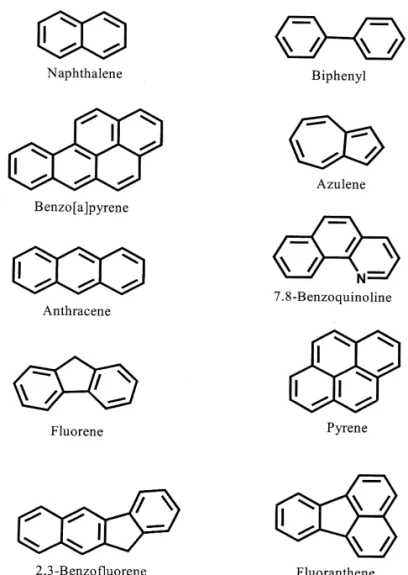
which supported our above-mentioned suggestions Ten selected PAHs with ring sizes 2 to 5 shown in that DS or TPAI competed with SDS to form Fig. 5 were separated in 0.1% PEO solution either complexes with PAHs. In order to elucidate the role containing 50 mM SDS, 0.02% DS, and 45% or 50% of TPAI or DS in determining separation, resolution methanol. Fig. 6A shows these analytes were sepa-values between any two adjacent peaks were plotted rated in less than 12 min, while the peak corre-in Fig. 4. Although resolution was slightly lost corre-in the sponding to benzo[a]pyrene was quite broad when
above 10 selected PAHs are not high when excited at 325 nm using a He–Cd laser. In order to test our hypothesis regarding solubility problems, we select-ed and testselect-ed seven PAHs with higher quantum yields at 325 nm. As seen in Table 1, the emission wavelengths for these analytes are also quite differ-ent. To simplify our setup, a cut-off filter was used, which allowed more lights reaching the detector. As a result, a higher background and a greater noise were expected, leading to higher limit of detection (LOD). The LOD [signal-to-noise ratio (S /N )53] for these PAHs shown in Table 1 are in nM to tenths of nM levels, which are about 100–1000-fold improve-ments in sensitivity compared to those obtained with
Fig. 4. Comparison of effects of DS and TPAI on resolution of
absorbance detection. The LOD can even be lowered
separating five selected PAHs. Resolution values were calculated
by performing analysis using a laser-induced
dis-from data obtained dis-from Figs. 3A–C. Peak pairs: 15mesityl oxide
persed fluorescence detection with multiple
excita-and naphthalene, 25naphthalene excita-and fluorene, 35fluorene excita-and
anthracene, 45anthracene and pyrene, and 55pyrene and ben- tion lines and a multiple detection system [31]. zo[a]pyrene.
3.5. Stepwise technique
using buffers containing 45% methanol. Although As a result of better sensitivity with an LIF the peak corresponding to benzo[a]pyrene became detection mode, more diluted samples were injected, very sharp and more symmetric, 7,8-benzoquinoline which allowed us to use buffers containing low and biphenyl were not resolved, and naphthalene and methanol and SDS for the following experiments azulene were only partially resolved when using without causing irreproducible problems. The use of buffers containing 50% methanol (Fig. 6B). The buffers containing less amounts of SDS also bene-migration order shown in both electropherograms fited for a low fluorescent background and high corresponds to the number of benzene rings (hydro- quantum yields (minimized Joule heating). Fig. 7A phobicity), except that for 7,8-benzoquinoline. At shows that the separation of the seven PAHs in 0.1% low methanol concentrations (45%), adsorption of PEO solution containing 0.02% DS, 35 mM SDS and PAHs was more serious. As a result, peaks were 40% methanol was accomplished in 60 min. Further broader and separation was less reproducible (the increases in methanol concentrations, separation was RSD values of the migration time for ben- faster but resolution was diminished. On the other
zo[a]pyrene was 3.5%). hand, Fig. 7B shows that seven peaks were detected
in 20 min in 0.1% PEO solution containing 0.02%
3.4. Detection limit DS, 20 mM SDS and 50% methanol. However
baseline resolution was not achieved between 7,8-Adsorption of PAHs on the capillary wall is less benzoquinoline and 2,3-benzofluorene and among when injecting a small amount of samples. To anthracene, fluoranthene, and pyrene. Please note minimize the problems associated with poor solu- that SDS micelles did not form under this condition. bility and adsorption of PAHs in MEKC, using a Although resolution increased with increasing SDS sensitive detection system is one of the choices. For concentrations, sensitivity was deteriorated due to this purpose, we performed analysis using a labora- Joule heating. Thus, to optimize resolution, speed, tory-made CE system with LIF. Because the maxi- and sensitivity, a gradient or stepwise technique mum excitation wavelengths for PAHs are distributed should be useful. For example, a gradient technique in a wide range, which are related to the ring size in conjunction with changes in acetonitrile concen-and substituted groups, the quantum yields for the tration has been developed for this purpose in CEC
Fig. 5. Structures of 10 selected PAHs used in analysis with a commercial CE system.
[32]. Because SDS micelles with a greater electro- 4. Conclusions
phoretic mobility, while methanol with a smaller
EPM than PAHs complexes toward the anode, sepa- We performed the separation of PAHs in 0.1% rations were performed in 0.1% PEO solution con- PEO solution containing SDS, methanol, and addi-taining 35 mM SDS and 40% methanol at 15 kV for tives. In the presence of PEO, bulk EOF was 120 s, and subsequently in 0.1% PEO solution regulated and adsorption of PAHs on the capillary containing 20 mM SDS and 50% methanol for the wall was reduced, leading to reproducibility and rest. Under this stepwise condition, PAHs traversed optimum resolution. In addition, DS was added to both zones containing SDS micelles and 50% metha- the buffers for optimum speed, resolution, and nol. As a consequence, resolution, sensitivity and reproducibility. The separation of 10 PAHs was reproducibility should be optimized. Fig. 7C shows accomplished less than 12 min in 0.1% PEO solution that the separation with reasonable resolution was containing 50 mM SDS, 0.02% DS, and 45% complete in 30 min. The RSD values for migration methanol. Resolution, sensitivity, speed, and repro-times of benzo[a]pyrene shown in these three elec- ducibility were also optimized by a stepwise tech-tropherograms were 4.5, 2.0, and 2.5%, respectively. nique associated with changes in SDS and methanol
Fig. 6. Separation of 10 selected PAHs in 0.1% PEO solution containing 5 mM THAM, 50 mM SDS, 0.02% DS and 45%
methanol (A) or 50% methanol (B) at 15 kV. Peak identities: Fig. 7. Separations of PAHs under isocratic conditions and under 15mesityl oxide; 25naphthalene; 35azulene; 457,8-benzo- stepwise changes in SDS and methanol concentrations, respective-quinoline; 55biphenyl; 65fluorene; 75anthracene; 852,3-ben- ly. (A) Separation was performed in 0.1% PEO solution con-zofluorene; 95fluoranthene; 105pyrene; and 115benzo[a]pyrene. taining 5 mM THAM, 35 mM SDS, 0.02% DS and 40% methanol
23
The concentrations of analytes are: 2?10 M mesityl oxide, at 15 kV. (B) Separation was performed in 0.1% PEO solution
23 23 24
2.67?10 M naphthalene, 1.33?10 M biphenyl, 6.67?10 M containing 5 mM THAM, 20 mM SDS, 0.02% DS and 50%
24 24
azulene, 2?10 M benzo[a]pyrene, anthracene, and 3.33?10 M methanol at 15 kV. (C) Separation was performed in 0.1% PEO 7,8-benzoquinoline, 7,8-benzoquinoline, 2,3-benzofluorene, solution containing 5 mM THAM, 35 mM SDS and 40% pyrene, fluoranthene and fluorene. Other conditions as in Fig. 1. methanol at 15 kV for 120 s, subsequently in 0.1% PEO solution containing 5 mM THAM, 20 mM SDS and 50% methanol for the rest. Peak identities: 153-aminofluoranthene (1 mM ); 257,8-benzopquinoline (2 mM ); 352,3-benzofluorene (1 mM ); 45 Table 1 anthracene (1 mM ); 55fluoranthene (1 mM ); 65pyrene (0.5 m
a
LOD values for PAHs using a He–Cd laser at 325 nm in MEKC M ); 75benzo[a]pyrene (1 mM ). Capillary: 50 cm (40 cm
effec-tive length); and filled with buffers containing 5 mM THAM, 35 b
PAH lex(nm) lem(nm) LOD (nM ) mM SDS, 0.02% DS and 40% methanol. 3-Aminofluoroanthene 305 480 14.7
7,8-Benzoquinoline 300 347 2.64 2,3-Benzofluorene 300 500 3.13
Anthracene 305 405 1.80 concentrations. It is suggested that buffers containing
Fluoranthene 305 480 2.40
a high concentration of SDS and a low percentage of
Pyrene 295 390 1.20
methanol are used for selectivity, while buffers
Benzo[a]pyrene 305 410 4.85
containing low concentrations of SDS and a higher
a
Separation in 0.1% PEO solution containing 20 mM SDS,
percentage of methanol are performed later for
0.02% DS, and 50% methanol using a capillary filled with buffers
detection and speed. The success of this stepwise
containing 35 mM SDS, 40% methanol, and 0.02% DS. b
[15] Z. Liu, H. Zou, M. Ye, J. Ni, Y. Zhang, J. Chromatogr. A 863
compounds indicated CE should be useful for
moni-(1999) 69.
toring environmental and biological samples.
[16] C. Yan, R. Dadoo, R.N. Zare, D.J. Rakestraw, D.S. Anex, Anal. Chem. 68 (1996) 2726.
[17] P.G. Muijselaar, H.B. Verhelst, H.A. Claessens, C.A.
Cram-Acknowledgements ers, J. Chromatogr. A 764 (1997) 323.
[18] J.L. Miller, M.G. Khaledi, D. Shea, Anal. Chem. 69 (1997) 1223.
This work was supported by a grant from Chinese
[19] S. Yang, J.G. Bumgarner, M.G. Khaledi, J. High. Resolut.
Petroleum Chemical Cooperation and a grant from
Chromatogr. 18 (1995) 443.
National Taiwan University. [20] C.P. Palmer, S. Terabe, Anal. Chem. 69 (1997) 1852.
[21] S.A. Shamsi, C. Akbay, I.M. Warner, Anal. Chem. 70 (1998) 3078.
[22] J.-L. Liao, N. Chen, C. Ericson, S. Hjerten, Anal. Chem. 68
References
(1996) 3468.
[23] P.B. Wright, A.S. Lister, J.G. Dorsey, Anal. Chem. 69 (1997) [1] S. Terabe, K. Otsuka, K. Ichikawa, A. Tsuchiya, T. Ando,
3251. Anal. Chem. 56 (1984) 111.
[24] G.W. Sovocool, W.C. Brumley, J.R. Donnelly, Electropho-[2] A. Zemann, D. Volgger, Anal. Chem. 69 (1997) 3243.
resis 20 (1999) 3297. [3] R.M. Seifar, J.C. Kraak, W.Th. Kok, Anal. Chem. 69 (1997)
[25] C. Yan, R. Dadoo, H. Zhao, R.N. Zare, D.J. Rakestraw, Anal. 2772.
Chem. 67 (1995) 2026. [4] W. Ding, J.S. Fritz, Anal. Chem. 70 (1998) 1859.
[26] R.S. Brown, J.H.T. Luong, O.H.J. Szolar, A. Halasz, J. [5] Z.E. Rassi, J. Chromatogr. A 875 (2000) 207.
Hawari, Anal. Chem. 68 (1996) 287. [6] T. Vo-Dinh (Ed.), Chemical Analysis of Polycyclic Aromatic
[27] R. Dadoo, R.N. Zare, C. Yan, D.S. Anex, Anal. Chem. 70 Compounds, Wiley, New York, 1989.
(1998) 4787. [7] G. Xue, H.-M. Pang, E.S. Yeung, Anal. Chem. 71 (1999)
[28] H.-S. Chen, H.-T. Chang, Anal. Chem. 71 (1999) 2033. 2642.
[29] H.-T. Chang, H.-S. Chen, M.-M. Hsieh, W.-L. Tseng, Rev. [8] X. Xu, R.J. Hurtubise, J. Chromatogr. A 829 (1999) 289.
Anal. Chem. 19 (2000) 1. [9] A.-L. Nguyen, J.H.T. Luong, Anal. Chem. 69 (1997) 1726.
[30] T. Kaneta, S. Tanaka, M. Taga, H. Yoshida, J. Chromatogr. [10] W. Ding, J.S. Fritz, Anal. Chem. 69 (1997) 1593.
609 (1992) 369. [11] C. Fujimoto, Y. Fujise, E. Matsuzawa, Anal. Chem. 68
[31] M.G. Garguilo, D.H. Thomas, D.S. Anex, D.J. Rakestraw, J. (1996) 2753.
Chromatogr. A 883 (2000) 231. [12] S. Terabe, Trends Anal. Chem. 8 (1984) 129.
[13] Y. Mechref, Z.E. Rassi, Anal. Chem. 68 (1996) 1771. [32] C. Yan, R. Dadoo, R.N. Zare, D.J. Rakestraw, D.S. Anex, [14] H. Nishi, M. Matsuo, J. Liq. Chromatogr. 14 (1991) 973. Anal. Chem. 68 (1996) 2726.