CCL2 increases migration and MMP-9 expression via CCR2 receptor, Ras, Raf, MEK, ERK and NF-κB-dependent
pathway in human chondrosarcoma cells
Chia-Chun Tsai1, Chih-Hsin Tang2,1*
1Graduate Institute of Basic Medical Science, China Medical University, Taichung, Taiwan 2Department of Pharmacology, School of Medicine, China Medical University, Taichung, Taiwan
Senior author: [email protected]
INTRODUCTION:
Chondrosarcoma is a type of highly malignant tumor with a potent capacity to invade locally and cause distant metastasis. It is second most common bone tumor and accounts for about 25% of all malignant bone tumors. It occurs commonly in people over 40 years old and affects the bones of the pelvis and hips. Invasion of tumor cells in clinic was reason of therapeutic failure in malignant chondrosarcoma treatment. CCL2 (CC chemokine ligand 2, also known as monocyte chemoattractant protein-1) is a member of CC chemokine ligands (CCL) family, the CC chemokine proteins have two adjacent cysteines near their N- terminus. It has been demonstrated to recruit monocytes to tumor sites. However, the effects of CCL2 in chondrosarcoma are mostly unknown. Here we found that CCL2 increased chondrosarcoma cell migration through MMP-9 up-regulation via Ras, Raf, MEK and ERK and NF-κB pathway.
METHODS:
Cell culture: The human chondrosarcoma cell lines (JJ012) were kindly
provided from the laboratory of Dr. Sean P Scully (University of Miami School of Medicine, Miami, FL, USA) and were cultured in DMEM and α-MEM supplemented with 10% FBS. Serum and maintained at 37°C in a humidified atmosphere of 5% CO2.
Migration assay; Western blot analysis; Transfection and reporter gene assay; Quantitative real-time PCR; Chromatin immunoprecipitation
RESULTS:
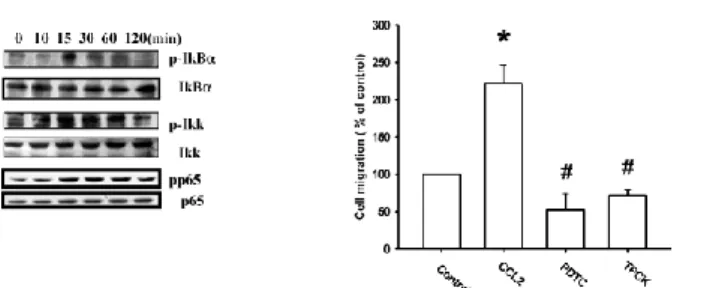
CCL2 has been demonstrated to recruit monocytes to tumor sites. To confirm the effects of CCL2 on chondrosarcoma cell migration, the Transwell assay was used. JJ012 was treated with various concentrations of CCL2 and significantly directed cells migration (Fig. 1A). It has been reported that CCL2 was directly bind to CCR2 or CCR4 receptor. Pretreatment of cells for 30 min with CCR2 but not CCR4 antagonist markedly inhibited the CCL2 -induced cancer migration (Fig. 1B). Therefore, CCR2 is mediated CCL2-induced cell migration in human chondrosarcoma. MMPs expression has reported in the regulation of growth and metastasis of human cancer cells. To investigate that MMPs is important for chondrosarcoma migration, we used qPCR to test which kind of MMP is involve in cell migration. Treatment of cells with CCL2 increased protein and mRNA expression of MMP-9 in a time-dependent manner by western blot analysis and qPCR (Fig. 2A). To confirm MMP9 is important for chondrosarcoma cell migration, the MMP-9 inhibitor was used. We found that MMP-9 inhibitor significantly decreased CCL2-mediated cell migration ability (Fig. 2B). Next, we examine whether Ras, Raf, MEK and ERK are involved in CCL2-induced cell migration. Pretreatment of cells with Ras inhibitor (Manumycin A), Raf inhibitor (GW5074), MEK inhibitor (PD98059), ERK inhibitor (U0126) reduced CCL2-induced migration and MMP-9 expression (Fig. 3). In addition, stimulation of cells with CCL2 induced Ras, Raf, MEK and ERK activation (Fig. 3). NF-κB activation is necessary for the migration and invasion of human cancer cells. We further examined activation of the NF-κB after CCL2 stimulation. We found that CCL2 increased phosphorylation of IKK, IKBα and p65. Cells treated with NF-κB inhibitor (PDTC and TPCK) significantly decreased CCL2-mediated cell migration and MMP-9 expression (Fig. 4). Finally, we demonstrate the DNA expression whether CCL2-induced. Stimulation of cells with CCL2 increased NF-κB luciferase activity and DNA binding activity. Therefore, Ras, Raf, MEK, ERK and NF-κB signaling pathways are involved in CCL2-mediated cell migration and MMP-9 expression.
Fig. 1 CCL2-directed chondrosarcoma cells migration through CCR2 receptor.
Fig. 2 CCL2 increases protein and mRNA expression of MMP-9.
Fig. 3 Ras, Raf, MEK and ERK are involved in CCL2-induced cell migration and MMP-9 expression.
Fig. 4 NF-κB is involved in CCL2-induced cell migration and MMP-9 expression.
DISCUSSION:
We present a novel mechanism of CCL2-induced migration of human chondrosarcoma cells by up-regulation of MMP-9. CCL2 increases MMP-9 expression and activity by binding to theCCR2 receptor and activation of Ras, Raf, MEK, ERK and resulting in the activations of NF-κB on the MMP-9 promoter and contribute to tumor metastasis.
SIGNIFICANCE:
Invasion of tumor cells in clinic was reason of therapeutic failure in malignant chondrosarcoma treatment. So, we find a new mechanism to avoid chondrosarcoma cells metastasis to other organs.