國立高雄大學亞太工商管理學系
碩士論文
以系統思考觀點探討台灣 C2C 電子商務生態系統
Applying Systems Thinking to Explore the Ecosystem of
C2C e-Commerce in Taiwan
研究生:黃柏銜撰
指導教授:李亭林 博士
以系統思考觀點探討台灣 C2C 電子商務生態系統
指導教授:李亭林 博士(教授) 國立高雄大學亞太工商管理所 學生:黃柏銜 國立高雄大學亞太工商管理所 摘要 折扣一直以來便是一種好用的炒作行銷手段,在今日,C2C 電子商務 平台,不斷利用促銷及補貼搶奪顧客,然而,促銷及補貼必定帶來相對應 的營運成本並進而影響平台收益並解影響平台其他支出。而大量的使用者 上升也帶來了更多的爭議性問題,如詐騙、棄標等。 本研究的主要目的是探討台灣 C2C 電子商務營運策略的有效性以及 改善方法。首先,本研究採用文獻分析與非結構化訪談,找出 C2C 電子商 務生態系統存在的問題。之後,利用顧客價值主張、消費者行為理論及炒 作行銷的概念建構出現有 C2C 電子商務生態系統之因果環路圖。並以系統 思考來討論 C2C 電子商務平台供應商所採取的政策之有效性。最後以制度 型信任作為對改善 C2C 電子商務產業環境提出建議。從本研究之因果環路 圖顯示,建立更可靠的平台比採取炒作行銷的策略更好,一個平台將通過 改進制度型信任相關機制可贏得消費者的信任並獲得客戶的忠誠度。另 外,太多的虛假信息和平台安全問題會降低消費者的使用意願。 本研究最大的貢獻是,先透過系統思考(system thinking)與團體建模 (group modeling)的方式探討現有 C2C 電子商務生態系統之爭議狀況及制 度型信任機制對爭議事件之影響,並根據制度型信任機制提出症狀解及根 本解。 關鍵字:電子商務生態系統、顧客價值主張、系統思考、消費者行為IV
Applying System Thinking to Explore the Ecosystem
of C2C e-Commerce in Taiwan
Advisor: Dr.(Professor) Ting-Lin Lee
Institute of Department of Asia-Pacific Industrial and Business Management National University of Kaohsiung
Student: Po-Hsien Huang
Institute of Department of Asia-Pacific Industrial and Business Management National University of Kaohsiung
ABSTRACT
Discount has always been a useful means of hype marketing, nowadays, C2C e-commerce platforms continue to use the promotion, subsidies and less restrictive conditions for register to snatch customers. But, it will also bring the corresponding operating costs, reduce platform revenue and affect the other expenses of platform. And a large number of users also brought more controversial issues, such as fraud, non-paying bid and so on.
The main purpose of this study is to explore the effectiveness of Taiwan C2C e-Commerce business strategy and improvement. First, this study used Document Analysis and Unstructured Interviewing to find existing problems of C2C e-commerce. After that, the idea of Customer Value Proposition, Consumer Behavior, and hype marketing were taken to build the causal loop diagram of existing C2C e-Commerce ecosystem. This study used System Thinking to discuss the effectiveness of policy taken by C2C e-commerce platform providers. And Institution-Based Trust was used to makes suggestions for improvement of the industrial environment. In this study, the causal loop shows that the policy to build a more reliable platform is better than take hype marketing, a platform will win the trust of consumers and get the loyalty of customers by improving the Institution-Based Trust mechanism. In addition, too much false information and platform security issues will reduce the consumers’ willingness to use.
The contribution of this research is to use system thinking and group modeling to explore the C2C e-commerce dispute situation and the influence of the institution-based trust mechanisms on the dispute events, while proposing
symptomatic solutions and fundamental solutions based on the institution-based trust mechanisms.
Keywords: E-Commerce Ecosystem, Customer Value Proposition, System
VI
誌謝
時光匆匆,求學時期的最後一個階段就這樣畫下句點。回首這兩年時 光,的確成長不少,但仍有必須改進的地方。在完成這份研究的同時在此 論文完成之際,首先感謝我的指導老師,李亭林教授,給與我許多寶貴的 建議與指導,使能順利的完成論文,讓我這段學習過程中受益良多,僅此 致最深之謝忱,提攜勉勵之情,畢生永難忘懷。老師的指導,學生皆銘記 在心。 在研究過程中,必須感謝兩位戰友,沈毅及文傑。那些一起在研究室 努力寫論文的夜晚,以及一起到泰國發表論文的時光,皆讓我難以忘懷。 雖然我們即將踏上各自的旅程,但期許再相會時,我們都能成長並蛻變成 為更完美的自己。另外必須感謝蕭乃沂教授、劉佳玲教授兩位口試委員在 口試及論文上的指正與建議,細心審查本論文,方能使之更為完整。當然 也要感謝我親愛的朋友,仲堯及子銘,在我念研究所的階段不斷鼓勵我、 陪伴我,並將各人在不同工作領域的經驗及心得共同分享,實是人生中最 珍貴的回憶。 最後,感謝我的家人,謝謝你們在這些年來給予我支持鼓勵與悉心關 懷,使得這一段求學生涯無後顧之憂,才得以順利完成學業。僅以本文獻 給我敬愛的家人及所有關心我的人,感謝你們在我人生旅途中給予我的所 有感動與關懷,謝謝。 黃柏銜 謹誌於 國立高雄大學亞太工商管理所 中華民國 一百零六年八月Table of Contents
Table of Contents ... VII List of Tables ... X List of Figures ... XI
Chapter One Introduction ... 1
1.1 Research Background ... 1
1.2 Research Motivation ... 2
1.3 Research Objectives and Research Questions ... 4
1.4 Research Procedure ... 5
Chapter Two Literature Review ... 7
2.1 Introduction of E-commerce In Taiwan ... 7
2.1.1 C2C Platform in Taiwan ... 10
2.1.2 Ecosystem of C2C e-Commerce in Taiwan ... 15
2.1.3 Boundary Selection ... 19
2.1.4 The challenges of C2C Platform in Taiwan ... 20
2.2 Customer Value Proposition ... 25
2.3 Consumer Behavior ... 26
2.3.1 Customer Perceive Value (CPV) ... 30
2.3.2 Customer Perceived Risk ... 32
2.3.3 Marketing hype and hype cycles ... 36
2.3.4 Remarks ... 38
2.4 Institution-based Trust Enabled Mechanism ... 39
2.5 System Dynamics ... 45
Chapter Three Research Methodology ... 49
VIII
3.1.1 Document Analysis ... 49
3.1.2 Interview ... 50
3.2 System Thinking ... 51
3.2.1 Causal Loop Diagrams ... 53
3.3 Group Modeling ... 55
3.3.1 Interviewee ... 58
3.3.2 Model Building Meeting ... 60
Chapter Four Analysis and Discussion ... 67
4.1 The structure behind the problem / behavior. ... 67
4.1.1 Financial Sector of C2C Platform ... 68
4.1.2 Internal Processes Sector of C2C Platform ... 69
4.1.3 Customer Sector of C2C Platform ... 71
4.1.4 Transaction Support Mechanism Sector of C2C Platform ... 73
4.1.5 Casual Loop Diagram of C2C platform ... 75
4.2 Find out the possible resolve variables ... 79
4.3 Select the most important various resolve variables ... 79
4.4 List the first few important resolve variables ... 80
4.5 Examining the resolve variables ... 83
4.6 Give the Conditions ... 84
4.7 Choose a better decision ... 86
Chapter Five Conclusions and Suggestions ... 87
5.1 Conclusions ... 87
5.1.1 A Robust C2C e-Commerce Ecosystem Should Be Built ... 87
5.1.2 Needing of a secure online shopping environment ... 88
5.1.3 Institution-Based Trust Mechanism Could Resolve Disputes ... 88
5.1.4 Real-name Mechanisms Should Be Created First. ... 89
5.3 Management Implications ... 90
5.4 Limitation and Future research ... 91
X
List of Tables
TABLE 2-1: Features of three major C2C e-commerce platforms in
Taiwan ... 13
TABLE 2-2: Definition of trust ... 40
TABLE 3-1: The Interviewee... 59
TABLE 3-2: List of Issues ... 62
TABLE 3-3: Key Factors of Topics retrieved from the 2nd meeting . 63 TABLE 3-4: The Dispute Events ... 63
TABLE 3-5: Dispute Event of operationalize Definition by author . 64 TABLE 4-1: Decision-making Matrix ... 85
List of Figures
Figure 1-1: The Flow Chart of This Research ... 6
Figure 2-1: Output value of the e-commerce market in Taiwan in 2016 ... 12
Figure 2-2: Buyers favorite way of logistics ... 15
Figure 2-3: C2C e-Commerce ecosystem in Taiwan ... 19
Figure 2-4: main activities in C2C e-commerce ... 20
Figure 2-5: The share price of PChome and momo in 2016 ... 22
Figure 2-6: The revenue and operating profit performance of PChome in past eight seasons ... 22
Figure 2-7: The model of stimulus-reaction ... 27
Figure 2-8: General Model of consumer behavior ... 28
Figure 2-9: The framework of TRA ... 29
Figure 2-10: Gartner Research's Hype Cycle diagram ... 38
Figure 3-1: An example of causal loop diagram ... 54
Figure 3-2: Preliminary causal loop diagram ... 62
Figure 4-1: Financial sector of C2C platform ... 68
Figure 4-2: Internal processes sector of C2C platform ... 70
Figure 4-3: Customer Sector of C2C platform ... 71
Note: Green line. ... 71
Figure 4-4: Transaction Support Mechanism Sector of C2C Platform ... 73
Figure 4-5: Causal loop diagram of C2C platform ... 75
Figure 4-6: Key resolve variables of C2C platform ... 80
1
Chapter One Introduction
1.1 Research Background
In recent years, along with the rise of online shopping, more and more consumers make consumption through the e-commerce platform, a common marketing strategy is the promotion of products through discount to attract consumers by the emerging e-commerce platform providers. "Free" offers can attract consumer’s attention effectively, but it was not truly "Free" (Anderson, 2009). Although the subsidy policy can attract a large number of users, but also bring a lot of operating costs, whether subsidies and other marketing strategies can make their benefits is still worth exploring.
The early e-commerce companies started in 1995, online business proceedings reached a peak in 2000, and decline sharply in 2002. Among the reasons of failure of the e-commerce companies, incapable of giving consumer values and the low barriers to entry are the most significant. Companies can easily imitate the competitive advantage of successful sales. By the end of 2002, e-commerce companies have begun to reverse the downfall. The main lesson learned from the Internet bubble is that successful e-commerce businesses have strong business models and that the website is designed and managed well.
According to a research of MIC for consumer online shopping behavior survey and found that the total average consumer spending in Taiwan showed a rising trend from 21,681 NT dollars to 27,715 NT dollars from
2014 to 2016, it also grew 12% from 2015, it is enough to show that Taiwan's consumer dependence on online shopping has continued to deepen the trend. Online auction which in terms of C2C e-commerce, due to improved convenience, as well as part of the product price relative to the entity path is relatively lower, coupled with the diversification of goods items, and attract many consumers to the Internet for consumer purchase behavior. In recent years, C2C e-commerce consumption is also more and more common, a large number of emerging C2C platform to enter the Taiwan market.
1.2 Research Motivation
“Subsidies” may be a reason for some customer to use C2C e-Commerce platforms, but in the long run, how the platform balance the benefits is a question worth to explore. And a large number of users also brought more controversial issues, such as fraud, non-paying bid and so on.
Nowadays, C2C e-commerce platforms continue to use the promotion, subsidies and less restrictive conditions for register to snatch customers. But, it will also bring the corresponding operating costs, reduce platform revenue and affect the other expenses of platform. Therefore, this study wants to understand whether the C2C e-commerce marketing strategy is effective. But from the interview process with C2C e-commerce related personnel and researchers’ experience of online shopping, we found that the service quality of overall C2C e-commerce is getting lower and lower. On the other hand, the fraud on the auction site is also becoming more and more rampant. According to the statistics provided by the Criminal Police Department of
3
the Ministry, the number of frauds increased from 1,055 to 23,175 between 2005 and 2015, showing that the number of fraud in this decade actually climbed more than twenty-two times. Although online auctions created new forms of transactions, brought consumers a lot of convenience, and attract more users, but the Internet fraud will bring a negative reputation and cause losses to the image of online auctions.
Managers or performers in the analysis of a problem often take the direction of static optimal solution to understand and explain the relevant issues, or use linear analysis to simulate the current situation and development, but the changes in the environment is not a single factor to the linear causal relationship, ignoring the important feedback mechanism in the system will not be able to fully understand the whole picture. They hardly have a relatively complete and close concept to the situation. System dynamics is mainly to study the dynamic complex system, through the C2C e-commerce status of the causal loop diagram analysis, the study hopes to be more clearly explain the C2C e-commerce direct contact with the problems faced by, and the synthesis of several major impact levels through the causal loop diagram as a basis for further research.
Zucker (1986) suggests that institutional trust is the most important mode by which trust is created in an inhuman economic environment without familiarity and similarity (communality). The effectiveness of institutional trust is certified in many areas, and in the e-commerce environment, there are many mechanisms which were regarded as institutional trust mechanism to enhance consumer confidence in the trading.
Compared with Taiwan's C2C e-commerce platforms, foreign C2C e-commerce platforms have more institution-based trust mechanisms, such as real-name mechanism in Taobao, seller review mechanism in Rakuten, and so on. This study also tried to figure out whether institution-based trust mechanism can solve the existing problems of C2C e-Commerce ecosystem in Taiwan with group thinking.
1.3 Research Objectives and Research Questions
From the research background and motivation above, C2C e-commerce platforms have gradually become one of the main channels for consumers to shopping online, but there are still many dispute events in C2C e-commerce. Whether C2C e-Commerce platforms can attract customers with promotions (discounts, subsidies) effectively is still worth discussing. The purposes of this study are:
1. To explore the effectiveness of Taiwan C2C e-Commerce business strategy and improvement
2. To apply system thinking to discuss current situation of C2C e-Commerce from a holistic viewpoint.
3. To apply the institution-based trust to give suggestions to C2C e-Commerce platform providers.
It is expected that platform providers, buyers and sellers will actually appreciate the research results of this study, and we provided a direction that platform providers can refer to in policy making and project research. Letting providers can understand the importance of building a trustworthy
5
environment by understanding the contents of this study and take related action.
Three points above seem to be helpful in attempting to explicate the purpose. The research questions include:
1. In addition to being a marketplace, what else should C2C e-Commerce platform strengthen to attract customers? What is the most important thing for consumers?
2. How to resolve the consumer dispute in C2C e-commerce? Which mechanism is the most effective?
1.4 Research Procedure
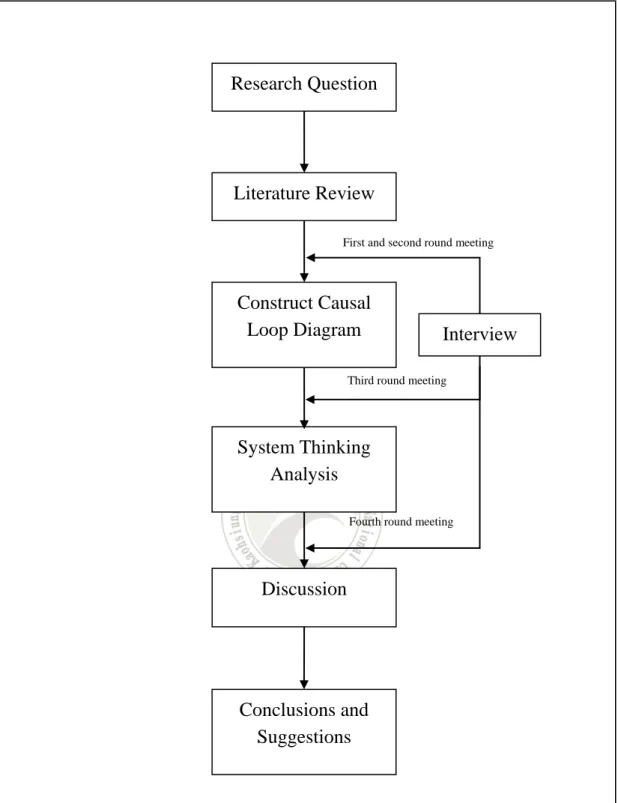
After the purposes of this study were determined, we collected and sort out the influencing factors and related customer value construction of C2C e-Commerce, and collect the existing problems by unstructured interviewing. This study built a causal loop diagram with system thinking, and gave suggestions as the conclusions of this study after group thinking. This study also tried to understand whether institution-based trust mechanism can solve the existing problems of C2C e-Commerce ecosystem in Taiwan. The research process is shown in Figure 1-1.
Figure 1-1: The Flow Chart of This Research Research Question Literature Review Construct Causal Loop Diagram System Thinking Analysis Discussion Conclusions and Suggestions Interview
First and second round meeting
Third round meeting
7
Chapter Two Literature Review
2.1 Introduction of E-commerce In Taiwan
Laudon and Laudon (2003) identify three major electronic commerce categories: business-to-consumer (B2C), business-to-business (B2B), and customer-to-customer (C2C). In general, the type of e-commerce business for consumers can be broadly divided into B2C (Business to Customer), B2B2C (Business to Business to Customer), and C2C (Customer to Customer). B2B e-Commerce is the sale of goods and services among businesses on the internet. In most cases, the total amount of B2B (business-to-business) transactions is much higher than the B2C trading volume. The main reason is that in a typical supply chain, there will be many B2B transactions involving subcomponents or raw materials, only one B2C transaction, especially the finished product sold to the end customer.
B2C commerce refers to the retailing of products or services from businesses to individual shoppers, and such a single store may be selling their own brand of goods (e.g. Lativ, or the general set up their own official website), or there are different suppliers to provide goods, but unified by the site into the goods, sales, as well as the reception of consumers.
B2B2C is provided by platform for shops to open stores on it, there is a consistent shelf published pages, the site may be responsible for part of the money flow, but usually shop business must bear more responsibility than B2C suppliers, such as self-shipping delivery, setting up storage resources by
themselves, as well as self-care consumer return procedures.
But B2C and B2B2C these two shopping sites for consumers in terms of more and more difficult to distinguish, because it is not clearly marked on the site front page that the responsibility is taken by the site or by the store sometimes. The more likely way to distinguish is the receipt of the goods if there is a consistent mark of the site logo, and opens a unified invoice by the name of the site.
In C2C e-Commerce, consumers sell goods and services to other consumers online. The responsibility of the site side is smaller, and the auction site of the past is usually identified as the standard C2C website. In general, the C2C website provides the seller with the least restrictions and the lowest charge (usually based on the number of published items rather than the monthly rental fee). But in the case of e-commerce entry threshold is low, even the auction site is also a lot of business is actually a store rather than individual sellers stationed, depending on the auction site for another publicity and sales of the pipeline. Similar to the B2B2C site is that the three major auction sites in Taiwan are also beginning to provide financial assistance.
On the C2C website, if it is a personal seller, or intended to avoid the tax of the store, will not open an invoice to the consumer, when the consumer dispute occurs, the site for the seller's binding is also small, usually suspended or off, and it is difficult to really mediate or compensate the loss of consumers. The above types of e-commerce sites for consumers, there is a certain degree of protection, even the auction site, in the normal
9
completion of the transaction process records, if the site to appeal, it is possible to obtain part of the insurance the amount of money, such as Yahoo bid providing up to 50,000 NT dollar in compensation amount. But with the rise of social networking sites, some sellers began to market through the community platform, has become one of the types of C2C e-commerce. For the seller, the community platform is usually completely free, published goods on the platform is almost zero cost, and also promote the promotional effect to members / fans, but the community platform is not a formal trading platform, and it is almost no guarantee for consumers that shopping transactions through the community platform, so it is more appropriate to take community platform as a marketing and publicity approach.
In addition to some of the above e-commerce is also known as O2O (Online to offline), more and more consumers experience services in the real world environment (offline) through booking/searching products online. Take Group-Buying site (such as GOMAJI, 17Life, etc.) as an example, consumers buy tickets or coupons through the site, and then go to the physical store to exchange goods or services. Some stores through the C2C platform as an advertising medium to attract customers visiting the store for consumption. Another kind of O2O business is dominated by business, assorting with the consumer's smart phone, and Local Based Service (referred to as LBS) instant push. Business uses the platform or self-developed APP for providing consumers download and using, businesses can take the initiative to send promotional messages to consumers, to attract consumers to the store to consume.
In addition to the above sales channels, with the wisdom of mobile phones and mobile devices, people can surf the internet anytime and anyplace, and they do not need to connect to the internet through a personal computer to enter the e-commerce site. The mode of using mobile APP to sell physical goods is also more popular, some large shopping platform through the erection of APP, so that suppliers or shopkeepers use their APP to face mobile business consumers selling goods, or some overseas C2C platform (such as: Shopee1 auction, Carousell2 auction, etc.) in the choice to
enter the Taiwan market, decided to give up the general computer version of the interface, directly to the mobile APP mode to attract consumers to use. In the case of cash flow, the use of cross-business or third-party payment tools, combined logistics with convenience stores KIOSK3 machines (such as
Seven-Eleven’s ibon), so that the seller can go to the convenience store and delivery goods via convenience store logistics delivery. Buyers and sellers can simply use the APP interface to complete the transaction, which led the innovative trading model to e-commerce.
2.1.1 C2C Platform in Taiwan
Since the 1995 Book.com which is an online bookstore opened, e-commerce has been developed for 20 years. Experienced the internet bubble in 2000, to later C2C auction, large-scale B2C business platform, B2B2C third-party electricity market platform of the channeling, and now
1 Shopee auction is an online transaction app which were developed by SHOPEE SINGAPORE
PRIVATE LIMITED for both buyers and sellers. It has become third largest C2C e-commerce platform in Taiwan.
2 Carousell which is headquartered in Singapore is a mobile and online C2C marketplace for buying and
selling new and secondhand goods, as the fourth in the market share rank in Taiwan.
11
going westward to China, South to Southeast Asia, and from the computer side to the smart phone, such as mobile devices. E-commerce can be said to be a mode of rapid change in the industry. From being regarded as a subsidiary of the physical retail industry, to being one of the key development direction of the government now.
In the C2C platform, as a result of including individual sellers and non-fixed supply of second-hand goods sellers, since Yahoo Bid began to charge 3 NT dollar per merchandise as the exhibition fee and 3% transaction fees in September 2006, there had been a wave of tide, and Ruten began to charge 1.5% transaction fees in November 2009 without goods slotting fee. Profitable retailers are more likely to sell and deal with the transaction fee than the individual seller who sells second-hand goods occasionally. This makes Taiwan's auction platform system into a sales trend.
In terms of operating costs, C2C platform entry threshold is low compared with B2C and B2B2C platform, which explains why retailers prefer to choose this platform. More and more consumers are no longer dependent on personal computers, and the use of intelligent mobile devices for web browsing, C2C platforms are focusing on smart phones personal end-to-end service, such as Shopee auction and Carousell auction C2C e-commerce are selected to APP business market, and KKBox4 launched
KKtown5 also joined the war.
4 KKBOX is a music streaming service established by Taiwanese Software Company in 2004, and it has
become the first large-scale music platform in Taiwan.
5 KKTOWN is a free online C2C marketplace for buying and selling which focus on secondhand goods,
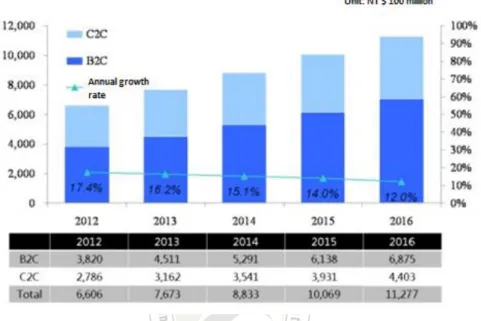
According to a China Times report, the output value of the e-commerce market in Taiwan in 2016 is about 1 trillion 1,277 billion NTD, of which B2C (enterprise-to-consumer) e-commerce market is 6,875 billion NTD; C2C (consumer-to-consumer) is $ 440.3 billion NTD.
Figure 2-1: Output value of the e-commerce market in Taiwan in 2016 Source: China Times March 3, 2015, from:
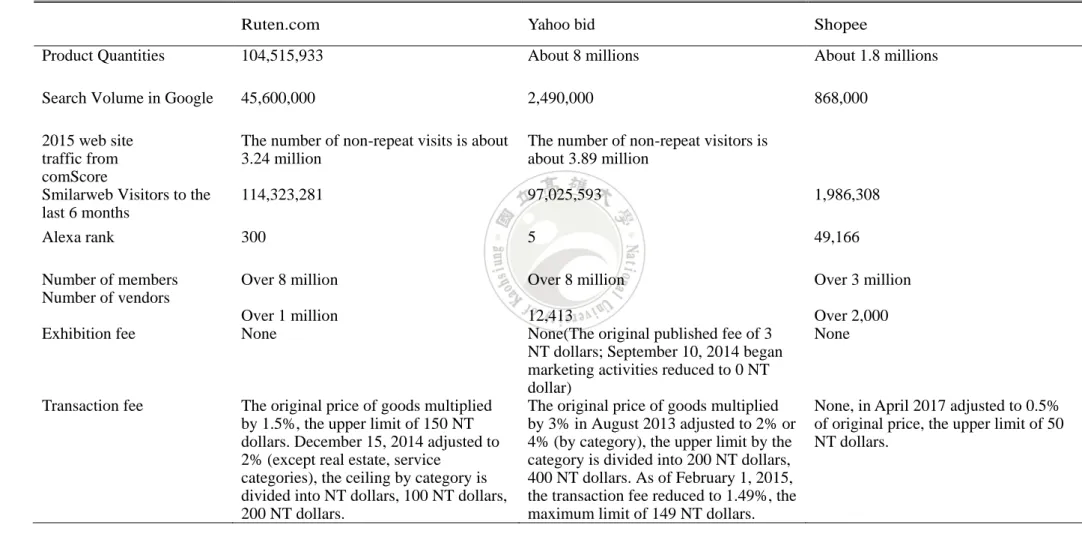
http://www.chinatimes.com/newspapers/20150303000216-260210 From our research, there are 8 main C2C e-commerce platforms in Taiwan, and Shopee auction is the third one. Shopee launched in Taiwan in October 2015, and used “free” transaction to attract buyers and sellers. At early stage, sellers are free to slot and no transaction fee required, however it began to charge 0.5% transaction free and 1.5% Credit card transaction fee since from April 17 2017. This kind of business model instantly attracted lots of users/consumers in one year, it also lead to a highly competition among C2C platforms, and getting more and more white-hot. Here we listed three major C2C e-commerce platforms in Taiwan to compare their charging content, features and GMV, refer to Table 2-1.
13
TABLE 2-1: Features of three major C2C e-commerce platforms in Taiwan
Ruten.com Yahoo bid Shopee
Product Quantities 104,515,933 About 8 millions About 1.8 millions
Search Volume in Google 45,600,000 2,490,000 868,000
2015 web site traffic from comScore
The number of non-repeat visits is about 3.24 million
The number of non-repeat visitors is about 3.89 million
Smilarweb Visitors to the last 6 months 114,323,281 97,025,593 1,986,308 Alexa rank 300 5 49,166 Number of members Number of vendors Over 8 million Over 1 million Over 8 million 12,413 Over 3 million Over 2,000
Exhibition fee None None(The original published fee of 3
NT dollars; September 10, 2014 began marketing activities reduced to 0 NT dollar)
None
Transaction fee The original price of goods multiplied
by 1.5%, the upper limit of 150 NT dollars. December 15, 2014 adjusted to 2% (except real estate, service
categories), the ceiling by category is divided into NT dollars, 100 NT dollars, 200 NT dollars.
The original price of goods multiplied by 3% in August 2013 adjusted to 2% or 4% (by category), the upper limit by the category is divided into 200 NT dollars, 400 NT dollars. As of February 1, 2015, the transaction fee reduced to 1.49%, the maximum limit of 149 NT dollars.
None, in April 2017 adjusted to 0.5% of original price, the upper limit of 50 NT dollars.
Features Since 2016, buyers have to apply for compensation to Ruten in accordance with the buyer protection program, and if the buyer didn’t paid by store pick-up within 7 days, the shipping fee is absorbed by the Ruten.
2016 CTBC Bank Co., Ltd. and Yahoo alliance, launched Yahoo bid third-party payment and protect the interests of buyers and sellers by the real name system
User account connected to community platform, attracting users with the freight subsidy policy. Only cash on delivery.
GMV of 2015 143.9 billion 122 billion 30 billion
15
From the research of 2016 E-commerce cloud innovation application and basic environment construction plan, we could find that buyers prefer to delivery home and pay online, thus a trustworthy platform system is very important.
Figure 2-2: Buyers favorite way of logistics
Source: Ministry of Economic Affairs, R.O.C (2017), from http://www.tieataiwan.org
2.1.2 Ecosystem of C2C e-Commerce in Taiwan
Commercial ecosystems refer to the concept of ecosystems in ecology. Tansley (1935) first proposed the concept of ecosystems, emphasizing that living organisms and physical environment (physical environment) are indivisible, that the two should be regarded as a whole (Tansley, 1935). The "business ecosystem" invokes this holistic view, with the overall "system" as the unit of analysis.
Moore (1993) first proposed the term "business ecosystem" and suggested replacing the concept of "industry" with "commercial ecosystems" because many of today's economic activities are not carried out in a single industry, but across industries. The Moore (1993) refers to a wide range of "business ecosystems" that encompass enterprises, customers, suppliers, major producers, competitors, and other stakeholders. Moore (1993) also proposed the concept of a business ecosystem life cycle, dividing the life of a business ecosystem into four stages: (1) birth; (2) expansion; (3) leadership; (4) self-renewal or death. At every stage, companies have different competitions and challenges in cooperation, and should take different management actions (Moore, 1993). Moore (1996) will be the previous article to be expanded, with a similar structure, based on the business ecosystem life cycle of the four stages, respectively, to manufacturers of different proposals. Gossain and Kandiah (1998) then quotes the concept of Moore (1993, 1996) business ecosystem to emphasize the important role that Internet plays in today's information economy. The authors argue that there is a significant increase in the connectivity between organizations in the context of the Internet after the rise of the Internet, so companies should make good use of new web technologies to work with partners and suppliers to build new business ecologies System to provide new information, products, and services to create new value for customers.
By 2004, Iansiti and Levien (2004) also used the analogy of biological ecosystems to describe the commercial ecosystem. They argue that business ecosystems are similar to biological ecosystems and are characterized by a large number of loosely connected participants, and that all participants in
17
the system are destined for each other. Therefore, the overall health of the business ecosystem is extremely important. A healthy system can make all participants multiply; but if the system crashes, all the participants will suffer. The "business ecosystem" described by Iansiti and Levien (2004) mainly refers to "a group of enterprises that link together and create value and share value", which is slightly narrower than that defined by Moore (1993). Follow-up researchers use the definition of Iansiti and Levien (2004).
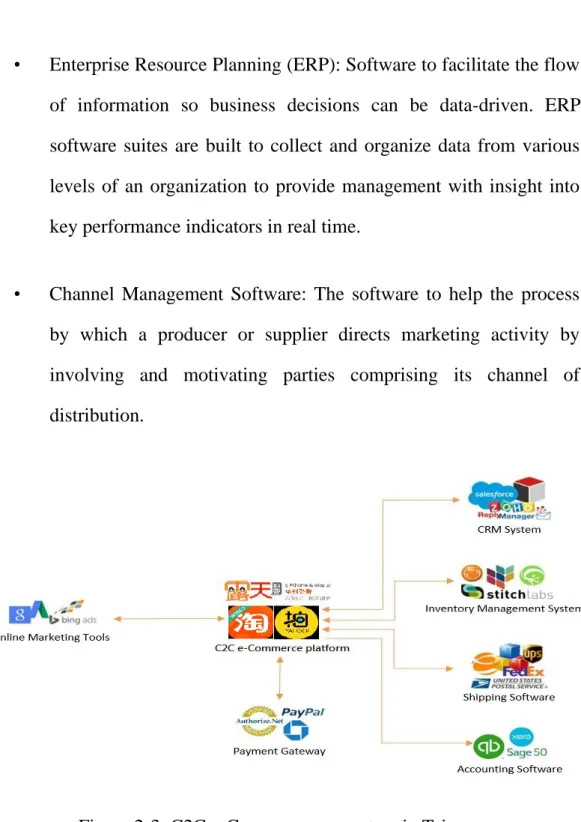
By definition, an ecosystem is a community of living organisms (plants, animals and microbes) in conjunction with the nonliving components of their environment (things like air, water and mineral soil), interacting as a system. Therefore, a C2C e-Commerce ecosystem is the complex network or interconnected systems that make up a C2C e-Commerce business. Typically, a C2C e-commerce ecosystem in Taiwan consists of the following components, see Figure 2-3:
• C2C e-Commerce Platform: A complete online store application that includes navigation, search, user accounts, shopping cart, and ordering capabilities. The term platform refers to the complete software needed to run a site. C2C platforms in Taiwan are often used as both marketplace and platform.
• Online Marketing Tools: The techniques and materials used by those who are involved in the promotion of goods and services. Most business that need to sell their goods or services to the public will make extensive use of various marketing tools, such as market research and advertising to help further their success.
• Payment Gateway: The payment gateway is a commercial service provided by an e-commerce application service provider, which is authorized to use credit cards or direct payment processing for e-commerce, online retailers, bricks and click or traditional entities. The payment gateway can be provided by the bank, or it can be provided by a dedicated financial service provider, such as PayPal.
• Accounting Software: Accounting software is a type of computer software used by accounting professionals to manage accounts and perform accounting operations.
• Shipping Software: A software for sellers to complete the logistics.
• Inventory Management System (IMS): A software for activities employed in maintaining the optimum number or amount of each inventory item.
• Customer Relationship Management (CRM): Software consolidates customer information and documents into a single CRM database so business users can more easily access and manage it. The other main functions of this software include recording various customer interactions (over email, phone calls, social media or other channels, depending on system capabilities), automating various workflow processes such as tasks, calendars and alerts, and giving managers the ability to track performance and productivity based on information logged within the system.
19
• Enterprise Resource Planning (ERP): Software to facilitate the flow of information so business decisions can be data-driven. ERP software suites are built to collect and organize data from various levels of an organization to provide management with insight into key performance indicators in real time.
• Channel Management Software: The software to help the process by which a producer or supplier directs marketing activity by involving and motivating parties comprising its channel of distribution.
Figure 2-3: C2C e-Commerce ecosystem in Taiwan
Source: Ecomsultant website, Retrieved April 3, 2017, from http://ecomsultant.com
2.1.3 Boundary Selection
In order to better understand the factors that affect the profitability of C2C e-commerce platform, we have discussed C2C e-commerce ecosystem.
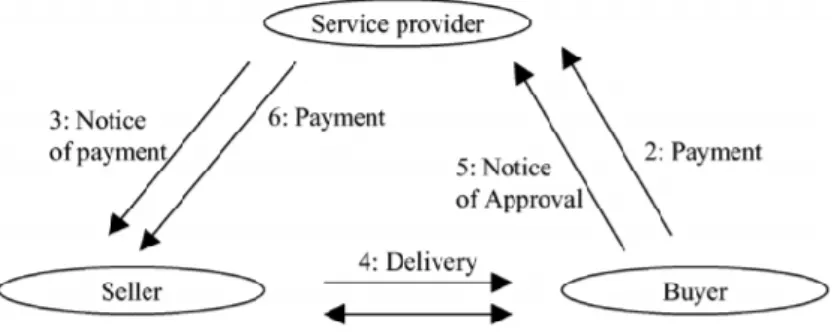
And Figure 2-4 shows the main activities in C2C e-commerce. We could find out that the most important activity to the profit of a C2C platform is “customers make decision to deal”. We will discuss the relevant theory below.
Figure 2-4: main activities in C2C e-commerce
Source: CareerRide website, retrieved April 15, 2017, from: http://www.careerride.com/page/em-commerce-for-computer-science-and-m
ca-students-668.aspx
In the real world, there are many factors that will affect the results. But most of the factors only have minor effects. Therefore, it is important to find the key factors to construct a causal loop diagram. To build the causal loop diagram, the key factors must be identified and the boundary must be selected first.
2.1.4 The challenges of C2C Platform in Taiwan
With the dynamic growth of e‑commerce, consumer-to-consumer (C2C) platform providers are facing fierce competition. Their Web sites are easily
21
emulated, while switching costs are trivial to their members. This is a serious threat to C2C platform providers because they do not hold their own merchandise, but serve only to offer an intermediary platform for members to conduct exchanges. When a C2C platform’s members switch to another C2C platform, they will take their merchandise and their social networks with them, both of which are core competitive resources of C2C platform providers. In contrast, business-to-consumer (B2C) vendors can still rely on their products as a key competency.
Despite the continued growth of the online shopping market in Taiwan over the past few years, the most representative is that the share price of two e-commerce companies keep declining: PChome6 (Mother Company of
Ruten) and momo7, whose revenue are growing almost every month. And
according to the above, C2C growth rate decreased year by year, also means that C2C platform in Taiwan suffered a growth limit, see Figure 2-4 and Figure 2-5.
6 PChome Online Inc(http://www.pchome.com.tw/) is one of Taiwan's three major entry sites and
operates both B2C and C2C e-commerce platforms
7 momoshop (http://www.momo.com.tw), launched in May 2005, is now one of the top 2 B to C
Figure 2-5: The share price of PChome and momo in 2016 Source: smartm, from:
https://www.smartm.com.tw/article/32393632cea3
Figure 2-6: The revenue and operating profit performance of PChome in past eight seasons
Source: Smartm, from
https://www.smartm.com.tw/article/32393632cea3
Nevertheless, the impact of cross-border e-commerce is not news. There are not only Alibaba's Tmalls8, Taobao9 from China, but also more and more
8 Tmall.com is a Chinese-language website for business-to-consumer (B2C) online retail, spun off from
Taobao, operated in China by Alibaba Group.
23
platform industry or brand industry influx of Taiwan market from around the world. According to the latest survey of MIC, in Taiwan, 37% of users have cross-border online shopping experience, and whether the future will be cross-border online shopping, the percentage of willingness as high as 84%. "This means that Taiwan's cross-border online shopping behavior will become increasingly active and it is a big crisis of Taiwan’s platforms because consumer demand will be moved abroad." In such a competitive environment, how can those platforms attract customers to trade, and profit are worthy of discussion.
From the report of BUSINESS NEXT, 62% of buyers have the seller's experience at the same time, more than 50% of members in Ruten have been the sellers for more than three years; amateur sellers sold the number of goods accounted for only 15% of total station, but to create 23% of the turnover. And reported by 2016 E-commerce cloud innovation application and basic environment construction plan, 75.1% of sellers posted the same commodities in different platforms. As the rise of Shopee, the seller can get lower costs, and at a lower price to attract customers, and the platform who lost customers will not be able to earn fees.
An interesting example is the competition between Ruten10.com and
Yahoo bid11 (Taiwan) in Taiwan. When Ruten.com first launched its C2C
platform in 2006, it was a questioned company with a market share of only 9.2
Hangzhou, Zhejiang by Alibaba Group, it is one of the world’s top 10 most visited websites according to Alexa .
10 Ruten.com is an online auction joint venture by PChome Online Inc. and the U.S. –based eBay Inc.,
which has been regarded as the top C2C market place in Taiwan.
11 Yahoo! Bid is a service set up by the online search giant Yahoo! in 1998 to compete against eBay, it
percent, compared to 89.9 percent for Yahoo bid (Taiwan). Two years later, however, Ruten was able to surpass Yahoo bid (Taiwan). In 2015, Ruten announced that the 2014 annual turnover of the platform has exceeded 50 billion NT dollars, 103% growth over the 2013 year, 8 years to grow 125 times, becoming the largest GMV of the C2C platform in Taiwan. It was obvious that many former Yahoo bid (Taiwan) members had switched to Ruten. Thus, how to build and maintain members’ loyalty is an important question for C2C platform providers in the face of fierce competition. Members’ loyalty to a C2C platform provider is different from their loyalty to a B2C vendor. In B2C e‑commerce, an on-line vendor has its own brand or store name, and deal in direct economic exchanges with customers. Online consumers can identify with the brand and develop a strong, lasting bond with the brand or the store name. However, in C2C e‑commerce, the platform provider is an intermediary and offers members a trustworthy and convenient trading environment.
Another interesting thing we found in this example is that not until Yahoo bid raise the transaction fee to 4% in 2013 and cause a number of users to transfer could Ruten reach this achievement for that endless problems of Ruten security making users couldn’t be assured. What worse is that fraud cases frequently occurred in recent years, leading to many people prefer to deal with brick-and-mortar stores or choose private transactions, resulting in platforms cannot profit from transactions.
According to an Appledaily report (2016) of online fraud, scam phone calls from C2C e-Commerce site information leaked and fake auction goods were still the top three cases of fraud of Taiwan in 2016. Apple daily reported
25
in 2015 that Ruten blocked over 4000 accounts in seven days due to the account exception. And there are over 300,000 issues about the security of C2C e-commerce site on the BBS in Taiwan. Therefore, the guarantee and convenience of the trading system are important factors for customer to use the platform.
2.2 Customer Value Proposition
Since the idea of “Competitive Advantage” which was proposed by Porter (1985) has been widely recognized by academia and the business community, people have begun to seek a sustainable competitive advantage for a positive attempt and exploration. Scholars explained how enterprises should establish a competitive advantage from the value chain management, quality management, organization and process reengineering, corporate culture, layoffs and other aspects, but all these efforts are fundamental to the internal improvement of the organization, and when these efforts are not market-oriented, there products and services would not be recognized by customers, these efforts could not establish a real competitive advantage. As early as 1954, Drucker pointed out that what customers bought and consumed is not the products, but the value. Woodruff (1997) argues that firms can only retain and create loyal customers by providing more value to customers than other competitors, so that they are invincible in the competition. Because of this, customer value has become the focus of the theoretical and business circles, is regarded as a new source of competitive advantage.
consumer decision-making, we discussed consumer behavior below.
2.3 Consumer Behavior
For long, Psychologists attempt to understand the role of mental functions in individual and social behavior, while also exploring the physiological and neurological processes that underlie certain functions and behaviors.
In 1913, John Broadus Watson the psychologist in American published in Psychological Review the article “Psychology as the Behaviorist View It,” that is often called the manifesto of the behaviorist movement. Psychology as the behaviorist views it is a purely objective experimental branch of natural science. Its theoretical goal is the prediction and control of behavior (Watson, 1913). Behavioristic psychology has as its goal to be able, given the stimulus, to predict the response, or seeing the reaction to identify the stimulus that called out the reaction. And four claims have been proposed by Behaviorism: (1) The researchers of natural science is able to objectively observe and measure human’s external behavior. (2) The basis of the individual response is constituted Behavior, set the number of responses to known acts of the whole behavior. (3) Individual behavior is not innate or determined by heredity, which is affected to learning by environmental factors changing. (4) Through experimental research on animals and children, the principles of behavior can explain generally behavior of human (Watson, 1997).
27
Figure 2-7: The model of stimulus-reaction Source: Waston (1913)
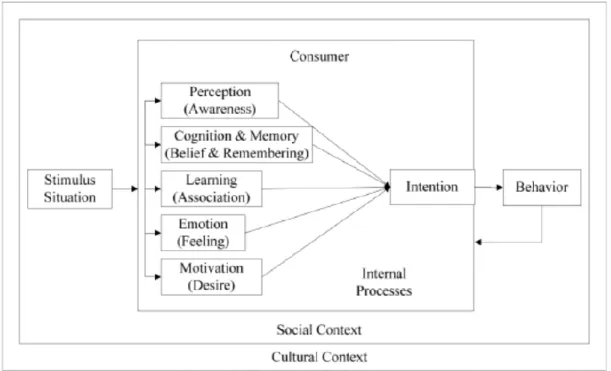
Consumer behavior official became an academic subject in 1960. It blends elements from psychology, sociology, social anthropology and economics. It attempts to understand the buyer decision making process, both individually and in groups. The model in Figure cleanly represents the variables and relationships that can affect consumer behavior (Mullen and Johnson, 1990). And it also presents the relationship with behaviorism psychology, clearly.
After the subject of consumer behavior emerged, a new subject in explaining human behavior being announced in 1994, that been named behavioral economics. Behavioral economics is the combination of psychology and economics that investigates what happens in markets in which some of the agents display human limitations and complications (Mullainathan, 2000). Those are much similarity between two subjects. In general terms, researchers view or model an individual as a collection of decision rules (rules that dictate the action to be taken in given situations) and a set of preferences used to evaluate the outcomes arising from particular situation-action combinations (Lucas Jr, 1986). What different between two subject?
The nature of consumer behavior, focusing on when, why, and where people do or do not buy products (Sandhusen, 2000). It focus on study “consumers” mental thought. Behavioral economics doesn’t be targeted any particular groups. It research generally human behavior in specific situation. It challenges the traditional economic theory assumes rational behavior. Most of people make decisions should under the condition of irrational or limited rational (Ariely, 2008; Becker, 1962).
Figure 2-8: General Model of consumer behavior Source: Mullen and Johnson (1990)
It should be concluded, from what has been said above, that people suffer the stimulus of external or internal environment, and then change people’s behavior response. Of course, the conclusion can apply in consumer’s behavior. This research takes the risk of consuming and the “promotion” as the external stimulation to discuss problems of C2C e-Commerce ecosystem.
29
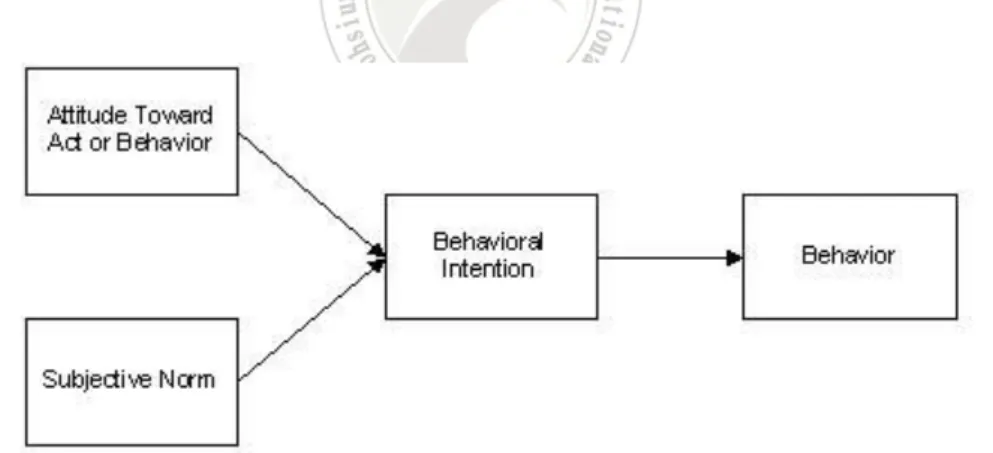
To explain customers purchase behavior, the author used the theory of reasoned action (TRA) proposed by Fishbein and Ajzen (1975) to link marketing and revenue. TRA states that, before people make some behavior, they must have some intention first (Fishbein and Ajzen, 1975). The TRA is based on the assumption that people make reasonable decisions with available information, and intent is the best immediate determinant of a person’s behavior, which is the cognitive expression of readiness to perform a given behavior (Ajzen and Fishbein 1980). Furthermore, attitude toward a particular behavior can be either positive or negative. More favorable attitudes towards a behavior should increase behavioral intent (Tipton, 2014). According to the theory, the individual’s attitude toward the behavior includes: behavioral belief, evaluations of the behavioral outcome, subjective norms, normative beliefs, and the motivation to comply (Ajzen and Fishbein, 1980).
Figure 2-9: The framework of TRA Source: Fishbein and Ajzen (1975).
The valence framework is derived primarily from the economics and psychology literature (Goodwin 1996). It has been used by game theorists (Harrington and Hess 1996) as well as marketing researchers to understand
behaviors that incorporate the simultaneous perception of risk and benefit (Peter and Tarpey 1975). Summarizing studies on consumers’ purchasing behavior, and articulating the valence framework, Peter and Tarpey (1975) noted that perceived risk and perceived benefit are fundamental aspects of consumer decision-making. On the one hand, the “perceived risk” perspective characterizes consumers as motivated to minimize, or at least reduce, any expected negative utility (perceived risk) associated with purchasing behavior. On the other hand, the “perceived benefit” perspective characterizes consumers as motivated to maximize, or at least increase, the positive utility (perceived benefit) of purchasing the product. Finally, the “perceived value” or valence framework assumes that consumers perceive products as having both positive and negative attributes, and accordingly make decisions to maximize net valence. Intuitively and conceptually, the valence framework is a superior model because it takes into account both positive and negative attributes of the decision (Peter and Tarpey, 1975).
2.3.1 Customer Perceive Value (CPV)
Zeithaml (1988) first introduced the Customer Perceived Value theory from the customer's point of view. She defines the customer perceived value as a measure of the product or service utility that the customer can perceive to gain a trade-off with the cost of acquiring a product or service. Garvin (1983) categorized quality into product quality and perceived quality. Perceived quality was defined as a customer's evaluation about the subjective advantages and disadvantages of a product or service. Whereas Monroe and Krishnan, in their research of 1985, further connected perceived quality with
31
perceived value, and came to a conclusion that as the customer perceived quality became higher, perceived value would also improve and even the consumer's repurchase intention would grow stronger. Perceived value referred to the difference between a customer's evaluation of the benefits and costs of one product during the maintenance of his relationship with the operator (Sirdeshmukn, Singh, and Sabol, 2002). The perceived value was formed when a customer took the price as the standard to measure quality and sacrifice, and judged the perceived value by comparing perceived quality and perceived sacrifice. Through extremely research, Monroe and Krishnan (1985) drew a conclusion that perceived value was among the factors that influenced a customer's purchase intention.
Consumer satisfaction is often considered a post-consumer valuation, depending on the perceived value or difference between the perceived value or the expectations, expectations and confirmations / uncertainties (if any) (Anderson, Fornell, and Lehmann, 1994). The correlation between satisfaction rating and company success is obvious (Anderson, Sullivan, 1993): As many studies have shown, satisfied customers have demonstrated considerable loyalty in products or services previously purchased from the same supplier. Repetitive purchase rate (which is its consequence) helps to ensure that the company's permanent sales base, which can be loyal customers as asset value. Another factor that has a positive impact on the success of the firm is the more obvious tendency for a customer to associate the advantages of its product (and possibly the shortcomings of the opponent's product) with other consumers (Reichheld and Sasser, 1990)
Dynamic characteristics are an important finding of customer value research, and many references refer to customer values that change over time. Slater and Narver (1994) argued that in order to continue to create good value for the buyer, the seller needs to understand the buyer's entire value chain, not only to understand what it is like, but also to understand its evolution over time. The value that customers expect from the product is not only different from the customer, but also for the same customer at different times. "Every customer only reflects one of his moments." Day and Crask (2000) found that customer value can be evaluated before use, both in use and after use, and that the customer value for each time period is different, implying that the change of CPV may occur at any point in the process. Woodruff, Flint et al. (1997) studied the dynamic characteristics of customer value and the "driving factors" of customer value changes. Parasuraman (1997) argues that customer value is a dynamic concept that emphasizes changes in the standard itself as well as the weight of the evaluation over time. He established a customer value change monitoring model, the customer is divided into the initial purchase, short-term, long-term and loss of four types, and with the deepening of the relationship between the customer’ value evaluations criteria will gradually comprehensive and abstract, and focus on results and target layers.
2.3.2 Customer Perceived Risk
Why consumers prefer to choice “shopping in the brick-and-mortar stores” rather than enjoying the convenience of online shopping? Because people have the loss aversion behavior, they afraid to make a wrong decision then cause the loss that is the risk consumers have to suffer. And consumer
33
loss aversion behavior is the powerful reason of the attractive of “shopping in the brick-and-mortar stores.” When people choice the “shopping in the brick-and-mortar stores” there is no visible possibility of loss
Over the past years a considerable number of studies have been made on risk (Deering and Jacoby, 1972; Dowling, 1986; Edwards, 1962; Kahneman and Tversky, 1979; Sinn, 1985). The concept of risk is one of the most pervasive in the theories of human choice (Dowling, 1986). Taylor (1994) attempted to construct a comprehensive and operational theory of risk taking in consumer behavior. He felt the outcome of a choice can only be known in the future, the consumer is forced to deal with uncertainty, or risk.
The remote and non-humanized nature of the online environment and the implicit uncertainty of transactions using the global open infrastructure have made risk a necessary element of e-commerce. There are two forms of uncertainty in online transactions: behavioral uncertainty and environmental uncertainty. Similarly, in the classification of Ring and Van de Ven (1994), risks are either technology-driven, thus deriving the potential infrastructure (environmental risk), or relationship caused by free trade partners (behavioral risk). Behavioral uncertainty occurs because online retailers have the opportunity to take advantage of the remote and non-personality characteristics of e-commerce in an opportunistic way, and the government is unable to adequately monitor all transactions. Examples of opportunistic behavior for E-commerce retailers include product misrepresentation, false identification, private information disclosure, misleading advertising, and warranty condemnation. Thus, behavioral uncertainty is mainly created
1. Economic risk, because of the possibility of monetary losses 2. Personal risk, because of potentially unsafe products and services 3. Seller performance risk, because of imperfect monitoring
4. Privacy risk, because of the opportunity to disclose private consumer information
5. Time risk: the time spent throughout the shopping process, especially the purchase of goods is not as expected, or need to return, adjust, repair, etc., must spend extra time, energy, often affect the shoppers for online shopping The factors of the evaluation of the mall
Environmental uncertainty is mainly due to the unpredictable nature of the Internet, which is not the overall control of online retailers or consumers. While retailers have an important impact on the security of trading media (such as encryption, authentication, firewalls), it is still possible for third parties to undermine the transaction process. Examples of environmental uncertainties include theft of credit card information, violation of private information, and theft of hackers to steal personal information. Therefore, environmental uncertainties are mainly included:
1. Economic risk, because of the opportunity for monetary losses. 2. Privacy risk, because of the possibility of theft of private information
or illegal disclosure.
Uncertainty behavior and environmental forms are usually intertwined because the behavior of e-commerce retailers has an important impact on the extent of third-party risks through encryption, firewalls and certification. In
35
the process of online transactions, consumers are faced with different types of risks are correct. However, because the risk is difficult to be regarded as objective reality, the literature mainly solves the concept of perceived risk, which is considered to be the subjective belief that consumers suffer losses in pursuit of desired results. As a result, consumers have personal beliefs about the inherent risks involved in each transaction, based on the limited information available to them. Because consumers have a certain expectation of the behavior of e-commerce retailers and the ability to protect critical information during the course of the transaction, without loss of generality, the proposed form of behavior and environmental uncertainty should be considered collectively. Even in the process of information retrieval and exchange to the product purchase process, the risk of the transaction increases, can still be regarded as the overall belief. Thus, the perceived risk associated with the online transaction process is a high-order one-dimensional construct that contains two kinds of suggested forms of uncertainty.
Consumer trading intentions depend on the beliefs of e-commerce retailers determined by behavior and environmental factors. Given the uncertainty of e-commerce, it is expected that perceived risk will reduce the intention of consumers to use the Internet site for trading. For example, consumers are less likely to conduct online transactions with e-commerce retailers that are considered opportunistic. Likewise, it is feared that e-commerce retailers do not take adequate steps to reduce infrastructure risk and have a negative impact on transaction intent. The relationship between perceived risk and transaction intention can be explained by the concept of perceived behavioral control described in the planning behavior theory. As the
attitude usually leads to action, it is expected that perceived risk reduction will affect the willingness to trade. In fact, Jarvenpaa (1999) and others suggested that reducing the risk associated with the purchase of Internet stores would increase the likelihood that consumers would buy from them. Perceived risk has been shown to have a negative impact on the intentions of e-commerce retailers. The perceived risk associated with online transactions may reduce the perception of behavior and environmental control, which may have a negative impact on the intent of the transaction. However, if consumers are mitigating the risk perception of behavior and environmental uncertainty, then consumers are likely to trade online and thus control their online transactions. Reasonable behavior theory predicts that if the consumer's risk awareness is low, consumers are willing to trade. Consumer intentions to transact are negatively related to perceived risk.
2.3.3 Marketing hype and hype cycles
Wind and Mahajan (1987), argue that the "marketing hype" process is a series of pre-launched activities that create a supportive market environment. This can lead to a broader strategy that focuses on key stakeholders as the subject of new product research and the objectives of introductory marketing programs. This will give a better understanding of the system impact on the adoption of new platforms and increase the chances of success for new platforms. However, in addition to the costs associated with it, there are some possible pitfalls to create marketing speculation plans, such as unexpected consequences, increased expectations and legal consequences. Given the possible pitfalls and costs of creating the necessary hype, the management
37
must carefully weigh and decide whether to design and implement such a plan, the size and nature of the program.
Promotional activities are helpful in short-term sales, but consumers may resume their original spending habits, and reduce the purchase of the original promotional products term after promotional activities stop in the long (Hartley and Cross, 1988). When the promotional activities of the discount are not so much,, consumers may increase their choice of products for perceived savings. If the discount is heavy, consumers will take promotional activities as a signal of negative quality, and they will reduce the choice of the product (Moore and Olshavskv, 1989). While suppliers may be tempted to hype up the marketing strategy to obtain additional sales in the short term, those customers persuaded by “hype” are often dissatisfied with their experiences, and that is negative for word-of-mouth in the long term
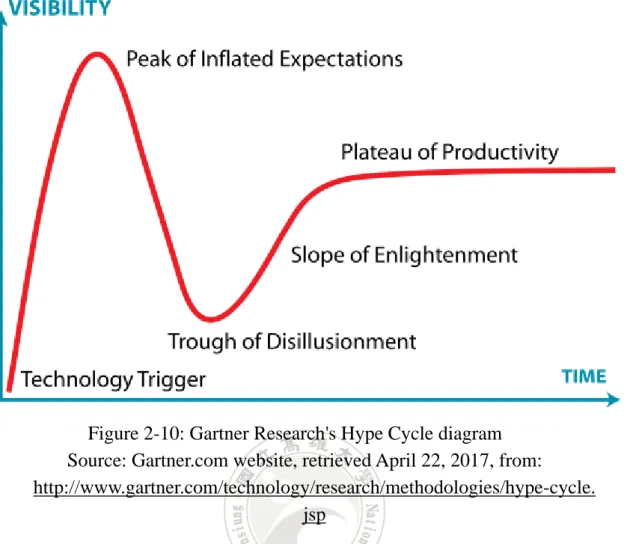
The hype cycle is a graphical representation of the maturity of a particular technology, adoption and business application. Since 1995, Gartner has used a hype cycle to characterize the excessive enthusiasm or "hype" and subsequent disappointment that are usually introduced when introducing new technologies. The speculation cycle also shows that if technology goes beyond speculation, it will provide practical benefits and be widely accepted.
Figure 2-10: Gartner Research's Hype Cycle diagram Source: Gartner.com website, retrieved April 22, 2017, from: http://www.gartner.com/technology/research/methodologies/hype-cycle.
jsp
From this theory, we can learn that, promotions and other hype marketing can promote the consumers’ purchase intention in the short term, but it may also improve consumer expectations, and it is not conducive to satisfaction in long-term.
2.3.4 Remarks
From this section has been said above, that “Promotion” is one of the benefit that strong stimulus both in “shopping in brick-and-mortar stores” or “shopping online” for customer. Therefore, it can reasonable to conclude “Promotion” has its formidable attraction regarding the consumer, and may
39
cause the consumer to make the response. It also explains why “Promotion” can always be the strategy for C2C e-Commerce platform to attract customers.
However, promotional activities cannot be maintained forever, whether C2C e-commerce platform can continue to retain the customer is still a test, and other perceived benefits and perceived risks can also influence consumer decision-making.
In order to better understand the relationship between them, this study use system thinking to construct a complete architecture of consumer behavior in ecommerce, and in the next chapter defines what consumer really care about by the interviews.
2.4 Institution-based Trust Enabled Mechanism
Trust is a major issue that baffles C2C development as more than half of the offline-only consumers do not purchase online because of their distrust of the digital channel (the website of Analysys, 2008). Some C2C sellers post fake product pictures taken from magazines or other websites and send buyers inferior knockoff products. An informal survey by Sina.com revealed that more than 70% of the respondents had bought fake products online and worried about making purchases on C2C websites in the future (the website of Sina, 2009).
In e-commerce, trust has been long recognized as a critical success factor, and much research has been conducted on trust (Gefen and Straub 2004;Kim and Benbasat, 2003; Lee and Turban, 2001). Trust is ‘‘the willingness of a
party to be vulnerable to the actions of another party based on the expectation that the other will perform a particular action important to the trustor, irrespective of the ability to monitor or control that other party” (Mayer, Schoorman, and Davis 1995). Researchers have also agreed that trust is multidimensional, and the most cited three dimensions of trust are ability, integrity, and benevolence (Gefen and Straub, 2004). Ability is the skills or competencies that allow a trustee to be perceived competent in a specific area. Integrity is the expectation that the trustee will act in accordance with social norms or principles that the trustor accepts. Benevolence is that the trustee will care about and be kind to the trustor. This study aggregates a number of scholars on the definition of trust as Table 2-2.
TABLE 2-2: Definition of trust
Scholar Year Definition
Zucker 1986 Trust is an important product of maintaining social
cooperation and a necessary basis for routine interaction in daily life.
Anderson and Narus 1990 Trust can save costs and create customer value to
improve satisfaction.
Carnevale and Wechsler 1992 Have confidence in the conduct or intention of an
individual or group, and it is expected that the other party will be ethical and account for fair and good behavior
Moorman et al 1993 Confidence in trading partners and the willingness to
rely on exchange partners.
Morgan and Hunt 1994 Honest and reliable faith in exchange partners.
Hosmer 1995 A group in the expected performance of each other will
be based on their own interests, regardless of whether the supervision or control of each other's behavior, willing to bear the risk of injury.
Doney and Cannon 1997 Trustworthiness and Credibility that a truster feel to
trustees.
41
positive expectation of the intention or behavior of others.
McLain and Hackman 1999 In the case of a specific party, he is willing and willing
to act in the best interests of the trust.
Gefen 2000 Individuals based on past interaction with others, the
future of others will be consistent with their preferences and expectations of holding the confidence.
Nicholson et al 2001 Trust has confidence in the dependence and honesty of
others.
Sirdeshmukh et al 2002 The customer's hold of the service provider is
dependent and can depend on the expectation of delivering its promise.
Rauyruen and Miller 2007 That there are two levels of trust, one is the customer
believes that the organization of a sales staff, and second, customers believe that the whole organization.
Amblee and Bui 2011 Consumers who have a positive relationship with an
online vendor tend to develop a perception
of high switching costs, which may lead to the formation of long-term commitment and loyalty to the online vendor.
Wang, Wang and Liu 2016 Trust is an inseparable critical factor for the forming
and maintaining business relationships between exchange parties.
Source: Wang, Wang and Liu (2016)
The perceived benefit in this study refers to the subjective perception of the potential positive value of a consumer's online transaction to a C2C platform. The relationship between trust and benefit is a subject of research on business relationships and organizational trust. Research and evidence show that there is a positive relationship between trust and various benefits. For example, trust can lead to higher productivity and profitability (Doney and Cannon, 1997;Morgan and Hunt, 1994), reduced transaction costs within the organization, spontaneous sociality, and appropriate respect for the organization (Kramer, 1999) related to trading partners (Ratnasingham, 2002).