Diode-pumped passively mode-locked multiwatt
Nd:GdVO
4
laser with a saturable Bragg reflector
Jing-Liang He, Chao-Kuei Lee, Jung Y. John Huang, Shing-Chung Wang, Ci-Ling Pan, and Kai-Feng Huang
We report a first demonstration, to our knowledge, of a cw passively mode-locked Nd:GdVO4laser共 ⫽ 1063 nm兲. A relaxed saturable Bragg reflector was used. The laser generates pulses of 9.2 ps at a repetition rate of 119 MHz. As much as 5.4 W of average power was realized with a slope efficiency of 25.7%. © 2003 Optical Society of America
OCIS codes: 140.3530, 140.3580, 140.4050, 140.7090, 160.6000.
1. Introduction
Compact diode-pumped mode-locked solid-state la-sers with high average power and good beam quality are essential for a wide variety of fundamental and industrial applications.1–3 For high-peak-power
ap-plications, passively mode-locked lasers are generally more desirable than active ones because of their sim-pler cavity setup and shorter pulse width. Owing to the successful development of semiconductor satura-ble absorber mirrors共SESAMs兲4and saturable Bragg
reflectors共SBRs兲,5,6 self-starting passive mode
lock-ing of a variety of diode-pumped solid-state lasers have been demonstrated.7 The advantages of these
semiconductor-based saturable absorbers are their low saturation energies, their compact design, and the possibility of engineering the absorber for partic-ular laser systems, e.g., dispersion compensation.8
Pulses as short as 2 cycles have been generated from a Ti:sapphire laser with a SESAM.9 Saturation
flu-ence as low as ⬍10 J兾cm2 was realized in a SBR with triple-strained quantum wells,7making this
de-vice particularly attractive for low-energy diode-pumped solid-state lasers. In the picosecond regime, various lasers with neodymium-共Nd-兲 doped
laser crystals, e.g. Nd:YAG,10 Nd:YVO
4,11,12 Nd:
YLF,13and Nd:KGd共WO
4兲214have been mode locked
successfully by use of either SESAMs or SBRs. Re-cently gadolinium vanadate doped with Nd, or Nd: GdVO4, has been recognized as a promising laser medium.15,16 Nd:GdVO
4, is similar to Nd:YVO4 in
many aspects, such as belonging to the same space group and having a higher absorption coefficient for diode pumping and a larger emission cross section 共seven-times-higher absorption cross section at 808 nm and a three-times-larger emission cross section at 1.06 m than does Nd:YAG兲.17,18 On the other
hand, Nd:GdVO4 exhibits some desirable features over Nd:YVO4, such as a wider bandwidth 共1.3 nm versus 0.8 nm兲 and much higher thermal conductiv-ity along the ⬍110⬎ direction.18 Furthermore the
specific heat of Nd:GdVO4is larger than that of Nd: YVO4. Because the specific heat is an important factor that influences the damage threshold of a laser crystal, Nd:GdVO4might be a promising alternative
to Nd:YVO4 in high-power pulsed laser systems.
Both continuous-wave 共cw兲 and Q-switched diode-pumped Nd:GdVO4 lasers have been reported.19,20
Wang et al. have compared the performances of diode-pumped Nd:GdVO4 and Nd:YVO4 lasers.20
The cw Nd:GdVO4 lasers at 1.06 and 1.34 m and
intracavity frequency-doubled Nd:GdVO4lasers with
KTP and LiB3O5outperform the Nd:YVO4 lasers in
terms of either slope efficiency or optical conversion efficiency.11,15 Further, the wider bandwidth of Nd:
GdVO4 promises subpicosecond pulses in
mode-locked operation. In this paper we report what is to our knowledge the first cw diode-pumped passively mode-locked Nd:GdVO4laser with a SBR. We
suc-cessfully generated a 9.2-ps pulse train at 119 MHz.
J.-L. He, C.-K. Lee共[email protected]兲, J. Y. Huang, S.-C. Wang, and C.-L. Pan are with the Institute of Electro-Optical Engineering, National Chiao Tung University, Hsinchu 30010, Taiwan. When the research was performed, J.-L. He was on leave from the Department of Physics, Nanjing University, Nanjing, China. K.-F. Huang is with Department of Electro-Physics, Na-tional Chiao Tung University, Hsinchu, 30010, Taiwan.
Received 28 January 2003, revised manuscript received 29 May 2003.
0003-6935兾03兾275496-04$15.00兾0 © 2003 Optical Society of America
The laser output power was 5.4 W with a slope effi-ciency of 25.7%.
2. Experimental Setup
A schematic of the laser configuration is shown in Fig. 1. The diode-laser pump source共Coherent FAP-81-25c-800-B兲 is rated at a maximum power of 25 W into a bandwidth of 3 nm共FWHM兲 around p ⫽ 808 nm at 25 °C. A fiber bundle with a diameter of 0.8 mm and a numerical aperture of 0.2 and coupling optics were used to focus the pump beam into the laser crystal. The spot size of the pump beam on the laser crystal facet was approximately 640m. The
a-cut 3 mm ⫻ 3 mm ⫻ 4 mm Nd:GdVO4 crystal,
doped at 1.3%, was coated for high reflection共HR, R䡠 99.8%兲 at 1063 nm and antireflection at 808 nm on the end face perpendicular to the laser beam axis. The front surface of the crystal was antireflection coated at 1063 nm to avoid a potential etalon effect. The laser crystal was wrapped with indium foil and then mounted in a water-cooled copper block. The water temperature was maintained at 20 °C. The cavity is a simple Z-folded resonator with one highly reflective 共R ⬎ 99.8% at 1063 nm兲 mirror M1, one
partially reflective mirror M2 共R 䡠 94% at 1063 nm兲, and a SBR. The radii of curvature of M1and M2are
50 and 25 cm, respectively, and the two mirrors are separated by 88 cm; the total cavity length is approx-imately 1.2 m. The laser cavity mode is focused more tightly on the SBR than on the laser rod, with a mode diameter approximately two times smaller than one on the laser rod. The absorber saturation pulse energy was estimated to be approximately 40 J兾cm2
, which is sufficiently small relative to the gain saturation fluence to ensure fast absorption sat-uration pulse shaping. The SBR was mounted on a copper heat sink, without cooling water or tempera-ture regulation. It consisted of a distributed Bragg reflector with 35 pairs of high–low兾4 Bragg layers of GaAs兾AlAs grown by molecular beam epitaxy. An additional兾4 layer of AlAs was grown on the top of the distributed Bragg reflector mirror, and a strained quantum well 共In0.3Ga0.7As兾GaAs兲 was inserted as the saturable absorber. For matching the wave-length of the laser, the SBR was designed with the photoluminescence peak wavelength of the absorber and the high reflectivity共R ⬎ 99.5%兲 of the distrib-uted Bragg reflector, both around 1.1m. The
mod-ulation depth, nonsaturable losses, saturation fluence, and absorption recovery time of the SBR are 1.0%, 0.2%, 40 J兾cm2, and ⬃20 ps, respectively. The same SBR was previously employed successfully for passive mode locking of a diode-pumped cw Nd: YVO4solid-state laser.12
3. Results and Discussions
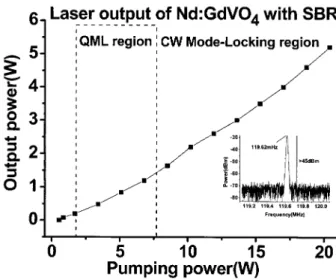
In Fig. 2 the laser output power is plotted as a func-tion of pumping power. The reported power is the sum of two output beams from the output coupler M2. No saturation in the laser power output was observed with our full diode-laser output, which clearly shows superior thermal properties of the material.19,20 We
noted that the same laser output power can also be obtained when the SBR was replaced with a high-reflective mirror. This observation indicates a low unsaturable loss of our SBR. This plot reveals that the cw threshold pumping power of the laser was as low as 540 mW. As the pumping power was in-creased to 20.4 W, the output power of the laser can reach 5.4 W with a conversion efficiency of 26.3%. Both results are essentially similar to that of a Nd: YVO4 laser mode locked by the same SBR and the
same pump power reported by Chen et al.12 Chen et al. achieved an average power of 23.5 W with
9-mm-long Nd:YVO4laser crystal pumped at 50 W. Their laser pulse width was 21 ps. Because of the higher thermal tolerance of Nd:GdVO4, we expect similar or better performance if a high-power diode laser and a longer rod length become available.
The laser also exhibits a clear regime of a
Q-switched mode-locking state at a pump power
range of 1.7 Wⱕ Ppumpⱕ 7.65 W. We employed a rf
spectrum analyzer共HP52601兲 to analyze the rf power spectrum. Relaxation oscillation at 110 kHz was ob-served in the Q-switched mode-locking region. At higher pumping power, a stable cw mode-locking state was achieved. The inset in Fig. 2 shows that the rf spectrum of the mode-locked pulse trains with
Fig. 1. Cavity configuration of the diode-pumped Nd:GdVO4 la-ser. M1and M2, mirrors; HR, high reflection; PR, partially reflec-tive.
Fig. 2. Dependence of the laser output power on absorbed pump power; inset shows the rf spectrum of the cw mode-locking opera-tion. QML, Q-switched mode locking.
a repetition rate of around 119.6 MHz. A side-mode suppression as large as⫺45 dBm was achieved, in-dicating a fairly stable cw mode-locking operation of our laser.
According to Refs. 21 and 22, the minimum intra-cavity pulse fluence FP,c for stable cw mode locking can be obtained by
F ⬎ FP,c⫽ 共Fsat,LFsat, AR兲1兾2, (1)
where Fsat,L⫽ h兾m denotes the saturation fluence of the gain medium with a lasing frequency, is the stimulated emission cross section, and m⫽ 2 is used to reflect an average over the standing wave in a linear cavity; Fsat,Adenotes the saturation fluence of the saturable absorber with a modulation depth of R. For Nd:GdVO4, the gain saturation fluence is esti-mated to be Fsat,L⫽ 0.375 J兾cm
2
. The spot size on the saturable absorber was⬃120 m, the saturation fluence of the absorber is then found to be Fsat,A⬃ 40 J兾cm2, and the modulation depth of the saturable
absorber is ⬃1%. Therefore the estimated mini-mum intracavity pulse energy for stable cw mode locking is E⬇ 12 nJ. At a pump power of 8 W, we estimate that E⬃ 100 nJ, which can be increased to 300 nJ when the pump power is higher than 19 W in our setup. Inequality 共1兲 is therefore well fulfilled. The transition from Q-switched mode locking to sta-ble cw mode locking is typical for passively mode-locked solid-state lasers. A similar trend was also observed by Chen’s group.12
The output pulses were further characterized with an autocorrelator by use of KTP as the frequency-doubling crystal. The FWHM of the au-tocorrelation trace 关see Fig. 3共a兲兴 was measured to be 12.9 ps. Assuming a hyperbolic secant pulse profile, we estimate the pulse duration to be approx-imately 9.2 ps. The measured optical spectrum of the mode-locking laser is presented in Fig. 3共b兲. The spectrum is centered at 1062.7 nm with a FWHM bandwidth of 0.51 nm with a slight asym-metric spectral distribution. The spectral feature also shows longitudinal mode spacing with an ef-fective optical length of 0.86 cm 关see inset of Fig. 3共b兲兴. By considering the index of refraction of the GdVO4crystal, we found the resulting geometrical
length of 4 mm to be fairly close to the laser crystal length. This indicates that the etalon effect from the two end surfaces of the crystal is not completely eliminated. It has been known that an intracavity etalon effect plays a significant role in the mode-locking pulse-shaping process and could lead to a asymmetric spectral profile. The resulting time– bandwidth product of the laser pulses is 1.24, indi-cating the presence of strong phase-modulation effects. Because the only transmissive element in our laser cavity is the gain medium, we therefore attribute the resulting non-transform-limited time– bandwidth product to originate from the dis-persive effect of the laser rod. When compared with the result of 21-ps pulse duration from a 9-mm-long Nd:YVO4 gain rod,12 the shorter pulse
width of 9.2 ps obtained in this study is a factor of 2.3 lower, which agrees well with the fact of a lower dispersion with a shorter rod length. With intra-cavity dispersion compensation, such as the use of Gires–Tournois interferometer mirrors for disper-sion compensation,23 a transform-limited pulse
width as short as 0.9 ps should be possible if the entire gain bandwidth can be utilized.
4. Summary
In summary, we report a first demonstration of a continuous-wave passively mode-locked Nd:GdVO4
laser at ⫽ 1062.7 nm. A strain-relaxed saturable Bragg reflector was used in the laser to generate pulses of 9.2 ps at a repetition rate of 119 MHz. As much as 5.4 W of average power was realized with a slope efficiency of 25.7%. Because of the excellent thermal properties and broad bandwidth共compared
Fig. 3. 共a兲 Envelope of collinear interferometric autocorrelation trace of the mode-locked laser pulses; 共b兲 Corresponding optical spectrum of the laser; inset is the magnification of part of the spectrum, showing minor peaks due to the etalon effect.
with Nd:YVO4兲, the mode-locked Nd:GdVO4 laser could be an interesting alternative to Nd:YVO4 for
the generation of high-power picosecond-to-subpicosecond pulses and applications.
This study was supported in part by the Academic Excellence Program of the Ministry of Education and the National Science Council under various grants. References
1. S. C. Tidwell, J. F. Seamans, M. S. Bowers, and A. K. Cousins, “Scaling cw diode-end-pumped Nd:YAG lasers to high average powers,” IEEE J. Quantum Electron. 28, 997–1009共1992兲. 2. W. A. Clarkson and D. C. Hanna, “Efficient Nd:YAG laser end
pumped by a 20-W diode-laser bar,” Opt. Lett. 21, 869 – 871 共1996兲.
3. W. A. Clarkson, P. J. Hardman, and D. C. Hanna, “High-power diode-bar end-pumped Nd:YLF laser at 1.053 mm,” Opt. Lett. 23, 1363–1365共1998兲.
4. U. Keller, K. J. Weingarten, F. X. Ka¨rtner, D. Kopf, B. Braun, I. D. Jung, R. Fluck, C. Ho¨nninger, N. Matuschek, and J. Ho¨nningen Aus der Au, “Semiconductor saturable absorber mirrors共SESAM’s兲 for femtosecond to nanosecond pulse gen-eration in solid-state lasers,” IEEE J. Sel. Top. Quantum Elec-tron. 2, 435– 453共1996兲.
5. M. J. Hayduk, S. T. Johns, M. F. Krol, C. R. Pollock, and R. P. Leavitt, “Self-starting passively mode-locked tunable femto-second Cr4⫹:YAG laser using a saturable absorber mirror,” Optics Commun. 137, 55–58共1997兲.
6. S. Tsuda, W. H. Knox, S. T. Cundiff, W. Y. Jan, and J. E. Cunningham, “Mode-locking ultrafast solid-state lasers with saturable Bragg reflectors,” IEEE J. Sel. Top. Quantum Elec-tron. 2, 454 – 464共1996兲.
7. J. M. Shieh, T. C. Huang, K. F. Huang, C. L. Wang, and C. L. Pan, “Broadly tunable self-starting passively mode-locked Ti: sapphire laser with triple-strained quantum-well saturable Bragg reflector,” Optics Commun. 156, 53–57共1998兲. 8. F. X. Ka¨rtner, N. Matuschek, T. Schibli, U. Keller, H. A. Haus,
C. Heine, R. Morf, V. Scheuer, M. Tilsch, and T. Tschudi, “Design and fabrication of double-chirped mirrors,” Opt. Lett. 22, 831– 833共1997兲.
9. D. H. Sutter, G. Steinmeyer, L. Gallmann, N. Matuschek, F. Morier-Genoud, U. Keller, V. Scheuer, G. Angelow, and T. Tschudi, “Semiconductor saturable-absorber mirror–assisted Kerr-lens mode-locked Ti:sapphire laser producing pulses in the two-cycle regime,” Opt. Lett. 24, 631– 633共1999兲. 10. G. J. Spuhler, T. Sudmeyer, R. Paschotta, M. Moser, K. J.
Weingarten, and U. Keller, “Passively mode-locked high-power Nd:YAG lasers with multiple laser heads,” Appl. Phys. B 71, 19 –25共2000兲.
11. D. Burns, M. Hetterich, A. I. Ferguson, E. Bente, M. D. Daw-son, J. I. Davies, and S. W. Bland, “High-average-power 共⬎20-W兲 Nd:YVO4lasers mode locked by strain-compensated saturable Bragg reflectors,” J. Opt. Soc. Am. B 17, 919 –926 共2000兲.
12. Y. F. Chen, S. W. Tsai, Y. P. Lan, S. C. Wang, and K. F. Huang, “Diode-end-pumped passively mode-locked high-power Nd: YVO4laser with a relaxed saturable Bragg reflector,” Opt. Lett. 26, 199 –201共2001兲.
13. U. Roth and J. E. Balmer, “Neodymium:YLF lasers at 1053 nm passively mode locked with a saturable Bragg reflector,” Appl. Opt. 41, 459 – 463共2002兲.
14. A. Major, N. Langford, T. Graf, D. Burns, and A. I. Ferguson, “Diode-pumped passively mode-locked Nd:KGd共WO4兲2 laser with 1-W average output power,” Opt. Lett. 27, 1478 –1480 共2002兲.
15. H. J. Zhang, J. H. Liu, J. Y. Wang, C. Q. Wang, L. Zhu, Z. S. Shao, X. L. Meng, X. B. Hu, and M. H. Jiang, “Characterization of the laser crystal Nd:GdVO4,” J. Opt. Soc. Am. B 19, 18 –27 共2002兲.
16. H. Zhang, X. Meng, L. Zhu, J. Liu, C. Wang, and Z. Shao, “Laser properties at 1.06 m for Nd:GdVO4 single crystal pumped by a high power laser diode,” Jpn. J. Appl. Phys. Part 2 38, L1231–L1233共1999兲.
17. D. C. Brown, R. Nelson, and L. Billings, “Efficient cw end-pumped, end-cooled Nd:YVO4diode-pumped laser,” Appl. Opt. 36, 8611– 8613共1997兲.
18. C. P. Wyss, W. Lu¨ thy, H. P. Weber, V. I. Vlasov, Yu. D. Zavart-sev, P. A. Studenikin, A. I. Zagumennyi, and I. A. Shcherba-kov, “Performance of a diode-pumped 5 W Nd3⫹:GdVO4 microchip laser at 1.06m,” Appl. Phys. B 68, 659–661 共1999兲. 19. J. H. Liu, C. Q. Wang, C. L. Du, L. Zhu, H. Z. Zhang, X. L. Meng, J. Y. Wang, Z. S. Shao, and M. H. Jiang, “High-power actively Q-switched Nd:GdVO4laser end-pumped by a fiber-coupled diode-laser array,” Opt. Commun. 188, 155–162 共2001兲.
20. A. Q. Wang, Y. T. Chow, L. Reekie, W. A. Gambling, H. J. Zhang, L. Zhu, and X. L. Meng, “A comparative study of the laser performance of diode-laser-pumped Nd:GdVO4and Nd: YVO4crystals,” Appl. Phys. B 70, 769 –772共2000兲.
21. L. Krainer, R. Paschotta, J. Aus der Au, C. Ho¨nninger, U. Keller, M. Moser, D. Kopf, and K. J. Weingarten, “Passively mode-locked Nd:YVO4 laser with up to 13 GHz repetition rate,” Appl. Phys. B 69, 245–247共1999兲.
22. C. Ho¨nninger, R. Paschotta, F. Morier-Genoud, M. Moser, and U. Keller, “Q-switching stability limits of continuous-wave passive mode locking,” J. Opt. Soc. Am. B 16, 46 –56共1999兲. 23. A. Robertson, H. Fuchs, U. Ernst, R. Wallenstein, V. Scheuer,
and T. Tschudi, “Prismless femtosecond Cr:forsterite laser,” J. Opt. Soc. Am. B 17, 668 – 671共2000兲.