118 IEEE PHOTONICS TECHNOLOGY LETTERS, VOL. 22, NO. 2, JANUARY 15, 2010
40-Gb/s Time-Division-Multiplexed Passive Optical
Networks Using Downstream OOK and Upstream
OFDM Modulations
Chien-Hung Yeh, Chi-Wai Chow, and Chih-Hung Hsu
Abstract—In this investigation, we first propose and investi-gate a 40-Gb/s time-division-multiplexed passive optical network (TDM-PON) using four wavelength-multiplexed signals in both downstream and upstream traffic. Here, each downstream signal uses 10-Gb/s on–off keying (OOK) format encoded by a Mach–Zehnder modulator (MZM) in 1.5- m band. And each upstream channel utilizes the highly spectral efficient 10-Gb/s or-thogonal frequency-division-multiplexing quadrature amplitude modulation (OFDM-QAM) generated by directly modulating a 1.3- m laser. Based on the proposed scheme, 40-Gb/s data traffic in a TDM-PON can be obtained easily by using four wave-length-multiplexed channels. In addition, the performance of the proposed PON architecture has also been discussed.
Index Terms—40 Gb/s, orthogonal frequency-division multi-plexing (OFDM), on–off keying (OOK), passive optical network (PON), wavelength-division multiplexing (WDM).
I. INTRODUCTION
D
UE to the increase in demand of broadband access networks, the last mile data access should provide higher and higher data rates in a more economic way. Fiber communication systems have the benefits of huge bandwidth, high capacity, lower latency, lower power consumption, and flexible bandwidth allocation. Therefore, fiber-to-the-home (FTTH) would be the best choice for the last mile access [1]. Recently, the time-division-multiplexing passive optical networks (TDM-PONs), such as broadband PON (BPON) [2], Ethernet PON (EPON) [3] and gigabit PON (GPON) [4], were standardized and deployed by telecom carriers for access network applications. In such PONs, 1490- and 1310-nm wavelengths were serving as the downstream and upstream traffic, respectively, with a maximum data rate of 2.5 Gb/s. However, the capacities of current TDM-PONs cannot sat-isfy the bandwidth requirement for the future multiple-play services (such as voice, video, Internet, and mobile connec-tions). Thus, the current TDM-PONs need to be upgraded to 10 Gb/s or above. In addition, the 10-G EPON and 10-GManuscript received August 19, 2009; revised October 05, 2009; accepted November 07, 2009. First published November 24, 2009; current version published January 07, 2010. This work was supported by the National Science Council, Taiwan, R.O.C., under Contract NSC-98-2622-E-009-185-CC2, NSC-98-2221-E-009-017-MY3, and NSC-97-2221-E-009-038-MY3.
C.-H. Yeh and C.-H. Hsu are with the Information and Communications Research Laboratories, Industrial Technology Research Institute, Chutung, Hsinchu 31040, Taiwan (e-mail: [email protected]).
C.-W. Chow is with the Department of Photonics and Institute of Electro-Optical Engineering, National Chiao Tung University, Hsinchu 30010, Taiwan. Color versions of one or more of the figures in this letter are available online at http://ieeexplore.ieee.org.
Digital Object Identifier 10.1109/LPT.2009.2036740
GPON have also been discussed by the standardizations for the next-generation 10-G access network applications [5], [6]. To satisfy the demand of wider bandwidth and higher capacity for new generation access systems, 40-Gb/s fiber access networks have also been proposed using 2.5 Gb/s 16 channels and 1.25 Gb/s 32 channels [7], [8]. Furthermore, to enhance the effective bandwidth based on the original light source, the orthogonal frequency-division-multiplexing quadrature amplitude modulation (OFDM-QAM) was used in the PON system [9]–[13]. In addition, the frequency diversity transmis-sion of OFDM signal would permit the simple equalization of frequency response and can effectively mitigate fiber chromatic dispersion [10], [12].
In this letter, we propose and demonstrate a 40-Gb/s TDM-PON using four wavelength-multiplexed signals to achieve 40-Gb/s downstream and upstream traffics in 25-km fiber transmission without any dispersion compensation. The downstream and upstream signals are modulated by on–off keying (OOK) and OFDM-QAM at 10 Gb/s, respectively. Moreover, the system performance is also discussed.
II. EXPERIMENT ANDDISCUSSION
In the 40-Gb/s TDM-PON, a single wavelength with 40-Gb/s data rate could be used in the optical line terminal (OLT) for broadcasting downstream traffic. According to current PON standards [2]–[4], the maximum fiber transmission length was around 20 km. Although using OOK modulation format is simple and cost-effective, the transmission of the 40-Gb/s OOK signal would be limited by fiber chromatic dispersion. Due to the unavailability of the 40-Gb/s nonreturn-to-zero (NRZ) source in the laboratory, we use commercial software (VPI Transmission Maker V7.5) to numerically analyze the 40-Gb/s OOK downstream traffic in the PON. In the sim-ulation, the 40-Gb/s OOK signal is generated by encoding a continuous-wave (CW) signal (wavelength nm, average power dBm) via a Mach–Zehnder modulator (MZM). The signal is then launched to an optically pream-plified receiver (Rx) via different standard single-mode fiber (SMF) (dispersion parameter ps nm km). The optically preamplified Rx consists of an erbium-doped fiber amplifier (EDFA) (noise figure dB), a bandpass optical fiber (Gaussian shaped, dB bandwidth GHz) and a PIN photodiode. Fig. 1 shows the bit-error-rate (BER) performance at back-to-back (B2B), 5- and 10-km transmissions, respec-tively. We can observe a power penalty of 6.3 dB at the BER of in 5-km transmission due to fiber dispersion. When the transmission length extends to 10 km, the BER almost cannot be measured, as shown in Fig. 1. To overcome the dispersion
YEH et al.: 40-Gb/s TDM-PONs USING DOWNSTREAM OOK AND UPSTREAM OFDM MODULATIONS 119
Fig. 1. Numerical analysis of BER performance at 40-Gb/s NRZ modulation format under B2B, 5-, and 10-km transmissions, respectively.
Fig. 2. Experimental setup of proposed 40-Gb/s TDM-PON architecture.
effect at higher and higher data rates in the current SMF-based PON architecture, we can employ four wavelength-multiplexed channels with 10-Gb/s rate to implement the 40-Gb/s transmis-sion in the TDM-PON.
The experimental setup of the proposed 40-Gb/s TDM-PON architecture is illustrated in Fig. 2. In this system, we use 1.5- and 1.3- m bands for the downstream and upstream traffic. In the OLT, there are four distributed-feedback laser diodes (DFB-LDs) connecting to four MZMs and a four-port wavelength-multiplexed filter, as shown in Fig. 2. An EDFA, with saturated output power of 21 dBm and noise figure of 5 dB, is utilized to compensate the transmission loss. The four wavelength-multiplexed channels are 1548.02, 1549.22, 1550.42, and 1551.62 nm, respectively, with the output powers of 2.5, 2.6, 2.6, and 2.4 dBm. We use external modulation in the downstream signal; however, direct modulation can be used.
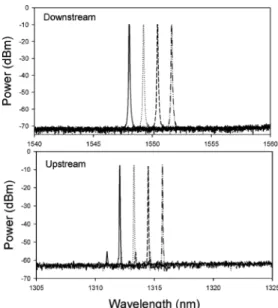
In the remote node (RN), a 1 32 optical splitter (SP) is em-ployed. In each optical networking unit (ONU), four DFB-LDs are connected to the four-port wavelength-multiplexed filter. The four DFB-LDs used are commercially available, with di-rect modulation bandwidth of up to 3 GHz. The upstream wave-lengths are 1312.08, 1313.28, 1314.48, and 1315.68 nm, respec-tively, with the output powers of 5.1, 5.0, 5.2, and 5.0 dBm. The 1.3/1.5- m wavelength-division-multiplexing (WDM) coupler (WC) is used to multiplex and demultiplex the downstream and upstream paths. The insertion loss of WC is around 3.2 dB. Fig. 3 shows the measured output optical spectra of downstream and upstream signals observing by an optical spectrum analyzer (OSA) with a 0.05-nm resolution.
Fig. 3. Output spectra of downstream and upstream signals used in the pro-posed TDM-PON system before transmitting.
Fig. 4. BER performance at 1549.22 nm with 10-Gb/s NRZ modulation format under B2B and 25-km transmission for downstream traffic, respectively. The inserts are corresponding eye diagrams.
For the downstream BER measurements, four wave-length-multiplexed channels are modulated at 10 Gb/s by the MZMs, respectively, using the NRZ pseudorandom binary sequence (PRBS) with pattern length of . Fig. 4 shows the BER performance of one of the selected wavelengths at 1549.22 nm at B2B and after 25-km SMF transmission, re-spectively. Negligible power penalty at the BER of are observed in all the four 10-Gb/s OOK channels after 25-km SMF transmission. The inserts of Fig. 4 are the corresponding eye diagrams at B2B and 25-km transmission.
For the upstream BER measurements, the 10-Gb/s OFDM-QAM signal is generated by a baseband digital signal processing (DSP) and a digital-to-analog converter (DAC), which is an arbitrary waveform generator with 50-GHz sampling rate. The incoming bit streams are packed into 128 subcarrier symbols, each subcarrier symbol is in a 16-QAM format. These subcarrier symbols are converted to a time-do-main OFDM symbol by using inverse fast Fourier transform (IFFT). Then the DAC converts the digital data to an analog
120 IEEE PHOTONICS TECHNOLOGY LETTERS, VOL. 22, NO. 2, JANUARY 15, 2010
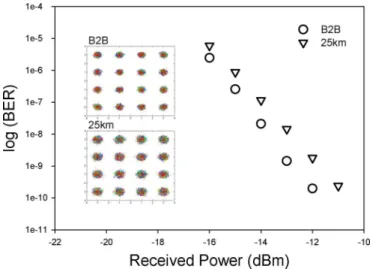
Fig. 5. BERs versus received optical power for 10-Gb/s upstream traffic of OFDM-QAM signals at B2B and after 25-km SMF transmission at the wave-length of 1313.28 nm. The insets are constellation diagrams of B2B and 25-km SMF transmission.
signal. In this experiment, the four DFB-LDs are directly modulated by the upstream OFDM signal. Here we selected the DFB-LD wavelength at 1313.28 nm with an average optical output power of 5.0 dBm for the analysis.
To analyze the upstream OFDM signal, the analog-to-digital converter (ADC), which is a real-time 50-GHz sampling os-cilloscope, converts the OFDM signal detected by the Rx to digital signals for demodulation. The demodulation is per-formed by using computer software. The synchronizer extracts the carrier phase and aligned the OFDM symbol boundaries. The time- to frequency-domain translation is performed with fast Fourier transform (FFT). A QAM decoder analyzed the symbol on each subcarrier to make the final decision. The total 10-Gb/s OFDM 16-QAM signal is very spectral efficient; it only occupies the spectrum from 100 to 2600 MHz. Hence, low-bandwidth ( 3 GHz) optical components can still be used. The BER performance is calculated from the measured error vector magnitude (EVM) [14].
Fig. 5 shows the BER curves of the 1.3- m OFDM 16-QAM signal at B2B and after 25-km transmission without dispersion compensation. Nearly 1.1-dB power penalty is observed. The higher power penalty observed in the OFDM case is due to the direct modulation of DFB-LD used. The requirement of relative larger received power than the NRZ signal is due to the unavail-able of 1.3- m optical preamplifier for the 1.3- m Rx. The mea-sured constellation diagrams of the OFDM signals are shown in insets of Fig. 5.
III. CONCLUSION
OFDM is a technique which traditionally belongs to long-haul transmissions. Due to its transmission advantages, OFDM PON has attracted much attention recently. We pro-posed and experimentally investigated a TDM-PON with 40-Gb/s data rate by using four wavelength-multiplexed chan-nels in both downstream and upstream traffic using OOK and OFDM modulations, respectively. In the experiment, the
downstream signal uses 4 10 Gb/s OOK format encoded by MZMs in the 1.5- m band. And the upstream signal utilizes the highly spectral efficient 4 10 Gb/s OFDM-QAM signal, using directly modulated 1.3- m DFB-LD with a modulation band-width of 3 GHz. Based on the proposed scheme, 40-Gb/s data traffic in TDM-PON can be obtained easily without affecting the present TDM-PON fiber infrastructure. Besides having a better chromatic dispersion tolerance than the single-channel 40-Gb/s system, the proposed ONU could be low cost since low bandwidth direct modulation lasers are used. It is also worth mentioning that the synchronization among the four channels in both OLT and ONU can be implemented in the media access control (MAC) layer protocol. For the BER measurements in the downstream and upstream traffics, negligible and 1.1-dB power penalties are observed, respectively, in the proposed PON system, showing the feasibility of the scheme. Although off-line processing is used in the experiment, the possibility of integration with forward-error correction (FEC) and the availability of the high-speed data converters ( GHz) [10] could make OFDM a practical candidate for upgrading optical access networks in the future.
REFERENCES
[1] H. Shinohara, “Overview of Japanese FTTH market and NTT’s strategies for entering full-scale FTTH era,” in Proc. APOC, Shanghai, China, 2007, Invited Paper FTTH2.1.
[2] Broadband Optical Access Systems Based on Passive Optical Network
(PON), ITU-T Recommendation G. 983.1, 1998.
[3] Gigabit-Capable Passive Optical Network (GPON): General
Charac-teristics, ITU-T Recommendation G. 984.1, 2003.
[4] Ethernet in the First Mile Task Force, IEEE 802.3ah, Draft 3.0b, 2004. [5] 10G EPON Study Group Public Articles [Online]. Available: http://
grouper.ieee.org/groups/802/3/av/index.html
[6] C. H. Yeh, C. W. Chow, C. H. Wang, F. Y. Shih, Y. F. Wu, and S. Chi, “Using four wavelength-multiplexed self-seeding Fabry–Perot lasers for 10 Gbps upstream traffic in TDM-PON,” Opt. Express, vol. 16, pp. 18857–18862, 2008.
[7] S. G. Mun, J. H. Moon, H. K. Lee, J. Y. Kim, and C. H. Lee, “A WDM-PON with a 40 Gb/s capacity based on wavelength-locked Fabry–Perot laser diodes,” in Proc. ECOC, Brussels, Belgium, 2008, Paper We.2.F.5.
[8] H. Kimura, Y. Sakai, N. IIyama, and K. Kumozaki, “Service rate matching optical receiver module with bit rates over 40 Gb/s for PS-based WDM PON systems,” in Proc. LEOS, Newport Beach, CA, 2008, Paper WEE2.
[9] J. Yu, M. F. Huang, D. Qian, L. Chen, and G. K. Chang, “Centralized lightwave WDM-PON employing 16-QAM intensity modulated OFDM downstream and OOK modulated upstream signals,” IEEE
Photon. Technol. Lett., vol. 20, no. 18, pp. 1545–1547, Sep. 15, 2008.
[10] Y. M. Lin, “Demonstration and design of high spectral efficiency 4 Gb/s OFDM system in passive optical networks,” in Proc. OFC, Ana-heim, CA, 2007, Paper OThD7.
[11] C. W. Chow, C. H. Yeh, C. H. Wang, F. Y. Shih, and S. Chi, “Rayleigh backscattering performance of OFDM-QAM in carrier distributed pas-sive optical networks,” IEEE Photon. Technol. Lett., vol. 20, no. 22, pp. 1848–1850, Nov. 15, 2008.
[12] C. W. Chow, C. H. Yeh, C. H. Wang, F. Y. Shih, C. L. Pan, and S. Chi, “WDM extended reach passive optical networks using OFDM-QAM,”
Opt. Express, vol. 16, pp. 12096–12101, 2008.
[13] C. W. Chow, C. H. Yeh, C. H. Wang, F. Y. Shih, and S. Chi, “Signal remodulation of OFDM-QAM for long reach carrier distributed passive optical networks,” IEEE Photon. Technol. Lett., vol. 21, no. 11, pp. 715–717, Jun. 1, 2009.
[14] V. J. Urick, J. X. Qiu, and F. Bucholtz, “Wide-band QAM-over-fiber using phase modulation and interferometric demodulation,” IEEE