Polyimides
CHIA-HUNG CHOU, D. SAHADEVA REDDY, CHING-FONG SHU
Department of Applied Chemistry, National Chiao Tung University, Hsin-Chu, Taiwan 30035, Republic of China
Received 25 March 2002; accepted 18 July 2002
Published online 00 Month 2002 in Wiley InterScience (www.interscience.wiley.com). DOI: 10.1002/pola.10431
ABSTRACT: The synthesis and properties of organosoluble aromatic polyimides, con-taining spiro-skeletal units in the polymer backbone on the basis of the spiro-diamine monomer, 2,2⬘-diamino-9,9⬘-spirobifluorene, are described. In the case of the spiro segment, the two fluorene rings are orthogonally arranged and connected through a tetrahedral bonding carbon atom, the spiro center. As a consequence, the polymer chain is periodically zigzagged with a 90° angle at each spiro center. This structural feature minimizes interchain interactions and restricts the close packing of the polymer chains, resulting in amorphous polyimides that have good solubility in organic solvents. Com-pared with their fluorene-based cardo analogues, the spirobifluorene-based polyimides have an improved solubility. Furthermore, the main-chain rigidity of the polyimide appears to be preserved because of the presence of the spiro structure, which restricts the free segmental mobility. As a result, these polyimides exhibit a high glass-transi-tion temperature (Tg’s) and good thermal stability. The Tg’s of these polyimides were in the range of 287–374 °C, and the decomposition temperatures in nitrogen for a 10% weight loss occurred at temperatures above 570 °C.© 2002 Wiley Periodicals, Inc. J Polym Sci Part A: Polym Chem 40: 3615–3621, 2002
Keywords: organosoluble; polyimides; spirobifluorene; amorphous; thermal proper-ties
INTRODUCTION
Aromatic polyimides possess outstanding ther-mal, mechanical, and electrical properties as well as excellent chemical resistance.1,2 However, their poor processability poses limitations to their use in practical applications.3 Considerable re-search efforts have been focused on the synthesis of soluble polyimides that maintain the excellent properties of this class of compounds.4 Typical approaches include the introduction of bulky lat-eral groups,5–12flexible linkages,13,14kinked15–20 or unsymmetrical structures21,22into the polymer backbone.
Previous studies have shown that the introduc-tion of a spirobifluorene linkage into the structure of small molecules led to the reduction in crystal-lization tendency, an enhancement in solubility, and an increase in glass-transition temperature (Tg).23–27 Such spiro structures have also been
applied to polymeric materials, and both Tg and
thermal stability are enhanced in the case of al-ternating 2,7-polyfluorene copolymers.28We have
synthesized amorphous aromatic polyquinolines and poly(ether imide)s, containing spirobiflu-orene units, that have an improved solubility and thermal stability.29,30 In light of these observa-tions, the goal of this research is to synthesize organosoluble polyimides with spiro-skeletal units in the polymer backbone on the basis of a spiro-fused diamine monomer. The spirobiflu-orene monomer 3 consists of two identical
amino-Correspondence to: C.-F. Shu (E-mail: [email protected])
Journal of Polymer Science: Part A: Polymer Chemistry, Vol. 40, 3615–3621 (2002) © 2002 Wiley Periodicals, Inc.
fluorene moieties connected through an sp3
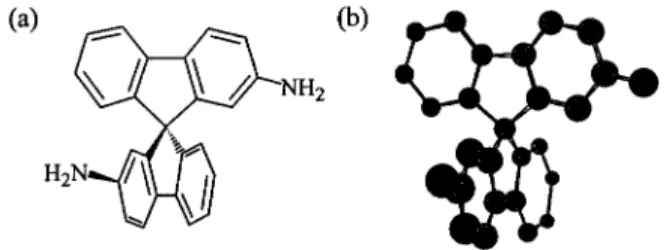
car-bon atom, the spiro center. Figure 1 illustrates a computer-generated three-dimensional structure of the spiro-diamine monomer using AM1 calcu-lations and MOPAC for energy minimization (Chem 3D software). In the spiro segment, the rings of the connected bifluorene entities are or-thogonally arranged.25,31 The resulting
polyim-ides would be expected to have a polymer back-bone that is periodically twisted with an angle of 90° at each spiro center. We anticipated that this structural feature would restrict the close pack-ing of the polymer chains and reduce the proba-bility of interchain interactions, resulting in more highly soluble polymers. In addition, the rigidity of the main chain of the polyimide would be pre-served because of the spiro structure, leading to a significant increase in both Tg and thermal
sta-bility. This article reports on the synthesis of ar-omatic polyimides containing 9,9⬘-spirobifluorene moieties in the main chain via the one-step poly-merization of 2,2⬘-diamino-9,9⬘-spirobifluorene
(3) with a variety of dianhydrides. The solubility,
crystallinity, and the thermal properties of the obtained polyimides are reported herein.
EXPERIMENTAL
Materials
The dianhydrides, 4,4 ⬘-(hexafluoroisopropyli-dene)diphthalic anhydride (4a), bisphenol-A di-anhydride (4b), 4,4⬘-oxydiphthalic anhydride
(4c), 3,3⬘,4,4⬘-benzophenonetetracarboxylic
dian-hydride (4d), and 3,3 ⬘,4,4⬘-biphenyltetracarboxy-lic dianhydride (4e) were recrystallized from ace-tic anhydride. m-Cresol was purified by distilla-tion under reduced pressure prior to use. Other common organic solvents were used as received unless otherwise stated.
Characterization
1
H and13C NMR spectra were recorded on a Var-ian Unity 300-MHz or a Bruker-DRX 300-MHz spectrometer with CDCl3or dimethyl sulfoxide-d6
(DMSO-d6) as solvents. IR spectra were obtained
on a Nicolet 360 FT-IR spectrometer. Differential scanning calorimetry (DSC) was performed with a DuPont TA 2000 instrument, with a heating/cool-ing rate of 20 °C min⫺1. Samples were scanned from 30 to 400 °C and then cooled to 30 °C and scanned a second time from 30 to 400 °C. The Tg
was determined from the second heating scan. Thermogravimetric analyses (TGAs) were made on a DuPont TGA 2950 instrument. The thermal stability of the samples was determined in nitro-gen by measuring weight loss during heating at a rate of 10 °C min⫺1. Size exclusion chromatogra-phy was carried out on a Waters chromatograchromatogra-phy unit, interfaced with a Waters 410 differential refractometer. Three 5 m Waters Styragel col-umns (300 ⫻ 7.8 mm), connected in series in decreasing order of pore size (105, 104, and 103A˚ ), were used with N,N-dimethyl formamide (DMF) as the eluent, and standard samples of Poly (methyl methacrylate) (PMMA) were used for cal-ibration. Wide-angle X-ray diffraction patterns were obtained at room temperature on a Rigaku DMX2B (Cu K␣, 20 mA, 30 kV) with a sampling step of 0.02° and a scan rate of 2° min⫺1.
9,9ⴕ-Spirobifluorene (1)32
A mixture of dry magnesium turnings (6.00 g, 0.25 mol) and 2-iodobiphenyl (63.0 g, 0.23 mol) in dry ether (250 mL) was refluxed gently for 1 h.
After this period, 9-fluorenone (44.6 g, 0.25 mol) was added dropwise over 30 min. The mixture was then heated under reflux overnight. The so-lution was cooled to room temperature, and am-monium chloride (aq) (10%, 400 mL) was added.
The aqueous layer was extracted with ether (3 ⫻ 50 mL), and the combined organic layers were
washed with brine and dried over magnesium sulfate. The crude product was recrystallized from ethanol to afford the desired carbinol as colorless plates (37.0 g, 57%). The carbinol ob-tained was cyclized by refluxing with glacial ace-tic acid (120 mL) in the presence of two drops of
concentrated hydrochloric acid over a period of 1 h. The solid solidified upon cooling was filtered and recrystallized from ethanol to give 1 (33.0 g, 94%).
1H NMR (DMSO-d
6):␦ 7.99 (d, 4H, J ⫽ 7.8 Hz),
7.36 (dd, 4H, J ⫽ 7.5, 7.5 Hz), 7.07 (dd, 4H, J
Figure 1. (a) Chemical structure and (b) the AM1 optimized molecular structure of the spiro-diamine monomer.
⫽ 7.5, 7.5 Hz), 6.57 (d, 4H, J ⫽ 7.5 Hz).13C NMR
(DMSO-d6): ␦ 148.1, 141.2, 127.9, 127.8, 123.4, 120.5, 65.4.
2,2ⴕ-Dinitro-9,9ⴕ-spirobifluorene (2)33
A mixture of concentrated nitric acid (80 mL) and
glacial acetic acid (60 mL) was added dropwise to
a boiling solution of 1 (8.00 g, 25.3 mmol) in acetic acid (90 mL) over 1 h, and the contents were
refluxed for a further 4 h. The reaction mixture was then cooled, and ice cold water (100 mL) was
added under stirring. The precipitated yellow solid was filtered and washed with excess water. Recrystallization of the crude dinitro compound from acetic acid afforded 2 (7.19 g, 70%) as yellow crystals. 1H NMR (CDCl 3): ␦ 8.32 (dd, 2H, J ⫽ 8.4, 2.1 Hz), 7.98 (d, 2H, J ⫽ 8.4 Hz), 7.96 (d, 2H, J ⫽ 7.5Hz), 7.53 (d, 2H, J ⫽ 2.1 Hz), 7.47 (dd, 2H, J ⫽ 7.5, 7.5 Hz), 7.25 (dd, 2H, J ⫽ 7.5, 7.5 Hz), 6.76 (d, 2H, J ⫽ 7.5 Hz). 13C NMR (CDCl 3): ␦ 148.3, 148.2, 148.1, 147.6, 139.4, 130.3, 129.0, 124.6, 124.3, 121.8, 120.6, 119.5, 65.6. 2,2ⴕ-Diamino-9,9ⴕ-spirobifluorene (3)33
Concentrated hydrochloric acid (5 mL) was added
dropwise into a boiling suspension of 2 (2.03 g, 5.00 mmol) and iron powder (2.15 g, 38.5 mmol) in ethanol (85 mL). After refluxing for 4 h, the excess
iron was filtered off. Activated charcoal (0.51 g) was added to the filtrate, heated, and again fil-tered through Celite. The solvent was evaporated, and the residue was purified by column chroma-tography over silica gel (ethyl acetate/hexane 1:3) to yield 3 (1.11 g, 64%) as colorless prisms.
1H NMR (DMSO-d 6):␦ 7.67 (d, 2H, J ⫽ 7.5 Hz), 7.57 (d, 2H, J⫽ 8.1 Hz), 7.24 (dd, 2H, J ⫽ 7.5, 7.5 Hz), 6.92 (dd, 2H, J⫽ 7.5, 7.5 Hz), 6.54 (dd, 2H, J ⫽ 8.1, 1.8 Hz), 6.50 (d, 2H, J ⫽ 7.5 Hz), 5.86 (d, 2H, J ⫽ 1.8 Hz), 5.12 (s, 4H).13C NMR (DMSO-d6): 150.9, 149.1, 148.0, 142.4, 129.0, 127.3, 125.1, 123.2, 120.8, 118.2, 113.3, 108.6, 64.9. Polymerization
A typical polymerization procedure is as follows. To a solution of 3 (173 mg, 500mol) in 1.0 mL of freshly distilled m-cresol, was added 4a (222 mg, 500mol) and isoquinoline (two to three drops) as the catalyst, followed by stirring at room temper-ature under a nitrogen atmosphere for 1 h. The reaction mixture was stirred at 80 °C for an
ad-ditional 2 h and then slowly heated to 200 °C with stirring for 6 h. After cooling, the viscous solution was added dropwise to an agitated methanol so-lution (100 mL), and the fibrous solid was col-lected by filtration, washed thoroughly with methanol, and dried under vacuum at 120 °C to afford the corresponding polyimide 5a. The poly-mer was further purified by reprecipitating from DMF into methanol. 5a: yield 87%.1H NMR (CDCl 3):␦ 7.90 (d, 2H, J⫽ 8.1 Hz), 7.85 (d, 2H, J ⫽ 8.1 Hz), 7.81 (d, 2H, J⫽ 7.8 Hz), 7.77 (s, 2H), 7.67 (d, 2H, J ⫽ 8.1 Hz), 7.39 (dd, 2H, J ⫽ 8.1, 1.8 Hz), 7.33 (dd, 2H, J ⫽ 7.8, 7.8 Hz), 7.12 (dd, 2H, J ⫽ 7.8, 7.8 Hz), 6.79 (d, 2H, J⫽ 1.8 Hz), 6.77 (d, 2H, J ⫽ 7.8 Hz).13C NMR (CDCl3):␦ 166.1, 166.0, 149.2, 148.6, 142.2, 140.8, 139.2, 136.0, 132.7, 132.4, 130.8, 128.8, 128.4, 126.6, 125.4, 124.5, 124.2, 122.7, 120.8, 120.6, 66.2. 5b: yield 90%.1H NMR (CDCl 3):␦ 7.90 (d, 2H, J⫽ 8.1 Hz), 7.81 (d, 2H, J ⫽ 7.8 Hz), 7.75 (d, 2H, J ⫽ 8.1 Hz), 7.42 (dd, 2H, J ⫽ 8.1,1.8 Hz), 7.35 (dd, 2H, J⫽ 7.5, 7.5 Hz), 7.28–7.23 (m, 8H), 7.13 (dd, 2H, J⫽ 7.5, 7.5 Hz), 6.95 (d, 4H, J ⫽ 8.1 Hz), 6.84 (d, 2H, J⫽ 1.5 Hz), 6.78 (d, 2H, J ⫽ 7.5 Hz), 1.67 (s, 6H). 13C NMR (CDCl 3): ␦ 166.5, 163.6, 152.6, 148.8, 148.5, 147.4, 141.5, 140.7, 134.1, 131.1, 128.6, 128.3, 128.1, 126.2, 125.5, 124.9, 124.2, 122.8, 122.4, 120.33, 120.25, 119.9, 111.6, 65.9, 42.5, 30.9. 5c: yield 86%.1H NMR (CDCl 3):␦ 7.87 (d, 2H, J ⫽ 8.1 Hz), 7.82–7.75 (m, 4H), 7.39 (d, 2H, J ⫽ 7.8 Hz), 7.36–7.30 (m, 4H), 7.26–7.21 (m, 2H), 7.10 (dd, 2H, J⫽ 7.8, 7.8 Hz), 6.82 (s, 2H), 6.75 (d, 2H, J⫽ 7.8 Hz).13C NMR (CDCl 3):␦ 166.0, 165.8, 160.9, 148.8, 148.4, 141.7, 140.6, 134.4, 130.8, 128.5, 128.1, 127.0, 126.3, 126.0, 124.5, 124.2, 122.4, 120.4, 120.3, 113.8, 65.9. 5d: yield 94%.1H NMR (CDCl 3):␦ 8.12 (s, 2H), 8.09 (d, 2H, J⫽ 7.5 Hz), 7.98–7.88 (m, 4H), 7.82 (d, H, J⫽ 7.5 Hz), 7.43 (d, 2H, J ⫽ 7.5 Hz), 7.36 (dd, 2H, J⫽ 7.5, 7.5 Hz), 7.14 (dd, 2H, J ⫽ 7.5, 7.5 Hz), 6.86 (s, 2H), 6.78 (d, 2H, J ⫽ 7.5 Hz). 13C NMR (CDCl3):␦ 192.7, 165.8, 148.9, 148.4, 141.9, 141.6, 140.5, 135.7, 134.8, 131.9, 130.6, 128.6, 128.2, 126.3, 124.6, 124.2, 124.1, 122.4, 120.5, 120.4, 66.0. 5e: yield 86%.1H NMR (CDCl 3):␦ 8.00 (s, 2H), 7.96 –7.78 (m, 8H), 7.42 (br, 2H), 7.34 (br, 2H), 7.12 (br, 2H), 6.86 (s, 2H), 6.76 (br, 2H).13C NMR (CDCl3):␦ 166.5, 148.9, 148.5, 145.3, 141.8, 140.6, 133.3, 132.8, 131.4, 130.9, 129.7, 128.5, 128.2, 126.4, 124.4, 124.2, 123.2, 122.3, 120.5, 118.9, 66.0.
RESULTS AND DISCUSSION
Monomer Synthesis
To introduce the spiro-skeletal units into the polyimide backbone, the novel spiro-diamine monomer, 3, was synthesized (as shown in Scheme 1). The precursor, 9,9⬘-spirobifluorene
(1), was prepared by reacting of 9-fluorenone with
the Grignard reagent prepared from 2-iodobiphe-nyl followed by dehydrative ring closure of the resulting carbinol in acetic acid.32The nitration of
1 with nitric acid in an acetic acid medium gave
the dinitro derivative 2, which subsequently on reduction using an iron powder/HCl mixture af-forded the desired monomer 3.33The structures of
compounds 1, 2, and 3 were verified by1H and13C
NMR spectroscopies.
Preparation of Polyimides
For the synthesis of polyimides 5a– e, a one-step polymerization method was used. This method is useful for the preparation of high-molecular-weight polyimides even from diamines or dianhy-drides with low reactivity.34However, the
disad-vantage of the one-step method is that insoluble polyimides cannot further react to form high-mo-lecular-weight polymers because of premature precipitation. The one-step solution method was chosen on the basis of the hypothesis that the
polyimides resulting from 3 would be soluble in
m-cresol. As shown in Scheme 1, the
polymeriza-tion of spiro-diamine 3 with a variety of dianhy-drides 4a– e was carried out in m-cresol with iso-quinoline as a catalyst (Scheme 1). In all these reactions, homogeneous solutions were obtained throughout the polymerization. The polymers were isolated in high yields by precipitation into methanol and dried under vacuum. The struc-tures of the synthesized polyimides 5a– e were characterized by IR and NMR spectroscopies. The IR spectra of these polyimides showed character-istic imide-ring absorptions near 1775 (CAO asymmetric stretching), 1720 (C⫽O symmetric stretching), and 1365 (CON stretching) cm⫺1. DSC and TGA measurements, which did not show any transition corresponding to imidization, are also consistent with the obtained polyimides be-ing fully imidized. With the supplementbe-ing of two-dimensional (H,H)-correlated NMR spectros-copy, the positions of the chemical shift for pro-tons of polymers 5a– e could be readily assigned as depicted in Figure 2. In addition to the distinct features associated with the spirobifluorene dia-mine moiety, resonances corresponding to the ar-omatic protons of the dianhydride component are clearly present. Thus, the 1H NMR spectra are
consistent with the assigned structures of polyim-ides 5a– e. 13C NMR spectra provided
comple-mentary information. Resonances associated with the carbonyl carbons of the imide ring appeared in the relatively downfield region (␦ 166).35
Poly-imides 5a– e had an inherent viscosity ranging from 0.40 to 0.77 dL/g in DMAc at 30 °C (Table 1). The molecular weights of the polymers were de-termined by gel permeation chromatography (GPC) with DMF as the eluent, calibrated against PMMA standards. GPC analysis indicated that the weight-average molecular weights and poly-dispersities (Mw/Mn) of the polyimides are in the range of (2.3–5.5)⫻ 104and 1.5–1.9, respectively,
as summarized in Table 1.
Properties of the Polyimides
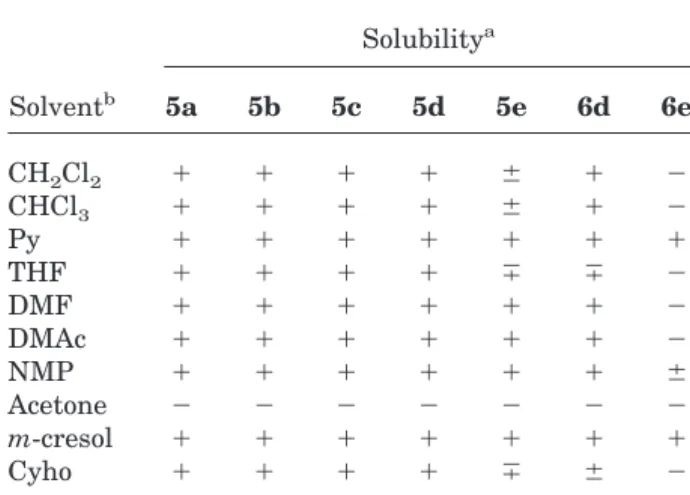
The crystallinity of the polyimides was evaluated by wide-angle X-ray diffraction experiments. All the polymers display amorphous diffraction pat-terns as a result of the kinked 9,9⬘-spirobifluorene structure. The amorphous character of the poly-imides was also reflected in their high solubility. The solubility of polyimides 5a– e was tested in a variety of organic solvents, and these results are summarized in Table 2. Although these
ides do not have a flexible aryl ether linkage in the diamine component as an auxiliary group for enhancing solubility, all the polyimides exhibited good solubility in polar aprotic solvents such as
NMP, DMF, DMAc and pyridine, and the phenolic solvent m-cresol as well as chlorinated solvents, including chloroform and methylene chloride, ex-cept for polymer 5e that was soluble in chloroform and methylene chloride only on heating. These polyimides, except for polyimide 5e, were also soluble in less polar solvents such as tetrahydro-furan (THF) and cyclohexanone. The poor solubil-ity of 5e in THF, cyclohexanone, and chlorinated solvents is possibly due to the rigid nature of the biphenylene moiety. Transparent, flexible films of the polyimides could be obtained by solution cast-ing.
Figure 2. 1H NMR spectra in CDCl
3of polyimides (a) 5a, (b) 5b, (c) 5c, (d) 5d, and (e) 5e (* signal arising from CHCl3).
Table 1. Molecular Weight, Inherent Viscosity, and Thermal Properties of Polyimides 5a– 6e
Polymer Mwa⫻ 104 Mw/Mn inh b (dL/g) DSC Tgc TGAd Yc(%)e 5% 10% 5a 2.3 1.5 0.40 364 542 573 63 5b 3.6 1.6 0.62 287 563 593 63 5c 4.2 1.7 0.55 362 606 652 70 5d 5.5 1.8 0.77 371 602 626 68 5e 3.9 1.9 0.61 374 587 647 69 6d 3.7 1.9 — 357 576 602 64 6e — — — 362 566 593 64
aMolecular weight was determined by GPC in DMF on the basis of PMMA standards. bMeasured at 0.5 g/dL in DMAc at 30 °C.
cT
gwas determined by DSC at a heating rate of 20 °C min⫺1under nitrogen.
dTemperature (⫾ 5 °C) at which a 5 and 10% weight losses were detected at a heating rate of 10 °C min⫺1under nitrogen. eChar yields at 900 °C in nitrogen.
Table 2. Solubility of Aromatic Polyimides
Solventb Solubilitya 5a 5b 5c 5d 5e 6d 6e CH2Cl2 ⫹ ⫹ ⫹ ⫹ ⫾ ⫹ ⫺ CHCl3 ⫹ ⫹ ⫹ ⫹ ⫾ ⫹ ⫺ Py ⫹ ⫹ ⫹ ⫹ ⫹ ⫹ ⫹ THF ⫹ ⫹ ⫹ ⫹ ⫿ ⫿ ⫺ DMF ⫹ ⫹ ⫹ ⫹ ⫹ ⫹ ⫺ DMAc ⫹ ⫹ ⫹ ⫹ ⫹ ⫹ ⫺ NMP ⫹ ⫹ ⫹ ⫹ ⫹ ⫹ ⫾ Acetone ⫺ ⫺ ⫺ ⫺ ⫺ ⫺ ⫺ m-cresol ⫹ ⫹ ⫹ ⫹ ⫹ ⫹ ⫹ Cyho ⫹ ⫹ ⫹ ⫹ ⫿ ⫾ ⫺
aSolubility: (⫹) soluble at room temperature; (⫾) soluble
on heating; (⫺⫹) partially soluble on heating; (⫺) insoluble.
bCH
2Cl2methylene chloride; CHCl3, chloroform; Py,
pyri-dine; THF, tetrahydrofuran; DMF, N,N-dimethylformamide; DMAc, N,N-dimethylacetamide; NMP, N-methyl-2-pyrroli-done; Cyho, cyclohexanone.
The highly amorphous nature and good solu-bility of these polyimides can be attributed to the presence of the kinked spirobifluorene units along the polymer backbone. In the case of the spiro-fused bifluorene moiety, the two fluorene rings are mutually perpendicular and connected via a common tetracoordinated carbon atom,25,31 and
consequently the polymer chain is repeatedly zig-zagged with an angle of 90° at each spiro center. This structural feature, which minimizes inter-chain interactions and restricts the close packing of the polymer chains, resulted in polyimides pos-sessing low crystallinity and high solubility. It has been demonstrated that the incorporation of a cyclic cardo side group, such as fluorene, into the polymer backbone affords aromatic polyimides with good solubility and high thermal stabil-ity.36 –38 For comparison, fluorene-based cardo
polyimides 6d and 6e were prepared by polymer-ization from 9,9⬘-bis(4-aminophenyl)fluorene with dianhydrides 4d and 4e. When comparing the solubility of polyimides 5d and 5e with their analogues 6d and 6e, 5d and 5e were more solu-ble than 6d and 6e (Tasolu-ble 2). This observation clearly demonstrates the important role of the orthogonal arrangement of each bifluorene moi-ety in the polymer chain for enhancing the solu-bility of the polyimides.
The thermal properties of the polyimide were investigated by DSC and TGA, and the results are presented in Table 1. The incorporation of rigid spirobifluorene units into the polymer backbone led to polyimides exhibiting a high Tg. The Tg’s of polyimides 5a– e were in the range of 287–374 °C, depending on the structure of the dianhydride monomer moiety. Polyimides 5d and 5e with a stiffer dianhydride moiety in the polymer back-bone had higher Tgvalues. The polyimide with a flexible linkage, such as the 4,4 ⬘-isopropylidene-diphenoxy (5b) group, exhibited a lower Tg. In a comparison of Tg’s of polymers 5d and 5e with 6d and 6e, the spirobifluorene-based polymers pos-sessed higher Tg’s, which were about 12–14 °C higher than the corresponding fluorene-based cardo polymers. This result demonstrates the role of the incorporated spiro-fused bifluorene moiety in increasing the rigidity of the polymer
back-bone. As evidenced by TGA, all the spirobiflu-orene-based polyimides have excellent thermal stability. Figure 3 shows typical TGA curves for these polyimides. The 5 and 10% weight-loss tem-peratures in nitrogen were in the range of 542– 606 and 573– 652 °C, respectively. The char yields for these polyimides were in the range of 63–70% in nitrogen at 900 °C. As shown in Table 1, poly-imides 5d– e also displayed a higher thermal sta-bility than their fluorene-based cardo analogues. These results are indicative of the high thermal stability of the spirobifluorene unit in the polymer backbone.
In conclusion, a series of aromatic polyimides containing 9,9⬘-spirobifluorene moieties in the main chain have been synthesized via the poly-condensation of 3 with a variety of dianhydrides. In the case of the spiro segment, the two fluorene rings are mutually perpendicular and are con-nected via a common tetracoordinated carbon. This structural feature confers an enhanced sol-ubility on the polyimides because of a decrease in the degree of molecular packing and crystallinity while imparting a significant increase in both Tg
and thermal stability by restricting segmental mobility. Further studies on the incorporation of spirobifluorene units into the polymer backbone achieving soluble polymeric materials that are amenable for use as light-emitting polymers are now in progress.39 – 41
The authors thank the National Science Council of the Republic of China for their financial support.
REFERENCES AND NOTES
1. Polyimides; Wilson, D.; Stenzenberzer, H. D.; Her-genrother, P. M., Eds.; Blackie, Chapman & Hall: New York, 1990; 58 –78.
Figure 3. TGA curves for polyimides 5a– e at a heat-ing rate of 10 °C min⫺1in N2.
2. Polyimides: Fundamentals and Applications; Ghosh, M. K.; Mittal, K. L., Eds.; Marcel Dekker: New York, 1996; pp 207–365.
3. Baise, A. I. J Appl Polym Sci 1986, 32, 4043. 4. de Abajo, J.; de la Campa, J. G. Processable
Aro-matic Polyimides. In Progress in Polyimide Chem-istry I; Kricheldorf, H. R., Ed.; Advance in Polymer Science 140; Springer: Berlin, 1999; pp 23–59, and references herein.
5. Spilopoulos, I. K.; Mikroyannidis, J. A. Macromol-ecules 1998, 31, 1236.
6. Liaw, D. J.; Liaw, B. Y.; Li, L. J.; Sillion, B.; Mer-cier, R.; Thiria, R.; Sekiguchi, H. Chem Mater 1998, 10, 734.
7. Yi, M. H.; Huang, W.; Lee, B. J.; Choi, K. Y. J Polym Sci Part A: Poylm Chem 1999, 37, 3449.
8. Yang, C. P.; Hsiao, S. H.; Yang, H. W. Macromol Chem Phys 2000, 201, 409.
9. Liaw, D. J.; Liaw, B. Y.; Chung, C. Y. Macromol Chem Phys 2000, 201, 1887.
10. Liou, G. S.; Wang, J. S. B.; Tseng, S. T.; Tsiang, R. C. C. J Polym Sci Part A: Polym Chem 1999, 37, 1673.
11. Yang, C. P.; Yu, C. W. J Polym Sci Part A: Polym Chem 2001, 39, 788.
12. Liaw, D. J.; Liaw, B. Y.; Lai, S. H. Macromol Chem Phys 2001, 202, 807.
13. Eastmond, G. C.; Paprotny, J.; Irwin, R. S. Macro-molecules 1996, 29, 1382.
14. Wang, C. S.; Leu, T. S. Polymer 2000, 41, 3581. 15. Mi, Q.; Gao, L.; Ding, M. Polymer 1997, 38, 3663. 16. Matsumoto, T.; Kurosaki, T. Macromolecules 1997,
30, 993.
17. Lin, S. H.; Li, F.; Cheng, S. Z. D.; Harris, F. W. Macromolecules 1998, 31, 2080.
18. Liou, G. S.; Maruyama, M.; Kakimoto, M. A.; Imai, Y. J Polym Sci Part A: Polym Chem 1998, 36, 2021. 19. Farr, I. V.; Kratzner, D.; Glass, T. E.; Dunson, D.; Ji, Q.; McGrath, J. E. J Polym Sci Part A: Polym Chem 2000, 38, 2840.
20. Liaw, D. J.; Hsu, P. N.; Liaw, B. Y. J Polym Sci Part A: Polym Chem 2001, 39, 63.
21. Chung, I. S.; Kim, S. Y. Macromolecules 2000, 33, 3190.
22. Zheng, H. B.; Wang, Z. H. Macromolecules 2000, 33, 4310.
23. Salbeck, J.; Yu, N.; Bauer, J.; Weisso¨rtel, F.; Best-gen, H. Synth Met 1997, 91, 209.
24. Salbeck, J.; Bauer, J.; Weisso¨rtel, F. Macromol Symp 1997, 125, 121.
25. Johansson, N.; dos Santos, D. A.; Guo, S.; Cornil, J.; Fahlman, M.; Salbeck, J.; Schenk, H.; Arwin, H.; Bre´das, J. L.; Salenek, W. R. J Chem Phys 1997, 107, 2542.
26. Johansson, N.; Salbeck, J.; Bauer, J.; Weisso¨rtel, F.; Bro¨ms, P.; Andersson, A.; Salaneck, W. R. Adv Mater 1998, 10, 1136.
27. Steuber, F.; Staudigel, J.; Sto¨ssel, M.; Simmerer, J.; Winnacker, A.; Spreitzer, H.; Weisso¨rtel, F.; Sal-beck, J. Adv Mater 2000, 12, 130.
28. Yu, W.-L.; Pei, J.; Huang, W.; Heeger, A. J. Adv Mater 2000, 12, 828.
29. Chiang, C.-L.; Shu, C.-F. Chem Mater 2002, 14, 682.
30. Reddy, D. S.; Shu, C.-F.; Wu, F.-I. J Polym Sci Part A: Polym Chem 2002, 40, 262.
31. Wu, R.; Schumm, J. S.; Pearson, D. L.; Tour, J. M. J Org Chem 1996, 61, 6906.
32. Clarkson, R. G.; Gomberg, M. J Am Chem Soc 1930, 52, 2881.
33. Weisburger, J. H.; Weisburger, E. K.; Ray, F. E. J Am Chem Soc 1950, 72, 4253.
34. Harris, F. W. In Polyimides; Wilson, D.; Stenzen-berzer, H. D.; Hergenrother, P. M., Eds.; Blackie, Chapman & Hall: New York, 1990; p 1.
35. White, D. M.; Takekoshi, T.; Williams, F. J.; Relles, H. M.; Donahue, P. E.; Klopfer, H. J.; Loucks, G. R.; Manello, J. S.; Matthews, R. O.; Schluenz, R. W. J Polym Sci Polym Chem Ed 1981, 19, 1635. 36. Korshak, V. V.; Vinogradova, S. V.; Vygodskii, Y. S.
J Macromol Sci Rev Macromol Chem Part C 1974, 11, 45.
37. Yang, C. P.; Lin, J. H. J Polym Sci Part A: Polym Chem 1993, 31, 2153.
38. Hsiao, S. H.; Li, C. T. J Polym Sci Part A: Polym Chem 1999, 37, 1403.
39. Kraft, A.; Grimsdale, A. C.; Holmes, A. B. Angew Chem Int Ed Engl 1998, 37, 402.
40. Mitschke, U.; Bau¨ erle, P. J Mater Chem 2000, 10, 1471.
41. Bernius, M. T.; Inbasekaran, M.; O’Brien, J.; Wu, W. Adv Mater 2000, 12, 1737.