.I
PHYs
IVFRANCE 7 (1997)Colloque C 1, Suppl6ment au Journal de Physique III de mars 1997
Preparation and Magnetic Properties of Zn-Doped
Fe304
Magnetic Colloid
P.C. Kuo,
J.L.
Pan, C.H. Lin* and D.R. Huang**
Institute of Materials Science, Taiwan University, Taipei, Taiwan, China
*Department of Materials Science, National Tsing Hua University, Hsinchu, Taiwan, China
**
Opto-Electronics & Systems Labo.,ITRI,
Hsinchu, Taiwan, ChinaAbstract. FeaO4 aagnentic colloids were produced by co-wecipitating a Fez*. Few, and Znl+ containing solution with a NaOE solution at 70DC. Analyses results indicated that the Zn content of the FeaO4 colloids was always less than the solution's Zn content. The difference wss found to be the smallest when the colloid was precipi- tated at pE=lO. The us values of the FerO4 colloid significantly improved by adding an appropriate mount of Zn ions and precipitaing it at an optimm pH value, pH=lO. The optimm Zn ion content was 6.18 at%, which was cor- responded to Zno. tts4Fec . B I tsFeaO4. At this camposition the colloid's a. value was 94 enu/g, and increased by more than 34% of pure FeaOc colloid' s a value. By theoretical calculation the o. should increase 27.8%.
INTRODUCTION
Investigaters have synthesized magnetite colloid by the chemical coprecipitation method to prepare aag-
netic fluid since 1966[1-31. An appropriate amount Zn ion in the colloids may increase the colloid's us
value because adding Zn ion increases the unbalanced magnetic moment between the spinel's A site and the B site. In this study, we investigate the effects of Zn ion on the U S value of FeaOc magnetic colloids
to test whether or not adding Zn ions can increase the colloid's magnetic properties and what the opti- mum amount of Zn ion is.
EXPERIMENTAL
Fe~04:Zn magnetic colloids were produced by the chemical co-precipitaion method, i.e.. mixing an acidic solution containing 0.1 M FeClr-4Hz0, 0.2 M FeC13-6Az0, an appropriate amount of ZnClz.4Az0, with a suf- ficiant volume of 0.1 M NaOH alkali solution at 70C, and then centrifuging them from the mixed solution. TEN, XRD, EDX, and VSM analyses were performed to measure the particle size, structure, chemical compo- sition, and magnetic properties of the FeaO4:Zn magnetic colloids.
RESULTS AND DISCUSSION
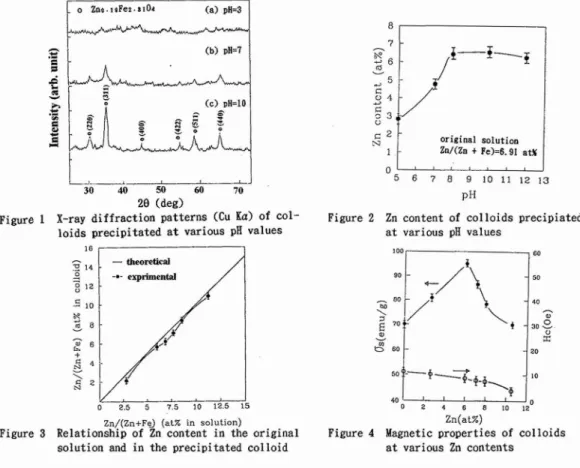
X-ray diffraction analysis results in Figure 1 reveal that a high pH value of the co-precipited solution favored the formation of FeaO4 colloids. At pE=lO, well crystallized spinel phase was formed and no oth- er phase was detected. Zn ion formed a solid solution with FesO4. EDX analysis of Zn ion content in FeaOc colloids (Figure 2) reveals that Zn ion content in FeaO4 colloid was always less that in the origi- nal solution because Zn has a higher solubility in this pH range than either Fez+ or Fe3+ ions. For an initially fixed Zn ion content of 6.91 at% (8 wt%) in the solution, the Zn ioa content in the FesO4 col- loids ranged from 2.87 atm% at pH=5 to a maximum value of 6.71 wt% at pH=lO. Later, it gradually de- clined to 6.32 wt% at pH=12. The difference between the Zn ion in the colloid and in the original solu- tion was the smallest at pH=lO because of the Zn ion' s amphibious property. At a fixed pH=lO in the pre- cipitated solution. Figure 3 shows the relationship between Zn content in the solution before co-precipi- tation and Zn content in the FesOc colloid. Zn ion content in the FeaO4 colloid is always less than that in the original solution. Electron micrographs reveal that the colloid particles were spherical with a diameter less than 1006.
C1-584 JOURNAL DE PHYSIQUE IV
Because the us value of FetO4:Zn colloids was found to be optimal when they were produced at pH=lO, FesO4:Zn colloids were produced at pH=lO for various Zn contents. Figure 4 reveals that the U a values of the FesO4 colloids significantly improved by adding an appropriate amount of Zn ions, e.g. ranging from 70 emu/g at Zn-0 at% to a maximum of 94 emu/g at Zn=6.18 at%. Later they reduced to 70 emu/g at Znz10.97 at%. The optimal Zn content of the FesO4:Zn colloid is Znz6.18 at% where the us value of the colloid is 34% more than the us values of the colloids without adding the Zn ion.
6.18 at% of Zn ion in the Fes0r:Zn colloid implies that, initially, Fez+ is 31.27 at% and Feat is 62.55 at% in this colloid. However, adding Zn2+ ion replaces Fez+ ion and causes a 6.18 at% surplus of Fee+ in the spinel structure. The fact that x-ray analysis in Figure 1 indicates that the FeaO4:Zn col- loid is a single phase solid solution, suggests that the surplus FeD must be somewhere in the spinel structure. The Fez+ was apparently oxidized to Fe3+ by dissolving oxygen in the solution and became part of the spinel because, at pH=lO, free Fe2+ is unstable and quite easily oxidized. If such a fact is true, the subsequent spinel formula of the FeaO4:6. 18 at% Zn colloid is as follows: (Zno .1ss4Fe~+o. 81 42) (Fe3+l. 18srFe~to. 814s)O4. This formula's net magnetic moment, as calculated from its individual magnetic moments, is 5.112 p ; meanwhile, the net magnetic moment of pure FesO4 is 4 p. Adding 6.18 at% Zn ion to FesO4 increases the as value of FesO4 by 27.8%, which is slightly different from the experimental value of 34%. The optimum us value of FesO4:Zn colloid is that the spinel's A site is occupied by 18.54 at% of Zn ion, which is quite different from the other members of the ferrite family where the optimum U a value occurs when the spinel's A site is occupied by 50 at% of Zn ion. Some Hc values were found in the FeaO4: Zn colloids (Figure 4), implying tlmt the colloids contain some larger particles which are beyond super- paramagnetic range and are therefore ferrimagnetic. Moreover. Figure 4 indicates that the Hc value of the Fea0r:Zn colloids gradually decrease with the Zn ion content.
o Z n o . ~ ~ P e z . ~ i 0 ~ (8) pH=3
-
7 (b) pII=7%-I-$
(c) pH-10 d Ci c 2 N original solutim 1 Zn/(Zn + Fe)=6.91 at% 0 5 6 7 8 9 10 11 12 13 30 40 50 60 70 20 (deg) PI{Figure 1 X-ray diffraction patterns (CU b) of col- Figure 2 Zn content of colloids precipiated
loids precipitated at various pH values at various pH values
Zn/(Zn+Fe_f (at% in solution) Zn(at%)
Figure 3 Relationship of Zn content in the original Figure 4 Magnetic properties of colloids
solution and in the precipitated colloid at various Zn contents
References
1. T.Sato, S.Higuchi and J.Shimoiizaka: 19th Annual Meeting of the Chemical Soc. of Japan, 293(1966). 2. K. Kimoto and I.Nishida, Japan J. Appl. Phys., 6, 1047(1967).