C
ATALYTIC
I
NCINERATION OF
C
2H
5SH
AND
I
TS
M
IXTURE WITH
CH
3SH
OVER A
Pt/Al
2O
3C
ATALYST
By Hsin Chu,
1Yiing-Yuan Chiou,
2Kuen-How Horng,
3and Ting-Ke Tseng
4ABSTRACT: Catalytic incineration is one of the cost-effective technologies to solve troublesome volatile organic compounds. However, some sulfur containing volatile organic compounds, such as ethyl mercaptan, may de-activate the Pt catalyst that is commonly used in the catalytic incineration process. This paper provides infor-mation on the poisoning effect of ethyl mercaptan. The catalytic incineration of ethyl mercaptan, typically emitted from the petrochemical industry, over a Pt/Al2O3fixed-bed catalytic reactor was studied. The effects of operating
parameters including inlet temperature, space velocity, C2H5SH concentration, O2 concentration, and catalyst
size were characterized. Catalytic incineration on a mixture of C2H5SH with CH3SH was also tested. The results
show that the conversions of C2H5SH increase as the inlet temperature increases and the space velocity decreases.
For the temperature from 200–260⬚C, the higher the C2H5SH concentration is, the lower its conversion. The O2
concentration has a positive effect on the conversion of C2H5SH. C2H5SH has a poisoning effect on the Pt/Al2O3
catalyst, especially at lower temperature. The existence of CH3SH has no effects on the conversion of C2H5SH.
INTRODUCTION
Volatile organic compounds (VOCs) are defined as the or-ganic compounds that have high vapor pressure and are easily vaporized at the condition of ambient temperature and pres-sure. Most hydrocarbons, including nitrogenous, chlorinated, and sulfurated organics, are determined to be VOCs. These compounds are usually found in the industries that manufac-ture or utilize organic solvents (e.g., petrochemical, pulp, or coating industry). In addition to causing harmful effects on human organs, VOCs may also react with NOx in the
atmo-sphere to form even more toxic photochemical smog and O3.
Some VOCs, such as mercaptans, dimethyl sulfides, or amines, are not extremely toxic but may present offensive odor even at an extremely low concentration. Mercaptans can be used to produce pesticides, catalysts, and jet plane fuels. Some VOCs, from the processes, may cause pollution problems. To remove these troublesome substances, a number of technologies have been developed. Among them, catalytic incineration has been paid the most attention lately because it is a final disposal and energy saving process (Van der Vaart et al. 1991a,b). However, sulfur-containing VOCs may deactivate the catalyst and reduce the advantage of catalytic incineration. Spivey (1987) indi-cated that the major parameters affecting catalytic incineration of VOCs included catalyst types, VOC types, VOC concen-tration, operating temperature, space velocity, and O2
concen-tration. The catalyst can be divided into two categories: pre-cious metals and metal oxides. Heyes et al. (1982) evaluated a series of catalysts for the destructive oxidation of n-butanal and methyl mercaptan. They found that the ability to destroy butanal in mixtures with methyl mercaptan at the end of life tests decreased in the following order: CuO = Pt > MnO2 >
V2O5> CO3O4. It revealed that catalyst type was a key
param-eter for catalytic incineration. Tichenor Palazzolo (1987) did
1Assoc. Prof., Dept. of Envir. Engrg., Nat. Cheng Kung Univ., 1
Uni-versity Rd., Tainan 701, Taiwan (corresponding author). E-mail: [email protected]
2
Res. Asst., Dept. of Envir. Engrg., Nat. Cheng Kung Univ., 1 Uni-versity Rd., Tainan 701, Taiwan.
3
Mgr., Sun Dream Envir. Tech. Co., 15 Lane 16, Fuchong St., Taichong 407, Taiwan.
4PhD Candidate, Dept. of Envir. Engrg., Nat. Cheng Kung Univ., 1
University Rd., Tainan 701, Taiwan.
Note. Associate Editor: Mark Rood. Discussion open until October 1, 2001. To extend the closing date one month, a written request must be filed with the ASCE Manager of Journals. The manuscript for this paper was submitted for review and possible publication on July 31, 2000; revised November 29, 2000. This paper is part of the Journal of
Envi-ronmental Engineering, Vol. 127, No. 5, May, 2001. 䉷ASCE, ISSN
0733-9372/01/0005-0438–0442/$8.00⫹ $.50 per page. Paper No. 22402.
a series of tests on catalytic incineration of tens of VOCs using precious metals. They found that destructibility of VOCs using precious metals decreased in the following order: alcohols > cellusolves > aldehydes > aromatics > ketones > acetates > alkanes > chlorinated hydrocarbon. However, the different be-havior of catalytic conversion of a single VOC and the VOC in a mixture of VOCs have not been thoroughly studied. In general, the operating temperature of catalytic incineration de-pends on catalyst types, VOC types, concentration of VOCs, and space velocity. From the definition, space velocity is the inverse of residence time of VOCs in the catalytic reactor. Therefore, residence time would decrease as space velocity increases, and the conversion of VOCs would drop. Vo¨lter et al. (1987) indicated that the activity of Pt catalyst was stronger in air than that in pure oxygen. Ross and Sood (1977) used CoMo4⭈H2O to control a simulated pulp mill effluent gas
con-taining 200 – 1,165-ppm methyl mercaptan, while O2
concen-trations varied from 1 to 4%. They found that the activity of the catalyst with respect to the production of an intermediate — dimethyl disulfide fell as the O2concentration in the effluent
increased from 1 to 4%, while the production of the complete oxidation product of methyl mercaptan — SO2 simultaneously
increased.
Jennings et al. (1985) showed that S was a reversible inhib-itor to the catalyst. Its effects depended on the S content of VOCs and operating temperature. Pope et al. (1978) used a Pt catalyst to catalytically convert n-butanal in the mixtures with methyl mercaptan. They found that the conversion of n-butanal was suppressed by the presence of 100-ppm CH3SH if the
operating temperature was below 300⬚C. A number of studies on the catalytic conversion of CO with mixtures of (CH3)2S
using various types of Co3O4 catalyst were investigated by
Pope et al. (1976). They suggested that the higher the specific surface area of the catalyst was, the more sites could be cov-ered by sulfur and the catalyst’s sulfur-resistibility was higher. Chu and Lee (1998) used a Pt/Al2O3 catalyst to catalytically
convert ethanol in the mixtures with dimethyl disulfide. They found that the conversion of ethanol was significantly sup-pressed by the existence of (CH3)2S2at temperature lower than
300⬚C.
This study was carried out by catalytic incineration of ethyl mercaptan, typically emitted from the petrochemical industry, over a Pt/Al2O3fixed-bed reactor. The effects of operating
pa-rameters, including inlet temperature, space velocity, C2H5SH
concentration, O2 concentration, and catalyst size were
char-acterized. A life test of the catalyst on C2H5SH was performed
to identify the sulfur poisoning effect. Catalytic incineration on a mixture of ethyl mercaptan with CH3SH was also tested
TABLE 1. Basic Properties of NIKKI NS-10 Catalyst Catalyst Shape Diameter size (mm) Bulk density (g/mL) Pt content (g/L) Pt/Al2O3 Pellet 3–3.5 0.35–0.4 1.8
FIG. 1. Schematic Diagram of Bench-Scale Catalytic Incinerator
to determine the interferences of CH3SH on the performance
of C2H5SH conversion.
MATERIALS AND METHODS
The catalytic incineration of this study was done in a bench-scale fixed-bed reaction system. The system can be divided into three parts: an effluent gas simulation system, a catalytic incineration system, and a combustion gas analyzing system as shown in Fig. 1. The effluent gas simulation system was composed of an air compressor (SWAN, Germany, 186 W), a pure N2cylinder (99.9%, San Fu, Taiwan), a pure CH3SH
cyl-inder (>99.5%, Merck, Germany), four mass flow meters (Te-ledyne Hasting-Raydist, HFC-202), two plug-flow mixers (Omega, Taiwan, FMX7106), a water bath (Deng Yng, Tai-wan,⫺20 to 80⬚C), and two VOC vapor generators (Pyrex). Flow rates of dilution N2, purge N2, and dilution air were
con-trolled by three mass flowmeters, to prepare the desired C2H5SH and O2 concentrations. Simulated gas of CH3SH was
made of pure CH3SH cylinder gas, dilution N2, and dilution
air. The simulated gas was then preheated by a electrical heat-ing tape before goheat-ing through the reactor. The material of pip-ings, valves, regulators, or fittings used was either SS-316 or polytetrafluoroethylene. The catalytic incineration system was composed of a custom-made SS-316 tube reactor and a elec-trical heater. The length, internal diameter, and outer diameter of the reactor were 45 cm, 1.5 cm, and 2.0 cm, respectively. A 200-mesh SS-316 sieve was set in the reactor, 24 cm below the top of the tube, to support the catalyst. The thickness of the catalyst packing was 1 cm. A thin layer of glass fiber and a layer of glass bead with a 2 mm diameter also covered the catalyst packing to uniformly distribute the gas. Two K-type thermocouples were inserted into the reactor to the positions on the top and bottom of the catalyst packing, respectively, to measure and control the inlet and outlet temperature. The gas analyzing system was composed of a gas chromatograph (GC) (Shimadzu, Japan, GC-14B), and four combustion gas analyz-ers: SO2 analyzer (Milton Roy Model ZRF infrared analyzer),
O2 analyzer (Signal Model magnetodynamic type), CO
ana-lyzer (Signal Series 2000), and CO2 analyzer (Signal Series
2000). The GC column was a 30-m-long capillary column with
diameter of 0.53 mm (J&W Scientific #115-3432). A 1:1 split-ter was connected with the column to split the sample gas into a flame ionization detector (FID) and a flame photometric de-tector (FPD). An icebox impingement condenser (Pyrex, Tai-wan) and two particle filters (Balston, 95S6 and 45G) were installed between the sampling port and four combustion gas analyzers. This arrangement was designed to prevent the an-alyzers from being damaged by condensed water and particles. All mass flowmeters and rotameters used in this study were calibrated by a bubble meter (Humonic digital flow meter 650) or a dry gas meter (Shinagawa DK-SCF-T, Japan) at their proper ranges. Standard gases included zero gas (N2, 99.995%,
San Fu, Taiwan), SO2span gas (435 ppm, San Fu, Taiwan), O2
span gas (19%, San Fu, Taiwan), CO span gas (502 ppm, San Fu, Taiwan), CO2 span gas (1,970 ppm, San Fu, Taiwan), and
CH3SH/C2H5SH span gas (200 ppm, U.S. Gas). The catalyst
samples were taken before and after the reaction to determine the changes of their specific surface area, because of sulfur poisoning, by a BET specific surface area analyzer (FlowSorb II 2300). Liquid C2H5SH was a product of Merck Chemical
Inc., Germany (purity >99%). The catalyst was a commercial product of NIKKI NS-10 Pt/Al2O3. Its basic properties are
shown in Table 1.
The experiments were also divided into three parts. The first part was performed to investigate the performance of Pt/Al2O3
on catalytic conversion of C2H5SH. The operating parameters
and ranges were inlet temperature (160 – 400⬚C), C2H5SH
con-centration (70 – 100 ppm), space velocity (50,000 – 100,000 h⫺1), and O2concentration (1 – 20.8%). The second part was a
life test of the catalyst by catalytic incineration of C2H5SH to
identify the sulfur poisoning effect. The last part was con-ducted to catalytically incinerate a mixture of C2H5SH with
CH3SH. The results could be compared with the first part of
the experiments to determine the interference of C2H5SH
con-version by adding CH3SH. Reagent grade liquid ethyl
mercap-tan was injected into the VOC generator, which was kept at a constant temperature of ⫺5⬚C in the water bath. Purged N2
carried the vaporized VOC to mix with dilution air and N2in
the mixture to simulate the waste gas, from a typical petro-chemical plant, at certain flow rate and O2concentration. The
simulated gas was injected into the catalytic reactor heated by a electrical furnace. One milliliter of gas samples was taken before and after the reaction, by an on-line autosampler, to be injected into the GC to determine the conversion of the VOC. The gas samples before and after the reaction were also ana-lyzed by four gas analyzers to determine the extent of com-plete oxidation.
RESULTS AND DISCUSSION
The preliminary tests were started from a series of blank tests by replacing catalyst packing with glass fiber. The results show that the conversion of C2H5SH is trivial in the operating
ranges of this study. This suggested that the catalyst is the key element for the conversion of C2H5SH. The commercial Pt
catalyst was ground to three particle size ranges: 30 – 50 mesh, 50 – 100 mesh, and 100 – 200 mesh. Their specific surface areas remain the same as that of the raw catalyst. A series of tests were performed on conversion of C2H5SH over three types of
catalyst with different sizes. The results show that the per-formances of the catalyst with different sizes were not signif-icantly different from one another. Therefore, the catalyst with
FIG. 2. Effect of C2H5SH Concentration on Catalytic Conversion of
C2H5SH (Space Velocity: 70,000 h⫺1; O2Concentration: 20.8%)
FIG. 3. Effect of Space Velocity on Catalytic Conversion of C2H5SH
(C2H5SH Concentration: 100 ppm; O2Concentration: 20.8%)
FIG. 5. Relationship of C2H5SH Conversion, CO2Yield, and SO2Yield
at Various Temperatures (C2H5SH Concentration: 100 ppm; Space
Veloc-ity: 50,000 h⫺1, O2Concentration: 20.8%)
FIG. 4. Effect of O2Concentration on Catalytic Conversion of C2H5SH
(Inlet Temperature: 250⬚C; C2H5SH Concentration: 100 ppm; Space
Ve-locity: 70,000 h⫺1)
size of 50 – 100 mesh was chosen to carry out the experiments for the rest of this study, to reduce both the mass transfer limitation and grinding effort.
The effect of C2H5SH concentration on its conversion at
various temperatures is shown in Fig. 2. It suggests that the conversion of C2H5SH increases as inlet temperature increases
in the range of 200 – 300⬚C. It also can be found that the con-version of C2H5SH increases as its concentration decreases
from 100 to 70 ppm at a lower temperature range. Fig. 3 shows that the lower the space velocity is, the higher the conversion of C2H5SH. The effect of O2 concentration on the conversion
of C2H5SH is shown in Fig. 4. It is found that the conversion
of C2H5SH increases as O2 concentration increases. This is
consistent with the results of Ross and Sood (1977) and Chu and Horng (1998). Their results showed that the adsorption of the O2molecule is important in the process of catalytic
incin-eration of CH3SH by the Langmuir-Hinshelwood model,
which describes the suitability of the catalytic incineration of CH3SH. Chu and Wu (1998) showed the phenomenon that the
O2 concentration had a positive effect on the conversion of
ethyl mercaptan. Figs. 5 and 6 show that the conversion of C2H5SH already reaches 70% around 250 and 260⬚C,
respec-tively, but the CO2 yield only amounted to less than 3% and
5%, respectively, at the same temperatures. This suggests that the intermediates of the reaction are the major components of the oxidized gas at lower temperature. Fig. 5 shows that the complete oxidation of C2H5SH is almost reached at an
oper-ating temperature higher than 400⬚C, where the CO2 yield is
85%. The trend is about the same in Fig. 6. For another com-plete oxidation product (SO2), its yield shows a wave pattern
within the temperature range tested in this study. This result is consistent with those of Heyes et al. (1982) and Pope et al. (1978). Fig. 5 shows that the peak of the SO2 yield of this
FIG. 6. Relationship of C2H5SH Conversion, CO2Yield, and SO2Yield
at Various Temperatures (C2H5SH Concentration: 100 ppm; Space
Veloc-ity: 70,000 h⫺1; O2Concentration: 20.8%)
FIG. 7. Poisoning Effect of C2H5SH on Pt/Al2O3Catalyst (Inlet
Tem-peratures: 250 and 100⬚C; C2H5SH Concentration: 100 ppm; Space
Ve-locity: 50,000 h⫺1; O2Concentration: 20.8%)
FIG. 8. Changes of Specific Surface Area of Pt/Al2O3Catalyst after
Sulfur Poisoning
FIG. 9. Differences between Catalytic Conversion of C2H5SH and
C2H5SH/CH3SH Mixture (C2H5SH Concentration: 155 ppm; CH3SH
Con-centration: 94 ppm; Space Velocity: 80,000 h⫺1, O2Concentration: 20.8%)
analysis of the intermediates by GC, we find that CH3SH is
the major component at temperatures in the range of 280 – 300⬚C. The trend is about the same for Fig. 6. In addition to the sulfur containing VOC intermediates possibly being formed at low temperature, the other reasons for S not being balanced at high temperature may be due to the formation of SO3 and .
2⫺ SO4
A series of life tests of the catalyst under the condition of 100-ppm C2H5SH were conducted to identify the
sulfur-poi-soning effect, and the results are shown in Fig. 7. The perfor-mance of the catalyst declines dramatically for a while and then reaches a stable condition. This phenomenon may be due to the following: certain activated sites of the catalyst would form irreversible sulfur-poisoned sites with sulfur; it would need time to accomplish the irreversible reaction; and the re-maining sites of the catalyst would be reversible
sulfur-poi-soned sites after all irreversible sites were covered by sulfur. Chu et al. (2001b) used the same Pt/Al2O3catalyst to
catalyt-ically convert CH3SH and (CH3)2S. An electron spectroscopy
for chemical analysis on the fresh catalyst and the poisoned catalyst, incinerating with 150-ppm CH3SH at 315⬚C, 20.8%
O2and 50,000 h
⫺1for 32 h, was conducted in that study. The results showed that the sulfur contents on the surface of the fresh catalyst and poisoned catalyst were 0.2 and 2.8%, re-spectively. That is consistent with the results of Fig. 7. It is also consistent with the results of Chu and Lee (1998), which showed that the (CH3)2S2 has a poisoning effect on the Pt/
Al2O3 catalyst. Chu et al. (2001a) used the same Pt/Al2O3
cat-alyst to study the kinetics of catalytic incineration of C2H5SH
and (CH3)2S2. The results showed that the
Langmuir-Hinshel-wood model was feasible to describe the catalytic incineration of both sulfur containing VOCs. The adsorption of sulfur on the activated sites of the catalyst suggested by this study may account for the feasibility of the Langmuir-Hinshelwood model
in that study. Fig. 8 shows that the specific surface area of the poisoned catalyst, operating at 100⬚C for 50 h, remains about the same as that of the fresh catalyst. However, a life test of the catalyst under 100-ppm C2H5SH at a temperature range
from 100 – 600⬚C for 20 h was also performed. The specific surface area of the poisoned catalyst is significantly less than that of the fresh catalyst. This suggests that sintering of the catalyst may be happening at high temperature (600⬚C) to re-duce the specific surface area of the catalyst. Therefore, the BET specific surface area test alone may not be sufficient to explain the sulfur-poisoning effect. Chu and Wu (1998) found that no sulfur-poisoning effect of C2H5SH was significantly
applied to the MnO/Fe2O3catalyst if the operating temperature
was high enough.
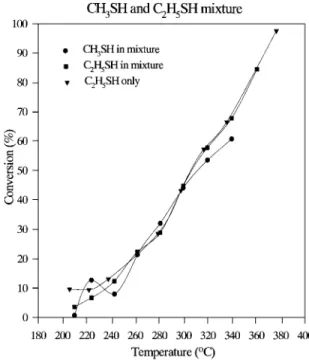
For the case of catalytic incineration of a mixture of C2H5SH
and CH3SH, 94-ppm CH3SH was added into a 155-ppm
C2H5SH simulated gas. To compare its effect with the single
component case, the operating conditions remained the same for both single component and mixture cases. The results are shown in Fig. 9. The existence of CH3SH has no effects on
the conversion of C2H5SH.
CONCLUSIONS
The catalytic incineration of C2H5SH on a Pt/Al2O3catalyst
was conducted over a variety of operating conditions. The re-sults show that the conversion of the C2H5SH increases as the
inlet temperature increases and the space velocity decreases. For a temperature range from 200 – 260⬚C, the higher the C2H5SH concentration is, the lower its conversion. The O2
con-centration has a positive effect on the conversion of C2H5SH.
C2H5SH has a considerable poisoning effect on the Pt/Al2O3
catalyst, especially at a lower temperature. However, the sul-fur-poisoning effect of C2H5SH on the catalyst can be reduced
by raising the operating temperature to a proper higher value. The existence of CH3SH has no effects on the conversion of
C2H5SH.
ACKNOWLEDGMENT
This study was funded by National Science Council, Republic of China (NSC 83-0421-E006-120-Z).
REFERENCES
Chu, H., and Horng, K. (1998). ‘‘The kinetic of catalytic incineration of CH3SH and (CH3)2S over a Pt/Al2O3catalyst.’’ Sci. Total Environment,
Amsterdam, 209, 149–156.
Chu, H., and Lee, W. T. (1998). ‘‘The effect of sulfur poisoning of di-methyl disulfide on the catalytic incineration over a Pt/Al2O3catalyst.’’
Sci. Total Environment, Amsterdam, 209, 217–224.
Chu, H., Lee, W. T., Chiou, Y. Y., and Tseng, T. T. (2001a). ‘‘The kinetics of catalytic incineration of C2H5SH and (CH3)2S2over a Pt/Al2O3
cat-alytic.’’ Envir. Technol., London, in press.
Chu, H., Lee, W. T., Horng, K. H., and Tseng, T. K. (2001b). ‘‘The catalytic incineration of (CH3)2S and its mixture with CH3SH over a
Pt/Al2O3catalyst.’’ J. Haz. Mat., Amsterdam, B82, 43–53.
Chu, H., and Wu, L. W. (1998). ‘‘The catalytic incineration of ethyl mer-captan over a MnO/Fe2O3 catalyst.’’ J. Envir. Sci. Health, A33(6),
1119–1148.
Heyes, C. J., Irwin, J. G., Johnson, H. A., and Moss, R. L. (1982). ‘‘The catalytic oxidation of organic air pollutants, part 1. single metal oxide catalysts.’’ J. Chem. Tech. Biotechnol., Oxford, 32, 1025–1033. Jennings, M. S. (1985). Catalytic incineration for control of volatile
or-ganic compound emissions, Noyes Publication, Park Ridge, N.J.
Pope, D., Walker, D. S., and Moss, R. L. (1976). ‘‘Evaluation of cobalt oxide catalysts for the oxidation of low concentration of organic com-pounds in air.’’ Atmospheric Envir., Oxford, 10, 951–956.
Pope, D., Walker, D. S., and Moss, R. L. (1978). ‘‘Evaluation of platinum-honeycomb catalysts for the destructive oxidation of low concentration of odorous compounds in air.’’ Atmospheric Envir., Oxford, 12, 1921– 1927.
Ross, R. A., and Sood, S. P. (1977). ‘‘Catalytic oxidation of methyl mer-captan over cobalt molybdate.’’ Ind. Eng. Chem. Prod. Res. Dev., 16(2), 147–150.
Spivey, J. J. (1987). ‘‘Complete catalytic oxidation of volatile organics.’’
Ind. Eng. Chem. Res. Dev., 26(11), 2165–2180.
Tichenor, B. A., and Palazzolo, M. A. (1987). ‘‘Destruction of volatile organic compound via catalytic incineration.’’ Envir. Progress, 6(3), 172–176.
Van der Vaart, D. R., Vatavuk, W. M., and Wehe, A. H. (1991a). ‘‘Thermal and catalytic incinerators for the control of VOCs.’’ J. Air Waste Mgmt.
Assn., 41(1), 92–98.
Van der Vaart, D. R., Vatavuk, W. M., and Wehe, A. H. (1991b). ‘‘The cost estimation of thermal and catalytic incinerators for the control of VOCs.’’ J. Air Waste Mgmt. Assn., 41(4), 497–501.
Vo¨lter, J., Lietz, G., Spindler, H., and Lieske, H. (1987). ‘‘Role of metallic and oxidic platinum in the catalytic combustion of n-heptane.’’ J.