Hydrogen sensing properties of a Pt-oxide-GaN Schottky diode
Yan-Ying Tsai,1Kun-Wei Lin,2Huey-Ing Chen,3I-Ping Liu,3Ching-Wen Hung,1 Tzu-Pin Chen,1Tsung-Han Tsai,1Li-Yang Chen,1Kuei-Yi Chu,1and Wen-Chau Liu1,a兲 1
Institute of Microelectronics, Department of Electrical Engineering, National Cheng-Kung University, No. 1, University Road, Tainan, TAIWAN 70101, Republic of China
2Department and Graduate Institute of Computer Science and Information Engineering, Chaoyang University of Technology, No. 168, Jifong East Road, Wufong Township, Taichung, TAIWAN 41349, Republic of China
3Department of Chemical Engineering, National Cheng-Kung University, No. 1, University Road, Tainan, TAIWAN 70101, Republic of China
共Received 23 January 2008; accepted 23 May 2008; published online 29 July 2008兲
The interesting hydrogen sensing properties of a Pt-oxide-GaN metal-oxide-semiconductor-type Schottky diode are comprehensively studied and demonstrated. In the hydrogen-containing environment, the shift in current-voltage curves and decrease in turn-on voltage are found to be caused by the lowering of Schottky barrier height. Also, the corresponding series resistance is decreased from 191.8共in air兲 to 155.3 ⍀ 共for a 9970 ppm H2/air gas兲 at 30 °C. As the carrier gas is replaced by a nitrogen gas, a significant variation of 0.32 V and 19.56 ⍀ in the turn-on voltage Von and series resistance Rs values, respectively, is obtained at 30 ° C, even at an extremely low
hydrogen concentration of 4.3 ppm H2/N2. Since the oxygen atoms will be dissolved on the Pt metal surface and react with hydrogen atoms by the formation of hydroxyl and water, the number of adsorbed hydrogen atoms on the Pt surface is reduced. Moreover, the shorter response time constant and the larger initial rate of current density variation are found even at room temperature. © 2008 American Institute of Physics.关DOI:10.1063/1.2959841兴
I. INTRODUCTION
Hydrogen is a technologically important gas used in many industries, such as semiconductor processes, metal-lurgy, chemical processing, and refining.1Recently, hydrogen has gained a lot of attention as a novel source of energy due to its efficiency and high energy output and because it does not pollute air. However, hydrogen is a flammable and ex-plosive gas. When the hydrogen concentration in air is greater than 4%, a hazardous explosion will occur. Thus, it is necessary to develop a safety monitoring system for detect-ing the hydrogen level usdetect-ing an accurate sensor. The hydro-gen sensor should work in a low hydrohydro-gen concentration, high operating temperature, and wide hydrogen concentra-tion range environment. In addiconcentra-tion, a short response time is also a critical requirement for hydrogen detection in real time applications. Based on the chemical, optical, and electronic transduction methods, difference-type hydrogen sensors were designed and reported in the past.2–4Electronic-based
hydro-gen sensors involving catalytic metal, such as
pyroelectronic,5 electrochemical,6 chemiresistive,7 and semiconductor/field effect sensors,8,9have recently played an important role in hydrogen sensing technology. A number of studies on diode-type hydrogen sensors based on the change of Schottky barrier height at the catalytic metal electrode for a sensing function of hydrogen concentration have been investigated.10,11 In comparison with capacitive devices, the advantage of the Schottky diode is its simplicity in electronic circuitry required for the operating sensors.
Moreover, the hydrogen sensors made by metal-oxide-semiconductor 共MOS兲 type of Schottky diode using com-pound semiconductor materials of wider band gap such as SiC and GaN have been developed and applied in a high-temperature environment.12,13 It is because a large band gap may result in high electron saturation velocity and high breakdown field strength. Furthermore, the MOS structure has better thermal stability than the metal-semiconductor structure and is well-suited to hydrogen sensing.14The prom-ising potential of MOS structure in hydrogen sensing was first pointed out by Lundström.15,16
In this work, an interesting compound-semiconductor-type Schottky diode-based hydrogen sensor with a Pt-oxide-GaN MOS structure is fabricated and studied. Hydrogen sensing characteristics for both the steady state and transient responses are measured under different hydrogen concentra-tions with the carrier gases of air and N2 at different tem-peratures. In the on state of the diode, the hydrogen effects on the turn-on voltage Von and series resistance Rs will be
studied. In the presence of oxygen, the surface reaction be-tween the hydrogen and oxygen atoms may be a dominant factor in diffusing the number of hydrogen atoms into the Pd-semiconductor interface.
II. EXPERIMENTS
The studied Pt/GaN MOS-type Schottky diode-based hy-drogen sensor was grown by a metal organic chemical vapor deposition system on two-inch c-plane sapphire substrates. The epitaxial structure consisted of a 2 m thick undoped GaN buffer layer and a 0.5 m Si-doped GaN active layer with a carrier concentration of 2⫻1018 cm−3. After epitaxial a兲.Author to whom correspondence should be addressed. Electronic mail:
growth, the devices were etched by an inductively coupled plasma reactive ion etching system for mesa isolation. The native oxide on the wafer was removed by a solution of HCl: H2O = 1 : 1. The Ohmic contact, formed by evaporating 100 nm thick Ti/Al metals, was subsequently annealed by a rapid thermal treatment at 900 ° C for 90 s in an N2 ambi-ence. Then, the sample was immediately put into the oven under dry oxygen environment to form a fresh thermal oxide layer to produce the desired MOS structure. Finally, the Schottky contact was produced by the evaporation of Pt metal on the surface of the thin oxide layer. The Pt metal thickness and effective area were 150 Å and 2.05 ⫻10−3 cm2, respectively. The schematic illustration of the studied devices is depicted in Fig.1.
III. RESULTS AND DISCUSSION
Figure 2 shows an example of current-voltage 共I-V兲 characteristics for the studied Pt-oxide-GaN MOS Schottky diode at 120 ° C under the N2, Ar, air, 98 ppm H2/air, and 98 ppm H2/N2 gases. It is well known that the argon environ-ment for hydrogen sensing test is a fundaenviron-mental and simple
situation. In this study, the nitrogen 共N2兲 is used instead of argon. The experimental results of I-V curves are almost the same for these two gases. It means that the nitrogen can also be used as a standard carrier gas. As seen in Fig. 2, the change in forward current density upon the introduction of a 98 ppm H2/N2gas is 1.04 A/cm2at a forward bias of 0.6 V or equivalently 0.41 V at a fixed current density of 1.0 A/cm2. This doubled detection sensitivity makes the studied device suitable for integrated circuit applications. When the carrier gas is replaced by a mixed air including 20% of oxygen gas, the corresponding change in current density is decreased to 0.043 A/cm2at a forward bias of 0.6 V. Since the oxygen gas will be dissolved on the Pt metal surface and react with hydrogen atoms by the formation of hydroxyl and water, the number of adsorbed hydrogen atoms on the Pt surface is reduced.17 In comparison with the I-V curves in N2and air environments, the former exhibits higher current density at a fixed voltage. This suggests that the dis-solved oxygen atoms will occupy the surface sites, which is equivalent to a series resistance to reduce the current density in air environment.
The hydrogen effect on the I-V characteristics with the carrier gas of air at 260 ° C is shown in Fig. 3共a兲. It is seen that the studied device maintains good rectification behavior in air. As the hydrogen gas is introduced, the Schottky recti-fication behavior will be gradually shifted to Ohmic-like property. This suggests that the H-induced dipolar layer will be formed and will lead to the decrease in the effective Schottky barrier height.18–20Thereby the corresponding cur-rent density is increased significantly. For example, when exposed to a 9970 ppm H2/air gas, a linear relationship be-tween the current density and applied voltage is remarkably revealed. In other words, the studied device works as a con-stant resistance of 0.38 ⍀ cm2 under this condition. As the carrier gas is replaced by N2, similar changes in I-V charac-teristics are shown in Fig. 3共b兲. It is shown that even at an extremely low hydrogen concentration of 4.3 ppm H2/N2, a larger voltage shift of 315.4 mV at a fixed current density of 1.0 A/cm2 is found. In addition, a constant resistance of 0.35 ⍀ cm2 is obtained under a 9970 ppm H
2/N2gas. This phenomenon of contact characteristics will be a significant basis for hydrogen sensing, particularly at a high tempera-ture.
As the I-V curves in high-current level 共J
⬎0.5 A/cm2兲 is extended to the applied voltage axis, an intersection point is obtained, which is defined as the turn-on voltage Von as shown in the inset of Fig. 3共a兲. Also, the reciprocal value of the slope of this straight line is defined as the series resistance Rs. In this sense, the diode is a binary
device that exists in only one of two possible operations. In the on state, the diode is forward biased as the applied volt-age across this diode exceeds the cut-in voltvolt-age Von. The off state exists when the applied voltage is less than Von, and in effect, reverse biases the diode. Figure 4共a兲 illustrates the turn-on voltage Vonand series resistance Rsas a function of
hydrogen concentration with the carrier gas of air at different temperatures. Obviously, the Von value becomes constant as the introduced hydrogen concentration is lower than 50.2 ppm H2/air. With increasing hydrogen concentration from FIG. 1. Schematic illustration of the Pt-oxide-GaN MOS Schottky
diode-based hydrogen sensor.
FIG. 2. An example of the current-voltage共I-V兲 characteristics for the stud-ied Pt-oxide-GaN MOS Schottky diode at 120 ° C under the N2, Ar, air, 98
ppm H2/air, and 98 ppm H2/N2environments.
50.2 to 9970 ppm H2/air, the corresponding Von value is decreased from 0.65 to 0.33 V at 30 ° C. Also, similar varia-tions in series resistances are found. For example, the Rs
values at 30 ° C are 191.8, 190.8, 189.4, 180.8, 165.6, and 155.3 ⍀ in air and under 4.3, 50.2, 191, 980, and 9970 ppm H2/air gases, respectively. In addition, a saturation trend is observed under higher concentration hydrogen gas at higher temperature. Because the hydrogen adsorption process is exothermic,21 the number of adsorbed sites at the Pt-oxide interface is decreased with increasing temperature. As seen in Fig.4共b兲, significant variations of 0.32 V and 19.56 ⍀ in Vonand Rsvalues are obtained at 30 ° C, respectively, even at
an extremely low hydrogen concentration of 4.3 ppm H2/N2. Due to the absence of oxygen, the larger number of hydrogen
atoms can diffuse into the Pt-oxide interface resulting in the larger reduction in Schottky barrier height.22 In addition, good linear relationships between the turn-on voltage and logarithm of hydrogen concentration become more promi-nent when the temperature is increased.
Based on the thermionic emission transport mechanism23 with the applied forward voltage V⬎3kT/q, the Schottky barrier heightbcan be approximately calculated from
JF= Jo
冋
exp冉
qV kT冊
− 1册
共1兲 and Jo= AⴱⴱT2exp冉
− qb kT冊
, 共2兲FIG. 3. The hydrogen effect on the J-V characteristics at 260 ° C with the carrier gases of共a兲 air and 共b兲 N2.
FIG. 4. Turn-on voltage Vonand series resistance Rsas a function of
hydro-gen concentration at different temperatures with the carrier gases of共a兲 air and共b兲 N2.
Aⴱⴱ=4qk 2m n ⴱ h3 = 120
冉
mnⴱ mn冊
, 共3兲where JFis the forward-biased conducting current density, Jo
is the reverse saturation current density, is the ideality factor, k is the Boltzmann constant, T is the absolute tem-perature, Aⴱⴱ is the effective Richardson constant, and mnⴱ
and mn are the electron effective mass of GaN material and
free electron mass in the vacuum, respectively. The ideal Richardson constant of GaN is found to be 24 A/K cm2. The hydrogen effect on the variation of Schottky barrier height⌬bwith different carrier gases共N2and air兲 at 30 °C are listed in Table I. As the hydrogen concentration is in-creased, the variations of Schottky barrier height with two carrier gases are increased. The observed lowering of Schottky barrier height can be interpreted by the appearance of a dipolar layer at the Pt-oxide interface.24This layer leads to a shift in the electrostatic potential of semiconductor with respect to the Pt metal.
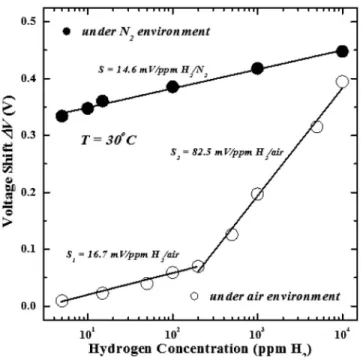
Figure5shows the relationship between the voltage shift ⌬V and logarithm of hydrogen concentration for different carrier gases共air and N2兲 at room temperature. The ⌬V value is defined as the voltage difference under air and H2-contained environments共Vair− VH2兲 at a fixed current of 1
mA. As seen in Fig. 5, it is clear that the sensing signals under the inert environment共N2兲, which is dependent on the interface coverage, are in proportion to the logarithmic
val-ues of hydrogen concentration. This result suggests that the hydrogen adsorption energy at the Pt-oxide interface varies linearly with the hydrogen concentration at the interface ni,25
⌬Hi=⌬Hi,0共1 − k
⬘
ni兲, 共4兲where⌬Hiis the heat change of hydrogen adsorption,⌬Hi,0
is the initial heat change of hydrogen adsorption, and k
⬘
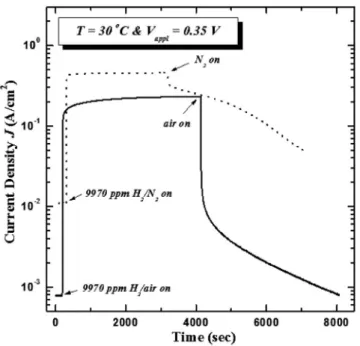
is a constant value. From this linear dependence, the so-called Temkin isotherm26can be used to interpret the hydrogen ad-sorption behavior at the Pt-oxide interface. Furthermore, a significant hydrogen sensitivity ratio of S = 14.6 mV/ppm H2/N2is obtained. However, under the air environment, the corresponding hydrogen responses are lowered due to the catalytic dissociation of hydrogen blocked by the chemi-sorbed oxygen,22especially at the lower hydrogen concentra-tion regime. The data show that the response signal follows two distinctly linear dependences on hydrogen concentration. Under the lower hydrogen concentration regimes, the water and hydroxyl formation rates on the Pt surface are so effec-tive that nearly no hydrogen atom is free to diffuse to the Pt-oxide interface. Nonetheless, the sensor exhibits a 6.88% increase in potential difference under a 98 ppm H2/air gas, which is sufficient for most practical applications. Also, the hydrogen sensitivity ratio is calculated as S1 = 16.7 mV/ppm H2/air. When the high-concentration hy-drogen gases are introduced, the much greater sensitivity ra-tio in a linear increase of S2= 82.5 mV/ppm H2/air can be observed remarkably. In comparison to the hydrogen sensi-tivity ratio in air and in N2environment, the S1and S2values are larger than the S one. This means that the carrier gas including oxygen gas 共like air兲 will improve the hydrogen adsorption rate.22Typical dynamic changes in current density J as a func-tion of time upon exposure to a 9970 ppm H2 gas with dif-ferent carrier gases 共N2 and air兲 are shown in Fig. 6. The sensor responses are measured as a shift in current density when the studied device is held at a constant voltage bias of 0.35 V. Just after exposure to the H2pulse in air or in N2, the sensor responds quickly with a substantial increase in the current density within a few seconds. However, as the time increases, the rate of change of the sensing signal decreases and gradually approaches a saturation value. After switching off the hydrogen gas flow, an initially fast and sharp recovery is observed. This implies that the hydrogen atoms are des-orbed from the catalytic Pt metal surface. It is well-known that desorption of hydrogen from the Pt metal surface may occur by using two methods, i.e., the formation of H2 mol-ecules and the composition of water molmol-ecules. For the car-rier gas of N2, the desorption process is only dependent on the recombination of hydrogen atoms due to the absence of
TABLE I. The variation of Schottky barrier height for the carrier gases of air and N2under different hydrogen
concentrations at 30 ° C.
Carrier gas Air N2
Schottky barrier heightb共eV兲 0.889共in air兲 0.88共in N2兲
Hydrogen concentration共ppm H2兲 4.3 98 9970 4.3 98 9970
Schottky barrier height variation⌬b共meV兲 2.96 22.03 257.73 227.12 262.91 319.33
FIG. 5. The relationship between the voltage shift⌬V and hydrogen con-centration under the mixed air and N2environment at 30 ° C.
oxygen. Thus a slower recovery is obviously seen in com-parison with the carrier gas of air. In addition, the time con-stant of adsorptiona, which is defined as the time required for reaching the inverse exponential magnitude共e−1兲 of the final steady-state value, is dependent on the initial rate of current density variation d⌬J/dt. When a 9970 ppm H2/air gas is introduced, the corresponding values ofaand d⌬J/dt are calculated to be 62 s and 4.80 A/sec, respectively. The
a and d⌬J/dt values upon exposure to a 9970 ppm H2/N2 gas are 76 s and 7.56 A/sec, respectively. Apparently, the
a value with the carrier gas of air is lower than that of N2. However, a larger initial rate is found for the carrier gas of N2. Due to the absence of oxygen, the variation of current density for the carrier gas of N2 共0445 A/cm2兲 is about twice as large as that for the carrier gas of air 共0.229 A/cm2兲. Figure 7 illustrates the curves of transient response upon the introduction and removal of 494, 980, 5040, and 9970 ppm H2/air gases, respectively, under the applied voltage of Vappl= 0.35 V at 150 ° C. Prior to the in-troduction of a new hydrogen gas mixture, the studied sensor is flushed with mixed air in order to recover the sensing electrode surface and also to bring the current density back to the baseline. The adsorption response time is typically less than 10 s to reach a sensing signal level of 90%. As the hydrogen concentration is lowered, the response time con-stanta becomes large. This is likely due to the presence of adsorbed oxygen on the working electrode surface, which will attract the sparsely available hydrogen atoms in the sys-tem by surface chemical reactions.22 At higher concentra-tions, a higher number of hydrogen gas molecules can reach the Pt electrode surface and promote a fast reaction with the catalyst. Thus, a fast response is seen.
IV. CONCLUSION
In this work, the interesting hydrogen sensing character-istics for a GaN-based MOS-type Schottky diode with a Pt
catalytic metal are studied. When this sensor is exposed to hydrogen gas, the Schottky rectification behavior共in air兲 will be gradually shifted to Ohmic-like property. This suggests that the hydrogen-induced dipolar layer is formed and leads to the decrease in the effective Schottky barrier height. In-creasing the hydrogen concentration from 50.2 to 9970 ppm H2/air would decrease the Von value from 0.65 to 0.33 V at 30 ° C. The Rs value is also decreased from 189.4 to
155.3 ⍀. For the carrier gas of N2, the corresponding varia-tions of 0.32 V and 19.56 ⍀ in Von and Rs values are
ob-tained at 30 ° C, respectively, even at an extremely low hy-drogen concentration of 4.3 ppm H2/N2. Due to the absence of oxygen, a large number of hydrogen atoms can diffuse into the Pt-oxide interface so as to greatly reduce the Schottky barrier height. When a 9970 ppm H2/air gas at room temperature is introduced, the corresponding values of
a and d⌬J/dt are calculated to be 62 s and 4.80 A/sec, respectively. The correspondingaand d⌬J/dt values of this studied sensor for a 9970 ppm H2/N2 gas are 76 s and 7.56 A/sec, respectively. These results demonstrate the promise of the studied Pt-oxide-GaN Schottky diode to per-form as a fast-response and sensitive hydrogen sensor over a broad range of operating temperatures.
ACKNOWLEDGMENTS
Part of this work was supported by the National Science Council of the Republic of China under Contract No. NSC 93-2215-E-006-002. This work also utilizes the Shared Fa-cilities supported by the Program of Top 100 Universities Advancement, Ministry of Education, Taiwan.
1F. DiMeo, Jr., I. S. Chen, P. Chen, J. Neuner, A. Roerhl, and J. Welch, Sens. Actuators B117, 10共2006兲.
2F. J. Ibanez and F. P. Zamborini, Langmuir 22, 9789共2006兲.
3Z. Zhao, M. A. Carpenter, H. Xia, and D. Welch,Sens. Actuators B113,
532共2006兲.
4Y.-I. Chou, C. M. Chen, W. C. Liu, and H. I. Chen,IEEE Electron Device Lett.26, 62共2005兲.
5C. Christofides and A. Mandelis,J. Appl. Phys.68, R1共1990兲.
FIG. 6. The curves of transient response with two testing gases 9970 ppm H2/N2and N2共dashed lines兲 and 9970 ppm H2/air and air 共solid lines兲 at
room temperature. The applied voltage is fixed at 0.35 V.
FIG. 7. The curves of transient response under different hydrogen concen-tration with the carrier gas of air at 150 ° C.
6B. J. Lutz, Z. H. Fan, T. Burgdorf, and B. Frieldrich,Anal. Chem.77,
4969共2005兲.
7T. Xu, M. P. Zach, Z. L. Xiao, D. Rosenmann, U. Welp, W. K. Kwok, and
G. W. Crabtree,Appl. Phys. Lett.86, 203104共2005兲.
8Y. Y. Tsai, C. W. Hung, K. W. Lin, P. H. Lai, S. I. Fu, H. M. Chuang, H.
I. Chen, and W. C. Liu,Semicond. Sci. Technol.21, 221共2006兲.
9C. C. Cheng, Y. Y. Tsai, K. W. Lin, H. I. Chen, and W. C. Liu,Appl. Phys. Lett.86, 112103共2005兲.
10Y. Y. Tsai, C. W. Hung, S. I. Fu, P. H. Lai, H. I. Chen, and W. C. Liu, Electrochem. Solid-State Lett.9, H108共2006兲.
11H. I. Chen, Y. I. Chou, and C. Y. Chu,Sens. Actuators B85, 10共2002兲. 12S. Kandasamy, A. Trinchi, W. Wlodarski, E. Comini, and G. Sberveglieri,
Sens. Actuators B 111-112, 111共2005兲.
13J. Song, W. Lu, J. S. Flynn, and G. R. Brandes,Solid-State Electron.49,
1330共2005兲.
14M. A. Khan, X. Hu, G. Sumin, A. Lunev, J. Yang, R. Gaska, and M. S.
Shur,IEEE Electron Device Lett.21, 63共2000兲.
15I. Lundström,Sens. Actuators1, 403共1981兲. 16I. Lundström,Sens. Actuators2, 105共1982兲.
17C. C. Cheng, Y. Y. Tsai, K. W. Lin, H. I. Chen, C. T. Lu, and W. C. Liu,
Sens. Actuators B99, 425共2004兲.
18M. Miyoshi, Y. Kuraoka, K. Asai, T. Shibata, M. Tanaka, and T. Egawa,J. Vac. Sci. Technol. B25, 1231共2007兲.
19M. Ali, V. Cimalla, V. Lebedev, H. Romanus, V. Tilak, D. Merfeld, P.
Sandvik, and O. Ambacher,Sens. Actuators B113, 797共2006兲.
20B. S. Kang, S. Kim, F. Ren, B. P. Gila, C. R. Abernathy, and S. J. Pearton, IEEE Sens. J.5, 677共2005兲.
21W.-C. Liu, K. W. Lin, H. I. Chen, C. K. Wang, C. C. Cheng, S. Y. Cheng,
and C. T. Lu,IEEE Electron Device Lett.23, 640共2002兲.
22J. W. Medlin, A. E. Lutz, R. Bastasz, and A. H. McDaniel,Sens. Actuators B96, 290共2003兲.
23S. M. Sze, Semiconductor Devices, Physics and Technology共Willey, New
York, 1985兲.
24Y. Y. Tsai, H. I. Chen, C. W. Humg, T. P. Chen, T. H. Tsai, K. Y. Chu, L.
Y. Chen, and W. C. Liu,J. Electrochem. Soc.154, J357共2007兲.
25A. Salomonsson, M. Eriksson, and H. Dannetun, J. Appl. Phys. 98,
014505共2005兲.
26M. Eriksson, I. Lundström, and L. G. Ekedahl,J. Appl. Phys.82, 3143
共1997兲.