嘉南藥理科技大學專題研究計畫成果報告
中草藥化妝品開發子計畫(1)—類黃酮素之活性評估
計畫類別:□個別型計畫 ■整合型計畫 計畫編號:CNIC93-01
執行期間:93 年 1 月 1 日至 93 年 12 月 31 日
計畫主持人:陳榮秀 共同主持人:林清宮 計畫參與人員:
執行單位:化粧品科技研究所
中華民國 94 年 02 月 20 日
一、摘要:
在文獻及往年研究發現天然物中含有豐富之類黃酮素、異黃酮素,此類 其藥理作用部分已確認,但在化粧品之應用仍不足,故本計畫以類黃酮素及 相關衍生物檢測其抗氧化活性,希望能將此類成分開發在化粧品之應用上。
本計畫使用之黃酮素或類黃酮的成分,包括Catechin、EGCG、Quercetin、
Myricetin 等,分別進行各項抗氧化效果之評估,方法包含 DPPH、NO 清除等。
結果顯示其濃度在100 µM 時,清除 DPPH 能力均大於 80 %;而一氧化氮清除 能力則以 Myricetin 效果最好,同時也具有酪胺酸酶抑制能力,因此未來開發 化粧品時可考慮此類成分
。
二、前言:
基於實驗環境分析設備的利用性以及研發者的興趣,有很多很複雜的方法 來評估自由基活性。在缺乏任何自由基活性測定的黃金標準,三種主要的方法已 被運用:(1) 內源性抗氧化劑濃物的測定、(2)氧化性聚分子產物的測定、(3) 自由基的直接偵測。為了分析內源性抗氧化劑能力,大部分的研究已經在血漿及 細胞測定抗氧化劑濃度(例如:vitamin E、 C、 carotenoids 、folate、 GSH 和 zinc)以及細胞的抗氧化酵素的活性(例如 glutathion reductase 、SOD 、 catalase 和 glutathione peroxidase)。 因為 GSH 可由自由基和其他活性氧快 速地氧化成 GSSG ,而且 GSSG 會從細胞被釋出,所以,細胞內[GSSG]:[GSH]的 比例可以提供氧化壓力一項參考指標。
脂質過氧化的評估包含分析脂質過氧化、isoprostanes、 diene conjugates 以 及 脂 質 裂 解 的 產 物 ( 例 如 malonaldehyde 、 ethane 、 pentane 和 4-hydroxynonenal)。在這些產物中,malonaldehyde 是時常被用來當作脂質過 氧化可靠的標的物。為了測定活性氧所誘發的蛋白質氧化,大部分研究者已經測 定醣蛋白產生中蛋白質內游離硫基團的喪失,以及蛋白質鍵結酪胺酸殘基的硝酸 反應。事實上蛋白質硝基酪氨酸已被廣泛當作穩定標地物,用於活性氮中心氧化 劑的產生(例如一氧化氮及過氧亞硝鹽)。特殊的 DNA 鹼基氧化的產物,例如:
8-hydroxydeoxyquanosine、 5-OH cytosine、 8-OH adenine 、8-OH quinine 以 及 thymine glycol 已經被測定出時常用來評估 DNA 鹼基的氧化反應。 重要的 是,尿液中 8-hydroxydeoxyguanosine 成分在人體和動物上,可以提供有用的非 侵犯性的來評估整體的 DNA 鹼基氧化反應。另一方面自由基直接的偵測已經可以 利用電子自旋技術及電子捕捉儀而呈現,但此技術是適於偵測自由基在溶液化學 上,對於生物組織的應用上仍有限制。總之,雖然測抗氧化的方法很多,不過以 簡便性而言,仍以 DPPH 及 NO 清除率最為簡易。
三、材料與方法:
1. 一氧化氮濃度的測定 I、試劑的配置
SNP 儲存溶液(Stock solution):
精稱適量SNP 粉末溶於 ddH2O 至最終濃度為 100mM,分裝後儲存於-20℃
冰箱,實驗中置於冰上慢慢解凍以維持其活性。
II、測定方法
a.備好不同濃度之樣品於 1.5ml eppendorf 中,每個均加入 5mM SNP 溶液 (Sample solution),另外取一個空 eppendorf 加入 5mMSNP 溶液(Positive control),置於室溫,在 2.5 小時於各自不同濃度的 eppendorf 取樣定量一 氧化氮之濃度。
b.每個樣品取 50µl 加入 96 well ELISA reader plate 中,再加入 50µlGriess reagent,然後置於室溫 10 分鐘。
c.利用 ELISA reader 波長 540nm 偵測吸光值此方法主要測定 NO2-(NO 會變 成穩定的NO2- ,共作三次。
d.一氧化氮產生的清除率:
由實驗結果所測得的值,可利用下列公式計算其抑制率:
Nitric Oxide Scavenging Percentage(%)
=((Positive control Abs-Sample solution Abs)/Positive control Abs)*100%
2. 清除 1,1-二苯基-2-苦味氫氧基團(1,1-diphenyl-2-picryl hydrazyl, DPPH)自由基 能力測定:
I、試劑的配置(stock solution preparation ) DPPH 乙醇溶液:
精秤適量DPPH 粉末溶於乙醇溶液至最終濃度為 20mg/l,冷暗藏保存。
II、測定方法:
a.取 375µL 之不同濃度之乙醇溶液,分別加入配製好之 20mg/ml DPPH 乙 醇溶液750µL,呈深紫藍色,混合均勻,反應 0-30 分鐘。
b.以分光光度計,在 517nm 波長下,測定其吸光值。(DPPH 自由基清除 能力 % =[(控制組在 517nm 下吸光值-試樣在 517nm 下吸光值)/控 制組在517nm 下吸光值] x 100)
3. 酪胺酸酶活性抑制的測定 (Assay of Tyrosinase Inhibitory Activity ) I、試劑的配置(stock solution preparation )
a. 酪胺酸緩衝溶液(Tyrosine Buffer Solution) :
精稱0.5 克酪胺酸(L-Tyrosine),加入磷酸緩衝溶液(PBS)定量至 100 毫升,
混合後靜置30 分鐘,取上清液。
b. 酪胺酸酶水溶液(Tyrosinase Solution):
將酪胺酸酶(Tyrosinase, 3216 unit/mg) 溶於緩衝液至最終濃度為 2mg/ml,
分裝後儲存於-20℃冰箱,要用時置於冰上慢慢解凍以維持其活性。
II、測定方法
a. 取 100µl 待測濃度加入 900µl 酪胺酸溶液(B)及 5µl 酪胺酸酶(E),另外取 1000µl 酪胺酸溶液(B)同樣加入 5µl 酪胺酸酶(E)當負向空白對照組以及 1000µl 酪胺酸溶液(B)當正向空白對照組,充分混合十分鐘後置入 37℃的 恆溫循環水浴箱(water bath)中 1 小時。
b.每個樣品取 100µl 加至 96 well ELISA reader plate,利用 ELISA reader 波
長450nm 偵測吸光值,共作三次。
c.酪胺酸酶活性的抑制率:
由實驗結果所測得 B,B+E,S+B+E,S+B 的 Abs 值,可利用下列公式計 算其抑制率:
Tyrosinase inhibition(%)=((BE-B)-(SBE-SB)/(BE-B))*100%
四、結果與討論:
我們利用Griess reaction 來探討一氧化氮清除能力,一氧化氮(nitric oxide) 的產生,是從 SNP 與氧反應形成亞硝酸(nitrite)的累積。在表中明顯顯示一氧化 氮清除效果myricetin>quercetin,EGCG>Catechin。myricetin 具有較佳的一氧化 氮作用,推測其結構中,氫氧基團(OH)具有還原一氧化氮自由基能力,使自由 基變成非自由基而達到清除的目的。由此可見含有氫氧基團對於自由基的清除作 用具有很大的影響力,至於詳細的機制就更待進一步的研究了。
為了評估一氧化氮的抑制是否與自由基的清除有相關性,於是利用 DPPH
自由基清除試驗來評估其功能。研究指出DPPH 的機轉可由下列方程式表示:
DPPH. + (AH)n→DPPH-H + (A.)n (紫色) (黃色)
研究顯示減少DPPH 的吸光值,是由於酚類化合物的結構中,提供了氫原 子給DPPH 自由基,因此酚類化合物中的氫氧基團扮演清除的重要角色。尤其是 黃酮類化合物A 環中 3-,5-氫氧基團、 B 環中若含有 catechol 基團(o-dihydroxyl) 及C 環的 2,3-雙鍵與 4-oxo 構型時,會增加 DPPH 自由基的清除。本實驗較佳的 DPPH 清除劑中,大多含有四到八個不等的氫氧基團,是具備清除活性的原因。
總結,myricetin 在抑制酪胺酸酶、DPPH、NO 清除方面,均有不錯的效果。顯 示氫氧基團之數目及位置均扮演重要角色。
Compounds (100μM)
Scavenging effect of DPPH free radical production
Scavenging effect of nitric oxide
Inhibitory effect of tyrosinase activity Flavanol compounds
Catechin
97.99±0.23 29.53±1.29 N
EGCG
93.86±3.66 33.57±4.93 9.46±1.41
Flavonol compounds
Quercetin
96.44±0.00 18.57±1.83 28.49±6.03
Myricetin
85.13±5.94 37.92±4.78 51.07±3.42
Other compounds Curcumin
87.55±3.43 17.68±1.88 62.54±2.21
α-Tocopherol
95.96±2.06 4.37±0 5.59±0.79
Ascorbic acid
82.22±18.29 12.46±1.56 9.63±4.88
N, no effect up to a concentration of 100µM.
*The value ± SE obtained from three separate experiments are shown.
五、參考文獻:
1. April CS, Jackson IJ, and Kidson SH. Molecular cloning and sequence analysis of a chicken cDNA encoding tyrosinase-related protein-2/DOPAchrome tautomerase. Gene 219: 45-53, 1998.
2. Beckman JS and Koppenol WH. Nitric oxide, superoxide, and peroxynitrite: the good, the bad, and ugly. Am J Physiol 271: C1424-1437, 1996.
3. Evans P and Halliwell B. Micronutrients: oxidant/antioxidant status. Br J Nutr 85 Suppl 2: S67-74, 2001.
4. Fridovich I. Fundamental aspects of reactive oxygen species, or what's the matter with oxygen? Ann N Y Acad Sci 893: 13-18, 1999.
5. Fuchs J, Mehlhorn RJ, and Packer L. Free radical reduction mechanisms in mouse epidermis skin homogenates. J Invest Dermatol 93: 633-640, 1989.
6. Haenen GR, Paquay JB, Korthouwer RE, and Bast A. Peroxynitrite scavenging by flavonoids.
Biochem Biophys Res Commun 236: 591-593, 1997.
7. Hirano R, Sasamoto W, Matsumoto A, Itakura H, Igarashi O, and Kondo K. Antioxidant ability of various flavonoids against DPPH radicals and LDL oxidation. J Nutr Sci Vitaminol (Tokyo) 47:
357-362, 2001.
8. Ignarro LJ, Cirino G, Casini A, and Napoli C. Nitric oxide as a signaling molecule in the vascular system: an overview. J Cardiovasc Pharmacol 34: 879-886, 1999.
9. Jackson MJ. An overview of methods for assessment of free radical activity in biology. Proc Nutr Soc 58: 1001-1006, 1999.
10. Johnson MK and Loo G. Effects of epigallocatechin gallate and quercetin on oxidative damage to cellular DNA. Mutat Res 459: 211-218, 2000.
11. Kahkonen MP, Hopia AI, and Heinonen M. Berry phenolics and their antioxidant activity. J Agric Food Chem 49: 4076-4082, 2001.
12. Kahraman S and Demiryurek AT. Propofol is a peroxynitrite scavenger. Anesth Analg 84: 1127-1129, 1997.
13. Kikuchi K, Nagano T, Hayakawa H, Hirata Y, and Hirobe M. Real time measurement of nitric oxide produced ex vivo by luminol-H2O2 chemiluminescence method. J Biol Chem 268: 23106-23110, 1993.
14. Lass A, Suessenbacher A, Wolkart G, Mayer B, and Brunner F. Functional and analytical evidence for scavenging of oxygen radicals by L-arginine. Mol Pharmacol 61: 1081-1088, 2002.
15. Lawler JM, Barnes WS, Wu G, Song W, and Demaree S. Direct antioxidant properties of creatine.
Biochem Biophys Res Commun 290: 47-52, 2002.
16. McCord JM. The evolution of free radicals and oxidative stress. Am J Med 108: 652-659, 2000.
17. Menconi MJ, Unno N, Smith M, Aguirre DE, and Fink MP. Nitric oxide donor-induced hyperpermeability of cultured intestinal epithelial monolayers: role of superoxide radical, hydroxyl radical, and peroxynitrite. Biochim Biophys Acta 1425: 189-203, 1998.
18. No JK, Soung DY, Kim YJ, Shim KH, Jun YS, Rhee SH, Yokozawa T, and Chung HY. Inhibition of tyrosinase by green tea components. Life Sci 65: PL241-246, 1999.
19. Ohshima H, Yoshie Y, Auriol S, and Gilibert I. Antioxidant and pro-oxidant actions of flavonoids:
effects on DNA damage induced by nitric oxide, peroxynitrite and nitroxyl anion. Free Radic Biol Med 25: 1057-1065, 1998.
20. Olivares C, Garcia-Borron JC, and Solano F. Identification of active site residues involved in metal cofactor binding and stereospecific substrate recognition in Mammalian tyrosinase. Implications to the catalytic cycle. Biochemistry 41: 679-686, 2002.
21. Pellegrini N, Simonetti P, Gardana C, Brenna O, Brighenti F, and Pietta P. Polyphenol content and total antioxidant activity of vini novelli (young red wines). J Agric Food Chem 48: 732-735, 2000.
22. Perez-Gilabert M and Garcia Carmona F. Characterization of catecholase and cresolase activities of eggplant polyphenol oxidase. J Agric Food Chem 48: 695-700, 2000.
23. Pfeiffer S, Schrammel A, Koesling D, Schmidt K, and Mayer B. Molecular actions of a Mn(III)Porphyrin superoxide dismutase mimetic and peroxynitrite scavenger: reaction with nitric oxide and direct inhibition of NO synthase and soluble guanylyl cyclase. Mol Pharmacol 53: 795-800, 1998.
24. Podrez EA, Schmitt D, Hoff HF, and Hazen SL. Myeloperoxidase-generated reactive nitrogen species convert LDL into an atherogenic form in vitro. J Clin Invest 103: 1547-1560, 1999.
25. Rassaf T, Preik M, Kleinbongard P, Lauer T, Heiss C, Strauer BE, Feelisch M, and Kelm M. Evidence for in vivo transport of bioactive nitric oxide in human plasma. J Clin Invest 109: 1241-1248, 2002.
26. Shin NH, Ryu SY, Choi EJ, Kang SH, Chang IM, Min KR, and Kim Y. Oxyresveratrol as the potent inhibitor on dopa oxidase activity of mushroom tyrosinase. Biochem Biophys Res Commun 243:
801-803, 1998.
27. Squadrito GL and Pryor WA. Oxidative chemistry of nitric oxide: the roles of superoxide, peroxynitrite, and carbon dioxide. Free Radic Biol Med 25: 392-403, 1998.
28. Sreejayan and Rao MN. Nitric oxide scavenging by curcuminoids. J Pharm Pharmacol 49: 105-107, 1997.
29. Sun JS, Hang YS, Huang IH, and Lu FJ. A simple chemiluminescence assay for detecting oxidative stress in ischemic limb injury. Free Radic Biol Med 20: 107-112, 1996.
30. Szabo A, Hake P, Salzman AL, and Szabo C. Beneficial effects of mercaptoethylguanidine, an inhibitor of the inducible isoform of nitric oxide synthase and a scavenger of peroxynitrite, in a porcine model of delayed hemorrhagic shock. Crit Care Med 27: 1343-1350, 1999.
31. Timmins GS, dos Santos RE, Whitwood AC, Catalani LH, Di Mascio P, Gilbert BC, and Bechara EJ.
Lipid peroxidation-dependent chemiluminescence from the cyclization of alkylperoxyl radicals to dioxetane radical intermediates. Chem Res Toxicol 10: 1090-1096, 1997.
32. Velazquez E, Tournier HA, Mordujovich de Buschiazzo P, Saavedra G, and Schinella GR. Antioxidant activity of Paraguayan plant extracts. Fitoterapia 74: 91-97, 2003.
嘉南藥理科技大學專題研究計畫成果報告
中草藥化妝品開發子計畫(二)-微生物產物之活性評估及配方研發
計畫類別:□個別型計畫 ■整合型計畫 計畫編號:CNIC93-01
執行期間:93 年 1 月 1 日至 93 年 12 月 31 日
計畫總主持人:陳榮秀 子計畫主持人:陳榮秀 共同主持人: 張德生
計畫參與人員:張德生、邱靖芳
執行單位:化粧品應用與管理系
中華民國 94 年 02 月 24 日
一、 摘要:
我們選用土壤中的放線菌所生產的抗生素作為標的物,用以判別微陣列盤 是否適合用於篩選出微生物二次代謝產物的培養容器。我們將土讓樣品中所分離 的 96 株放線菌,分別在 250 ml 玻璃搖瓶(含有 25 ml 培養基)、15 ml 離心管(含 有 1.5 ml 培養基)、每孔容量 2.2 ml 之 96 孔微陣列盤(含有 0.22 ml 培養基) 及每孔容量 4.8 ml 之 48 孔微陣列盤(含有 0.48 ml 培養基)中以 200 rpm 轉速室 溫震盪培養五天,接著以格蘭氏陽性枯草桿菌測量每管發酵液中是否含有抗生 素。結果我們在利用 250 ml 玻璃搖瓶作為發酵培養的實驗組中,篩到七株土壤 放線菌其發酵液中具有抗格蘭氏陽性枯草桿菌生長的能力,其中五株同時在 15 ml 離心管及 48 孔微陣列盤亦被篩選出來。另一方面,在利用 96 孔微陣列盤作 為發酵培養的實驗組中則僅篩到其中的二株菌。此結果顯示以 48 孔微陣列盤作 為篩選培養容器,可同時達到快速且準確的結果。
二、 前言:
微生物是地球上生物多樣性中,種類最多的一個族群。伴隨其生長所生產的 代謝產物種類更是多采多姿,其中又以許多的微生物二次代謝產物為最複雜且豐 富的一群天然化學分子[1]。在眾多的微生物二次代謝產物中,已有許多特殊分 子被發現具有特殊的應用價值[2-3]。因此,至今仍有許多科學家專注於篩選最 新且有用的微生物二次代謝產物[4]。
然而,針對許多微生物二次代謝產物篩選的工作而言,篩選效率是能夠篩到 所需要特殊功能微生物的最重要因素之一。大部分的微生物二次代謝產物篩選的 工作都是將由樣品所分離出來的微生物在玻璃搖瓶中進行發酵,接著再從玻璃搖 瓶中取出發酵液進行所欲篩選的生物活性分析。對於上述的篩選流程,雖然篩選 的準確性高,但是最大的缺點是其篩選效率不高。在產業界中,或許可由大量設 備(整層搖瓶培養室)及人力(操作員)加以克服,但是對於學術研究中,以增加大 量的設備及人力來增加篩選效率卻是很困難並不切實際的方法。
針對上述問題,我們嘗試利用微陣列盤加以改善。若將由樣品所分離出來的 微生物在微陣列盤中進行發酵,接著再從微陣列盤中進行生物活性分析,則整個 篩選程序的效率可以增加。然而,將培養容器由玻璃搖瓶改成微陣列盤,由於培 養容器不同,造成環境如溶氧值(DO value)、混合時間(Mixing time)、磨差壓 力(Shearing stress)等因素改變,進而影響所篩選培養的微生物生產其二次代 謝產物的能力[5]。因此,本研究選用土壤中的放線菌所生產的抗生素作為標的 物,將土讓樣品中所分離的 96 株放線菌,分別在玻璃搖瓶、離心管、96 孔微陣 列盤及 48 孔微陣列盤中進行培養,並且比較彼此篩選的正確性。結果我們發現 以 48 孔微陣列盤作為篩選培養容器,可同時達到快速且準確的結果。
三、 材料與方法:
3.1 材料
儀器:震盪器、白金環棒、酒精燈、震盪培養箱、八爪與單爪吸取器。
材料: 1.5 ml 離心管、藥杓、牙籤、L 型玻棒、每孔容量 2.2 ml 之 96 孔 微陣列盤、每孔容量 4.8 ml 之 48 孔微陣列盤、微量吸管、乙醇、
石蠟膜、1.5 ml 無菌離心管。
溶液備製:6 %酵母萃取液及 0.05 %SDS、無菌水、酒精、AI plate (per liter:
Sodium caseinate 2.0g/ Sodium propionate 4.0g/ Asparagine 0.1g/ K2HPO4 0.5g/ MgSO4 0.1g/ FeSO4 1mg/ Nalidixic acid 20mg / Cycloheximide 50mg/ Agar 15g/ pH7.2)、GYM medium (per liter:
Glucose 4.0g/ Yeast extract 4.0g/ Malt extract 10.0g/ pH7.2)。
3.2 土壤菌株分離
樣品收集方法是以藥杓將欲採集土壤表面下方 2-3 公分之土壤,裝入無菌 1.5 ml 離心管中,帶回實驗室中進行下一步驟菌株分離。土壤樣品來自於北二 高各處休息站之土壤,包括有新化、東山、古坑、南投、清水及西湖等 6 處,共 6 種樣品,採集日期為 93 年 4 月 17 日。
採回的樣品接著進行樣品前處理步驟:將土壤樣品懸濁於 1.0 ml 的 6 % 酵母萃取液及 0.05 %的 SDS 中,置於恆溫 40℃震盪器攪拌使其均勻懸浮二小時。
將前處理完成之樣品,靜置數分鐘使大顆粒沉降底部後,取上清液以無菌水做一 系列稀釋後(10-2, 10-4),分別取原液及稀釋液 100 ul 塗佈於分離培養基(AI plate) 中,置於室溫五天,等待菌落形成。
3.3 分離菌株發酵培養
利用滅過菌的牙籤將 2.2 步驟所得到的 96 個單一菌落分別挑至含有 2.0 ml GYM 發酵培養基的 15 ml 離心管中,置於室溫震盪培養箱培養 2 天。
接著將初培養完成的 96 株分離菌株分別以十分之一的接菌量接種至含有 25 ml GYM 發酵培養基的 250 ml 玻璃搖瓶、含有 1.5 ml GYM 發酵培養基的 15 ml 離心管、含有 0.22 ml GYM 發酵培養基的 96 孔微陣列盤及含有 0.48 ml GYM 發 酵培養基的 48 孔微陣列盤中,以 200 rpm 轉速於室溫震盪培養五天,接著進行 抗生素生產測試。
3.4 抗生素生產測試
將過夜培養完成的格蘭氏陽性枯草桿菌與等倍體基滅過菌置於恆溫 45℃的 種層洋菜膠(0.75 % agar)快速混合均勻後,倒入預先準備好含有底層洋菜膠(1.5
% agar)的培養皿中,置於無菌台上 30 分鐘待其凝固,進行下一步驟。
將 2.3 步驟中所得到的分離菌株之發酵液以滅過菌之牙籤沾濕後插入上述所 置備之含有格蘭氏陽性枯草桿菌的測試培養皿中,如此將所有分離菌株在不同容 器培養所得之發酵液按不同組別以編號次序依序插上測試培養皿中,最後將所有 牙籤拔除,並將測試培養皿置於 37℃過夜培養後觀察培養皿中是否有透明圈
(clear zoom)形成,並紀錄各組中有形成透明圈的分離菌株編號。同時觀察其所 形成透明圈的大小。此步驟實驗需重複三次。
四、 結果
4.1 土壤菌株分離為了有效自土壤中分離出放線菌,我們使用放線菌專用的分離培養基(actinomycete isolation agar,AI agar) [6]。在所取樣的每個土壤樣品中,最少可以分離出 100 株菌株,最多可 以分離出超過 1000 株菌株。其中可以發現自古坑及南投休息站所取得的土壤為富含有機質的黑 土,可以分離出最多的放線菌。此外,雖然使用放線菌專用的分離培養基作為菌株分離之用,但 是仍有少數的黴菌生長。但不致影響往後的實驗,因為本實驗總共須 96 株放線菌。為了分散篩 選樣本,我們分別自每個土壤樣品中挑選 16 株共 96 株菌株作為往後實驗用。
表一:各種培養容器所篩選出具有抗格蘭氏陽性枯草桿菌生長的分離放線菌菌株編號 培養容器
菌株編號
250 ml 玻 璃搖瓶
15 ml 離 心管
96 孔微陣 列盤
48 孔微陣 列盤
No.2 + + - -
No.14 +++ + - +
No.28 +++ + + +
No.29 +++ + + +
No.31 + - - -
No.73 + + - +
No.90 + - - +
+++:平均透明圈半徑大於 1 mm。
+:平均透明圈半徑小於 1 mm。
-:肉眼無法辨識具有形成之透明圈。
4.2 分離菌株發酵培養及抗生素生產測試
將所分離之 96 株土壤放線菌於不同的容器進行發酵培養,並進行二次代謝物抗生素生產的 篩選實驗,結果如表一所示。在利用 250 ml 玻璃搖瓶作為發酵培養的實驗組中,我們篩到七株 土壤放線菌其發酵液中具有抗格蘭氏陽性枯草桿菌生長的能力,其中有三株分離菌株之發酵液具 有較強的抗菌能力。另外,利用 15 ml 離心管及 48 孔微陣列盤亦分別自該七株菌中篩出五株。
另一方面,在利用 96 孔微陣列盤作為發酵培養的實驗組中則僅篩到其中的二株菌。
若將上述各組所篩選到的菌株數目以 250 ml 玻璃搖瓶該組作為基準,可以算出各種培養容 器之相對篩選正確率,如表二所示。其中,以 15 ml 離心管及 48 孔微陣列盤作為發酵篩選的培 養容器,其相對篩選正確率均可達到 70 %以上。然而使用 96 孔微陣列盤作為發酵篩選的培養容 器,其相對篩選正確率則僅剩下不到三成。
表二:各種培養容器之相對篩選正確率a
250 ml 玻璃 搖瓶
15 ml 離 心管
96 孔微陣 列盤
48 孔微陣 列盤 相對正
確率
100.0 % 71.4 % 28.5 % 71.4 %
a:相對篩選正確率計算以該組所篩出的菌株數目除以 250 ml 玻璃搖瓶該組所篩的菌株數目,並 換算為百分比。
由上述結果可以推測,以 250 ml 玻璃搖瓶作為發酵培養,其所提供的環境因子如溶氧值、
混合時間等因素比較適合微生物生產二次代謝產物。特別是菌株編號 14、28 及 29 等三株篩選菌,
僅在以 250 ml 玻璃搖瓶作為發酵培養的條件下可以表現出高抗菌效果的結果。此外,由於大部 分的放線菌為非常耗氧的細菌,因此 250 ml 玻璃搖瓶應該可以提供較大的氧氣質傳速率(kLa value),也因此其中的放線菌生長較好,進而增加往後的二次代謝產物生成。然而,將培養容器 由玻璃搖瓶改成 96 孔微陣列盤,由於培養容器不同,造成環境改變,進而影響所篩選培養的微 生物生產其二次代謝產物的能力。
五、討論:
本研究結果顯示以 48 孔微陣列盤作為篩選培養容器,可同時兼顧快速且準確的菌株篩選 需求。若針對所欲篩選分析的生物活性,可以利用呈色法或測量濁度法而在微陣列盤適用的分光 光度計如 elisa reader 或 micro plate reader 下進行操作,則整套大量快速篩選之操作程序可 以依序在不同的微陣列盤下完成:先利用 48 孔微陣列盤進行初級與生產發酵培養,再利用 96 孔免疫螢光盤進行生物活性測試。我們認為此大量快速之篩選平台有助於提高學術界在篩選菌株 時之篩選效率。
六、參考文獻:
1. Omura S, Ikeda H, Ishikawa J, Hanamoto A, Takahashi C, Shinose M, Takahashi Y, Horikawa H, Nakazawa H, Osonoe T, Kikuchi H, Shiba T, Sakaki Y, Hattori M (2001) Genome sequence of an industrial microorganism Streptomyces avermitilis:
deducing the ability of producing secondary metabolites. Proc Natl Acad Sci USA 98:12215-12220
2. Thompson CJ, Fink D, Nguyen LD (2002) Principles of microbial alchemy:
insights from the Streptomyces coelicolor genome sequence. Genome Biol 3:1-4 3. Doekel S, Marahiel A (2001) Biosynthesis of natural products on modular peptide
synthetases. Metabol Engineer 3:64-77
4. Basilio A, Gonzalez I, Vicente MF, Gorrochategui J, Cabello A, Gonzalez A,
Genilloud O (2003) Patterns of antimicrobial activities from soil actinomycetes isolated under different conditions of pH and salinity. J Appl Microbiol
95:814-823
5. Challis GL, Hopwood DA (2003) Synergy and contingency as driving forces for the evolution of multiple secondary metabolite production by Streptomyces species. Proc Natl Acad Sci USA 100:14555-61
6. Difco laboratories: Bacto-actinomycete isolation agar. Code 0957 (1962) In Difco Supplementary Literature. Difco Lab., Detroit USA.
嘉南藥理科技大學專題研究計畫成果報告
中草藥化粧品中抗氧化能力之有效性評估
計畫類別:□個別型計畫 █整合型計畫 計畫編號:CNIC-01 子計畫(3)
執行期間:93 年 1 月 1 日至 933 年 12 月 31 日
總計畫主持人:陳榮秀 子計畫主持人:楊朝成
計畫參與人員:楊朝成、林小菁、羅苓瑜
執行單位:化粧品科技研究所
中華民國 94 年 02 月 28 日
摘 要
本研究主要篩選黃耆、枸杞、何首烏及杜仲等四種知名中草藥,利用不同有 機溶劑萃取後,藉由 TEAC 與 DPPH 抗自由基測試法評估其抗氧化能力評估。
實驗結果顯示何首烏之乙醇溶液部分抗氧化能力最強(IC 50 = 4.60 ppm)(與 Trolox 效果相似),另外,黃耆之乙醇溶液部分、何首烏之丁醇溶液部分、杜仲 之乙醇溶液部分、枸杞 LCE 之乙醇溶液部分也有不錯的抗氧化效果。
前 言
永保年輕、美麗是每一個女人共通的夢想,永遠青春、活力也是所有男人同 樣的願望。可是隨著年齡增長,不管是男人或是女人,都會隨著年齡而在身體內 外留下歲月痕跡,逐漸老化。這是多麼令人傷心失望的現實。老化的確是不能避 免的必然過程,但為何有些人老得快,還不到六十歲,卻像七十幾歲一般;而有 些人卻老得慢,明明是已快八十了,卻還常常被誤認為六十幾歲,可見老化的速 度是因人而異的。這些因素某部分雖有其遺傳關係,但這其中最大差異性與其日 常生活、飲食等習慣有密切關連。
目前還不是十分瞭解老化的確切機轉,但已知道和活過氧化物有重要的關 係。人體活動中,會不斷地吸入氧氣、代謝養分,以產生人體生活所需之能量,
然而在吸入氧氣代謝養分過程中也會不斷產生過氧化物,這過氧化物具有強烈氧 化其他物質能力,因此可被用來消滅入侵的病毒或細菌,也可對抗體內正常細胞 突變後所產生之癌症細胞;可是過多的過氧化物也會破壞身體組織,如破壞皮膚 的膠原纖維,皮膚喪失膠原纖維的功能後,便會失去彈性和保水能力,皺紋也因 而產生。過氧化物也會氧化血液中之低密度膽固醇,而氧化後之低密度膽固醇很 容易蓄積在動脈血管壁內,造成動脈硬化。
現在許多文獻報導指出,過氧化物所產生之體內自由基(Free radical)就是身 體老化的最主要原因。然而身體中抗氧化酵素可以中和掉這些多餘有害的自由 基,但是隨著年齡增加,人體內自身抗氧化酵素的活性也會愈來愈差,因此,隨 著年齡增長,從自然界攝取抗氧化成分以提昇抗氧化能力,減緩老化發生,是所 有健康美化產生所致力追求的目標。
抗老化化化粧品為當今化粧產品之主流,由於許多化學合成添加物常會有副 作用發生,因此,現在含天然中草藥抗老化天然產品已蔚為時尚主流產品。為了 尋求有效抗自由基能力之中草藥,我們本計畫先選黃耆(Astragali Radix)、枸杞 (Lycium Chinese Mill)、何首烏(Polygoni Multiflori Radix)、杜仲(Eucommiae Cortex) 等四種知名中草藥,利用有機溶劑萃取法,萃取其混合成分,再利用 TEAC 法 及 DPPH 法之抗氧化測試其溶在不同溶劑的成分,探討其抗氧化能力。
結果與討論
一、 中草藥有效成分之萃取:首先我們將黃耆(AM)、枸杞(LC)、何首烏(PM)及杜仲(EU)等四種知名中 草藥曬乾後,分別取 1 公斤利用乙醇(Ethanol)加熱迴流萃取,濃縮後再分 別用正己烷(Hexane)、乙醇(Ethanol)、丁醇(Butanol)及水(Water)等四種不 同極性溶劑再次分別溶解,濃縮後依其溶在不同溶液分別標為 AMH、
AME、AMB、AMW、LCH、LCE、LCB、LCW、PMH、PME、PMB、
PMW、EUH、EUE、EUB 及 EUW 等十六部分成分。
二、 抗氧化能力測試:
1. TEAC 法 之 抗 氧 化 試 驗 : 主 要 作 用 原 理 為 利 用 Azino-bis (3-ethylbenzthiaoline)-6-sulfonic acid (簡稱 ABTS)在水溶液中經雙氧水及 過氧化酵素( Peroxidase)於暗室中反應一小時,呈現穩定之藍綠色(ABTS 自由基顏色),加入抗氧化中草藥萃取成分,反應十分鐘後,測 OD 734 nm 吸光值,並與 Trolox(水溶性維生素 E 衍生物作抗氧化能力之比較。
2. DPPH 法抗氧化試驗:DPPH 為一種最簡易之抗自由基方法測試,主要 利用 2,2-Diphenyl-1-picryl hydrazyl 化合物在乙醇溶液中能自行產生穩定 之自由基,並呈現紫色反應,加入抗自由基成分後,利用 ELISA 判讀 OD 540 nm 其吸光值,測試其抗氧化能力。
三、 抗氧化測試結果:
我們將四種中草藥不同溶劑萃取成分,分別配置不同濃度之 DMSO 溶液 中,分別利用 TEAC 法及 DPPH 法測試其抗氧化能力,並求出 TEAC 法 之 IC50 之濃度。其結果如下表所示:
表(一) 黃耆(AM)、枸杞(LC)、何首烏(PM)及杜仲(EU)之抗氧化能力:
Sample TEAC 100ppm
TEAC 50ppm
TEAC IC50
DPPH 100ppm
DPPH 50ppm EUH 6.34 % - - 5.07 % 2.91 % EUE 94.77 % 88.64 % 27.04 ppm 46.35 % 30.55 % EUB 60.09 % 59.07 % 67.63 ppm 19.22 % 7.82 % EUW 12.91 % - - 2.31 % 5.29 %
LCH X - - X X
LCE 87.57 % 81.78 % 32.30 ppm 28.61 % 14.31 % LCB 69.26 % 61.04 % 75.9 ppm 22.28 % 17.73 % LCW 26.56 % - - 4.99 % 3.65 % PMH 5.34 % - - 4.62 % 1.64 % PME 98.95 % 99.90 % 4.60 ppm 89.72 % 87.33 %
IC50:11.20ppm Trolox IC50:8.0 ppm PMB 99.57 % 99.16 % 25.07 ppm 55.37 % 33.61 % PMW 55.43 % 56.29 % - 21.83 % 11.92 % AMH 1.23 % - - 2.16 % 5.73 % AME 96.53 % 95.52 % 20.62 ppm 34.13 % 24.88 % AMB 58.04 % 52.76 % - 8.79 % 2.16 %
AMW 14.50 % - - 6.48 % X
Trolox* 10 ppm 61~69%
5 ppm 51~54%
5.56 ppm 10 ppm 73.97%
5 ppm 46.35%
註 1. “-“表為測試。
2. “X”表測試值為負值。
四、 討論:
實驗中,以 DPPH 方式,其中以 PME(何首烏的乙醇溶解成分)最為有效(IC 50
= 11.20 ppm),與水溶性維生素 E(Trolox)(IC50 = 8.0ppm)差不多;其餘效果並不 佳。而 TEAC 法結果顯示:同樣以 PME 效果最佳(IC 50 = 4.60 ppm,Trolox IC 50
= 5.56 ppm),另外,AME、PMB、EUE、LCE 也有不錯的效果;可以進一步進 行單離分析工作,套探討其確實有抗氧化能力之主成分結構。從結果得知 TEAC 法與 DPPH 法所測抗氧化能力並不一致,原因可能是自由基的型態不同所致,由 於自由基可能為超氧自由基、氫氧自由基、一氧化氮自由基、碳自由基、、、等 等不同型態,因此,自然界各抗氧化成分所扮演消除自由基的方式不同,而呈現 不同成果。許多文獻報導抗氧化能力評估往往需要測試不同測試方法,以便提供 各種有效抗氧化能力之結果;因此,我們實驗室中現在極力在探討 Liposome 系
統、一氧化氮、超微弱發光儀(BJL)等抗氧化能力評估測試法,可以提供更有效 抗氧化能力評估篩選方式。
實驗部分 一、 中草藥成分萃取:
委由丁秀玉老師幫忙篩選與萃取工作四種中草藥,分別為黃耆、枸杞、何 首烏及杜仲,先作基源鑑定後,曬乾,分別取一公斤溶於 10 公升乙醇浸 泡加熱迴流 2 天,過濾濃縮,再分別利用正己烷、丁醇、水作分層萃取,
收集溶於不同溶液成分之混合濃縮物。
二、 抗氧化能力測試:
1. TEAC 法:
(1). 取 2, 2-azinobis(3-ethylbenz-thiazoline)-6-sulfonic acid( 簡 寫 ABTS)0.0054 克加入 10 毫升之蒸餾水,配置為 1000 µM 濃度。
(2). 配置 H2O2 500 µM 濃度 10 ml。(30 % H2O2 0.06 ml + 9.94 mL H2O
→50 mM;再取 0.1 ml 之 H2O2 50 mM + 9.9 ml H2O→500 µM)。
(3). Peroxidase 44 unit/ml (sigma P-6782,1310 unit/ml):取 0.0025g + 12.4 ml 蒸餾水 配置成 264 unit/ml → 再取 2 ml 之 264 unit/ml + 10 ml 蒸餾水
→44 unit/ml。
(4). 取 250 µl 之 ABTS(1000 µM) + 1.5 ml H2O + 250 µl 之 H2O2 (500 µm) + 250 µl 之 Peroxidase(44 unit/ml),混合後在暗室反應 1 小時(反應後呈現 穩定之藍綠色)。
(5). 加入不同濃度之待測物 250 µl(DMSO 溶液),反應 10 分鐘,以分光 光度計測 OD 734 nm 之吸光值,並以 Troxlox 作標準曲線,求其 IC 50 之抗氧化物之濃度。
2. DPPH 法:
(1). 配置 20 mg/l 濃度之 DPPH 乙醇溶液,冷藏保存。
(2). 取不同濃度之待測物 375 µl 之 DMSO 溶液,分別加入於製好之 20 mg/l DPPH 乙醇溶液 750 µl,混合均勻,靜置 30 分鐘後,以分光光度計 測 OD 517 nm 之吸光值,並以 Troxlox 作標準曲線,求其 IC 50 之抗氧 化物之濃度。
謝 誌
感謝嘉南藥理科技大學及教育部經費支持,另外感謝丁秀玉老師的中草藥樣 品提供。
參考文獻
1. P. D. Duh, G. C. Yen, W. J. Yen, L. W. Chang, J. Agric. Food Chem. 2001, 49, 1455.
2. G. C. Yen, P. D. Duh, H. L. Tsai, S. L. Huang, Biosci. Biotechnol. Biochem., 2003,
67, 1215.
3. W. J. Yen, L. W. Chang, C. P. Lee, P. D. Duh, J. Am. Oil. Chem. Soc. 2002, 79,
329.
4. B. Fauconneau, P. Waffo-Teguo, F. Huguet, L. Barrier, A. Decendit, J. M. Merillon,
Life Sci., 1997, 61, 2103.
5. H. J. Lee, J. W. Seo, B. H. Lee, K. H. Chung, D. Y. Chi, Bioorg. Med. Chem. Lett.
2004, 14, 463.
6. L. Marcocci, J. J. aguire, M. T. Droy-Lefaix, L. Packer, Biochem. Biophy. Res.
Commun. 1994, 201, 748.
7. T. L. Wadsworth, D. R. Koop, Chemico-Biological Interactions, 2001, 137, 43.
8. L. W. Chang, W. J. Ten, S. C. Huang, P.D. Duh, Food Chem. 2002, 78, 347.
嘉南藥理科技大學專題研究計畫成果報告
中草藥化妝品之研發—植酸應用於化妝品之研究
計畫類別:□個別型計畫 J整合型計畫 計畫編號:
執行期間:93 年 01 月 01 日至 93 年 12 月 31 日
計畫主持人:楊朝成 共同主持人:呂敏勇 計畫參與人員:賴怡甄
執行單位:化妝品應用與管理系
中華民國 94 年 02 月 28 日
一、前言
皮膚的老化過程主要由兩種原因所造成,一種為自然老化或稱內在老化 (intrinsic senescence),此現象是與生俱來的,由基因所控管;另一種老化為外在老 化(extrinsic senescence),由外在環境因子所造成,例如陽光中紫外線;內在老化 無法或很難被人為改變,但外在老化卻可被人為所避免。皮膚老化的過程主要因 為 表 皮 層 角 質 細 胞(epidermal keratinocytes) 及 真 皮 層 纖 維 母 細 胞 (dermal fibroblasts)的增生減緩,造成皮膚內真皮層(dermis)細胞外基質的大分子成份 (macromolecular components of the extracellular matrix) [ 包 括 膠 原 蛋 白 (collagens)、彈性素(elastins)、胜醣(proteoglycans)、葡萄糖胺醣(glycosaminoglycans;
hyaluronan 屬於此類)及結構性醣蛋白(structural glycoproteins)]的改變,進而導致 皮膚的皺縮、厚度變薄、暗沉、彈性降低及保濕性降低等種種的老化現象(1, 2, 3, 4, 5, 6)。膠原蛋白是人類皮膚真皮層細胞外間質(extracellular matrix)的主要大分 子成份(約佔 70%),其主要的功能是維持真皮層的穩固及對抗外來的壓力,其中 type (85Ⅰ %)、type (15%)Ⅲ 與 type (5%)Ⅴ 膠原蛋白則是真皮層細胞外基質內主要 的膠原蛋白(6);但隨著年齡的增加或外在環境因子(例如︰UV irradiation 與抽煙) 的影響,真皮層細胞外基質內的基質金屬螯合蛋白酶(matrix metalloproteinases;
MMP)的活性也隨著增加,這些種類眾多的基質金屬蛋白酶的活性增加將造成真 皮層細胞外基質內大部份的大分子成份被分解,進而引起皺縮、厚度變薄等皮膚 的老化現象(1, 2, 3, 4, 5, 7, 8)。其中基質金屬蛋白酶-1 [matrix metalloproteinase-1
(MMP-1),是一種鋅離子依賴性的內切性胜肽酶(Zn2+-dependent endopeptidase);
也是一種間質性的膠原蛋白酶(interstitial collagenase),可以導致皮膚真皮層細胞
外基質內的膠原蛋白被初步分解成高分子量的膠原蛋白片段(high molecular weight collagen fragments),而後基質金屬蛋白酶-2 [matrix metalloproteinase-2 (MMP-2) , 是 一 種 明 膠 酶 A (gelatinase A)] 以 及 基 質 金 屬 蛋 白 酶 -9 [matrix metalloproteinase-9 (MMP-9) ,是一種明膠酶 B (gelatinase B)],這兩種基質金屬 蛋白酶再將上述的高分子量的膠原蛋白片段進一步破壞而瓦解(9, 10, 11);另一 方面,這些由膠原蛋白被基質金屬蛋白酶-1 初步分解而形成的高分子量的膠原蛋
白片段存在於真皮層細胞外基質會抑制新膠原蛋白的合成,也會引起真皮層細胞 外間質內膠原蛋白的補充不足(12)。所以在真皮層細胞外基質內,基質金屬蛋白 酶-1 的蛋白質及活性表現量是一種皮膚老化現象的指標;當然,typeⅠ、typeⅢ
與 typeⅤ膠原蛋白在真皮層細胞外基質內的含量與合成也是另一個說明皮膚真 皮是否老化的因子;因此,與原膠原蛋白(procollagen)新合成相關的 heat shock protein 47 (Hsp47) (13, 14, 15),它所對應 mRNA 的表現量及蛋白質量,亦是與皮 膚老化有關且值得深入探討的重要因素。
在另一方面,六磷酸肌醇(myo-inositol-1,2,3,4,5,6-hexakisphosphate, inositol hexaphosphate, IP6),又稱為植酸(phytic acid),其結構式如上圖所示,它是一種二 價金屬離子(例如:Zn2+, Cu2+, Ca2+, Cd2+等)的螯合劑(chelator),容易與金屬離子 形成不溶性的化合物(16, 17);目前已知六磷酸肌醇大量存在於各類穀類種子、
豆莢、可榨油的果實(例如:花生)、堅果、孢子及花粉之內,約佔重量之 1~5
%,並證實具有抗氧化(antioxidant)及抗腫瘤(antineoplastic)的能力(18)。它擁有獨 特的抗氧化能力,可以阻斷自由基(free radical)的形成,並且抑制脂質的過氧化 (lipid peroxidation)以及 DNA 的損傷,而可預防心血管疾病罹患危險(19, 20)。近 來醫學研究發現植酸本身或在體內代謝而導致去磷酸化(dephosphorylation),
展現其對癌症的抑制與治療效果,諸如大腸癌、結腸癌、直腸癌等(21, 22, 23, 24, 36)。它亦可以藉由降低惡性細胞的增生(maligmant cell proliferation)並予消減,
以抑制乳腺癌細胞(mammary carcinoma cells)(25, 26)。另外,如採用高植酸配 方膳食時,應注意其可能罹患礦物質缺乏症的危險。因植酸通常與營養上重要的 礦物質,諸如,鈣,鎂,銅,鐵,鋅,鈷,錳等,結合(即螯合)而成為植酸鹽
(phytate)而妨礙人體吸收金屬離子,以致會降低膳食礦物質(dietary minerals)
的生物可利用率(bioavailability)(27, 28),而且當攝取高植酸含量的食品,易引 起鐵質缺乏貧血症(iron deficiency anemia)(29);目前已有研究人員藉由基因轉 殖技術培養出含有植酸酶(phytase) 的基因轉殖穀類植物,利用植酸酶分解植酸 以製造出低植酸含量的食品,來改善並提升膳食礦物質的生物可利用率(30,31)。
因此植酸是屬於一種抗營養的物質,卻具有如上述擁有強烈的抗氧化作用以及抑 制癌症的能力,可以保護人體的健康。
植酸除了上述的抗氧化和抑制癌症的功用以外,植酸亦有其他的生理機能。
如植酸可處置自發性的尿鈣過多症(hypercalciuria),以避免產生腎臟結石(kidney stones)(32);同時它擁有降低血膽固醇的效應(hypocholesterolemic effect),可 供血脂過多症(hyperlipidemia)的治療應用(33, 34)。植酸經在體內代謝而完全 脫磷酸化後,則產生肌醇(inositol),肌醇本身亦擁有抗癌的效應,對於植酸的 抗癌效果具有合作增效的作用(synergistic effect)(35)。
有文獻發現經植酸處理過的breast cancer cells,可能藉由植酸降低 43%的基 質金屬蛋白酶-9 (MMP-9)活性來達到抑制這種癌細胞的黏附(adhesion)與轉移 (migration)作用(40)。關於上述的金屬性酵素的活性抑制研究,作者或已證實、
或推測均與植酸對於金屬離子的螯合作用有關。而與皮膚老化相關的基質金屬蛋 白酶-2 與基質金屬蛋白酶-9 (MMP-2 and MMP-9),亦是一種鋅離子依賴性的內切 性胜肽酶(Zn2+-dependent endopeptidase),它們參與皮膚真皮層細胞外基質內的膠 原蛋白的破壞而導致皮膚老化,因此本研究計劃將利用植酸(六磷酸肌醇)來處理 纖維母細胞,以探討植酸對於基質金屬蛋白酶-2 與基質金屬蛋白酶-9 的活性表 現,並分析這些纖維母細胞的生長情況,我們預期六磷酸肌醇藉由其螯合的能力 可以抑制基質金屬蛋白酶的活性,進而使膠原蛋白的分解與破壞降低,並可作為
抗老化化妝品的有效成份。
二、材料與方法
1. 纖維母細胞的培養與處理:
人類皮膚纖維母細胞(human skin fibroblast)培養於含 10%胎牛血清(fetal calf serum, Hyclone)及 2.5%小牛血清(bovine calf serum, Hyclone)之 Dulbecco’s Modified Eagle’s Medium (DMEM)培養基並加入 3.7% (w/v)的碳酸氫鈉,0.03%
(w/v)的麩氨酸(L-glutamine),每毫升含 100 單位的 penicillin 及 100 毫克 streptomycin 等抗生素,在 37℃,10% CO2培養箱培養,一般接種1 x 10⁶ cells 於75 cm2之培養皿,每三至四天進行繼代培養並換以新鮮培養基。取約第十 代細胞進行不同濃度的六磷酸肌醇(pH 7.4)之處理實驗。
2. 基質金屬蛋白酶-2 與 -9 (MMP-2 and -9)的 zymography 分析:
收集有處理或無處理(控制組)六磷酸肌醇(pH 7.4)之纖維母細胞的胞外培 養基,收集的胞外培養基經Centricon 10 (Millipore)的濃縮(約 100 倍濃縮),其 蛋白質濃度以Bio-Rad protein determination assay kit 測量,取約相同量(10 g) 的蛋白質,於10%的 Tris-Glycine gels (with 0.1% 膠原蛋白)進行 non-denaturing 的蛋白質電泳分析,電泳完成後,於室溫、緩和搖擺振盪的情形下,電泳膠 片以 2.5%的 Triton X-100 處理 30 分鐘以恢復蛋白質的活性,電泳膠片再與 developing buffer (Bio-Rad) 於室溫下先反應 30 分鐘,然後於 37℃下再反應至 少24 小時,反應完成後,電泳膠片以 0.1%的 Coomassie blue (in 9.2% acetic acid and 45.4% methanol) 於室溫下染色 20 分鐘,然後以 9.2% acetic acid 與 45.4%
methanol 清洗 10 分鐘,重複 2 次,最後以 10% acetic acid 與 10% methanol 清洗至基質金屬蛋白酶-2 與 -9 的蛋白質 bands 出現,即完成分析步驟。
3. 纖維母細胞生長的分析:
細胞培養於含10%胎牛血清及 2.5%小牛血清 DMEM 培養基,取約 5000 cells/well 分別加入於 96-well microtiter plate,再以不同濃度的六磷酸肌醇(pH 7.4) 處 理 細 胞 , 於 37℃ 培 養 4 天 , 再 加 入 0.2%
3-(4,5-dimethylthiazol-2-yl)-2,5-diphenyltetrazolium bromide (MTT, 50 l/well)
,於 37℃再培養 4 天,產生 formazan,formazan 的製造量可作為細 胞生存能力的指標,再利用dimethyl sulfoxide 將 formazan 溶出,以 microplate reader 於 570 nm 的波長下讀出吸光值,代表細胞增生的情形。
三、結果與討論
在不危害纖維母細胞的情況下,根據MTT 的細胞毒性分析(作用 72 小時,
如圖一所示),植酸對於纖維母細胞的作用濃度為 1.75 mM。所以本研究植酸應 用於纖維母細胞的處理濃度均設定為1.75 mM。
另外,根據基質金屬蛋白酶-2 與基質金屬蛋白酶-9 (MMP-2 and MMP-9)的 zymography 分析之實驗資料(如圖二所示),我們無法證明 sodium phytate(本實驗 所利用的植酸試劑)可以對基質金屬蛋白酶-2 與基質金屬蛋白酶-9 有抑制的作 用,也就是本研究實驗中sodium phytate 無法利用其螯合的特性將基質金屬蛋白 酶的 Zn2+螯合住,使得纖維母細胞所分泌的基質金屬蛋白酶-2 與基質金屬蛋白 酶-9 失去活性,即使是在 sodium phytate 作用 72 小時之後。因此本研究進行至 目前,無法獲得預期的結果—六磷酸肌醇藉由其螯合的能力可以抑制基質金屬蛋 白酶的活性,進而使膠原蛋白的分解與破壞降低。可能必須修正本研究實驗所利 用的植酸試劑,例如︰calcium phytate, copper phytate, or barium phytate,因有研
究文獻報導,植酸與 2 價銅離子的複合物可應用於抑制或降低金屬性酵素
(metalloenzymes)的活性,例如︰phytate-Cu(II) complexes 與 carboxypeptidase A (一種 Zn2+-containing metalloenzyme)於 pH 7.2 與 25℃的條件下進行反應,可導
致carboxypeptidase A 的活性減少 95%以上(37, 38, 39)。所以本研究將繼續應用 其他的植酸相關試劑,例如︰calcium phytate, copper phytate, or barium phytate,
處理纖維母細胞,再利用基質金屬蛋白酶-2 與基質金屬蛋白酶-9 的 zymography 分析方法,研究探討是否2 價離子與植酸的複合物可與基質金屬蛋白酶進行相互 間的離子交換,藉由離子交換將基質金屬蛋白酶的 Zn2+置換成 Ca2+、Cu2+、或 Ba2+,以達到抑制基質金屬蛋白酶活性的目的。
四、參考文獻
1. Fisher GJ, Kang S, Varani J, Bata-Csorgo Z, Wan Y, Datta S, Voorhees JJ. 2002.
Mechanisms of photoaging and chronological skin aging. Arch Dermatol. 138 (11):
1462-1470.
2. Jenkins G. 2002. Molecular mechanisms of skin ageing. Mech Ageing Dev. 123 (7):
801-810.
3. Trautinger F. 2001. Mechanisms of photodamage of the skin and its functional consequences for skin ageing. Clin Exp Dermatol. 26 (7): 573-577.
4. Wlaschek M, Tantcheva-Poor I, Naderi L, Ma W, Schneider LA, Razi-Wolf Z, Schuller J, Scharffetter-Kochanek K. 2001. Solar UV irradiation and dermal photoaging. J Photochem Photobiol B. 63 (1-3): 41-51.
5. Scharffetter-Kochanek K, Brenneisen P, Wenk J, Herrmann G, Ma W, Kuhr L, Meewes C, Wlaschek M. 2000. Photoaging of the skin from phenotype to mechanisms. Exp Gerontol. 35 (3): 307-316.
6. Robert L. 2001. Extracellular matrix and aging: a review of mechanisms and interventions. Cosmetics & Toiletries. 116 (1): 61-70.
7. Kennedy C, Bastiaens MT, Bajdik CD, Willemze R, Westendorp RG, Bouwes Bavinck JN. 2003. Effect of smoking and sun on the aging skin. J Invest Dermatol.
120 (4): 548-554.
8. Yin L, Morita A, Tsuji T. 2001. Skin aging induced by ultraviolet exposure and tobacco smoking: evidence from epidemiological and molecular studies.
Photodermatol Photoimmunol Photomed. 17 (4): 178-183.
9. Kähäri VM, Saarialho-Kere U. 1997. Matrix metalloproteinases in skin. Exp Dermatol. 6: 199-213.
10. Woessner JF Jr. 1998. The matrix metalloproteinase family, in Matrix Metalloproteinases, WC Parks and RP Mecham, eds, San Diego, California:
Academic Press. pp 1-14.
11. Thibodeau A. 2000. Metalloproteinase inhibitors. Cosmetics & Toiletries. 115
(11): 75-82.
12. Varani J, Perone P, Fligiel SE, Fisher GJ, Voorhees JJ. 2002. Inhibition of type I procollagen production in photodamage: correlation between presence of high molecular weight collagen fragments and reduced procollagen synthesis. J Invest Dermatol. 119 (1): 122-129.
13. Kuroda K, Tsukifuji R, Shinkai H. 1998. Increased expression of heat-shock protein 47 is associated with overproduction of type I procollagen in systemic sclerosis skin fibroblasts. J Invest Dermatol. 111 (6): 1023-1028.
14. Ohba S, Wang ZL, Baba TT, Nemoto TK, Inokuchi T. 2003. Antisense oligonucleotide against 47-kDa heat shock protein (Hsp47) inhibits wound-induced enhancement of collagen production. Arch Oral Biol. 48 (9): 627-633.
15. Wang JF, Olson ME, Winkfein RJ, Kulyk WM, Wright JB, Hart DA. 2002.
Molecular and cell biology of porcine HSP47 during wound healing: complete cDNA sequence and regulation of gene expression. Wound Repair Regen. 10 (4):
230-240.
16. Lee DY, Schroeder J 3rd, Gordon DT. 1988. Enhancement of Cu bioavailability in the rat by phytic acid. J Nutr. 118 (6): 712-717.
17. Martin CJ, Evans WJ. 1986. Phytic acid-metal ion interactions. II. The effect of pH on Ca(II) binding. J Inorg Biochem. 27 (1): 17-30.
18. Raboy V. 2003. myo-Inositol-1,2,3,4,5,6-hexakisphosphate. Phytochemistry. 64 (6): 1033-1043.
19. Graf E, Eaton JW. 1990. Antioxidant functions of phytic acid. Free Radic Biol Med. 8 (1): 61-69.
20. Graf E, Empson KL, Eaton JW. 1987. Phytic acid. A natural antioxidant. J Biol Chem. 262 (24): 11647-11650.
21. Fox CH, Eberl M. 2002. Phytic acid (IP6), novel broad spectrum anti-neoplastic agent: a systematic review. Complement Ther Med. 10 (4): 229-234.
22. Zhou JR, Erdman JW Jr. 1995. Phytic acid in health and disease. Crit Rev Food Sci Nutr. 35 (6): 495-508.
23. Graf E, Eaton JW. 1993. Suppression of colonic cancer by dietary phytic acid.
Nutr Cancer. 19 (1): 11-19.
24. Nielsen BK, Thompson LU, Bird RP. 1987. Effect of phytic acid on colonic epithelial cell proliferation. Cancer Lett. 37 (3): 317-325.
25. Shamsuddin AM, Yang GY, Vucenik I. 1996. Novel anti-cancer functions of IP6:
growth inhibition and differentiation of human mammary cancer cell lines in vitro.
Anticancer Res. 16 (6A): 3287-3292.
26. Shamsuddin AM, Vucenik I. 1999. Mammary tumor inhibition by IP6: a review.
Anticancer Res. 19 (5A): 3671-3674.
27. Hurrell RF. 2002. Phytic acid (IP6), novel broad spectrum anti-neoplastic agent: a systematic review. Complement Ther Med. 10 (4): 229-234.
28. Sandberg AS. 2002. Bioavailability of minerals in legumes. Br J Nutr. 88 Suppl 3:
S281-S285.
29. Lucca P, Hurrell R, Potrykus I. 2002. Fighting iron deficiency anemia with iron-rich rice. J Am Coll Nutr. 21 (3 Suppl): 184S-190S.
30. Holm PB, Kristiansen KN, Pedersen HB. 2002. Transgenic approaches in commonly consumed cereals to improve iron and zinc content and bioavailability. J Nutr. 132 (3): 514S-516S.
31. Davidsson L. 2003. Approaches to improve iron bioavailability from complementary foods. J Nutr. 133 (5 Suppl 1): 1560S-1562S.
32. Ohkawa T, Ebisuno S, Kitagawa M, Morimoto S, Miyazaki Y, Yasukawa S. 1984.
Rice bran treatment for patients with hypercalciuric stones: experimental and clinical studies. J Urol. 132 (6): 1140-1145.
33. Jariwalla RJ. 1999. Inositol hexaphosphate (IP6) as an anti-neoplastic and lipid-lowering agent. Anticancer Res. 19 (5A): 3699-3702.
34. Potter SM. 1995. Overview of proposed mechanisms for the hypocholesterolemic effect of soy. J Nutr. 125 (3 Suppl): 606S-611S.
35. Vucenik I, Shamsuddin AM. 2003. Cancer inhibition by inositol hexaphosphate (IP6) and inositol: from laboratory to clinic. J Nutr. 133 (11 Suppl 1):
3778S-3784S.
36. Shamsuddin AM, Vucenik I, Cole KE. 1997. IP6: a novel anti-cancer agent. Life Sci. 61 (4): 343-354.
37. Martin CJ, Evans WJ. 1989. Phytic acid-enhanced metal ion exchange reactions:
the effect on carboxypeptidase A. J Inorg Biochem. 35 (4): 267-288.
38. Friedman M, Grosjean OK, Zahnley JC. 1986. Inactivation of metalloenzymes by food constituents. Food Chem Toxicol. 24 (9): 897-902.
39. Friedman M, Grosjean OK, Zahnley JC. 1986. Inactivation of metalloenzymes by lysinoalanine, phenylethylaminoalanine, alkali-treated food proteins, and sulfur amino acids. Adv Exp Med Biol. 199: 531-560.
40. Tantivejkul K, Vucenik I, Shamsuddin AM. 2003. Inositol hexaphosphate (IP6) inhibits key events of cancer metastasis: I. In vitro studies of adhesion, migration and invasion of MDA-MB 231 human breast cancer cells. Anticancer Res. 23 (5A):
3671-3679.
嘉南藥理科技大學專題研究計畫成果報告
中草藥化妝品開發子計畫( 7)—含多氫氧基二苯乙烯與含雙 Cu(I)類 核酪胺酶之作用機轉探討
計畫類別:□個別型計畫 ■整合型計畫 計畫編號:CNIC93-01
執行期間:93 年 1 月 1 日至 93 年 12 月 31 日
計畫總主持人:陳榮秀 子計畫主持人:王詠騰 共同主持人:
計畫參與人員:
執行單位:化粧品應用與管理系
Abstract
The TPA Cobalt metal ion complex was synthesized latterly. Besides It is currently
my interesting that the complex can be using to enhance the sensitivity of platinum electrodes. The complex is used to be instead of which the enzymes such as
Tyrosinase to study the mechanisms of the catalysis of some of whiting active compounds with Tyrosinase like catalyst also is my target. Here we report that the complex which has been synthesized. And it was already determined with X-ray diffraction, Elemental Analysis, and cyclovoltammetry methods. Among the results, the X-ray data shows that the structure of the TPA Cobalt metal ion complex is packing in space group P21/c and it possess a good leaving group on Cobalt atom. It meant that when the whiting active compounds would be a chance binding on Cobalt atom. And besides According to the cyclovoltammetry data this complex is very easily to reduce due to it has low energy (it could be reduced at –510mv ) to be reduced with reducers such as the whiting active compounds. Even thought the reactions of whiting compounds with TPA Cobalt metal ion complex not performed yet. We are already proposing that it is must to reach any way. So we shell be test it in the future.
Introduction:
Reactions of the whiting effect compounds such as Vitamine C, catachol, cysteine, and stilbene derivatives with Tyrosinase are well-known in the literatures recently. They are reducer on Chemistry. According to the literatures, Tyrosnase bind molecular oxygen and active for catalysis whiting compounds that they are mentioned.
And the mechanism had been discussed which is showed in the Figure 1. This process has been found in the basis epidermal layer it is called Melanogenesis. However the skin whiting effect compounds that we mentioned can inhibit Melanogenesis because
Figure 1
of their high sensitivity with Tyosinase. It is why most of eastern women want whiting their skin, especially in Taiwan. The stilbene derivatives are some of popular chemicals. Usually you could found them in the mushrooms. By the literatures study,
CuI N
N
CuI N
N N Tyrosinase
+ O2 CuI
N N
N
CuI N
N O
O Actived Tyrosinase
O
OH R
CuI CuI N
N N
N N O
O R
O OH
CuII N N N
O O
R OH
O
- N
N CuI CuI N
N
N N N N
N
N
N N
+
O O
OH R
+ H+ O
H
H +H2O
CuI
we found that some research groups focused their attention on the cancers therapy, and some of them focused on the whiting effect on the Cosmetics area. Because of the sensitivity also have attracted many research groups. That’s why we paid attention and researched it in this project. Every one who used the electrochemical equipments to perform the experiments must knew that on the surface of some metal that they are to be a electrodes. Something must bather them. The naked surface of the metal electrode has been cumulated with the electrochemical oxidation products
of whiting compounds. It cause that the signals still decay whatever linear scan or differential pulse method.. Therefore most of research groups had been using modified surface electrodes to measure the concentration of the whiting compounds solution. They had been modified with TiO2 particles, metal ion complexes, or something that it could conduct
electricity, especially dicopper ions complexes are more popular to currently use.
However they had been synthesized to spent a lot of money and besides they are too difficult to buy. So in order to avoiding the cumulation phenomenon this project, a simple complex that TPA (HClO4)3 reacted with CoCl2 to obtain TPACo (ClO4-
)were synthesized. The complex was further determined with X-ray, Elemental Analysis, and Cyclovoltammetry. The mechanisms of reaction of complex with polyhydroxy stilbene derivatives would be further to perform in the next period of time.
Results and Discussion
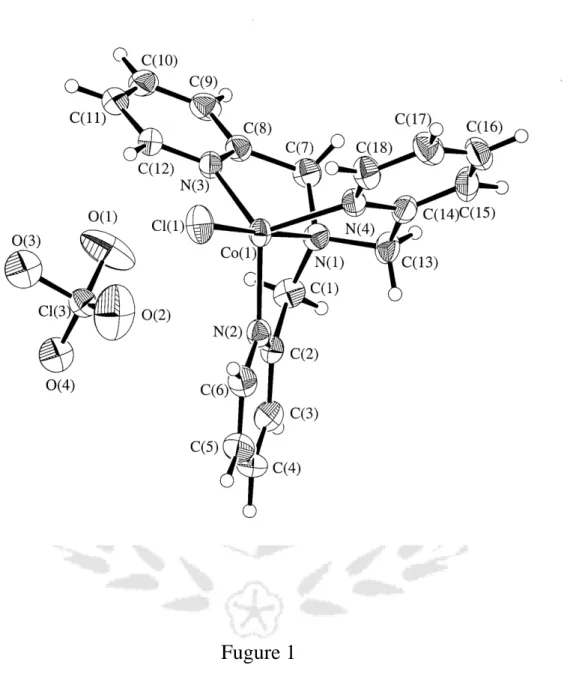
According to the X-ray report, metal ion is chelated with TPA ligend and a Cl anion in a distortion triangle di-pyramid structure is also bounded on Co atom. The Co atom has keeping formal charge 1+ which is obviously known with one accompanied perchlorate counter anion. The crystal is packing in P21/c group space.
The X-ray data is showed below (see Figue2 and Table 1, and 2)
The Elemental analysis report show that it’s consist with the X-ray data. Even thought there are a little residue mixing together.(Table 3)
Cyclovoltammetry was also performed. By the results, it has a reduction signal at –510mv in aqueous solution. It meant that it’s a very easily to reduce compound. In my opinion, it must be easy combined with the whiting compounds. So we shell be further to apply it enhancing the sensitivity of the platinum electrodes surface.
The experimental section
The materials:
All the chemicals were purchased in commercials and has been dewater and keeping in a closed container to store.
The synthesis of TPA:
Solve 2-chloromthylpyridine 0.01moles with 2-aminemethyl- pyridine 0.005moles in a three necks flask together in THF solvent. And keep stirring it under atmosphere nitrogen with flexing for three days. Then extracted the mixture with ethyl alcohol. Collected the exacted solution and neutralized with 6mL 60%
perchloric acid solution. Further used the de-pressure rota-vapor equipment to concentrate it and 77 grams TPR·(HClO4)3 was obtained.(91% yield)
The synthesis of complex:
Reacted CoCl2 (0.1mole) with the THF solution of TPA containing triethyl amine under atmosphere nitrogen and continuously stirring, and flexing for 24 hours.
Then filtrated the mixture to get the black residue. We used ethyl alcohol to washed and recrystalized them. The single crystal of dark green color crystal solid was further to get in aqueous solution.(85% yield)
The synthesis of polyhydroxy stilbene derivatives
We fallow the Literatures to synthesize the polyhydroxy stilbene derivatives by two steps. polyhydroxy benzyl aldehyde was reacted with polyhydroxy benzyl amine by a copper metal to get a intermediate. And further the intermediate was reacted with a reducer solution to get the target compounds
The measurement of X-ray
The X-ray data was collected by the Expensive equipments center of NSYSU which is showing in Figue 2 and Table 1, and 2.
Fugure 1 The experiment of cyclovoltammetry
The three electrodes system was used to measured the
cyclovoltammetry of TPA Cobalt complex with BAS100 potential stat in KCl aqueous solution. The reduction signal was obtained at –510mv.
Table 1 The crystal datas of TPACo
Empirical Formula C
18H
18Cl
2N
4O
4Formula Weight 484.20
Crystal Color, Habit green plate
Crystal Dimensions 0.2×0.38×0.6mm
Cell Determinations (2θ range) 25(15.2-24.4)
Omega Scan Peak Width
At Half-height 0.26°
Lattice Parameter a = 14.685(5)Å b = 9.410(2)Å
c = 29.794(4)Å β = 90.64(2)°
V = 4117(1) Å
3Space group p2
1/cZ value 8
F
0001976.00 µ(MoKα 11.26cm
−1Residuals 0.044; 0.052 Table2 Bond Angle (º) and Bond length(Å)
Cl Co N(2) 104.5(2) º Cl Co N(4) 102.5(2) º N(1) Co N(3) 77.6(2) º N(2) Co N(3) 120.4(2) º N(3) Co N(4) 114.9(2) º Co N(1) 2.192(5)Å Co N(2) 2.055(5)Å Co N(3) 2.066(5)Å Co Cl 2.282(2)Å Table 3 The Elemental Analysis Data
N% C% H%
Experimental Data 10.94 43.79 4.32 Calculatio Data 9.46 43.98 3.66 References
1.R. E. Norman,; R. A. Leising,; S. Yan,; L. Que, Jr. Inorg. Chim. Acta 1998, 273, 393-396.
2. Q. Li,; Y. Wang,; G. Luo Materi. Scien. And Engin.C 2000, 11, 71-74.
3.Z. Duraun,; G. Nisli Talanta 2004, 63, 873-878.
4.K. Ikehata,; J. A. Nicell Biores. Tech.2000, 74, 191-199.
5.L. G. Fenoll,; J. N. Rodriguez-López,; F. Garcia-Molinz Int. J. Biochem.
& Cell Bio. 2002, 34, 332-336.
6.L. Bubacco,; J. Salgado,; A. W.J.W. Tepper,; E. Vijgenboom 1999, 442,
215-220.