國立臺灣大學文學院語言學研究所 碩士論文
Graduate Institute of Linguistics College of Liberal Arts
National Taiwan University Master Thesis
從要求到給予:台灣政論節目中「好不好」與「好 嗎」的知識轉換
From Demanding to Giving: Epistemic Transformation of Taiwan Mandarin Hao Bu Hao and Hao Ma in
Political Talk Shows
李子民 Tzu-Min Li
指導教授﹕呂佳蓉 博士 Advisor: Chia-Rung Lu, Ph.D.
中華民國 108 年 8 月
August 2019
誌謝
在歷經了無數掙扎、挫折、絕望、灰心、焦慮、恐慌之後,這份論文在最後 的最後,挾帶著許多人的支持、鼓勵、期許、關心、祝福、打氣——當然還有最 重要的,伴隨著我的淚水——誕生。「我總算也來到這一天了嗎?」此刻坐在電 腦前的我,依然感到不真實。回首這段日子裡的點點滴滴,每一件小事都同樣地 刻骨銘心、念念不忘。對於這些帶給我幫助的人,我有一些話想說。但,再怎麼 書寫,語言終究只能表達思維的部分。這些謝辭不過佔我心中感謝的微小部份而 已。
首先 ,感謝呂老師對我的寬容,給予我在尋找研究題目、發想架構、語料 取材、分析,還有文字書寫上極高的自由度。感謝老師對我的信任與寬宏大度,
忍受我這樣任性專斷地驟下許多決策,從而使我學習擔起身為研究者應當擔受的 責任。沒有老師,我不會知道自己的極限可以推往何處,也不會認識這樣的自己。
謝謝老師帶給我的成長、淬鍊。
當然,我也要感謝我的口試委員——王萸芳老師、蔡宜妮老師。在短短的十 十、十一天之內,兩位老師於百忙之中撥冗閱讀了我的論文初稿,並給出了寶貴 的建議、指教、提醒,令我獲益匪淺。兩位老師親切、細心地給予我點評,不但 絲毫沒有因為閱讀時的緊迫而不悅,甚至還給我的口試極高的評價,我由衷地感
謝二位老師。王萸芳老師給出許多 top-down 的大架構、大方向的建議,是我未
曾注意到的。蔡宜妮老師在個別例子的細部討論,則讓我看到自己的疏漏之處。
由於兩位老師的知識與經驗,我才能跳脫出自己的視角,審視自己的論文。
再來,我要感謝一群可愛溫暖的同儕。
謝謝葉遲在我最頹喪孤絕、心浮氣躁、萬念俱灰的時候永不缺席的陪伴。妳 總是適時給我打氣與鼓勵。也是因為妳的督促,我才能度過每一個裹足不前的關 頭,完成這篇艱難的論文。
謝謝Mergen 對我的關心,時不時問我是否需要幫助,煩惱我這個擔心我那
個,也願意和我一起分享研究上遭遇的問題。你總是那麼地熱心助人,又觀察細 膩。你不但時常提醒我重要時程,口試當天還自願幫我去取餐盒,讓我得以專心 準備。你身為「所爸」當之無愧。
謝謝Craig 自己可能都料想不到的貢獻。一項研究該如何著手進行,很少是
一開始就確定的,有時候必須先走不通的路,才會領悟另有哪些路可以走。雖然 我後來放棄 Principled Polysemy 的理論,但正是因為你的報告,與我跌跌撞撞的 嘗試與失敗,我才領悟到我的研究對象的本質。回首來時路,也許這段錯誤是種 必然。
謝謝Chester,你一向是我的 intellectual hero。在我探索 CA 的路途上,你扮
演很重要的角色。謝謝你向一開始什麼都不懂的我介紹許多術語與常規,還有這
個領域的發展、軼事……等等。有時候我會怕自己太頻繁找你,或是問太久,但 你總是很熱心地一一解決我所有疑問,滿足我所有好奇。
謝謝lab 裡面的成員在平常課堂上的討論。特別感謝阿良深刻的觀察、精闢
的分析、還有許多深遠的卓識。Thomas 經常開各種好笑的玩笑,讓課堂很有趣。
偶爾跟Andrew 在走廊沙發,或是電話中的長談,讓我對學術界有更多認識,也
對英語的知識更上層樓。
感謝我的家人默默做我的後盾,我才能無後顧之憂地專心在研究上。有你們 的支持,我才能將時間與精力奉獻給深奧的語言學。阿公,雖然你沒能看到這份 論文,但你知道了一定會很開心吧。
最後,謝謝鐘尹學姊。雖然我不曾見過妳,但因為妳的論文,讓我得以找到 許多有用的文獻資料。這份論文的完成,也有部分是出自妳的貢獻。希望妳知道,
這個世界上,又多一位記得妳的人。
2019 年 8 月 19 日 樂學館
中文摘要
一般人咸同意,一句話語披著疑問結構的外衣並不表示其立意必然是尋求訊 息。多虧語用學、言談分析、對話分析、功能主義等等語言學學派的成果,研究 者已逐漸揭露由「語言形式」至「互動功能」之間的映射關係並不完美(反之亦
然)。本文受到語言中這種有趣的不確定性所驅使,企圖揭露漢語中「失職」的
「偽疑問結構」,針對的兩個對象為「好不好」與「好嗎」。雖然此二結構看似疑
問,但已有許多研究者(Chen & Liu, 2009; Hu, 2002; H.-I. Liu, 2008; L. Y. Wang, 2005)稱其可用作「挑戰」、「反駁」、「駁斥」、「否定」。
在Sacks, Schegloff, Jefferson (1974)與 Levinson (1983)建立並發展的對話分析 的框架之下檢視政論節目〈新聞面對面〉裡的談話之後,我辨識出九項經由非正 統附加問句用法的「好不好」所執行的社會行為/功能,以及兩項經由似附加問句 用法的「好不好」所執行的功能。另一方面,兩項經由非正統附加問句用法的「好 嗎」所執行的社會行為也在本文中被辨識出來。總的來說,本文所辨識出來的社 會行為/功能如下:(i) 同意、(ii) 糾正、(iii) 散佈新聞、(iv) 不同意、(v) 名詞解 釋、(vi) 通知/自我通知、(vii) 協商標記、(viii) 預糾正、(ix) 提醒、(x) 吸引注 意力。本文的發現不但證實自然語言對於多義性/多功能性驚人的容忍度,更重 要的是根據上述社會行為/功能的共性,我主張「好不好」與「好嗎」此二合成結
構經歷了「知識轉換」。也就是說,套用Halliday 自 1985 年發展的功能語法,我
們可以說,除了由扮演著「要求者」(demander)的語言角色 (speech role),以尋求
訊息的說話者口中說出來以外,現代漢語的「好不好」與「好嗎」亦可由扮演著
「給予者」(giver)的語言角色,自願傳遞訊息/知識的說話者口中說出。
關鍵詞:「好不好」、「好嗎」、附加問句、疑問句、對話分析、知識轉換、社會行
為
Abstract
As laypeople can attest, just because an utterance has the appearance of an interrogative structure does not entail that it is indeed intended as in search of information. Thanks to schools of linguistics such as pragmatics, discourse analysis, Conversation Analysis, functionalism, etc. researchers have gradually unearthed the imperfect mappings from linguistic forms to interactional functions (or the other way around). Motivated by this fascinating unpredictability, this thesis aims to disclose
“fake” interrogative structures in Mandarin Chinese that “do not do their jobs.” The items selected are hao bu hao and hao ma, two seeming interrogative structures that, some researchers (Chen & Liu, 2009; Hu, 2002; H.-I. Liu, 2008; L. Y. Wang, 2005) claim, can be used for challenges/refutations/rebuttals/negation.
Examining naturally occurring talk-in-interaction in the TV talk show Facenews (新聞面對面) under the framework of Conversation Analysis (CA) as launched and developed by Sacks, Schegloff, and Jefferson (1974) and Levinson (1983), I identify as many as nine social actions/functions that are implemented through the non-canonical tag uses of hao bu hao, along with two functions that are performed by the quasi-tag uses of hao bu hao. On the other hand, two social actions that get done via the non- canonical tag uses of hao ma are identified. Overall, on the list of all the social actions/functions found in this study are (i) agreeing, (ii) correcting, (iii) delivering news, (iv) disagreeing, (v) explaining jargon, (vi) informing/self-informing, (vii) negotiation marker, (viii) pre-correction, (ix) reminding, and (x) attention getter. The findings not only bear witness to the fact that natural language is unimaginably tolerant of an enormous amount of polysemy/poly-functionality. More importantly, based on the commonalities among these social actions/functions, I argue that the two composite structures hao bu hao and hao ma have undergone an “epistemic transformation.” That
is, besides coming from a speaker who plays the speech role of a demander in search of information or knowledge (as is assumed in existing grammars of Chinese) in conversation, hao bu hao and hao ma in Modern Chinese can also be produced by someone who plays the speech role of a giver willing to transmit information or knowledge.
Keywords: hao bu hao, hao ma, tag questions, interrogatives, conversation analysis, epistemic transformation, social actions
Table of Contents
誌謝... i
中文摘要... iii
Abstract ... iv
Table of Contents ... vi
List of Figures ... viii
List of Tables ... ix
Chapter 1: Introduction ... 1
1.1 Current Understanding of Hao Bu Hao and Hao Ma ... 2
1.2 Research Questions ... 6
1.3 Organization of the Thesis ... 6
Chapter 2: Literature Review ... 8
2.1 Epistemics ... 8
2.1.1 Sacks ... 8
2.1.2 Pomerantz ... 10
2.1.3 Goodwin ... 11
2.1.4 Labov and Fanshel ... 13
2.1.5 Kamio ... 15
2.1.6 Heritage ... 18
2.1.7 Interim Summary... 20
2.2 Conversation Analysis ... 20
2.2.1 Basic Assumptions of Conversation Analysis ... 21
2.2.2 A Simplest Systematics for the Organization of Turn-Taking ... 22
2.2.3 Adjacency Pairs ... 25
2.2.4 Interim Summary... 27
2.3 Studies on Irregular Cases of Hao Bu Hao and Hao Ma ... 28
2.3.1 Hu ... 28
2.3.2 Negation ... 31
2.3.3 Emotion ... 35
2.3.4 Politeness ... 37
2.3.5 Interim Summary... 39
Chapter 3: Methodology ... 41
3.1 Criteria for Data Collection ... 41
3.2 Data ... 42
3.3 Analytical Framework ... 45
Chapter 4: Results and Discussion ... 48
4.1 Hao Bu Hao ... 48
4.1.1 A-not-A questions ... 48
4.1.2 Canonical Tag Questions ... 49
4.1.3 Ostensible Tag questions ... 51
4.1.3.1 Correcting ... 51
4.1.3.2 Informing/self-informing ... 70
4.1.3.3 Delivering News ... 93
4.1.3.4 Reminding ... 99
4.1.3.5 Pre-correction ... 120
4.1.3.6 Disagreeing with Assessments ... 127
4.1.3.7 Agreeing with Assessments ... 133
4.1.3.8 Explaining Jargon ... 139
4.1.3.9 Negotiation Marker ... 141
4.1.4 Others ... 145
4.1.4.1 Quasi-tags Attached to Expressives ... 145
4.1.4.2 Quasi-tags Attached to Noun Phrases ... 148
4.2 Hao Ma ... 152
4.2.1 Ostensible Tag Questions ... 152
4.2.1.1 Informing ... 152
4.2.1.2 Reminding ... 157
Chapter 5: Conclusion ... 163
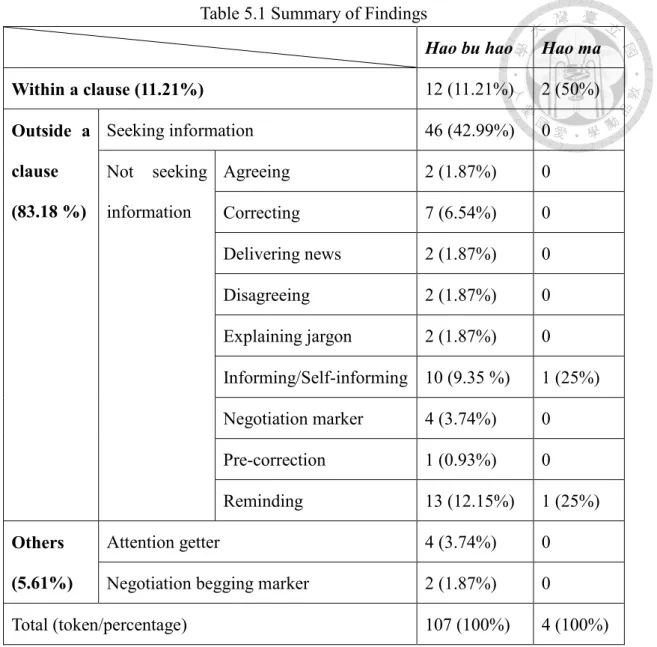
5.1 Summary of Findings ... 163
5.2 Epistemic Transformation ... 164
5.3 Implications ... 166
5.4 Limitations and Suggestions for Further Research ... 167
References ... 169
Appendix A: Transcription Conventions ... 177
Appendix B: List of Abbreviations ... 178
List of Figures
Figure 2.1 Two Scenarios Proposed by Sacks ... 9
Figure 2.2 The Cigarette Conversation ... 12
Figure 2.3 The Overall Structure of Discourse ... 13
Figure 2.4 Territories of Information ... 16
Figure 2.5 Epistemic Gradient ... 19
Figure 2.6 A Simplest Systematics for the Organization of Turn-Taking ... 23
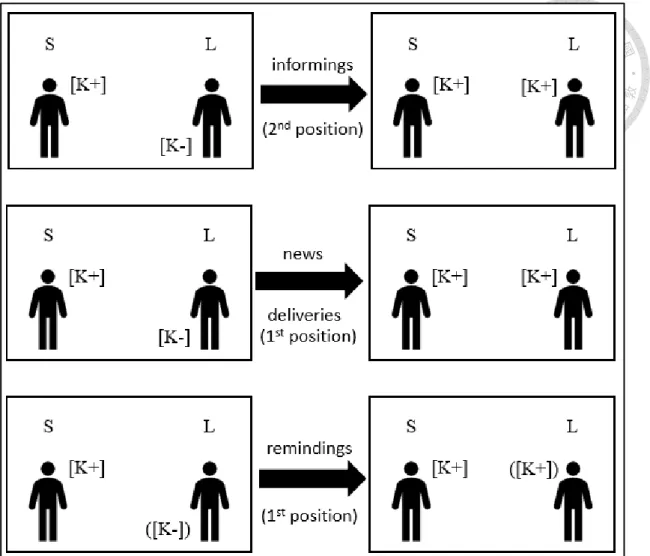
Figure 4.1 Epistemic Structures of Informings, News Deliveries, and
………….Remindings ... 100
Figure 5.1 Epistemic Transformation of Hao Bu Hao and Hao Ma ... 166
List of Tables
Table 1.1 Current Understanding of Hao Bu Hao and Hao Ma ... 6
Table 2.1 The Uses of Hao Bu Hao and Hao Ma in Previous Studies ... 40
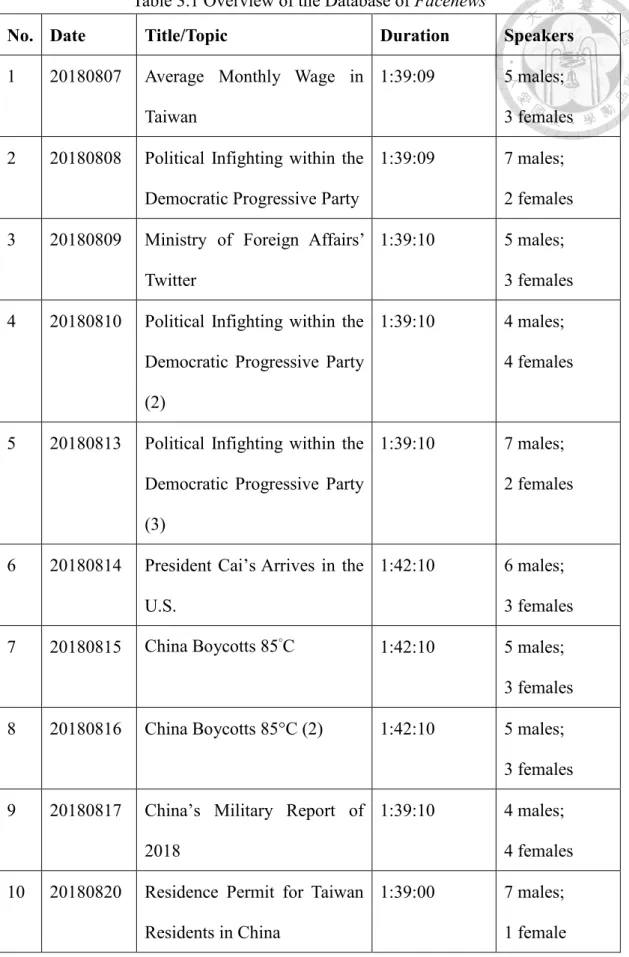
Table 3.1 Overview of the Database of Facenews ... 43
Table 5.1 Summary of Findings ... 164
Chapter 1: Introduction
Asking questions is one of the defining features of Homo sapiens1 and the cornerstone that our daily communication builds upon. Human children begin to query their parents a variety of things from as early as about two years old, most of them being yes-no questions (Tyack & Ingram, 1977). For adults, who engage in all sorts of institutional encounters, questions play a central role in their social life, for the practice of questioning “enacts and reflects an institution’s specific goals and values” (Tracy &
Robles, 2009). In the history-taking phase of a medical visit, for example, a series of questions are asked to further the physician’s progress toward a particular diagnosis (Stivers, 2007). In TV talk shows, wh-questions are a typical format for narrative elicitation, whereas yes-no questions are more likely to elicit opinions (Thornborrow, 2010). In telephone sells, both the caller and the customer employ questioning strategies to reach their respective goals (Freed, 2010). In fact, even when people meet in the first place, greetings are often done in the shape of questions (e.g., How are you? How’s it
going?). It is unimaginable how normal conversation would be like with questions
removed.Though questions can usually be recognized by their morpho-syntactic characteristics easily (e.g., subject-auxiliary inversion, verb raising, wh-words, sentence final particles, etc.), the presence of an interrogative structure does not guarantee that a question has been posed2 . Generally speaking, interrogatives are produced because there is a deficiency in the speaker’s knowledge (Heritage &
1 While animals have been shown to demonstrate rudimentary ways of transmitting information, the ability to ask questions has not been observed in non-human communication systems. It seems fair to say that questions set humans from the rest of life. For more information, see Premack and Premack (1983) and Jordania (2006).
2 To borrow Levinson’s (2012:12) metaphor, interrogatives are “the workhorses in the functional arenas,”
Raymond, 2012) and the speaker feels impelled to correct this deficiency3. However, in Yoon’s (2010) examination of eight sets of naturally occurring Korean conversations, a minority (< 10%) of the questions collected, despite their interrogative formats, do not seek information. Rhetorical questions, for example, are formulated in such a way that they appear “unanswerable”; interrogatives of this sort are arguably “dedicated to performing accusations” (Clayman & Heritage, 2002a, 2002b; Heinemann, 2008). In fact, corpus studies show that a widely-seen context wherein interrogatives are used is one in which the speaker is pretty sure that he knows the information and simply wants it repeated (Levinson, 2012). In his Toward a Linguistic Theory of Speech Acts, Sadock (1974) even coined the term “queclarative” to account for utterances which are intended as assertions but formally disguised as interrogatives4. Together, these findings suggest that the tie between the appearance of a question and the act of information seeking (or, for that matter, a speaker lacking in certain information), if there is any, is not a firm one. Inspired by this imperfect correspondence, the present study aims to unveil “fake”
interrogative expressions in Mandarin Chinese that “do not do their jobs” and to probe into their usages in face-to-face talk-in-interaction. The items selected are hao bu hao
‘good or not good’ and hao ma ‘good?’, two composite structures whose non- interrogativity has been noticed only until quite recently.
1.1 Current Understanding of Hao Bu Hao and Hao Ma
According to existing grammars of Modern Chinese with respect to its interrogative system, the combination hao bu hao can be treated in two ways. For some scholars (Chao, 1968; Huang, Li, & Li, 2009; Y. Liu, Pan, & Gu, 2006; Tang, 1981;
3 By the way, chimpanzees, our closest relatives, do not possess this kind of metacognition, though.
According to Premack and Premack (1983: 29), who attempt to teach language to four apes, language training cannot teach a creature to examine the state of its knowledge or to find deficiencies that impel the desire for information.
4 Queclaratives differ from genuine inquiries in several respects. Collocationally, for example, they do not go with by any chance or the “X in the hell” construction (e.g., ?Does Arthur, by any chance, know a damn thing about syntax?).
Zhan & Bai, 2016), it is an A-not-A structure within a clause; for other scholars, it can be analyzed as either an A-not-A structure or a tag attached to the end of a clause (Chang, 2012; Chu, 2010; C. N. Li & Thompson, 1981; Shao, 2014). Whichever analysis one adopts, hao bu hao is understood as an interrogative device.
An A-not-A question, as its name suggests, is a question characterized by the juxtaposition of the affirmative and the negative version of a clause. When someone utters an A-not-A question, he presents an either-or choice to the respondent (C. N. Li
& Thompson, 1981). Generally speaking, except for the second subject being co- referential with the first one, the deletion of which is obligatory, speakers can delete elements that are not the focus of the information to be communicated for economy’s sake, as long as doing so does not cause misunderstanding. Therefore, instead of the full repetition in (1):
(1) [from C. N. Li & Thompson 1981: 536]
他 在 家 不 在 家?
ta zai jia bu zai jia.
he at home NEG at home
‘Is he at home?’
one can choose to say (2):
(2) 他 在 不 在 家
ta zai bu zai jia he at NEG at home
‘Is he at home?’
In (1) the two-place predicate zai ‘at’ is copied along with its argument jia ‘home’, while in (2) only zai gets copied. If the internal structure of the predicate5 in question is simpler, such as the one-place predicate hao ‘good’, one can get cases like (3) and (4) below:
(3) 他 的 中文 好 不 好?
ta de zhongwen hao bu hao he GEN Chinese good NEG good
‘How is his Chinese?’
(4) 他 唱 得 好 不 好?
ta chang de hao bu hao he sing CSC good NEG good
‘How does he sing?’
Since an A-not-A question is formed by putting two versions of a clause together, the A-not-A part is by definition integral to the new clause that is created in the sense that the removal of it would damage the integrity of the new clause. That is to say, one would get a so-called “sentence fragment.”
Tag questions, on the other hand, are different. For most scholars who recognize the syntactic status of tag questions in Chinese (e.g., Chang, 2012; Chu, 2010; C. N. Li
& Thompson, 1981), a tag question is created by adding a short A-not-A form (e.g., hao
bu hao) to the end of a self-contained, well-formed clause. Only Shao (2014) explicitly
states that the tag can be in the “X PRT” format, such as hao ma. In spite of the lack of5 Although the A element in the A-not-A questions discussed here are all predicates, it is not my intention to give the impression that the two slots can be occucpied by predicates only. In fact, constituents other than adverbial phrases can all enter the A positions (Shao, 2014: 151).
consensus on the actual realization of tag questions, it is agreed that the function of tag questions is to seek confirmation/permission/opinion of or on the propositional content that the preceding clause contains. What follows are two examples:
(5) [from C. N. Li & Thompson 1981: 546]
我們 去 吃 水果 好 不 好?
women qu chi shuiguo hao bu hao we go eat fruit good NEG good ‘Let’s go eat some fruit, ok?’
(6) [from Shao 2014: 202]
你 今天 不要 去 明天 去,好 吗?
ni jintian buyao qu mingtian qu hao ma you today don’t go tomorrow go good PRT ‘Don’t go today. Wait till tomorrow, ok?’
Because the tag is an extra element that is attached to the end of the clause as demonstrated above, it is by definition not constitutive of the structurally bigger, and derivationally later, clause. In other words, its existence is optional rather than necessary.
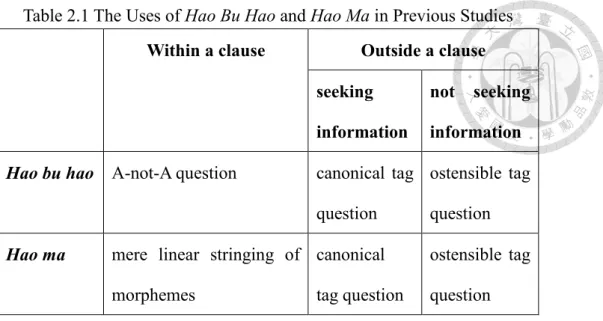
Combining what have been discussed so far, we can summarize the current understanding of the two combination hao bu hao and hao ma in the following table:
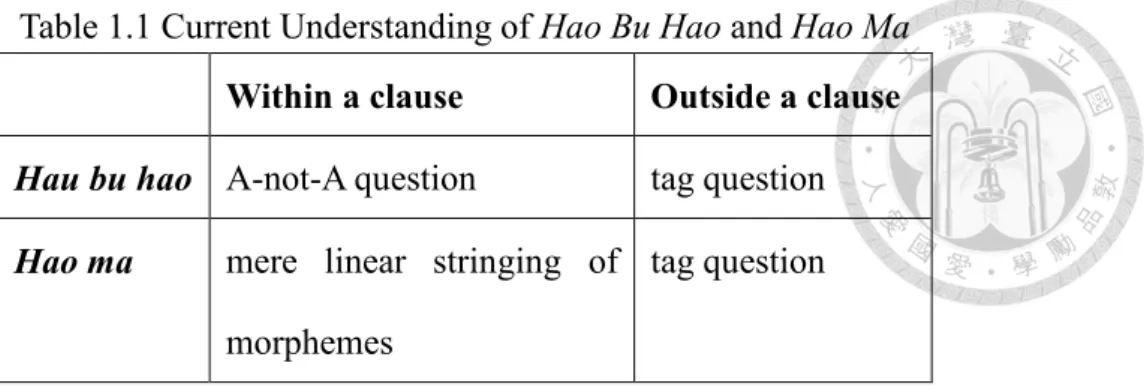
Table 1.1 Current Understanding of Hao Bu Hao and Hao Ma
Within a clause Outside a clause
Hau bu hao A-not-A question
tag questionHao ma
mere linear stringing ofmorphemes
tag question
1.2 Research Questions
Despite current understanding of hao bu hao and hao ma, the two composite structures have been claimed to be used as/for challenges/refutations/rebuttals/negation (see section 2.3 of the next chapter). It is the aim of the present study to answer the following questions (to be refined in section 2.3.5 of the next chapter):
1. What social actions/functions (other than asking questions) do hao bu hao and hao
ma get done in talk-in-interaction?
2. Are there any commonalities between the social actions/fuctions that get done via
hao bu hao and hao ma?
In this study, I will try to answer these fundamental questions by examining tokens of
hao bu hao and hao ma in naturally occurring conversation under the analytical
framework of Conversation Analysis (CA).1.3 Organization of the Thesis
The thesis is organized as follows. Chapter 2 reviews literature on (i) the notion of epistemics, which is the focus of the present study, (ii) Conversation Analysis, the approach employed by the present study, and (iii) irregular cases of hao bu hao and hao
ma, the two targets of the present study. Chapter 3 deals with methodological issues,
including (i) criteria for data collection, (ii) the database used, and (iii) the analytical framework adopted. Chapter 4 reports findings of the present study, that is, social actions/functions that get done via non-interrogative uses of hao bu hao and hao ma.
Chapter 5 offers an interpretation of the findings obtained and some suggestions for future research.
Chapter 2: Literature Review
2.1 Epistemics
Although the study of knowledge, or epistemology, has a long tradition in philosophy dating back to at least some two thousand years ago6 and has received so much attention that it enters the four major philosophical arenas (the other three being logic, metaphysics, and ethics), considering the recorded history of linguistics in the widest sense that is equally long7, scholars’ contemplation on the role knowledge plays in language sciences and what bearing knowledge has on human communication comes unproportionally late. In what follows, I will give a sketchy overview of writings of the interaction between knowledge and conversation, though in this context the term
epistemics is preferred to epistemology, since the interest of language scientists is
markedly different from that of philosophers.2.1.1 Sacks
In discussing how, under ordinary circumstances, one manages to answer the question How are you? in an exchange of “greeting substitutes”8 , Sacks (1975) incidentally touches upon what conversation analysts nowadays call “epistemics.” To begin with, he posits two theoretical constructs. The first is a class called “personal states,” consisting of things like mood, appetite, sleep, etc (Sacks, 1975: 69). The other is “value states,” including terms such as good, lousy, great, ok, fine, wonderful, awful, and so forth. These terms are grouped into three subsets, which Sacks labels as [-],
6 The goal of epistemology is to answer the question of “what constitutes knowledge.” Before Gettier’s (1963) influential paper, Plato’s (428-348 B.C.E) idea that knowledge is “justified true belief” (JTB) had long been the so-called “classic account.”
7 Thanks to Plato’s dialogue Cratylus, whose theme is a debate on the origin of language and on the relations between word form and word meaning, it is widely agreed that (at least European) linguistics has its root in Greek Antiquity (see, for example, Robins (1997) and Seuren (1998)).
8 Sacks (1975: 68) distinguishes between greetings—such as Hi! and Hello!—and what he calls
“greeting substitutes” (e.g., How are you?). There are two reasons for such distinction. First, except in telephone calls, greetings are not repeatedly used. Furthermore, if greeting substitutes are used in combination with true greetings, they always occur in a fixed order. Greetings precede greeting substitutes.
[+], and [0] (possibly meaning “negative,” “positive,” and “neutral” respectively). The three subsets are mutually exclusive; if a term belongs to a certain subset, it belongs to that particular subset only. When one is faced with the question How are you?, Sacks hypothesizes, he goes through two steps in his mind. The first step is “monitoring” and the second “selecting a term.” The first step involves choosing a subset (that is, either [-], [+], or [0]). Given the subset being chosen (say, [-]), one selects an appropriate term from it in the second step (for example, lousy).
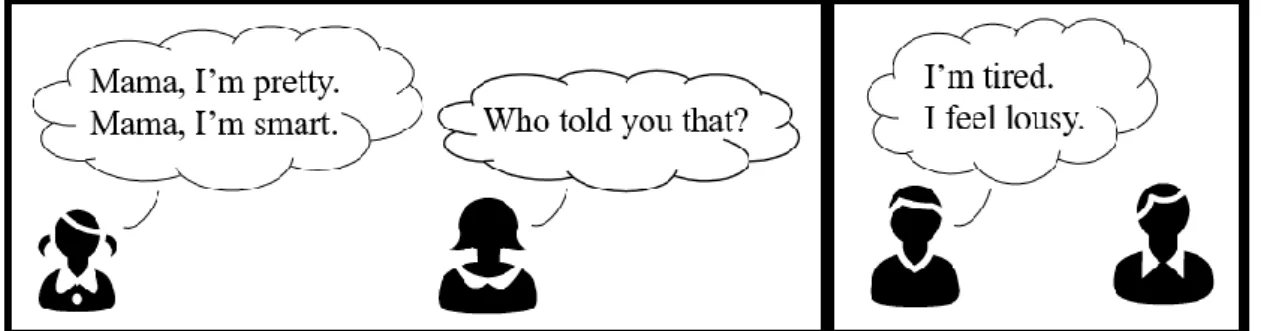
Now Sacks justifies the monitoring stage, which might appear artifitial, by invoking two scenarios (see Figure 2.1 below). Suppose a little girl comes home and says to her mother, Mama, I’m pretty or Mama, I’m smart. In response, the mother would, very likely, say “Who told you that?” However, if someone says I’m tired or I
feel lousy, no such question is asked. The reason for this disparity, Sacks argues, is
simple—one is responsible for knowing some things on one’s own behalf, in contrast to the situation in which one is treated as likely to be repeating what another has told him about himself (Sacks, 1975: 72). The explanation is substantiated by a datum Sacks offers: You keep saying you’re insane. Has anybody been telling you that recently? In other words, there are things that are heard as things one knows on his behalf and things that are heard as things one knows by virtue of another’s having told him. The answer to How are you? belongs to the former category.Figure 2.1 Two Scenarios Proposed by Sacks
2.1.2 Pomerantz
A similar two-fold analysis can be seen in Pomerantz’s (1980) study of interactants’ ways of getting information from co-interactants. Generally speaking, if one wishes to find out something from his interlocutor(s), the easiest way to do it is simply to ask about it. Sometimes, however, what is done is indirect. To figure out how this is achieved, Pomerantz (1980: 187) identifies two types of knowledge. Type 1
knowables are those that subject-actors as subject-actors have rights and obligations to
know. One’s name, what one is doing, and so on are prototypical instances. Type 2knowables are those that subject-actors are assumed to have access to by virtue of the
knowings being “occasioned.” For instance, where one’s friend is and what he did yesterday are not things that subject-actors inherently know. Rather, they are told by someone else, or are “found out” in one way or another. According to Pomerantz, what one is responsible for knowing on his own behalf in what Sacks (1975) calls the“monitoring” step (recall section 2.1.1) is equivalent to type 1 knowables. On the other hand, what one asserts that is heard as “repeated” is tantamount to type 2 knowables.
The distinction between type 1 knowables and type 2 knowables comes in handy in the analysis of what Pomerantz (1980: 188) calls “fishing” or “my side telling”
(Pomerantz, 1980: 191). In fishing, a speaker makes an assertion of a type 2 knowable that refers to a particular event about which there is a type 1 knowable for the recipient at the same time. This assertion is recognized as a product of limited access relative to the recipient’s type 1 knowable. Take the utterance I saw you drive by last night as an example. In this case, the speaker proffers a piece of information in which the recipient is the very object of the reported seeing. Whether the recipient did drive by is something that the recipient as a subject-actor knows inherently; that is, it is his type 1 knowable, and he is in this sense “authoritative.” As for the speaker, who produces this whole
utterance, the event is known to him by virtue of occasioning, in this case, through his sight.
When a speaker asserts a type 1 knowable, so the argument goes, the recipient may warrantably infer, inquire about, or puzzle over, and so on the occasioning of the knowing. Consider, for example, a context where speaker A says I rang you earlier but
you were out and speaker B says Oh I must have been at Dez’s Mom’s. Here speaker A
gives a report on speaker B’s whereabouts, which is known to speaker A himself by virtue of his having tried to reach speaker B some time earlier. As the recipient, speaker B’s work is to find an event that will fit and account for the experience reported by speaker A. In other words, speaker B’s response is going to be a “corresponding event”(Pomerantz 1980: 191) that somehow relates to speaker A’s prior “my side telling.” In this case, the reason for speaker B’s being out is that he has been somewhere else.
2.1.3 Goodwin
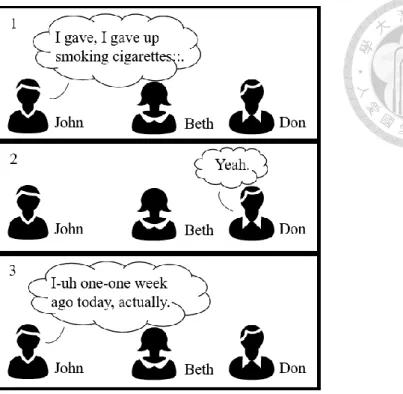
Another writing of the role epistemics plays in face-to-face verbal interaction is Goodwin’s (1979) study of sentences situated in conversation. Contrary to what is assumed in traditional linguistics, Goowdin argues that the analysis of sentences cannot be isolated from the process by which speakers interact. To be specific, focusing on a mini dialogue comprised of only three turns (presented below), Goodwin tries to show that a speaker can reconstruct the emerging meaning of his sentence as he is producing it in order to maintain its appropriateness to its recipient of the moment. He begins by making a distinction between an “unknowing recipient” and a “knowing recipient”
(Goodwin, 1979: 100). An unknowing recipient is a possible recipient not expected to know about an event being reported by a speaker, whereas a knowing recipient is a possible recipient already informed about that event. Consider Goodwin’s example visualized below:
Figure 2.2 The Cigarette Conversation
The dialogue takes place in a dinner in the house of John and his wife Beth attended by Don and another friend (not shown here). Directing his gaze towards Don, John initiates his talk by saying I gave, I gave up smoking cigarettes::. Getting little response from Don, who is an unknowing recipient the utterance is designed for, John shifts his gaze to his wife (Beth) and adds I-uh one-one week ago today actually. This increment is noteworthy in the following sense: Though as John’s wife, Beth possesses the knowledge that John has quit smoking (which makes her a knowing recipient), it does not follow that she is necessarily aware of the lapse between the onset of that decision and the speech time. In adding this extra piece of information (viz. it has been exactly one week since John’s quitting smoking), John presents (or packages) his news in a brand-new fashion. Therefore, he creates a product that is known to neither Don nor Beth. The underlying principle at work, Goodwin argues, is a general rule Sacks (1973:
139) observes: one should not tell one’s co-participants what one takes it they already know.
2.1.4 Labov and Fanshel
Using therapeutic discourse as data, Labov and Fanshel (1977) develop what they call “comprehensive discourse analysis,” in which epistemics has a significant place.
Before we delve into the details, it is helpful to get a grip on some background information in the first place.
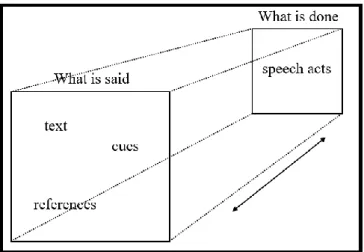
In Labov and Famshel’s understanding of human communication, there are two major planes of conversational behavior (see Figure 2.3 below). One the one hand, there is the plane of “what is said,” comprised of the text, para-linguistic cues, and implicit references to other cues and propositions. On the other hand, there is the plane of “what is done,” a multi-layered complex of speech acts. The coherence of discourse hinges upon the connections between these two planes, a series of “rules of interpretation and production” (Labov and Fanshel, 1977: 71). Contrary to everyday conceptualization of the word rule, however, these bridging rules are meant not to be “prescriptive”—when one employs any one of these rules, he is not making any conscious choices. Rather, the rules are in his competence already. He cannot help using these rules.
Figure 2.3 The Overall Structure of Discourse9
Of particular relevance to the notion of epistemics are a set of rules subsumed under the rubric of “coherence” (Labov and Fanshel, 1977: 98). In face-to-face interaction, speakers often request information, and in most cases the grammatical form of the response is closely connected to that of the request for information. Nevertheless, there do exist cases where, judging from the recipient’s response, a request for information, despite its non-interrogative appearance, is thought to be present.
According to Labov and Fanshel, this can be accounted for by means of the shared knowledge involved in the speech setting. To be specific, they provide the following classification of statements (Labov and Fanshel, 1977: 100):
‧An A-event is known to A but not to B.
‧A B-event is known to B but not to A.
‧An AB-event is known to both A and B.
‧An O-event is known to everyone else.
‧A D-event is known to be disputable.
Such classification, Labov and Fanshel argue, is a “social fact”—it is something shared by all those who participate in the discourse. If there is any doubt about the status of a certain event, it automatically falls into the last category.
Once a consensus as to what category a particular event belongs to has been reached, complex requests for information become possible. For example, the rule of
confirmation states that if A makes a statement about B-events, then it is heard as a
request for confirmation. Labov and Fanshel report an experiment that tests this rule:In a series of interviews cocncerning life in New York City, if the subject reported a burglary, the interviewer would then insert the utterance And you never called the police with a declarative intonation. As it turned out, all subjects responded to this statement as if the interviewer were saying And is it true that you never called the police? The
responses obtained were either a simple No, or positive ones plus some indication of surprise (e.g., Oh, yes, I called them.).
On the other hand, the rule of socratic specification states the following (thogh rather cumbersome):
If A makes a request for information of B, and B refuses to answer on the ground that he does not have the ability, and A makes another request for information which is more specific, then A is heard as asserting that this specific information is part of the answer, thereby disallowing further refusals on the same account.
Labov and Fanshel (1977: 103) offer a case where this rule is resorted to:
1 Th Why do they keeping reapting it?
2 R I don’t know.
3 Th → What are they feeling?
Here Rhoda (a patient), upon hearing the therapist’s question in line 1, claims that she does not know why her family is behaving in a certain way. Confronted with I don’t
know, the therapist asks a wh-question that makes it impossible for Rhoda to continue
her claim of disability any longer. In doing so, the therapist opens up the opportunity for further discussion.2.1.5 Kamio
To one’s surprise, new blood in the study of epistemics can come from disciplines other than language sciences. Originally trained as a psychologist, Kamio (1997) applies the concept of territory in ethology to his research into natural language, trying to delineate information of different natures expressed in discourse. To begin with, he
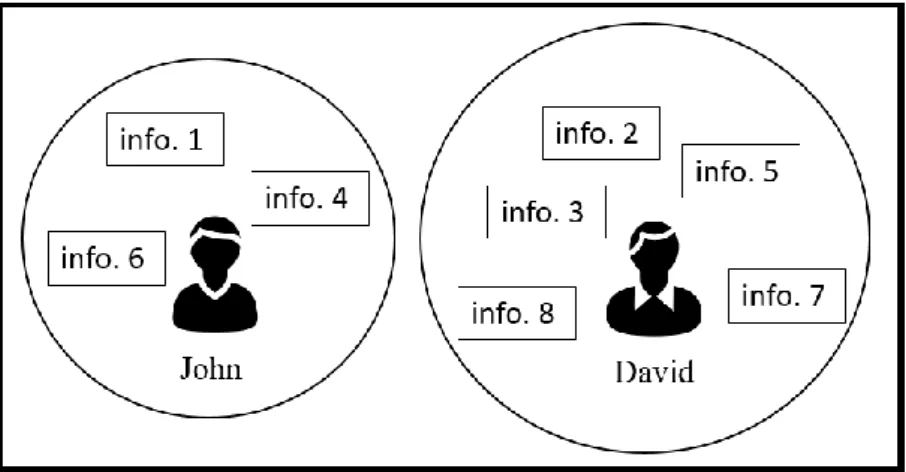
makes a conceptual dinstinction between simply having/knowing information and having/knowing information in one’s territory of information (Kamio, 1997: 16). The former refers to having/knowing information in one’s general storage of information, whereas the latter means that, within one’s general storage of information, there is a conceptual category called the territory of information. Therefore, a relation of entailment (or “redundancy relation,” as Kamio calls it) is observed—having/knowing information in one’s territory of information entails simply having/knowing information, but not the other way around. To see exactly what this prolix wording means, consider Figure 2.4 below.
Figure 2.4 Territories of Information
As this figure illustrates, among the eight pieces of information involved in John and David’s conversation, three pieces of information reside in John’s territory of information, and five pieces of information fall within David’s territory of information.
That is, pieces of information that come and go during conversation are not randomly distributed in the “discoursal universe.”10 Rather, most of them fall into either the speaker’s or the hearer’s cognitive territory. Information that falls within the speaker’s
10 This metaphor is mine.
terrirory of information is said to be proximal or “close” to him. For example, info. 1, info. 4, and info. 6 are proximal to John (but not to David), while info. 2, infor. 3, infor 5, info. 7, and info. 8 are proximal to David (but not to John).
A question that might arise at this juncture, then, is how to determine where a particular piece of information belongs. Kamio (1997: 18) offers four conditions:
a. information obtained through the speaker's/hearer's internal direct experience b. information embodying detailed knowledge which falls into the range of the
speaker's/hearer's professional or other expertise
c. information obtained through the speaker's/hearer's external direct experience including information verbally conveyed to him by others
d. information about persons, objects, events and facts close to the speaker/hearer including such information about the speaker/hearer himself
Three points need to be made. First of all, if the speaker/hearer does not have a solid, adequate basis for information of b, c, and d, information of these sorts is considered less proximal to the speaker/hearer. Secondly, information whose accessibility to the speaker/hearer is low is considered less proximal to him. Finally, if none of the four is applicable to both the speaker and the hearer, then the information in question is close to no one.
As Kamio (1997: 21) points out, information of different natures correlates with different consequences. For example, consider the three utterances below:
(a) The owner of the shop at the corner is an Italian.
(b) ?The owner of the shop at the corner has a stomach ulcer.
(c) I hear that the owner of the shop at the corner has a stomach ulcer.
Notice that the shape an utterance takes is tied up with the relative distance between the information contained and the producer. Since (a) conveys rather public information that is easy to be cognizant of, it is presented in a direct, unmarked form. However, it would be quite weird (or even intrusive) to utter (b)—which is also in a direct form—
because it contains private information about a person to whom the speaker is not close and which is accordingly not easily accessible. Yet if one modifies the utterance morpho-syntactically by, say, supplying evidentiality as in (c), there would be no trouble.
2.1.6 Heritage
These valuable writings notwithstanding, it is Heritage (2012a, 2012b) who brings fruits of them together whereby to really shed new light on the study of everyday conversation. Inspired by the aforementioned scholars, Heritage (2012b: 4) realizes that, since different speakers access a variety of information in different ways, relative states of knowledge can range from circumstances in which speaker A may have absolute knowledge of some state of affair (while speaker B has none) to cases where both speakers may have exactly equal information, as well as every point in between.
Furthermore, Heritage (2012a: 32) conceptualizes relative access to a domain knowledge as stratified between speakers such that they occupy different positions on an imaginary “epistemic gradient.” Such relative positioning is referred to as “epistemic status”. As Figure 2.5 shows below, for example, speaker A is in a less knowledgeable epistemic status, and speaker B is in a more knowledgeable epistemic status (where K stands for knowledge). According to Heritage, the configuration of conversationalists
in terms of their access to some domain knowledge is a more or less settled or agreed- upon matter of fact11, for it is based on their valuation of one another’s cognitive states12.
Figure 2.5 Epistemic Gradient
Of most interest in Heritage’s work is his claim about the role epistemics plays in conversation. As he points out, when there is a consensus about who has primary access to a targeted element of knowledge or information, that is, who has primary epistemic status, then, quite surprisingly, this takes precedence over morphosyntax and prosody as resources for determining whether an utterance conveys or request information (Heritage, 2012b: 3). To be precise, if a speaker claims (or is understood) to be in a knowledgeable status, his utterance is going to be interpreted as conveying information, irrespective of its syntax or the accompanying intonation. If, on the other hand, a speaker claims (or is understood) to be in a less knowledgeable status, then what he says is going to be construed as requesting information, regardless of its syntactic structure or pitch. What follows is an example concerning a patient (a middle-aged woman with a daughter in her twenties) and a doctor:
11 Which might remind the reader of Labov and Fanshel’s (1977: 100) contention that the five types of events they describe are “social facts” (c.f. section 2.1.4).
12 By the way, Heritage (2012b: 25) conjectures that the increasing value, complexity, and necessity of keeping track of the epistemic statuses of a myriad of interlocutors—think about how many times one converses with others throughout his lifetime—might be a driving force for the increase of neocortex associated with ever-complex bonded social groups described in Dunbar’s (2003) well-known “social
[from Heritage 2012b: 8]
1 DOC Are you married?
2 PAT No.
3 DOC → You’re divorced cur[rently].
4 PAT [Mm hm].
In line 1 the doctor inquires into the patient’s marital status—which is something that the patient has previliged access to—by asking a question. Getting a No in line 2, the doctor goes on to make, as Heritage calls it, a “next best guess” about the marital situation the patient is currently in. Note that despite the declarative formulation the doctor opts for, line 3 is irrefutably heard as in search of information. The patient returns a positive anwer (though not a serious one), as if the doctor were saying Are you
divorced currently?
2.1.7 Interim Summary
To sum up, studies over the past four decades have indicated that when people talk to each other there are complex cognitive processes going on in their heads. As Heritage (2012b: 24) notes, interactants must at all times be aware of what they take to be the real-world distribution of knowledge (that is, who knows what and who lacks what) and rights of knowledge between them. Different epistemic preconditions have different consequences, and speakers are obliged to be epistemically vigilant in order to not only produce but also comprehend utterances properly. In the present study, I will try to demonstrate what I call “epistemic transformation” by using naturally occurring conversation.
2.2 Conversation Analysis
Conversation is one of the most prevalent uses of natural language. It is the way in which people establish social bonds with each other and the mainstay of a functioning
society (Liddicoat, 2011). Research has shown that by the 9th grade, girls spend roughly 16 hours a week, and boys about 8 hours a week, “just talking” (Raffaelli & Duckett, 1989). These figures do not include occasions when adolescents are engaged in activities such as eating, doing sports, or watching TV, and carrying conversation at the same time, but is limited to cases when talking is the primary business (not to mention that they have to sleep). As for college students, it is reported that 32.1 % of the
“communication day” (that is, time spent communicating in one way or another) is devoted to listening—which excludes listening to mass media and music already—and another 16.3 % of it is taken up by speaking, most of which is done in the form of interpersonal speaking (Barker, Gladney, Edwards, Holley, & Gaines, 1980). Employed adults, on the other hand, spend two-thirds of their workdays communicating with each other by means of talking (Klemmer & Snyder, 1972). It seems fair to say that to picture a society where its members do not exchange language is to imagine the unimaginable.
2.2.1 Basic Assumptions of Conversation Analysis
Since conversation is integral to the social life of humans, it should not strike one as odd that serious attempts to work out the machinery whereby people interact through talk, collectively called “Conversation Analysis” (CA) nowadays, stem from ethnomethodology, a subdiscipline of sociology. This point has been emphasized by many scholars (Ford, Fox, & Thompson, 2002; Hutchby & Wooffitt, 1998; Lee, 1987;
Levinson, 1983; Liddicoat, 2011; Psathas, 1995)13. Against this backdrop, CA is akin to sociologically oriented sciences in many respects. At the most general level, CA studies social activities and the way in which they are co-ordinated or ordered (Lee,
13 To say that an enterprise stems from some school of thought is one thing, but to evaluate the status of the former in the latter is another. In fact, the sociological study of mundane conversation has not drawn enough attention from researchers working in classical sociology yet. Verbal communication is more of a recource in the research process than a topic of research (Wooffitt 2005: 22). A similar sentiment of
1987). In other words, they seek patterns and organization. What follows are some of the basic assumptions of CA with slight modifications (Psathas, 1995: 2-3)14:
1. Order is orderliness produced by the parties in situ; that is, it is situated and
occasioned.
2. The parties orient to that order themselves; that is, this order is not something imposed by the analyst for some theoretical/descriptive/analytical purposes but is collaboratively accomplished by the parties
3. Order is repeatable and recurrent.
4. Issues of how frequently, how widely, or how often particular phenomena occur are to be set aside in the interest of discovering, describing, and analyzing the structures, practices, procedures, etc. in which order is produced.
5. Structures of social actions, once discerned, can be described and analyzed in formal—that is, structural, organizational, logical, atopically contentless, consistent, and abstract—terms.
2.2.2 A Simplest Systematics for the Organization of Turn-Taking
Given these assumptions, one of the most fundamental organizations of practice for talk-in-interaction recognized by conversation analysts is the organization of “turn- taking” (Schegloff, 2007: 1), a characteristic of conversation thoroughly discussed by Sacks et al. (1974). As they point out, the existence of organized turn-taking—the overwhelming fact that one party talks at a time—is something that the data of conversation make increasingly plain, and there should be a model for this organization such that it has the twin features of being both context-free and context-sensitive (Sacks et al., 1974: 699). The reason is simple—because conversation as a universal
14 It should be noted, however, that Psathas himself thinks the expression conversation analysis is a misnomer because, strictly speaking, it is not “conversation” per se but “talk-in-interaction” that is the focus of this academic realm. Interaction analysis and ethnomethodological interaction analysis are two terms he suggests (Psathas, 1995: 2).
phenomenon can accommodate a wide range of situations, including interviews, meetings, debates, ceremonies, to name but a few, in which people with any potential identities and with any potential familiarity operate, some aspects of the organization of conversation must be expected to be context-free. However, it is conceivable that examination of real data would reveal particularities that are specific to certain cases only. The point is, it is the context-free structure that defines how and where context- sensitivity can be displayed; the particularities of context that are exhibited in systemically organized ways and places are shaped by the context-free organization.
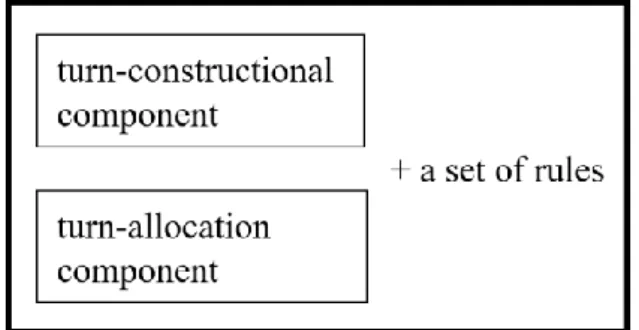
After examination of massive data, Sacks et al. (1974) propose a a model for turn- taking in conversation that is (i) locally managed, (ii) party-administered, (iii) interactionally controlled, and (iv) sensitive to recipient design. Such “simplest systematics,” as they call it, are comprised of a turn-constructional component, a turn- allocation component, together with a set of rules, shown in Figure 2.6 below.
Figure 2.6 A Simplest Systematics for the Organization of Turn-Taking
To begin with, there are a variety of unit-types with which a speaker may choose to construct a turn. A turn can be lexical (e.g., Yeah., Who?, Huh?), phrasal (e.g., On
Mondays?, Met whom?), or clausal/sentential (e.g., Uh you been down here before
havenche?, Was last night the first time you met Missiz Kelly?) in nature. The first
possible completion of a first turn-constructional unit (TCU) is an initial “transition-relevance place” (TRP), a point where transfer of speakership can but need not take place. To have a grasp of what this means, consider the following made-up dialogue15.
1 John [So… are we going to the movies tonight?]TCU (TRP) 2 Mary [I thought you planned to hang out with Dave.]TCU (TRP) 3 John [Who?]TCU
(TRP)
4 Mary [Dave, the guy we met this morning.]TCU (TRP) 5 John [Oh you mean Darrel?]TCU (TRP)
In this idealized example (in the sense that no interruptions or overlaps occur), utterances construed as turn-constructional units are surrounded by brackets subscripted with TCU. Here we have three clausal/sentential TCUs (viz. line 1, line 2, and line 5), one single-word turn (viz. line 3), and one phrasal TCU (viz. line 4). At the end of each line is a transition-relevance place, where the other speaker, once recognizing the completion of the current turn, can speak, and indeed this is what each would-be speaker does.
Now let us turn our attention to the turn-allocation component and the rules associated with it. According to Sacks et al. (1974), turn-allocational techniques are distributed into (i) those by which the next turn is allocated by the current speaker’s selecting the next speaker and (ii) those by which the next turn is allocated by self- selection. The following set of rules are thought to govern turn construction. To facilitate comprehension, however, I present Levinson’s (1983: 298) simplied version, where C stands for the current speaker, and N stands for the next speaker:
15 I thank the webpage https://www.sltinfo.com/ca101-turn-allocation/ for this ingenious visualization.
Rule 1 (applies initially at the first TRP of any turn)
(a) If C selects N in the enxt turn, then C must stop speaking, and N must speak next, with transition occurring at the first TRP after N-selection.
(b) If C does not select N, then any (other) party may self-select, with the first speaker gaining rights to the enxt turn.
(c) If C has not selected N, and no other party self-selects under option (b), then C may but need not continue
Rule 2 (applies at all subsequent TRPs)
(a)
When Rule 1 (c) has been applied by C, then at the next TRP Rules 1 (a)-(c) apply, until speaker change is effected.(b)
2.2.3 Adjacency Pairs
That said, a moment’s reflection should suggest that turns do not, as a matter of fact, follow one another like identical beads on a string. As Schegloff (2007) points out, turns seem to be grouped in “batches” or “clumps” in which a number of turns somehow
“hang together” or cohere. The consensus in CA is that these clumps are sequences of actions that have some shape or trajectory to them. It is by virtue of this organization that parties to talk-in-interaction can undergo meaningful conversation. Presented with a pool of turns, the conversation analyst would then ask: What could someone be doing by talking in this way? What does that bit of talk appear designed to do? What is the action that it is a practice for? (Schegloff 2007: 8). In this regard, conversation analysts approach natural language in a bottom-up fashion. Instead of decomposing pre-existing,
a priori classes or categories of actions, one starts from singular bits of data, each
embedded and situated, and seeks out what the speaker appears to be doing (which is indexed by how co-participants orient to the turns produced).Once turns are collected and examined in terms of sequences of actions, the next step (which is probably the most intriguing part of scientific exploration) is to find general patterns that can be isolated from myriads of instances. Over decades of research, scholars have identified the pivot through which sequences are organized—
the adjacency pair. In its minimal form, an adjancey pair is characterized by the following features (c.f. Schegloff 2007: 13):
(a) It is composed of two turns that are produced by different speakers.
(b) The two turns are adjacently placed; that is, one immediately follows the other.
(c) These two turns are relatively ordered. One is termed the “first pair part” (or FPP), and the other the “second pair part” (or SPP). First pair parts (e.g., invitations, requests, warnings, etc.) are utterance types that initiate some exchange, whereas second pair parts (e.g., answers, refusals, agreements, etc.) are utterance types that are responsive to the action of a prior turn.
(d) FPPs and SPPs are “pair-type related”. That is to say, not every SPP can properly follow any FPP. To identify an adjacency pair is to witness an FPP and an SPP coming from the same pair type. This is not just some doctrine or creed. In reality, parties to talk-interaction do not just pick some random SPP to respond to an FPP (consider the absurdities in “Hello!”-“No, thank you.” or “Would you like a cup of
coffee”?-“Hi, there!”). Instead, they choose to produce an SPP that is contingent
on the preceding FPP.It should become clear, then, that the notion of “adjacency” is central to the ways in which talk-in-interaction is organized and understood. Next turns are understood by co-
participants to display the producer’s understanding of the just-prior turn and to embody an action responsive to the just-prior turn so understood16.
Granted, natural conversation undertaken by people are much more complicated, and strict adjacency pairs are not always observed. I will end this section by briefly mentioning a unique alternative to doing an appropriate SPP. Examine the following excerpt:
[Schegloff 2007: 17]
1 Pat Do you think I’m insane now?
2 Doc → Do you think so?
3 Pat No, of course not.
4 Doc But I think you are.
In line 1 the patient asks a question (FPP), which makes relevant an answer in the next turn. Here we see that before responding with an SPP to this just-completed FPP, the doctor redirects the same FPP (modified a bit, though) to the patient in line 2. In other words, the direction of the sequence and its flow, so to speak, is reversed. Only after the patient answers the question in line 3 does the doctor offers his own answer. The doing of an SPP is clearly deferred, and the doctor’s turn in line 2 is called a “counter”.
2.2.4 Interim Summary
In sum, the organization of turn-taking for conversation is of great import in that it gives shape and coherence to stretches of talk and the series of turns in them (Schegloff: 251). The focus of such organization, as we have noted, is the contingent
16 Perhaps this is why Lee (1987: 22) treats studies in CA as “studies of understanding”. For him, these studies deal with the issue of how conversationalists understand, communicate their understandings and use those understandings to make sense of their talk and hence to make sense of the world they live and
development of courses of action. It is by interpreting turns as clumps of actions that speakers can properly deal with, that is, “inter-act” with one another.
2.3 Studies on Irregular Cases of Hao Bu Hao and Hao Ma
The valuable writings of hao bu hao and hao ma in section 1.1 notwithstanding, language as manifested in reality turns out to be much more variegated than is conceived. In what follows, I will review studies that either directly deal with or merely touch upon cases of hao bu hao and hao ma where no information is sought from the speaker and try to bring to light gaps waiting to be bridged.
2.3.1 Hu
In Hu’s (2002) documentation of question tags in Taiwan Mandarin, she identifies three distinct discourse functions that the combination hao bu hao performs in conversation: (i) to request the addressee’s evaluation of a proposition or consent to a suggestion; (ii) to mark directives/prohibitions to the addressee; and (iii) to express refutation to the addressee’s statement/presupposition. The three functions, according to Hu, form a continnum from propositional meaning to expressive meaning.
To begin with, since the A element hao in the A-not-A format literally means
‘good’, it follows that, Hu argues, the basic function of hao bu hao is to request the addressee’s judgment of the propositional content of its head utterance. Frequently heard between parents and their children, this propositional use usually forms an adjacency pair with its response hao ‘ok’. Although it begs the question of why Hu lumps together the literal, truth-conditional use of hao bu hao and the pragmatic use of it at the interactional level (viz. to request consent to a suggestion), this does not pose too big a problem to the present study, since both cases are unquestionably recognized as questions17.
17 “Question tags” as defined by Hu are structures that function at a level higher than language, i.e., at the “meta-linguistic” level (Hu, 2002: 3). Seen from this perspective, the first major function of hao bu hao that she identifies is problematic. The fact that hao bu hao requests the addressee’s judgment of a sentential subject has nothing to do with pragmatics or interaction at all; it is something observed at the
The second function of hao bu hao is to mark directives/prohibitions, that is, to ask the addressee to do or not to do something. What follows is an example:
(7) [from Hu 2002: 73]
1 H3 heN, 送 了 一 箱 這個 玩具,
heN song le yi xiang zhege wanju PRT send PFV one box this toy
2 → 但是 這 玩具 真的 要 洗 一 下,好
danshi zhe wanju zhende yao xi yi xia hao but this toy really need wash one CL good
3 → 不 好., 我 回 家 洗 了 很 久
bu hao wo hui jia xi le hen jiu NEG good I return home wash PFV very long
4 耶 <@哈 哈 哈 哈@>
ye
<@ha
ha ha ha PRT<@ha
ha ha ha‘He sent us a box of toys. But these toys really needed washing, ok? I took them home and washed them for very long!’
Although Hu claims that when hao bu hao of this sort occurs there is often a strong presupposition in the speaker’s mind that he is “the right side” (Hu, 2002: 72) and the addressee is left with little latitude in choosing how to react, theoretically the addressee can still refuse to cooperate if he cares little about the consequence. Thus, function (ii) can still be broadly taken as a question.
linguistic level. It just so happens that the subject predicated by hao bu hao is an abstract event or state
The most intriguing finding about hao bu hao is function (iii), the attachment of it to a statement that asserts the speaker’s opposing opinion to the other party of the conversation. Observed mostly in heated quarrels or arguments, such hao bu hao requires no response and is said to “refute” the addressee. It cannot be viewed as a question anymore, as shown below:
(8) [from Hu 2002: 78]
1 G3 剛剛,
[我們
在 討論 說,[ 妳 說 妳ganggang
[women zai
taolun shuo[
ni shuo ni just[we
DUR discuss say you say you2 喜歡 看 書, 妳 喜歡 看 什麼 書?
xihuan kan shu ni xihuan kan shenme shu like read book you like read what book
‘We just discussed that, you said that you like to read. What kind of book do you like to read?’
3 H6 → 喔,這個 很 厲害 啦,好 不 好, 書,
o zhege hen lihai la hao bu hao shu PRT this very awesome PRT good NEG good book
4 內容, 代表 她 成熟度. 看 什麼 書?
neirong daibiao ta chengshoudu kan shenme shu content indicate she maturity read what book
‘Oh, this is very professional, OK? Books, the content, indicate her maturity. What books do you read?’
5 4 就, 小說 啊,不然 一些, 小品文 啊,.
jiu xiaoshuo a buran yixie xiaopinwen a EMP novel PRT otherwise some essay PRT
6 對 啊.
dui a right PRT
‘Just some novels, or some decent articles. Right.’
Hu’s analysis is problematic, though. Without detailed explanation or a rigorous proof procedure, it is often hard to determine exactly what the speaker really tries to refute. For example, according to Hu, H6’s hao bu hao in line 3 above is motivated by his assumption of the addressee’s contrary belief (Hu, 2002: 77). Upon hearing the question which G3 poses in line 2, H6 refutes the assumption that a question about what kind of book one reads is too easy. However, it seems weird and untenable to posit an assumption held by G3 which is in turn assumed by H6. Here G3 simply raises a question about an interlocutor’s hobby out of curiosity and interest, and it calls for explanation for why, under such circumstances, H6 would assume that G3 regards the question as a trivial one and would even go on to refute this made-up belief. Such analysis seems unsound.
Excepting L. Y. Wang (2005), who incidentally finds non-interrogative uses of hao
bu hao and hao ma in her study of the polysemy of the lexeme hao and treats both
composite structures as “rebuttal markers” (similar to Hu’s analysis), later researchers focus primarily on three issues—politeness, emotion, and negation.2.3.2 Negation
Firs of all, the non-interrogative use of hao bu hao has been associated with negation in quite a number of studies. For Peng and Fu (2008), when what the clause preceding hao bu hao denotes is no longer an irrealis event (as in imperative clauses) but a realis one, the original grammatical meaning of hao bu hao (viz. to seek the addressee’s opinion) is completely lost, and hao bu hao as a unit used in this way is
said to have developed into a function word that strengthens semantic negation. In the same vein, Gao (2009) points out that when hao bu hao follows assertions instead of requests its discourse function is not to seek the addressee’s compliance; rather, it is used to remind the addressee of something by which the speaker can negate the addressee’s opinion. This grammatical function, he continues, has been conventionalized. When used this way, hao bu hao cannot be replaced by hao ma. In Zheng and Shao (2008), hao bu hao is claimed to have turned into a discourse marker that signals negation, the cause of which is attributed to language contact with Taiwan Mandarin. Similarly, Tan (2010) argues that hao bu hao has “lexicalized” (Dong, 2002) into a yuci ci ‘mood word’ that strengthens negation18. Finally, H.-I. Liu (2008) and Chen and Liu (2009) interpret the non-canonical use of hao bu hao and hao ma as
“completely negating” the addressee’s opinion.
Nonetheless, there is a serious problem with these studies. As Yu and Yao (2009) rightly observe, many hao bu hao instances in the aforementioned work, in actual fact, do not convey negation at all. Consider examples (9) - (12) below:
(9) [from Gao 2009: 100]
1 人 不 是 以 性别 来 区分 的,
ren bu shi yi xingbie lai qufen de human NEG be via gender to differentiate NOM
2 → 人 是 以 阶级 来 区分 的 好 不
ren shi yi jieji lai qufen de hao bu human be via class to differentiate NOM good NEG
3 → 好。
18 It should be noted, however, that Tan seems to contradict himself when he says that the negation- strengtheing mood word hao bu hao renders the negation in the sentence milder (Tan 2010: 125).