Tracking control of a two-axis motion system via a filtering-type sliding-mode control with radial basis function network
Faa-Jeng Lin
Senior Member, IEEE National Central University No.300, Jhongda Rd., Jhongli City,
Taoyuan County 32001, Taiwan [email protected]
Hsin-Jang Shieh
Member, IEEE National Dong Hwa University No. 1, Sec. 2, Da Hsueh Rd., Shoufeng,
Hualien 97401,Taiwan [email protected]
Po-Huan Chou
National Dong Hwa University No. 1, Sec. 2, Da Hsueh Rd., Shoufeng,
Hualien 97401,Taiwan [email protected]
Abstract -- In this paper, a filtering-type sliding-mode control with a radial basis function network (FSCRBFN) for a two-axis motion control system, which consists of two permanent magnet linear synchronous motors (PMLSMs), is proposed. First, the dynamics of the single-axis motion system with a lumped uncertainty which contains parameter variations, external disturbances, cross-coupled interference and nonlinear friction force is derived. Next, a filtering-type sliding-mode control (FSC) is adopted for the two-axis motion control system to confront the lumped uncertainty. Then, to improve the control performance in contour tracking, the FSCRBFN control approach is developed. In the control approach, a radial basis function network (RBFN) is employed mainly to estimate the lumped uncertainty. Moreover, the proposed control approach is performed on a digital signal process (DSP)-based control system using TMS320C32. Finally, some experimental results are illustrated to show the validity of the proposed control approach.
Index Terms-- Filtering-type sliding-mode control; radial basis function network; permanent magnet linear synchronous motor; two-axis motion control system.
I. INTRODUCTION
Sliding-mode control (SMC) has been one of the robust control approaches since it gives systems an invariance property to uncertainties once the system dynamics is in the sliding mode [1]. The first development step for SMC is to select a stable sliding surface that can specify the system performance while the system state variables stay on the surface. In the second step, a control law is developed for which the system state variables can be forced toward the sliding surface and then stay on it thereafter. During the period of staying on the surface, the system states move along the sliding surface to the origin to complete the control task. However, the robustness of the SMC is guaranteed usually using a large switching gain control strategy. This switching strategy often leads to drawbacks as follows:
undesired chattering behavior, mechanisms wearing, and exciting unexpected system dynamics. Therefore, there have been several methods proposed to solve this problem. One of them is the higher order sliding mode control [2-3]. In [2], the second order sliding mode controller was designed for real systems and were also successfully implemented for the motor control. However, it only provides an asymptotic convergence of the position error. To ensure the finite time
convergence, the construction of a third order sliding mode controller is necessary [3]. However, this kind of controller is difficult to design and implement due to its high dimension [3]. Therefore, a filtering-type sliding-mode control (FSC) approach [4] is adopted in this study. This approach is one of the integral sliding mode controls [4-5], which not only possesses the merits of the traditional SMC, but also alleviates the chattering phenomena. In addition, this approach can alleviate the steady-state error of the control systems.
In general, intelligent control approaches such as neural and fuzzy mechanisms are of dynamic model-free control techniques. Therefore, many studies on neuro-fuzzy approaches for controller developments and for describing the dynamic behaviors of complex systems have been published [6]. In these approaches, the RBFN method, which took local receptive field to perform function mappings, was investigated in [7]. Because the RBFN has a simple structure, the convergence speed of the RBFN is faster than a multilayer perceptron (MLP) network. Moreover, the RBFN has similar features in the following as the fuzzy system: (i) The output value is obtained by using a weighted sum method; (ii) The number of nodes in hidden layer in the RBFN is identical to the number of if-then rules in the fuzzy system; (iii) The receptive field functions in RBFN are similar to the membership functions of the premise part in the fuzzy system. As a result, the RBFN is one of the powerful tools for the systems control development [8-9].
II. MODELING OF X-YTABLE MACHINE
The configuration of a single-axis field-oriented control PMLSM servo drive system is depicted in Fig. 1 [1], where d is the position command; mi d is the position of the i
motor; v is the velocity command; mi v is the linear i
velocity of the mover; i , ai* i andbi* i are the three-phase *ci
command currents; i and ai i are the A and B phase bi
currents; T , ai T and bi T are the switching signals of ci
the inverter; i is the flux current command; ∗di i is the qi*
thrust current command. With the implementation of the field-oriented control, the electromagnetic force can be simplified as follows:
Fig. 1. Configuration of field-oriented control PMLSM servo drive.
Fig. 2. Configuration of FSC.
* qi fi
ei K i
F = (1)
) 2 ( / 3 pi PMi i
fi n
K = π λ τ (2)
where K is the thrust coefficient. The mover dynamic fi
equation using the electromagnetic force shown in (3) is )
f (v F v D v M
Fei = i&i + i i+ Li+ i (3) where M is the total mass of the mover; i D is the viscous i
friction and iron-loss coefficient; F includes the external Li
disturbances and the cross-coupled interference due to two- axis mechanism; fi(v) is the friction force.
III. FILTERING-TYPE SLIDING-MODE CONTROL
An FSC [4] is adopted in this section for the motion control of an X-Y table. The motions of the X-axis and Y- axis are controlled separately. The configuration of the proposed FSC for a single-axis PMLSM is depicted in Fig. 2.
All the subscript i are removed for simplicity in the descriptions of the following sections including Figs. 2 and 4.
Assuming that the system parameter variations and external disturbance including cross-coupled interference and friction force are absent, each field-oriented control PMLSM servo drive can be formulated by rewriting (1) and (3) as follows:
u B t d A t M i t K M d t D
d&&()=− &()+ f q*()∆ n&()+ n (4)
where An=−D M ; Bn=Kf M >0; u is the control effort, i.e., the thrust current command. Now, considering the existence of parameter variations and external force disturbances including cross-coupled interference and friction force for the single-axis field-oriented control PMLSM servo drive system, then
)]
( [ ) (
) (
) ( ) (
)
(t A Ad t B B u C C F f v
d&& = n+∆ & + n+∆ + n+∆ L+ H
u B t d
An + n +
= &() (5)
where Cn=−1/M ; ∆ , A ∆ and CB ∆ denote the
uncertainties introduced by system parameters M and D ; H is named the lumped uncertainty and defined by
)]
( )[
( )
(t Bu C C F f v
d A
H≡∆ & +∆ + n+∆ L+ (6)
A. FSC design
To design the FSC, the lumped uncertainty is assumed to be bounded
β1
≤
H (7)
where β1 is a given positive constant. The control objective is to design a control system so that the mover position d(t) can track any desired command dm(t), asymptotically.
Assume that not only dm(t) but also its first two derivatives )
d&m(t , d&&m(t) are all bounded functions of time.
To achieve the control objective via the FSC design technique, the state variables are defined as follows:
d
x1= , x2=d&, x3=u+uEϕ−uEH and
EH E
a u u u
u =&+&ϕ−& (8)
where u is an auxiliary control; a u and EH u denote the Eϕ
compensators of the lumped uncertainty H and the exponential terms ϕ in the x2a(t), respectively; u& and EH
ϕ
u& are the derivatives of E u and EH u . Then, state-space Eϕ
for (5) can be represented as follows:
2
1 x
x& =
H x B x A
x&2 = n 2+ n 3− (9)
ua
x&3=
Here, the tracking errors are defined as follows:
dm
x e1= 1−
xa
x
e2= 2− 1 (10)
xa
x e3= 3− 2
where x1a and x2a denote the virtual controls for stabilizing the subsystem consisting of the dynamics of e 1
and e [4], respectively. Taking the derivative of (13) gives 2
Fig. 3. Structure of radial basis function network.
dm
x e&1= &1− &
a a
n
nx B e x H x
A
e&2= 2+ ( 3+ 2 )− −&1 (11)
a
a x
u e&3= −&2
According to (11), the following sliding-surfaces S and 1 S are designed: 2
2 1
1 e e
S =η + and S2= e3 (12) where η is a suitable positive constant. To stabilize the sliding-surfaces consisting of (12) associated with the tracking error system (11), the following equations are given by [4]:
m
a d
x1 = & (13)
[
n a a]
n
a e A x S x x
x2 = B1 −η 2− 2−α1 1+&1 + 2 (14)
τfx&2a =−x2a−β1sgn(S1) (15)
a a
nS S S x x
B
u&=− 1−α2 2−β2sgn( 2)+&2 −&2 (16)
1
1 1 1 2
2 1sgn( )
S S S uEH S
β β δ
+
& =
(17)
1
1 3 2 2
2 3sgn( )
S S S uE S
β δ β
ϕ =− +
&
(18)
where τf is a suitable time constant of the designated filtering (15); x2a denotes an auxiliary control in (14); α1, α2, δ1 and δ2 denote suitable positive constants; β2 is a positive constant which satisfy x&2a ≤β2; β3 is a positive constant which satisfy ϕ ≤β3. By using (13)-(18), the tracking error system given in (11) can be stabilized.
Consequently, the motion control of the two-axis motion control system using the adopted FSC approach is completed [4]. The details of the stability analysis can be found in the
Appendix A.
The selection of the upper bound of the lumped uncertainty H and the nonlinear function ϕ has a significant effect on the control performance. However, the lumped uncertainty H and the nonlinear function ϕ are difficult to measure, since the exact value of the external disturbances, cross-coupled interference, friction force and exponential terms of auxiliary control x2a(t) are difficult to know in advance in practical applications. Thus, conservative bounds are usually selected by trial and error to achieve the best control performance in the design of the FSC [4]. In order to solve this problem, in this study, a RBFN is proposed to alleviate the above difficulty.
B. Description of the RBFN estimator
It is well known that there were many researchers using RBFN to represent complex plants and construct advanced controllers, since the RBFN has a faster convergence property and a similar feature to the fuzzy system. Therefore, a RBFN estimator with two inputs and two outputs is developed in this study to estimate the nonlinear functions
H and ϕ online. The general architecture of a RBFN with M receptive field units is shown in Fig. 3 [9]. The receptive field function is usually a Gaussian function or a logistic function [7]. If the Gaussian function is selected to be the receptive field function, and assume that the input vector of the RBFN is σ =[e1e2Lek]T, where k is the number of input nodes, and use the weighted sum method to calculate the output of the RBFN, then the output becomes
∑
== M
j j ji
i w Γ
f
1
(X , ) i=1,2,....,L (19)
M j
Γj(X)=exp[-(σ-Mj)TΩj(σ-Mj)], =1,2,K, (20) where M and L are the numbers of hidden nodes and output nodes, respectively. Moreover, w is the connective weight ji
between the hidden layer and the output layer;
T kj j j
j=[m1 m2 L m ]
M is the mean vector;
T kj j j
j =diag[1/s12 1/s22 L 1/s2]
Ω is the standard deviation
vector. Furthermore, in this study, the inputs of the RBFN are the tracking error and its derivative, i.e. k=2, and
e T
e ]
[ 1 2 =[e ]e& ; M=9, which means that there are nine T neurons in the hidden layer; the output vector of the RBFN is
]
[f1 f2 =[Hˆ ϕˆ], i.e. L=2. For ease of discussion, the RBFN estimator is rewritten as follows:
Γ E Eˆ) ˆT
| ˆ(e =
H (21)
Γ F Fˆ) ˆT
| ˆ(e =
ϕ (22)
where Γ=[Γ1 Γ2LΓj]T ; ˆ [w w wM]T
1 21
11 L
=
E and
Fig. 4. Configuration of FSCRBFN control system.
Fig. 5. Photos of DSP-based computer control two-axis motion control system
T
wM
w
w ]
ˆ [
2 22
12 L
=
F are two weighting vectors, and their on- line parameter training algorithm will be discussed latter. In addition, to improve the control performance in contour tracking of the two-axis motion control system, the proposed FSCRBFN control system is designed in the following sections. The control block diagram of FSCRBFN control system is shown in Fig. 4.
C. FSCRBFN control system design
By universal approximation theorem, there exists an optimal RBFN estimator in the form of (21) and (22) such that
e H
H
H= ∗( |E∗)=E∗TΓ+ε (23)
εϕ
ϕ
ϕ= ∗(e|F∗)=F∗TΓ+ (24) where E and ∗ F are optimal weighting vectors that ∗
achieve the perfect approximation, and εH, εϕ are the minimum reconstructed errors for H and ϕ, respectively.
Each absolute value of
ε
H andε
ϕ is assumed to be less than a positive constant δH and δϕ, i.e. εH <δH andϕ
ϕ δ
ε < . Thus, the control law of the FSCRBFN control system is redesigned as follows:
uH
u u
x3= + ϕ− and ua=u&+u&ϕ−u&H (25)
[
EˆTΓ FˆTΓ]
1
2 1 1 1 2 2
2 = − − n − + a+ a+ −
n
a e Ax S x x
x B η α & (26)
Γ
Eˆ& =γ1S1 (27)
Γ
Fˆ& =−γ2S1 (28)
1
1 3 2
2) sgn( S
S S
u S
H H H
δ δ δ
+
& =
(29)
1
1 4 2
2) sgn( S
S S
u S
ϕ ϕ ϕ
δ δ δ
+
−
& =
(30)
where γ1 and γ2 denote the adaptation gains for (27) and (28); δ3 and δ4 denote suitable positive constants; u H
and u are the robust compensators which are designed to ϕ
compensate the minimum reconstructed error between H and Hˆ , ϕ and ϕˆ , respectively; u& and H u& are the ϕ
derivatives of u and H u . By using (15), (16) and (25)-(30), ϕ
the tracking error system given in (11) can be stabilized.
Consequently, the motion control of the two-axis motion control system using the proposed FSCRBFN control system approach is completed. The details of the stability analysis can be found in the Appendix B.
IV. EXPERIMENTAL RESULTS
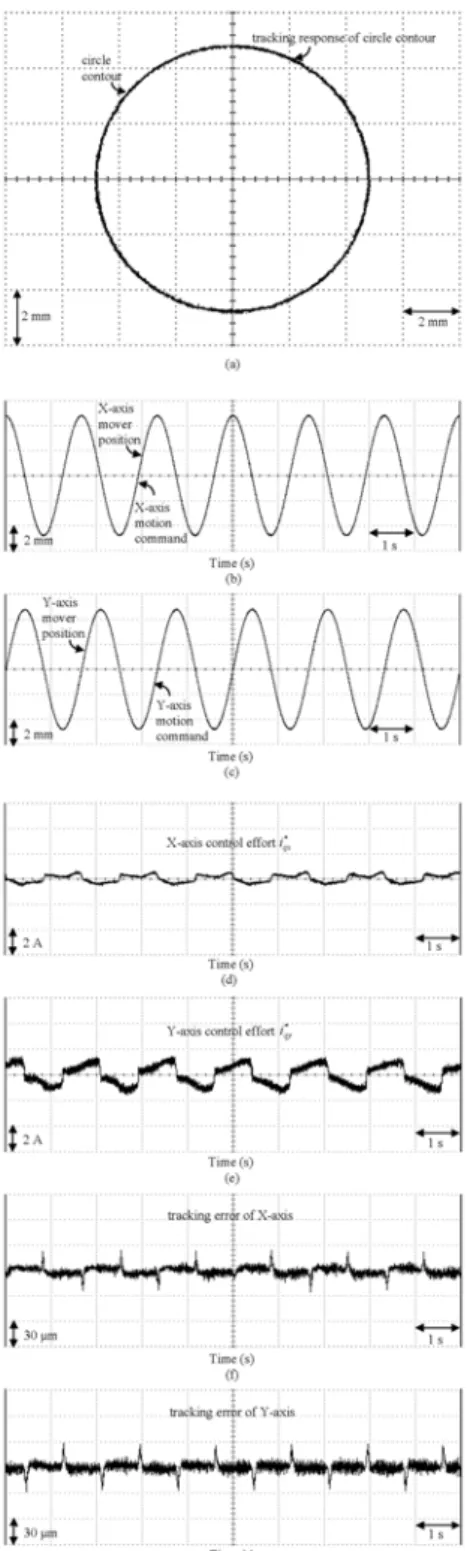
The photos of the DSP-based computer control system, the development system using PC, the motor drives and the X-Y table mechanism are shown in Fig. 5. To demonstrate the effectiveness of the proposed FSCRBFN control system, the nominal condition and the parameter variation condition are provided in the experimentation. The parameter variation condition is the addition of one iron disk with 20kg to the mass of the mover at the beginning. The experimental results of the tracking response, control effort and tracking error of the two test conditions are shown in Fig. 6 and Fig. 7, respectively. From the results, the excellent control performance of the proposed FSCRBFN control system under the occurrence of parameter variations are obvious owing to on-line learning.
V. CONCLUSIONS
The major contributions of this study are: (i) the successful derivation of adaptive learning algorithms based on Lyapunov stability for a FSCRBFN; (ii) the successful development of a FSCRBFN control system to confront the parameter variations and disturbances including cross- coupled interference and friction force; (iii) the successful application of a FSCRBFN control system on a two-axis motion control system to track reference contour with robust control performance.
APPENDIX A
Considering the error system (11) with the assigned sliding surfaces (12), the first Lyapunov function is chosen in the following:
2 2 2 1
1 2
1 2
1S S
V = + (31)
Taking the derivative of (31) yields
) ( )
( 1 2 2 2
1 2 2 1 1
1 S S S S S e e S ua xa
V& = & + & = η& +& + −& (32) with the β1 is a positive constant and substituting (16), (17) and (18) into (36) yields
)
( 2
2
1 1 1 1 2 1 2 1 1 1
a EH E n
x u u u S
S S H S S S B S V
&
&
&
&
&
−
− + +
− +
− +
−
=
ϕ
β ϕ α
1 3 2 2
2 1 2
1 1 1 2
2 1 2 1
2 2 2 1 1
S S
S S
S S S S
β δ δ β
δ α δ
α
+ + + +
−
−
≤ (33)
Hence, V&1≤0 can be guaranteed for small enough δ1 and δ2 . According to the Lyapunov stability theory, the boundedness of S and 1 S can be guaranteed in the case 2 of the boundedness of all the states and control input. This conclusion implies that the asymptotic stability of e , 1 e 2
and e can be guaranteed. 3
APPENDIX B
Substituting (21), (22), (23) and (24) into (32), the derivative of first Lyapunov function can be rewritten as follows:
) (
~ ) (
~ ) (
2 2 1
1 2 1 2 1 1 1
a a
H H n
x u S u
S
u S
S S B S V
&
&
− +
− +
−
− + +
+
−
=
ϕ
ϕ ε
ε α
Γ F
Γ E
T
T
(34) To minimize the error system shown in (11) and to derive the adaptation laws of E and F , the following Lyapunov function candidate is selected.
F F E
ET ~T~ 2
1
~
~ 2
1
2 1
1
2= V + γ + γ
V (35)
Take the derivative of the Lyapunov function as follows:
F F E
ET& T&
&
& 1 ~ ˆ 1 ~ ˆ
2 1
1
2= V +γ +γ
V (36)
Substitute (16) and (25)-(30) into (36), then
(
a)
H
H H
x S S
S S S
S S
S S S S V
2 2 2
1 4 2
2 1
1 3 2
2 1
2 2 2 2 1 1 2
&
&
−
−
⎟⎟
⎟⎟
⎟
⎠
⎞
⎜⎜
⎜⎜
⎜
⎝
⎛
− +
−
⎟⎟
⎟⎟
⎠
⎞
⎜⎜
⎜⎜
⎝
⎛
− +
−
−
−
≤
β ε
δ δ δ
ε δ
δ α δ
α
ϕ ϕ ϕ
1 4 2
2 1 4
1 3 2
2 1 2 3
2 2 2 1 1
S S
S S
S S S S
H δϕ
δ δ δ
δ α δ
α
+ + +
+
−
−
≤ (37)
Hence, V&2≤0 can be guaranteed for small enough δ3 and
δ
4 . According to the Lyapunov stability theory, the boundedness of S and 1 S can be guaranteed in the case 2of the boundedness of all the states and control input.
ACKNOWLEDGMENT
The authors would like to acknowledge the financial support of the National Science Council of Taiwan, R.O.C.
through its grant NSC 95-2221-E-008-177-MY3.
REFERENCES
[1] F. J. Lin and P. H. Shen, “Robust fuzzy neural network sliding-mode control for two-axis motion control system,” IEEE Trans. Ind. Electron., vol. 53, no. 4, pp. 1209-1225, 2006.
[2] S. Laghrouche, F. Plestan, A. Glumineau and R. Boisliveau, “Robust sceond order sliding mode control for a permanent magnet synchronous motor,” Proc. American Control Conf. Denver, pp. 4071-4076 June, 2003.
[3] A. Levant, “Quasi-continuous high-order sliding-mode controllers,”
IEEE Trans. Automatic Control, vol. 50, no. 11, pp. 1812-1816, 2005.
[4] H. J. Shieh and P. K. Hung, “Precise tracking of a piezoelectric positioning stage via a filtering-type sliding-surface control with chattering alleviation,” IET Control Theory Appl., vol. 1, no. 3, pp.
586-594, 2007.
[5] I. C. Baik, K. H. Kim, and M. J. Youn, “Robust nonlinear speed control of PM synchronous motor using boundary layer integral sliding mode control technique,” IEEE Trans. Control Systems Technology, vol. 8, no. 1, pp. 47-54, 2000
[6] J. S. R. Jang, C. T. Sun, and E. Mizutani, Neuro-fuzzy and soft computing: a computational approach to learning and machine intelligence, Prentice-Hall, NJ, 1997.
[7] H. D. Patino and D. Liu, “Neural network-based model reference adaptive control system,” IEEE Trans. Syst., Man, Cybern. B, vol. 30, no. 1, pp. 198-204, 2000.
Fig. 6. Experimental responses of FSCRBFN due to circle contour at nominal condition: (a) tracking response of X-Y table; (b) tracking response of X-axis; (c) tracking response of Y-axis; (d) control effort of X-axis; (e) control effort of Y-axis; (f) tracking error of X-axis; (g) tracking error of Y-axis.
Fig. 7. Experimental responses of FSCRBFN due to circle contour at parameter variation condition: (a) tracking response of X-Y table; (b) tracking response of X-axis; (c) tracking response of Y-axis; (d) control effort of X-axis; (e) control effort of Y-axis; (f) tracking error of X-axis; (g) tracking error of Y-axis.
[8] S. Seshagiri and H. K. Khail, “Output feedback control of nonlinear systems using RBF neural networks,” IEEE Trans. Neural Networks, vol. 11, no. 1, pp. 69-79, 2000.
[9] F. J. Lin, L. T. Teng, and P. H. Shieh, “Intelligent sliding-mode control using RBFN for magnetic levitation system,” IEEE Trans. Ind.
Electron., vol. 54, no. 3, pp. 1752-1762, 2007.

![Fig. 5. Photos of DSP-based computer control two-axis motion control system T w Mww ]ˆ[22212L=](https://thumb-ap.123doks.com/thumbv2/9libinfo/9127938.412067/4.892.87.420.168.402/fig-photos-dsp-based-computer-control-motion-control.webp)