行政院國家科學委員會專題研究計畫 成果報告
製備條件對 Cu-Zn/Mg-Al Hydrotalcite 觸媒的結構與甲醇 縮合反應特性的影響(第 2 年)
研究成果報告(完整版)
計 畫 類 別 : 個別型
計 畫 編 號 : NSC 98-2221-E-011-069-MY2
執 行 期 間 : 99 年 08 月 01 日至 100 年 10 月 31 日 執 行 單 位 : 國立臺灣科技大學化學工程系
計 畫 主 持 人 : 林昇佃
計畫參與人員: 碩士班研究生-兼任助理人員:黃偉華 博士班研究生-兼任助理人員:林智慧
報 告 附 件 : 出席國際會議研究心得報告及發表論文
公 開 資 訊 : 本計畫可公開查詢
中 華 民 國 101 年 01 月 19 日
中 文 摘 要 : 本研究以先前獲得具有催化甲醇縮合反應活性的 Cu-Zn/Mg- Al HTlcs (Hydrotalcite-like compounds)四元觸媒為基 礎,擬藉由改變觸媒製備程序來改變 Cu-Zn 在 HTlcs 結構 中的分佈狀態,本研究第一年度(2009)計畫採用共沈澱方法 製備具 HTlcs 結構的二元、三元、與四元混合氧化物,再依 沈澱或含浸法製成具有不同鍵結環境的 Cu-Zn/Mg-Al HTlcs 四元觸媒,進行反應測試與觸媒結構鑑定。分析確定所製得 二元-四元觸媒皆具有 HT 結構,但 HT 結構的熱穩定性隨製備 方法不同而異,可能是由於製備方法造成層間離子的作用力 改變,分析也顯示以沈澱法擔載銅的作法較易於讓銅進入 HT 結構中的 MII 位置,有高分散度但較不易被還原。擔體先經 673K 煆燒破壞 HT 結構再行含浸,所得觸媒(CuZn/HT673)中 的 Cu 顆粒較大,反應特性也有別於具 HT 結構擔體製得觸媒 (CuZn/HT573)。CuZn/HT573 觸媒在 423- 573K 範圍內具有相 當高的甲醇縮合產物(C2+)選擇率,相對而言,CuZn/HT673 觸媒的最佳 C2+選擇率出現在 523K,其數值與反應轉化率都 低於 CuZn/HT573。473-573K 的觸媒還原溫度通常也能獲得較 高的 C2+產物選擇率,EXAFS 顯示該條件下 Cu 僅為部分還 原。DRIFTS 分析顯示甲醇吸附於 CuZn/HT573 會有甲醛生 成,推論是經由甲醛寡聚合才有 C2+產物生成。反應的共進 料成分對反應活性與 C2+產物選擇率也有顯著影響,當使用 O2、CO、或 CO2 共進料且用量莫耳比 0.3 時,甲醇轉化活性 與 C2+選擇率顯著下降,H2 共進料則僅略微降低選擇率,H2O 共進料除了略提升甲醇轉化反應活性,還能選擇性的生成乙 醛產物。本研究結果顯示,可以藉由觸媒製備條件與反應共 進料條件調控,來改變甲醇縮合生成高碳數產物的反應活性 與選擇性。
中文關鍵詞: 甲醇、縮合、銅鋅、前處理、觸媒製備、共進料、選擇率 英 文 摘 要 : We previously reported that a CuZn/MgAl HTlcs
(hydrotalcite-like compounds) catalyst can catalyze the methanol condensation to form higher oxygenates.
This study extends the previous finding by preparing the 4-component Mg-Al HTlcs with different conditions of the support calcination temperature, the number of components in HTlcs, the catalyst calcination
temperature, the reduction temperature and the molar ratio of Mg/Al. Catalysts were characterized by XRD, EXAFS, TGA, TPR, DRIFTS, and the MeOH reaction tests with/without a co-feed species of H2, H2O, O2, CO, or CO2. Whether the HT structure of support was
preserved or not while the impregnation of Cu and/or Zn changed the dispersion state of Cu. This is
indicated by the effect of support calcination. The one prepared with support HT structure while
impregnation, CuZn/HT573, showed a better C2+
selectivity and a higher MeOH conversion than the one without (CuZn/HT673). Reduction temperature also changed the MeOH conversion rate and the product selectivity. EXAFS shows that oxidic Cu was presented even after high temperature reduction, suggesting Cu+2 may take the interlayer anions positions. DRIFTS showed that FAL and its oligomer were presented which can explain the formation of C2+. The presence of co- feed can significantly change the product selectivity and/or MeOH conversion rate. In the presence of H2O co-feed, acetaldehyde was a dominating C2+ product comparing to a broad distribution of C2+ during the reaction without co-feed or with H2 co-feed. The presence of O2, CO, or CO2 during MeOH reaction completely suppressed the formation of C2+ product.
The support Mg/Al ratio slightly changed the MeOH conversion rate and the product selectivity.
英文關鍵詞: methanol, condensation, Cu-Zn, hydrotalcites, pretreatment, preparation, co-feed
行政院國家科學委員會補助專題研究計畫 □ 成 果 報 告
□期中進度報告
製備條件對 Cu-Zn/Mg-Al Hydrotalcite 觸媒的結構與甲醇縮 合反應特性的影響
計畫類別:;個別型計畫 □整合型計畫 計畫編號:NSC 98-2221-E-011 -069 -MY2
執行期間:98 年 8 月 1 日至 100 年 10 月 31 日 執行機構及系所:國立臺灣科技大學化工系
計畫主持人:林昇佃 共同主持人:
計畫參與人員:M.M.R. Bhuiyan、黃偉華
成果報告類型(依經費核定清單規定繳交):□精簡報告 ;完整報告
本計畫除繳交成果報告外,另須繳交以下出國心得報告:
□赴國外出差或研習心得報告
□赴大陸地區出差或研習心得報告
;出席國際學術會議心得報告
□國際合作研究計畫國外研究報告
處理方式:除列管計畫及下列情形者外,得立即公開查詢
□涉及專利或其他智慧財產權,□一年□二年後可公開查詢 中 華 民 國 年 月 日
目錄:
1. 中文摘要……… 3
2. 英文摘要……… 3
3. 前言……… 3
4. 實驗方法……… 4
5. 結果與討論……… 5
5.1. Effect of preparation conditions……….. 5
5.2. Effect of co-feed on MeOH conversion……….. 9
5.3. DRIFTS during MeOH sTPD………. 10
5.4. MeOH/H2 over different catalysts……….. 11
6. 結論……….. 12
參考文獻……….. 13
行政院國家科學委員會專題研究計畫成果報告
製備條件對Cu-Zn/Mg-Al Hydrotalcite 觸媒的結構與甲醇縮合反應特性的影響 計畫編號:NSC 98-2221-E-011 -069 -MY2
執行期限:98 年 8 月 1 日至 100 年 10 月 31 日 主持人:林昇佃 國立臺灣科技大學化學工程學系
E-mail: [email protected]
1.中文摘要
本研究以先前獲得具有催化甲醇縮合反應活性的Cu-Zn/Mg-Al HTlcs (Hydrotalcite-like compounds) 四元觸媒為基礎,擬藉由改變觸媒製備程序來改變 Cu-Zn 在 HTlcs 結構中的分佈狀態,本研究第一 年度(2009)計畫採用共沈澱方法製備具 HTlcs 結構的二元、三元、與四元混合氧化物,再依沈澱或含
浸法製成具有不同鍵結環境的Cu-Zn/Mg-Al HTlcs 四元觸媒,進行反應測試與觸媒結構鑑定。分析確
定所製得二元-四元觸媒皆具有 HT 結構,但 HT 結構的熱穩定性隨製備方法不同而異,可能是由於製
備方法造成層間離子的作用力改變,分析也顯示以沈澱法擔載銅的作法較易於讓銅進入 HT 結構中的
MII位置,有高分散度但較不易被還原。擔體先經673K 煆燒破壞 HT 結構再行含浸,所得觸媒(CuZn/HT673) 中的Cu 顆粒較大,反應特性也有別於具 HT 結構擔體製得觸媒(CuZn/HT573)。CuZn/HT573觸媒在423- 573K 範圍內具有相當高的甲醇縮合產物(C2+)選擇率,相對而言,CuZn/HT673觸媒的最佳C2+選擇率出
現在 523K,其數值與反應轉化率都低於 CuZn/HT573。473-573K 的觸媒還原溫度通常也能獲得較高的
C2+產物選擇率,EXAFS 顯示該條件下 Cu 僅為部分還原。DRIFTS 分析顯示甲醇吸附於 CuZn/HT573會
有甲醛生成,推論是經由甲醛寡聚合才有C2+產物生成。反應的共進料成分對反應活性與C2+產物選擇
率也有顯著影響,當使用O2、CO、或 CO2共進料且用量莫耳比0.3 時,甲醇轉化活性與 C2+選擇率顯
著下降,H2共進料則僅略微降低選擇率,H2O 共進料除了略提升甲醇轉化反應活性,還能選擇性的生
成乙醛產物。本研究結果顯示,可以藉由觸媒製備條件與反應共進料條件調控,來改變甲醇縮合生成 高碳數產物的反應活性與選擇性。
關鍵詞:甲醇、縮合、銅鋅、前處理、觸媒製備、共進料、選擇率 2. Abstract
We previously reported that a CuZn/MgAl HTlcs (hydrotalcite-like compounds) catalyst can catalyze the methanol condensation to form higher oxygenates. This study extends the previous finding by preparing the 4-component Mg-Al HTlcs with different conditions of the support calcination temperature, the number of components in HTlcs, the catalyst calcination temperature, the reduction temperature and the molar ratio of Mg/Al. Catalysts were characterized by XRD, EXAFS, TGA, TPR, DRIFTS, and the MeOH reaction tests with/without a co-feed species of H2, H2O, O2, CO, or CO2. Whether the HT structure of support was preserved or not while the impregnation of Cu and/or Zn changed the dispersion state of Cu. This is indicated by the effect of support calcination. The one prepared with support HT structure while impregnation, CuZn/HT573, showed a better C2+ selectivity and a higher MeOH conversion than the one without (CuZn/HT673). Reduction temperature also changed the MeOH conversion rate and the product selectivity.
EXAFS shows that oxidic Cu was presented even after high temperature reduction, suggesting Cu+2 may take the interlayer anions positions. DRIFTS showed that FAL and its oligomer were presented which can explain the formation of C2+. The presence of co-feed can significantly change the product selectivity and/or MeOH conversion rate. In the presence of H2O co-feed, acetaldehyde was a dominating C2+ product comparing to a broad distribution of C2+ during the reaction without co-feed or with H2 co-feed. The presence of O2, CO, or CO2 during MeOH reaction completely suppressed the formation of C2+ product. The support Mg/Al ratio slightly changed the MeOH conversion rate and the product selectivity.
Keywords: methanol, condensation, Cu-Zn, hydrotalcites, pretreatment, preparation, co-feed.
3. Introduction
Currently, the chemical industry relies heavily on petroleum to supply both raw materials and energy. With the decreasing supply of petroleum and its hiking price, the calls for decreasing the dependency on oil is rising.
This needs to find an alternative resource for the supply of energy and also for the supply of raw materials for
the chemical industry. Methane is getting more attention recently as a candidate to replace petroleum.
However, the shipping of methane is expensive and therefore the on-site conversion of methane to liquid fuel is proposed. The partial oxidation of methane to methanol [1-3] is one of the popular reactions for this conversion. Accordingly, the chemical industry will need to shift the paradigm to the utilization of methanol.
Furthermore, methanol can also come from the syn gas from coal conversion and from bio-processes. This indicates that a new methanol-economy is happening and may be a major industry sector for the next few decades. The conversion of methanol to molecules of longer carbon chain is consequently an important technology for using methanol as the source of raw materials.
The C-C bond formation is required for flexible supply of raw materials from the methanol conversions.
The methanol-to- gasoline (MTG) [4-6], the methanol-to-olefins (MTO) [7-9], and the methanol-to-hydrocarbons (MTH) [10-15] processes are proven technologies, in which zeolites are used almost exclusively as catalysts at temperatures from 623 K and above. The acid sites of zeolites catalyze dehydration and cracking reactions and higher alkanes and alkenes can be formed via dimethyl ether intermediate. Dehydration and cracking involved may lead to catalyst coking. This together with the high energy consumptions are the disadvantages of these MTX processes. We found previously [16] that a Cu-Zn/Mg-Al HTlcs (hydrotalcite-like compounds) catalyst can catalyze the methanol condensation to form higher oxygenates at 573 K and below. The lower reaction temperatures result in lower coking tendency and lower energy demand. Furthermore, the products involved more oxygenates comparing to the MTX processes.
This makes the newly found process an attractive one for methanol conversion to higher hydrocarbons. In this study, we examined the effect of preparation procedures and the effect of co-feed species on the methanol conversion over the Cu-Zn/HT catalysts. The control of product selectivity of this methanol conversion is our main goal in this study.
4. Experimental
4.1.Catalyst preparation: The Cu-Zn/Mg-Al HT 4-component catalysts were prepared by either impregnation or deposition of component(s) commercial HT supports (Sasol, PURAL MG 50). The commercial HT was calcined at either 573 or 673K for 6 hours before uses, and is denoted henceforth as HT573 and HT673
respectively. Either impregnation or deposition method (at pH=10) was used to load Cu(NO3)2•3H2O (Merck, 99.5%), Zn(NO3)2•6H2O (Aldrich, 99.8%). The final composition of all the samples was:
CuO:ZnO:MgO:Al2O3 = 4:3:46.5:46.5 on weight basis. The prepared catalysts were vacuum dried and then calcined at either 573 or 673 K. House-prepared HT support was coprecipitated from the aqueous solutions of Mg(NO3)2.6H2O (Sigma-Aldrich 99.8 %) and Al(NO3)3.6H2O (J.T. Baker, 99 %) by an aqueous solution of Na2CO3 (Sigma-Aldrich, 99.95 %) to maintain pH =10 in a reflux system under N2 atmosphere. The resulted mixture was aged at 333K, pH = 10, 500 rpm, for 6 hours followed by gravity filtration. The filtered powders was then washed several times using de-ionized water until the pH of the filtrate reached 7 assuming all Na+ were washed away. According to the calcination temperature, this house-prepared support was acronymed as HTP573.
The coprecipitation procedures were used to prepared 3-component (CuMgAl and ZnMgAl) and 4-component (CuZnMgAl) HT catalysts. A subscript p is used to denote the precipitated HT samples prepared in house. Both the 2-component and 3-component HT samples were loaded with Cu(NO3)2•3H2O (Merck, 99.5%), Zn(NO3)2•6H2O (Aldrich, 99.8%) by either impregnation or deposition method. The deposition conditions were the same as those used in the coprecipitation procedures. The prepared samples were vacuum-dried overnight at room temperature and stored in desiccators for later uses.
The methanol reaction was performed at atmospheric pressure with a methanol partial pressure of 26.7 kPa (200 torr), balanced with helium and a WHSV (weight hourly space velocity, in g MeOH/g catalyst.h) of 0.2 h-1. The catalyst was loaded into a pyrex reactor and reduced inline by hydrogen typically at 523K.
Methanol (Merck, spectroscopy grade, 99.95%) was dehydrated by soaking with molecular sieves, then fed into a heated foreline using a syringe pump and carried into a reactor by helium. The reactor was subjected to a stepwise temperature-ramp sequence in which methanol was fed only at constant- temperature segments.
The reactor effluent was analyzed by inline GC (Shimadzu 8A, using TCD detector). The reaction conversions calculated from the percentage of methanol remained in the effluent. The effluent C-balance is typically within + 5 % of the feed when no C2+ products were observed in GC traces. The carbon selectivity is calculated as the ratio of the fractional methanol conversion to a specific product to the total methanol conversion. The produced C2+ was usually a mixture and therefore, its carbon selectivity is calculated from
the missing methanol conversion in carbon balance.
4.2. Catalyst characterization : The powder X-ray diffraction (XRD) of the prepared samples were recorded with either in-house commercial system or at 01C beamline in NSRRC with 15- 18 keV energy and 0.775Å wavelength. The latter was used exclusively for in-situ analysis. The raw data from synchrotron-XRD were extracted by fit2d software and converted to the values corresponding to monochromatic 1.5418Å to cope with mainstream Cu kα based XRD data. The accuracy of the data was ensured by comparing with Ag-SiO2
standard reference mixture calibration. BET surface area was analyzed with N2 adsorption at 77 K using a commercial instrument (Micromeritics, ASAP-2000). N2O-decomposition method was used to determine the copper surface area of reduced catalysts, from which the percentage dispersion and Cu particle size were determined. The basic strength of the prepared catalysts was analyzed by CO2-pulse adsorption and a following TPD.
5. Results and Discussion
5.1. Effect of preparation conditions
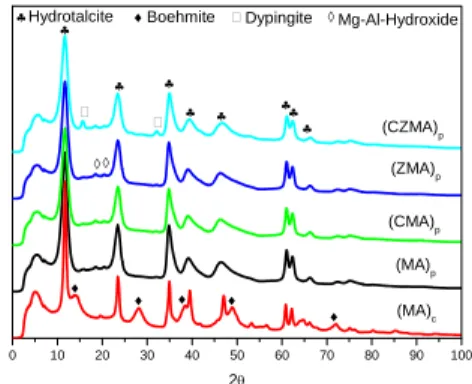
XRD analyses in Fig. 1 show that the as-received HT support contained sharp diffraction peaks of Mg-Al HT (JCPDS, #22-700), broader peaks attributable to Boehmite (JCPDS, #21-1307), and some weak peaks that might be Dypingite (JCPDS, #29-0857) and Mg-Al-Hydroxide (JCPDS, #35-1274). The presence of Boehmite is frequently observed for HTlcs of MgO : Al2O3 = 1 : 1. The house-prepared 2- to 4- component precipitates had the similar HT diffraction peaks. All the house-prepared HT samples showed no other diffraction peaks, except that the 4-component sample (CZMA)P contained peaks attributable to Dypingite.
The absence of phase of, particularly, nitrates, carbonates, oxides or hydroxides of Cu and Zn, in the house-prepared samples suggests that Cu and Zn may have taken the MII positions in the HT structure or in a highly dispersed or amorphous state.
0 10 20 30 40 50 60 70 80 90 100
♦ ♦
♦ ♦ ♦
♣♣
♣ ♣
♣
♣ ♣
♣ ◊
◊
◊
Mg-Al-Hydroxide Dypingite
(CZMA)p (ZMA)
p
(CMA)p
(MA)c
(MA)p
2θ
♦
♣Hydrotalcite Boehmite
Fig. 1 XRD of the commercial and the house-prepared HT supports.
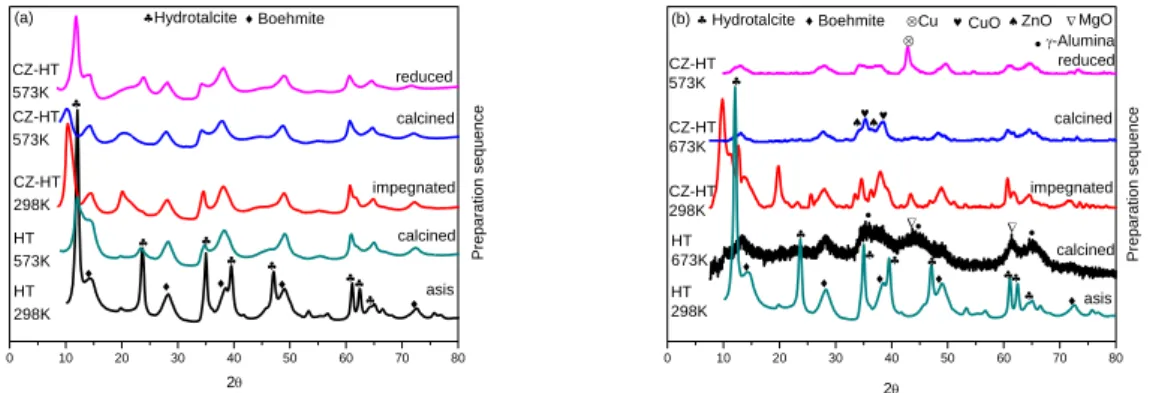
After high-temperature calcination, the layer structure of HT can disappear. Fig. 2 compares the XRD profiles of the commercial HT support after calcination at either 573 or 673 K (HT573 and HT673, respectively) and the corresponding subsequent impregnation, calcination and reduction. Fig. 2(a) and 2(b) show that the fresh support comprises of HT and Boehmite. During calcination in air, all the peaks of HT in the support continued to exist but become broadened at 573K (HT573) and disappeared at 673K (HT673). Boehmite was not significantly changed after calcination to 673K.
After Cu and Zn impregnation on HT573 (CuZn/HT573), the diffraction peaks of HT withstood and shifted their positions. This indicates that the type of interlayer anions was changed. The HT diffraction peaks continued after another calcination of this CuZn/HT573 at 573K (Fig. 2(a)). No obvious peak of Cu or Zn oxide was found. After reduction, HT peaks shifted somewhat, started to decrease in intensity at 623 K and disappeared at 673 K
After impregnation of Cu and Zn on HT673 (Cu-Zn/HT673), three HT phases of different lattice spacing resurrected (Fig. 2(b)). After subsequent calcination at 673K, all three HT structures disappeared yielding mixed oxides of MgO (JCPDS, #45-0946), γ-Al2O3 (JCPDS, #29-0063), CuO (JCPDS #45-0937) and ZnO (JCPDS #36-1451). During reduction of Cu-Zn/HT673 (Fig. 2(b)), CuO was reduced to Cu. Table 1 listed the analyzed lattice constants of HT phases in HT supports and Cu-Zn/HT catalysts. During impregnation, NO3
and OH took HT interlayer anion positions.
0 10 20 30 40 50 60 70 80
♦ ♦ ♦ ♦
♦
♣
♣
♣♣
♣
♣ ♣
♣ (a)
2θ CZ-HT
573K
Preparation sequence
HT 573K CZ-HT 573K
CZ-HT 298K
HT 298K
♦
♣Hydrotalcite Boehmite
asis calcined impegnated calcined reduced
0 10 20 30 40 50 60 70 80
• •
∇ ∇•
♠
♠ ♥♥
⊗
♦ ♦ ♦ ♦
♦
♣♣
♣ ♣
♣ ♣
♣
♣
Preparation sequence
(b)
CZ-HT 573K
2θ CZ-HT
673K
HT 673K CZ-HT 298K
HT 298K
γ-Alumina
♠
•
♦ ♥
♣Hydrotalcite Boehmite ⊗Cu CuO ZnO ∇MgO
asis calcined impegnated calcined reduced
Fig 2 XRD profiles of Cu-Zn/HT573K and Cu-Zn/HT673K at different stages of preparation.
Table 1 Effect of calcinations condition on the crystal parameters of HT structure of CuZn/HT catalysts.
Sample TCalc
(K) c = D003
(nm) a = 2D110
(nm)
Interlayer* thickness* (nm)
HT673 673 .759 .305 .282 CuZn/HT673 298
HT1 .906 .306 .429 HT2 .751 .307 .273 HT3 .700 .307 .223
HT573 573 .757 .304 .280 CuZn/HT573 298 .875 .305 .398
CuZn/HT573 573 .862 .304 .385
HTP573 573 .759 .303 .282
CuZn/HTP573 298 .778 .304 .301 CuZn/HTP573 573 .793 .304 .317
*provided that the layer thickness remains constant at 0.477 nm.
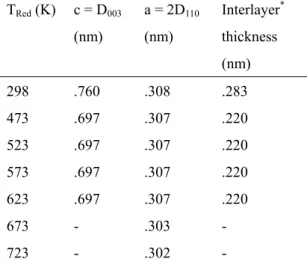
TPR indicates that the percentage of CuO reduction in the deposited samples was much lower than that of the impregnated samples. This suggests that part of Cu took the MII positions in HT structure and consequently was not reduced under the conditions of this test. Fig. 3 shows the effect of reduction temperature on the in-situ XRD of the 573K-calcined (CuZn)IM/HTP573. Table 2 shows the analyzed crystal structure parameters. The results indicate that HT inter-layer distance shrink with increasing hydrogen reduction temperature and the layer structure disappeared after H2 treatment at > 623K when reduced Cu phase started to appear. The changes of BET surface area and Cu dispersion of the CuZn/HT673 reduced at different temperature are listed in Table 3. It shows that the reduced Cu phase appeared at lower temperature when the HT structure was broke down before impregnation.
0 10 20 30 40 50 60 70 80
♣ ♣ ♣♣♣
♣ ♣
♣
• ∇⊗• ∇
2θ
298K 473K 523K 573K 623K 673K 723K amorphous phase ♣Hydrotalcite ⊗ Cu ∇MgO γ-Alumina
•
Fig 3 The in-situ XRD profile of (CuZn)IM/HTP573 where HTP573K belongs to homemade HT calcined at 573K.
Table 2 Effect of reduction temperature on the crystal parameters of HT structure of the (CuZn)IM/HTP573 catalyst.
TRed (K) c = D003
(nm)
a = 2D110
(nm)
Interlayer* thickness (nm) 298 .760 .308 .283 473 .697 .307 .220 523 .697 .307 .220 573 .697 .307 .220 623 .697 .307 .220
673 - .303 -
723 - .302 -
Table 3 Effect of reduction temperature on the BET surface area and the Cu surface area of CuZn/HT673 catalyst.
N2O ads XRD Pretreatment
BET (m2/g) DCu
(%) dCub
(nm) dCuO
(nm) dCu
(nm) C673 182 -- -- 11 -- C673 + R473 178 30 3.4 10 9 C673 + R523 177 28 3.6 9 10 C673 + R573 170 27 3.8 -- 10 C673 + R673 167 25 3.9 -- 12
R523 -- 29 3.5 -- --
The Cu K-edge EXAFS and XANES spectrum of CuZn/HT573 and CuZn/HT673 are shown in Fig. 4. The fresh CuZn/HT573 catalyst had mainly Cu-O coordination and a second-shell Cu-Mg. After reduction at 573K, the Cu-Mg coordination disappeared and both Cu-O and Cu-Cu metal shell were presented. After reduction to 723K, Cu-Cu metal coordination dominated but Cu-O was still presented. This indicates that a portion of Cu remained in oxidized phase after high temperature reduction which is likely Cu insertion to interlayer of HT.
CuZn/HT573 was partially reduced at 573 K which condition was used prior to all reaction tests. The fresh Cu-Zn/HT673 has mainly Cu-O and minor Cu-Cu shells. During reduction up to 723K, Cu-Cu dominates over Cu-O but Cu-O remained present after 723 K reduction. This suggests that HT support can stabilize oxidic Cu.
The CuZn/HT673 reduced at 523 or 573 K showed similar coordination structures in EXAFS; both were partially reduced with metallic Cu-Cu coordination number of 7. Comparatively, The CuZn/HT573 reduced at 573 K had a metallic Cu-Cu coordination number of 5, indicating that smaller Cu particles were presented in CuZn/HT573 -R573 than in CuZn/HT673–R523.
Fig. 4 The XANES/k-space/r-space profiles of CuZn/HT573 (a-c) and of CuZn/HT673 (d-f).
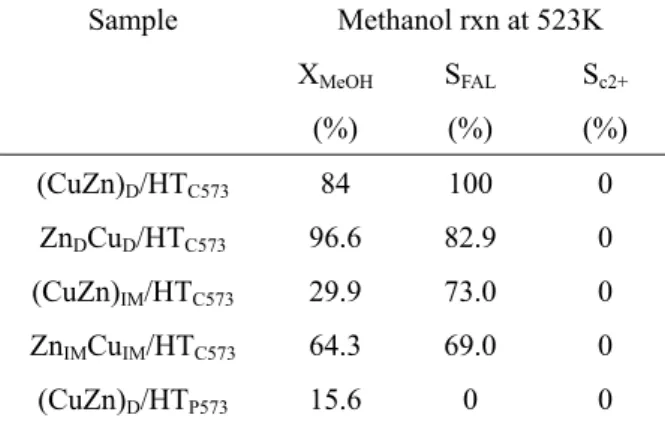
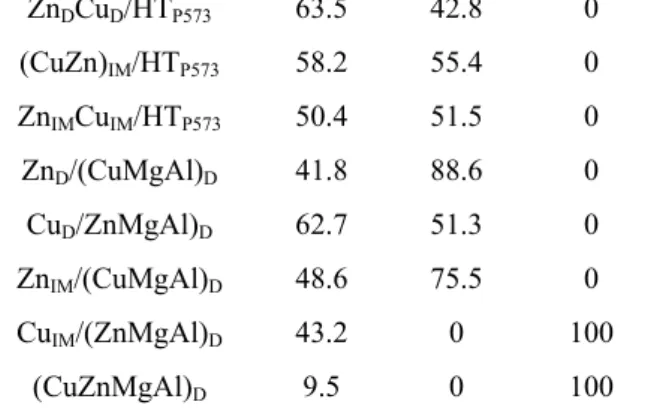
Fig. 5 shows the effect of reduction temperature on the MeOH conversion over the 673K-calcined CuZn/HT673. It indicates that the MeOH conversion increased with increasing reduction temperature but the C2+ selectivity had a maximum at the reduction temperature of 523K. Table 4 compares the MeOH reaction data at 623 K over all the 4-component catalysts prepared in this study, all after hydrogen reduction at 573 K.
Results showed that the selectivity to C2+ and formaldehyde varied with the catalyst preparation procedure.
450 500 550 600
0 20 40 60 80 100
0 20 40 60 80 100
MeOH Conversion (%)
Selectivity to C2+ (%)
Temperature (K) TR(K) XMeOH SC2+
O673K O673K + R473K O673K + R523K O673K + R573K Onone + R523K
Fig. 5 Effect of reduction temperature on the MeOH reaction over CuZn/HT673 catalyst.
Table 4: Methanol reaction at 523 K over differently prepared 4-component Cu-Zn-Mg-Al catalysts.
Methanol rxn at 523K Sample
XMeOH
(%)
SFAL
(%)
Sc2+
(%) (CuZn)D/HTC573 84 100 0
ZnDCuD/HTC573 96.6 82.9 0 (CuZn)IM/HTC573 29.9 73.0 0 ZnIMCuIM/HTC573 64.3 69.0 0
(CuZn)D/HTP573 15.6 0 0
ZnDCuD/HTP573 63.5 42.8 0 (CuZn)IM/HTP573 58.2 55.4 0 ZnIMCuIM/HTP573 50.4 51.5 0 ZnD/(CuMgAl)D 41.8 88.6 0 CuD/ZnMgAl)D 62.7 51.3 0 ZnIM/(CuMgAl)D 48.6 75.5 0 CuIM/(ZnMgAl)D 43.2 0 100
(CuZnMgAl)D 9.5 0 100 SFAL = selectivity of formaldehyde
Sc2+ = selectivity of higher oxygenates
It is evident from Fig. 6 that calcination during catalyst preparation changed the catalyst performance for MeOH conversion to higher oxygenates. The CuZn/HT573–R573 catalyst had a higher MeOH conversion activity than the CuZn/HT673–R573 catalyst. Over CuZn/HT573 -R573 (Fig. 6(a)), C2+ was the main product at temperatures below 473K, formaldehyde (FAL) increased with increasing temperature, and CO and CO2
emerged after 523 K. Over CuZn/HT673–R573 (Fig. 6(b)), formaldehyde (FAL) was not produced steadily and the highest C2+ selectivity was obtained at around 500K while CO was the major product. The product selectivity was strongly dependent on the calcination temperature.
Fig 6 MC activity of Cu-Zn/HT573K (Fig. 6a) and Cu-Zn/HT673K (Fig. 6b)
5.2. Effect of co-feed on MeOH conversion
The product selectivity of methanol decomposition over a commercial Cu-ZnO catalyst was found [17]
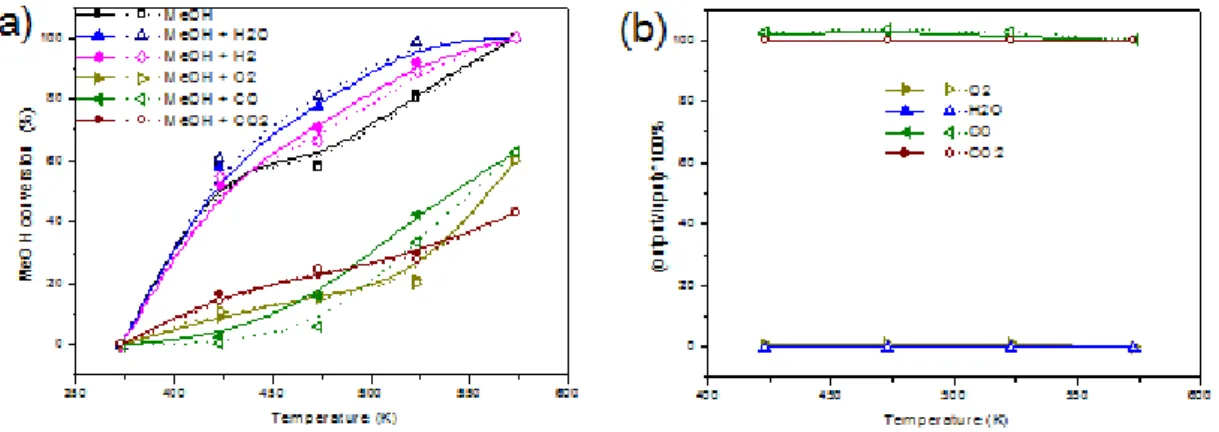
to change in the presence of co-fed H2. In this study, we examined the effect of co-feed of H2O, H2, O2, CO and CO2, at a co-feed/MeOH molar ratio of 0.3, on the MeOH conversion over CuZn/HT573–R573. Fig. 7 compares the MeOH conversion and co-feed conversion in each case. There is no MeOH conversion at 373K in all cases. The trend of MeOH conversions with respect to the type of co-feed is: H2O > H2 > no co-feed >>
O2 ~ CO ~ CO2 (Fig 7(a)). The difference of co-feed species between input and output streams (Fig. 7(b)) indicates that a co-feed as O2 or H2O was completely consumed while CO and CO2 were not at all consumed during the reaction.
Fig 7 Effect of co-feed species on (a) MeoH conversion of Cu-Zn/HT573 and (b) the consumption of co-feed during reaction.
Fig. 8 compares the effect of co-feed on the product selectivity. Without co-feed species (Fig. 8(a)), the Cu-Zn/HT573 produced mainly C2+ product at 423 - 473K. FAL, CO and CO2 appeared in the temperature ranges when the selectivity of C2+ decreased and formaldehyde selectivity was relatively high. With H2
co-feed (Fig. 8(b)), CO and C2+ were formed at low temperatures, and thereafter C2+ decreased and FAL and CO increased. With H2O co-feed (Fig. 8(c)), conversion products were limited to acetaldehyde (AAL), CO2
and CO. Acetaldehyde selectivity was very high initially at 423K but went down with temperature when CO2
selectivity increased. The selectivity of CO was low maintaining < 10% within the experimental temperature range. The product was further limited only to CO2 when O2 is used as the co-feed (Fig. 8(d)). When CO or CO2 was used as the co-feed (Fig. 8(e), 8(f)), FAL was the only product and the co-feed was not consumed.
These results indicate that the type of co-feed can change the product selectivity. Among the co-feed species tested, H2O is unique in producing a high selectivity to a specific C2+ product, i.e., AAL.
400 450 500 550 600
0 20 40 60 80 100
0 20 40 60 80 100
Conversion (%)
Selectivity (%)
Temperature (K) C2+
FAL
CO
CO2
400 450 500 550 600
0 20 40 60 80 100
0 20 40 60 80 100
Conversion (%)
Temperature (K)
Selectivity (%)
H2/MeOH = 0.3 C2+
FAL CO
400 450 500 550 600
0 20 40 60 80 100
0 20 40 60 80 100
Conversion (%)
Selectivity (%)
Temperature (K) H2O/MeOH = 0.3 AA
CO CO2
400 450 500 550 600
0 20 40 60 80 100
0 20 40 60 80 100
Conversion (%)
Selectivity (%)
O2/MeOH = 0.3
Temperature (K) CO2
400 450 500 550 600
0 20 40 60 80 100
0 20 40 60 80 100
Selectivity (%) Conversion (%)
CO/MeOH = 0.3
Temperature (K) CO FAL
400 450 500 550 600
0 20 40 60 80 100
0 20 40 60 80 100
Selectivity (%) Conversion (%)
CO2/MeOH = 0.3
Temperature (K) FAL
CO
Fig 8 Changes in the MeOH conversion and the selectivity over Cu-Zn/HT573 when (a) without co-feed, and in the presence of the co-feed (b) H2, (c) H2O, (d) O2, (e) CO, or (f) CO2.
5.3. DRIFTS during MeOH sTPD
We carried out MeOH adsorption over CuZn/HT573 at 298 K, followed by He purge and a subsequent sTPD (stepwise TPD) under different atmosphere of purge gas containing the co-feed species used above. The DRIFTS at different temperature under different purge gas during sTPD is shown in Fig. 9. Fig. 9(a) shows that MeOH adsorption on CuZn/HT573 at 298 K yielded molecular MeOH (3238, 2560, 1440, 1120 cm-1), methoxy (2941, 2820, 2602, 2468, 1408, 1194, 1060 cm-1), methyl formate (MF, 1660, 1442 cm-1), FAL and its polymer (2913, 2843, 1700 - 1850 cm-1), and maybe some carbobnates (1415cm-1) adspecies. Increasing
temperature under inert gas flow, MeOH signals disappeared first. Thereafter, methoxy species decreased and monodentate formate (m-F, 2890, 2834, 1613, 1390 cm-1) appeared and increased with increasing temperature.
FAL and MF disappeared at 473K and CO (2204, 2138 cm-1) appeared at 573 K. At 523 and 573K, b-F was also found. This suggests that polymeric FAL resulted in C2+ products which disappeared from DRIFTS at higher temperatures when CO became obvious.
When H2 was introduced at 298 K, MF intensity increased slightly (Fig. 9(b)). During sTPD in the presence of H2, the changes in DRIFTS were similar to that without H2 except in the temperature range.
MeOH disappeared at around 393 K, and CO appeared after 523 K.
In the presence of H2O at 298 K, the DRIFTS changes significantly (Fig.9(c)). The C-H stretching region became a broad band and the combination bands at around 2600 and 2560 cm-1 seems disappeared. Two more distinguishable absorbances were at 2440 and 2167 cm-1; the former shifted to lower wave number and the latter disappeared at high temperatures.
When O2 was introduced at 298 K, MF intensity increased (Fig. 9(d)). During sTPD in the presence of O2, the changes in DRIFTS were similar to that under inert gas flow except in the temperature range. MeOH disappeared at around 393 K, and methoxy disappeared after 523 K. CO2 appeared after 523 K and at the same time m-F was the dominate adspecies. In the presence of CO at 298 K, MF and carbonates increased in intensity (Fig.9(e)). As temperature increased, m-F increased. When methoxy was largely converted after 473 K, CO2 and FAL became obvious in DRIFTS. When CO2 was in the gas stream at 298 K, MF and carbonates increased significantly (Fig.9(f)). Methoxy disappeared at high temperatures and m-F became more abundant.
Also, FAL became obvious in DRIFTS. Fig.9 clearly indicates that co-feed species changed the adspecies and their reactivity.
3500 3000 2500 2000 1500 1000
MeOH MeO MeO
FAL MF
MeO
MeOH m-F
MeO MeO (e)
(d) (c) (b)
(a)
Absorbance (a.u.)
Wavenumber (cm-1)
3500 3000 2500 2000 1500 1000
MeOHMeO MeO
FAL MF
MeO
MeOH
(e) (f)
(d) (c)
(a) (b)
CO m-F
MeO
MeO
Absorbance (a.u.)
Wavenumber (cm-1)
3500 3000 2500 2000 1500 1000
2167
2440MeOHMeO MeO
FAL MF
MeO
MeOH MeO
MeO
(f) (e) (d)
(c) (b) (a)
Absorbance (a.u.)
Wavenumber (cm-1)
3500 3000 2500 2000 1500 1000
MeOH MeO MeO
FAL MF
MeO
MeOH m-F
CO2
MeO
MeO
(d) (e) (f)
(c) (b) Absorbance (a.u.) (a)
Wavenumber (cm-1)
3500 3000 2500 2000 1500 1000
MeOH MeO MeO
FAL MF
MeO
MeOH CO m-F
MeOMeO CO2
(e) (f)
(d) (c) (b) Absorbance (a.u.) (a)
Wavenumber (cm-1)
3500 3000 2500 2000 1500 1000
MeOHMeO MeO
FAL MF
MeO
MeOH
(f) (e) (d) (c) (b) (a)
m-F
MeO
MeO
Absorbance (a.u.)
Wavenumber (cm-1)
Fig 9 DRIFTS during MeOH adsorption and the subsequent sTPD over CuZn/HT573 when (a) without co-feed, and in the presence of the co-feed (b) H2, (c) H2O, (d) O2, (e) CO, or (f) CO2.
5.4. MeOH/H2 over different catalysts
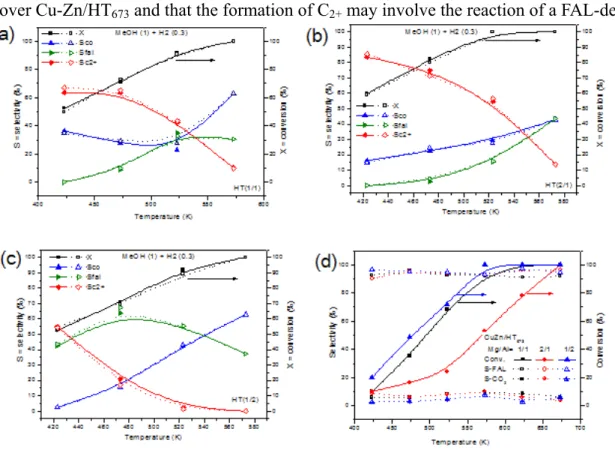
Fig.10 shows the effect of H2 co-feed on the MeOH conversion over CuZn/HT573 and CuZn/HT673
catalysts with different Mg/Al ratios of HT. Different Mg/Al ratio in HT changed the MeOH conversion reactivity but not the product selectivity in respective cases. All three catalysts with H2 co-feed showed a high selectivity to FAL with CO2 as the minor product over Cu-Zn/HT673 catalysts. Cu-Zn/HT573K catalysts show C2+, FAL and CO selectivity variable to Mg/Al ratio. Comparing to the results without H2 co-feed (Fig.
6b), the C2+ and CO selectivity was suppressed and the FAL selectivity was enhanced by the co-feed H2. This is similar with the effect of co-feed H2 on the MeOH conversion over commercial CuZn/Al2O3 catalyst
[17].Comparatively, the H2 co-feed on CuZn/HT573 also suppressed, but not completely, the formation of C2+
and the FAL formation was enhanced. This suggests that H2 suppressed the dehydrogenation of FAL to CO over Cu-Zn/HT673 and that the formation of C2+ may involve the reaction of a FAL-derived species.
Fig 10 MC activity with H2 co-feed of CuZn/HT573 (a-c) and of CuZn/HT673(d).
6. Conclusions
We have prepared 4-component Cu-Zn-Mg-Al catalysts with different procedures. The HT-like structure was confirmed with all the prepared catalysts. The HT structure was changed by the pretreatment at higher temperatures under either oxidation or reduction conditions. In-situ XRD analysis showed that the interlayer distance shrinked with increasing pretreatment temperature till a limit when layer structure broke down. The stability of HT-like structure varied with the catalyst preparation procedure. After impregnation, HT structure resurrected with interlayer anions containing the NO3 and OH from the surroundings. The catalyst prepared by the impregnation over a support with preserved HT structure (HT573) dispersed Cu moiety better than that over a support without the preserved HT structure (HT673). Part of the Cu included retained oxidized even after high temperature reduction. This suggests a tendency of Cu and/or Zn to take the MII position in HT structure.
The MeOH reaction performance varied over differently prepared and pretreated CuZn/HT catalysts. The CuZn/HT573-R573 yielded a high C2+ product selectivity at 423 – 523 K which decreased with further increase of temperature. In comparison, the CuZn/HT673-R573 showed a peak C2+ product selectivity at 523 K which peak value was lower than that of CuZn/HT573-R573. High C2+ product selectivity was found at a medium catalyst reduction temperature at 473 – 573 K. This suggests that oxidic Cu is involved in the MeOH conversion.
The product selectivity during MeOH conversion was also changed by the presence of co-feed species.
The MeOH conversion was not significantly change by the presence of H2 or H2O, but the C2+ selectivity was decreased. The presence of H2O limited the C2+ to include mainly acetaldehyde which clearly showed the product selectivity can be tuned by the use of suitable co-feed species. When using O2, CO, or CO2 as the co-feed, the MeOH conversion was significantly decreased and the C2+ selectivity was largely suppressed.
CO2 was the main product when O2 was presented while FAL was the main product when CO or CO2 was included as the co-feed. DRIFTS analysis suggested that FAL formed from MeOH adsorption may oligomerize to form C2+ product. The DRIFTS during subsequent desorption varied by the presence of different co-feed species in purge gas. With H2, the DRIFTS during sTPD was similar with that without co-feed. With H2O, surface adspecies almost completely disappeared with the occurrence of a strong band at
around 1720 cm-1 which may be attributed to AAL.
References:
[1] J. Haggin, Chem & Eng. News, 71 (1993) 27.
[2] R. H. Crabtree, Chem. Rev. 95 (1995) 987.
[3] B. K. Warren, S. T. Oyama, Heterogeneous Hydrocarbon Oxidation (American Chemical Society, 1996).
[4] S.A. Tabak, S. Yurchak, Catal. Today, 6 (1990) 307
[5] K.G. Allum, A.R. Willliams, Stud. Surf. Sci. Catal., 36 (1988) 691 [6] B. Sulikowski, J. Klinowski, Appl. Catal., 89 (1992) 69.
[7] W.J.H. Dehertog, G. F. Froment, Appl. Catal., 71 (1991) 153.
[8] M. Seiler, W. Wang, A. Buchholz, M. Hunger, Catal. Lett., 88 (2003) 187.
[9] D. Prizn, L. Riekert, Appl Catal 37 (1988) 139.
[10] C.D. Cheng, Chem Eng Sci 35 (1980) 619.
[11] R. L. Espinoza, C. M. Stander, W. G. B. mandersloot, Appl. Catal., 42 (1988) 29.
[12] L. J. V. Rensburg, R. Hunter, G. J. Hutchings, Appl Catal., 42 (1988) 29.
[13] G. J. Hutchings, P. Johnson, Appl. Catal., 67 (1990) L5.
[14] D. Freedman, R.P.K. Wells, G.J. Hutchings, Catal. Lett., 82 (2002) 217.
[15] P. Yarlagadda, C.R.F. Lund, E. Ruchenstein, Appl. Catal., 54 (1989) 139.
[16] T. C. Hsiao, S. D. Lin, Catal. Lett., 119 (2007) 72.
[17] T. C. Hsiao, S. D. Lin, J. Mol. Catal., 277 (2007) 137.
國科會補助專題研究計畫成果報告自評表
請就研究內容與原計畫相符程度、達成預期目標情況、研究成果之學術或應用價 值(簡要敘述成果所代表之意義、價值、影響或進一步發展之可能性)、是否適 合在學術期刊發表或申請專利、主要發現或其他有關價值等,作一綜合評估。
1. 請就研究內容與原計畫相符程度、達成預期目標情況作一綜合評估
□ ;達成目標
□ 未達成目標(請說明,以 100 字為限)
□ 實驗失敗
□ 因故實驗中斷
□ 其他原因 說明:
2. 研究成果在學術期刊發表或申請專利等情形:
論文:□已發表 □未發表之文稿 ;撰寫中 □無 專利:□已獲得 □申請中 □無
技轉:□已技轉 □洽談中 □無 其他:(以 100 字為限)
3. 請依學術成就、技術創新、社會影響等方面,評估研究成果之學術或應用價 值(簡要敘述成果所代表之意義、價值、影響或進一步發展之可能性)(以 500 字為限)
本研究計畫的目的在於尋求以甲醇作為化學品製作原料的新製程,目標在於 甲醇以 C-C 鍵形式進行縮合,以產製高碳數化學品,可以在石油原料逐漸耗 竭時,以甲醇作為替代的化學品原料。此研究方法在前期已獲得美國專利,
本研究嘗試進行產物選擇率的調控,結果顯示可以藉由觸媒製備方法的改變 與反應共進料的使用,來調控高碳數化學品的生成選擇率,研究發現使用少 量水為共進料反應務實,可以選擇性的生成乙醛產物,顯示本研究方法作為 化學品產製技術的實用價值。
附件二
國科會補助專題研究計畫項下出席國際學術會議心得報告
日期: 年 月 日
一、參加會議經過
第二十二屆北美催化會議 (22nd North American Catalysis Society Meeting)在美國底特律(Detroit) 的 Renaissance Center 中的 Marriott Hotel 舉行,Renaissance Center 也就是通用汽車總部(GM Renaissance Center),是 Detroit 臨河最熱鬧的市中心區,也是 Detroit 街區再生的重要景觀建築,附
近區域有許多商辦大樓與政府建築,該市職棒的場館也在附近,是Detroit 最主要的中樞區域。6 月
初的Detroit 白天陽光高照,在中午最高溫有 25-30 度,午餐休息時間河邊閒逛的人潮絡繹不絕。
北美催化會議每 2 年輪流在美國各城市舉辦,自第一次 1969 年在 Atlantic City 舉行以來,規
模逐漸成長,本次會議統計有超過1000 人註冊參加,來自 38 國的研究人員與會,參與人士除了學
數單位和研究機構研究員,還有許多來自工業界的研究人,得以促成產學界間的討論,強化學術與 應用的連結。6 月 5 日晚上大會的 Reception 安排到福特汽車博物館(Henry Ford Museum),也是重 要的歷史展點。從星期一開始,每天早上以 Plenary lecture 開場,之後分開在 6 個 session 會議廳,
同時進行論文口頭報告,上下午各穿插有許多Keynote lecture (共 24 篇),口頭報告總計有 426 篇,
另外約有 400 篇以上海報展示發表,是星期一、二和三每天下午 5:30 開始分別展示到 8 點,場地
計畫編號 NSC 98-2221-E-011 -069 -MY2
計畫名稱 製備條件對Cu-Zn/Mg-Al Hydrotalcite 觸媒的結構與甲醇縮合反應特
性的影響 出國人員
姓名 林昇佃 服務機構
及職稱 台灣科技大學化工系教授 會議時間 100 年 6 月 5 日至
100 年 6 月 10 日 會議地點 Detroit, USA
會議名稱
(中文)第二十二屆 北美催化學術會議
(英文) 22nd North American Catalysis Society Meeting
發表論文 題目
(中文)
(英文)
1. Effect of boron on the stability of CuNi/SiO2 catalysts during ethanol steam reforming
2. Effect of Pd particle size on methanol decomposition over Pd/ZnO
內有數十家儀器、觸媒及化學品公司參與攤位展示,同時間提供食物與飲料,份量足供與會者晚餐,
因此海報展示期間人潮來往、討論的氣氛熱烈,這多是由一些著名的化學產業公司所提供的經費贊
助;另外,每天一早的Plenary lecture 結束後,休息時間也略微加長,並提供足夠餐點與飲料作為
與會者的早餐,兼做吸引與會者到會場的一種誘因。整體而言,本次會議整體的安排,能吸引與會 者的參與,並構成一個可以充分交流討論的氛圍。
本次大會有 4 個主題,(1) Catalysis, Materials, and Reaction Engineering for Environmental Protection, (2) Catalysis, Materials, and Reaction Engineering for Fuel Production/Utilization, (3) Catalysis, Materials, and Reaction Engineering for Industrial Chemicals, (4) Emerging Issues: Novel Materials, Theory, and Experimental Methods。可見主要是以應用領域作分類,包含環境、能源與工 業化學品三大領域,其餘的歸為發展中議題。本次所發表的一篇口頭報告論文是由實驗室博士班學 生上台,是報告含硼成分(NaBH4與 H3BO3)添加對 CuNi 觸媒在乙醇蒸氣重組反應中,表面積碳現
象的抑制作用。另一篇壁報論文討論後處理方法對於Pd 奈米顆粒與 ZnO 載體的交互作用的影響。
二篇論文都有許多與會者熱心提出建議、並相互討論交換看法,,可以供往後實驗的改進技巧以及
將來提計畫研究方向的重要參考。在poster 展示時,除了國外學者專家外,也吸引不少台灣在美國
唸書的留學生前來討論,並互相認識,彼此都獲得良好的建議。
二、與會心得
本次NAM 大會中,能源發展領域議題仍是一個顯著佔有較高比例的主題,顯示是美國與全世
界共同熱切探討的議題,與國內外其他觸媒相關研討會的特徵相似,不過NAM 會議中有許多工業
界人士參與,得以聽聞產業界人士的看法,也明確點出各種新能源技術的優缺點與產業化的限制因 素,得以讓技術發展方向更明確,而這些被提到的限制條件有很大一部份是具有地域性的,透過產 業界與學術界的討論互動,可以對不同地域適合的能源技術發展方向有密切的交流討論。相較而 言,在國內的相關研討會中,極少聽到此類產業界參與的交流討論,可能是形成國內能源相關技術 發展方向多頭分歧的原因之一,值得國內省思與借鏡。此外,美國有許多大的跨國石油或化學公司
例如Dutch Shell、BP 等,投入龐大的研究經費在觸媒及反應方面,也常常借助學術單位的研發能
量進行技術合作開發,所以他們的技術可以保持領先的地位。國內在觸媒方面的研究發展,主要在 學術界,除非中油、台塑等大廠有興趣投入,單靠學術界的力量,只能有零星的成果。這種產業界
與學術界的互動應該也不是一朝一夕就成形的,有數十年歷史的NAM 會議,會議流程順暢,與國
內舉辦會議相較,最顯著的差異是來自工業界的與會者人數相對多,且工業界發表論文篇數也相對 多,可以看到工業界與學術界相當多的互動,這是國內研討會較少見的;缺少產業界互動,也可能 會使國內的學術研究無法跨入實際應用的技術領域,應該是我們需要嘗試改進的,也是舉辦研會實 應該要嚐試達到更多的產業界互動。
三、考察參觀活動(無是項活動者略) 無
四、建議 無
五、攜回資料名稱及內容 1.研討會的摘要論文集
2.參展廠商提供的資料 六、其他
無