國立臺灣大學資訊管理學研究所碩士論文
National Taiwan University College of Management
Graduate Institute of Information management
指導教授:黃明蕙博士
Advisor : Dr. Huang Ming-Hui
社會認知:於獨裁者賽局中視為訊息或報酬
Social recognition: Signal or reward in dictator games
Acknowledgement
Being one of the very, very few non native full time students studying in National Taiwan University’s information management department can be a real struggle at times. I am just not the type to be a guinea pig and it has taken me too long to ask for help.
Eventually, I have been helped by so many that it would double the number of pages if I had to thank everyone individually. In the spirit of my research, it is not more than fair that I express my gratitude to:
Professor Huang Ming-Hui: For all your intellectual stimulation. The simple questions that are so hard to answer taught me so much. You believed in me from the beginning of the first semester. You are the reason I wanted to stick with the program, and you are the reason I could finish.
Alfred, Dean: For allowing me to work irregular hours and to do school work in office hours, so that I could use school hours for sleeping.
Wes and Max from the E-commerce lab: For helping me with the numerous procedures, your moral support and your help with the survey.
Judy; without your help translating the website into Chinese and arranging all the participants, I think there would not have been a survey.
Conrad: Thanks for pointing me to the survey software. Your gigabytes and your bandwidth are one less worry on my mind.
Natasha, Candics, Adam, Nick, Poyu and all of you who wished to remain anonymous: You know what you did and you know that I know it too. It has been much appreciated.
Oscar Graveland, June 2009
中文摘要
論文題目: 社會認知:於獨裁者賽局中視為訊息或報酬
作者:奧斯卡 2009 年 6 月
指導教授:黃明蕙 博士
公平理論已足以與典型的經濟理論形成互補關係。學者在進行如獨裁者賽局、最 後通牒賽局等選擇類型實驗時所發現的異常結果,常可藉由公平理論來獲得解釋。公 平理論的成功之處在於揭露了一般人對平均主義有所偏好,然而,公平理論卻未能解 釋這種偏好的理由。另外,學者們進行相關實驗時,常為了避免偏誤而將實驗設計得 非常精密,但這些精密設計反而造成實驗與現實世界脫節:在現實生活中,金錢必須 靠工作賺得,但在許多選擇實驗裡,受試者於初始階段即憑空得到了一筆金錢。這使 得受試者在被要求分配手中金錢時,可能僅憑喜好、或僅憑與他人的親殊程度就決定 了分配比例。
有鑑於此,我們提出對獨裁者賽局的修改版本:兩名受試者在雙方不直接互動下 合作完成一項工作,並共同分享完成任務後所得到的報酬。我們將受試者伙伴如何履 行工作的資訊提供給受試者,並讓受試者決定自己應得之報酬比例。我們希望觀察受 試者在接收到不同伙伴工作資訊以及不同程度的社會認知時,對其決定報酬的行為有 何影響。
Thesis abstract
Social recognition: signal or reward in dictator games
By Oscar Onno Graveland
GRADUATE INSTITUTE OF INFORMATION MANAGEMENT NATIONAL TAIWAN UNIVERSITY
JUNE 2009
ADVISOR: Dr. MING-HUI HUANG
Standard economics theory has been complemented with fairness theories in an attempt to explain the anomalies found in choice type experiments, most of which are done as either dictator games, ultimatum games or tournaments of such games. The distinct success of fairness theories exposed a basic preference for a level of equalitarianism, but it has not revealed the motivation for the preference for fair outcomes. The experiments were carefully designed to avoid framing, but as a result lost some connection to real life situations, in which monetary compensation is only exchanged for the delivery of goods or services. In that case it is possible that the outcome strongly reflects the perceived or assumed kinship of the agents.
We present a modified version of a dictator game where two agents get rewarded for performing a collaborative task in and where the “dictator” is responsible for sharing the reward with the other agent. We are interested in how information about the other agents’
performance and social recognition of the dictator interact with the choice behavior of the dictator.
Key words: fairness, dictator game, transaction.
中文摘要 ... i
Thesis abstract ... ii
1 Introduction ... 1
1.1 Research Motivation... 2
1.2 Fairness... 3
1.3 Research Question ... 3
2 Literature Review ... 4
2.1 Observed choice behavior in games ... 4
2.2 Dictator Games and Ultimatum Games... 4
2.3 Fairness Models... 6
2.3.1 Equity, Reciprocity and Competition ...6
2.3.2 Efficiency, Inequality aversion...7
2.4 Paying for fairness ... 7
2.5 Three types of fairness... 8
2.6 Maslow’s hierarchy of needs... 9
3 Methodology... 10
3.1 Research model... 10
4 Experimental Setup ... 12
4.1 The survey ... 13
4.1.1 Scenario 1, The control group ...13
4.1.2 Scenario 2, Shared task, no information...14
4.1.3 Scenario 3, Social interaction ...14
4.1.4 Scenario 4 to 9, different levels of relative performance ...15
4.2 The decision question. ... 16
5 Results and Qualitative analysis ... 17
5.1 Precondition checks... 17
5.1.1 Acceptance of manipulation ...17
5.1.2 Privacy guaranteed ...18
5.1.3 Observing the progress bar. ...18
5.2 Distribution of chosen amounts... 19
List of Figures
Figure 1 Maslow’s Hierarchy of Needs... 9
Figure 2 Research Model... 10
Figure 3 Previous version of progress bar, participants failed to notice. ... 15
Figure 4 Final version of progress bar... 15
Figure 5 Slider before making a choice... 16
Figure 6 Slider after making a choice... 16
Figure 7 Distribution of Amounts Chosen ... 19
Figure 8 The effect of social recognition... 21
List of Tables Table 1 Scenarios... 13
Table 2 Distrubution of chosen amounts... 55
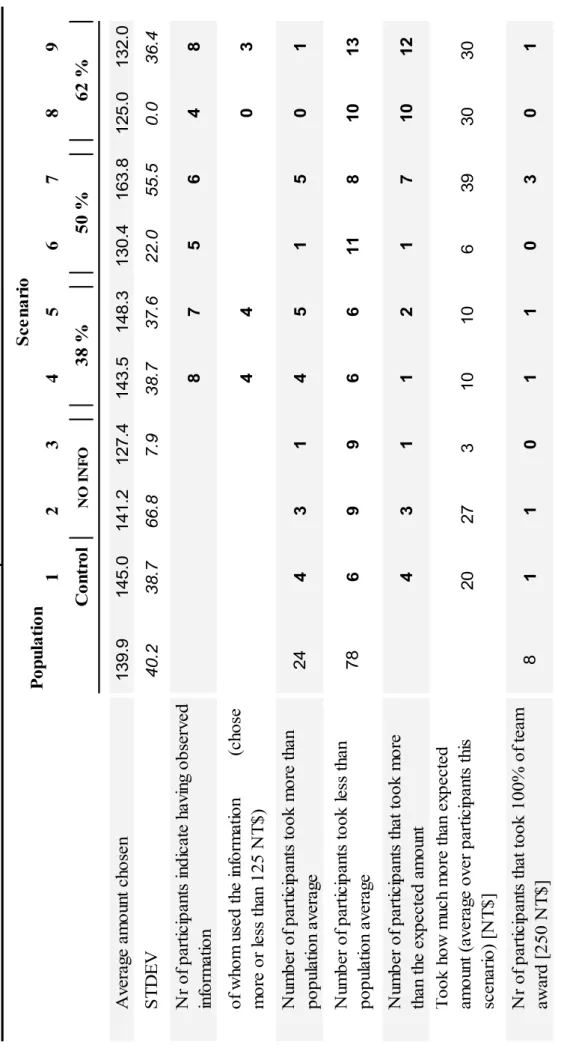
Table 3 Participants behavior in numbers ... 56
1 Introduction
Economics experiments dealing with choice decisions have indicated that the “homo- economicus” model of pure self-interested agents, is not sufficient to describe the outcome of such experiments (Camerer & Thaler, 1995). Different fairness models, introducing inequality aversion, Maximin preferences and efficiency concerns of the agents have to a reasonable extend been able to capture an altruistic component (Bolton & Ockenfels, 1998; Fehr &
Schmidt, 1999).
The majority of this fairness research has been done by means of dictator- or ultimatum games, where an agent must decide how much, if any of the money given to him gets shared with another (anonymous) agent (Engelmann & Strobel, 2004). Although these experiments successfully capture a basic level of fairness preference in the agents, in real life we seldom meet philanthropists handing out “free” money, and we seldom encounter in economics transactions with anonymous partners.
In supply chains, economic value gets added in every activity of the chain. For the success of the chain to sustain, each member must cooperate and thereto each member must be rewarded for his value contribution. A fair level of reward for each activity in the chain would represent the value added by that activity.
To bring dictator game experiments one step closer to the domain of everyday transactions we propose to let two agents perform a task in collaboration for which the second agent will be rewarded. He then decides how much of that reward is given to the other agent. We are
interested if information about the performance of the other agent, a proxy for the value added by his activity, will affect the amount paid to that agent.
Humans are social beings and we reciprocate social behavior.(Albert, Güth, Kirchler, &
Maciejovsky, 2007) We are interested how social interaction with the second agent will affect the amount paid to the first agent.
1.1 Research Motivation
To economists the world seems like a hard place. Homo-economicus is survival of the fittest. But the old marketing catchphrase “Customer is King” suggests, as does resource based theory of competitive advantage, that companies only stay in business in the long term when they deliver all that the customer asks for at the lowest cost (Grant, 1991). In everyday life everything comes at a price. How the price for a good is determined depends on the type of market. In monopolistic markets, price is determined by cost of goods sold plus a
predetermined profit margin(Varian, 2005).
In sufficiently competitive markets, the price is the result of supply and demand economics. If at the current market price, a majority of people prefer alternative goods or services, the price of the good or service will be driven downward until buyers can buy at a price below their private value and sellers can sell at a level above their marginal cost. (Vernon, 1962)
Even if the market for a consumer good is sufficiently competitive, this may not be the case for the market of half finished goods.
For those who pay attention to such news, the media frequently report about wrongful situations in the value chains of consumer goods. From sweat-shops in China, where low cost workers produce the expensive clothes for international brands, to child labor in India. From the price we pay for our vegetables, our milk and our coffee in the supermarket to the price farmers get for their crops. More recent in the news are reports of exaggerated executive salaries.
Such reports give consumers information about unfair sharing of profits, but seldom can we see consumers refuse such products. Individual consumers are powerless to change a market situation. But what would we do if we could dictate the relative share of the total surplus created by the value chain, of each member of the value chain?
1.2 Fairness
Transactions by definition must have at least two parties. In order to judge the fairness of a transaction, we must consider the needs of both parties in that transaction. This requires empathy, the ability to identify feelings, thoughts and attitudes of others.
For fairness here, we want to observe the total equation of the transaction, that is the ratio of efforts put forward in the transaction and the ratio of rewards paid to both parties.
If we are stakeholder of such transaction, we are by definition biased. We have a far superior ability to identify our own needs, thoughts and feelings than we can do for others.
We judge fairness from our own perspective. This causes fairness to be self-centered.
1.3 Research Question
Simple dictator games, as we will later describe, only deal with the distribution of allocations for which no measureable effort was put forward. We are interested if adding a task for both agents and adding information about the amount of work done by each agent, (a performance indicator) will affect the amount the second agent in the chain, the dictator, will share with his partner.
- Does the introduction of a task with performance indicators shift the distribution ratio in a direction to represent the performance level?
Knowing that humans reciprocate social behavior(Albert, Güth, Kirchler, & Maciejovsky, 2007), we further want to find out if the agents are sensitive for the way researchers approach them.
- In case of known relative performance, does social recognition of the dictator affect
2 Literature Review
This chapter will introduce two popular models for fairness that are different in the way empathy is modeled into their respective motivation curves. Though both have seemingly succeeded in exposing a basic preference for fair outcomes, the results were always very dependant on the exact setting of the experiment(Camerer & Thaler, 1995) .
We introduce concepts from Maslow’s hierarchy of needs theory, to argue that agents may abstain from maximizing monetary reward, because social recognition is a psychological need.
2.1 Observed choice behavior in games
Game theory, formally introduced in the beginning of the 20th century by von Neumann (1928) claims to predict how rational, self-interested agents solve decision problems. Two agents make independent choices about some interaction, whereby the outcome for each of the agents depends on their own decision and the decision of the other. Under the assumption that both agents act rationally and self-interested (the traditional economics assumption of homo-economicus), some games predict equilibrium outcomes(J. von Neumann, Morgenstern, O., 1944). In order to account for the fact that these equilibrium outcomes are not always observed in experiments, we need to modify the assumption of rationality and self- interestedness.
2.2 Dictator Games and Ultimatum Games
The two most frequently used games to study fairness perception are the dictator game and the ultimatum game. Each has its own link to agents’ fairness perception.
In a dictator game the first agent, the proposer, determines the ratio of an endowment (usually money) that he keeps, over what he shares with a second agent, the responder. The responder has only to accept the choice made by the proposer.
Dictator games are not considered games in game theory, as the responder has no influence on the outcome. Dictator games link to the fairness perception of just the proposer, without concerning the responder.
In an ultimatum game a proposer and a responder bargain about the distribution of an endowment of fixed size. The bargaining rules are that the proposer offers a share of the endowment to the responder. The responder can either accept or reject the offer. In case the offer is accepted, both get paid as was offered by the proposer. In case of rejection, both responder and proposer get nothing. Ultimatum games are not considered games in the strict sense of game theory as the action of both parties do not take place simultaneously.
Where it would be possible for the proposer to offer nothing in the dictator game, it is very unlikely that the responder will accept such offer in the ultimatum game. The ultimatum game links to the proposers’ expectation of the fairness perception of the responder.
2.3 Fairness Models
Fairness models can be seen as a refinement of dictator games.
2.3.1 Equity, Reciprocity and Competition
Bolton and Ockenfels (2000) introduce a model where agents act to maximize a motivation function with two independent variables, agents (absolute) monetary payoff (γi) and agents relative share of the payoff (σi).
(1)
The actual motivation function may look like this:
(2)
- νi
(
γi,0)
is a (less than) proportionally rising function.- νi
(
0,σi)
has a maximum where σi is equalitarian.The objectives (γi and σi) are weighted in specific choice type tasks, and the (ratio of) weighing factors are said to define a person’s type.
The weighing is linked with two thresholds: “r” links with the ratio offered in dictator games (maximizes the motivation function) and “s” links with the ratio that splits rejection or acceptance in ultimatum games. (makes the motivation function negative)
All subjects in the population will have r ∈ [1/n , 1] and s ∈ (0 , 1/n ]. That is, they offer average or below ratios in dictator games and reject offers in ultimatum games that are larger than zero but by implication less than 1/n.
Subjects like their own payoff to be close to the average.
) , ( i i
i
i v y
v = σ
2
2 1 ) 2
,
(
−
−
= i i i i
i i i
c b a c
v σ σ σ σ
2.3.2 Efficiency, Inequality aversion
In a study about the impact of the competitive environment on fairness and cooperation (Fehr & Schmidt, 1999) a model of self-centered inequality aversion is proposed. Agents dislike inequitable outcomes that favor them as well as inequitable outcomes that favor others.
In case of two agents:
(3)
In general, subjects minimize the difference between their own payoff and that of any other subject. In comparing two player transactions both models do not predict different outcomes.
2.4 Paying for fairness
Ochs and Roth (1989) find that subjects are willing to sacrifice for fairness in bargaining situations. In comparing the fairness models of paragraph 2.3.1 and 2.3.2 and testing their relative importance to efficiency concerns, Engelmann and Stobel (2004) find that subjects are willing to sacrifice pecuniary reward to gain efficiency (a higher sum of payoffs, but a lower outcome for dictator) and equity (a more equal payoff for proposer and responder, at a cost for the proposer) in single shot distribution experiments.
4 4 3 4
4 2 1 4
4 3 4
4 2 1 43
42 1
Guilt ) (
Envy ) (
interested self
) ,
( i j i i j i i i j
i x x x x x x x
U − − − −
−
= α β
2.5 Three types of fairness
Most experiments are driven by role ambiguity and strategy in a sense that people are not offered a perspective of future games, but are predisposition to the existence of future events.
We distinguish three complementary dimensions of fairness in a transaction. Firstly, as discussed, distributive fairness refers to the evaluation of the outcome of a transaction.
Secondly, procedural fairness refers to the processes used to reach an outcome of a transaction (Greenberg, 1987). Finally, people perceive interactional fairness when they believe they have been treated with respect and they have been given reasonable explanation about procedures and actions(Bies, 1986).
A lack of distributive fairness can be mitigated by additional procedural- or interactional fairness (Brockner et al., 1994).
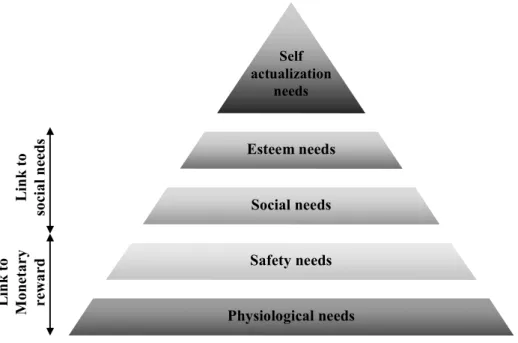
Physiological needs Safety needs Social needs Esteem needs
Self actualization
needs
Link to Monetary rewardLink to social needs
2.6 Maslow’s hierarchy of needs
Maslow (1943) ranks human needs in five separate levels. The original model stated that higher order needs only become discernible after lower order needs have been sufficiently satisfied. Later versions release some of this restriction.
Figure 1 Maslow’s Hierarchy of Needs
We only introduce the model here to show that social needs are complimentary to physiological needs. We regroup the five levels into two levels, where the difference is the requirement of conscience and empathy. In order to appreciate the social recognition from others, we must value it and in order to value it, we need to incorporate empathy.
. For our purpose we propose that the lower two of Maslow’s needs link to monetary reward in dictator games, and social and esteem needs link to social recognition. We then propose agents may regard social recognition as an additional reward for their performance.
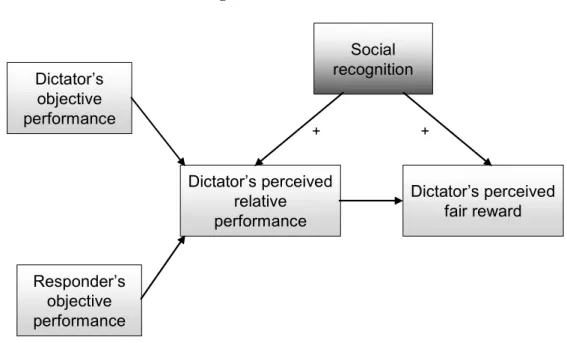
Dictator’s perceived relative performance
Dictator’s perceived fair reward
Responder’s objective performance
Dictator’s objective performance
Social recognition
+ +
3 Methodology
3.1 Research model
Imagine two agents, a “proposer” and a “responder”, performing specific tasks for a principle (the experimenter). The principle rewards the dictator for both his contribution and that of the responder. The dictator then decides the fraction of his reward that he passes to the responder.
In first approach, we expect the fraction to represent the ratio of perceived performance of both agents. The degree to which it does not is an indicator for absence of distributive fairness.
Figure 2 Research Model
H1: Introduction of a task with a performance indicator drives the outcome of dictator games in the direction of the relative perceived performance.
We will refer to outcomes that are equal to the relative level of performance as equalitarian outcomes.
Besides handing out the monetary reward, the experimenter also provides social recognition to the dictator, in the form of offering assistance through an MSN account that is installed on his terminal. This social recognition could affect the outcome of the dictator’s decision in either one of two ways (or both).
Following Maslow’s hierarchy of needs, the social recognition is seen as an additional reward :
(4)
Or it is seen as an additional signal to the dictator that his performance is a more than average contribution to the task, justifying an increased share of the total reward.
(5)
H2: Social recognition of the dictator will lower the monetary reward chosen by dictators.
n Recognitio Social
Reward
RewardResponder = Dictator +
n Recognitio Social
e Performanc
Reward e
Performanc Reward
Dictator
Dictator ResponderR
Responder
= +
4 Experimental Setup
To test our hypothesis H1 and H2, we carry out a modified version of a dictator game. We use a manipulation experiment in which the dictator game comes under the disguise of an on- line survey. We invited over a 150 students from within Taiwan National University to join one of the 8 survey sessions available. Sessions are held in a computer room of the
Department of Information management of the National Taiwan University. Students are not limited from within the department. Students from a wide range of departments signed up for their preferred session. Funding for the survey has been generously provided by the National Science Council under budget number 79-2752-H-002-008-PAE.
In the survey each participant is matched with a virtual other participant to form a team. To augment the manipulation, we have printed the instructions for participants on one side in Dutch, and on the other side in Chinese. On the Dutch side of the instruction page, we have put a little sticker with a login ID and password, supposedly put there by the other participant.
Hence, the participant is made to believe he is the second and final participant of his/her group. At the end of the survey, each team gets rewarded a fixed amount for the team and the ratio for each team member has to be decided by the participant, who by deciding, becomes and instant dictator. The dictator and the responder are both guaranteed anonymity with respect to each other and to the experimenter. This is important because we want participants to feel free to choose any amount they see as appropriate and not merely show socially acceptable behavior. Although the other agent’s identity is usually hidden in dictator games, factors like location may provide some basic clues about the other person (e.g. that he is a student too), or at least that he is a person.
There are 9 possible routes, scenarios, through the survey which are carefully controlled.
The difference between scenarios can be found in Table 1, and are discussed in chapter 4.1.
Because in dictator games the responder has no decision power, we have made his role is a virtual one. (The dictator, of course, is not aware of that)
1 2 3 4 5 6 7 8 9
Virtual team member's performance N.A.
Social recognition (MSN help account) No No Yes No Yes No Yes No Yes Online search questions None All All All All All All All All Distribution Question Yes Yes Yes Yes Yes Yes Yes Yes Yes Equalitarian outcome ( NT$ ) 125 125 125 155 155 125 125 95 95
Scenario
No info. 38 % 50 % 62 %
4.1 The survey
The topic of the survey, “information search, a cultural component” is in itself not
important. It only serves the purpose of being a task for which the team gets rewarded. For the manipulation to be successful, we have tried to design a survey that makes the fact that
participants are teamed up, seem logical to them. The only question important for the experiment is the final one, in which the dictator is asked to decide a ratio for the reward.
Table 1 Scenarios
4.1.1 Scenario 1, The control group
Participants that are selected for scenario one, are not required to fill out the survey. Their ID number brings them directly to the ratio question at the end of the survey. In effect, scenario 1 is a simple dictator game.
This is the only scenario that does not have its own session. We felt it would be more natural if each of the other sessions had two or three participants with this very short and specific task. A message inside the survey, but after the decision question, asks these participants to stay at least until 20 minutes into the session, in order not to raise questions from the other participants.
4.1.2 Scenario 2, Shared task, no information
The ID number of a participant in scenario 2 brings him virtually to somewhere halfway the survey. The participant has no information about the absolute position or progress throughout the survey, but is manipulated to believe that his partner has completed part of a collective question list. Participants can not go back to check the questions or answers that their team member has completed.
4.1.3 Scenario 3, Social interaction
The ID number of a participant in group 3 brings them to the same position in the survey as the participant in scenario 2. He also does not know how much his (again, virtual) partner has done. The difference with scenario 2 is that participants get the opportunity to ask questions or communicate on MSN with a research assistant. During the session for scenario 3 (and 5, 7 and 9), Each PC has a preconfigured MSN account. Sometime at the beginning of the session an assistant sends a scripted MSN message. In the message the assistant thanks the participant for helping the experiment by doing this survey, and offers help in return in case it is needed.
The MSN accounts deliver social recognition outside the context of the survey, which makes it more likely to the dictator that he is socially recognized and leaves ambiguity about social recognition of his teammate. A negative effect may be that having an MSN account open during the survey raises the suspicion that the dictator is observed and no longer anonymous.
We need to test for this effect.
4.1.4 Scenario 4 to 9, different levels of relative performance
To test if participants use information about the performance of team members, starting from scenario 4, we offer a progress indicator on top of the survey page that indicates the percentage of questions that the virtual partner has completed (38 – 50 – 62 percent respectively, as in Table 1). Progress indicators are common in online surveys. The
participant is not specifically told to use this information in rewarding his/her team member.
From a pilot survey we know we need to be specific about the different colors in the progress bar.
Figure 3 Previous version of progress bar, participants failed to notice.
Figure 4 Final version of progress bar.
4.2 The decision question.
The final page of the survey tells participants in all scenarios that their team has earned 250 NT$. We tell them they have to decide how much of that amount they will take for
themselves and how much they leave to the teammate.
Bardsley (2008) indicates that the range of the choice set that is available to subjects in a game carries some clues toward acceptable test-behavior.
By starting the slider at nothing for participants and 250NT$ for the team member, rather than at 125 NTD for each, we achieve two things.
- We make sure participants do make a conscious choice.
- We avoid providing a reasonable choice set.
Figure 5 Slider before making a choice
Figure 6 Slider after making a choice
5 Results and Qualitative analysis
5.1 Precondition checks
Before discussing weather or not dictators modify their preference for a distribution outcome based on the information they have about the other agents’ activity level, we must make sure some preconditions are met. These preconditions are:
- Participants must accept the manipulation, (they believe the survey)
- Participants must feel free to make their decision based on internal motivation and if possible not worry about showing socially acceptable behavior. They must believe their privacy is guaranteed.
- Participants must have observed the information we expect them to act on.
To help us test for those preconditions, one page of questions was added after the distribution level question, at the end of each survey session. (Except scenario 1) In this page, we ask them to help us make the survey better. Participants answer questions about how easy they think the survey was, how fair they think the reward is for the amount of work they and their partner did, weather they believe the internet is easier to use for native speakers of English and how much they concern for their privacy.
5.1.1 Acceptance of manipulation
We gauge participant’ suspicion about being manipulated from comments, both inside and outside the survey. Within the survey, nobody commented about the distribution question, while five people spontaneously left their opinion about the survey subject. One such comment was from a participant to whom it became clear that he or she exhibits a Pavlov reaction when it comes to looking for information.
One participant came forward after his session with the question if the amount chosen was
5.1.2 Privacy guaranteed
On the question “I worried about my privacy while doing this survey”, only 13 out of 102 participants scored on the top half of the 10 point scale. Interestingly these 13 chose an
average of 161 NT$ for themselves. Obviously their concern for (lack of) privacy did not stop them from choosing higher amounts than the average population.
5.1.3 Observing the progress bar.
Out of the 70 participants whom we provided with a progress bar, 38 gave a correct answer to the question if they knew how much work was done by their team member. This means they observed, remembered and understood the meaning of the progress bar. In the comments we found one person spontaneously remarking he/she saw the percentage but did not link it to the performance of his/her virtual partner. He/She correctly remembered the percentage, 38%, but offered 125 NT$ for the virtual team member.
5.2 Distribution of chosen amounts
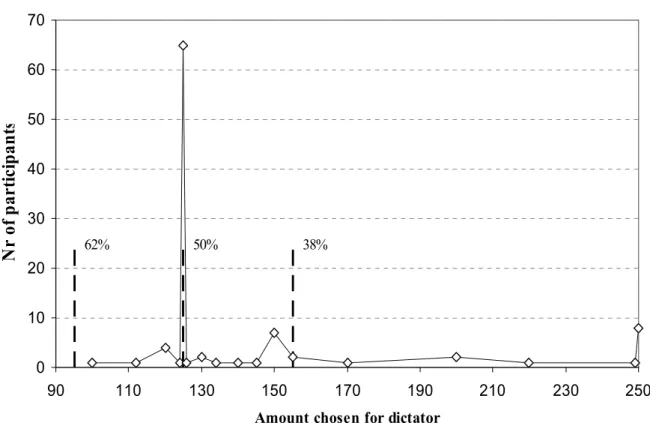
Figure 7 represents the amount chosen and the number of times that amount was chosen. If participants have used the information we would expect peaks around 95NT$ (from those who observed 62 %) around 125NT$ (The from the groups observing 50% and the groups without information) and around 155NT$ (from those who observed 38%)
In fact, we can see there are 4 distinct peaks.
In Taiwan, where the smallest bill is 100NT$, you might expect the first peak to have moved from 95NT$ to 100NT$ based on peoples preference for easy payouts and or round numbers. Participants seem to have discounted the observed information with their level of self interestedness.
By far the largest peak is at exactly 125NT$. This is to be expected since for people without specific information (scenario 1, 2 and 3) as well as for people who observed the 50% work done by their team member ( scenario 6 and 7), 125 NT$ is the equalitarian outcome. There are 18 participants from scenario 8 and 9 who choose to take 125NT$.
Figure 7 Distribution of Amounts Chosen
62% 50% 38%
20 30 40 50 60 70
Nr of participants
The third peak, which if people had fully used the information would appear at 155 NT$, is found at 150 NT$. This could again be due to the preference for round numbers.
It is interesting to see that nobody chose 160NT$ (the first round number higher than 155NT$) and that two participants (from scenario 2 and 6) took 200NT$ (the preferred amount for bills only)
Another observation is that the peaks on either side of the 125NT$ mark has moved closer to the middle than could be expected from the information alone. If this were significant, it would increase the strength of the predictions by the fairness models from paragraphs 2.3.1 and 2.3.2. Even in the presence of information about relative performance, participants do not like their payment to differentiate from the payment of the partner too much.
The tables for payouts per scenario, can be found in Appendix C
5.3 Effect of Social recognition.
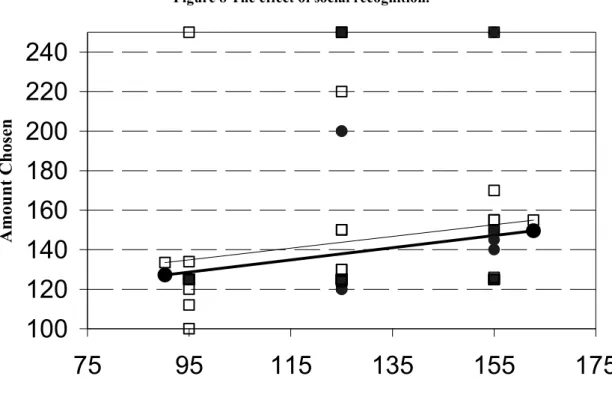
Figure 8 shows the effect of social recognition on the amount chosen by dictators. We plot the chosen amount as a function of the equalitarian outcome. The lines in the plot are the best fit through the data. Although the fit is visibly poor, it appears that participants with social recognition have chosen more for themselves, rather than less. This is against hypothesis 2.
Rejecting all those participants who chose 250NT$ does not change this observation.
Figure 8 The effect of social recognition.
100 120 140 160 180 200 220 240
75 95 115 135 155 175
Equalitatian outcome
Amount Chosen
NO Social Recognition
5.4 Discussion
Even if we can see a trend that seems to confirm hypothesis 1 and negate hypothesis 2, we did not get near statistical proof for either hypothesis.
The first reason for this is the very low number of people who actually observed and or understood the progress bar. There are two paths for correcting this:
1) Further improve the layout and wording of the progress-bar.
2) Increase the number of people in those scenarios that use progress bars.
We may chose to remove scenario 6 and 7 and increase the number of people in scenario’s 4, 5, 8 and 9 since we may find support for hypothesis 1 even if there are only two levels of the progress bar available. As long as they are significantly different from the “no information”
scenario’s
1 2 3 4 5 8 9
Virtual team member's performance N.A.
Social recognition (MSN help account) No No Yes No Yes No Yes
Online search questions None All All All All All All
Distribution Question Yes Yes Yes Yes Yes Yes Yes
Equalitarian outcome ( NT$ ) 125 125 125 155 155 95 95
Scenario
No info. 38 % 62 %
Perhaps not finding significant support for hypothesis 2 can be explained from the implementation of social interaction. In our current experiment we have tried to avoid an implementation that links too much to either the information role or the reward role of social interaction. We must find ways to increase the influence of the interaction on the participants.
Two suggestions for this are:
1) Increase the effect of the implementation of the MSN account, by removing the option to ask questions to research staff in the room during the survey. The MSN account will then be the default way to ask questions or report problems for those scenario’s.
We must in this case put even more effort on general instructions, to avoid rising frustration levels in the scenarios without interaction.
2) Implement social interaction in two mutually distinguishable ways. One where we aim for the information effect, and one where we aim for the reward effect.
If we can observe significant difference between absence of social interaction on one side and either one or both of the implementations on the other side, we may learn something about what provides what clue to participants.
References
Albert, M., Güth, W., Kirchler, E., & Maciejovsky, B. (2007). Are we nice(r) to nice(r) people?—An experimental analysis. Experimental Economics, 10(1), 53-69.
Bardsley, N. (2008). Dictator game giving: altruism or artefact? Experimental Economics, 11(2), 122-133.
Bies, R. J., Moag, J. S. (1986). Interactional justice: Communication criteria of fairness.
Research on Negotiation in Organizations, Vol. 1(;), 43-55.
Bolton, G. E., & Ockenfels, A. (1998). Strategy and Equity: An ERC-Analysis of the Güth- van Damme Game. Journal of Mathematical Psychology, 42(2-3), 215-226.
Bolton, G. E., & Ockenfels, A. (2000). ERC: A Theory of Equity, Reciprocity, and Competition. American Economic Review Vol. 90( Issue 1), p166-193, 128p.
Brockner, J., Konovsky, M., Cooper-Schneider, R., Folger, R., Martin, C., & Bies, R. J.
(1994). Interactive Effects of Procedural Justice and Outcome Negativity on Victims and Survivors of Job Loss. The Academy of Management Journal, 37(2), 397-409.
Camerer, C., & Thaler, R. H. (1995). Anomalies: Ultimatums, Dictators and Manners. The Journal of Economic Perspectives, 9(2), 209-219.
Engelmann, D., & Strobel, M. (2004). Inequality Aversion, Efficiency, and Maximin Preferences in Simple Distribution Experiments. American Economic Review, 94 4, 857-869.
Fehr, E., & Schmidt, K. M. (1999). A Theory Of Fairness, Competition, and Cooperation*.
Quarterly Journal of Economics, 114(3), 817-868.
Grant, R. M. (1991). The resource-based Theory of competitive advantage. California Management Review, 33, 114-135.
Greenberg, J. (1987). Reactions to procedural injustice in payment distributions. Jounal of Applied Psychology, Vol 72(1)(Feb 1987), 55-61.
Maslow, A. H. (1943). A Theory of Human Motivation. Psychological Review(50), 370-396.
Ochs, J., & Roth, A. E. (1989). An Experimental Study of Sequential Bargaining. The American Economic Review, 79(3), 355-384.
Varian, H. R. (2005). Intermediate Microeconomics. New York: W. W. Norton & Company.
Vernon, L. S. (1962). An Experimental Study of Competitive Market Behavior. The Journal of Political Economy, 70(2), 111-137.
Von Neumann, J. (1928). Zur theorie der gesellschaftsspiele. Mathematische Annalen, 100(1), 295.
von Neumann, J., Morgenstern, O. (1944). Theory of Games and Economic behavior:
Princeton university press.
Appendix A: Survey Website
(Screen shots)
Appendix A (continued) Survey Website (Questions, English)
Welcome
Welcome back to this saved session.
You may now change language to your local language if so required and continue with the survey.
歡迎回到本問券。請選擇您的母語,
並繼續完成此份問券。
Explanation
The answers you are about to give in this survey will make more sense to us after we link them to your personality traits.
Before we start the information search questions, we would like to know a little bit about your personality where it concerns the way you handle information.
These questions, on the next 3 pages, are personal and mandatory.
~
Please fill them out to your best judgement, avoid giving socially desirable answers.
Please be reminded that this survey is done anonymous, your name is not recorded anywhere.
Offline information behavior
If I have a problem / Question ...
Please choose the appropriate response for each item:
Never Sometimes Usually Frequently Always
... I ask my friends / family ... I read a book / magazine ... I find an answer on-line
... I wait, problems solve themselves ... I check the bulletin board ( BBS )
Personality traits
Please read the following statements, then indicate how much they match your personality
Openness
Strongly
Disagree Disagree Somewhat
Disagree Neutral Somewhat
Agree Agree Strongly Agree I have a rich
vocabulary I have a vivid imagination I am quick to
understand new things I spend much time thinking about my ideas
Conscientiousness
Strongly
Disagree Disagree Somewhat
Disagree Neutral Somewhat
Agree Agree Strongly Agree I follow a strict
schedule
On-line information behavior Ranking Browsers
Please rank your favorite web browsers . Don't choose those you never use
Please number each box in order of preference from 1 to 5
• Internet Explorer
• Firefox
• Opera
• Chrome
• Safari
Rank Search engines
Please rank your favorite search engines . Don't choose those you never use
Please number each box in order of preference from 1 to 6
• Yahoo
• Answers.com
• AOL search
• Ask.com
• Baidu
Rank Portals
Please rank your favorite web-portals Don't click those you never use.
Please number each box in order of preference from 1 to 6 Please number each box in order of preference from 1 to 6
• Startpagina.nlYahoo
• Yahoo
• MSN
• Apple startpage
• Excite.com
• Mail.com
Start information search
We will now start with the information search questions.
In the following pages we will ask you a number of trivia questions. We are not testing your knowledge and it is more than likely that you do not know the answer right away.
We will then ask you to find an answer to that question. You may use any written source available. Books, pocket dictionary, or in fact the whole internet. But please do not talk to others.
After you found an answer we would like to know how you came to your answer, how easy it was and how confident you are that the answer is correct.
Good Luck!
01 foreign language
What does the word Xenophobia mean ?
Please use any written source available to you at this moment to confirm the answer.
Then fill out the questions below
Please write your answer here:
Please indicate how you found the answer.
In my search engine
Please choose all that apply:
• I only used the top ranked link
• I could easily find the answer in that page.
• This was the first time i visited this webpage.
In my web-portal
Please choose all that apply:
• I could easily find the "clicks" I needed.
• I needed 3 or less clicks to find the answer.
• This was the first time I visited this webpage.
Please read the following statements about the answer you found on-line
Please choose the appropriate response for each item:
Disagree Somewhat
disagree Neutral Somewhat Agree Agree The answer was easy to find
I am confident the answer is correct I could also easily find the answer off-line I look for this type of information
frequently
02 Order Pizza
I Live near Taipei Main station and I am hungry for Pizza. What is the address and phone number of the nearest Pizza-hut.?
Address Phone number
I can get my pizza at :
Please indicate how you found the answer.
Please choose all that apply:
• I used an offline source
• I used a search engine
• I used a web portal
• You may copy paste the URL
In my search engine
Please choose all that apply:
• I only used the top ranked link
• I could easily find the answer in that page.
• This was the first time i visited this webpage.
In my web-portal
Please choose all that apply:
• I could easily find the "clicks" i needed.
• I needed 3 or less clicks to find the answer.
• This was the first time i visited this webpage.
Please read the following statements about the answer you found on-line
Please choose the appropriate response for each item:
Disagree Somewhat
disagree Neutral Somewhat Agree Agree The answers were easy to find
03 Exhange rate
For every 1 US$ I can buy (exactly) NT$
please use any written source available to you at this moment to find the answer.
Then fill out the questions below
Please indicate how you found the answer.
Please choose all that apply:
• I used an offline source
• I used a search engine
• I used a web portal
• You may copy paste the URL
In my search engine
Please choose all that apply:
• I only used the top ranked link
• I could easily find the answer in that page.
• This was the first time I visited this webpage.
In my web-portal
Please choose all that apply:
• I could easily find the "clicks" I needed.
• I needed 3 or less clicks to find the answer.
• This was the first time I visited this webpage.
Please read the following statements about the answer you found on-line
Please choose the appropriate response for each item:
Disagree Somewhat
disagree Neutral Somewhat Agree Agree The answer was easy to find
I am confident the answer is correct I could also easily find the answer off-line I look for this type of information
frequently
04 Buying Books
I am looking for an older book: "Games People Play", by Eric Berne M.D.
Where can I get it, and how much does it cost?
The book can be bought at for (dollars)
Please indicate how you found the answer.
Please choose all that apply:
• I used an offline source
• I used a search engine
• I used a web portal
• You may copy paste the URL
In my search engine
Please choose all that apply:
• I only used the top ranked link
• I could easily find the answer in that page.
• This was the first time i visited this webpage.
In my web-portal
Please choose all that apply:
• I could easily find the "clicks" i needed.
• I needed 3 or less clicks to find the answer.
• This was the first time i visited this webpage.
Please read the following statements about the answer you found on-line
Please choose the appropriate response for each item:
Disagree Somewhat
disagree Neutral Somewhat
Agree Agree I buy books on line frequently
05 Directions
Which main highway connects Amsterdam and Maastricht (in the Netherlands)?
Please write your answer here:
Please indicate how you found the answer.
Please choose all that apply:
• I used an offline source
• I used a search engine
• I used a web portal
• You may copy paste the URL
In my search engine
Please choose all that apply:
• I only used the top ranked link
• I could easily find the answer in that page.
• This was the first time i visited this webpage.
In my web-portal
Please choose all that apply:
• I could easily find the "clicks" i needed.
• I needed 3 or less clicks to find the answer.
• This was the first time i visited this webpage.
Please read the following statements about the answer you found on-line
Please choose the appropriate response for each item:
Disagree Somewhat
disagree Neutral Somewhat Agree Agree The answer was easy to find
I am confident the answer is correct I could also easily find the answers off-line I look for this type of information
frequently
06 Schoolwork
I am writing a report for my biology class. What is the birth date of the inventor of penicillin?
Please enter a date: (YY / MM / DD)
Please indicate how you found the answer.
Please choose all that apply:
• I used an offline source
• I used a search engine
• I used a web portal
• You may copy paste the URL
In my search engine
Please choose all that apply:
• I only used the top ranked link
• I could easily find the answer in that page.
• This was the first time i visited this webpage.
In my web-portal
Please choose all that apply:
• I could easily find the "clicks" i needed.
• I needed 3 or less clicks to find the answer.
• This was the first time i visited this webpage.
Please read the following statements about the answer you found on-line
Please choose the appropriate response for each item:
Disagree Somewhat
disagree Neutral Somewhat Agree Agree I use internet a lot to do my homework.
07 The movies
There is this movie I really want see recently:
Please go find a location, a time and a price for a ticket this evening around 20:00.
Location Time Ticket price
Please indicate how you found the answer.
Please choose all that apply:
• I used an offline source
• I used a search engine
• I used a web portal
• You may copy paste the URL
In my search engine
Please choose all that apply:
• I only used the top ranked link
• I could easily find the answer in that page.
• This was the first time i visited this webpage.
In my web-portal
Please choose all that apply:
• I could easily find the "clicks" i needed.
• I needed 3 or less clicks to find the answer.
• This was the first time i visited this webpage.
Please read the following statements about the answer you found on-line
Please choose the appropriate response for each item:
Disagree Somewhat
disagree Neutral Somewhat Agree Agree The answer was easy to find
I often go to this theater
I usually buy movie tickets on-line I prefer movies in my own language
Administrative Message Control group
In the previous round of the survey we did not have enough capacity. Your group drew the lucky number and is exempt from filling out the questions.
, but you can still collect your reward.
The next page will be a final question for administrative purpose
~~~~~~~
Ratio Question
Thank you. Your team has successfully completed this survey. We will deliver the reward to each team member as indicated on your instruction sheet.
Since you are the final person in your team to answer the questions, we leave it up to you to share the reward with your team member.
Your personal reward will be put in a closed envelope and the envelope will be given to you in exchange for the ID card. Please bring the ID card we have given you, as it is the only way we can identify you.
Your team has earned 250NT$
Please choose how much we should give you and your team member.
HIM: 220 YOU : 30
• (Drag the slider: HIM <--- to the left to the right ---> YOU)
Don't forget to have your ID-paper chopped by the survey assistant.
Help us get better
You have finished the survey
Finally, please help us make this survey better.
If you know it, please tell us how much of the survey was completed by your team member before you.
Please write your answer here: %
Please read the following statements about the survey you just finished *
Please choose the appropriate response for each item:
Totally
disagree 2 3 4 5 6 7 8 9 Totally Agree The procedure for filing out this survey were
clear and easy.
The questions about my personality were clear
and easy.
The reward my team got is fair for about half
an hours work each.
The questions about information search were
clear and easy.
I think the internet is easier to use for people
who speak English.
I worry about my privacy when filling out this
survey.
I have never had more fun filling out a survey.
I have some comments about this survey:
Apendix B: Participant Instructions (Dutch)
Welkom bij de tweede ronde van dit onderzoek.
We proberen te begijpen hoe taal en kultuur de manier waarop we informatie zoeken en vinden op internet beinvloeden.
Dit onderzoek:
We voeren een enquête met willekeurige, virtuele teams. In de eerste ronde, (21 en 22 April), heeft een groep Taiwanese studenten hun deel van de enquête met goed gevolg afgerond. Die antwoorden zijn opgeslagen onder een willekeurig toegewezen ID-nummer en paswoord.
Vandaag is de tweede ronde. Jij zal willekeurig worden gekoppeld aan een van de opgeslagen sessies. Jullie beiden, hoewel je elkaar nooit zult ontmoeten, vormen du seen virtueel team met verschillende kulturele achtergrond en met een verschillende moerstaal.
Sommige vragen zijn voor jullie beiden gelijk, andere zijn dat niet. Bovendien krijgt niet elk team dezelfde vragen.
De vragen zullen worden gesteld in je eigen taal, en dienen indien mogelijk ook in je eigen taal te worden beantwoord.
Procedure:
Je “team maatje” heeft zijn ID-nummer aan de onderkant van dit formulier geplakt, en heeft kopie ervan met zich meegenomen. Zijn antwoorden zijn reeds door ons geverifieerd.
Zoek alstjeblieft een computer in de zaal, open je favoriete browser en surf naar http://ntu.c- hosting.nl/ Vervolgens selecteer je de “information search” survey.
Onderaan de pagina vindt je de <onafgemaakte enquete laden> knop. Op de pagina die volgt vul je het nummer dat je onderaan dit formulier vind in. Paswoord is gelijk aan ID-nummer.
Zorg er voor dat de taal ingesteld is op je eigen taal indien dat niet reeds is gedaan.
Waneer er in de enquête wordt gevraagd een antwoord online te vinden, open dan een nieuw browser window. Je mag hiervoor je favoriete browser gebruiken (IE, Firefox...) LET OP. Sluit niet het window waarin de enquête draait.
Beloning:
Nadat je de laatste vraag hebt ingevuld, wordt je verzocht dit formulier door de assistant te laten afstempelen. Je weet dan ook gelijk hoeveel je precies krijgt. De belonging krijg je echter pas nadat iedereen klaar is met de enquete. Een medewerker zal het bedrag in een envelop stoppen waarop ook je ID-nummer is gedrukt.
In de week van 6/25 ~ 7/2 kun je die envelope ophalen op vertoon van dit formulier.
Wij bieden een anonieme enquête en we vragen in ruil daarvoor dat je niets uit deze enquête verteld aan anderen tot ten minste 6/25.
YOUR ID NUMBER AND PASSWORD 您的帳號及密碼
(Chinese)
歡迎來到本問卷第二輪的研究 歡迎來到本問卷第二輪的研究 歡迎來到本問卷第二輪的研究 歡迎來到本問卷第二輪的研究
目前,我們正在試圖了解語言和文化在一般情形下如何具體影響人們在線上搜尋資訊的方法。
關於本問卷 關於本問卷 關於本問卷 關於本問卷
本問卷是以隨機配對的團隊來進行。在第一輪的部份中,約 200 名的荷蘭學生於 4 月 20 日及 21 日成功地完成了各自所屬部分的問卷。
我們使用隨機指定的問卷 ID 號碼及密碼儲存他們的問卷答案。
今天要進行的是本問卷第二輪的部份。您會被隨機指定到接續其中一份在第一輪中儲存的問 卷。您們兩位將會組成一隊,同組的兩位隊員彼此間未曾見過面,也各自擁有不同的文化背景 及各自的母語。
您被要求回答的問題有些跟您的隊員一樣,有些則否。而且每個小組的問卷問題並不是都一樣 的。
問卷中的問題會以母語的方式呈現,也請您盡可能以您的母語來回答。
問卷步驟 問卷步驟 問卷步驟問卷步驟
您的隊員已經將他的研究 ID 號碼黏在本頁最下方,同時自己也保留了一份一樣的 ID 號碼。他 的答案也已經通過一致性的測試了。
請在本電腦教室中找個位置,打開瀏覽器,連到 http://ntu.c-hosting.nl/ ,然後選擇 ''information search'' 問卷。
在首頁的最下方您會發現<load unfinished survey>按鈕。
在下一頁中,請使用本頁下方的研究 ID 號碼登入到您團隊的未完成問卷中。並請記得選擇使 用您的母語。
當問卷裡請您在線上搜尋答案時,請開啟新的瀏覽器視窗。您可以使用您偏好的瀏覽器。請不 要關閉或從問卷視窗中離開以瀏覽其他網頁。
報酬 報酬 報酬報酬
在您完成本問卷後,請帶著本問卷簡介說明到講台前方讓研究助理在您的簡介上蓋章。你可以 在問卷結束後馬上知道您的報酬,但我們會在所有的問卷實驗都結束後才發放。助理會將您的 報酬放入信封,信封上只會註明您的 ID 號碼。
在 6/25-7/2 的那周,請持 ID 卡片來領取您的信封。
本問卷是匿名問卷,您的個人資料我們會妥善保密,同時也請您在 6/25 前不要對任何人揭露問 卷及研究的內容。
.
YOUR ID NUMBER AND PASSWORD 您的帳號及密碼
Apendix C: Tables
Table 2 Distrubution of chosen amounts
( Figure 7)
Amount Nr of times
100 1
112 1
120 4
124 1
125 65
126 1
130 2
134 1
140 1
145 1
150 7
155 2
170 1
200 2
220 1
249 1
250 8
56
Table 3 Participants behavior in numbers 123456789 Control verage amount chosen139.9145.0141.2127.4143.5148.3130.4163.8125.0132.0 TDEV40.238.766.87.938.737.622.055.50.036.4 r of participants indicate having observed formation875648 f whom used the information (chose ore or less than 125 NT$)4403 umber of participants took more than opulation average24431451501 umber of participants took less than opulation average78699661181013 umber of participants that took more an the expected amount43112171012 ook how much more than expected mount (average over participants this enario) [NT$]2027310106393030 r of participants that took 100% of team ward [250 NT$]8110110301 Population NO INFO38 %50 %62 %
Scenario