行政院國家科學委員會專題研究計畫 期末報告
環境中雙酚 A 流佈及其母體暴露對於孩童健康之影響評估- -我國懷孕婦女及胎兒雙酚 A 暴露研究(I)
計 畫 類 別 : 整合型
計 畫 編 號 : NSC 100-2621-M-040-001-
執 行 期 間 : 100 年 08 月 01 日至 101 年 12 月 31 日 執 行 單 位 : 中山醫學大學職業安全衛生學系暨碩士班
計 畫 主 持 人 : 毛義方
共 同 主 持 人 : 陳美蓮、王淑麗
計畫參與人員: 碩士級-專任助理人員:林靖雯 學士級-專任助理人員:蔡宜螢
碩士班研究生-兼任助理人員:陳建宇 碩士班研究生-兼任助理人員:楊子慶 碩士班研究生-兼任助理人員:江博安
公 開 資 訊 : 本計畫涉及專利或其他智慧財產權,2 年後可公開查詢
中 華 民 國 102 年 02 月 26 日
中 文 摘 要 : 2005 年以來之科學研究,陸續發現尿中雙酚 A(bisphenol A, BPA)之濃度與糖尿病、心臟病及肝臟毒性有關,且婦女懷孕 時之 BPA 內在劑量暴露亦可能降低胎兒的存活率、出生體重 及其生殖能力。至今我們尚無法有效了解國人全部的暴露途 徑,因此進行懷孕母親與胎兒、嬰兒之 BPA 內在劑量的生物 偵測,以作為健康危害評估的依據。雙酚 A 目前為商業上使 用最多的化學物質之一,世界年產量 320 萬噸,除具雌激素 活性會對人體內分泌造成干擾外,亦會造成水體物種之急毒 性反應。BPA 主要為環氧樹脂、聚碳酸酯、塑膠等製造之原 料,大量使用製造之產品,如罐裝食物容器內襯塗料、速食 便當盒、食物包裝、飲料包裝之紙杯容器、牙科密封劑等。
雙酚 A 是 2005 年聯合國環境規劃署認定的 12 種環境荷爾蒙 之一,它會從含塑膠容器內經由清潔劑、酸性、飲料果汁或 高溫水液溶出,最近研究顯示美國國民 90%尿液可測出 BPA,同時也發現在極低 BPA 濃度(10ppb 以下)會干擾小老 鼠胎兒生長,及會造成細胞功能改變,因此 BPA 的汙染重要 性極度受到先進國家之重視。台灣目前有關 BPA 之環境暴露 與人體生物偵測的基本資料較缺乏,尤其懷孕婦女及胎兒嬰 兒之資料尚少見到,因此本研究欲配合 BPA 之整合型計劃(環 境中雙酚 A 流佈及母體暴露對其孩童健康影響評估),以了解 母親與嬰兒之環境暴露及血液、尿中之 BPA 濃度;並提供其 他子計畫應用,作為國人 BPA 健康影響評估的重要資料。研 究對象為國內醫院懷孕檢查及待產的母親及胎兒,使用結構 式問卷及化學分析方法探討母體之環境暴露及血液及尿液 BPA 濃度。第一年,「人體血及尿中 BPA 採樣及偵測方法建 立」
中文關鍵詞: 雙酚 A、孕婦、胎兒、臍帶血、尿液、偵測方法
英 文 摘 要 : Since 2005, a large and well-controlled study of the possible health effect of bisphenol A(BPA) exposure on humans was conducted, they found positive
associations between total urinary BPA concentration and prevalence of diabetes, heart disease, and liver toxicity. More important, BPA can be rapidly absorbed and easily pass through the placenta that maternal exposure to BPA results in the
transfer of BPA to fetal tissue and cause many health adverse effect of baby and child. The need for human BPA bio-monitoring for risk assessment is undisputed because all resource of exposure have not been
identified, and thus internal exposures can not be
accurately determined.
Due to an increase in the use of products that is used BPA as a material, such as in resins lining metal cans, food packaging and plastic bottles, and dental sealants, it has been showed that BPA
molecules underwent hydrolysis, resulting in the release of free BPA into food, beverages, and the environment, and increased the human exposure potential. Numerous monitoring studies now show almost ubiquitious human exposure to biologically active levels of BPA. Bisphenol A has been proposed as one of 16 persistant organic products and one of 12 endocrine disruptors by U.N. EPA in 2005. In published findings, BPA manufactures persist in describing BPA as a estrogen and insist there is little effect with human health. However, BPA has been known to leach from plastics which are cleaned with detergents or used acidic or high temperature liquids. The recent studies show that 90% of US people urine can be detected BPA and even very low levels(<10ppb) of BPA can disrupt neural development in the rat fetus. Therefore, the BPA health concern rised again in the US and European countries.The data of all BPA exposure and the bio-monitoring data are limited in Taiwan, especially, little information exist concerning maternal and fetal exposure to BPA during pregnancy. This study purposed to evaluate the correlation between maternal and fetal exposure, and to assess exposure levels of BPA in maternal and their fetus; and provide the results of their study for the partners of intergrated research program to take health risk assessment of maternal and fetus.
The all results will provide the valuable information to our official EPA and health authorities. A project is proposed here as following:
1. First year: sampling and analytic methods used in BPA bio-monitoring studies.
英文關鍵詞: bisphenol A, pregnant woman, fetus, umbilical core blood, urine, .determin methods
行政院國家科學委員會專題研究計畫成果報告
我國懷孕婦女及胎兒雙酚 A 暴露研究(1/1)
計畫編號:NSC 100-2621-M-040-001- 執行期限:100 年 8 月 1 日至 101 年 12 月 31 日 主持人:毛義方 中山醫學大學職業安全衛生學系暨碩士班 共同主持人:陳美蓮 陽明大學環境與職業衛生研究所 共同主持人:王淑麗 國家衛生院
計畫參與人員:林靖雯、程莉婷
中文摘要
2005 年以來之科學研究,陸續發現尿中 雙酚 A(bisphenol A, BPA)之濃度與糖尿病、
心臟病及肝臟毒性有關,且婦女懷孕時之 BPA 內在劑量暴露亦可能降低胎兒的存活 率、出生體重及其生殖能力。至今我們尚無 法有效了解國人全部的暴露途徑,因此進行 懷孕母親與胎兒、嬰兒之 BPA 內在劑量的 生物偵測,以作為健康危害評估的依據。
雙酚 A 目前為商業上使用最多的化學 物質之一,世界年產量 320 萬噸,除具雌激 素活性會對人體內分泌造成干擾外,亦會造 成水體物種之急毒性反應。BPA 主要為環氧 樹脂、聚碳酸酯、塑膠等製造之原料,大量 使用製造之產品,如罐裝食物容器內襯塗 料、速食便當盒、食物包裝、飲料包裝之紙 杯容器、牙科密封劑等。雙酚 A 是 2005 年 聯合國環境規劃署認定的 12 種環境荷爾蒙 之一,它會從含塑膠容器內經由清潔劑、酸 性、飲料果汁或高溫水液溶出,最近研究顯 示美國國民 90%尿液可測出 BPA,同時也 發現在極低 BPA 濃度(10ppb 以下)會干擾 小老鼠胎兒生長,及會造成細胞功能改變,
因此 BPA 的汙染重要性極度受到先進國家 之重視。
台灣目前有關 BPA 之環境暴露與人體
生物偵測的基本資料較缺乏,尤其懷孕婦女 及胎兒嬰兒之資料尚少見到,因此本研究欲 配合 BPA 之整合型計劃(環境中雙酚 A 流佈 及母體暴露對其孩童健康影響評估),以了 解母親與嬰兒之環境暴露及血液、尿中之 BPA 濃度;並提供其他子計畫應用,作為國 人 BPA 健康影響評估的重要資料。研究對 象為國內醫院懷孕檢查及待產的母親及胎 兒,使用結構式問卷及化學分析方法探討母 體之環境暴露及血液及尿液 BPA 濃度。第 一年,「人體血及尿中 BPA 採樣及偵測方法 建立」
關鍵詞:雙酚 A、孕婦、胎兒、臍帶血、尿 液、偵測方法
Abstract
Since 2005, a large and well-controlled study of the possible health effect of bisphenol A(BPA) exposure on humans was conducted, they found positive associations between total urinary BPA concentration and prevalence of diabetes, heart disease, and liver toxicity.
More important, BPA can be rapidly absorbed and easily pass through the placenta that maternal exposure to BPA results in the
transfer of BPA to fetal tissue and cause many health adverse effect of baby and child. The need for human BPA bio-monitoring for risk assessment is undisputed because all resource of exposure have not been identified, and thus internal exposures can not be accurately determined.
Due to an increase in the use of products that is used BPA as a material, such as in resins lining metal cans, food packaging and plastic bottles, and dental sealants, it has been showed that BPA molecules underwent
hydrolysis, resulting in the release of free BPA into food, beverages, and the environment, and increased the human exposure potential.
Numerous monitoring studies now show almost ubiquitious human exposure to
biologically active levels of BPA. Bisphenol A has been proposed as one of 16 persistant organic products and one of 12 endocrine disruptors by U.N. EPA in 2005. In published findings, BPA manufactures persist in
describing BPA as a estrogen and insist there is little effect with human health. However, BPA has been known to leach from plastics which are cleaned with detergents or used acidic or high temperature liquids. The recent studies show that 90% of US people urine can be detected BPA and even very low levels(<
10ppb) of BPA can disrupt neural
development in the rat fetus. Therefore, the BPA health concern rised again in the US and European countries.
The data of all BPA exposure and the bio-monitoring data are limited in Taiwan, especially, little information exist concerning
maternal and fetal exposure to BPA during pregnancy. This study purposed to evaluate the correlation between maternal and fetal
exposure, and to assess exposure levels of BPA in maternal and their fetus; and provide the results of their study for the partners of intergrated research program to take health risk assessment of maternal and fetus. The all results will provide the valuable information to our official EPA and health authorities. A project is proposed here as following:
1. First year: sampling and analytic methods used in BPA bio-monitoring studies.
Keywords: bisphenol A, pregnant woman, fetus, umbilical core blood, urine, .determin methods
壹、前言
由於 BPA 對於人類胎兒(fetus)、嬰兒 (infants)及新生兒(neonates)的器官發育及腦 體內荷爾蒙的影響較為敏感(Vandenberg et al. 2009),因此對於此些人的暴露特別關 心。如何將動物實驗結果應用在人類上,
BPA 生物偵測在各種不同族群的濃度則成 為人類暴露評估的一個重要指標。
基本上,BPA 經口進入人體,由肝臟代 謝並非 100%,因此在血液及尿中均能偵測 到非結合性(unconjugated)BPA,利用生物偵 測研究可以了解體內之內在劑量(internal dose)及排出濃度,可以有效計算可能的所有 暴露來源。然而 BPA 的特性會影響到它存 在不同檢體的濃度,有些 BPA 在血中會被 酵素改變或改善成較不具毒性之物質,有些 在尿中會被分解(Calafat & Needham, 2008)。
生物偵測方法的有效性及精確性,樣本
的收集方法及實驗室之汙染包括器皿及化 學物,都會影響到測定結果,因此建立可信 賴的生物偵測方法應用在系列研究上是最 重要的步驟之一。
故除使用測定的儀器以外,使用到的設 備、器具及容器必須避免含有 BPA 成分的 製品,而一般塑膠製品均含 BPA 成分,故 在測定生物偵測指標物 BPA 時,尤須重視 污染的情形,以避免一些低濃度的生物檢體 之 BPA 微量濃度是由實驗及儲存因素所造 成的(Willhite et al. 2008)。
過去一些方法都可以來測定全部結合 及非結合性 BPA,應用於人類的血液、尿及 組織樣本,常用的儀器為 GC 及 HPLC 加上 各種不同的偵測器包括質譜儀(mass
spectrometry, MS),tandem MS(MS/MS),電 化學,UV,螢光偵測器等。雖然
HPLC-MS/MS 是一種較可靠的儀器,但其 儀器購置及維護費用偏高,常影響許多研究 進行的可近性(Calafat et al. 2008)。
ELISA(enzyme-linked immunosorbent assay) 已使用於體液及組織之測定與研究,其好處 是方便、簡單、便宜。通常用於篩選大量的 樣本用,但缺點是其方法特異性(specificity) 較差於其他化學定性定量方法,因此,一般 均認為 ELISA 之 BPA 定量方法較不適合應 用於生物偵測上,因為較敏感,高精密度 (precise)及精確度(accurate)的分析方法已經 可以確立(Dekant & Volkel, 2008)(Fukata et al. 2006)(Kuklenyik et al. 2009)。
貳、研究目的
我國是石化業很發達的國家,國人塑膠 製品使用非常普遍,而 BPA 是其主要原料 之一。因 BPA 為環境荷爾蒙且最近五年來 陸續發現在低微量(0.05mg/kg/day)即可造成 一些細胞、生理上、生殖上之健康危害,本 計劃欲研究國人血中及尿中 BPA 濃度,進
行我國孕婦及胎兒 BPA 之生物偵測。以下 為本研究內容:
1. 建立血液及尿液中 BPA 採樣及分析之可 行方法。
參、研究方法及材料
▲ 尿液
一、研究方法 1.尿液樣本之收集
收 集 受 試 者 清 晨 午 餐 後 第 一 泡 之 尿 液,尿液量約 50 mL,收集後立即冷藏運回 實驗室,在-25°С 之下冷凍直到分析。
2. 分析項目:
(1)尿中總 BPA 濃度 (2)尿中 creatinine 濃度 3.尿液樣本之前處理分析方法:
尿液樣本之前處理方法參考 Chen et al.(2005)之分析方法。取 10 mL 尿液樣本以 醋酸酸化至 pH=5.5 後,加入 1 mL 1M 醋酸 銨緩衝溶液(pH=5.3)和 125 μL
β-glucuronidase 並均勻混合。接著將尿液樣 本至於37˚C 水浴槽中震盪 15 小時,接著以 超音波震碎機進行震碎 1 分鐘,再以 1M HCl 將尿液樣本酸化至 pH=3。另預先準備塞入 約 2 公分玻璃棉之 PH phenyl sorbent 固相萃 取管,依序加入 20mL 甲醇和 3mL 經 1M HCl 酸化至 pH=3 之去離子水進行流洗後,將上 述處裡過之尿液樣本通過此萃取管,再以 5 mL 去離子水清洗。接著在萃取管下端接上 PTFE 濾膜並裝置於真空抽取器上,以 3 mL 甲醇沖提出待測物,即可以 HPLC 進行分 析。
4.尿液肌酸酐測定
將 依 alkaline picrate 反 應 呈 色 法
(Folin Wu method)測定尿中肌酸酐濃度,
再將中 BPA 濃度以 creatinine 濃度作校 正。肌酸酐濃度介於 0.3 g/L 至 3 g/L 之間 的尿液才使用,太濃或太稀樣本將廢棄不 用。
5.問卷調查
為了解懷孕婦女及胎兒體內的 BPA 含
量,針對本計畫參與之懷孕婦女及胎兒所食 用之日常食物、罐裝食物、飲水及塑膠瓶裝 水之消費情形,以進行食物中 BPA 總攝取 量之估計,採面對面進行問卷訪視。問卷內 容包括個人基本資料、每日平均飲食習慣、
份量、頻數以及每日平均飲水習慣、份量及 罐頭食品使用頻率等(如附件)。
▲ 血液
一、研究方法 1.血液樣本之收集
收集受試者為母體生產過程中之臍帶 血約 15 mL 置入玻璃儲存管中並加以密 封,收集後立即冷藏運回實驗室,
在-25°С 之下冷凍直到分析。
2. 分析項目:
(一) 血中總 BPA 濃度
3.血液樣本之前處理分析方法:
方法一:血液前處理方法參考
Matsumoto et al.(2003)及 Kim et al.(2003)之 方法並以 Mao et al.(2005)加以修改使用。取 1mL 血漿用 20 μL 之
β-glucuronidase/arylsulfatase(type H-2, H.
pomatia)在 60 μL 之 2M acetate buffer
(pH=5.0)37°С 之下水解(hydrolyzed)4 小時。再加入 internal standard(Bisphenol B, BPB 100ng)及 4mL 之 MTBE,然後置入冰 箱-20°С 去分離 MTBE 層,如此程序再進 行 1 次,然後將 MTBE(Methyl tributyl ether)
層抽取液混合,再使用和緩的氮氣流蒸發 MTBE(8ml 約 45 分),殘留物(residues)溶 解在 200 μL 的 60% acetonitrile 中(含 40
%之水)。
方法二:取 1 mL 血漿用 200 μL 之 0.01M acetate buffer(pH=4.5)再加入 4 mL 之正己烷:乙醚(7:3),混合 5 秒後震盪 2min 靜止 1min,加入 9 μL 之 9.187M 過氯酸(純 度 60-62%),經離心 3000 轉 5 分鐘後抽取 上層澄清液,再使用和緩的氮氣流蒸發液體 (4ml 約 30 分),殘留物(residues)溶解在
200 μL 的 80% methanol 中(含 2%之水)。 4. 問卷調查
為了解懷孕婦女及胎兒體內的 BPA 含 量,針對本計畫參與之懷孕婦女及胎兒所食 用之日常食物、罐裝食物、飲水及塑膠瓶裝 水之消費情形,以進行食物中 BPA 總攝取 量之估計,採面對面進行問卷訪視。問卷內 容包括個人基本資料、每日平均飲食習慣、
份量、頻數以及每日平均飲水習慣、份量及 罐頭食品使用頻率等(如附件)。
▲
分析方法尿液、血液
尿液及血液樣本經前處理後,利用高效 能 液 相 層 析 儀 / 螢 光 偵 測 器
(HPLC/fluorescence detection)設定參數:
1.Column : Chromolith RP-18e ( 10cm × 4.6mm ID,5 μm particle size)﹝Merck Co.﹞
2.Mobile phase:30% acetonitrile and 70% D.I water
3.Flow-rate:1.0mL/min
4.Fluorescence detector wavelength:275 nm excitation wavelength 、 300 nm emission wavelength
5.Injection volume:20 μL
▲ 品質保證(QA)與品質管制(QC):
依 環 保 署 環 境 檢 驗 所 制 訂 之 QA/QC 規範進行。
(1)空白樣本
尿液真正空白樣本可能無法取得,因國 人之 BPA 檢出率可能達 80%以上,因此採 購人工合成尿液,每一批分析樣本皆有一個 空白樣本,與樣本同樣前處理程序及測定分 析。
(2)檢量線
約每一個禮拜均重新配製標準溶液,以 確保標準液不因使用與存放時間過長而變 質。每次檢量線每個化合物的 R 值皆>
0.995。並設定檢量線範圍。
(3)精確度(precision)
利用添加各種濃度標準品之樣本,取三 種添加濃度,添加每種濃度之樣本,重複作 三次測定,以檢定其 CV(%)值,並進行同 日及異日之變異係數 CV(%)。
(4)回收率之測定
利用添加 BPA 適當濃度於樣本中,經 相同之樣本萃取步驟後,以 HPLC/FLD 進行 分析,以此評估食物樣本、液體樣本 BPA 測定方法之回收率。
(5)偵測極限(detection limit)
配製儀器所能偵測出之最低濃度,將此 濃度重複分析 7 次,求取平均值和標準差,
以此標準差之 3 倍數值除以 7 個樣本之平均 值後,再乘以所配製之濃度,即可得儀器偵 測極限。
(6)查核樣本
每天樣本使用 HPLC/FD 分析前,皆先 分析 1 個中濃度檢量線的點,確定該儀器的 靈敏度沒有改變。其反應面積差異在可接受 範圍(5%以內),並於每批次樣本分析後,進 行查核樣本分析。
(7)避免 BPA 污染,所有玻璃器皿之清洗、
試 藥配製、樣本收集、保存、前處理、標 準曲線製備及儀器操作,完全不使用塑膠材 料於實驗過程中,完成使用玻璃器具(pyrex Co.) , 並 依 循 標 準 操 作 程 序 (standard operation procedure, SOP)進行。所有程序均 設法降低 BPA 之污染干擾。
肆、 結果
一、尿液中 BPA 含量測定方法之建立 本實驗室已建立 HPLC/Fluorencence 之
尿液中 BPA 分析方法,檢量線之濃度範 圍為 0.02~1.00ppm,R 值為 0.999。
(1)尿中 BPA 之檢量線及標準品圖譜
Fig1.尿中 BPA 檢量線圖譜
Fig2.尿中.BPA standard-0.500ppm
(2)偵測極限:
測定檢量線最低點 0.02ppm 之水溶液後.經 過計算,其方法之偵測極限為 0.5ppb。
(3)變異係數
Table1 建立尿液中 BPA 測定方法之變異係 數(precision)
濃度(ppm) CV
0.02 11.9%
0.1 1.4%
0.5 1.3%
1.0 0.6%
average 3.8%
(4)回收率(Recovery):
Table 2 建立尿液中 BPA 測定方法之 Recovery
濃度(ppm) Avergy Recovery
0.2 75%
0.5 80%
1 92%
平均 82.3%
﹡於 10mL 尿液樣本中各添加 1 ppm 100 μL、250 μL;5 ppm 100 μL,萃取至 0.5 mL 溶液。
本期末報告已建立尿液中 BPA 的測定 方法,其方法偵測極限為 0.5 ppb,precision 平均為 3.8%,回收率平均為 82.3%,此方 法可有效偵測我國成年人尿液中 BPA 之濃 度,並且準確度及精確度均佳。
二、血液中 BPA 含量測定方法之建立
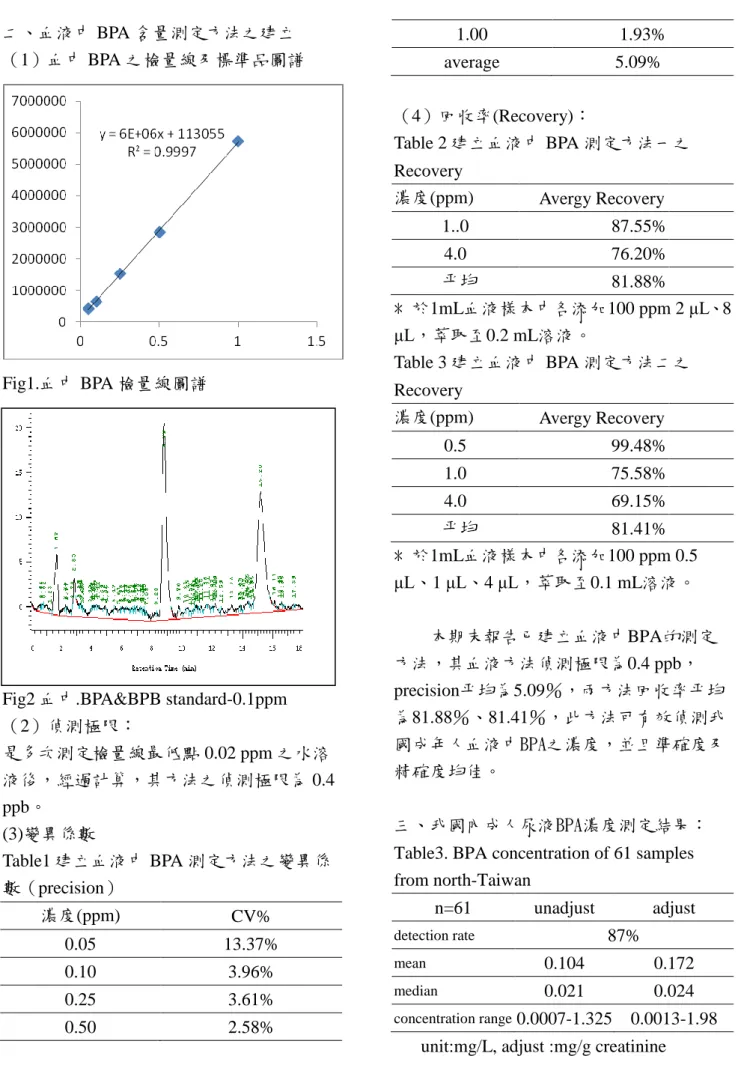
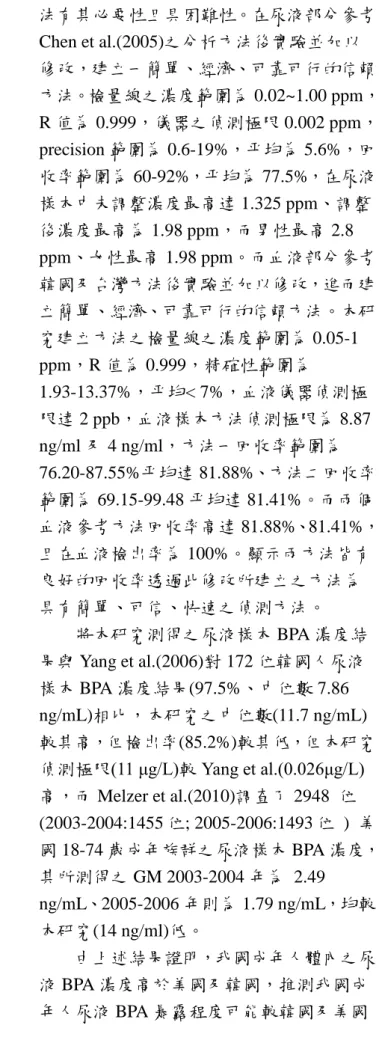
(1)血中 BPA 之檢量線及標準品圖譜
Fig1.血中 BPA 檢量線圖譜
Fig2 血中.BPA&BPB standard-0.1ppm
(2)偵測極限:
是多次測定檢量線最低點 0.02 ppm 之水溶 液後,經過計算,其方法之偵測極限為 0.4 ppb。
(3)變異係數
Table1 建立血液中 BPA 測定方法之變異係 數(precision)
濃度(ppm) CV%
0.05 13.37%
0.10 3.96%
0.25 3.61%
0.50 2.58%
1.00 1.93%
average 5.09%
(4)回收率(Recovery):
Table 2 建立血液中 BPA 測定方法一之 Recovery
濃度(ppm) Avergy Recovery
1..0 87.55%
4.0 76.20%
平均 81.88%
﹡於1mL血液樣本中各添加100 ppm 2 μL、8 μL,萃取至0.2 mL溶液。
Table 3 建立血液中 BPA 測定方法二之 Recovery
濃度(ppm) Avergy Recovery
0.5 99.48%
1.0 75.58%
4.0 69.15%
平均 81.41%
﹡於1mL血液樣本中各添加100 ppm 0.5 μL、1 μL、4 μL,萃取至0.1 mL溶液。
本期末報告已建立血液中BPA的測定 方法,其血液方法偵測極限為0.4 ppb,
precision平均為5.09%,兩方法回收率平均 為81.88%、81.41%,此方法可有效偵測我 國成年人血液中BPA之濃度,並且準確度及 精確度均佳。
三、我國內成人尿液BPA濃度測定結果:
Table3. BPA concentration of 61 samples from north-Taiwan
n=61 unadjust adjust
detection rate 87%
mean 0.104 0.172
median 0.021 0.024
concentration range 0.0007-1.325 0.0013-1.98 unit:mg/L, adjust :mg/g creatinine
Table4. Female urinary BPA concentration n=22 Unadjust adjust
detection rate 82%
Mean 0.112 0.269
Median 0.166 0.024
concentration range 0.0007-1.325 0.0017-1.98 unit:mg/L adjust: mg/g creatinine
Table5. Male urinary BPA concentration n=39 unadjust adjust
detection rate 90%
mean 0.069 0.07
median 0.026 0.025
concentration range 0.0009-0.8 0.0013-0.643 unit:mg/L,mg/g creatinine
尿液樣本已完成北部61個樣本的測定,.
四、我國成人血液 BPA 濃度測定結果:
Table 6. Blood BPA concentration of 20 samples from adults
n=20 Blood BPA (PPb)
detection rate 100%
mean 5.4
median 3.9
concentration range 1.8-24.1
血液樣本部分已建立血中BPA含量測定方 法,血液樣本截至目前經由實驗,已完成20 個樣本的測定,接下來繼續完成其他血液樣 本的測定。
伍、討論:
由於血中及尿中生物偵測的基質都較 複雜,所以在偵測方法上建立 BPA 測定方
法有其必要性且具困難性。在尿液部分參考 Chen et al.(2005)之分析方法後實驗並加以 修改,建立一簡單、經濟、可靠可行的信賴 方法。檢量線之濃度範圍為 0.02~1.00 ppm,
R 值為 0.999,儀器之偵測極限 0.002 ppm,
precision 範圍為 0.6-19%,平均為 5.6%,回 收率範圍為 60-92%,平均為 77.5%,在尿液 樣本中未調整濃度最高達 1.325 ppm、調整 後濃度最高為 1.98 ppm,而男性最高 2.8 ppm、女性最高 1.98 ppm。而血液部分參考 韓國及台灣方法後實驗並加以修改,進而建 立簡單、經濟、可靠可行的信賴方法。本研 究建立方法之檢量線之濃度範圍為 0.05-1 ppm,R 值為 0.999,精確性範圍為
1.93-13.37%,平均< 7%,血液儀器偵測極 限達 2 ppb,血液樣本方法偵測極限為 8.87 ng/ml 及 4 ng/ml,方法一回收率範圍為 76.20-87.55%平均達 81.88%、方法二回收率 範圍為 69.15-99.48 平均達 81.41%。而兩個 血液參考方法回收率高達 81.88%、81.41%,
且在血液檢出率為 100%。顯示兩方法皆有 良好的回收率透過此修改所建立之方法為 具有簡單、可信、快速之偵測方法。
將本研究測得之尿液樣本 BPA 濃度結 果與 Yang et al.(2006)對 172 位韓國人尿液 樣本 BPA 濃度結果(97.5%、中位數 7.86 ng/mL)相比,本研究之中位數(11.7 ng/mL) 較其高,但檢出率(85.2%)較其低,但本研究 偵測極限(11 μg/L)較 Yang et al.(0.026μg/L) 高,而 Melzer et al.(2010)調查了 2948 位 (2003-2004:1455 位; 2005-2006:1493 位 ) 美 國 18-74 歲成年族群之尿液樣本 BPA 濃度,
其所測得之 GM 2003-2004 年為 2.49 ng/mL、2005-2006 年則為 1.79 ng/mL,均較 本研究(14 ng/ml)低。
由上述結果證明,我國成年人體內之尿 液 BPA 濃度高於美國及韓國,推測我國成 年人尿液 BPA 暴露程度可能較韓國及美國
嚴重,而尿液 BPA 濃度已知高於其他國家,
在血液中 BPA 濃度可能相對更高於代謝出 尿液之 BPA 濃度,這使得我國民眾可能高 暴露在 BPA 中,高濃度之 BPA 暴露尤其又 以懷孕婦女及體內之胎兒更為嚴重且需要 更被重視。
雖然目前尚未有證據指出對人體有危 害,但藉由得知體內尿液及血液 BPA 濃度 值可有效了解相關之暴露來源以及暴露 量,由此 BPA 暴露來源及 BPA 暴露量可得 知懷孕婦女及體內胎兒所遭受之汙染及危 害,藉此可做一有效監測來降低懷孕婦女及 胎兒的暴露量。
陸、結論:
本研究建立方法尿液部分檢量線範圍 為 0.02~1.00ppm,方法之偵測極限為 0.5ppb,精確度平均為 3.8%,回收率平均為 82.3%,尿液檢出率 87% (52/60)。本研究建 立方法血液部分檢量線之濃度範圍為 0.02-1 ppm,精確性平均< 7%,方法之偵測極限為 0.4 μg/L(ppb)方法一回收率為 81.88%、方法 二回收率為 81.41%,顯示兩法皆有良好之 回收效果。.4ng/ml,方法一回收率範圍為 76.20-87.55%平均達 81.88%、方法二回收率 範圍為 69.15-99.48 平均達 81.41%,血液檢 出率為 100%。
利用建立之方法分析尿液及血液樣 本,發現雙酚 A 普遍存在於尿液及血液中,
而尿液中濃度高達 1.98 ppm、血液中濃度高 達 24.1 ppb。這使得我們對於測定懷孕婦女 及胎兒體內之 BPA 濃度為一相當重要且迫 切的課題,雖目前尚未有證據指出 BPA 對 人體有危害,但藉由得知體內尿液及血液 BPA 濃度值可做一有效之監測及了解相關 之暴露來源以期減少暴露源之暴露。
柒、參考文獻
1. Al-Hiyasat AS, Darmani H and Elbetieha AM. 2002. Effects of bisphenol A on adult male mouse fertility. Eur. J. Oral Sci.
110:163-167.
2. Aloisi AM, Della Seta D, Ceccarelli I, Farabollini F. 2001. Bisphenol-A differently affects estrogen receptors-alpha in
estrous-cycling and lactating female rats.
Neurosci. Lett. 310:49-52.
3. Aloisi AM, Della Seta D, Rendo C, Ceccarelli I, Scaramuzzino A, Farabollini F.
2002. Exposure to the estrogenic pollutant bisphenol A affects pain behavior induced by subcutaneous formalin injection in male and female rats. Brain Res. 937:1-7.
4. Alonso-Magdalena P, Morimoto S, Ripoll C, Fuentes E, Nadal A. 2006. The estrogenic effect of bisphenol A disrupts pancreatic ß-cell function in vivo and induces insulin resistance. Environ Health Perspect 114:106–112.
5. Becker K, Göen T, Seiwert M, Conrad A, Pick-Fuβ H, Müller J, et al. 2009. GerES Ⅳ:
phthalate metabolites and bisphenol A in urine of German children. Int J Hyg Environ Health 212(6):685-692.
6. Belfroid A, van Velzen M, van der Horst B and Vethaak D. 2002. Occurrence of
bisphenol A in surface water and uptake in fish: evaluation of field measurements, Chemosphere 49: 97–103.
7. Brede C, Fjeldal P, Skjevrak I and Herikstad H. 2003. Increased migration levels of bisphenol A from polycarbonate baby bottles after dishwashing, boiling and brushing, Food Addit. Contam. 20: 684–689.
8. Brotons JA, Olea-Serrano MF, Villalobos M, Pedraza V, Olea N. 1995. Xenoestrogens
released from lacquer coating in food cans.
Environ Health Perspect 103:608–612.
9. Bushnik T, Haines D, Levallois P, et al.
2010. Lead and bisphenol A concentrations in the Canadian population. Statistics Canada, Catalogue 82-003-XPE, Health Reports 21:3.
10. Calafat AM, Kuklenyik Z, Reidy JA, Caudill SP, Ekong J, Needham LL. 2005.
Urinary concentrations of bisphenol A and 4-nonyl phenol in a human reference population. Environ Health Perspect 113:391–395.
11. Calafat AM, Weuve J, Ye X, Jia LT, Hu H, Ringer S, et al. 2009. Exposure to
bisphenol A and other phenols in neonatal intensive care unit premature infants. Environ Health Perspect 117:639-644.
12. Cantonwine D, Meeker JD, Hu Howard, et al. 2010. Bisphenol a exposure in Mexico City and risk of prematurity: a pilot nested case control study. Environ Health. 9:62.
13. Cappiello M, Giuliani L, Rane A and Pacifici GM. 2000. Uridine
5′-diphosphoglucuronic acid (UDPGLcUA) in the human fetal liver, kidney and placenta, Eur.
J. Drug Pharmacokine. 25: 161–163.
14. Chen Mei-Lien, Lee Wan-Ping, Chuang Hsin-Yi, Guo Bey-Rong, Mao I-Fang. 2005.
Biomonitoring of alkylphenols exposure for textile and housekeeping workers. Intern. J.
Environ. Anal. Chem. 85(4-5):335-347.
15. Dirtu AC, Roosens L, Geens T, Gheorghe A, Neels H, Covaci A. 2008.
Simultaneous determination of bisphenol A, triclosan, and tetrabromobisphenol A in human serum using solid-phase extraction and gas chromatography-electron capture
negative-ionization mass spectrometry. Anal
Bioanal Chem 391:1175-1181.
16. Domoradzki JY, Pottenger LH, Thornton CM, Hansen SC, Card TL, Markham DA, Dryzga MD, Shiotsuka RN, Waechter Jr JM.
2003. Metabolism and pharmacokinetics of bisphenol A (BPA) and the embryo-fetal distribution of BPA and
BPA-monoglucuronide in CD
Sprague-Dawley rats at three gestational stages. Toxicol Sci 76:21–34.
17. EC (European Commission). 1990.
Commission directive 90/128/EEC relating to plastics materials and articles intended to come into contact with foodstuffs. Off J Eur Commun L297, 26-30.
18. EC (European Commission). 2002.
Opinion of the Scientific Committee on Food on Bisphenol A. SCF/CS/PM/3936 Final, Scientific Committee on Food, Brusssels, Belgium.
19. EC (European Commission). 2004.
Commission directive of 1 March 2004 amending directive 2002/72/EC relating to plastic materials and articles intended to come into contact with foodstuffs, Off. J. Eur.
Commun. L71, 8–21.
20. Farabollini F, Porrini S, Della Seta D, Bianchi F, Dessi-Fulgheri F. 2002. Effects of perinatal exposure to bisphenol A on
sociosexual behavior of female and male rats.
Environ. Health Perspect. 110 Suppl 3:409-414.
21. FSA (Food Standards Agency) 2000.
Survey of Bisphenols in Canned Foods. Food Surveillance Information Sheet. Number 13/01. April 2001, Food Standards Agency, UK.
22. Fukata H, Miyagawa H, Yamazaki N,
Mori C. 2006. Comparison of ELISA- and LC-MS-based methodologies for the exposure assessment of bisphenol A. Toxicol Mech Methods 16:427-430.
23. Funabashi T, Sano A, Mitsushima D, Kimura F. 2003. Bisphenol A increases progesterone receptor immunoreactivity in the hypothalamus in a dose-dependent manner and affects sexual behaviour in adult ovariectomized rats. J. Neuroendocrinol.
15:134-140.
24. Goodson A, Summerfield W and Cooper I. 2002. Survey of bisphenol A and bisphenol F in canned foods, Food Addit. Contam. 19:
796–802.
25. Goodson A, Robin H, Summerfield W and Cooper I. 2004. Migration of bisphenol A from can coatings-effects of damages, storage conditions and heating, Food Addit. Contam.
21: 1015–1026.
26. Gupta C. 2000. Reproductive
malformation of the male offspring following maternal exposure to estrogenic chemicals.
Proc Soc Exp Biol Med 224:61–68.
27. Hanaoka T, Kawamura N, Hara K and Tsugane S. 2002. Urinary bisphenol A and plasma hormone concentrations in male workers exposed to bisphenol A diglycidyl ether and mixed organic solvents, Occup.
Environ. Med. 59: 625–628.
28. He Y, Miao M, Herrinton LJ, Wu C, Yuan W, Zhou Z, et al. 2009. Bisphenol A levels in blood and urine in a Chinese population and the personal factors affecting the levels. Environ Res 109(5):629-633.
29. Honma S, Suzuki A, Buchanan DL, Katsu Y, Watanabe H, Iguchi T. 2002. Low dose effect of in utero exposure to bisphenol A
and diethylstilbestrol on female mouse reproduction. Reprod Toxicol 16:117–122.
30. Howdeshell KL, Hotchkiss AK, Thayer KA, Vandenbergh JG, vom Saal FS. 1999.
Exposure to bisphenol A advances puberty.
Nature 401:763–764.
31. Hunt PA, Koehler KE, Susiarjo M, Hodges CA, Hagan A, Voigt RC, Thomas S, Thomas BF, Hassold TJ. 2003. Bisphenol A causes meiotic aneuploidy in the female mouse. Curr Biol 13:546–553.
32. Ike M, Jin CS and Fujita M. 2000.
Biodegradation of bisphenol A in the aquatic environment, Water Sci. Technol. 42: 31–38.
33. Ikezuki Y, Tsutsumi O, Takai Y, Kamei Y, Taketani Y. 2002. Determination of bisphenol A concentrations in human biological fluids reveals significant early prenatal exposure, Hum Reprod
17:2839-2841.
34. Inoue K, Kawaguchi M, Funakoshi Y and Nakazawa Y. 2003. Size-exclusion flow extraction of bisphenol A in human urine for liquid chromatography–mass spectrometry, J.
Chromatogr. B 798: 17–23.
35. Inoue K, Kato K, Yoshimura Y, Makino T, Nakazawa H. 2000. Determination of bisphenol A in human serum by
high-performance liquid chromatography with multi-electrode electrochemical detection. J Chromatogr B Biomed Sci Appl 749:17–23.
36. Inoue K, Yamaguchi A, Wada M, Yoshimura Y, Makino T, Nakazawa H. 2001.
Quantitative detection of bisphenol A and bisphenol A diglycidyl ether metabolities in human plasma by liquid chromatography electrospray mass spectrometry. J Chromatogr B 765:121-126.
37. IRIS 1988. Bisphenol A (CASRN 80-05-7). In: US-EPA Integrated Risk Information System Substance file.
http://www.epa.gov/iris/subst/0356.htm.
38. Jolanki R, Kanerva L, Estlander T. 1995.
Occupational allergic contact dermatitis caused by epoxy diacrylate in
ultraviolet-light-cured paint, and bisphenol A in dental composite resin. Contact Dermatitis 33:94-99.
39. Kaddar N, Bendridi N, Harthé C, de Ravel MR, Bienvenu AL, Cuilleron CY, et al.
2009. Development of a radioimmunoassay for the measurement of Bisphenol A in biological samples. Anal Chim Acta 645:1-4.
40. Kang JH, Kondo F, Katayama Y. 2006.
Human exposure to bisphenol A. Toxicology 226: 79-89.
41. Kang JH, Kito K and Kondo F. 2003.
Factors influencing the migration of bisphenol A from cans, J. Food Prot. 66: 1444–1447.
42. Kawaguchi M, Sakui N, Okanouchi N, Ito R, Saito K, Izumi S, Makino T and Nakazawa H. 2005. Stir bar sorptive extraction with in situ derivatization and thermal desorption-gas chromatography–mass spectrometry for measurement of phenolic xenoestrogens in human urine samples, J.
Chromatogr. B 820: 49–57.
43. Kawamoto Y, Matsuyama W, Wade M, Hishikawa J, Chan MP, Nakayama A, et al.
2007. Development of a physiologically based pharmacokinetic model for bisphenol A in pregnant mice. Toxicol Appl Pharmacol 224(2):182-191.
44. Kawamura Y, Inoue K, Nakazawa H, Yamada T and Maitari T. 2001. Cause of bisphenol A migration from cans for drinks
and assessment of improved cans, J. Food Hyg.
Soc. Jpn. 42: 13–17 (in Japanese).
45. Kim YH, Kim CS, Park S, Han SY, Pyo MY, Yang M. 2003. Gender differences in the levels of bisphenol A metabolites in urine.
46. Kuklenyik Z, Ye X, Needham LL, Calafat AM. 2009. Automated solid-phase extraction approaches for large scale
biomonitoring studiess. J Chromatograph Sci 47 :12-18.
47. Kuroda N, Kinoshita Y, Sun Y, Wade M, Kishikawa N, Nakashima K, et al. 2003.
Measurement of bisphenol A levels in human blood serum and ascitic fluid by HPLC using a fluorescent labeling reagent. J Pharm Biomed Anal 30: 1743-1749.
48. Lakind JS, Naiman DQ. 2008. Bisphenol A (BPA) daily intakes in the United States:
estimates from the 2003-2004 NHANES urinary BPA data. J. Expo Sci Environ Epidemiol 18(6): 608-615.
49. Lang IA, Galloway TS, Scarlett A, HenleyWE, Depledge M, Wallace RB, Melzer D. 2008. Association of urinary bisphenol A concentration with medical disorders and laboratory abnormalities in adults. JAMA 300 (11): 1303-1310.
50. Lee HB and Peart TE. 2000.
Determination of bisphenol A in sewage effluent and sludge by solid-phase and supercritical fluid extraction and gas
chromatography/mass spectrometry, J. AOAC Int. 83: 290–297.
51. Lee YJ, Ryu H-Y, Kim H-K, Min CS, Lee JH, Kim E, et al. 2008. Maternal and fatal exposure to bisphenol A in Korea. Reprod Toxicol 25:413-419.
52. Liu M, Hashi Y, Pan F, Yao J, Song G,
Lin JM. 2007. Automated on-line liquid chromatrography-photodiode arry-mass spectrometry method with dilution line for the determination of bisphenol A and
4-octylphenol in serum. J Chromatogr A 1133:
142-148.
53. Liu Z, Wolff MS and Moline J. 2005.
Analysis of environmental biomarkers in urine using an electrochemical detector, J.
Chromatogr. B 819: 155–159.
54. Matsumoto A, Kunugita N, Kitagawa K, Isse T, Oyama T, Foureman GL, Morita M, Kawamoto T. 2003. Bisphenol A levels in human urine. Environ Health Perspect 111:101–104.
55. Mielke H and Gundert-Remy U.
Bisphenol A levels in blood depend on age and exposure. 2009. Toxicology Letters 190(1): 32-40.
56. Moriyama K, Tagami T, Akamizu T, Usui T, Saljo M, Kanamoto N, Hataya Y, Shimatsu A, Kuzuya H, Nakao K. 2002.
Thyroid hormone action is disrupted by bisphenol A as an antagonist. J Clin Endocrinol Metab 87:5185–5190.
57. Munguía-López EM and Soto-Valdez H.
2001. Effect of heat processing and storage time on migration of bisphenol A (BPA) and bisphenol A-diglycidyl ether (BADGE) to aqueous food stimulant from Mexican can coatings, J. Agric. Food Chem. 49:
3666–3671.
58. Munguía-López EM, Peralta E, Gonzalez-Leon A, Vargas-Requena C and Soto-Valdez H. 2002. Migration of bisphenol A (BPA) from epoxy can coatings to Jalapeno and an acid food simulant, J. Agric. Food Chem. 50: 7299–7302.
59. Munguía-López EM, Gerardo-Lugo S, Peralta E, Bolumen S and Soto-Valdez H.
2005. Migration of bisphenol A (BPA) from can coatings into a fatty-food simulant and tuna fish, Food Addit. Contam. 22: 892–898.
60. Nepomnaschy PA, Baird DD, Weinberg CR, Hoppin JA, Longnecker MP, Wilcox AJ.
2009. Within-person variability in urinary bisphenol A concentration: measurements from specimens after long-term frozen storage.
Environ Res 109(6): 734-737.
61. Newbold RR, Jefferson WJ and Padilla-Banks E. Prenatal Exposure to Bisphenol A at Environmentally Relevent Doses Adversely Affects the Murine Female Reproductive Tract Later in Life. 2009.
Environmental Health Perspectives 117(6):
879-885.
62. Padmanabhan V, Siefert K, Ransom S, Johnson T, Pinkerton J, Anderson L, et al.
2008. Maternal A bisphenol-A levels at delivery: a looming problem? J Perinatol 28:258-263.
63. Palanza P, Howdeshell KL, Parmigiani S, vom Saal FS. 2002. Exposure to a low dose of bisphenol A during fetal life or in adulthood alters maternal behavior in mice. Environ.
64. Schönfelder G, Wittfoht W, Hopp H, Talsness CE, Paul M, Chahoud I. 2002. Parent bisphenol A accumulation in human
maternal-fetal-placental unit. Environ Health Perspect 110:A703–A707.
65. Schöringhumer K, Cichna-Markl M.
2007. Sample clean-up with sol-gel enzyme and immunoaffinity columns for the
determination of bisphenol A in urine. J Chromatogr B 850:361-369.
66. Sugiura-Ogasawara M, Ozaki Y, Sonta S,
Makino T, Suzumori K. 2005. Exposure to bisphenol A is associated with recurrent miscarriage. Hum Reprod 20:2325–2329.
67. Takao Y, Lee HC, Kohra S and Arizono K. 2002. Release of bisphenol A from food can lining upon heating, J. Health Sci. 48:
31–334.
68. Takao Y, Chul Lee H, Ishibashi Y, Kohra S, Tominaga N, Arizono K. 1999. Fast
screening method for bisphenol A in environmental water and in food by
solid-phase microextraction (SPME). J Health Sci 45:39.
69. Takeuchi T, Tsutsumi O, Ikezuki Y, Kamei Y, Osuga Y, Fujiwara T, et al. 2006.
Elevated serum bisphenol A levels under hyperandrogenic conditions may be caused by decreased UDP-glucuronosyltransferase activity. Endocrine J 53(4):485-491.
70. Takeuchi T, Tsutsumi O, Ikezuki Y, Takai Y, Taketani Y. 2004. Positive relationship between androgen and the endocrine disruptor, bisphenol A, in normal women and women with ovarian dysfunction.
Endocr J 51:165–169.
71. Tan BLL, Ali Mohd M. 2003. Analysis of selected pesticides and alkylphenols in human cord blood by gas chromatograph-mass spectrometer. Talanta 61: 385-391.
72. Thomson BM and Grounds PR. 2005.
Bisphenol A in canned foods in New Zealand:
an exposure assessment, Food Addit. Contam.
73. Vandenberg LN, Hauser R, Marcus M, Olea N, Welshons WV. 2007. Human exposure to bisphenol A(BPA). Reprod Toxicol 24(2):139-177.
74. Vandenberg LN, Maffini MV,
Sonnenschein C, Rubin BS, Soto AM. 2009.
Bisphenol-A and the great divide: a review of controversies in the field of endocrine
disruption. Endocrine Rev 30(1):75-95.
75. Volkel W, Bittner N, Dekant W. 2005.
Quantitation of bisphenol A and bisphenol A glucuronide in biological samples by high performance liquid chromatography-tandem mass spectrometry. Drug Metab Dispos 33:1748-1757.
76. Volkel W, Colnot T, Csanady GA, Filsner JG, Dekant W. 2002. Metabolism and kinetics of bisphenol A in humans at low doses following oral administration. Chem Res Toxicol 15:1281-1287
77. Volkel W, Kiranoglu M, Fromme H.
2008. Determination of free and total bisphenol A in human urine to assess daily uptake as a basis for a valid risk assessment.
Toxicol Lett 179:155-162.
78. Wozniak AL, Bulayeva NN, Watson CS.
2005. Xenoestrogens at picomolar to
nanomolar concentrations trigger membrane estrogen receptor-a mediated Ca2+ fluxes and prolactin release in GH3/B6 pituitary tumor cells. Environ Health Perspect 113:431–439.
79. Yamada H, Furuta I. Kato EH, Kataoka S, Usuki Y, Kobashi G, et al. 2002. Maternal serum and amniotic fluid bisphenol A concentrations in the early second trimester.
Reprod Toxicol 16:735-739.
80. Yang M, Kim SY, Chang SS, Lee IS, Kawamoto T. 2006. Urinary concentrations of bisphenol A in relation to biomarkers of sensitivity and effect and endocrine-related health effects. Environ Mol Mutagen 47:571-578.
81. Yang M, Kim SY, Lee SM, Chang SS, Kawamoto T, Jang JY and Ahn YO. 2003.
Biological monitoring of bisphenol A in a Korean population, Arch. Environ. Contam.
Toxicol. 44: 546–551.
82. Yang M, Ryu JH, Jeon R, Kang D, Yoo KY. 2009. Effects of bisphenol A on breast cancer and its risk factors. Arch Toxicol 83:281-285.
83. Yang YJ, Hong YC, Oh SY, Park MS, Kim H, Leem JH, et al. 2009. Bisphenol A exposure is associated with oxidative stress and inflammation in postmenopausal women.
Environ Res 109(6):797-801.
84. Ye X, Bishop AM, Needham LL, Calafat AM. 2008a. Automated on-line
column-switching HPLC-MS/MS method with peak focusing for measuring parabens, triclosan, and other environmental phenols in human milk. Anal Chim Acta 622(1-2):
150-156.
85. Ye X, Bishop AM, Reidy JA, Needham LL, Calafat AM. 2007. Temporal stability of the conjugated species of bisphenol A, parabens, and other environmental phenols in urine. J Expo Sci Environ Epidemiol
17:567-572.
86. Ye X, Kuklenyik Z, Needham LL and Calafat AM. 2005a. Automated on-line column-switching HPLC-MS/MS method with peak focusing for the determination of nine environmental phenols in urine. Anal Chem 77(16): 5407-5413.
87. Ye X, Kuklenyik Z, Needham LL and Calafat AM. 2005. Quantification of urinary conjugates of bisphenol A, 2,5-dichlorophenol, and 2-hydroxy-4-methoxybenzophenone in humans by online solid phase extraction-high performance liquid chromatography–tandem
mass spectrometry, Anal. Bioanal. Chem. 383:
638–644.
88. Ye X, Kuklenyik Z, Needham LL and Calafat AM .2006. Measuring environmental phenols and chlorinated organic chemicals in breast milk using automated on-line
column-switching-high performance liquid chromatography-isotope dilution tandem mass spectrometry. J Chromatogr B 831:110-115.
89. Ye X, Pierik FH, Angerer J, Meltzer HM, Jaddoe WW, Tiemeier H, et al. 2009a. Levles of metabolites of organophosphate pesticides, phthalates, and bisphenol A in pooled urine specimens from pregnant women participating in the Norwegian Mother and Child Cohort Study (MoBa). Int J Hyg Environ Health 212(5): 481-491.
90. Ye X, Pierik FH, Hauser R, Duty S, Angerer J, Park MM, et al. 2008b. Urinary metabolites concentrations of
organophos-phorous pesticides, bisphenol A, and phthalates among pregnant women in Rotterdam, the Netherlands: the Generation R study. Environ Res 108: 260-267.
91. Yoshida T, Horie M, Hoshino Y and Nakazawa H. 2001. Determination of
bisphenol A in canned vegetables and fruit by high performance liquid chromatography, Food Addit. Contam. 18: 69–75.
92. 吳建宜、丁望賢,2000:環境荷爾蒙- 壬基苯酚與雙酚A 在臺灣水環境中之分布 與流布調查。環境檢驗通訊雜誌,33: 12-21。
國科會補助計畫衍生研發成果推廣資料表
日期:2013/02/26
國科會補助計畫
計畫名稱: 我國懷孕婦女及胎兒雙酚A暴露研究(I) 計畫主持人: 毛義方
計畫編號: 100-2621-M-040-001- 學門領域: 永續發展研究-生物科學
無研發成果推廣資料
100 年度專題研究計畫研究成果彙整表
計畫主持人:毛義方 計畫編號:100-2621-M-040-001-
計畫名稱:環境中雙酚 A 流佈及其母體暴露對於孩童健康之影響評估--我國懷孕婦女及胎兒雙酚 A 暴
露研究(I)量化
成果項目 實際已達成
數(被接受 或已發表)
預期總達成 數(含實際已
達成數)
本計畫實 際貢獻百
分比 單位
備 註 ( 質 化 說 明:如 數 個 計 畫 共 同 成 果、成 果 列 為 該 期 刊 之 封 面 故 事 ...
等)
期刊論文 0 0 100%
研究報告/技術報告 1 1 100%
研討會論文 2 2 100%
論文著作 篇
專書 0 0 100%
申請中件數 0 0 100%
專利 已獲得件數 0 0 100% 件
件數 0 0 100% 件
技術移轉
權利金 0 0 100% 千元
碩士生 1 0 100%
博士生 0 0 100%
博士後研究員 0 0 100%
國內
參與計畫人力
(本國籍)
專任助理 1 0 100%
人次
期刊論文 0 0 100%
研究報告/技術報告 0 0 100%
研討會論文 0 0 100%
論文著作 篇
專書 0 0 100% 章/本
申請中件數 0 0 100%
專利 已獲得件數 0 0 100% 件
件數 0 0 100% 件
技術移轉
權利金 0 0 100% 千元
碩士生 0 0 100%
博士生 0 0 100%
博士後研究員 0 0 100%
國外
參與計畫人力
(外國籍)
專任助理 0 0 100%
人次
其他成果
(
無法以量化表達之成果如辦理學術活動、獲 得獎項、重要國際合 作、研究成果國際影響 力及其他協助產業技 術發展之具體效益事 項等,請以文字敘述填 列。)
無
成果項目 量化 名稱或內容性質簡述
測驗工具(含質性與量性) 0
課程/模組 0
電腦及網路系統或工具 0
教材 0
舉辦之活動/競賽 0
研討會/工作坊 0
電子報、網站 0
科 教 處 計 畫 加 填 項
目 計畫成果推廣之參與(閱聽)人數 0
國科會補助專題研究計畫成果報告自評表
請就研究內容與原計畫相符程度、達成預期目標情況、研究成果之學術或應用價 值(簡要敘述成果所代表之意義、價值、影響或進一步發展之可能性) 、是否適 合在學術期刊發表或申請專利、主要發現或其他有關價值等,作一綜合評估。
1. 請就研究內容與原計畫相符程度、達成預期目標情況作一綜合評估
■達成目標
□未達成目標(請說明,以 100 字為限)
□實驗失敗
□因故實驗中斷
□其他原因 說明:
2. 研究成果在學術期刊發表或申請專利等情形:
論文:□已發表 ■未發表之文稿 □撰寫中 □無 專利:□已獲得 □申請中 ■無
技轉:□已技轉 □洽談中 ■無 其他:(以 100 字為限)
3. 請依學術成就、技術創新、社會影響等方面,評估研究成果之學術或應用價 值(簡要敘述成果所代表之意義、價值、影響或進一步發展之可能性)(以 500 字為限)
1.開發 BPA 雙酚 A 在國人尿中濃度及血液中濃度之測定方法包含精確度,精密度,回收率及 field 採樣本之測定可能性.
2.開發的方法可供國內其他研究者使用的可行方法,增進國內研究者研究 BPA 對台灣國人 健康影響之可近性及方便性.