國立臺灣大學理學院物理研究所 碩士論文
Department of Physics Collage of Science
National Taiwan University Master Thesis
B 介子至η介子和 h 介子之二體稀有衰變與電荷宇稱 對稱破壞之量測
Measurements of Branching fractions and CP Asymmetries of B→ηh decays
許祖達 Chou Tat Hoi
指導教授:張寶隸 Advisor: Paoti Chang
中華民國 100 年 8 月
Acknowledgment
First I would like to thank my parents for their supports that allow me to finish the educations. Also, I am grateful to everyone who gives me comments and suggestion. Especially, I thank my advisor Paoti Chang, people work or study in Belle Collaboration, and
members in NTUHEP.
中文摘要
在此篇論文中,我們使用了日本國家高能加速器中心 B 介子工廠 (KEKB) 及其 Belle 偵測器。我們從 772×10
6B 介子對中分析了 B 介子至 η 介子和 h 介子之二體稀有衰變與電荷宇稱對稱破壞。其中 η 介子由兩個光子或三個π介子重組而成。h 介子則分別代表了帶電 K 介子,電π介子和中性 K 介子。
最後我們在 和 衰變中找到超過 3σ的電荷宇稱 對稱破壞徵兆。同時我們也首次量測到 衰變。
K
B B
0 0
K B
Abstract
We present the improved measurements of the B → ηh branching fraction and CP asymmetries using a data sample of 711 fb−1 that contains 771.58± 10.57 million BB pairs collected on Υ(4S) resonance with the Belle detector at the KEKB asymmetric energy e+e− collider. Here h means π±, K± and KS0. And η is selected in η → γγ and η → π+π−π0 decays.
The evidence of CP asymmetry for B± → ηK± is found with 3.8 σ, and 3.0 σ in B± → ηπ± CP asymmetry. The branching fraction of B0 → ηK0 is observed with 5.4 σ standard deviation from zero.
Contents
1 Prologue 1
1.1 Standard Model . . . 1
1.2 CP violation and CKM matrix . . . 3
1.3 Motivation . . . 3
2 KEK B-Factory 7 2.1 KEKB Accelerator . . . 7
2.2 Belle Detector . . . 11
2.2.1 Beam Pipe . . . 11
2.2.2 Silicon Vertex Detector (SVD) . . . 13
2.2.3 Extreme Forward Calorimeter (EFC) . . . 14
2.2.4 Central Drift Chamber (CDC) . . . 15
2.2.5 Aerogel Cherenkov counter system (ACC) . . . 16
2.2.6 Time-of-Flight Counters (TOF) . . . 17
2.2.7 Electromagnetic Calorimeter (ECL) . . . 18
2.2.8 KL and Muon Detector (KLM) . . . 20
2.2.9 Solenoid Magnet . . . 21
3 Basic Selection and and B Reconstruction 25
3.1 Introduction . . . 25
3.2 Reconstruction and Event Selection . . . 25
4 Background Suppression 33 4.1 Continuum Backgrounds . . . 33
4.1.1 Super Fox/Wolfram moment (SFW) . . . 34
4.1.2 Fisher discriminant . . . 34
4.1.3 Likelihood Ratio (LR) . . . 36
4.1.4 2D Fit (Mbc & ∆E ) . . . . 38
4.1.5 3D Fit (Mbc , ∆E & LR) . . . 39
4.2 Generic BB and rare B Backgrounds . . . . 44
4.3 Feedacross Backgrounds . . . 44
5 Control Sample Study 50 5.1 The calibration factors between MC and real data . . . 52
6 Signal Extraction 56 6.1 Signal And Background PDFs . . . 56
6.2 Ensemble Test . . . 62
6.2.1 B± → η(γγ)K± and B± → η(γγ)π± Signal Yield En- semble Test . . . 63
6.2.2 B± → η(π+π−π0)K± and B± → η(π+π−π0)π± Signal Yield Ensemble Test . . . 66
6.2.3 B0 → η(γγ)KS0 Signal Yield Ensemble Test . . . 69
6.2.4 B0 → η(π+π−π0)KS0 Signal Yield Ensemble Test . . . . 71
6.2.5 B± → η(γγ)K± and B±→ η(γγ)π±ACP Ensemble Test 74 6.2.6 B± → η(π+π−π0)K± and B± → η(π+π−π0)π± ACP Ensemble Test . . . 76
6.2.7 B± → η(γγ)KS0 and B± → η(π+π−π0))KS0 ACP En- semble Test . . . 78
7 Systematics Error and Efficiency Correction 79 7.1 The efficiency of LR cut . . . 80
7.2 Systematics of Particle Identification . . . 83
7.3 Systmatics Error of η and π0 Uncertainty . . . 83
7.4 Summary of Systematics Error . . . 84
8 Box Opening Result 87
A Figure Of Merit 96
B The Translated LR 101
C The modify Mbc 105
D Self Cross Feed Study 111
E Fudge Factors Study in High π0 Momentum Region 116
F The Significance 119
G η → γγ and η → π+π−π0 result combination 122
H Assumptions in Branching Fraction Measurements 124
List of Figures
1.1 The three generation quarks and leptons, with the gauge bosons in the rightmost column. . . 2 1.2 Examples of Feynman diagrams involved in B± → ηK± decay. 5 1.3 Examples of Feynman diagrams involved in B± → ηπ± decay. 6 1.4 Examples of Feynman diagrams involved in B± → ηKS0 decay. 6
2.1 Schematic layout of KEKB from the top and side view. . . 10 2.2 The structure of the Belle detector in isometric and side view. [26]. 11 2.3 The cross-section of the beam pipe at the IP [25]. . . 13 2.4 The structure of the beam pipe and horizontal masks [25]. . . 13 2.5 Configuration of SVD [25]. . . 14 2.6 Side view of forward EFC (left) and isometric view of the
forward and backward EFC detectors (right) [25]. . . 15 2.7 Overview of CDC structure [25]. The lengths in the figure are
in units of mm. . . 16 2.8 Cell structure (left) and the cathode sector configuration (right) [25].
18
2.9 The plot of dE/dx and particle momentum, together with the expected truncated mean [25]. . . 19 2.10 The arrangement of ACC in the Belle detector [25]. . . 20 2.11 Schematic drawing of a typical ACC counter module: (a) bar-
rel and (b) end-cap ACC [25]. . . 20 2.12 A TOF/TSC module [25]. . . 21 2.13 Mass distribution from TOF for particle momenta below 1.2
GeV/c [25]. . . . 22 2.14 The CDC, ACC and TOF are useful for particle identification
in different momentum region [26]. . . 23 2.15 Configuration of ECL [25]. . . 23 2.16 Cross-section of a KLM superlayer [25]. . . 24 2.17 Pass rate of the muon preselection (primary requirement is
two associated KLM hits at least) for muons (open circle) and pions (closed circle) within 23◦ < θ < 150 ◦. The crosse are for muons with one hits at least [27]. . . 24
3.1 The Siganl MC ∆E and Mbc distribution and P.D.F.S. . . 32
4.1 The momentum topology of jet-like qq events and spherical- like BB events. . . . 33 4.2 The distributions of Mmiss and Fisher discriminant for each
Mmiss bin. The left figures stands for η(γγ)K± and right ones stands for η(π+π−π0)K±. The red line stands for signal MC and blue line stands for qq MC. . . . 36
4.3 The distributions of the components ofLR and itself. The top three figures denote Fisher discriminant, cosθB, and ∆Z for the B± → η(γγ)K± decay while the middle three ones are for B± → η(π+π−π0)K± decay. The bottom left figure denotes the LR distribution for B± → η(γγ)K± decay, and the The bottom right figure is for B± → η(π+π−π0)K± decay. The blue line stands for signal MC while the red line stands for qq
MC. . . 37
4.4 The ”qB× q × r” distributions for B± → ηK± (lef t) and ”r” distributions for B±→ ηKS0(right). . . . 38
4.5 ∆E and Mbc fitting result in 2D ensemble test . . . 40
4.6 ∆E Mbc, and LR fitting result in 3D ensemble test . . . . 41
4.7 Pull, yield, error in 2D ensemble test . . . 42
4.8 Pull, yield, error in 3D ensemble test . . . 43
4.9 The generic BB background ∆E− Mbc scatter plots. . . 46
4.10 The rare BB background ∆E− Mbc scatter plots. Signal and feedacross background are already removed. . . 47
4.11 The rare BB background ∆E− Mbc scatter plots. Signal and feedacross background are already removed. . . 48
4.12 The signal (red) and feed across background (blue) ∆E and Mbc distribution and relative ratio in B→ ηh decay. . . 49
5.1 The ∆E (left) and Mbc(right) distribution for B+ → D0(K+π−π0)π+ signal MC. . . 52
5.2 The translated LR distribution for B+ → D0(K+π−π0)π+ signal MC. . . 52
5.3 The ∆E (left) and Mbc(right) distribution for B+ → D0(K+π−π0)π+ realdata (Exp. 7 : 65). . . 53 5.4 The translated LR distribution for B+ → D0(K+π−π0)π+
realdata (Exp. 7 : 65). . . 53 5.5 The D0 mass distribution of inclusive D0 → K+π−π0 decay,
in cc MC (top) and real data (down). . . . 54
6.1 The 3D fit ∆E, Mbc and translated LR plots in ηh siganl MC (from left to right). . . 60 6.2 The 3D fit ∆E, Mbc and translated LR plots in ηh siganl MC
(from left to right). . . 61 6.3 The projection plots from ensemble test. The red line is signal
PDF, blue line is continuum background, green for rare B and yellow for freedacross. The ∆E plot is showed with projection Mbc > 5.27 andLR > 0.7. Mbc plot is showed with projection
−0.15 < ∆E < 0.1 and LR > 0.7. LR plot is showed with projection −0.15 < ∆E < 0.1 and Mbc > 5.27. The top one is from B± → η(γγ)K± mode, and the bottom one is from B± → η(γγ)π±. . . 63 6.4 The ensemble test result in B± → η(γγ)K±mode. Pull(upper
left side), yield(upper right side) and error(bottom) distribu- tion. . . 64 6.5 The ensemble test result in B± → η(γγ)π± mode. Pull(upper
left side), yield(upper right side) and error(bottom) distribu- tion. . . 65
6.6 The projection plots from ensemble test. The ∆E plot is showed with projection Mbc > 5.27 and LR > 0.7. Mbc plot is showed with projection −0.1 < ∆E < 0.08 and LR > 0.7.
LR plot is showed with projection −0.1 < ∆E < 0.08 and Mbc > 5.27. The top one is from B± → η(π+π−π0)K± mode, and the bottom one is from B± → η(π+π−π0)π±. . . 66 6.7 The ensemble test result in B± → η(π+π−π0)K±mode. Pull(upper
left side), yield(upper right side) and error(bottom) distribu- tion. . . 67 6.8 The ensemble test result in B± → η(π+π−π0)π±mode. Pull(upper
left side), yield(upper right side) and error(bottom) distribu- tion. . . 68 6.9 The projection plots from ensemble test in B± → η(γγ)KS0
mode. The ∆E plot is showed with projection Mbc > 5.27 and LR > 0.7. Mbc plot is showed with projection −0.15 <
∆E < 0.1 and LR > 0.7. LR plot is showed with projection
−0.15 < ∆E < 0.1 and Mbc> 5.27. . . . 69 6.10 The ensemble test result in B0 → η(γγ)KS0 mode. Pull(upper
left side), yield(upper right side) and error(bottom) distribu- tion. . . 70 6.11 The projection plots from ensemble test in B0 → η(π+π−π0)KS0
mode. The ∆E plot is showed with projection Mbc > 5.27 and LR > 0.7. Mbc plot is showed with projection −0.15 <
∆E < 0.1 and LR > 0.7. LR plot is showed with projection
−0.15 < ∆E < 0.1 and Mbc> 5.27. . . . 71 6.12 The ensemble test result in B0 → η(π+π−π0)KS0 mode. Pull(upper
left side), yield(upper right side) and error(bottom) distribu- tion. . . 72
6.13 The fit bias of signal and background in B± → η(γγ)K± and B± → η(γγ)π± mode. Only small bias in signal and rare B background in B± → η(γγ)K± mode. . . 73 6.14 The ensemble test result in B± → η(γγ)K±mode. Pull(upper
left side), ACP(upper right side) and error(bottom) distribu- tion. The PDG value is equal to -0.37. . . 74 6.15 The ensemble test result in B± → η(γγ)π± mode. Pull(upper
left side), ACP(upper right side) and error(bottom) distribu- tion.The PDG value is equal to -0.13. . . 75 6.16 The ensemble test result in B± → η(π+π−π0)K±mode. Pull(upper
left side), ACP(upper right side) and error(bottom) distribu- tion. The PDG value is equal to -0.37. . . 76 6.17 The ensemble test result in B± → η(π+π−π0)π±mode. Pull(upper
left side), ACP(upper right side) and error(bottom) distribu- tion.The PDG value is equal to -0.13. . . 77 6.18 The ensemble test result in B0 → η(γγ)KS0 and B0 → η(π+π−π0))KS0
mode. Pull(upper left side), ACP(upper right side) and er- ror(bottom) distribution. The bias is within two sigma. . . 78
7.1 The ∆E, Mbc and LR distribution for B+ → D0(K+π−π0)π+ in data, no LR cut is required. . . 82 7.2 The ∆E, Mbc and LR distribution for B+ → D0(K+π−π0)π+
in data,LR > 0.2 is required. . . 82
8.1 The projection plots from real data in B± → η(γγ)K±(top) and B± → η(γγ)π±(bottom). The red line is signal PDF, blue line is continuum background, green dashed line for rare B and yellow region for freedacross. The ∆E plot is showed with projection Mbc > 5.27 andLR > 1.95. Mbcplot is showed with projection −0.1 < ∆E < 0.08 and LR > 1.95. LR plot is showed with projection −0.1 < ∆E < 0.08 and Mbc > 5.27. 89 8.2 The projection plots from real data in B± → η(π+π−π0)K±(top)
and B±→ η(π+π−π0)π±(bottom). The red line is signal PDF, blue line is continuum background, green dashed line for rare B and yellow region for freedacross. The ∆E plot is showed with projection Mbc > 5.27 andLR > 1.95. Mbcplot is showed with projection−0.05 < ∆E < 0.05 and LR > 1.95. LR plot is showed with projection −0.05 < ∆E < 0.05 and Mbc > 5.27. 90 8.3 The projection plots from real data in B0 → η(γγ)KS0(top).
The red line is signal PDF, blue line is continuum background, green dashed line for rare B. The ∆E plot is showed with pro- jection Mbc > 5.27 andLR > 1.1. Mbcplot is showed with pro- jection −0.1 < ∆E < 0.08 and LR > 1.1. LR plot is showed with projection −0.1 < ∆E < 0.08 and Mbc > 5.27. And the projection plots from real data in B0 → η(π+π−π0)KS0(bottom).
The ∆E plot is showed with projection Mbc > 5.27 and LR >
0.51. Mbc plot is showed with projection −0.05 < ∆E < 0.05 and LR > 0.51. LR plot is showed with projection −0.05 <
∆E < 0.05 and Mbc> 5.27. . . . 91 8.4 The projection plots in B+ → η(γγ)K+(left) and B− →
η(γγ)K−(right). . . 92 8.5 The projection plots in B+ → η(γγ)π+(left) and B− → η(γγ)π−(right). 93 8.6 The projection plots in B+→ η(π+π−π0)K+(left) and B−→
η(π+π−π0)K−(right). . . 94
8.7 The projection plots in B+ → η(π+π−π0)π+(left) and B− → η(π+π−π0)π−(right). . . 95
A.1 Figure A.3: The F.O.M. distribution in different qB × q × r bins from B±→ ηK±decay, The red arrows show the LR cut selections. . . 100
B.1 The translate function. First order differential is larger than zero when 0.2 < x < 1.0. Also give a better resolution in 0.8 < x < 1.0 and 0.2 < x < 0.4 after translated. . . 102 B.2 TheLR(left) and the translated LR(right) in B±→ η(γγ)K±
decay. The red line shows the signal and blue line stands for countinuum background. . . 103 B.3 Describe the translated LR of B± → η(γγ)K± countinuum
background with two Gaussian(left). Describe the translated LR of B± → η(γγ)K± signal with one Gaussian(right). . . 104
C.1 The modify Mbc(red) and typical Mbc(blue) in B±→ η(γγ)K± signal MC. Better resolution is provided by the modify Mbc. . 107 C.2 The modify Mbc(red) and typical Mbc(blue) in B±→ η(π+π−π0)K±(left)
and B+ → D0π+(right) signal MC. . . 107 C.3 The modify ∆E and typical Mbc scatter plot(left), ∆E and
modify Mbcscatter plot(right). Correlation is reduced in mod- ify Mbc. . . 108 C.4 The ∆E(left) and Mbc(right) distributions in B±→ η(γγ)K±
rare B background, The red one is from modify Mbc and blue one is typical Mbc. The modify Mbcprovide a better seperation between signal and rare B background. . . 109
C.5 The ∆E(left) and Mbc(right) distributions in B±→ η(π+π−π0)K± rare B background, The red one is from modify Mbc and blue one is typical Mbc. The modify Mbcprovide a better seperation between signal and rare B background. . . 109 C.6 The ∆E(left) and Mbc(right) distributions in B±→ η(γγ)K±
continuum background, The red one is from modify Mbc and blue one is typical Mbc. The distributions are same in two definition. . . 110
D.1 The ∆E plots in different Mbcregions of B± → η(γγ)K±mode in true signal with(left) and without(right) normalization. . . 112 D.2 The ∆E plots in different Mbcregions of B± → η(γγ)K±mode
in SCF with(left) and without(right) normalization. . . 112 D.3 The Mbcplots in different ∆E regions of B± → η(γγ)K±mode
in true signal with(left) and without(right) normalization. . . 113 D.4 The Mbcplots in different ∆E regions of B± → η(γγ)K±mode
in SCF with(left) and without(right) normalization. . . 113 D.5 The ∆E plots in different Mbc regions of B → η(π+π−π0)K±
mode in true signal with(left) and without(right) normaliza- tion. . . 114 D.6 The ∆E plots in different Mbc regions of B → η(π+π−π0)K±
mode in SCF with(left) and without(right) normalization. . . 114 D.7 The Mbc plots in different ∆E regions of B → η(π+π−π0)K±
mode in true signal with(left) and without(right) normaliza- tion. . . 115 D.8 The Mbc plots in different ∆E regions of B → η(π+π−π0)K±
mode in SCF with(left) and without(right) normalization. . . 115
E.1 The ∆E (left) and Mbc (right) 1-D fit from signal MC (control sample). LR cut larger than 0.2 is applied. . . 117 E.2 The ∆E (left) and Mbc (right) 1-D fit from real data (control
sample). LR cut larger than 0.2 is applied. The blue line shows the signal PDF, red for continuum background, and green for generic B background. . . 117 E.3 The fudge fators study in different π0 momentum regions. . . 118
F.1 The M ax(likelihood)likelihood in different branching fraction in B± → η(γγ)K± mode (top). The blue line is before smearing, and red line is after smearing with PDFs systematic error. And they overlap completely because the PDFs systematic error is very small. So we also show the effect in smearing with total systematic error (bottom). And it is a dome, we do not use the bottom one to calculate significance. . . 120 F.2 The M ax(likelihood)likelihood in different ACP in B± → η(γγ)K± mode
(top). And in B± → η(γγ)π± mode (bottom). The blue line is before smearing, and red line is after smearing with PDFs systematic error. And they overlap completely because the PDFs systematic error is very small. . . 121
G.1 The log(likelihood) distribution in different branching fraction in B±→ η(γγ)K± mode. . . 122 G.2 The log(likelihood) distribution in different branching fraction
in B±→ η(π+π−π0)K± mode. . . 123 G.3 The combined log(likelihood) in B± → ηK± mode. . . 123
List of Tables
1.1 The branching ratio in B → ηK± decay is 2.33+0.33−0.34 in PDG . . 4
1.2 The branching ratio in B → ηπ± decay is 4.07± 0.32 in PDG . 4 1.3 The branching ratio in B → ηKS0 decay is 1.15+0.43−0.38± 0.09 in PDG. . . 5
1.4 The branching ratio in η decay [PDG]. . . . 5
2.1 The parameters of the KEKB accelerator. . . 9
2.2 The detail of each sub-detector in the Belle detector. . . 12
2.3 Configuration of the CDC sense wire and cathode strips [25]. . 17
2.4 Parameters of ECL [25]. . . 21
3.1 Summary of particle selection criteria . . . 27
4.1 The regions of missing mass of KSFW . . . 35
4.2 The fisher distance for each Mmiss bin. . . 35
4.3 The summary of expected signal in signal box for 2D fit and 3D fit in each decay mode. . . 39
4.4 The summary of ratio between feedacross backgrounds and fitting yield. For example, if there are 1 signal yield in B±→ η(γγ)π± decay mode, the fitter will force 0.08215 feedacross background in B± → η(γγ)K± decay mode. . . 45
5.1 The selection criteria of B+ → D0(K+π−π0)π+ . . . 51 5.2 The selection criteria of inclusive D0 → K+π−π0 . . . 51 5.3 The fitting results of Fig. 3.1 and Fig. 3.2. The shape param-
eter of the PDFs are listed in Table 5.4. . . 53 5.4 The calibration factors. All units are MeV/c2 for Mbc param-
eters and MeV for ∆E parameters. . . . 55
6.1 The wrong-tagging fraction wl for tagged B0 and B0 in each r bin. . . . 58 6.2 The PDFs for Mbc, ∆E and translated LR 3-D fit in B →
η(γγ)h modes. . . . 58 6.3 The PDFs for Mbc, ∆E and translated LR 3-D fit in B →
η(π+π−π0)h modes. . . . 59 6.4 The poisson distribution mean for signal and background in
our ensemble test. . . 63 6.5 The poisson distribution mean for signal and background in
our ensemble test. . . 66 6.6 The poisson distribution mean for signal and background in
our ensemble test. . . 69 6.7 The poisson distribution mean for signal and background in
our ensemble test. . . 71
7.1 The LR cut efficiency for data and MC of the control sample. 81 7.2 The KID efficiency (%) and fake rate for B± → ηK± and
B± → ηπ±, here K± and π± come from B± . Ratio = (Data/M C). . . . 83 7.3 The KID efficiency (%) for B → η(π+π−π0)h. The π± effi-
ciency comes from η. . . . 83 7.4 The summary of branching fractions systematics error (%) for
each mode. . . 85 7.5 The summary of ACP systematics error (%) for each mode. . 86
8.1 Summary table of branching fractions and other details for each decay mode. Detection efficiency ϵef f including sub-decay branching fraction, yield, fit bias, significance (Sig.), measured branching fraction (B), and ACP for the B→ ηh decays. Thre first errors are statistical and the second ones are systematic. . 87 8.2 Summary table of ACP in each decay mode. . . 88 8.3 Summary table of continuum background ACP in each decay
mode. All of them are less than 10% of statistical error in signal ACP. . . 88 8.4 Summary table of yields of continuum background in each
decay mode. . . 88
A.1 Table A.1: The summarization ofLR cuts in each qB× q × r bins in B± → ηK± decay mode. . . 99
H.1 Summary table of ϵBB and r(ϵqq). . . 125
Chapter 1 Prologue
1.1 Standard Model
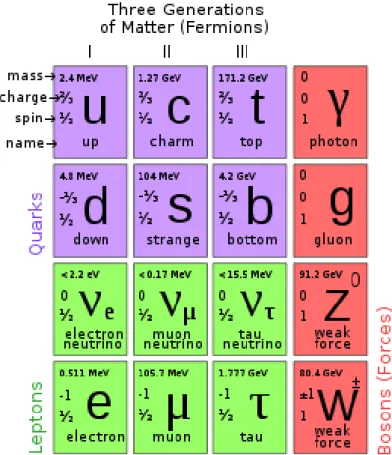
The Standard Model of particle physics (SM) [15] is a theoretical picture concerning the electroweak, electromagnetic, and strong interactions. The elementary particles are separated into four families, namely the quarks, leptons, gauge bosons and other bosons(Higgs boson). Quarks and leptons consist of six particles, split into three generations, And with the first gen- eration being the lightest, and the third the heaviest in quarks and charged leptons. Furthermore, gauge bosons are force carrying mediators in the three interactions.
The dynamics in Standard Model depend on 28 parameters, whose nu- merical values are established by experiment. The 28 parameters include 6 leptons mass, 6 quarks mass, 3 CKM mixing angle, 1 CKM CPV phase, 3 gauge coupling constant, 1 QCD vacuum angle, 1 Higgs quadractic coupling, 1 Higgs self-coupling strength, 3 PMNS mixing angle, 1 PMNS Dirac CPV phase, and 2 PMNS Majorana CPV phase .
Figure 1.1: The three generation quarks and leptons, with the gauge bosons in the rightmost column.
1.2 CP violation and CKM matrix
Parity(P) conservation is believed to be true before C.-S. Wu found the parity violation in the β decay in 1957. After that, people replace parity conservation to charge conjugation and parity (CP) conservation. But in 1964, the violation of CP symmetry was found in the decays of neutral K meson system by James Cronin and Val Fitch [18].
In Standard Model weak interaction is the only way that qaurks and leptons can change to anther type. And the flavor changing of quark is described by
d′ s′ b′
= VCKM
d s b
=
Vud Vus Vub Vcd Vcs Vcb Vtd Vts Vtb
d s b
, (1.1)
where the 3 × 3 unitary matrix is called CKM matrix or quark mixing matrix [19]. The CKM matrix can parameterized in several ways, one of the parameterization, called Wolfenstein’s parameterization, which transfer the CKM matrix in the form of an expansion in λ = sin θc, where θc is Cabibbo angle. And Wolfenstein’s parameterization has an advantage of giving four parameters in a same order.
VCKM =
1−λ22 λ Aλ3(ρ− iη)
−λ 1− λ22 Aλ2 Aλ3(1− ρ − iη) −Aλ2 1
+ O(λ4) , (1.2)
1.3 Motivation
Our motivation is to give branching ratios of B → ηh decays with about 50%
more data compare to the previous measurement in Belle. And in order to rise the significance we also going to 3-D fit instead of 2-D fit.
In SM, η and η′ quark wave functions are linear combinations of uu+dd√ 2 and ss. It is expected to enhance the B± → η′K± decay amplitude but suppress the B± → ηK± decay amplitude. Thus, studying B± → ηK± may give us more information in η− η′ mixing and B(B± → η′K±) puzzle. Moreover, interference of different diagrams may provide a large direct CP asymmetry in B± → ηK± and B± → ηπ±. Therefore, the previous BaBar and Belle measurements give a CP asymmetry near to−30% in B± → ηK±decay. It’s very interesting and important to confirm the Acp(ηK±). And here shows the Feynman diagrams involved in our study.
We report the final updated measurements of branching fractions and partial rate asymmetries for B decays to a pseudoscalar-pseudoscalar mesons with one η meason in the final state. Our decay modes are considered:
η(γγ)K+, η(π+π−π0)K+, η(γγ)K0, η(π+π−π0)K0, η(γγ)π+, η(π+π−π0)π+ The data sample consists of 710 f b−1 for data from Exps 7-65, corresponding to 772 million BB pairs. Here shows the braching ratios in B → ηh± decay measured by pervious experiments in PDG.
Table 1.1: The branching ratio in B → ηK± decay is 2.33+0.33−0.34 in PDG . Branching Ratio (10−6) Author TECN COMMENT
2.94+0.39−0.34 ± 0.21 Aubert 09AV BABR [1] e+e−→ Υ(4S) 2.21+0.48−0.42(stat)±0.25−0.18(syst) Wicht 08 BELL[2] e+e−→ Υ(4S) 1.9± 0.3+0.2−0.1 Chang 07B BELL[3] e+e−→ Υ(4S) 2.2+2.8−2.2 Richichi 00 CLE2[4] e+e−→ Υ(4S)
Table 1.2: The branching ratio in B → ηπ± decay is 4.07± 0.32 in PDG . Branching Ratio (10−6) Author TECN COMMENT
4.00± 0.40 ± 0.24 Aubert 09AV BABR e+e− → Υ(4S) 4.2± 0.4 ± 0.2 Chang 07B BELL e+e− → Υ(4S) 1.2+2.8−1.2 Richichi 00 CLE2 e+e− → Υ(4S)
Table 1.3: The branching ratio in B → ηKS0 decay is 1.15+0.43−0.38±0.09 in PDG.
Branching Ratio (upper limit) (10−6) Author TECN COMMENT 1.15+0.43−0.38 ± 0.09(< 1.8) Aubert 09AV BABR e+e−→ Υ(4S) (< 1.9) [ not used in PDG ] Chang 07B BELL e+e−→ Υ(4S)
Table 1.4: The branching ratio in η decay [PDG].
Decay mode Branching Ratio (%)
2 γ 39.31± 0.20
π+ π− π0 22.74± 0.28
Figure 1.2: Examples of Feynman diagrams involved in B±→ ηK± decay.
Figure 1.3: Examples of Feynman diagrams involved in B±→ ηπ± decay.
Figure 1.4: Examples of Feynman diagrams involved in B± → ηKS0 decay.
Chapter 2
KEK B-Factory
The KEK B-Factory (KEKB) [22] is an e+-e− collider which located at the High Energy Accelerator Research Organization (KEK) in Tsukuba area, Ibaraki Prefecture, Japan. The construction of KEKB accelerator and de- tector started in April 1994. Operatoin was started at Dec. 1998 and truned off at June 30 2010. It’s main goal is to search for signatures of physics beyond the standard model through high-sensitivity measurements. It also presents the measurements of CP asymmetry in B meson decays. The re- sults of KEKB agree the prediction of KM model [19], and provided a strong experimental support for M. Kobayashi and T. Maskawa to win the 2008 Nobel Prize in Physics [24].
2.1 KEKB Accelerator
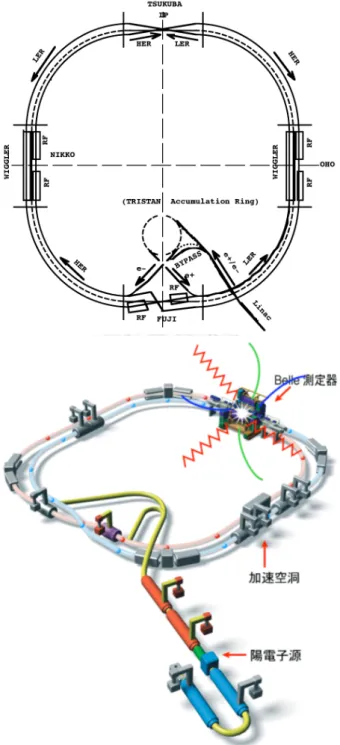
The KEKB accelerator is an two-rings, asymmetric, e+-e−collider. Which is based on the existing TRISTAN tunnel of 3 km circumference to construct the high energy ring (HER) and low energy ring (LER). The HER stores e− and the LER stores e+. The energy of e+and e−is 3.5 and 8 GeV, and provide the center-of-mass energy of e+-e− beams at the Υ(4S) resonance, and large number of B meson pairs can be produce via e+e−→ Υ(4S) → BB.
In KEKB accelerator electrons and positrons beam collide at a crossing angle of±11 mrad at the center of the BELLE detector. It not only allows su- perconducting RF cavity to be filled within the beam but also avoid parasitic collisions. The crossing angle also eliminate the need of the separation-bend magnets and reduces beam-related backgrounds in BELLE detector.
The main parameters of KEKB are summarized in Table 2.1, and Figure 2.1 shows the configuration of the accelerator.
Table 2.1: The parameters of the KEKB accelerator.
Ring LER HER Unit
Energy E 3.5 8.0 GeV
Circumference C 3016.26 m
Luminosity L 1× 1034 cm−2s−1
Crossing angle θx ±11 mrad
Tune shifts ξx/ξy 0.039/0.052
Beta function at IP βx∗/βy∗ 0.33/0.01 m
Beam current I 2.6 1.1 A
Natural bunch length σz 0.4 cm
Energy spread σε 7.1× 10⁻⁴ 6.7× 10⁻⁴
Bunch spacing sb 0.59 m
Particles/bunch N 3.3× 10¹⁰ 1.4× 10¹⁰ Emittance εx/εy 1.8× 10⁻⁸/3.6× 10−10
Synchrotron νs 0.01∼ 0.02
Betatron tune νx/νy 45.52/45.08 47.52/43.08 Momentum compaction factor αp 1× 10⁻⁴∼ 2 × 10⁻⁴
Energy loss/turn U0 0.81†/1.5†† 3.5 MeV
RF voltage Vc 5∼ 10 10∼ 20 MV
RF frequency fRF 508.887 MHz
Harmonic number h 5120
Longitudinal damping time τε 43†/23†† 23 ms
Total beam power Pb 2.7†/4.5†† 4.0 MW
Radiation power PSR 2.1†/4.0†† 3.8 MW
HOM power PHOM 0.57 0.15 MW
Bending radius ρ 16.3 104.5 m
Length of bending magnet lB 0.915 5.86 m
†: without wigglers, ††: with wigglers
Figure 2.1: Schematic layout of KEKB from the top and side view.
2.2 Belle Detector
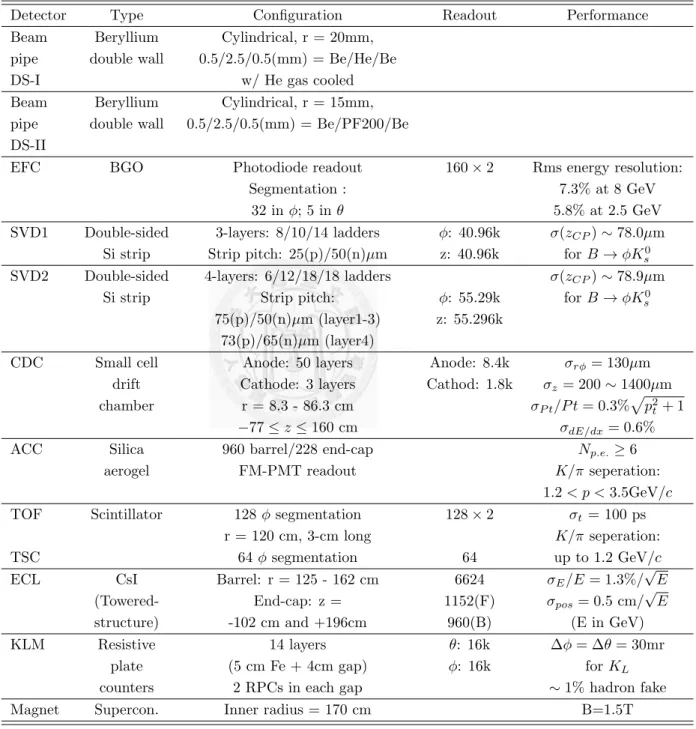
The Belle detector [25] is a collection of sub-detectors built around the inter- action point of the KEKB accelerator. The coordinate system of the Belle detector is defined with the z-axis antiparallel to the e+ beam and the x-axias pointing inward, toward the center of the KEKB storage rings. It is often to use polar corrdinates(θ, ϕ,and r) with polar angle θ defined as the angle away from the z-axis. The Belle detector subsystems cover a full 2π in ϕ and three ranges in polar angle θ: the barrel region (34◦ < θ < 127◦), the forward endcap (17◦ < θ < 34◦), and the backward endcap(127◦ < θ < 150◦). Table 2.2 summarize the performance of the Belle detector and its sub-detectors, and Figure 2.2 shows the configuration of them in isometric and side view.
Figure 2.2: The structure of the Belle detector in isometric and side view. [26].
2.2.1 Beam Pipe
Since the multiple Coulomb scattering could affects the track resolution, it is important to minimise the impact of the beampipe on particle trajectories with a thin material(low atomic number). So a beryllium beampipe was installed in the Belle Detector. The beam pipe is a dual layer cylinder with radii 20.0 mm and 23.0 mm, which thickness are 0.5 mm. The gap between these two beryllium walls provides a channel for helium gas, which is used as a coolant. In 2003, the original beampipe was replaced by a new one which
Table 2.2: The detail of each sub-detector in the Belle detector.
Detector Type Configuration Readout Performance
Beam Beryllium Cylindrical, r = 20mm, pipe double wall 0.5/2.5/0.5(mm) = Be/He/Be
DS-I w/ He gas cooled
Beam Beryllium Cylindrical, r = 15mm, pipe double wall 0.5/2.5/0.5(mm) = Be/PF200/Be DS-II
EFC BGO Photodiode readout 160× 2 Rms energy resolution:
Segmentation : 7.3% at 8 GeV
32 in ϕ; 5 in θ 5.8% at 2.5 GeV
SVD1 Double-sided 3-layers: 8/10/14 ladders ϕ: 40.96k σ(zCP)∼ 78.0µm Si strip Strip pitch: 25(p)/50(n)µm z: 40.96k for B → ϕKs0
SVD2 Double-sided 4-layers: 6/12/18/18 ladders σ(zCP)∼ 78.9µm
Si strip Strip pitch: ϕ: 55.29k for B → ϕKs0
75(p)/50(n)µm (layer1-3) z: 55.296k 73(p)/65(n)µm (layer4)
CDC Small cell Anode: 50 layers Anode: 8.4k σrϕ= 130µm
drift Cathode: 3 layers Cathod: 1.8k σz= 200∼ 1400µm
chamber r = 8.3 - 86.3 cm σP t/P t = 0.3%√
p2t+ 1
−77 ≤ z ≤ 160 cm σdE/dx= 0.6%
ACC Silica 960 barrel/228 end-cap Np.e.≥ 6
aerogel FM-PMT readout K/π seperation:
1.2 < p < 3.5GeV/c
TOF Scintillator 128 ϕ segmentation 128× 2 σt = 100 ps
r = 120 cm, 3-cm long K/π seperation:
TSC 64 ϕ segmentation 64 up to 1.2 GeV/c
ECL CsI Barrel: r = 125 - 162 cm 6624 σE/E = 1.3%/√
E
(Towered- End-cap: z = 1152(F) σpos= 0.5 cm/√
E
structure) -102 cm and +196cm 960(B) (E in GeV)
KLM Resistive 14 layers θ: 16k ∆ϕ = ∆θ = 30mr
plate (5 cm Fe + 4cm gap) ϕ: 16k for KL
counters 2 RPCs in each gap ∼ 1% hadron fake
Magnet Supercon. Inner radius = 170 cm B=1.5T
inner radius is 15.0 mm. The cross-section of the beam pipe is shown in Figure 2.3. The arrangment of the beam pipe and these masks are in Figure 2.4.
Figure 2.3: The cross-section of the beam pipe at the IP [25].
Figure 2.4: The structure of the beam pipe and horizontal masks [25].
2.2.2 Silicon Vertex Detector (SVD)
The primary goal of the SVD is to measure the B meson decay vertex, which is essential for time-dependent CP V study. SVD1 was a three layers Double- sided Silicon Detector(DSSD) in a barrel-only design(23◦ < θ < 139◦),
comprising of 8, 10, and 14 ladders in the inner, middle, and outer layers, respectively. Each ladder is constructed from two joined half-ladders. In summer 2003, the SVD 2 was replaced by a new SVD system (SVD 2). The SVD 2 consists four layers consisting of 6, 12, 18, and 18 ladders from the innermost layer, respectively. And covers more percentage of full solid angle then SVD I (17◦ < θ < 150◦).
Figure 2.5: Configuration of SVD [25].
2.2.3 Extreme Forward Calorimeter (EFC)
The Extreme Forward Calorimeter (EFC) extend the polar angle coverage in both extreme forward and backward regions (6.4◦ < θ < 11.5◦ and 163.3◦ < θ < 171.2◦) which do not cover by ECL. It is useful to improve the experimental sensitivity in some special decay channels such as B → τν decay. The main material of EFC is the radiation-hard BGO (Bismuth Ger- manate, Bi4Ge3O12) crystal calorimeter due to their higher radiation toler- ance.
In fact, the EFC has never been used in decay reconstruction. However, its geometric location allows it to act as a beam mask to reduce radiation
backgrounds to the CDC. In addition, EFC is used for online luminosity and background monitoring. The structure of the cone-like EFC are shown in Fig. 2.6.
Figure 2.6: Side view of forward EFC (left) and isometric view of the forward and backward EFC detectors (right) [25].
2.2.4 Central Drift Chamber (CDC)
The Central Drift Chamber (CDC) with inner(outer) radius 103.5(874) mm and covers the angular range from 17◦ < θ < 150◦. The CDC has a total of a total of 8400 drift cells placed on 50 cylindrical layers. Each of its 8400 drift cells consists of a sense wire, held at a high voltage(2.35 kV), surrounded by field wires, held at low voltage. The CDC is filled with a 50% helium, 50% ethane (C2H6) mixture.The configuration of CDC can be seen in Fig.
2.7. The CDC is used to provide the information of momentum and dE/dx (for particle identification) from charged particles. Charged particles passing through the gas ionize electrons, and the ionized electrons drift forwards to the sense wire. Therefore, the track information is collected.
The particle transverse momentum can be determined from the curvature of the helix(r) as pT = 0.3Br, where pT is in units of GeV/c, B is the magnetic field in Tesla, and r is in meters. More details of CDC are summarized in Table 2.3, and the configuration of CDC drift cells are shown in Fig. 2.8.
Figure 2.7: Overview of CDC structure [25]. The lengths in the figure are in units of mm.
2.2.5 Aerogel Cherenkov counter system (ACC)
The Aerogel Cherenkov counter (ACC) is used to provide particle identifica- tion information to distinguish K± from π± in high monmentum range (1.2 GeV/c∼ 4.0 GeV/c) by Cherenkov radiation. Cerenkov radiation is emitted if the velocity of a charged particle exceeds the speed of light in medium, n > β1 = √
1 + (mp)2, where m and p are the mass and momentum of the charged particle, and n is the refractive index of the material. Therefore, it is possible to distinguish kaons from pions by selecting a material in which pions will emit Cherenkov light, but kaons will not.
The ACC can be separated into barrel and forward end-cap part. The barrel part is consists of 960 counter modules, and 228 in the end-cap part.
The counter module is a thin aluminum box containing two principal compo- nents: a stack of ultralight aerogel with index of refraction (n = 1.010, 1.013, 1.015, 1.020, 1.028 and 1.030), and one or two fine mesh photomultipler tubes (PMTs) to detect Cherenkov light. Figure 2.10 shows the configuration of ACC, and Figure 2.11 shows the counter module in the barrel and end-cap
Table 2.3: Configuration of the CDC sense wire and cathode strips [25].
Superlayer No. of Channels Radius Stereo angle (mrad) type layers per layer (mm) [strip pitch (mm)]
Cathode 1 64(z)×8(ϕ) 83.0 [8.2]
Axial 1 2 64 88.0−98.0 0.
Cathode 1 80(z)×8(ϕ) 103.0 [8.2]
Cathode 1 80(z)×8(ϕ) 103.5 [8.2]
Axial 1 4 64 108.5−159.5 0.
Stereo 2 3 80 178.5−209.5 71.46−73.75
Axial 3 6 96 224.5−304.0 0.
Stereo 4 3 128 322.5−353.5 -42.28−-45.80
Axial 5 5 144 368.5−431.5 0.
Stereo 6 4 160 450.5−497.5 45.11−49.36
Axial 7 5 192 512.5−575.5 0.
Stereo 8 4 208 594.5−641.5 -52.68−-57.01
Axial 9 5 240 656.5−719.5 0.
Stereo 10 4 256 738.5−785.5 62.10−67.09
Axial 11 5 288 800.5−863.0 0.
parts.
2.2.6 Time-of-Flight Counters (TOF)
The Time of Flight Counter (TOF) provide particle identification information to distinguish charged kaons from pions in the low momentum region(less then 1.2 GeV/c).
The TOF covers the agnle range region of 34◦ < θ < 120◦, and it con- sists of 128 TOF counters and 64 trigger scintillation counters (TSC). One TOF/TSC modules is consists of two trapezoidally shaped TOF and one TSC counters. Signals could be read by fine-mesh-dynode photomultiplier tubes (FM-PMT) which is mounted directly on the TOF and TSC scintilla- tion counters and placed in a magnetic field of 1:5 T. Figure 2.12 shows a TOF/TSC module geometry..
Figure 2.8: Cell structure (left) and the cathode sector configuration (right) [25].
In TOF, the mass m of the charged particle is calculated from the follow- ing formula:
Mtrack2 = ( 1
β2 − 1 )
P2 =
((cTobstwc Lpath
)2
− 1 )
P2 , (2.1)
where Tobstwc is the time walk correction on the measured FM-PMT signal time to get a precise observed time, and Lpath(P ) stands for the path length (momentum) obtained from the CDC track. Fig. 2.13 shows the mass distri- bution for momenta below 1.2 GeV/c.
For each charged track, the CDC, ACC and TOF information are are combined to give a likelihood ratio to the particle identification, mainly for the separation of protons/kaons/pions. Fig. 2.14 shows a plot that indicate the regions in which they work well in distinguishing charged particles.
2.2.7 Electromagnetic Calorimeter (ECL)
The Electromagnetic Calorimeter (ECL) is mainly used to detect the energy and position of photons from B meson decays by measuring electromagnetic
Figure 2.9: The plot of dE/dx and particle momentum, together with the expected truncated mean [25].
showers. And the photons momentum could be caluate with the photons’
mother’s decay point or IP. Combining the ECL information and dE/dx information in CDC and light yield in ACC, the ECL can also provide nice electron idnetification. Figure 2.15 shows the configuration of ECL.
High energy incident electron or photon causes an electromagnetic shower when interacting with a material. If the material is doped with a fluor, the ionization energy losses from the shower are converted into visible light, which can be measured by a photodetector. Thus, cesium iodide crystals, doped with thallium as a fluor (CsI(Tl)), are chosen. The ECL consists of 8,736 CsI(Tl) crystals shaped in a half-tower and point to the IP. The size of crystals range from 55 × 55 mm2 (front face) and 82 × 82 mm2 (rear face) for barrel part, and vary from 44.5 to 70.8 mm and from 54 to 82 mm, respectively in end-cap part. The length of each crystal is chosen to be 30 cm (16.2X0). The whole ECL is comprised of a barrel section with 3m in length and 1.25m inner radius. And cover the polar angle region of 17◦ < θ < 150◦, the total covred solid-angle is 91% of 4π, other details of ECL can be seen in Table 2.4.
Figure 2.10: The arrangement of ACC in the Belle detector [25].
Figure 2.11: Schematic drawing of a typical ACC counter module: (a) barrel and (b) end-cap ACC [25].
2.2.8 K
Land Muon Detector (KLM)
The KL and Muon Detector (KLM), which covering the polar angle region from 20◦ to 155◦, is located outside the solenoid and designed to detect KL0 and µ± particle with enough momentum to reach the KLM, P > 0.6GeV /c.
The KLM consists of 15 (14) layers of glass-electrode-resistive plate coun- ters (RPCs) and 14 (14) layers of 4.7 cm-thick iron plates in the octagonal barrel region (the forward and backword end-caps). Those multiple layers of charged particle detectors and iron allow discrimination between muons and charged hadrons (π±, K±) based upon their range and transverse scattering.
![Figure 2.2: The structure of the Belle detector in isometric and side view. [26].](https://thumb-ap.123doks.com/thumbv2/9libinfo/9607299.633056/32.892.185.711.538.751/figure-structure-belle-detector-isometric-view.webp)
![Figure 2.4: The structure of the beam pipe and horizontal masks [25].](https://thumb-ap.123doks.com/thumbv2/9libinfo/9607299.633056/34.892.178.718.551.837/figure-structure-beam-pipe-horizontal-masks.webp)
![Figure 2.7: Overview of CDC structure [25]. The lengths in the figure are in units of mm.](https://thumb-ap.123doks.com/thumbv2/9libinfo/9607299.633056/37.892.176.718.197.489/figure-overview-cdc-structure-lengths-figure-units-mm.webp)
![Figure 2.13: Mass distribution from TOF for particle momenta below 1.2 GeV/c [25].](https://thumb-ap.123doks.com/thumbv2/9libinfo/9607299.633056/43.892.215.678.193.521/figure-mass-distribution-tof-particle-momenta-gev-c.webp)