第 1 页 共 5 页
招生考试试题
科目代码:862 科目名称:激光原理 考生须知:
1. 本试卷满分为 150 分,全部考试时间总计 180 分钟。
2. 所有答案必须写在答题纸上,写在试题纸上或草稿纸上一律无效。
3. 可以使用不带储存及编程功能的计算器。
4. 本试卷的所有中文题目均已翻译为英文,英文翻译在后。考生可在中英文中 任选一种语言作答(专业词汇不限) 。同一题若使用中英文同时作答,不重复计 分。
一、填空题(40 分)
1.(2 分)激光的英文名称 Laser 是一个缩写词,Laser 的英文全称是_________________ 。 2.(6 分)构建激光器所需要的三个基本元素包括__________、__________、__________。
3. (4 分) 无源谐振腔存在多种损耗,其中的四种损耗包括_________、_________、_________、
________。
4.(4 分)均匀加宽增益介质的线型为_______线型,与其对应的两种物理机制为________、
________。
5.(4 分)激光器的纵模是指___________________________,选择单纵模的两种方式包括 ____________、_____________。
6. (6 分)一单纵模激光器输出激光的谱线线宽为 3.0 MHz,则该激光的相干长度为____m
(米)。假设该激光器的波长为 1.5 μm,腔镜直径为 1 mm,则其输出激光的最小发散角为
_____ rad (弧度)。在此发散角下,激光功率为 1 W (瓦),则激光的亮度为_____ W/(cm2.Sr).
7. (4 分)假设某增益介质没有损耗,为使得增益介质变得透明(既不吸收光也不放大光),
则其小信号增益系数为______ /cm;将此增益介质放入谐振腔内形成激光器,谐振腔的平均 损耗系数为 10 /cm,为实现激光振荡,泵浦源所需提供的最小增益为______ /cm。
8.(2 分)假设增益介质存在两种加宽机制,其所导致的谱线加宽线宽分别为 10 MHz 和 30 MHz。
若两种加宽机制均为均匀加宽,则谱线的总线宽为_______ MHz。
9.(4 分)假设一激光腔内激光的波长为 1 μm,其中高斯光束束腰的半径为 1mm,则高斯 光束的共焦参数 f 为__________ cm,在束腰位置的 q 参数为___________。
10.(4 分)一个 Nd:YAG 激光器的腔长为 10 cm,其中增益介质长度为 3 cm,增益曲线的半
第 2 页 共 5 页 高宽为 100 GHz。使用锁模技术产生激光脉冲,则激光脉冲的持续时间为_____ ps,脉冲之 间的时间间隔为_____ ns。
二、简答题(40 分)
11. (15 分)描述均匀加宽激光器中的纵模模式竞争现象,并解释其存在多纵模振荡的原 因。
12. (10 分)描述三能级激光系统和四能级激光系统的主要区别,解释四能级系统比三能 级系统更容易产生激光的原因,举例说明三能级激光器和四能级激光器有哪些?
13.(15 分)解释什么是基模高斯光束,以及其在自由空间传输中有什么特点。
三、计算及应用题(70 分)
14. (20 分)一个无源 Fabry-Perot(平-平)谐振腔的长度为 L=10 cm,腔镜的反射率分别为 R1=100%, R2=90%,腔内平均损耗系数 ɑi=5/cm,腔内折射率 nr=3.0。
(1)(10 分)若腔内光子频率为 ν=100 THz,计算光腔的品质因子 Q 值。
(2)(10 分)计算光腔纵模的波长以及模式的频率间隔。
15. (20 分)一个 Fabry-Perot 谐振腔的长度为 L,两个腔镜的反射率分别为 R1和 R2,在谐 振腔中心位置插入一个焦距为 f 的薄透镜。
(1)(10 分)计算光束在谐振腔中单程传输的 ABCD 矩阵。
(2)(10 分)谐振腔中传输的为基模高斯光束,分别计算光束在腔镜和透镜位置处的光斑 尺寸。
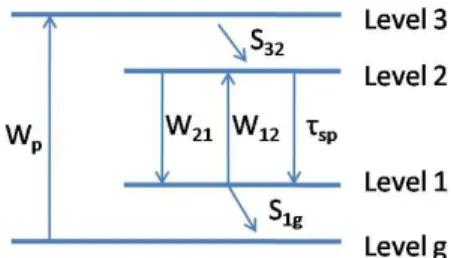
16. (30 分)典型的四能级激光系统如图 1 所示,其中 Wp为泵浦速率,S32和 S1g为无辐射 跃迁速率,W21为受激辐射速率,W12为受激吸收速率(W12=W21),τsp为自发辐射寿命。基 态的粒子密度为 Ng,光子在腔内的寿命为τp,光子在介质中的速度为 vg,光子能量为 hν0。
图 1. 四能级激光系统
(1)(15 分)分别写出四个能级的粒子密度 N3, N2, N1和光子数密度 S 的速率方程。
第 3 页 共 5 页
(2)(15 分)给出介质受激辐射速率 W21与受激发射截面σ 和光子数密度 S 之间的关系。
由于自发辐射,介质的增益曲线发生加宽,给出增益曲线的半高宽 Δν。增益曲线峰值位于
频率ν0,其小信号增益为 g00,增益饱和光强为 Is0,在频率为ν1的位置入射光强为 I1。利用
以上参数求解介质在ν1处的饱和增益。
一、Blanks Filling(40 分)
1. (2 points)The word Laser is an acronym for_____________________________________.
2. (6 points)The three basic elements for constructing a laser are __________、__________、
__________.
3. (4 points)There are several loss mechanisms for a passive resonator, including _________、
_________、_________、and _________.
4. (4 points)The lineshape function of a homogeneous broadening gain medium is _______, and the corresponding two physical mechanisms are ________ and ________.
5. (4 points)In a laser, the longitudinal modes indicate ___________________________. In order to select a single longitudinal mode, two methods are ____________ and _____________.
6. (6 points) If the spectral linewidth of a single longitudinal mode laser is 3.0 MHz, the coherent length of this laser is ____ m. If the lasing wavelength of this laser is 1.5 μm, and the diameter of the cavity mirror is 1 mm, then the minimum beam divergence angle is _____ rad. At this diffractive angle, if the laser power is 1W, the brightness of the laser is _____ W/(cm2.Sr).
7. (4 points)Assuming the gain medium is lossless, in order to obtain a transparent gain medium (neither absorbing light nor amplifying light), the small signal gain coefficient is ______ /cm;
When inserting the medium into a resonator to form a laser, assuming the loss coefficient of the resonator is 10/cm, to realize the laser oscillation, the minimum gain of the pump should be ______ /cm.
8. (2 points)Assuming there are two broadening mechanisms in a gain medium, the induced broadening linewidth are 10MHz and 30MHz, respectively. If both are homogeneous broadening, the total linewidth is_______ MHz.
9. (4 points)Assuming the lasing wavelength is 1 μm, and the beam waist of a Gaussian beam is 1mm, then the confocal parameter f is __________ cm, the q parameter at the beam waist is __________.
第 4 页 共 5 页 10. (4 points)A Nd:YAG laser has a 10 cm long cavity, 3 cm long gain medium and 100GHz full width at half maximum (FWHM). If the mode locking is used to generate laser pulses, then the pulse duration is ______ps, and the pulse interval is ______ns.
二、Short-answer Questions(40 points)
11. (15 points)Please describe the longitudinal modes competition phenomenon in a homogeneous broadening laser, and explain the physical mechanism for multi-longitudinal mode oscillations.
12. (10 points)Please describe the difference between a three-level laser system and a four-level laser system; explain why the four-level system has lower threshold pumping rate than the three-level system; list some examples of a three-level system based laser and a four-level system based laser.
13. (15 points)Please explain what is the fundamental Gaussian mode and describe its transmission properties in free space.
三、Calculations(70 points)
14. (20 points)The length of a passive Fabry-Perot resonator is L=10 cm, the reflectivity of the two mirrors are R1=100% and R2=90% respectively, the average loss coefficient of the cavity is ɑi=5/cm, and the refractive index of the cavity is nr=3.0.
(1) (10 points)If the laser frequency is ν=100 THz, please calculate the quality factor Q of the cavity.
(2) (10 points)Please calculate the wavelengths of the longitudinal modes and the frequency interval of the modes.
15. (20 points)The length of a Fabry-Perot resonator is L, the reflectivity of the two mirrors are R1 and R2, respectively. One lens with a focus length f is inserted at the center of the cavity.
(1) (10 points)Please calculate the ABCD transfer matrix for a single trip light travel.
(2) (10 points)Considering a fundamental Gaussian mode inside the cavity, please calculate the beam size at the cavity mirror and at the lens, respectively.
16. (30 points)The typical four-lever laser system is shown in the Figure 1, where Wp is the pumping rate, S32 and S1g are the nonradiative transition rates, W21 is the stimulated transition rate, W12 is the stimulated emission rate (W12=W21), τsp is the spontaneous emission lifetime.
第 5 页 共 5 页 Assume the population in the ground level is Ng and the lifetime of photo is τp, the speed of light inside the medium is vg, and the photo energy is hν0.
Fig. 1. Schematic of a four-level laser system.
(1) (15 points)Please write the rate equations for the population N3, N2, N1 of the four levels, and for the photo density S, respectively.
(2) (15 points)Please give the expression of the stimulated emission rate W21, as a function of the stimulated emission cross section σ and the photo density S. Due to the spontaneous emission, the gain spectrum will be broadened, please write the full width of half maximum linewidth of the gain spectrum. The peak of the gain spectrum locates at frequency ν0, and its small signal gain is g00, the gain saturated intensity is Is0. If the incident light intensity at frequency ν1 is I1, please calculate the saturated gain at ν1.