• 沒有找到結果。

CHAPTER V. CONCLUSIONS AND RECOMMENDATIONS

N/A
N/A
Protected

Academic year: 2021

Share "CHAPTER V. CONCLUSIONS AND RECOMMENDATIONS "

Copied!
18
0
0

加載中.... (立即查看全文)

全文

(1)

CHAPTER V. CONCLUSIONS AND RECOMMENDATIONS

With the exploration on the competencies that are assumed to be present in strategic negotiator, this study tends to build the competency model for strategic negotiator with conclusions and recommendations derived from the findings. In this chapter, the competency model for strategic negotiator, conclusions and recommendations are presented.

Conclusions

From the perspective of the formation of “Olympic Mode” which is generally applied to the recognition of national identity of Taiwan in the international community at current stage, the confrontation and disputes of two Chinese Olympic Committees within the Olympic Movement emerged when China in Beijing argued for

its representation in the Olympic Movement. The Chinese Olympic Committee in Taiwan fought against China and the IOC to protect its membership of the Olympic Movement, and at the end, the parties concerned turned out to work out solutions through negotiation at table. In this study, the negotiation in sport and other sectors were provided to help building the competency model for strategic negotiator.

In accordance to the research purpose and based on the research findings, the competency model for strategic negotiator is described and elaborated as follows:

1. Action orientation

A. Effectively seek and consolidate the information relating to the issues in an

organized form

(2)

B. Make clear and deliverable negotiation strategy and tactics

C. Develop new insights into situation and applies practical and feasible solutions to facilitate the achievement of the goal for negotiation

2. Initiative (decisiveness, self-direction)

A. Demonstrates belief in own abilities and ideas B. Be self-motivating and result oriented

C. Recognize own strengths and weaknesses D. Make sound, well-informed decisions

E. Commit to action to accomplish organizational goals F. Perceive the impact of decisions or policies

3. Relational influence (interpersonal relationships)

A. Develop networks and partnership with others who have mutual interests or goals, and complementary skills and knowledge

B. Gain cooperation from others to obtain and share information and accomplish goals

C. Persuade others and influence outcomes

D. Develop and maintain awareness of the organizational value and external factors that affect the organization

4. Cognitive

A. Diagnose and analyze the organizational advantage and disadvantage in negotiation

B. Think proactively and apply new concepts

C. Develop technical, professional and managerial expertise in related subjects D. Recognize the leverage approaches of others and develop strategies utilizing

available leverage for negotiation

(3)

5. Flexibility and adaptability A. Remain open to change

B. Adapt behavior and work methods in response to new information, changing conditions, or unexpected challenges

C. Able to deal in crisis D. Able to take the risk

6. Communication (oral, written and listening)

A. Effectively express ideas and facts in an organized manner B. Make clear and convincing presentation

C. Give voice to ideas and thoughts with proficiency in a second language

D. Consider and respond appropriately to ideas, thoughts, and suggestions expressed by others

E. Undertake upward and downward communication to coordinate with other parts of the organization to facilitate the negotiation process and to accomplish the mission

7. Conflict management

A. Resolve conflict, confrontations, and disagreement in a positive and constructive manner

B. Strive for win-win solutions C. Work to minimize negative impact 8. Managerial skills and leadership

A. Determine objectives and strategies of negotiation B. Develop plans for implementation

C. Coordinate with other parts of the organization to accomplish goals D. Evaluate the progress and outcomes of negotiation

E. Inspire and challenge others

(4)

F. Work with others to build vision

G. Empower people by sharing information, knowledge, skills, power, and authority

9. Developing others

A. Motivate and guide others toward goal accomplishment B. Coach and mentor others

10. Team building

A. Build a workforce that is appropriately selected, utilized, appraised and developed

B. Manage group process

C. Encourage and facilitate cooperation, collaboration, pride, trust and group identity

D. Foster commitment and team spirit

E. Formulate with others for a sense of group purpose F. Observe the group code of ethics

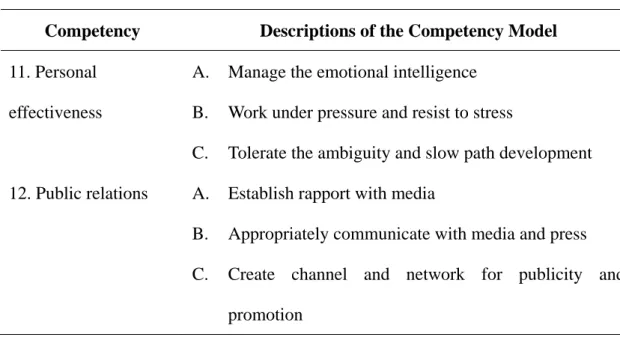
11. Personal effectiveness

A. Manage the emotional intelligence B. Work under pressure and resist to stress

C. Tolerate the ambiguity and slow path development 12. Public relations

A. Establish rapport with media

B. Appropriately communicate with media and press C. Create channel and network for publicity and promotion

The study concluded with the competency model for strategic negotiator built on

basis of the general competencies of negotiator in twelve major competencies: (1)

(5)

action orientation, enabling a negotiator to accomplish the goals and work out practical and feasible solutions; (2) initiative: the negotiator shall be self-motivated and recognize own strengths and weakness and take initiative to accomplish organizational goals; (3) relational influence: to develop networks and partnership and persuade others; (4) cognitive ability allows the negotiator to diagnose and analyze the organizational advantage and disadvantage and to develop technical, professional and managerial expertise in related subjects; (5) flexibility and adaptability enable the negotiator to remain open to change, and adapt behavior and work methods in response to the change or unexpected challenges; (6) communication sills will help the negotiator to effectively express ideas and facts in organized manner; (7) conflict management allows the negotiator to resolve conflict, confrontations and disagreement in a positive and constructive manner; (8) managerial skills and leadership help the negotiator to coordinate with others and evaluate the progress; (9) developing others can motivate and coach teammate toward goal accomplishment; (10) team building allows the negotiator to build a workforce and manage group process; (11) personal effectiveness can facilitate the undertakings of negotiation; (12) public relations can establish the rapport with media and facilitate communication with media and press.

It is suggested that the above 12 competencies drawn from the research findings may apply and refer to a competency model for strategic negotiator in sport sector that can generalize to negotiator in other sectors.

Based on the research purposes and research findings, this study may conclude that:

1. The key elements extracted from the strategy and process of the negotiation between the CTOC and IOC were found similar to the negotiation in other sectors.

The universal negotiation process consists of three stages, namely preparation,

(6)

negotiation and post-negotiation, while the strategy is adopted and delivered in accordance with the issues to be negotiated and in compliance with organizational values.

2. The competencies required for a negotiator dealing with Olympic Mode are confirmed with the competencies required for negotiation in international issues and business across borders, for example, accession to WTO, APEC or OECD, and were induced from the obtained data through interviews and the general competencies were formulated as illustrated in Table 5-1.

3. Whereas the general competencies were formulated and applied, the competency model of strategic negotiator was built on basis of research findings. Twelve major competencies of strategic negotiator were set.

4. The competency model set in previous section tends to provide a benchmarked

framework of selecting right person and training them for undertaking

negotiation whenever appropriate.

(7)

Table 5-1 Competency Model for Strategic Negotiator

Competency Descriptions of the Competency Model

1. Action orientation A. Effectively seek and consolidate the information relating to the issues in an organized form

B. Make clear and deliverable negotiation strategy and tactics

C. Develop new insights into situation and applies practical and feasible solutions to facilitate the achievement of the goal for negotiation

2. Initiative (decisiveness, self-direction)

A. Demonstrates belief in own abilities and ideas B. Be self-motivating and result oriented

C. Recognize own strengths and weaknesses D. Make sound, well-informed decisions

E. Commit to action to accomplish organizational goals F. Perceive the impact of decisions or policies

3. Relational influence (interpersonal

relationships)

A. Develop networks and partnership with others who have mutual interests or goals, and complementary skills and knowledge

B. Gain cooperation from others to obtain and share information and accomplish goals

C. Persuade others and influence outcomes

D. Develop and maintain awareness of the organizational

value and external factors that affect the organization

(8)

Table 5-1 (Continued)

Competency Descriptions of the Competency Model

4. Cognitive A. Diagnose and analyze the organizational advantage and disadvantage in negotiation

B. Think proactively and apply new concepts

C. Develop technical, professional and managerial expertise in related subjects

D. Recognize the leverage approaches of others and develop strategies utilizing available leverage for negotiation

5. Flexibility and adaptability

A. Remain open to change

B. Adapt behavior and work methods in response to new information, changing conditions, or unexpected challenges

C. Able to deal in crisis

D. Able to take the risk

(9)

Table 5-1 (Continued)

Competency Descriptions of the Competency Model

6. Communication (oral, written and listening)

A. Effectively express ideas and facts in an organized manner

B. Make clear and convincing presentation

C. Give voice to ideas and thoughts with proficiency in a second language

D. Consider and respond appropriately to ideas, thoughts, and suggestions expressed by others

E. Undertake upward and downward communication to coordinate with other parts of the organization to facilitate the negotiation process and to accomplish the mission

7. Conflict

management Conflict management

A. Resolve conflict, confrontations, and disagreement in a positive and constructive manner

B. Strive for win-win solutions

C. Work to minimize negative impact

(10)

Table 5-1 (Continued)

Competency Descriptions of the Competency Model

8. Managerial skills and leadership

A. Determine objectives and strategies of negotiation B. Develop plans for implementation

C. Coordinate with other parts of the organization to accomplish goals

D. Evaluate the progress and outcomes of negotiation E. Inspire and challenge others

F. Work with others to build vision

G. Empower people by sharing information, knowledge, skills, power, and authority

9. Developing others A. Motivate and guide others toward goal accomplishment

B. Coach and mentor others

10. Team building A. Build a workforce that is appropriately selected, utilized, appraised and developed

B. Manage group process

C. Encourage and facilitate cooperation, collaboration, pride, trust and group identity

D. Foster commitment and team spirit

E. Formulate with others for a sense of group purpose

F. Observe the group code of ethics

(11)

Table 5-1 Competency Model for Strategic Negotiator

Competency Descriptions of the Competency Model

11. Personal effectiveness

A. Manage the emotional intelligence B. Work under pressure and resist to stress

C. Tolerate the ambiguity and slow path development 12. Public relations A. Establish rapport with media

B. Appropriately communicate with media and press C. Create channel and network for publicity and

promotion

The purpose of the competency model for strategic negotiator built through this study tends to provide a benchmarked framework to select, utilize, and develop the right person for participating in negotiation in relevant cases.

In conclusion, the competency model of a strategic negotiator can ensure that the

negotiator is properly selected and to prepare with negotiation knowledge and skills

step by step and accomplish the goals. The author has attempted to figure out the major

competencies required for negotiation, thereby developing and building the

aforementioned competency model for strategic negotiator in sport sector, which may

be generalized and referred to as the criteria for selecting right person to the right

position to make the organizational goals accomplished and the agreements through

negotiation fulfilled. It is expected that the competency model illustrated in Table 5-1

will be generalized as good model of practice for selecting, training and fostering a

strategically competent negotiator to accomplish the negotiation with success

whenever necessary.

(12)

Recommendations

The study technically tends to focus on competencies required for strategic negotiator in sport related issues, especially from the perspective of “Olympic Mode”, which has never been explored before. However, the scope of data collection was expanded by including the cases that the negotiators in international issues, such as accession to WTO, APEC or OECD dealt and experienced, as the universal rule and process apply to any negotiation in any issues or topics in business or international relations.

In consequence, the competency model for strategic negotiator concluded in previous section is highly recommended and can be served as benchmark criteria for strategically selecting, training, and developing any individual to be a negotiator. In reflections on the competencies as discussed in previous chapter, the competency model for strategic negotiator can be described and perceived in major areas listed below:

(1) action orientation: the negotiator is encouraged to take initiative and action

with self-motivation to define the problem and diagnose the focus for negotiation,

whereby to scan for potential opportunities that may break through the underlying

deadlock in negotiation, so as to create value for win-win negotiation. Thus, action

orientation is recommended for inclusion in the competencies for strategic negotiator

as it is one of the key success factors at pre-negotiation stage for a negotiator to

prepare him/herself for negotiation. Meanwhile, take initiative will facilitate and take

leading role in negotiation. The competency of action orientation enables the strategic

negotiator to act proactively and accomplish the negotiation with win-win results.

(13)

(2) relational influence: the strategy and tactics of negotiation may change along with the actual situation in the process of negotiation. In no cases, the negotiation may be completed successfully without diagnostically understanding the underlying opportunities and impacts that may be learned on basis of interpersonal understanding and partnership networking. The preparation for negotiation and the negotiation outcomes generally will be affected and influenced by means of organizational needs and values, whereas the third party involvement will facilitate the negotiation process.

To this regard, this competency is suggested to be an integral part of the criteria for strategic negotiator to foster and cultivate, and the negotiator is required to develop contact and understand the organization in order to set goal catering for the organizational needs and in accord with the organizational values.

(3) cognitive: the perceptions of cognitive are recommended for inclusion in the competencies for strategic negotiator. When undertaking negotiation, the negotiator will be required to analyze, reason and diagnose the advantages and disadvantages of negotiation. Without the capability of logical and critical thinking, the negotiator may not make the negotiation completed successfully, and without the expertise on the negotiation issue, the negotiator may fail in make favorable decision. In sense of planning, strategizing and framing the action plans and tactics, the cognitive ability is recommended.

(4) managerial skills and leadership: the negotiation normally is regarded as a

competency of management, especially when the negotiation involves a group of

people of different background and diversified expertise to work together. Within the

context, the competency of building workforce and develop other people, so as to build

vision toward a successful negotiation is important. In addition, the coordination

(14)

ability and evaluation of progress and performance play important part of the process of negotiation. It is therefore recommended to include this competency for strategic negotiator.

(5) personal effectiveness: negotiation is a way of communications. To facilitate the negotiation, especially the negotiation at international level, the written, oral and listening communication abilities with excellent language proficiency are the must for negotiator in order to obtain necessary information and clearly express ideas and facts in an organized manner on the one hand, while on the other hand, the negotiator must be flexible to meet any change, enabling him or her deal in crisis and take the risk, thereby adapt him/ herself into the situation.

(6) public relations: the public relations nowadays become a significant influential factor that may severely impact the negotiation. In terms of avoiding any disclosure of any immature outcomes, disturbance and interference in the process of negotiation, the negotiator is recommended to establish rapport with media and communicate with media and press from time to time to feed the media with the information not harmful to the negotiation in process. To operate publicity and propaganda effectively, and keep the negotiation in pace, it is important that the negotiator shall foster him/herself with such competency.

Based on these competencies identified, some of the competencies consist of

similar components. Nevertheless, the competency model attempts to provide a holistic

and general model for strategic negotiator, even though the findings appear to cover

the competencies required at pre-negotiation stage. It is possible to use this model

serving as benchmark criteria for selecting right persons and for training and fostering

(15)

the strategic negotiator.

Actually this study is comprised of several main issues, namely (1) the negotiation including its preparation, process, strategy and tactics, as well as the competencies that may involve the cultural influence, social values and probably the organizational commitments; (2) the evolution of Olympic Mode and its impact, which can be explored as an individual research topic; (3) the role of negotiator in negotiation.

Within the context of the study, the negotiation has been explored to some extent with the competencies required for undertaking the negotiation on a specific issue when confrontation, controversy or conflict occurs. Notwithstanding the negotiation has been explored from the stages of preparation through to the negotiation process, where the post-negotiation, i.e., the implementation and evaluation of the agreement that may cause to the recurrence of negotiation were not actually explored in this study. Thus, the post-negotiation aftermath and its effect may become a research topic and further study can be conducted if anyone would like to know profoundly in this issue.

Although the study concludes with the research findings generating the competencies that are assumed to be present in a negotiator and build the competency model of a strategic negotiator, there is a vast space for modifying this model along with the changing conditions and external factors. To this extent, it is suggested that further study shall be encouraged and undertaken, as the information on the competencies required for a negotiator is very limited.

Furthermore, the study explored the competency model from the perspective of

the Olympic Mode that helps review the historical evolution of the Olympic Mode and

reveal the generic background of negotiation toward the very outcome, which may not

(16)

be satisfactory but be acceptable with a view of protecting the right of competing in the international sport arena by Taiwan athletes. With close and thorough review on the Olympic Mode and its impact, it is suggested that further study should be encouraged, as it is not only a mode at current stage limited to the sport sector, but is little by little adopted and applied by the international organizations other than the Olympic Movement as well.

Moreover, the research on the Olympic Mode may also be of interest for further study due to its uniqueness and strong effect on the national identity and representation of Taiwan in the international community, which is a critical issue that reflects the critical situation of Taiwan not only in sport community but also in other corner of the international community. Therefore, the following areas of research interests are suggested:

1. Since the Olympic Mode is now a generally known and accepted protocol for the representation of Taiwan sport teams in international community, and in some cases, has been applied to other sectors, the research on the application of Olympic Mode and its impact in political sector, for example, the national identity and representation in international organizations may be encouraged.

2. The aftermath of Olympic Mode may be of interest to certain researchers,

who are not satisfactory with the implementation of Olympic Mode and

would like to find the alternatives of positioning the national identity and

representation of Taiwan in the international community. In such cases,

the further study on how the Olympic Mode is evolved and formed will be

helpful in formulating new version of the Olympic Mode and figuring out

(17)

some favorable alternatives that may be acceptable to the majority of the general public in Taiwan.

3. The impact of Olympic Mode may also be explored in its political, social and socio-economic values, particularly the sport development and promotion, the international sport exchange program, as well as sport marketing.

Under such circumstances, it is expected that more researchers will contribute to

the research on these topics or issues to explore further and examine the findings with

more concrete and extensive information.

(18)

數據

Table 5-1 Competency Model for Strategic Negotiator

參考文獻

相關文件

(2) The employer who shall meet the professional and technical work regulations for each business or sector (e.g.: the employer of cultural, sports and recreational services

(2) The employer who shall meet the professional and technical work regulations for each business or sector (e.g.: the employer of cultural, sports and recreational services

Let f being a Morse function on a smooth compact manifold M (In his paper, the result can be generalized to non-compact cases in certain ways, but we assume the compactness

The Task Force fully recognises students’ diverse learning and development needs across different key stages and domains, and hence the recommendations need to be considered in

To stimulate creativity, smart learning, critical thinking and logical reasoning in students, drama and arts play a pivotal role in the..

reading and creating multimodal texts, promoting Reading across the Curriculum (RaC) and developing students’ self-directed learning capabilities... “Work as a team to identify the

 Promote project learning, mathematical modeling, and problem-based learning to strengthen the ability to integrate and apply knowledge and skills, and make. calculated

(b) reviewing the positioning of VPET in the higher education system in Hong Kong, exploring the merits of developing professional vocational qualifications at the degree