Chapter 4
The Functions of the Response Token O
4.0 Introduction
In the previous chapter, we have discussed the discourse functions of shi-o. It is a newsmarker, which is responded to news. As a continuing study, we examine a similar RT, o, based upon the same framework. Since the present thesis focuses on response tokens, we only include the tokens of o which occur in the speaker’s response answering the preceding turn. The non-RT o used mainly by the speaker to propose an informing such as wo kaosu ni o “You know, I want to tell you something,” is not taken into account. It may be related to the topic of talk in the previous turns, but it is not the concurring turn used to reply to the previous turn.
Such a type of o is not included in our study. Besides, the pitch of o in our data is not discussed since all the occurrences of o are drawn from MSN conversations.
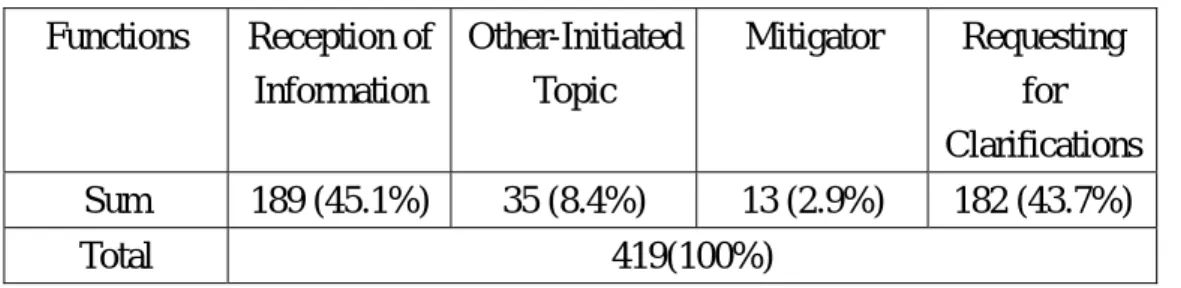
A total of 993 occurrences of o are found in the databank, which display a higher frequency than shi-o does (330 tokens). They can be classified into two main categories, initial response token o (IRT: 574 tokens) and final response token o (FRT:
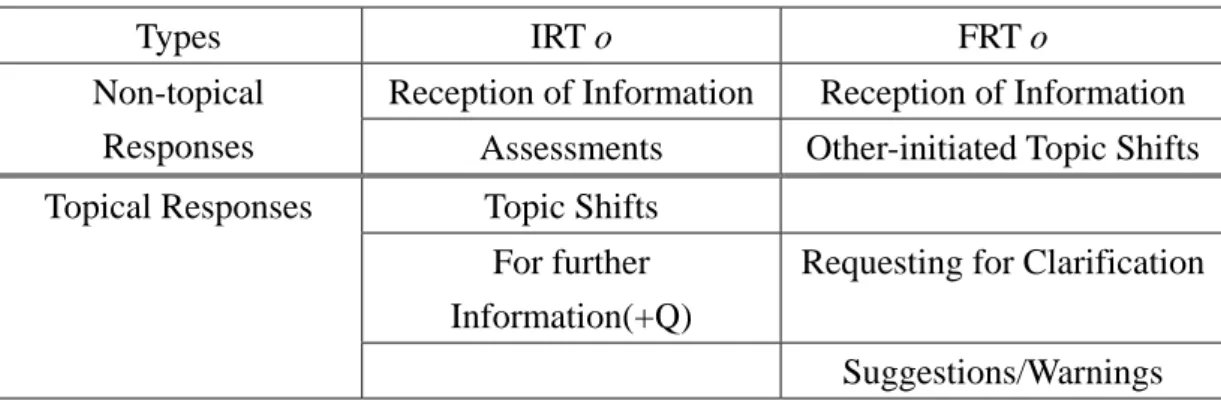
419 tokens). The former includes those that are not attached to an utterance but occur initially within a turn constructional unit, while the latter indicate those which are attached to a head utterance. Among the 993 tokens of o (IRT+FRT), over half of o tokens are IRT o (574/993=57.8%). Based on the initial observation, we will tap into the discourse functions of IRT o in detail in section 4.1 first and then further explore the functions of FRT o in section 4.2. Section 4.3 summarizes the findings and discusses the similarities and differences of IRT o and FRT o.
4.1. Discourse Functions of Initial RT O
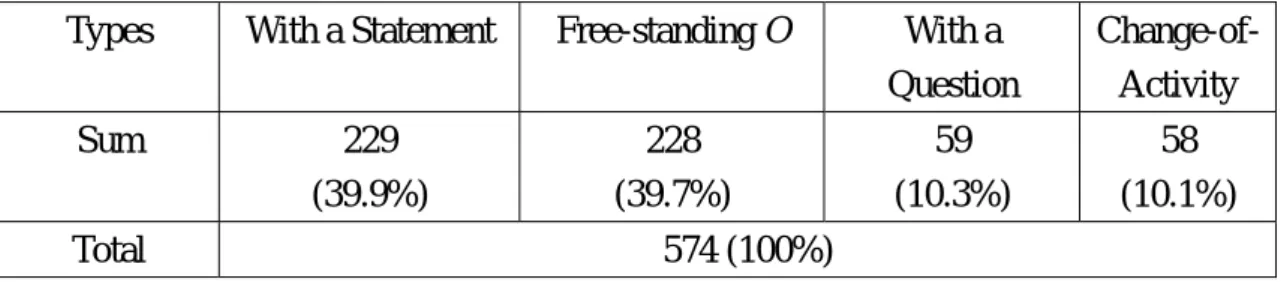
Based on the framework we use in analyzing shi-o, IRT o can be classified into four types as follows, as illustrated in Table 4.
Table 4. Types of IRT O in MSN Talk
I will examine the functions of IRT o in different conversational contexts. O aligned with brief talk will be discussed in section 4.1.1 first. It will be analyzed by looking at its surrounding environment, especially the brief responses that follow.
The brief responses include short responsive talk, assessments, and repetitions which do not add much substantially referential meaning to the proposition in the prior turn (cf. Gardner 2001:102). Section 4.1.2 concentrates on the function of free-standing o. In section 4.1.3 and section 4.1.4, we discuss how IRT o behaves when it is
followed by a question and a newly introduced topic by the same speaker. A summary is presented in section 4.1.5
4.1.1 With a Statement
As shown in Table 4, 229 (229/574=39.9%) occurrences of o are used with a statement. Furthermore, such a statement is exclusively a brief talk. Take (4.1) as an example.
(4.1) MN1: liaotian shi yao zeme kai 聊天 室 要 怎麼 開 Chat room want how activate ‘How do you activate a chatroom talk?’
MN2: nimen dou hao lihai 你們 都 好 厲害
Types With a Statement Free-standing O With a Question
Change-of- Activity Sum 229
(39.9%)
228 (39.7%)
59 (10.3%)
58 (10.1%)
Total 574 (100%)
2PL all very great
‘You are all so great.’
MN3: wo zhi hui dan da 我 只 會 單 打 1SG only can single type
‘I can only use two-way chatroom.’
GG1: :|
GG2: jiu an zuo shang jiao de yaoqing 就 按 左 上 角 的 邀請 just click left above corner GEN invitation
‘Just click on the button “invitation” on the left side above,’
GG3: jiu keyi 就 可以 just can
‘and it will work.’
MN4: zhijie an zuqun ma 直接 按 族群 ㄇ[嗎]
direct click group PAR
‘Just click on the button “group members”?’
GG4: fanzheng ni an xuanze ni yao yaoqing de 反正 你 按.. 選擇 你 要 邀請 的 anyway 2SG click choose 2SG want invite NOM
‘Anyway, you just click on..click on (the name of person) you want to invite.’
ÆMN5: o liaojie
喔瞭解
RT understand ‘Oh, I see.’
(the end of the current topic)
Questions are linguistic means employed to request for information and actions and
thus they are enacted to ‘fulfill an expectation’ (Schiffrin 1987:104). In other words,
when a chatter proposes a question, his/her uninformed state is assumed and the
respondent is assumed to have the ability and the responsibility to answer the question
(Heritage 1984). As shown in (4.1), MN uses a WH-question to target the
information gap that needs to be filled in to complete this unfinished proposition in
MN1 (cf. Schiffrin 1987:104). MN does not know how to use MSN chatroom system and GG in GG2 and GG3 gives her the directions. Finally in MN5, by producing o, MN shows that she has received all the information which she needs with o and an immediately following brief talk, liaojie “I got it.” That is, the brief statement after o in MN5 depicts the chatter’s current knowledge state and the topic is usually terminated at this point. Thus, this structure, o-plus-brief talk is regularly topic-curtailing in essence, as found in Heritage’s (1984) analysis on English oh. O together with a brief statement commonly occurs at the end of ‘complete’ informing since the chatter does not project o until he/she completely understands.
As argued by Heritage (1984:310), English oh involves the transmission of information from an informed to an uninformed party. Similarly, Mandarin o typically functions as an information receipt to mark the receipt of the prior information and display a speaker’s understanding (cf. Chao 1968: 405). Besides, it is interesting to note that IRT o usually occurs in a Q-A sequence (319/574=55.6%).
O is usually employed to signal the successful transmission of information requested
by the inquirer.
Since o marks the chatter’s change of information state, it is also used to display recognition of a certain piece of information (Schiffrin 1987:91). The information might be known to the speaker formerly but does not exist in the speaker’s current knowledge state. In this case, o is used to show the recalling of a familiar piece of information, as illustrated in example (4.2).
(4.2) (SA and GG are expressing that they hate to go to work on a rainy day since they may get wet when they ride a motorcycle.)
SA4: mei banfa weile wu dou mi haishi dei zheyao
沒 辦法..為了 五 斗 米 還是 得 折腰
NEG way for five PL rice still need bend
‘I can do nothing about it but to work hard for money.’
GG3: mei cuo 沒 錯 NEG wrong
‘That’s right.’
GG4: you leng yu you da 又 冷.. 雨 又 大 too cold rain too big
‘It’s cold and raining a lot.’
SA5: ni de jiajiao ye zai shi zhengfu fujin a 你 的 家教 也 在 市 政府 附近 啊..
2SG GEN tutor too at city government near PAR
‘You tutoring job is also near the (Taipei) City Hall?’
GG5: jinghuacheng a jiu jingguo songshan gaozhong 精[京]華成[城] 阿.. 就 經過 松山 高中
Jinghuacheng PAR just pass Songshan senior-high-school guoqu jiu dao le
過去 就 到 了 pass just reach PFV
‘Don’t you remember that it is near (the Department Store) Jinghuacheng.
After passing Songshan Senior High School, you reach the place where I work.’
ÆSA6: o wo xiang qilai le
喔...我 想 起來 了..
RT 1SG think up CRS
‘Oh, I remember it.’
(the end of the current topic)
As exemplified in example (4.2), SA forgets where GG tutors her student although they discussed this topic before. In GG5, GG introduces several famous buildings, such as a department store and a senior high school, to evoke SA’s memory.
When SA suddenly recalls where it is, o is used to mark his recognition explicitly with a short statement to display his sudden recognition and that he is informed now.
Since SA can identify where GG works, GG does not continue to elaborate it. It can
be further noted that shi-o is inappropriate in this context in that what is informed is a
known piece of information, whereas shi-o commonly occurs after a new and unexpected piece of informing.
Based upon the fact that o indicates a chatter’s recognition of familiar information, we may expect o to be used not to signal chatter’s surprise in some contexts. Observe the example (4.3) and (4.4) respectively.
(4.3) (Both CW and FQ want to purchase a mirror from the Internet. CW introduces a website to FQ showing that a variety of goods are sold and that she wants to do the on-line shopping.)
CW2: wo hui mai ze ge 我 會 買 這 個 1SG will buy this CL
‘I’ll buy this one.’
ÆFQ1: o o ni gei wo kan guo
喔喔,你 給 我 砍[看] 過 RT 2SG give 1SG see ASP
‘Oh, you showed me (this website) before.’
CW3: dui ya 對 呀 yes PAR ‘Right.’
CW4: wo men na shi mai erjiujiu zhile de ba 我 們 那 時 買 299 之類 的 吧 1SG PL that moment buy 299 something ASSOC PAR
‘(I guess) that we spent 299 buying (a mirror) at that time.’
FQ2: en en 嗯 嗯 RT RT
‘Mm mm.’
(FQ then describes the type of mirror that she wants to purchase and this is not sold in the website that CW introduces.)
(4.4) BM1: Jade shuo ta danjiang yinggai keyi shang ye Jade 說 他 淡江 應該 可以 上 耶 Jade say 3SG Danjiang should can enter PAR
‘Jade said that she may be admitted to Tamkang (University).’
BM2: shuo fuda you dian pin 說 輔大 有 點 拼 say Furen-university have a little difficult
‘She said that it may be a little difficult for her to be admitted to Furen University.’
ÆCW1: o na hen hao ya
喔.. 那 很 好 呀 RT that very good PAR
‘Oh, very good.’
CW2: ^^
BM3: en a 恩 阿 RT PAR ‘Mm hum.’
BM4: wo shuo danjiang na fangzi hao pianyi 我 說 淡江 那 房子 好 便宜 1SG say Danjiang that house very cheap
‘I said that (the rent) of the houses near Tamkang University is low.’
BM5: ta shuo yao ban chuqu zhu 他 說 要 搬 出去 駐[住]
3SG say want move out live
‘She said that she will move out and (won’t live in the dorm at school).’
CW3: dui 對...
RT
‘Yeah,’
CW4: hen pianyi 很 便宜 very cheap
‘Very cheap.’
(the end of the topic)
As exemplified in example (4.3), CW shows a website to FQ and in CW2 tells her
which mirror she would like to purchase. However, after receiving the informing,
FQ produces o first, and then tells CW that the website was shown to her before.
Since this is also a familiar piece of action, FQ opts for o to indicate her receipt of it and does not imply tone of surprise. FQ continues to talk about the type of mirror that she herself wants to purchase and ignores what mirror CW wants to buy. This implies that FQ does not show much interest in the informing that CW proffers.
Regarding example (4.4), BM makes a news announcement in BM1 and BM2.
CW responds to this piece of news by the production of o followed by an assessment.
Although the assessment is positive, CW does not participate actively in the development of this topic but responds briefly and passively. Besides, the topic is curtailed soon after a few turns. It seems that BM has sensed CW’s detachment and thus does not develop the topic further. Therefore, o does not only serve as an information receipt but also frequently marks the speaker’s detachment.
A special use of o is found where it prefaces a repair completion (cf. Schiffrin 1987). Sometimes, a repairable item may arise during the conversation due to the speaker’s misunderstanding, as shown in the following example.
(4.5) (JM tells BD that he has a girlfriend who works in Taipei. However, he complains that his girlfriend seems to be unusually busy because she has not contacted him recently.)
BD23: keshi zai mei kong ye yigai you kong gen ni he 可是 再 沒 空 也 應該 有 空 跟 你 喝 but again NEG free too should have free with 2SG have bei kafai ba
杯 咖啡 吧 CL coffe PAR
‘But no matter how busy she is, she should have had time to have a cup of coffee with you.’
JM21: wo xianzai bu zai taibei 我 現在 不 在 台北 1SG now NEG in Taipei
‘I am not in Taipei now.’
JM22: zai longtan 在龍潭 in Longtan
‘I am at Longtan now.’
BD24: a 啊??
PAR
‘What?’
ÆBD25: o
喔∼ RT ‘Oh,’
BD26: yuanlai ni pao qu longtan la 原來 你 跑 去 龍潭 啦 turn-out 2SG run go Longtan PAR
‘You have gone to Longtan, haven’t you?’
JM24: shi a wo men yao gen zhe gong di pao 是阿,我 們 要 跟 著 工 地 跑 RT 1SG PL need follow DIR construction site run
‘Yeah, we got to move around with the team of the construction company.’
(Topic shift here)
In BD23, BD considers that there is something wrong with JM’s relationship with his girlfriend. BD says that no matter how busy JM’s girlfriend is, she at least should have had time to have a cup of coffee with JM since both of them work in Taipei.
However, this causes a repairable item for JM to revise in that JM is not in Taipei now but at another city. This is contrastive with BD’s assumption. At first, BD appears to be confused by uttering a plus question marks because she assumed that JM worked in Taipei. Then, BD produces o in BD25 and an additional short statement in the immediate following turn to repair her own misunderstanding. This evidences that o is used to signal BD’s sudden realization, and the symbol ‘~’
1seems to signal
1
The punctuation marks such as ‘~’ and dots have not been conventionalized by MSN users. Some
MSN users may use them to mark lengthening but not every chatter uses them.
her change of knowledge state. Besides, additional completion is provided by JM in JM24 to reconfirm the replacement and explain why he is at another city, Longtan.
In addition to a repair that designate acceptance of information, it is common to find an approbation item after o, as seen in example (4.6).
(4.6) (The chatters are discussing how to play on-line poker and they are testing the system.)
WL1: ei wo aixin qi zhang danshi yi dian ㄟ 我 愛心 7 張 但是 1 點 1SG heart seven CL but one point
‘Hey, I have seven hearts, but only one point.’
WL2: ni xing ma 妳[你] 行 嗎 2SG okay PAR
‘Can you follow me?’
CB1: deng yi xia 等 一 下 wait one CL
‘Wait.’
CB2: wo yao jieshu 我 要 結束 1SG want end
‘I want to end the game.’
CB3: wo xiangyao shi kan kan bie de 我 想要 試 看 看 別 的 1SG want try see see another NOM
‘I want to try another (table).’
ÆWL3: o hao
喔好 RT RT
‘Oh, ok.’
(the end of the topic)
Example (4.6) shows that CB and WL are playing an on-line poker and they need to
make sure whether both parties can activate an on-line poker table to play with other
anonymous people on-line. Thus, WL asks CB whether his system is viable in WL2.
However, it seems that there is something wrong and CB tells WL in CB3 that he wants to try another table. WL shows his reception of information by producing o which is immediately followed by hao serving as an agreement/acceptance marker (Wang 2005:78). Hao again does not contribute much new information to the prior talk. And the poker talk is terminated at this point.
So far, we have explored the functions of IRT o with a variety of brief responses.
O regularly emerges after an answer solicited from a question and precedes brief
statement to mark the chatter’s change of knowledge state and current informed state.
Basically, o marks the receipt of the information and is followed by statements without rich referential meaning. The following statements regularly express the speaker’s assessment on the prior informing or report the speaker’s currently informed knowledge state, such as liaojie ‘I understand,’ hao ‘okay,’ or statement signaling that the information was formerly known to the current chatter. In particular, o often occurs with brief talk after familiar information and this discourse structure marks the chatter’s detachment in that the brief talk usually suggests that the speaker has no intention to continue the current topic. Accordingly, the conversation topic is always terminated immediately or soon after o-utterance is made. Such a tone of low involvement and interest is even more prominent with the use of free-standing o, as we will discuss below.
4.1.2 Free-standing O
Free-standing o accounts for second highest occurrence of all the tokens, about
39.7% (228/569). As discussed above, o signifies that the speaker goes through a
change of knowledge state. The brief response after o regularly depicts the chatter’s
current cognitive state or a brief subjective evaluation. In the following, we will
show that even though no other brief responses follow o, the interlocutor still knows that the chatter uttering o is now in an informed state. (4.7) is an example:
(4.7) MB1: ni yuanchuan dianhua ji hao ya 你遠傳電話幾號呀?
‘What is your cell phone number?’
AL1: XXXXXXXXXX(cell phone number) ÆMB2: o
哦
‘Oh.’
(…the end of the current topic)
As shown in (4.7), MB proposes a wh-question to request AL to give him the cell phone number. After receipt of the information, only a free-standing o in MB2 is used to indicate that MB’s information gap has been filled. Since MB does not inquire further but only uses o in his response, we can infer that he has already obtained the telephone number he wants. This is supported by previous researches on Mandarin o which can signal understanding (C. Wang 1984; L. Wang 1987; Chao 1994). Furthermore, since the answerer does not further the talk in the subsequent turn after o, we can say that a free-standing o is also topic-curtailing, as does o-plus-statement.
As noted in the discussion of (4.5), o is regularly used to show the speaker’s repair of his/her misunderstanding. A free-standing o can also mark that the chatter accepts the counterinforming as correction. As illustrated in (4.8), FQ does not know that there is an information gap existing in her own knowledge state about time of eating until CW tells her that she will eat MOS fast food tomorrow:
(4.8) (A sudden message shows on the FQ’s screen when she is surfing the net.) CW1: wo yao chi mosi
我 要 吃 磨斯 (MOS fast food restaurant)
1SG want eat MOS
‘I want to go to MOS restaurant to eat.’
FQ1: zeme turan 這麼 突然 so sudden
‘How immediate .’
FQ2: zaijian 再見 goodbye
‘See you.’
CW2: tumaluo
orz
2土罵羅(tomorrow) tomorrow
‘(I mean I will eat MOS fast food) tomorrow.’
ÆFQ3: o
喔~ RT ‘Oh.’
(The end of the current topic.)
The message that CW wants to eat at MOS restaurant suddenly pops up on FQ’s screen. Because of the lack of specific time annotated in CW1, FQ thinks CW is going to have a meal at MOS fast food restaurant right away and says goodbye to her.
After the repair by CW to clarify that CW will go to MOS restaurant tomorrow (CW2), o in FQ3 is used to indicate FQ’s repair of knowledge state and her acceptance of CW’s revision.
Similarly, with the use of free-standing o, the speaker can express that he/she accepts another speaker’s position after a series of contrastive arguments.
(4.9) (WL feels bored and wants to invite CB to watch a baseball game. However, the only tickets sold now are for the team which they do not support, so CB does not want to watch the game.)
2