Research Express@NCKU - Articles Digest
Research Express@NCKU Volume 15 Issue 8 - October 22, 2010 [ http://research.ncku.edu.tw/re/articles/e/20101022/4.html ]
Advanced study of plasmonic photonics
Kuan-Ren Chen
1,2,*, Jian-Shiung Hong
2, Anatoliy V. Goncharenko
11Department of Physics, National Cheng Kung University
2Institute of Electro-Optical Science and Engineering, National Cheng Kung University [email protected]
NCKU Landmark Project《R029》
F
ree electrons on the surface of metal can efficiently interact with the external electromagnetic fields when the structure dimension is minified to nanoscale , and this interaction can result in the optical meta-characteristics of the medium which may be completely different from those of the bulk medium. Based on these characteristics, our study is to investigate the influence of coupled surface plasmons to the electromagnetic wave using specifically designed subwavelength structures and its physical insight, and to discuss the possibility of break-through applications. Below, we briefly describe ourresearch achievement on plasmonic focusing lens under the invitation of “Headquarters of University Advancement, NCKU”.
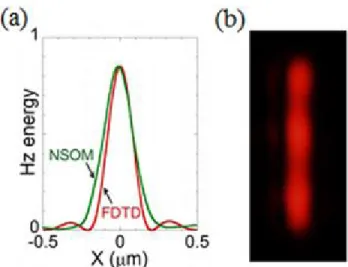
Fig. 1 (a) The profiles of the NSOM measurement (green) and the peak focused magnetic field energy (red) from the simulation along the metal surface (peak value of NSOM measurement has been normalized to the one of magnetic energy) (b) The picture taken by the OM measurement.
We show that light can be focused beyond the conventional diffraction limit value of half the wavelength in the intermediate zone with the use of a plasmonic focusing lens consisting of a metallic film with a double-slit and a patterned exit structure. The simulation results have been verified experimentally with near-field scanning optical microscope (NSOM) and optical microscope (OM) (Fig. 1) [1]. The focal point of the focused light is in the intermediate zone with the capability of propagation to the far zone (Fig.
2). This is much different from the work of Pendry, et al., who dealt with the evanescent near-field that cannot propagate (this takes place in the so-called super lens) [2-7]. In microwave regime, we have also obtained similar results of the focused electromagnetic wave beyond the conventional diffraction limit value of half the wavelength. The evanescent waves are negligible at these frequencies. Thus, we can also exclude their effect in optical regime. The designed
subwavelength plasmonic lens is expected to be applied to photolithography processing of semiconductors, image sensors, high-resolution imaging systems, and optical storage of high-density information beyond the conventional diffraction limit.
1 of 2
Research Express@NCKU - Articles Digest
Fig. 2 The snapshot of the simulated magnetic field
On the foundation of fundamental scientific research, we have also provided novel physical mechanisms of the optical meta-characteristics of coupled surface plasmons with the electromagnetic waves, such as enhanced transmission and evanescent near-field waves; the manipulation of light using designed subwavelength structures with involvement of surface plasmon resonances under specific purposes is expected to show great promise for applications of optical nanometer devices and improving the limitations of modern optical systems.
References:
1. K. R. Chen, et al., “Beyond-limit light focusing in the intermediate zone”, arXive:0901.1731v1 [physics.
optics]
2. J. B. Pendry, “Negative Refraction Makes a Perfect Lens”, Phys. Reve. Lett., 85, 3966 (2000).
3. N. Fang, H. Lee, C. Sun, X. Zhang, “Sub-Diffraction-Limited Optical Imaging with a Silver Superlens”, Science, 308, 534 (2005).
4. T. Taubner, D. Korobkin, Y. Urzhumov, G. Shvets, R. Hillenbrand, “Near-Field Microscopy Through a Sic Superlens”, Science, 313, 534 (2005).
5. D. O. S. Melville, R. J. Blaikie, “Super-resolution imaging through a planar silver layer”, Opt. Express, 12, 2127 (2005).
6. Z. W. Liu, H. Lee, C. Sun, X. Zhang, “Far-Field Optical Hyperlens Magnifying Sub-Diffraction- Limited Objects”, Science, 315, 1686 (2007).
7. R. Merlin, “Radiation Electromagnetic Interference: Evanescent-Field Lenses and Perfect Focusing”, Science, 317, 927 (2007).
2 of 2