Graduate Program of Teaching Chinese as a Second Language College of Liberal Arts
National Taiwan University Master Thesis
A study of psycholinguistic reality of temporal sequence in Mandarin Chinese
Chung-che Huang
Advisor: Te-hsin Liu, Ph.D.
103 9
September 2014
25
Tai (1985)
ABSTRACT
The ‘time as space’ metaphor proposed by Lakoff & Johnson (1980) has provided a great insight into the way people conceptualize the world and also has a profound impact on cognitive linguistics in academia. Based on the ‘time as space’ metaphor, researchers have long debated whether or not native Mandarin Chinese speakers conceptualize time as vertical, whilst native English speakers horizontal (Boroditsky, 2001; Chen, 2007; January & Kako, 2007; Fuhrman et al., 2011). This thesis, however, aims to identify another method of thinking about time employed by native Mandarin Chinese speakers. In chapter 2, data from ancient Chinese were collected to prove that hòu (“later” or “back”) was used to talk about time at first, and was then used to refer to space later. This suggests that hòu should be considered as ‘a product of restructuring’ rather than a ‘time as space’ metaphor. In chapter 3, by providing an overview of the three syntactic principles in Mandarin Chinese proposed by Tai (1985), it is indicated that the Principle of Temporal Sequence (PTS) and the Principle of Temporal Scope (PTSC) actually constitute the main method of thinking about time used by native Mandarin Chinese speakers, and the “time as space” metaphor is only applicable to PTSC. To prove this, two experiments were conducted in chapter 4.
Experiment 1 examined the relationship between word order and the two temporal principles, through which a positive relation was identified. This suggests that PTS and PTSC are cognitive principles indeed existing in Mandarin Chinese. Experiment 2 was designed to test whether or not the PTS exists independently of the “time as space”
metaphor. The results suggest that native Mandarin Chinese speakers refer to PTS to think of time, while English speakers space. Thus, this appears to demonstrate that native Mandarin Chinese speakers indeed conceptualize time in terms of the two temporal principles, whereas native English speakers space.
Keywords: ‘time as space’ metaphor, cognition, syntactic principles, temporal sequence, Mandarin Chinese
CONTENTS
... #
25 ... i!
... ii!
ABSTRACT ... iii!
CONTENTS ... iv!
LIST OF FIGURES ... vii!
LIST OF TABLES ... viii!
Chapter 1! ... 1!
1.1! ... 1!
1.2! ... 1!
1.3! ... 9!
1.3.1! ... 9!
1.3.2! ... 12!
1.3.3! ... 14!
Chapter 2! ... 15!
2.1! ... 15!
2.2! ... 17!
2.3! ... 22!
3.3.1! Paris & Peyraube ... 35!
3.3.2! ... 38!
3.4! ... 41!
3.5! ... 43!
Chapter 4! ... 45!
4.1! ... 46!
4.1.1! ... 50!
4.1.2! ... 50!
4.1.3! ... 51!
4.1.4! ... 51!
4.1.5! ... 51!
4.1.6! ... 51!
4.1.7! ... 54!
4.2! ... 55!
4.2.1! ... 56!
4.2.2! ... 56!
4.2.3! ... 59!
4.2.4! ... 59!
4.2.5! ... 59!
4.2.6! ... 59!
4.2.7! ... 61!
4.3! ... 62!
Chapter 5! ... 63!
5.1! ... 63!
5.2! ... 64!
5.3! ... 65!
APPENDIX 1 ... 67!
APPENDIX 2 ... 71!
REFERENCES ... 75!
LIST OF FIGURES
Figure 1.! before after (Radden, 2011:20) ... 7!
Figure 2.! (Radden, 2011: 21) ... 8!
Figure 3.! (Myers & Ko, 2010) ... 47!
Figure 4.! ... 54!
Figure 5.! ... 71!
Figure 6.! ... 71!
LIST OF TABLES
Table 1.! ... 39!
Table 2.! Myers & Ko (2010) ... 46!
Table 3.! PTS ... 52!
Table 4.! PTSC ... 52!
Table 5.! PTS & PTSC ... 53!
Table 6.! ... 60!
Table 7.! ... 60!
Table 8.! ... 72!
Table 9.! ... 73!
Table 10.! ... 74!
Chapter 1
1.1
1.2
Lakoff & Johnson (1980) (metaphor)
(time is money)
(time)
(1) You are wasting my time.
(2) This gadget will save you hours.
(3) I don’t have the time to give you.
(4) How do you spend your time these days?
(5) That flat tire cost me an hour.
(6) I have invested a lot of time in her.
(7) I don’t have enough time to spare for that.
(Lakoff & Johnson, 1980:7-8)
(object) (money)
(waste)
(save) (have) (give) (spend, cost) (invest)
(spare) (enough)
Clark (1973) (metaphoric relationship)
(when) (where)
(When did the boy jump over the
fence?) (right there)
(That time is here) (I’m looking ahead
to Christmas) (Moving Time) (b)
(Time passing is motion over landscape)
(He will have his degree in two years) (We’re coming
up on Christmas) Moving Ego
Lakoff Yu (1998:83-159)
( We’re racing against time) ( We are ahead of time )
Lakoff Moore (2004, 2006)
(Moving Ego) (Moving Time)
(Perspective-Specific)
(Perspective-Neutral)
(Sequence is Relative Position on a Path) Núñez, Motz & Teuscher (2006)
(Ego-Reference-Point)
(Wednesday follows Tuesday) (February comes before March)
(Time-Reference-Point)
(Ego) (Now)
(Boston time is three hours ahead of San
Francisco time) (It is 20 minutes ahead of 1 pm)
(Scott, 1989; Yu, 1998:83-139; Radden, 2004:228-229; ,
2007; , 2007; , 2008; & , 2010; , 2010; ,
2010; , 2010; Radden, 2011:4-8)
(Boroditsky, 2001; Fuhrman et al., 2011)
( , 2006; Chen, 2007; January & Kako, 2007; Tse & Altarriba, 2008)
( , 2011; Lai & Boroditsky, 2013)
( , 2011; Miles et al., 2011)
(1)
(2) (Time as Bounded Space)
(3) (The Duality: Mixture of Case
One and Case Two)
Yu
Yu
(2003) Yu
1 Yu
Yu
Yu
(1) (now)
(2)
(3) 1980
(4)
1
( , 1997) ( , 2008; , 2009; Ji et al.,
2009; , 2011)
(2008) Moore Núñez
(Moving Time)
(Moving Ego) (Sequence as Position on a Path)
(The Path
is in Front) (the
hardships gone through in the past 25 years) (even now) (from now on)
Radden (2004, 2011) Lakoff Yu Moore Núñez
(static vs. dynamic) (non-deictic
vs. deictic)
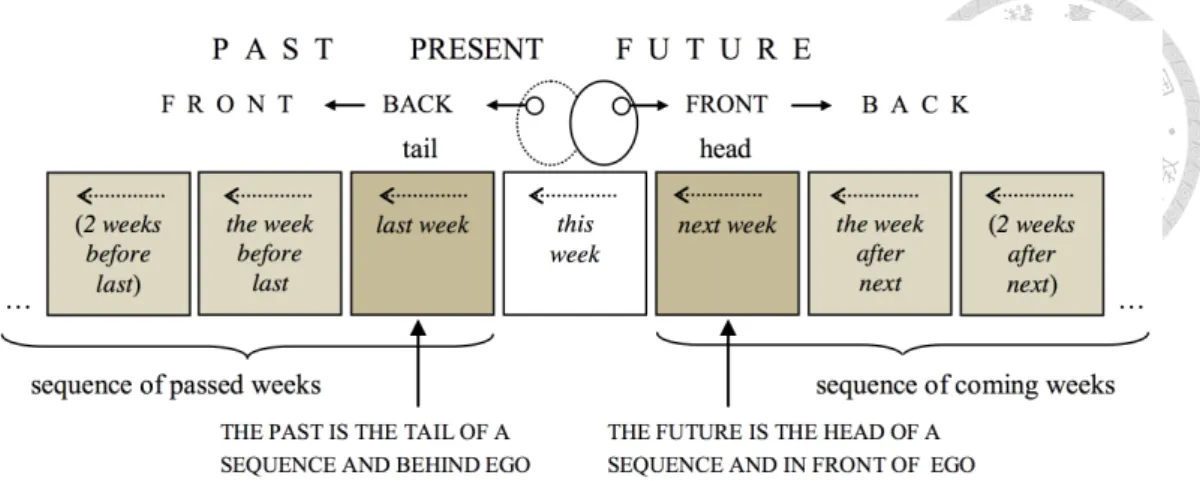
next after
last before
Figure 1. before after (Radden, 2011:20) (divided) (Ego as Reference Point)
Radden
(head)
(tail)
(Figure 2) Radden
Figure 2. (Radden, 2011: 21)
(past) (now) (future)
1.3
1.3.1
(time as space)
(8) (9)
(8) (8)
(9) (9)
(8) (9)
(10)
Lai & Boroditsky (2013:2-3) (Time Moving)
(2011:20) Núñez, Motz & Teuscher (2006)
(10)
(10)
(10)
2
(206BC 220AD)
3
( Chapter 2 )
(Tai, 1985)
( )
( 3.4 )
2 . 2006. 164-165
3 1956
1.3.2
(tense)
(tense) (aspect) (temporal sequence and scope)
( , 1988:417-420)
( , 2002)
( , 1988:420)
Tai (1985) (Principle of
Temporal Sequence, PTS) (Principle of Temporal Scope, PTSC)
Tai
Tai
2014 9 5 2:30
2014 9 ( Chapter
(2002)
(11) (12)
( , 2002:32) (11) (12)
(11) (12)
(11) (12)
(13) A:
B
B
( Chapter 4 )
1.3.3
Chapter 2
Chapter 3
Chapter 4
Chapter 2
2.1
2.2
2.1
(1600BC 1046BC)
4
Lakoff & Johnson (1980) (metonymy)
4 . 2006 164-165
(14) (15) (16) (14) (15)
(16)
(15)
(19) (17)
(18)
(19)
(19)
2.2
Lakoff
(206BC 220AD)
5
(20)
5
(21)
(22)
(20)
(21) (22)
(23)
(24)
(25)
(26)
(28)
(29)
(30)
(31)
(32)
(28) (29) (30)
(31) (28)
(33)
(34)
(35)
(36)
(37)
(38)
(39)
(33) (37) (38) (39)
(40)
Lakoff Lakoff (1987:110-112) (hon)
30 Lakoff
(a product of restructuring)
X Y X Y
2.3
2.1
2.2
Chapter 3
( Tai)
3.1
Tai (Tai,
1989; , 2003:34-37; Tai, 2005:539-552; , 2007:1-5; 2008) Tai Tai
Tai Chomsky
Tai
Tai Tai
Tai
Tai Tai
Tai Tai
Tai
Tai Tai
Tai
Tai
(Principle of Temporal Sequence) (Principle of Spatial
Scope) (Principle of Temporal Scope) (Tai, 1985, 1989; ,
2003:37-42; 2007:21-25; 2011)
Tai
c.
d.
e.
(Tai, 1985:50) (43)
(43)d
Tai (44) a.
b. * (45) a.
b. *
(Tai, 1985:51, 55) (44)
(45)
Tai (46) a.
b.
(47) a.
b.
(Tai, 1985:51, 54)
(46) (47) (46)a
(46)b
(47)
(48) a.
b.
(49) a.
b.
(Tai, 1985:51-52) (48)
(49) (49)
Tai
(Duration) (Frequency)
(Adverbial Placement)
(50) (51)
(Tai, 1985:58)
(52)
(Tai, 1985:59) (52)
(53) a.
b. * (54) a.
b.
(Tai, 1985:59-60)
(53) (54)
(53)
(54) Tai
Tai
(55) a.
b.
(Tai, 1999:99)
Tai (1999)
Tai (55) (descriptive)
(55) (55)a
(55)b
Tai (55)a
(55)b
(56) a. * b.
c.
(56) (56)a
b
b
a (56)c
b. * c.
(58) a.
b.
(Tai, 1985:53; , 2011:75)
(57) (58)
(57)
(57)a (57)c (58)
(58)a (58)b
(57)b
(59) a.
b.
(60) a.
b.
( , 2011:75-76)
(59) (59)a
(59)b (59)
(60)
(59) (60) Tai
(60)a (60)b
Tai
Tai
No. 1, Sec. 4, Roosevelt Road, Taipei Tai
Tai
(61) a.
b.
c.
(62) a.
b.
c.
(Tai, 1989:203) (61)
(62)
(63) a.
b.
(Tai, 1989:204) (63)
Tai Tai
(Metaphorical Extension)
X Y
YX (Tai, 1989:214; , 2011:79)
2014 5 29
3:23 (64) a.
b. * (65) a.
b. * (66) a.
b. * (67) a.
b.
( , 2011:79) (64) (66)
(65)
(65)b Tai (67) (67)a
(67)b Tai
(67)b
Tai
Tai
( 3.3 )
Tai
Tai
Tai Tai
3.2
Tai (2002) Newmeyer (1992, 1998)
Tai
Tai Newmeyer
(68) a. Mary bought some motor oil and went to the supermarket.
b. Mary went to the supermarket and bought some motor oil.
(69) a. Mary bought some motor oil and went to the supermarket—but not in that order.
b. Mary went to the supermarket and bought some motor oil—but not in that order.
(Newmeyer, 1992:759)
(68) Newmeyer
(conversational implicature)
but not in that
Newmeyer Tai (2002) Newmeyer
(70) a.
b.
(71) a. * b. *
(Tai, 2002:333)
Tai Newmeyer
(70)
(71)
Tai Newmeyer
Newmeyer Tai
(see also Tai, 2002:332-340) Paris & Peyraube (1993)
(72) (73)
(Tai, 2002:340)
Paris & Peyraube (72) Tai (73)
Tai (2002)
(72) (73) (Head-Final Structural Principle)
Tai
(72) (73) Tai
Tai Tai (72) (73)
*
Paris & Peyraube (1993)
(74) (75)
(Tai, 2002:341) Tai (2002) (74)
* Tai
(74) (75)
(74) (75)
(Tai, 1985:66; 2002:341-342; , 2011:75-76) Paris & Peyraube (1993)
(76) (77)
(Tai, 2002:342)
( 3.3 ) Paris & Peyraube (1993)
(78) (79)
(Tai, 2002:342-343) (78)
(79)
Tai (2002)
Tai Tai
Tai (74) (77)
3.3
(74) (77)
3.3.1 Paris & Peyraube
Tai
Paris & Peyraube Tai
(80) A:
B:
(81) A:
B:
(74) (75)
(80)
(81) (80) A B
(theme) (rheme)
(81) A B
(theme) (rheme)
Tai (1989)
(74) (75) Paris & Peyraube Tai
(82) a.
(82)a (82)b (82)
(82)a (82)b
(82)a (82)b
(83) Tai (1993; 1999:138-140)
(82)a (83)a (83)a
(83)a
(83)b
(83)a (83)
Tai (82)
(82)a (82)b
(76) (77)
(82)
3.3.2
(2011:68-69) Allen (1984) Hwang (2008)
Tai
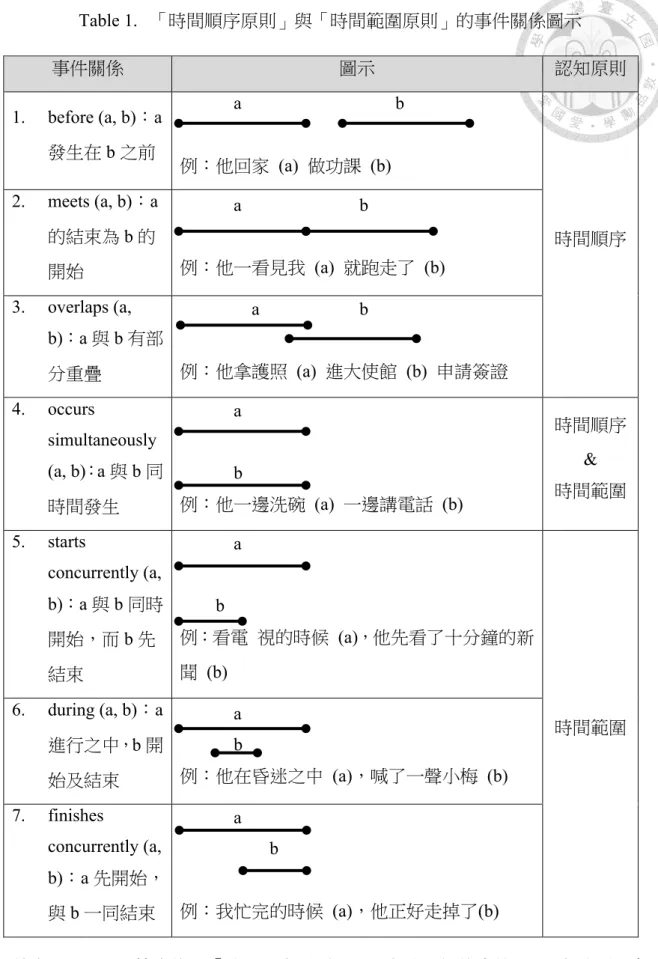
Table 1.
1. before (a, b) a b
a b
(a) (b) 2. meets (a, b) a
b
a b
(a) (b)
3. overlaps (a,
b) a b
a b
(a) (b)
4. occurs
simultaneously (a, b) a b
a
b
(a) (b)
&
5. starts
concurrently (a,
b) a b
b
a
b
(a) (b)
6. during (a, b) a b
a b
(a) (b)
7. finishes
concurrently (a, b) a
b
a b
(a) (b)
1 2 3 a b
3 a b
a b 5 6 7
a b
b
a b
4
4
(84) a.
b.
(85) a.
b.
(86) a.
b.
(85) (86) (84)
(84) a
(84)b
(84)
(84)a (84)b
3.4
(Temporal Sequence and Scope)
Tai
Tai (1989)
Tai
Tai Tai
(
Chapter 4 )
(2002)
(87)
I saw her yesterday afternoon (88)
He rang yesterday while you were out (87)
yesterday
3.5
Tai Tai
Tai Tai
3.1 Tai Tai
Tai
3.2 Newmeyer Paris & Peyraube Tai
Newmeyer
Tai Newmeyer
Newmeyer Paris
& Peyraube Tai Paris &
Peyraube
3.3
3.4
Tai
Chapter 4
Lakoff
(Boroditsky, 2001; Casasanto & Boroditsky, 2008;
Fuhrman et al., 2011)
( , 2006; Chen, 2007; January & Kako, 2007; Tse & Altarriba, 2008)
( , 2011; Lai &
Boroditsky, 2013)
( , 2011; Miles et al., 2011)
Myers & Ko (2010)
Boroditsky (2001)
4.1
Myers & Ko (2010)
Myers & Ko (2010) Tai (1985) Myers &
Ko
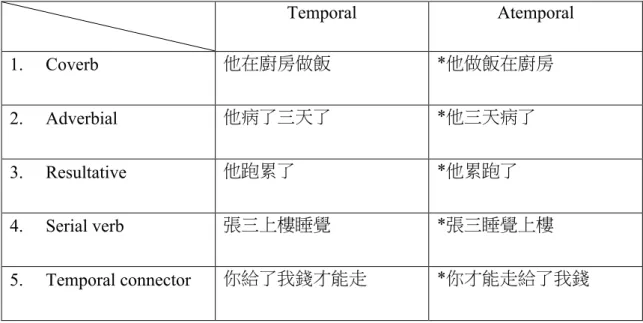
Myers & Ko 120 5 coverb
adverbial resultative serial verb temporal connector
Tai (temporal) (atemporal)
Table 2. Myers & Ko (2010)
Temporal Atemporal
1. Coverb *
2. Adverbial *
3. Resultative *
Myers & Ko 20
1 7
(serial verb)
Figure 3. (Myers & Ko, 2010)
Myers & Ko 120
30 Myers & Ko
(temporal) (atemporal)
Tai
Myers & Ko
(nonfixed) Myers & Ko 50
20
(fixed v.s. nonfixed) (temporal v.s.
atemporal)
Myers & Ko
26 Myers & Ko
Myers & Ko (2010) Tai (1985)
Myers & Ko resultative
Myers & Ko
(89) a.
b.
(89)a (89)a
resultative
Myers & Ko resultative
Myers & Ko
Myers & Ko
(association of word order and temporal order)
Myers & Ko
Myers
& Ko
Myers &
Ko
4
Myers & Ko (2010)
(PTS)
(PTSC) (PTS & PTSC)
Myers & Ko (2010)
Myers & Ko (2010)
Myers & Ko (2010)
4.1.1
*
*
4.1.2
60 30
(temporal) 30 (atemporal)
180
100
90 (30 )
2x2x2 8 10 90
10
(1) (2) (3) (4)
(5) (
APPENDIX 2)
4.1.3
68 18 27
49
4.1.4
180 (PTS, PTSC and PTS & PTSC)
(temporal and atemporal)
8 mysurvey.com
4.1.5
4.1.6
(PTS)
(PTSC) (PTS
& PTSC) (Chi-squared test)
10
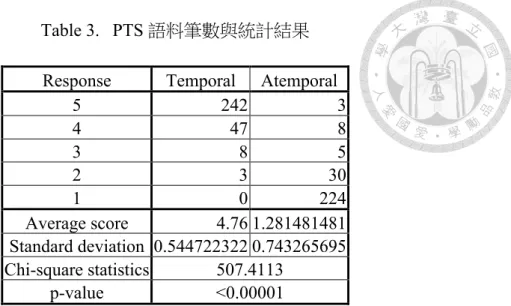
PTS Table 3
Table 3. PTS
Response Temporal Atemporal
5 242 3
4 47 8
3 8 5
2 3 30
1 0 224
Average score 4.76 1.281481481 Standard deviation 0.544722322 0.743265695 Chi-square statistics 507.4113
p-value <0.00001
PTS Temporal Atemporal
(Chi=507.411; p<.00001) PTS
PTSC Table 4
Table 4. PTSC
Response Temporal Atemporal
5 270 11
4 20 9
3 7 31
2 3 85
1 0 134
Average score 4.856666667 1.807407407 Standard deviation 0.479815554 1.03827349 Chi-square statistics 468.1798
p-value <0.00001
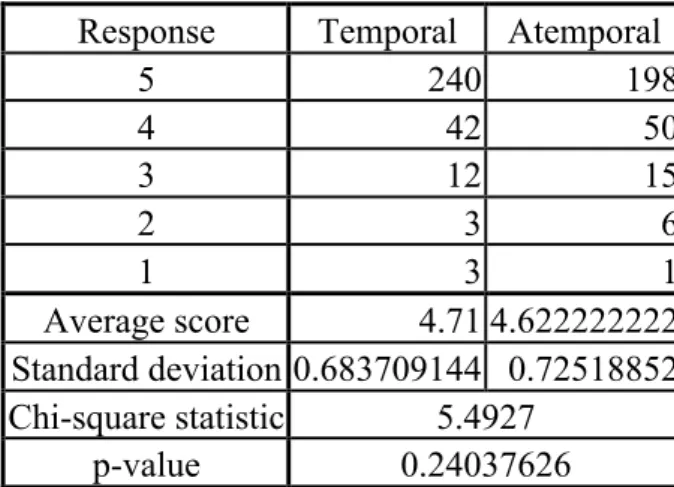
PTS & PTSC Table 5
Table 5. PTS & PTSC
Response Temporal Atemporal
5 240 198
4 42 50
3 12 15
2 3 6
1 3 1
Average score 4.71 4.622222222 Standard deviation 0.683709144 0.72518852 Chi-square statistic 5.4927
p-value 0.24037626
PTS & PTSC Temporal Atemporal
(Chi=5.492; p=.240) PTS &
PTSC
PTS PTSC
PTS & PTSC
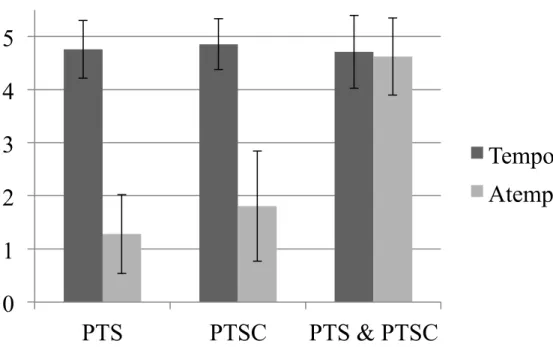
Figure 4.
Figure 4
PTS PTSC PTS & PTSC 4.7
PTS PTSC
1.8 PTS & PTSC
4.1.7
PTS PTSC
PTS & PTSC
0 1 2 3 4 5
PTS PTSC PTS & PTSC
Temporal
Atemporal
*
Newmeyer (1992, 1998) Tai
PTS PTSC PTS & PTSC
PTS PTSC
PTS & PTSC
Boroditsky (2001)
4.2
Boroditsky (2001)
( , 2006; Chen, 2007; January & Kako, 2007; Tse & Altarriba, 2008;
, 2011; Miles et al., 2011) Boroditsky
(Casasanto & Boroditsky, 2008; Fuhrman et al., 2011; Lai & Boroditsky, 2013)
Boroditsky (2001)
4.2.1
(target question) (response time)
(prime)
4.2.2
(trial)
! ! ! (
APPENDIX 1)
Boroditsky (2001)
1234!4!14!
14
O X
(horizontal and temporal) (horizontal and atemporal) (vertical and temporal) (vertical and atemporal)
X
Y X Y X, and Y X, and then Y
Boroditsky (2001) (June comes before August) (August comes later than June)
(trial)
O O
O
O O O (filler)
( APPENDIX 1)
X
(filler question) X
4.2.3
21
20 21
20
4.2.4
64 32 The Complete Peanuts,
1955 to 1956 32 64
64 64
O O O 6
6 6
1 E-prime
4.2.5
30 40 6
4.2.6
two-way ANOVA p<.01
Table 6.
Table 6
(p=.002) (p=.533)
(p=.245)
Table 7.
(p=.002) (p=0.253)
4.2.7
Lakoff & Johnson (1980)
( 1.3.2)
Sapir-Whorf
Tai (1989)
Tai
4.3
Chapter 3
Lakoff
Chapter 5
5.1
(past) (now)
(future) (tense)
Chapter 2
Chapter 3
Tai (1985)
Newmeyer Paris & Peyraube Tai Tai
Chapter 4
5.2
Chapter 1
Chapter 2
Chapter 3
Chapter 4
(vertical) (horizontal)
Boroditsky (2001) Boroditsky (2001)
5.3
APPENDIX 1
Horizontal and temporal trial in English Horizontal and atemporal trial in English
Vertical and temporal trial in English Vertical and atemporal trial in English
Horizontal and temporal trial in Chinese Horizontal and atemporal trial in Chinese
Vertical and temporal trial in Chinese Vertical and atemporal trial in Chinese
6
APPENDIX 2
Figure 5.
Figure 6.
Table 8.
Sentences following the Temporal Sequence Principle
Temporal order Atemporal order
1.
2.
3.
4.
5.
6.
7.
8.
9.
10.
11.
12.
13.
14.
15.
16.
17.
18.
19.
20.
21.
22.
23.
24.
25.
26.
27.
1.
2.
3.
4.
5.
6.
7.
8.
9.
10.
11.
12.
13.
14.
15.
16.
17.
18.
19.
20.
21.
22.
23.
24.
25.
26.
27.
Table 9.
Sentences following the Temporal Scope Priciple
Temporal order Atemporal order
1.
2.
3.
4.
5.
6.
7.
8.
9.
10.
11.
12.
13.
14.
15.
16.
17.
18.
19.
20.
21.
22.
23.
24.
25.
26.
27.
28.
29.
30.
1.
2.
3.
4.
5.
6.
7.
8.
9.
10.
11.
12.
13.
14.
15.
16.
17.
18.
19.
20.
21.
22.
23.
24.
25.
26.
27.
28.
29.
30.
Table 10.
Sentences following both the Temporal Sequence and Temporal Scope Principle
Temporal order Atemporal order
1.
2.
3.
4.
5.
6.
7.
8.
9.
10.
11.
12.
13.
14.
15.
16.
17.
18.
19.
20.
21.
22.
23.
24.
25.
26.
27.
28.
29.
30.
1.
2.
3.
4.
5.
6.
7.
8.
9.
10.
11.
12.
13.
14.
15.
16.
17.
18.
19.
20.
21.
22.
23.
24.
25.
26.
27.
28.
29.
30.
REFERENCES
http://old_chinese.ling.sinica.edu.tw/
http://ancientchinese.sinica.edu.tw/
http://inscription.sinica.edu.tw/
. 2006.
1956 Péngdì. 2003. Yuánbǎn Āmólín (Vol. 1&2). Běijīng: Xīyuàn.
Schulz, Charles M. 2004. The Complete Peanuts, 1955 to 1956. Seattle, WA:
Fantagraphics Books.
Allen, James F. 1984. Towards a general theory of action and time. Artificial intelligence, 23(2), 123-154.
Boroditsky, Lera. 2001. Does language shape thought?: Mandarin and English speakers' conceptions of time. Cognitive Psychology, 43(1), 1-22.
Casasanto, D. & Boroditsky, L. 2008. Time in the mind: using space to think about time.
Cognition, 106(2), 579-93.
Chen, J. Y. 2007. Do Chinese and English speakers think about time differently? Failure of replicating Boroditsky (2001). Cognition, 104(2), 427-36.
Clark, Herbert H. 1973. Space, time, semantics, and the child. In Timothy E. Moore (Ed.), Cognitive development and the acquisition of language. New York:
Academic Press, 27-63.
Fuhrman, O., McCormick, K., Chen, E., Jiang, H., Shu, D., Mao, S. & Boroditsky, L.
2011. How linguistic and cultural forces shape conceptions of time: English and Mandarin time in 3D. Cognitive Science, 35(7), 1305-28.
Hwang, Hui-hua. 2008. Serial verb constructions in Chinese. (Ph.D. Thesis ), University of Hawai'i at Manoa.
January, D. & Kako, E. 2007. Re-evaluating evidence for linguistic relativity: reply to
Boroditsky (2001). Cognition, 104(2), 417-26.
Ji, L. J., Guo, T., Zhang, Z. & Messervey, D. 2009. Looking into the past: cultural differences in perception and representation of past information. J Pers Soc Psychol, 96(4), 761-9.
Lai, V. T. & Boroditsky, L. 2013. The immediate and chronic influence of spatio-temporal metaphors on the mental representations of time in English, Mandarin, and Mandarin-English speakers. Frontiers in Psychology, 4, 1-10.
Lakoff, George. 1987. Women, fire, and dangerous things : what categories reveal about the mind. Chicago: University of Chicago Press.
Lakoff, George. 1993. The contemporary theory of metaphor. In Andrew Ortony (Ed.), Metaphor and thought (2 ed.). Cambridge: Cambridge University Press, 202-251.
Lakoff, George & Johnson, Mark. 1980. Metaphors we live by. Chicago: University of Chicago Press.
Miles, L. K., Tan, L., Noble, G. D., Lumsden, J. & Macrae, C. N. 2011. Can a mind have two time lines? Exploring space-time mapping in Mandarin and English speakers. Psychon Bull Rev, 18(3), 598-604.
Moore, Kevin Ezra 2004. Ego-based and field-based frames of reference in space to time metaphors. In Michel Achard & Suzanne Kemmer (Eds.), Language, culture and mind. Stanford, Calif.: CSLI Publications, 151-165.
Moore, Kevin Ezra 2006. Space-to-time mappings and temporal concepts. Cognitive Linguistics, 17(2), 199 244.
Myers, James & Ko, Yuguang. 2010. An experimental test of the temporal sequence principle in Chinese. Paper presented at the the Seventh International Conference on Cognitive Science, Beijing, China.
Newmeyer, Frederick J. 1992. Iconicity and generative grammar. Language, 756-796.
für Interkulturellen Fremdsprachenunterricht, 8(2/3), 1-14.
Radden, Günter. 2011. Spatial time in the West and the East. In Mario Brdar, Marija Omazic, Visnja Pavicic, Tanja Gradecak and Gabrijela Buljan (Eds.), Space and Time in Language. Frankfurt am Main: Peter Lang, 1-40.
Scott, Amanda. 1989. The vertical dimension and time in mandarin. Australian Journal of Linguistics, 9(2), 295-314.
Tai, James H-Y. 1985. Temporal sequence and Chinese word order. In John Haiman (Ed.), Iconicity in syntax. Amsterdam: John Benjamins Publishing Company, 49-72.
Tai, James H-Y. 1989. Toward a cognition-based functional grammar of Chinese.
Functionalism and Chinese grammar, Monograph Series of the Journal of the Chinese Language Teachers Association, no.1, 187-226.
Tai, James H-Y. 1993. Iconicity: Motivation in Chinese Grammar. In Mushira Eid &
Gregory Iverson (Eds.), Principles and Prediction: The analysis of natural language (Vol. 98). Amsterdam: John Benjamins Publishing Company, 153-173.
Tai, James H-Y. 1999. Verb-copying in Chinese revisited. Chinese languages and linguistics, 5, 97-119.
Tai, James H-Y. 2002. Temporal Sequence in Chinese: A Rejoinder. Form and Function: Linguistic Studies in Honor of Shuanfan Huang, 331-351.
Tai, James H-Y. 2005. Conceptual Structure and Conceptualization in Chinese.
Language and Linguistics, 6(4), 539-574.
Tse, Chi-Shing & Altarriba, Jeanette. 2008. Evidence Against Linguistic Relativity in Chinese and English: A Case Study of Spatial and Temporal Metaphors. Journal of Cognition and Culture, 8(3), 335-357.
Yu, Ning. 1998. The Contemporary Theory of Metaphor: A Perspective from Chinese.
Amsterdam: John Benjamins.
. 2008. up down
2008.33:106-109 . 2008.
& . 2010.
32.1:133-135 . 1997.
2:17-29 . 2010.
25.8:68-71
. 2002. 3.1:1-25
. 2011.
. 2007. 25.5:83-87
. 2003.
5:84-91
. 1988. 6:401-422
. 2002.
6:28-37
. 2007. 2007.1:88-91
. 2010.
32.1:16-19 . 2011.
2011.10:115-117
34-45
. 2007. 4.1:1-30
. 2008. 255:226-233
. 2011.
65-85 . 2009.
25.1:24-27