國 立 交 通 大 學
資訊科學與工程研究所
碩 士 論 文
透過例外機制實作程式模糊化
Obfuscation Using Exception Handling
研 究 生:黃致超
指導教授:楊 武 教授
透過例外機制實作程式模糊化
Obfuscation Using Exception Handling
研 究 生:黃致超 Student:Chih-Chao Huang
指導教授:楊 武 博士 Advisor:Dr. Wuu Yang
國 立 交 通 大 學
資 訊 科 學 與 工 程 研 究 所
碩 士 論 文
A Thesis
Submitted to Institute of Computer Science and Engineering College of Computer Science and Information Engineering
National Chiao Tung University in partial Fulfillment of the Requirements
for the Degree of Master
in
Institution of Computer Science and Engineering September 2010
Hsinchu, Taiwan, Republic of China
透過例外機制實作程式模糊化
學生:黃致超
指導教授:楊 武 博士
國立交通大學資訊科學與工程研究所
摘 要
為了保護軟體不被反組譯工具順利的轉為原始碼進而竊取其中重要的演算法, 程式模糊化(obfuscation)技術是所有方法中最簡單卻又能達到很好效果的方法之 一。一個好的程式模糊化技術不但能使被模糊後的程式不容易看懂,還能確保其程 式正確性。 舊有的研究絕大多數都對於程式碼的轉換(program transformation)來達到模 糊化的效果,雖然此種方法可順利的讓程式難以辨別,但卻會使得在編譯優化 (compiler optimization)時無法套用所有的優化程式,進而使得產生的程式效能跟 原本的程式差非常多 在 本 論 文 中 , 我 們 利 用 動 態 例 外 (runtime exception) 不 輕 易 在 編 譯 時 期 (compile time)被發現的特性來把真正的程式碼隱藏起來, 並加入一些假的程式碼 (bogus code)來增加攻擊者判斷的難度。程式經過我們的方法後,從實驗數據可得 知我們的方法除了確保程式正確性外,對於效能和程式大小的增加也不大,爾且經 過我們方法的程式也無法再被反組譯回原始碼。Obfuscation Using Exception Handling
Student: Chih-Chao Huang Advisor: Dr. Wuu Yang
Institute of Computer Science and Engineering
National Chiao Tung University
Abstract
There exist several reverse engineering tools that can easily recover source code from a lower level immediate representation. To protect intellectual property,
obfuscation is one of the easiest and efficient way to achieve this goal. A good obfuscation tool can not only makes the obfuscated code much harder to understand but also ensures the correctness.
Previous obfuscating approaches mostly use program transformation that base on opaque predicate to obfuscate control flow transfer. However, although these methods can provide a good resilient, they usually decrease performance a lot if applied on the whole program.
In this paper, we use runtime exception to hide the real code. During obfuscation, the original program is obfuscated by changing each loop into a specific runtime exception and inserting bogus code after the runtime exception. The obfuscated code's correctness is maintained but the code is now unable to be decompiled. Experiment results show that our obfuscation technique increase less overhead and code size on SPECJVM2008.
誌 謝
能完成此論文首先要感謝楊武教授在我碩士年兩中不斷的給予指導,提 出許多我沒想到的盲點,讓我透過不斷的修正,最終能完成此研究。同時也要感 謝口試委員游坤明教授,徐慰中教授以及雍忠教授,各位的意見令我的論文更具 有說服力。 另外也要感謝安森貓,死敗,morain 及 SOD WU 學長們,由於你們適 時的在我研究遇到困難時伸出援手,才能有此論文的產生。當然也要感謝 PLASLAB 的夥伴們,實驗室的歡樂氣氛使我在研究的路途上獲得了許多幫助, 我們這一屆更與學長們共創了 PLASLAB 史上最輝煌,人最多的一段。 最後,當然要感謝我的父母及女友佳宜的支持與照顧,沒有你們在後方 相挺,我一定無法完成此研究。僅將此篇論文獻給你們。
The work reported in this paper is partially supported by National Science Council, Taiwan, Republic of China, under grants NSC 96-2628-E-009-014-MY3, NSC 98-2220-E-009-050, NSC 98-2220-E-009-051, and 99-2219-E009-013 and a grant from Sun Microsystems OpenSparc Project.
Table of Contents
摘 要... iii
Abstract ... iv
誌 謝... v
Table of Contents ... vi
List of Figures ... viii
Chapter 1 Introduction ... 1
Chapter 2 Related Work ... 4
2.1 Obfuscation Background ... 4
2.1.1 Layout Obfuscation ... 5
2.1.2 Data Obfuscation ... 5
2.1.3 Control Flow Obfuscation ... 6
2.1.3 Preventative Obfuscation ... 7
2.2 Control Flow Flattening ... 8
2.3 Binary Obfuscation Using Signals ... 8
Chapter 3 Motivation ...11
Chapter 4 Implementation ... 12
4.1 Overview ... 13
4.2 How To Find Loops?... 15
4.2.1 Basic Loop... 15
4.2.2 Same Loop Header ... 16
4.2.3 Multi-Loop ... 16
4.3 Setup, Restore ... 17
4.4 Runtime Exception... 18
4.4.2 Static Initializer ... 19
4.5 Bogus Code ... 20
4.5.1 Intersection Loop Obfuscation ... 21
4.6 Transfer Table ... 22
4.7 Local Variable Inconsistent ... 26
Chapter 5 Experiment ... 28
5.1 Performance of the Obfuscated Program ... 29
5.2 Code Size ... 31
5.3 Decompiler ... 32
5.4 Visualizing the Effects of Obfuscation ... 33
Chapter 6 Conclusion ... 34
List of Figures
2.1 Obfuscation concept. . . 5
2.2 Data obfuscation categories. . . 6
2.3 An example of a data encoding obfuscation. . . 6
2.4 Control flow obfuscation categories. . . 7
2.5 Internal concept of an obfuscator. . . 8
2.6 Source code and its control flow graph before flattening. . . . 9
2.7 After control flow flattening. . . 9
2.8 Summary of Source Code Transformations [13]. . . 10
4.1 Framework of our obfuscation. . . 13
4.2 Example for basic loop pattern. . . 15
4.3 Example for same loop header pattern. . . 16
4.4 Example for multi loop pattern. . . 17
4.5 Relationship between loop and original exception. . . 18
4.6 Before and after handling exception collision case two. . . 19
4.7 Concept of adding bogus code. . . 20
4.9 Intersection loop obfuscation example. (1) is the original
con-trol flow and the rest is the transformation process for each
step. . . 23
4.10 Loop after applying intersection loop obfuscation. . . 24
4.11 Concept of hashing source address. . . 25
4.12 Process of transfer target to PC. . . 25
4.13 Use switch to build transfer table. . . 26
4.14 How local variable inconsistent occur. . . 27
5.1 Performance on SpecJVM2008. . . 29
5.2 Relationship among Utils.java and other programs. . . 30
5.3 Performance on SpecJVM2008 without obfuscate Utils.java. . 30
5.4 Code size increased after obfuscation. . . 31
5.5 Test result of decompilation obfuscated program. . . 32
Chapter 1
Introduction
To obtain good portability, there are many programming languages transform
their source code into a platform independence intermediate representation
(IR), such as Java and .NET, then compile the IR into a specific target’s
machine code. Imagine, if we can transform all programming languages into
a common IR, compiler’s optimization techniques can be developed without
considering each language’s features and portability can easily be achieved
by using a VM translate the IR to a specific target’s binary. But before this
idea can be put into practice, security is the most important issue we need
to think about.
Reverse engineering tools such as decompiler is used to recover source code
and meaning from a IR. There are many free decompilers can be download
from internet, such as Jad, CavaJ, JD-GUI and Mocha. Software hackers
Obfuscation is one of the efficient tools that can be used to protect the
intellectual property. The goal of obfuscation is to make it difficult for an
attacker from understanding the meaning and structure of a program. It
works by transforming a program into a functionally-equivalent one but not
readable for human reader. In this way, an attacker may takes more time to
reverse engineering than rewrite a same program.
Previous researches on obfuscation mostly focus on program transforms
that rely on opaque predicates to obfuscate the control flow. Although it can
successfully blur the program, these methods usually come in with notable
decrease in performance when applied on the whole program.
In this thesis, our obfuscation technique is to obfuscate intermediate
rep-resentations that rely on runtime exception to against decompilers, though
using runtime exception to implement obfuscation is not a new idea [10].
Prior works usually use runtime exception to hide the real control flow, but
they did not notice that the exception table contains all the exception
in-formation. That is, an attacker can find out all the mapping of runtime
exception by analyzing the exception table of the program.
The basic idea of our approach contains three parts: (1)find loops then
move the loops away; (2)substitute the loops by runtime exceptions; and
(3)build a transfer table that map the runtime exception to the substituted
loop. To complicate the mapping of each runtime exception, we use a transfer
table and hash function to further hide the real control flow. In this way, the
We have used BCEL [1] to implement our method and experimented on
Java bytecode. The experiment shows that our approach can be done
effi-ciently with moderate decrease in performance. We also test the obfuscated
program on many decompilers, and none of them can be decompile
success-fully.
The rest of this paper is organized as follows: Section 2 provides
back-ground and related work of obfuscation. Section 3 describes the motivation
of our work. Section 4 describe the techniques we used and explain how they
are implemented. Section 5 gives experimental results for programs in the
Chapter 2
Related Work
This section reviews the backgournd of obfuscation and gives a brief
intro-duction to two related works that represent recently proposed mechanism.
2.1
Obfuscation Background
It’s easy to reverse engineer Java class files since Java bytecode contains a
lot of the same information as its original source code. To overcome this
problem, obfuscator can give us some help.
An obfuscator is a program used to transform original program. The
out-put of the obfuscated code is more difficult to understand but is
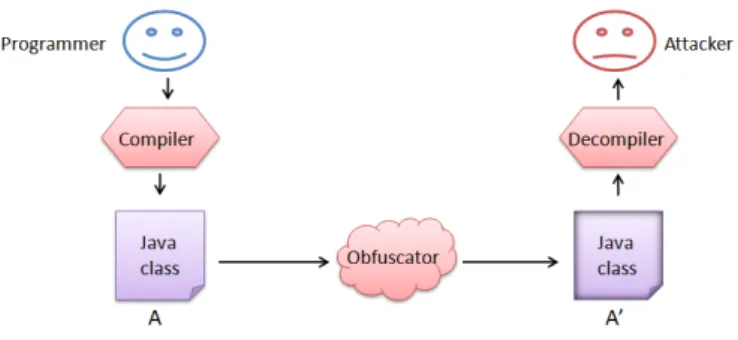
functionally-equivalent to the original. Figure 2.1 shows the process and concept of an
obfuscator.
Obfuscation can be classfied according to what kind of information they
Figure 2.1: Obfuscation concept.
2.1.1
Layout Obfuscation
Layout obfuscation affect the information in the program code that is
unnec-essary to its execution. These obfuscations are typically trivial and reduce
the amount of information available to a human reader. Examples include
source code formatting, variable names and commments [5].
2.1.2
Data Obfuscation
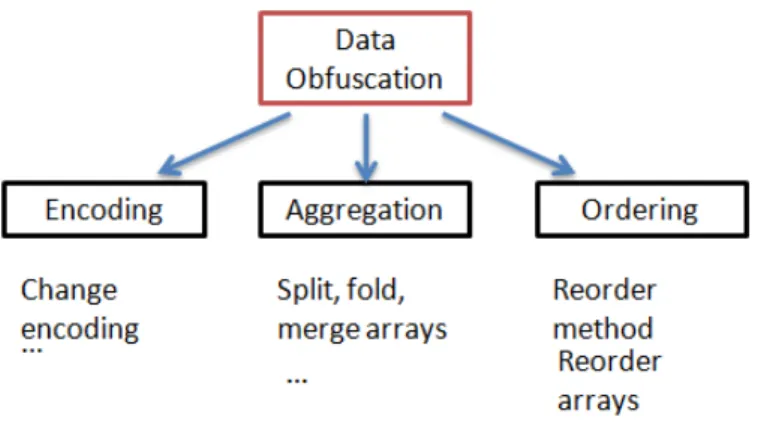
Data obfuscations operate on the data structures used in the program. Can
be classified according to what operation they perform on the data structures.
Figure 2.2 shows the classification.
Data encoding obfuscations affect how the stored data is interpreted,
for example replacing an integer variable i by the expression 8 * i + 2. Source
code would be transformed in the manner of Figure 2.3
Data aggregation obfuscation change how data is grouped. For
exam-ple, transforming a two-dimensional array into a one-dimensional array and
Figure 2.2: Data obfuscation categories.
Figure 2.3: An example of a data encoding obfuscation.
Data ordering obfuscations change how data is ordered. The normal
way in which an array is used to store a list of integers has the ith element
in the list at position i in the array. Instead, we could use a function f(i) to
determine the position of the ith element in the list.
2.1.3
Control Flow Obfuscation
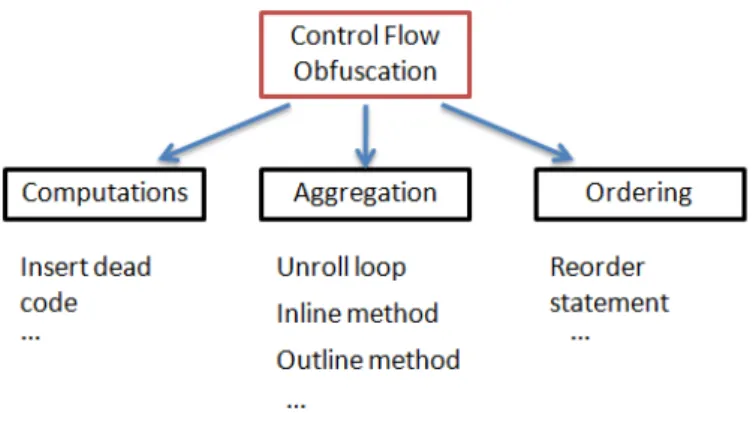
Control flow obfuscation affect the contorl flow of the program. Figure 2.4
shows the classification according to what operation they perform.
Control aggregation obfuscations change the way in which program
proce-Figure 2.4: Control flow obfuscation categories.
dure, that is, replacing a procedure call with the statements from the called
procedure itself.
Control ordering obfuscations change the order where statements are
executed. For example, loops can sometimes be made to iterate backwards
instead of forwards.
Control computation obfuscations hide the real control flow in a
pro-gram. For example, statements which have no effect can be inserted into a
program.
2.1.4
Preventive Obfuscation
The main goal is to stop decompilers and deobfuscators from functioning
correctly by using the ambiguities and irregularities left in the language [6] [5].
methods and provide an interface to let user selects the required level of
ob-fuscation and the maximum execution time/space penalty that the obfuscator
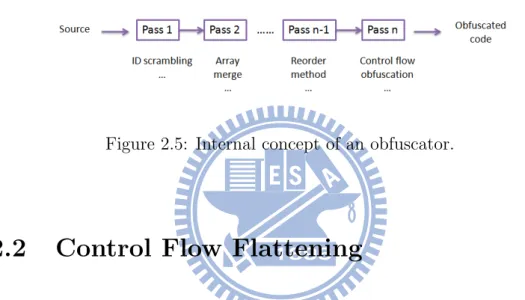
is allowed to add to the application [9]. Figure 2.5 shows the internal
con-cept of an obfuscator. In our work, we only propose an obfuscation method
instead of implementating a complete obfuscator.
Figure 2.5: Internal concept of an obfuscator.
2.2
Control Flow Flattening
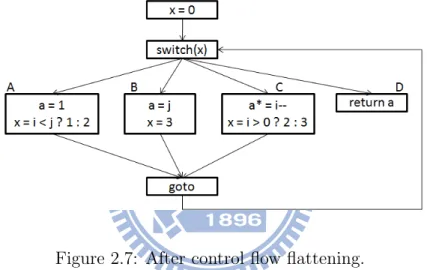
Control flow flattening aims to obscure the control flow logic of a program
by ”flattening” the control flow graph so that all basic blocks appear to have
the same set of predecessors and successors. The actual control flow during
execution is guided by a dispatcher variable [14]. Figure 2.6 and Figure 2.7
shows the program that before and after control flow flattening obfuscation.
2.3
Binary Obfuscation Using Signals
Previous obfuscating approaches mostly use program transformation rely on
pred-Figure 2.6: Source code and its control flow graph before flattening.
Figure 2.7: After control flow flattening.
icates to hide the control flow transfer and then insert bogus code in untaken
path to obfuscate the data flow. Although it can successfully obfuscate the
origin program, it break the origin structure of program. So it may cause the
compiler can not apply all optimization techniques on it, and further get a
notable performance degradation if applied on the whole program [7]. Such
obfuscation approach like control flow flattening [14] [15]. To overcome this
drawback, researchers recently propose using signal handling as a mechanism
In Binary Obfuscation Using Signals [13], it describes two techniques
for obfuscating binaries. The primary technique is to replace control
trans-fer instructions–jumps, calls, and returns by instructions that raise traps at
runtime; these traps are then fielded by signal handling code that carries
out the appropriate control transfer. The secondary technique is to insert
(unreachable) code after traps that contains fake control transfers and that
make it hard to find the beginning of the true next instructions. Figure 2.8
shows the summary of how this method work.
Chapter 3
Motivation
Although Binary Obfuscation Using Signals [13] can solve prior obfuscation
approaches’ problems, it still has two main problems. The first and most
important one is this approach may incur high performance overhead due
to the high cost of signal handling. For example, it could incur more than
43X performance overhead when obfuscating 90% of the branches [7]. The
next problem is that since it is a binary obfuscation, it can only be used on
specific environment, that is, it is not portable.
Based on these reasons, we propose a framework that not only can offer
high quality of obfuscation but also with moderate increase in execution time
Chapter 4
Implementation
Our method is similar to Binary Obfuscation Using Signals [13], the most
difference is we focus our technique on intermediate code instead of binary,
so it is not limited by a single environment.
Our main obfuscation technique is to change loops into code sequences
that cause runtime exception, then it will jump to a table we called Transfer
Table. The role of this table is like an address controller, its responsibility is
to accept all the input from different runtime exceptions we made, and find
the unique output then jump to the corresponding address.
The other obfuscation technique is to add bogus code after the handmade
runtime exceptions. Since runtime exception is not easy to be detect at
compile time, bogus code may increase the strength of our obfuscation. To
further make the added bogus code hard to be decompiled, we propose a
Figure 4.1: Framework of our obfuscation.
Below we give an overview of how these techniques are implemented.
Then we describe in detail how to solve the runtime exception collision, how
we deal with the implementation of transfer table, and some other issues we
faced.
4.1
Overview
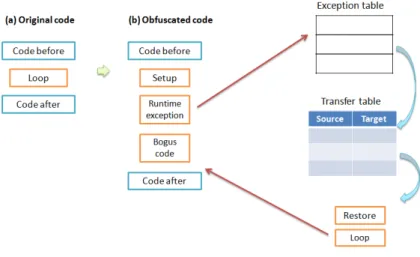
Figure 4.1 summarizes the overview of our framework. Figure 4.1(a) contains
a fragment of machine code in the origin code. Loop is our obfuscation
target, and the instructions that is proceeded and followed Loop are indicated
by Code before and Code after.
The reason why we choose loop as our obfuscation target is that it will
not cause a notable degradation of performance while applied our framework
obfuscate, then an runtime exception will be occurred for each iteration in
a loop. Since an exception incurs high overhead, it will lower performance a
lot.
4.1(b) contains the corresponding code fragment in the obfuscated code.
Loop is replaced by three components, which will be described in the
follow-ing sections.
When executing the obfuscated code, it causes the runtime exception.
Then the runtime exception handler will transfer control to the Transfer
Table which contains mapping from the address of raising runtime exception
to the Loop. Since the source address that raised runtime exception has been
saved to a local variable in Setup, so we can use this source to find the
corresponding target in the Transfer Table and then execute the Loop.
Before discussing in detail for each component, there is one more issue we
need to consider about. Since our method will produce so many runtime
ex-ceptions, will these exceptions increase too many overhead to performance?
This problem can be solved by an optimization called Exception-Directed
Op-timization(EDO) [12] that is developed by IBM. EDO is a feedback-directed
dynamic optimization. It attempts to detect hot exception paths, when it
find the exception is hot enough, it will inline the hot exception path to the
program. So next time it won’t raise an exception and save a lot of overhead.
With help from EDO, our method can be done efficiently with moderate
4.2
How To Find Loops?
When obfuscating a program, our obfuscator will find loops first. We use a
simple heuristic that first appeared in Dynamo [4] to identify loop headers.
After loading a class file, our obfuscator traverses the bytecode program
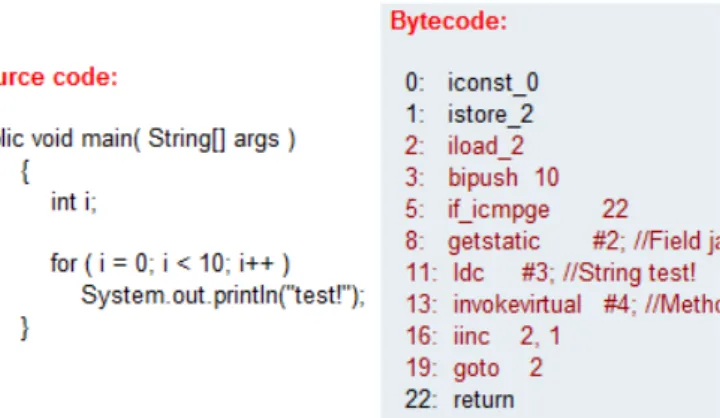
instruction by instruction in each method. Each time a backwards branch
instruction is found, our obfuscator put it into a backwards branch array
since the destination of that jump is a loop header. When all backwards
branches are gathered, the way to find a loop can be classified according to
the position of each backwards branch.
4.2.1
Basic Loop
A basic loop is a pattern that there contains no other backwards branches in
the scope of a backwards branch and its corresponding loop header. Figure
4.2 shows the concept.
4.2.2
Same Loop Header
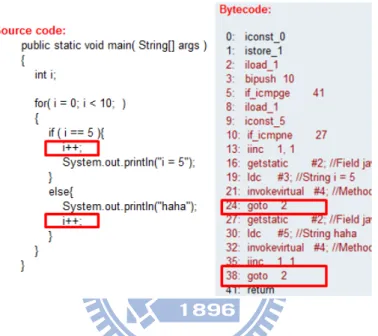
A same loop header pattern means in the scope of a backwards branch and its
corresponding loop header, there exist other backwards branches that share
the same loop header. Figure 4.3 shows this pattern.
Figure 4.3: Example for same loop header pattern.
4.2.3
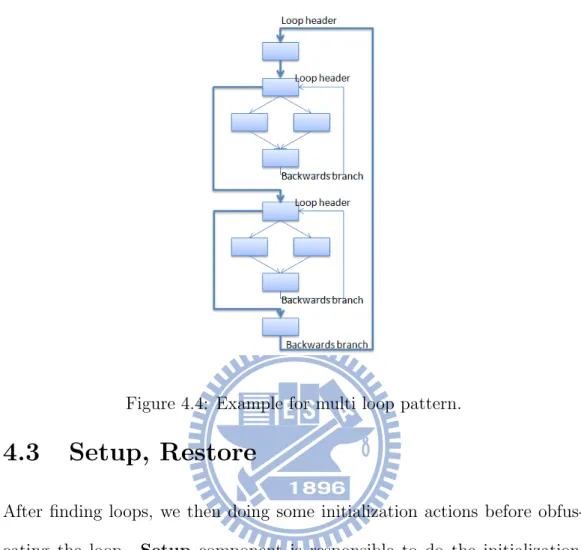
Multi-Loop
A multi-loop pattern means for a loop constructed by one backwards branch
and its corresponding loop header, there exit another backwards branch and
loop header forms a bigger scope and includes the loop. Figure 4.4 shows the
Figure 4.4: Example for multi loop pattern.
4.3
Setup, Restore
After finding loops, we then doing some initialization actions before
obfus-cating the loop. Setup component is responsible to do the initialization.
The setup component does three things: (1) store the source address(
run-time exception’s location ) which will be used when building transfer table;
(2) push the source address to operand stack and store it to a specified
lo-cal variable so it can later be used by transfer table; and (3) save operand
stack’s values to heap so the original program’s state can later be restored
4.4
Runtime Exception
After initialization, before we can move loop away and insert a runtime
ex-ception, there is still one more thing we need to consider about. Will the
runtime exceptions we made collision with exceptions in original program?
Figure 4.5 shows all possible situations for relationship between loop and
original exception.
4.4.1
Runtime Exception Collision Problem
Figure 4.5: Relationship between loop and original exception.
In figure 4.5, we can see that case one and case four are impossible, so we
don’t have to handle it. Case two means a loop is included by an exception
and case three is opposite. There are two steps to handle case two: (1) find
the original exception’s exception type and handler, then set to the moved
loop; and (2) divide the original exception into two parts and insert our
runtime exception between them. Figure 4.6 shows the concept. In this way,
the collision problem can be solved. For case three, since the exception will
Figure 4.6: Before and after handling exception collision case two.
dealing with collision problem, we can now insert our runtime exception.
4.4.2
Static Initializer
To further confuse attackers, we use some techniques to implement our
run-time exception. For example, when an divide zero exception want to be
raised, before executing an idiv bytecode, operand stack must contains a
zero value. So our concept is to store values that will be used in runtime
exception to heap in advance and then get these values by reference in our
runtime exception. Thus, attacker won’t easily figure out what values are
contained in operand stack.
There are two steps to achieve this goal: (1) write a static initialize
method that store the value will be used in runtime exception to heap in
advance; and (2) use static initializer to call the static initialize method.
Since the code in a static initializer block is executed automatically by the
Figure 4.7: Concept of adding bogus code.
be put in heap at the same time.
In this way, the attacker is hard to figure out weather a runtime exception
will happen or not because it becomes an inter-procedure data-flow analysis
problem.
4.5
Bogus Code
After obfuscating the Loop, we then insert bogus code to further confuse
attackers. Figure 4.7 shows the concept of how we insert bogus code after
runtime exception.
The main reason why we insert bogus code after runtime exception is to
increase the strength of our obfuscation. Although bogus code is unreachable,
attacker is not easy to identify since runtime exception is hard to detect at
compile time. The other benefit of bogus code is that it can make an attacker
think there is another edge in the control flow graph.
Figure 4.8: Gap between Java source code and Java bytecode.
program. Since previous researches on obfuscation almost focus on control
flow, so using loop as bogus code may misleading attackers.
4.5.1
Intersection Loop Obfuscation
It is trivially true that every valid Java source code program must compile
to a valid Java class file. A valid class file must pass through the verifier
without causing any errors. However, not every Java class file has a direct
correspondence to a valid Java source code program. This is because the Java
bytecode instruction set supports a richer set of language features than the
language Java. These features include goto and subroutine instructions [11].
To further confuse attackers, we use this gap between Java bytecode and
Java source code to propose a new technique called intersection loop
ob-fuscation. Figure 4.8 shows the concept of our idea. As can be seen in
the graph, a intersected loop is not permitted in any high-level language.
Our method aims to transform bogus code into intersected loop. The
transformation process contains five steps: (1) tail duplication; (2) duplicate
conditional block and put onto the original conditional block; (3) move one
of the tail above duplicated conditional block; (4) add a GOTO above whole
loop and point to the duplicated conditional block; and (5) retarget the tail’s
destination to the duplicated conditional block. Figure 4.9 shows an example
of how our method work, and Figure 4.10 depict the transformed control flow,
as can be seen in Figure 4.10 black line and dotted line form intersection loop.
After intersection loop obfuscation, the bogus code is transformed from
a ”loop” into a ”intersected loop” that can resist decompilers. Although
this transformation breaks the origin control flow of the loop and may cause
the compiler can not apply all optimization techniques on it then further
get a notable performance degradation, since bogus code is unreachable,
performance will not be affected.
4.6
Transfer Table
After obfuscating each Loop and inserting Bogus code, all information that
needs to build transfer table are gathered. A transfer table act like a
con-troller, when handmade runtime exception occurs, the exception handler will
guide the next execution instruction to our transfer table and then the table
will be traversed to find the corresponding target address and set this address
Figure 4.9: Intersection loop obfuscation example. (1) is the original control
Figure 4.10: Loop after applying intersection loop obfuscation.
the moved loop.
To make it hard to reverse engineer the contents of transfer table, before
store the source address into it, we use a hash function and store the hashed
value into transfer table. This not only hides the value of the source address
but also complicate the transfer table because source addresses do not appear
in the obfuscated program directly. The concept is summarized in Figure
4.11.
After getting the corresponding target from transfer table, the next
ques-tion is how to put the target into PC. The process is depicted in Figure
4.12.
Figure 4.11: Concept of hashing source address.
Figure 4.12: Process of transfer target to PC.
and (2) push the value in the local variable into PC. Unfortunately, neither of
these two steps can be achieved because JVM does not supply such bytecodes
that can store a reference type value( target’s type is present as reference
in JVM ) into local variable and none of bytecodes can do indirect jump. So
we choose switch to build our transfer table. Figure 4.13 shows the concept
how a transfer table looks like. The drawback of using switch to implement
our transfer table is that for each case in switch, the target is fixed. This
means we can only play tricks on source address but not on target address
Figure 4.13: Use switch to build transfer table.
4.7
Local Variable Inconsistent
Local variable inconsistent problem is a verify error, it is occurred when java
verifier verifies our obfuscated program. Let’s explain this problem in Figure
4.14. Figure 4.14.(a) is the original program which contains three for loops.
After our obfuscation, these three loops will be replaced by three runtime
exceptions and a transfer table will contains the target information for each
source. Figure 4.14.(b) depict the concept. When we run the obfuscated
code, the java verifier will be raised to verify the whole program, when it
encounters the first runtime exception, it jumps to the transfer table. Since
the transfer table is made by switch, java verifier won’t have any idea what
the correct case is, so it will traverse every cases one by one. Then when it
verifies Figure 4.14.(2), a local variable inconsistent problem will be occurred
because local variable j has not been declared.
To solve this problem, we can simply copy the declaration of each local
variable that will be used in current method and put it on top of the method.
vari-Figure 4.14: How local variable inconsistent occur.
ables are initialized in advance before executing the first runtime exception
Chapter 5
Experiment
We evaluated our efficiency of our approach using seven programs from the
SPCEJVM2008 benchmark suite. Our experiment were run under windows
7 on Intel Core 2 Duo CPU E7400, with 4GB RAM. We used the Sun Java
HotSpot Client VM, 16.3-b01 mixed mode with the default Just-In-Time
compiler turned on. Each evaluated on the program includes iteration and
warmup. An iteration goes on for a certain duration, by default 240 seconds.
During this time the program will be called several times, one by one as soon
as previous program completed. It will never abort a program, but wait
until a program is completed for stopping. The first iteration is a warmup
iteration, run for 120 seconds by default. The result of the warmup iteration
is not included in the benchmark result. The result for each profile is a score
5.1
Performance of the Obufscated Program
The following data was obtained by applying our obfuscation to SPECJVM2008
benchmark programs. Seven SPEC programs are used in this experiment.
Figure 5.1 shows the result. We tested each benchmark program by
obfus-cating 0%, 10%, 50% and 80% of the program. As can be seen in Figure 5.1,
derby decrease a lot.
Figure 5.1: Performance on SpecJVM2008.
Derby contains six programs. After tracing it, we found that there are
four programs will call Utils.java when they execute. Figure 5.2 depict the
relationship among the four programs and Utils.java. After obfuscating,
loops in Utils.java become runtime exceptions. Since exception increase lots
of overhead, it decrease performance a lot when the four programs keep
performance after obfuscation.
Figure 5.2: Relationship among Utils.java and other programs.
Although Utils.java is hot, it is not necessarily to be importance code.
This means weather we obfuscate Utils.java or not, an attacker won’t be able
to get important algorithms from the obfuscated program, so we choose not
to obfuscate it. Figure 5.3 shows the result. As can be seen, all the decrease
on performance is less then 21%.
5.2
Code Size
Since dynamic class loading is one of the important features of JVM, so to
keep increased code size down is a major issue for obfuscation.
To decrease the impact on code size after obfuscation, we remove the
LineNumberTable and LocalVariableTable from class file after obfuscation.
These two attributes are optional and may be used by debuggers to get more
debugging information from class file. So removing these two attributes not
only can save much space but also make debuggers hard to work.
Figure 5.4 shows the impact of our obfuscation techniques on code size.
We can see that the code size factor ranges from 1.07 (Crypto) to 1.28
(Sci-mark), with a mean increase of a factor of 1.15. The increase of code size
mainly comes from added bogus code.
5.3
Decompiler
To proof our obfuscation technique can resist decompiler, we use 9
decom-pilers and one deobfuscator to test the obfuscated code. The way how we
test decompilers contains four steps: (1) use javac to compile the java source
code to bytecode; (2) apply our obfuscation technique on the bytecode; (3)
use decompiler to decompile the obfuscated bytecode; and (4) use javac to
compile the produced source code again. If javac shows compile error, we say
that the tested decompiler is fail and mark a X on the blank of the
corre-sponding decompiler. Figure 5.5 shows the result of our testing. Blanks with
”Version mismatch” means the decompiler is too old to support new version
of class file that we used.
5.4
Visualizing the Effects of Obfuscation
To give an intuitive view on the effect of our obfuscation techniques, we
use c1Visualizer [2] to visualize the control flow graph of both the original
program and obfuscated one. For easy understanding, we use a small program
that contains three for loops.
Before visualize the obfuscated program, we apply Java Deobfuscator
(JDO) [3] on it. As can be seen in Figure 5.6, JDO could not eliminate most
of the faked control flow edges. Hence, we can see a dramatically change to
the obfuscated code.
Chapter 6
Conclusion
The problem of protecting software from attackers is an important issue. To
protect intellectual property, obfuscation is one of the easiest and efficient
way to achieve this goal.
In this paper, we has described a new approach to obfuscating java
byte-code and evaluated its effectiveness and byte-code size on programs in SPECJVM2008
benchmark suite. In our framework, we replace loops by some bytecode that
cause runtime exception, then use a transfer table to response the mapping
of runtime exception and loop, and insert bogus code to further confuses
decompilers.
The experiment results show that the average effect on performance is
less than 21%, and the mean increase of code size is 1.15X. We also use 9
de-compilers and 1 deobfuscator to test the strength of our obfuscation method.
to source code.
Since we propose a obfuscation method that can be done efficiently with
moderate increase in execution time and code size, our method can be
Bibliography
[1] http://jakarta.apache.org/bcel/.
[2] https://c1visualizer.dev.java.net/.
[3]
http://www.softpedia.com/get/programming/debuggers-decompilers-dissasemblers/java-deobfuscator.shtml.
[4] Vasanth Bala, Evelyn Duesterwald, and Sanjeev Banerjia. Dynamo: A
transparent dynamic optimization system. In ACM SIGPLAN Notices,
pages 1–12, 2000.
[5] Jien-Tsai Chan and Wuu Yang. Advanced obfuscation techniques for
java bytecode. J. Syst. Softw., 71(1-2):1–10, 2004.
[6] Jien-Tsai Chan, Wuu Yang, and Jing-Wei Huang. Traps in java. J. Syst.
Softw., 72(1):33–47, 2004.
[7] Haibo Chen, Liwei Yuan, Xi Wu, Binyu Zang, Bo Huang, and Pen
In Proc. MICRO-42 Microarchitecture 42nd Annual IEEE/ACM Int.
Symp, pages 391–400, 2009.
[8] C. S. Collberg and C. Thomborson. Watermarking, tamper-proofing,
and obfuscation - tools for software protection. 28(8):735–746, 2002.
[9] Christian Collberg, Clark Thomborson, and Douglas Low. A taxonomy
of obfuscating transformations. Technical Report 148, July 1997.
[10] Daniel Dolz and Gerardo Parra. Using exception handling to build
opaque predicates in intermediate code obfuscation techiniques. JCS&T,
8(2), 2008.
[11] Douglas Low. Java control flow obfuscation. Technical report, 1998.
[12] Takeshi Ogasawara, Hideaki Komatsu, and Toshio Nakatani. A study
of exception handling and its dynamic optimization in java. In
OOP-SLA ’01: Proceedings of the 16th ACM SIGPLAN conference on
Object-oriented programming, systems, languages, and applications, pages 83–
95, New York, NY, USA, 2001. ACM.
[13] Igor V. Popov, Saumya K. Debray, and Gregory R. Andrews. Binary
obfuscation using signals. In SS’07: Proceedings of 16th USENIX
Secu-rity Symposium on USENIX SecuSecu-rity Symposium, pages 1–16, Berkeley,
CA, USA, 2007. USENIX Association.
[14] Chenxi Wang, J. Davidson, J. Hill, and J. Knight. Protection of
and Survivable Information Systems] Foundations of Intrusion Tolerant
Systems, pages 273–282, 2003.
[15] Chenxi Wang, Jonathan Hill, John C. Knight, and Jack W.
David-son. Protection of software-based survivability mechanisms. In DSN
’01: Proceedings of the 2001 International Conference on Dependable
Systems and Networks (formerly: FTCS), pages 193–202, Washington,
![Figure 2.8: Summary of Source Code Transformations [13].](https://thumb-ap.123doks.com/thumbv2/9libinfo/8739538.203961/19.892.218.685.512.744/figure-summary-of-source-code-transformations.webp)