
成人初顯世代的兩個族群
122
0
0
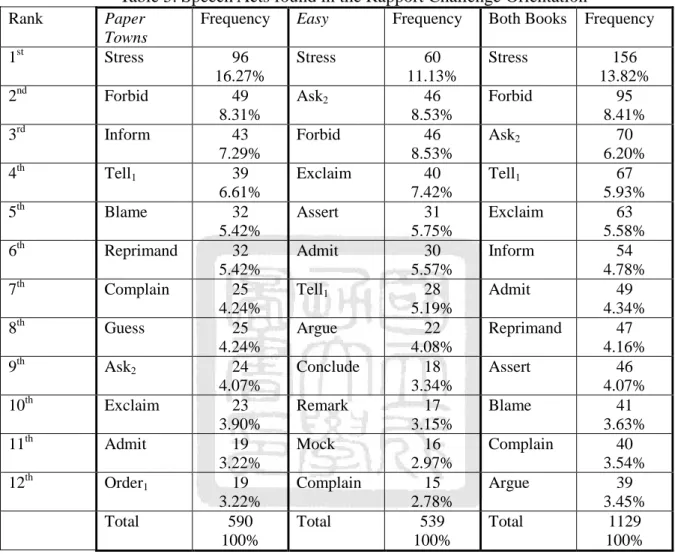
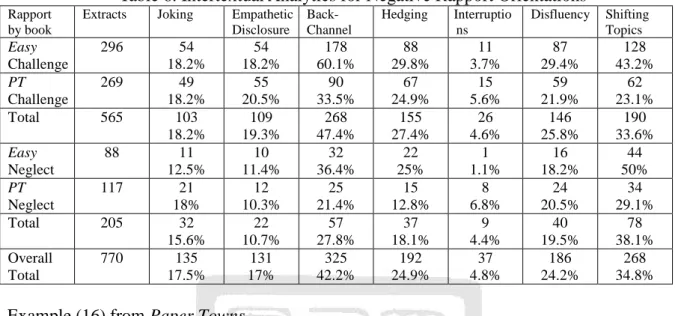
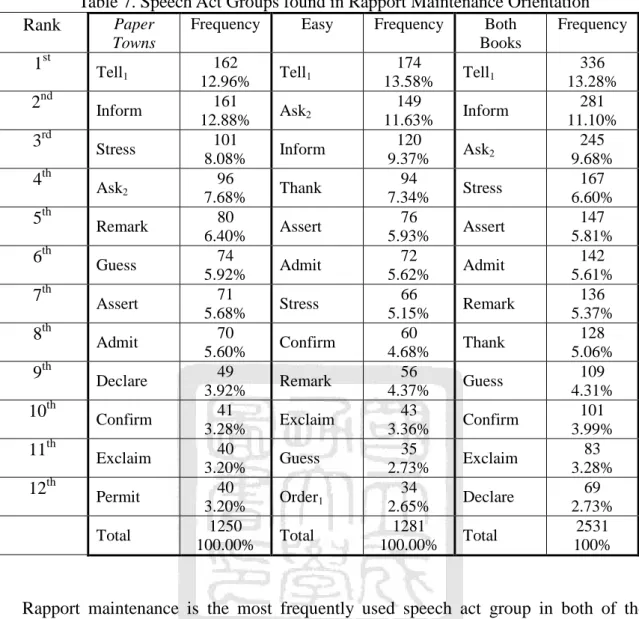
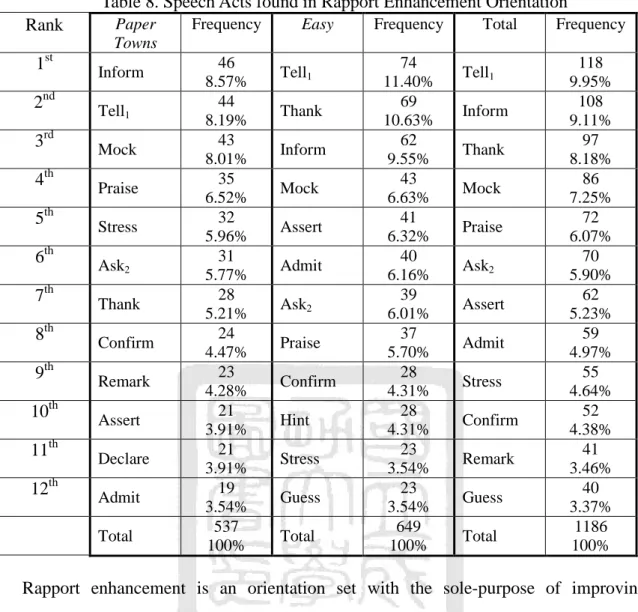
全文
(2)
(3) Abstract (Chinese) 本論文探討成人初顯世代的兩個族群:從小說 Paper Towns(Webber, 2012)與 Easy (Green, 2008)看這兩本小說中初期階段與中期階段的初顯世代現象。本論文 針對此兩本小說的長篇互動對話,以 Spencer-Oatey’s 關係管理之研究(2000, 2003, 2005, 2007, 2011)所設計出的關係架構加以修改後進行分析。本論文探討以下研究 問題:(1)分析 Paper Towns 與 Easy 裡,好壞關係的互動模式如何呈現? (2)比較 此兩本小說,何種言談行為較易聯想為友好關係或是敵對關係? (3)在這兩本小說 中,以表達親疏關係為主的情境裡,同理心是如何呈現? (4)親疏相關研究所指出 的互動模式是否與小說 Easy 和 Paper Towns 所發現的一致? 本研究所選用的分析體 是以 Spencer-Oatey 的五大親疏關係研究領域為主:發語詞、言談分析、參域、非語 言與文體。發語詞的分析是以 Wierzbicka 的言談行為分類研究(1987)及 Searle (1975)所發展出的言談行為中,更明確的分類學方法來分析。本研究試著就敵對 關係的爭論情境,套用 Traverso (2009)的爭論點核心理論去分析,以本研究中的 一個範例與 Yu(2011)的研究作比較,觀察 Traverso 的理論是否符合。 研究結果顯示(a)這兩本小說的互動情境中皆可觀察到友好關係與敵對關係有 不同的互動模式:例如,在具挑戰的互動中,較常使用規避詞、也較有同理心的對 話。另一方面,優化關係技巧性的大多透過笑話來呈現維持對話關係則常轉換話題 或是使用回應句。(b) 一般來說,施壓最常作為表達敵對關係的策略,然而在研究 中的此二成人初顯世代族群其言談行為的使用並不全然一致;但訊息告知則很一致 的都出現在友好關係的情境裡。此發現強調朋友間資訊的分享是強化友好關係很重 要的因素。(c)同理心的呈現則是意外的在挑戰的情境中較常出現,即便它是強化 友誼的一種策略。(d) Yu(2011)的研究所發現的爭論模式與本研究所發現的與 Traverso 的核心爭論理論一致,透過旁敲側擊人身攻擊的方式從旁抵毀對話者是作 為反駁主要論點的方式。 如同透過敵友關係的呈現,有效的讓成人初顯世代從較關注自我的青少年時期 轉變為對外關注他人的成人期行為。期望本論文能幫助早期初顯世代了解並逐漸適 應社交行為,以期順暢的轉換至未來世代而至專業的生活領域。 關鍵字:友好關係、敵對關係、成人初顯世代、親和感、面子、言談行為、同理心 的呈現. 2.
(4) Abstract (English) This thesis examines two groups of emerging adults: an early phase and a middle phase within two emerging adulthood novels: Paper Towns (Webber, 2012) and Easy (Green, 2008). Long interactional exchanges from both novels are analyzed using a modified version of the rapport framework designed by Spencer-Oatey’s rapport management (2000, 2003, 2005, 2007, 2011). This thesis answers the following research questions: (1) What patterns are observable in positive versus negative rapport encounters, analyzed in the novels: Paper Towns (Webber, 2012) and Easy (Green, 2008)? (2) In comparing the two novels which speech acts were most commonly associated with friendship and likewise rivalry? (3) How is empathetic disclosure responded to within the two novels across the rapport orientations? (4) Is interactional pattern research on emerging adulthood consistent with the findings observable in Easy and Paper Towns? The analytics chosen for this study are representative of Spencer-Oatey’s five rapport judgment domains: illocutionary domain, discourse domain, participation domain, non-verbal domain, and stylistics domain. The analytics representative of the illocutionary domain follow the speech act taxonomy by Searle (1975) with a closer taxonomical approach via Wierzbicka’s taxonomy (1987). In our attempt to compare our current research on emerging adults with existing research, we examined rivalry explicitly in arguments, using Traverso’s theory of core issues in arguments (2009). We compared an example from the current study with Yu (2011) to examine whether Traverso’s theory is supported. The results show that (a) there are observable patterns that point to a difference in interactions within friendship and rivalry dynamics throughout the two novels: e.g., the frequency of hedging is noticeably higher in the challenge orientation, challenge also had a higher rate of empathetic disclosures, on the other hand, enhancement statistically held a higher margin of jokes, and maintenance demonstrated the largest number of topic shifts and back-channels. (b) Stress is the most common rivalry strategy overall, but there were some inconsistencies in speech act use between the two groups of emerging adulthood; however tell is fairly consistently used as a friendship strategy. This consistency reaffirms that information-sharing between friends is paramount to reinforcing friendships, regardless the difference in age within the two emerging adulthood groups. (c) Empathetic disclosure surprisingly occurs most often within the challenge orientation, even though it is a friendship enhancing strategy. (d) Patterns of argumentation found in Yu’s example (2011) and the one from our present research were consistent with Traverso’s theory of core issues in arguments. Tangent micro-arguments occurred peripherally to the core issues in the form of personal attacks meant to discredit the interlocutors. As friendships and rivalries make up the economies that move emerging adults from the self-focused adolescence towards the outward-looking adulthood, it is tantamount that we better understand the connections that lead early emerging adults towards socialization adaptability, in order to better prepare future generations for smoother transitions into their professional lives. Keywords: friendship, rivalry, emerging adulthood, rapport, face, speech acts, empathetic disclosure.. 3.
(5) Acknowledgements Researching and writing this thesis has been a challenging task. There were many times where the task seemed greater a task than time seemed to afford. I am grateful for my thesis advisor, Dr. Shelley Ching-yu Hsieh’s clear insight and guidance about following the necessary steps to achieve a successful thesis. Without her help I would not have this finished this thesis. I would also like to thank my committee members, Dr. Shin-Mei Kao and Dr. Chao-Chih Liao for their expert criticism and their insightful feedback. Luckily during the difficulties of writing I had some people to keep me encouraged and motivated to take those arduous steps necessary to work till the dawn of many mornings. My greatest supporter through this time has been my girlfriend, Joan Cheng, who told me stories of the stages of thesis life and how suffering was just a sign that progress was being made. I also want to thank my thesis groupmates: Kelly Chuang and Yvonne Chen. We bunkered down together to fight the fight and never give up while writing our thesis. I’d also like to thank my parents, George and Dolores for their support and all the conversations that developed my love for analyzing language, as well as the number of times my mom said Jason you are playing Semantics. Who knew when I grew up that I’d still be playing Semantics at 35 years old. I’d also like to thank my two elder brothers Adam and Jamie for being examplars of working hard and sticking to their goals no matter how adverse the job and always remembering what’s most important in the process. If there is one thing that I’ve learned in the process of writing such a piece, it is that a solid group of support is healthy and makes the difference every difference in the world. This includes all of the FLLD departmental faculty for the years of guidance: especially David Chen and Isabella Yeh for all their personal and academic support.. 4.
(6) Contents Abstract (Chinese) .............................................................................................................................. 2 Abstract (English)................................................................................................................................ 3 Acknowledgements ............................................................................................................................ 4 List of Tables ....................................................................................................................................... 7 Conventions ........................................................................................................................................ 8 Chapter 1 Introduction .................................................................................................................... 9 1.1 Motivation ...................................................................................................................... 9 1.2. Research Questions ...................................................................................................... 10. 1.3. Structure of Thesis ........................................................................................................ 11. Chapter 2 2.1. Literature Review.......................................................................................................... 13 Friendship ..................................................................................................................... 13. 2.1.1 Rapport ......................................................................................................................... 15 2.1.2 Face............................................................................................................................... 17 2.2. Interactional Goals........................................................................................................ 20. 2.2.1 Behavioral Expectations ............................................................................................... 22 2.2.2 Interactional Principles ................................................................................................. 24 2.2.3. Chapter Summary ......................................................................................................... 25 Chapter 3 3.1. Methodology ................................................................................................................ 26 Data Sources ................................................................................................................. 26. 3.1.1 Paper Towns.................................................................................................................. 29 3.1.2 Easy ............................................................................................................................... 30 3.1.3 Novel Comparison ........................................................................................................ 31 3.2. The five Domains .......................................................................................................... 33. 3.2.1 Illocutionary Domain .................................................................................................... 34 3.2.2 Discourse Domain and Non-verbal Domain ................................................................. 40 3.2.3 Participation Domain .................................................................................................... 41 3.2.4 Stylistic Domain ............................................................................................................ 42 3.3. Handling of Data ........................................................................................................... 43. 3.4. Chapter Summary ......................................................................................................... 43. Chapter 4 4.1. Micro level Analysis of Friendship and Rivalry ............................................................. 45 Negative Rapport Orientations..................................................................................... 46. 4.1.1 Rapport Neglect Orientation ........................................................................................ 46 4.1.2 Rapport Challenge ........................................................................................................ 51 4.2. Positive Rapport Orientations ...................................................................................... 56. 5.
(7) 4.2.1 Rapport Maintenance................................................................................................... 56 4.2.2 Rapport Enhancement Orientation .............................................................................. 63 4.2.3 Chapter Summary ......................................................................................................... 65 Chapter 5 5.1. Macro Level Analysis of Friendship and Rivalry............................................................ 67 Negative Rapport Orientations..................................................................................... 68. 5.1.1 Rapport Neglect............................................................................................................ 68 5.1.2 Rapport Challenge ........................................................................................................ 71 5.1.3 Negative Rapport Analytics Cross-Comparison ............................................................ 75 5.2. Positive Rapport Orientations ...................................................................................... 79. 5.2.1 Rapport Maintenance................................................................................................... 80 5.2.2 Rapport Enhancement Orientation .............................................................................. 83 5.2.3 Positive Rapport Analytics Cross-Comparison .............................................................. 86 5.3. Results .......................................................................................................................... 89. 5.3.1 Research Question 1, Observable Patterns .................................................................. 89 5.3.2 Research Question 2, Speech Acts................................................................................ 91 5.3.3 Research Question 3, Empathetic Disclosures.............................................................. 93 5.4. Chapter Summary ......................................................................................................... 95. Chapter 6 6.1. Argument Structure Comparison ................................................................................. 97 Argument Research in relation to Current Study ......................................................... 97. 6.2. Research Question 4, Arguments in Interaction ......................................................... 102. 6.3. Chapter Summary ....................................................................................................... 103. Chapter 7 7.1. Conclusion .................................................................................................................. 105 Summary of Major Findings ....................................................................................... 105. 7.2. Contribution of the Thesis .......................................................................................... 108. 7.3. Limitations and Further Studies ................................................................................. 109. 7.4. Final Notes on the Current Study ............................................................................... 110. References ...................................................................................................................................... 111 Appendix 1 Discourse Analytics...................................................................................................... 117 Appendix 2 Speech Act Rates in the Novels ................................................................................... 120. 6.
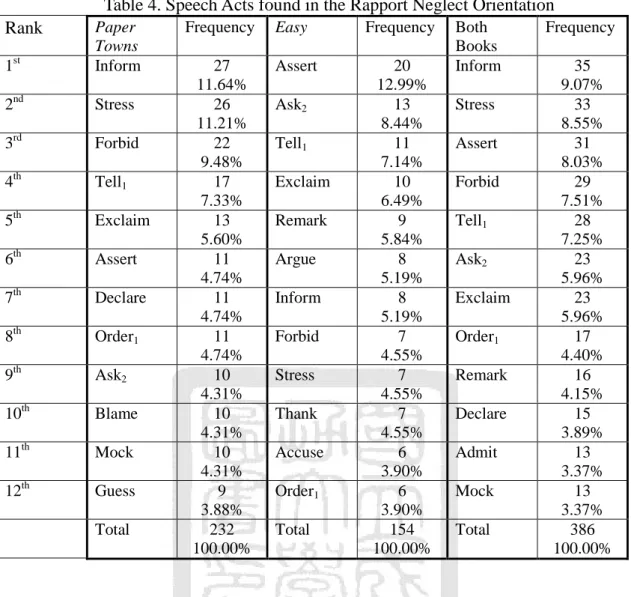
(8) List of Tables Table 1. Self-Aspect Model of Identity (Hogg and Simon, 2004) ...................................... 28 Table 2. Five Rapport Judgment Criteria ............................................................................ 34 Table 3. Speech Act Groups situated by type (Wierzicka, 1987; Searle,1975) ................... 37 Table 4. Speech Acts found in the Rapport Neglect Orientation......................................... 69 Table 5. Speech Acts found in the Rapport Challenge Orientation ..................................... 72 Table 6. Intertextual Analytics for Negative Rapport Orientations ..................................... 76 Table 7. Speech Act Groups found in Rapport Maintenance Orientation ........................... 81 Table 8. Speech Acts found in Rapport Enhancement Orientation ..................................... 84. 7.
(9) Conventions Textual citations line numbers speech acts speech act groups discourse markers non-verbal acts. italicized e.g., When this is the case within brackets e.g., [2-4] all caps e.g., REQUEST, APPOINT bold e.g., inform, tell1 dotted heavy underline e.g., I mean within brackets e.g., [Quentin repeated]. 8.
(10) Chapter 1 Introduction 1.1 Motivation Understanding effective communication has drawn critical debates among many scholars within the field of discourse analysis, pragmatics, and sociolinguistic studies (Heath, 1984; Duncan and Moriarty, 1998; Dwyer, 1987; Ädel, 2011). In an attempt to culminate face theory, politeness theory and speech acts, SpencerOatey (2000) developed the theory of rapport management. Just as Grice’s maxims (1975) allow for flouting, Spencer-Oatey’s rapport management attenuated to the idea of individuals’ having a range of different communicational aims, which may be positive when individuals enhance or maintain their current relationship; or negative when individuals neglect or challenge their relationship. This research looks at both positive rapport and negative rapport orientations. The research will examine characters in two novels, Paper Towns (Webber, 2012) and Easy (Green, 2008): high school seniors (17-18) vs. college students, mostly sophomores (20-21 year olds). Arnett (2000) classified this target age as a post-adolescent age and pre-adult age; giving it the name emerging adulthood. It is an important age for people leaving adolescence to develop and mature into the people they will be as adults. This can be seen in the ways they learn how to develop bonds with other people as well as the strategies they use to establish their identity. In examining the social interactions among the characters throughout the novel, we can explore their positive rapport relations, as well as their negative rapport relations. It is the researcher’s hope that by exploring these rapport relations in depth, it can increase our understandings of how individuals develop during the early maturation years of emerging adulthood.. 9.
(11) As identities continue to maturate, so do their relationships with other people. There are many different types of relationships: e.g., parent-child, internship, buyer-seller, employer-employee, and husband-wife. All of these relationships develop into two types: friendship and rivalry, which can be further classified according to Spencer-Oatey’s four rapport types: enhancement and maintenance or neglect and challenge. Enhancement and maintenance are positive rapport types, while neglect and challenge are negative. It is the hope that through studying friendship and rivalry in this age through the breadth of these two novels that we can better understand what changes take place from the beginning of emerging adulthood, which will be looked at in the first novel Paper Towns, to the mid-point of emerging adulthood, which will be looked at in the second novel, Easy. By examining the social interactions among the characters in the novel, we can explore their positive rapport relations, as well as their negative rapport relations. It is the researchers’ hope that by exploring these rapport relations in depth, it can increase our understandings of how individuals develop during the early maturation years of emerging adulthood. 1.2 Research Questions The data for the current research was obtained by extracting every interaction between emerging adults in the two novels. Following that, the extracts were analyzed according to nine analytics representative of the 5 rapport judgment criteria, which are explained in section 3.2. By examining the rapport orientations and analytics in the two novels in relation to friendship development and rivalry formation, I hope to answer a few questions:. 10.
(12) 1. What patterns are observable in positive versus negative rapport encounters, analyzed in the novels: Paper Towns and Easy? 2. In comparing the two novels which speech acts were most commonly associated with friendship and likewise rivalry? 3. How is empathetic disclosure responded to within the two novels across the rapport orientations? 4. Is interactional pattern research on emerging adulthood consistent with the findings observable in Easy and Paper Towns? 1.3 Structure of Thesis This thesis consists of 7 chapters. This first chapter introduces previous research conducted by relevant researchers, leading up to the present work, as well as presents the research questions for this study, and the motivation for the study. Chapter 2 will review research relevant to the current study: concerning rapport, face, and speech acts. Chapter 3 will explain the methodology framework for the current study, including an explication of the two novels that are used as data sources for the study, as well as a description of the five domains, which make up the core analytical framework for the study. Chapter 4 will attempt to use analytics presented in Chapter 3 in order to determine friendship and rivalry dynamics as they appear in examples from the two novels. This will help us identify patterns that relate to answering research questions 1 and 2. Chapter 5 moves away from single example analysis to an analysis of all the compiled extracts from the two novels, analyzing the four rapport orientations that occur throughout the two novels under investigation: looking at differences between the novels, as well as in isolation. Chapter 4 and 5 will both look at the rapport types: chapter 4 from a micro-level in depth analysis of specific examples, and chapter 5 from a macro-level approach to determine patterns of consistency within rapport types as well across rapport types. Chapter 6 will in turn use Traverso’s (2009) argument structure to compare an example from Yu (2011) with Example (3) from the current study. Chapter 6 will move back to a micro-level approach similar to chapter 4, but will be informed by the results of chapter 5’s discussion. Chapter 7. 11.
(13) will conclude the current study: giving the general findings, suggestions for further research and limitations of the study.. 12.
(14) Chapter 2 Literature Review In this section, friendship and interactional goal literature are reviewed. In 2.1 we will discuss friendship research. This research will be integrated into our study of rapport management within 2.1.1. In 2.1.2, we will then move on to discuss how rapport management functions to support the theoretical framework of face. Next in 2.2 and 2.2.1, we will look at the constituent parts of rapport: interactional goals and behavioral expectations. In the final section of this chapter 2.2.2, we will further refine the discussion of rapport by looking at research concerning how individuals attend to their interactional goals in interacting with their interlocutors.. 2.1. Friendship We will begin our discussion of friendship with a focus on the mental state of. emerging adults as our research is directly focused on friendship in emerging adulthood. The innovator of term emerging adulthood, Arnett (Grusec, 2008) described emerging adults as “considerably less egocentric than adolescents, and considerably better at roletaking with respect to their parents” (Grusec, 2008, p. 217), leading them to see their parents beyond their parental roles, and instead as people. He surmised that emerging adults learn to view their relationships with their parents as more of a relationship among adults rather than strictly in terms of the roles of parents and children. He went on further to suggest that this phenomenon is not only to be found in the relationships between parents and children, but also relevant in other relationships, such as friendships. He suggested that with the development of new social skills, emerging adults drive the changes in the nature of their relationships (Grusec, 2008, p. 210). In assessing a sample of 402 college students 4 times over the course of two years, Luyckx (2006) found that the. 13.
(15) students’ identification with commitment was the core identity cycle for students going on to their sophomore year. Arnett (2008) pointed to a notable difference between the beginning phase and later phases of emerging adulthood. One of the social skills: self-regulation, which is important for adulthood is typically not attained by the start of emerging adulthood. He found that early emerging adults had difficulty with emotional self-regulation. Mood fluctuations were found to be greater in adolescence than in childhood or adulthood, and depression was also common. He found in his study that emotional self-regulation improved significantly through the course of emerging adulthood. However, he also found that emerging adulthood was a period, marked by a higher rate of risk behavior, but subsided towards the end of emerging adulthood. The decrease in risk behavior he demarcated as representative of behavioral self-regulation. Turning from the cultivation of emerging adulthood psyche will now turn to what constitutes friendship paradigms. Berndt (2002) listed self-esteem, support, intimacy and loyalty as positive features for good friendships and, on the other hand, high in conflicts, and dominance and rivalry. It was Berndt’s findings (2002) that these positive features and negative features are the connectives that demarcate friendship and rivalry dynamics. Barry (2009) suggested similar criteria that identity development and adulthood skill formation would result in more positive qualities in their romantic relationships but contrarily negatively affect friendships, specifically friendships that require large time commitments. In contrast, it seems while this has a negative effect on friendship, it has a positive effect on acclimating to early adulthood (Barry, 2009, p. 217). As Arnett (2008) gaining a grasp of what it means to be an adult is the trial of emerging adults, but likewise as Barry’s research found that can also cause conflicts for their friendship intimacy.. 14.
(16) Friendship intimacy is an important demarcation of friendships. For friendship regulation strategies to be effective, an individual needs to engage both dependence strategies (e.g., intimacy and trust) and independence strategies (e.g., control and positiveness). Societal rituals help shape friendship identity and are dynamically engaged in situ. They however are not absolute patterns for friendship communication (Kong, 2003, p. 497). Grice (1975, 1978) and Leech (1983, 2007) both agreed however that these means of judging communication were subject to being flouted when communication was between close friends; in other words being violated intentionally (Leech, 2007: p. 23). Leech (2007) pointed out that the rules that govern effective communication are weakened as the distance between interactants is reduced as is the case with the communication between friends (Leech, 2007, p. 189). Regardless of the type of communication the only criteria absolutely necessary for it to be considered positive is that it conveys to the listener the impression of positive support (Spencer-Oatey, 2000, p. 30). 2.1.1 Rapport Rapport refers to what Spencer-Oatey (2000) labels the relative harmony and smoothness of relations between people; rapport management refers to anything that affects rapport quality: positively, negatively. Interlocutors, consciously or unconsciously, determine the quality of their rapport with their interlocutor, based on three judgmental criteria: behavioral expectations, face sensitivities, and interactional wants. Laursen (1994) looked at interpersonal conflict. He did not find a large difference between conflict behavior due to age or maturity. He suggested that the significant differences in conflict behaviors were not based on the ages, but rather the adolescent relationships and conflict settings. Using interdependence and equity analytics as opposed to psychoanalytic and cognitive-developmental studies, Robles (2012) looked at. 15.
(17) interpersonal difficulties with assessments in gift giving occasions. Robles looked at home videos of the same family over the course of 13 years: specifically isolating the speech act assessments within 44 gifting occasions. Her findings were that the main difficulty speakers had during gift giving was in making positive authenticate assessments of the gifts they received. This follows Spencer-Oatey’s (2005) assertion that as people converse, they consider whether their conversational interactional wants are being met. Interlocutors also pay attention to the verbal and non-verbal behaviors of their conversational partner in relation to their notion of suitable or insufficiently appropriate behavior. If they are fulfilled, then behaviors are considered within acceptance levels and no strict attention is paid to them (Spencer-Oatey, 2005, p. 108). These three judgments are independent of one another. They can be diametrically opposed to one another, working in opposite directions, or working contiguous with one another (Spencer-Oatey, 2005, p. 108). As people converse, they consider whether their conversational interactional wants are being met. They also pay attention to the verbal and non-verbal behaviors of their interlocutor in relation to their notion of suitable or insufficiently appropriate behavior. If they are fulfilled, then behaviors are considered within acceptance levels and no strict attention is paid to them. A number of factors affect the judgment criteria people use when engaged with one another: including personality types, behavioral expectations, and societal-obligations (Spencer-Oatey, 2005, p. 116). Shiner (2002) examined personality and competence from a sample of 205 children initially when they were 8-12 years of age and later followed up with them 10 years later, when they were all emerging adults. Shiner linked negative emotionality (NEM), the inability to develop or sustain lasting friendships, with childhood and emerging adulthood maladaptation. She suggested that NEM was linked to major developmental tasks. Summing up that adult personalities may be the result of adaptive. 16.
(18) strategies developed from childhood in addition to their personality type. Through in situ dynamic interaction, people determine whether their rapport has been enhanced, maintained, neglected or damaged. Through in situ dynamic interaction, people determine whether their rapport has been enhanced, maintained, neglected or damaged. Rapport orientations may differ from personto-person and can change in situ. A rapport-enhancement orientation refers to an interlocutor’s attempt to improve relations with their interlocutor. Rapport-maintenance orientation refers to an individual’s attempt to ensure the continuity of their relationship with their interlocutor (Spencer-Oatey, 2000, p. 30). A rapport-neglect orientation refers to a lack of focus by an individual on the continuity of the relationship with their interlocutor. A rapport challenge orientation is an outward attempt to disrupt or discontinue the relationship with the other (Spencer-Oatey, 2000, p. 30) The first of the three criteria for whether rapport has been enhanced, maintained, neglected or challenged is face, which will be discussed in the following section 2.1.2. 2.1.2 Face Two of the most instrumental researchers in the field of politeness have been Brown and Levinson (1978, 1987). Their work has been instrumental in creating a starting point for many studies of politeness. Brown and Levinson’s politeness theory is based on the premise of positive and negative face. Brown and Levinson’s concept of face is borrowed from Goffman’s (1955) research on face. Goffman’s description of face is only concerned with individuals’ positive attributes they want others to notice. Goffman’s view of face as something positive is consistent with Levinson’s positive face, but Levinson went further by creating the concept of negative face. Negative face is an individual’s desire to not be transgressed upon.. 17.
(19) Another leading research in the field of politeness-face is Grice. He used conversational maxims in order to develop his theory of Cooperative Principle (Grice, 1975, 1978). These maxims were meant as a way to judge whether or not an individual was adhering to a conditional set of conversational rules: Quality, Quantity, Relevance, and Manner. In other words, good communication should be clear and concise, not too long or too short, be relevant to the situation, and conveyed without too much ambiguity. Lakoff (1973, 1979) in her work on politeness, suggested three politeness maxims: do not impose, give options, and be friendly. Leech (1983) added his own maxim of politeness that would deal with whether individuals were adhering to a set of politeness criteria: tact, generosity, approbation, modesty, agreement, sympathy. Tact and generosity are grouped together. Generosity is seen through offers, invitations and promises, but mitigation of these invitations or declarations is done via tact. Tact and modesty are interactional strategies that interlocutors use in pursuance of communicational synchrony, particularly through the act of being polite (Leech, 2005, p. 7, 13) Approbation is seen through the act of compliments, which is at times necessary, but in order to avoid committing the act of ‘insincere or excessive compliments’ modesty serves to regulate the degree of compliments (Leech, 2005, p. 14) The next two politeness criteria are agreement and sympathy. Agreement regarding interlocutors’ opinions is a preferential interactional pattern, but is also moderated by modesty. As excessive agreement can be seen as insincere and thus violating what constitutes an honest conversation. Sympathy shows a speaker’s concern for the interlocutor’s feelings, and follows the convention of being polite by empathizing with others (Leech, 2005, p. 17) Identity is the social constructs that define a person: as an individual, in their relations with others, as well as in their collective participation in communities. An individual’s. 18.
(20) identity may consist of positive, neutral or negative classifiers. Spencer-Oatey (2007) states that identity infuses a sense of belonging and through the self-aspects that individuals value, they create a level of individuality or collectiveness (Spencer-Oatey, 2007, p. 6). However, face is a narrower constraint inside the classification of identity. Identity is self-perception, however, face is an outward view of how the individual believes others should perceive them, and unlike identity, only contains attributes that are affectively sensitive (Spencer-Oatey, 2007, p. 7-10). Integrating Schwartz’s (1992, 2001) value constructs onto Goffman’s (1955) theory of face, Schwartz’s value constructs include: body issues/features, material possessions, status as part of a collective, abilities, performance, social values, and verbal/nonverbal behavioral conventions; of which individuals may claim multiple positive self-aspects, concurrently (Spencer-Oatey, 2005, p. 104,106). The value an individual places on a self-aspect constitutes the strength of its face affective sensitivity. When affective sensitivities are challenged or neglected, face threats become perceptible; on the other hand, if their sensitivities are praised by interlocutors then the individual’s face will be enhanced (Spencer-Oatey, 2005, p. 104). Face sensitivities may also be affected by prescribed and proscribed societal edicts of societal rightsobligations (Spencer-Oatey, 2007, p. 19). Beyond the self, an individual’s face can also be manifested from their collective and relational identity. The individual’s relation to their significant other, friends, nationality or religion can influence their affective sensitivities as well (Spencer-Oatey, 2005, p. 107). However, unlike identity, it is not their actual identity within the group, but rather their self-perceived identity in the group. Self-presentation is an online judgment protocol that measures face, in situ, throughout dynamic interactions. Self-presentation, as Spencer-Oatey (2007) explains is. 19.
(21) constantly online (Spencer-Oatey, 2007, p. 14). Self-presentation is an important rapport mechanism as Spencer-Oatey makes the connection to it being similar to an anti-virus program running explicitly and implicitly throughout the duration of the conversation; protecting speaker’s positive and negative aspectual face attributes. If an interaction is smooth, then self-presentation is less explicit, and subtle. However, the moment facesensitive attributes are positively evaluated, negatively evaluated, or neglected, an individual’s self-presentation may become actively engaged (Spencer-Oatey, 2007, p. 9). The attempt to mitigate the loss of face by the Speaker is called a face saving act. Face saving acts are when individuals engage strategies to attend to what they perceive are their interlocutor’s friendship needs in order to reduce potential face loss (Yul e, 1996, p. 62; Li, 2009, p. 73). Understanding why people consider certain situations face threatening can be informative in illustrating their underlying conceptions of societal rights-obligations. It may also help in anticipating people’s face sensitivities and thereby helping people mitigate them more effectively (Spencer-Oatey, 2007, p. 653). The next section will investigate interactional goals in communication: looking at relational, and/or transactional goals individuals pursue in their interactional exchanges.. 2.2. Interactional Goals Interactional goals are the goals that individuals have in either developing relational. quality with their interlocutor(s) or transactional goals that involve substantive real-world goals. The intent of relational goals can be to affect an individual’s relationship with another individual, group, or community. Examples of transactional goals, on the other hand, can be obtaining written or verbal approval for something, asking someone to help to do something, or borrowing money.. 20.
(22) Kasper (1990) sees these two goals as often being in sync with one another and relational goals often being the clutch that helps individuals accomplish or delimit their ability to accomplish transactional goals. “When this is the case, or when people want to achieve a particular relational goal, then the management of rapport can be very strategic” (Kasper, 1990 in Spencer-Oatey, 2005, p. 107). Everts (2003) in her study, examined a family that used humor as a typical strategy to accomplish various interactional goals, one of which was to enhance rapport, which was achieved through solidary strategies to involve the entire family in the joking. This was seen as an effective strategy to lessen the interlocutors’ face sensitivities. Humor can be useful and effective, however if the strategic relations are perceived the interlocutors may view the behavior negatively (Spencer-Oatey, 2005, p. 108). If the strategy is detected, then there is the possibility that the goal will be perceived as important and urgent, which will result in the interlocutor being more likely to make an allowance for the otherwise, inappropriate behavior. However, if the interlocutor perceives the strategic relations, then they may view the behavior negatively. As a mitigator, however, if the strategy is detected and the goal is perceived to be important and urgent, then the interlocutor will be more likely to make allowances for the otherwise, inappropriate behavior (Spencer-Oatey, 2005, p. 108). In section 2.2.1, we introduce behavioral expectations. Which will be further explained in terms of how interactional goals are evaluated in situ within 2.2.2; making up the third and final frame of judgment for whether rapport is managed.. 21.
(23) 2.2.1 Behavioral Expectations Behavioral expectations are one factor that help people determine whether a facethreat is intentional or excusable (Spencer-Oatey, 2005, p. 109). Central to the issue of determining face threats and the resultant face loss is the interlocutor’s conception of what it means to be a friend. “Important insights into why people experience certain occurrences as face threatening can be gained by considering their underlying conceptions of societal rights–obligations” (Spencer-Oatey, 2007, p. 21). These rights or judgments about socially appropriate behavior are premised on a set of expectations. People’s behavioral expectations and the societal rights–obligations associated with them are derived from a range of sources: e.g., people’s conceptualizations of a given role relationship (SpencerOatey, 2007, p. 19-20). For an example of roles within relationships, Park (2010) studied the behavioral expectations of mothers and fathers while looking at gender equality. She explored the implicit associations subjects had between the female and male behavioral expectations of mothers versus fathers providing childcare versus working in an office. She found traditional stereotypes and also an implication of higher degree of difficulties for women to manage their work life alongside being a mother. Behavioral expectations come from observations and personal determinations of what is prescribed or proscribed in various social environments. Prescribed behavior relates to socially accepted actions and also to social obligations: e.g., offering to help a friend move, or giving your seat to an elderly person or a pregnant woman. Proscribed behavior manifests itself in illegal or socially inappropriate behavior: e.g., shoplifting, or ignoring a friend who is crying (Goffman, 1967, p. 7 in Spencer-Oatey, 2005, p. 98). A third type of behavior is permitted behavior. “It is behavior that is allowed, but neither technically prescribed nor proscribed” (Spencer-Oatey, 2005, p. 98). Certain. 22.
(24) types of permitted behavior are not related to obligations or expectations but are regarded as socially desirable. Other types of permitted behavior are not socially relevant or affective and are thus ignored. However, common, expected behavior is considered obligatory. Wentzel (2010) defined the behavioral expectations of a classroom. She marked aggressive, inattentiveness, or disruptive behavior as negative or maladaptive behaviors, whereas cooperativeness and socialization with other students, as well as self-regulation were considered positive. The students’ behavioral styles are decided by the degree to which students follow the social-obligations and expectations of the teachers and their classmates in the classroom. When societal rights–obligations are not adhered to, then the interlocutor may consider the interlocutor’s action or lack thereof, rude (Spencer-Oatey, 2005, p. 98). Even though several types of behavioral expectations and sociality rights-obligations exist, they are contextually dependent, and vary due to the operations of several domains: i.e., a) type of illocutionary domain—i.e., speech acts); b) discourse domain—the way information is organized and the order in which it is presented: e.g., content and topic choice; c) participation domain—the way participants interact: e.g., turn-taking; and their rights and obligations, the inclusion or exclusion of people, and the (non)use of verbal and non-verbal responses; d) stylistic domain—the interactional styles speakers use: e.g., interactional frame, and register shifts; e) non-verbal domain—non-verbal communication: e.g., eye gaze, and proxemics Spencer-Oatey (2000, p. 20). In the next section 2.2.2, we will look at interactional principles. They relate to an individual’s values and/or beliefs, and “are scalar in nature and are very contextually dependent” (Spencer-Oatey, 2005, p. 99). The interactional principles consist of two superordinate principles: the equity principle and the association principle.. 23.
(25) 2.2.2 Interactional Principles “Interactional principles are similar in many respects to conversational maxims except that they are more closely associated with values and/or beliefs, are scalar in nature and are very contextually dependent” (Spencer-Oatey, 2005, p. 99). Interlocutor’s interactional goals go through a strategic relations process. This process is checked by the previous two criteria mentioned in section 2.2.1: behavioral expectations as well as its constituent societal rights-obligations, and a third is the interactional principles that we will elaborate upon in this section. The flexibility to attempt to reach interactional goals will be greater or lesser depending on the rapport between the participants (Spencer-Oatey, 2005, p. 100). As with behavioral expectations and societal rights-obligations, interactional principles: equity principle, and association principle affectively monitor strategic relations employed by interlocutors in a constant online observation of whether the interlocutor’s intended goal is fair and gives sufficient friendship privileges. The first interactional principle, the equity principle, governs an individual’s belief about fairness and reciprocity, an individual’s entitlement to an equal level of treatment from others; autonomy control, an individual’s right not to be taken advantage of; and costbenefit considerations, the benefits an individual is entitled to receive and the judgment as to the appropriateness of the requirements placed upon the individual (Spencer-Oatey, 2005, p. 100). These factors create conditions that must be met or exceeded in order to maintain or enhance the individual’s face: e.g., special treatment should be reciprocal; and requests for help should be returned with offers to help. The larger the request an interlocutor makes of an individual, the more important the appropriateness of the request. Hambling-Jones (2012) argued that while face is. 24.
(26) interpersonally negotiated, it hinges upon the balance between our interactional wants and the wants of others (Hambling-Jones, 2012, p. 1119). The second interactional principle is the association principle. It relates to an individual’s belief of entitlement to continuity in terms of their relationships with individuals, groups or communities. This principle has three components: 1) gauging whether the amount and type of involvement is appropriate; 2) whether interlocutor(s) express empathy, in terms of sharing appropriate concerns, feelings and interests; and 3) determining whether an appropriate level of respect is observable (Spencer-Oatey, 2005, p. 100). 2.2.3. Chapter Summary In this chapter, we reviewed studies on friendships situated within emerging adulthood, face, and the constituent parts of rapport management: interactional goals and behavioral expectations. Emerging adulthood was explicated in further detail during the friendship section, in order to show the differences between the other age phases and emerging adulthood. This was done by showing examples from recent researchers’ studies, while tying them into the current research discussion. The historical background of politenessface was discussed in order to better inform the study as to what aspects of face and politeness will be looked at in the current study. Interactional goals were looked at in terms of the strategic relations that individuals use in trying to successfully achieve their interactional goals. Behavioral expectations took into context these goals and began to look at how interlocutors judge whether strategic relations conveying interactional goals violate societal conventions appropriate to their level of relationship. Chapter 3 will explicate how this rapport framework will interpret rapport dynamics within long interactional exchanges between emerging adults within the two novels.. 25.
(27) Chapter 3 Methodology This study will analyze the nature of friendships and rivalries as they manifest themselves within Easy and Paper Towns. First, we will discuss the overall theoretical structure for the current study. Then we will examine how the analytics from the five domains will be used to analyze the novels.. 3.1. Data Sources In this study, we will look at two novels, Paper Towns and Easy from two age groups. within the emerging adulthood period, 17-18 year olds with 20-21 year olds. Paper Towns takes place with a group of friends in their senior year of high school, during the months leading up to graduation. While Easy takes place with a group of friends in their sophomore year of college. Both of the novels chosen are New York Times bestsellers. They were also chosen based on a set of criteria that the characters in both novels had the following similiarities: 1. Characters deal with some type of difficulty during the novel that would cause significant challenges in their relationships with others, which ties in with observing and measuring rapport for research question 1 and 2. 2. The novels both revolve around a close friendship connection with at least one other emerging adult, so there are several instances of empathetic disclosure to observe during heated arguments or intimate reveals about their own situations. 3. Age ranges were consistent and in line with the research on emerging adulthood, particularly allowing for a comparison between early emerging adults in Paper Towns with mid-ranged emerging adults in Easy. Both novelists have a strong connection to the community for which they write. For example John Green is a video blogger for a community called the Nerdfighter Community.. 26.
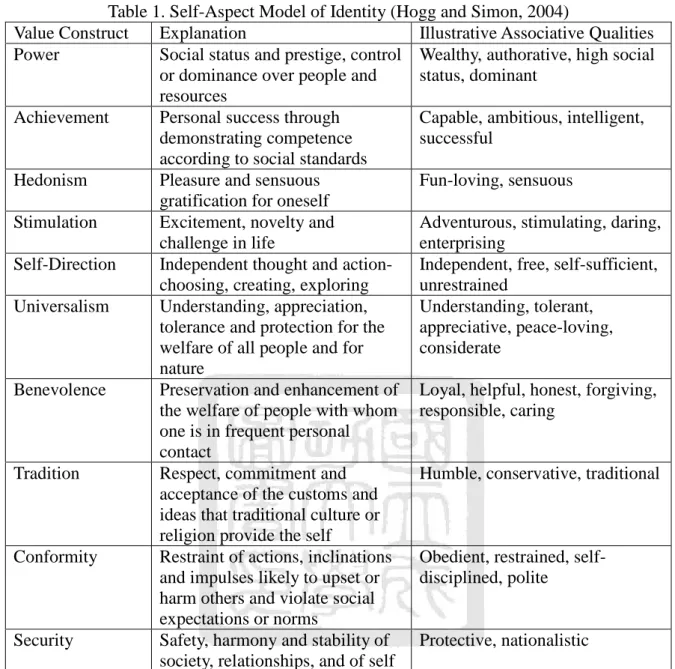
(28) He is in constant contact with the self-proclaimed nerdfighter community, which consists of a large amount of teenagers. Paper Towns is also set in Orlando, Florida, which is where he grew up. While he says that none of the characters from the novel are strictly from any one person, he says that he takes a lot from different people he has known to form the characters of his novel (Green, 2008a). Tammara Webber is also closely connected to her writing community. She worked on a university campus as an undergraduate advisor. As an undergraduate she did the job that one of the main characters did in the novel. She states that while she was not a member of a sorority, as an advisor she had several students that were in sororities, and also a number of friends of her gave her detailed information about living in a sorority. Through both personal experiences and friends’ stories she developed the narrative for the story. Another aspect introduced by Spencer-Oatey from the field of psychology was the Self-Aspect Model of Identity originally proposed by Hogg and Simon (2004)). This model of identity allows us to consider the face identity of participants. Using this model, we can classify individuals based on their face wants and their sense of identity. Each value construct with the exception of hedonism refers to a classification of a type of personality: Self-enhancement, Openness to change, Self-transcendence, and conservatism. Hedonism falls outside this field of purview as it is individualistic and ignores the conventions of purposes outside the desire of entertainment.. 27.
(29) Table 1. Self-Aspect Model of Identity (Hogg and Simon, 2004) Value Construct Explanation Illustrative Associative Qualities Power Social status and prestige, control Wealthy, authorative, high social or dominance over people and status, dominant resources Achievement Personal success through Capable, ambitious, intelligent, demonstrating competence successful according to social standards Hedonism Pleasure and sensuous Fun-loving, sensuous gratification for oneself Stimulation Excitement, novelty and Adventurous, stimulating, daring, challenge in life enterprising Self-Direction Independent thought and actionIndependent, free, self-sufficient, choosing, creating, exploring unrestrained Universalism Understanding, appreciation, Understanding, tolerant, tolerance and protection for the appreciative, peace-loving, welfare of all people and for considerate nature Benevolence Preservation and enhancement of Loyal, helpful, honest, forgiving, the welfare of people with whom responsible, caring one is in frequent personal contact Tradition Respect, commitment and Humble, conservative, traditional acceptance of the customs and ideas that traditional culture or religion provide the self Conformity Restraint of actions, inclinations Obedient, restrained, selfand impulses likely to upset or disciplined, polite harm others and violate social expectations or norms Security Safety, harmony and stability of Protective, nationalistic society, relationships, and of self These aspects of identity constitute self-image. Self-image is constituted by three types: individual (mentioned in the self-aspect model), relational and collective (both are mentioned within the behavioral expectations and societal rights-obligations). This selfimage can be seen in: personality traits, abilities, physical features, behavioral characteristics, ideologies, social roles, language affiliations, as well as group membership roles. These self-images develop the core identities of people and how they relate to a vast range of situations. In discussing the character’s self-image, it is our hope that we can help give a general category type for the types of subjects examined within this research.. 28.
(30) In 3.1.1 and 3.1.2 we will use Hogg and Simon’s classification of self-image to try to understand the relations and identity types existent within the two novels. This type of analysis gives us a better understanding of the behavioral expectations that characters have of others as well as their rapport dynamics situated within their friendship paradigms. 3.1.1 Paper Towns Paper Towns follows the life of an 18 year old boy, Quentin Jacobsen. The novel establishes early on that Quentin and his friends are not part of the popular kids. Quentin has a crush on his neighbor and classmate Margo, but is unable to approach her. Margo is the proclaimed leader of the cool kids, and Quentin’s only connection to her is that she is his neighbor and as 9 year olds they both discovered a suicide victim in the park. One night, she knocks on his window asking him to go out on a late night of delinquency. He emerges from the night of mayhem with a newly revitalized identity and believes that his becoming more of a risk-taker will lead him and Margo to being together. However, Margo disappears the next day. Lacey, one of the victims of Margo and Quentin’s spray paint vandalism is not angry at Quentin, but hopes that he might be able to help her find out more about Margo’s disappearance. Lacey’s new inclusion to the group, results in Ben and her hooking up and going to the prom together. Ben develops from band geek to a more confident and motivated party kid. Margo sees Quentin as weak for his fear and desire to conform to community standards set by others. She initially looks at her relationship with Quentin as mentor/tutee, often at times trying to manipulate him into seeing things from her perspective. By the end of the novel, however, we find her losing strength in her conviction to project herself as strong and individualistic.. 29.
(31) After the night out with Margo, Quentin takes on a self-transcendence identity: focusing more on justice, moral integrity, and loyalty. Lacey’s personality pulls from three different types of identities: loyalty, power and stability. Ben also comes from two of the three same categories: loyalty, and power, but is different in his marked need for stimulation. Their close friend, Radar, has a strong sense of self-enhancement as Quentin did prior to his adventure with Margo. He also holds a strong sense of loyalty and helpfulness from the benevolence category. We also see Quentin with his strong sense of justice and power, attempting to control his friends and getting angry at them for not following his lead. Quentin is more likely to listen to Radar, than he is to listen to Ben. Ben uses a lot of humor to situate himself within the friendship dynamic. This comes to his benefit when navigating potentially face threatening encounters in the novel. His encounters with Lacey seem to be heavily based on humor exchanges, and when not based on humor, they are based on both. 3.1.2 Easy The second novel is Easy. The novel mainly takes place on a state university campus. As with Paper Towns, the protagonist is also the narrator. Jacqueline is a 20 or 21 year old woman. Her boyfriend of almost 3 years, who she followed from high school, has just broken up with her to chase other girls. Most of the people that were friends with them as a couple have chosen to continue to be friends with him and have cut ties with her, in some cases completely ignoring her presence. As a result, she has a small group of friends, Erin, her best friends, Maggie, a sorority sister of Erin, and Benji, a classmate she befriends. He ex-boyfriend, Kennedy, is a well-recognized member of a fraternity, which makes it difficult for Jacqueline to completely avoid people that knew her as his girlfriend. Erin, her best friend and dorm roommate is also a member of a sorority, which makes it impossible. 30.
(32) all together to avoid the fraternity members. Jacqueline follows the benevolence paradigm, and is very courteous, but struggles with the notion of balancing security, stimulation and hedonism throughout the novel. This is a consistent marker of emerging adulthood research that emerging adults are in the most experimental periods of their lives. Her best friend, Erin is emblematic of the selfenhancement type. She holds strong to having a strong sense of power and achievement, but also is invested in the openness to change type. At times these two parts of her personality are at odds with one another. Maggie in her appearances in the novel shows a strong desire for fun and stimulation. Benji, the classmate, follows closer to the selftranscendence type, as he goes out of his way to be truthful and is helpful to and protective of Jacqueline. Lucas, the love interest, has a strong sense of self-transcendence as well, but is also invested in his personal security, which puts him at odds with him being openly honest. Kennedy, the ex-boyfriend, follows the self-enhancement type strongly, but experiments with hedonism, which is why his relationship with Jacqueline is broken off. The challenges that they face in this novel revolve around Buck’s constant attempts to get Jacqueline alone; Kennedy’s attempts at hooking back up with Jacqueline; and also a number of secrets that get exposed that test Jacqueline’s relationship with Lucas as well as her relationship with her best friend Erin. The revelation of these secrets causes a great deal of consternation for the characters of the novel. 3.1.3 Novel Comparison Communication in the two novels as introduced in 3.1.1 and 3.1.2 is heavily based on the level of rapport between the interlocutors and how the personality types of the interactants either come together or differ. One similarity within both novels is that there is a character that has a strong agenda and is inclined to controlling other characters. In Paper. 31.
(33) Towns, the character, Margo, is not supportive, but instead rather abusive when characters disagree with her. On the other hand, Erin, from Easy, is very supportive of her friends, in Easy. This could be representative of the difference between maturity levels or personality types. We will further explore the differences between the characters in chapters 4 and 5. The situations of both novels display a level of drama, but the contextual settings are representative of the difference between the beginning phase of emerging adulthood in Paper Towns versus the middle stage of emerging adulthood in Easy. Paper Towns starts in the middle of the last semester of the characters’ senior year of high school. The characters in the novel try to assert their individual identities while maintaining friendships with one another. Ben, Radar and Quentin maintain their friendship by eating lunches together, meeting at their lockers, and playing video games together. Easy has a different dimension of drama. Easy begins with the attempted rape of the main character, and her subsequent rescue by the love interest of the novel. The characters are not trying to assert individual identities in their relationships with each other, as much as is observed in Paper Towns. Rather the characters seem to try harder to fit into their collective groups. This is further exemplified by the events that take place concerning the fraternity sorority scenes. While the characters in Paper Towns try to help Quentin with the major event of trying to find Margo, the characters from Easy also try to help Jacqueline: a) deal with her breakup with Kennedy; b) find a new boyfriend; c) deal with Buck and his constant advances. These two novels will give us the data we need in order to analyze long interactional exchanges between interlocutors. These novels are chosen based on the ages of the characters. The characters from Paper Towns belong to the beginning phase of emerging adulthood, whereas the characters from Easy are in the middle phase. Based on the literature we reviewed in Chapter 2, it was determined that the best way to judge rapport within emerging adulthood was to look at two phases in order to compare and contrast. 32.
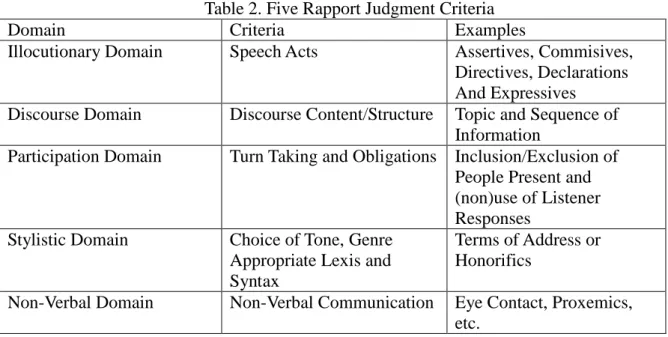
(34) them. The following sections will elaborate on the analytical framework that will make up our study.. 3.2. The five Domains We will look at the five judgment criteria for determining friendship and rivalry. dynamics in the study: illocutionary domain, discourse domain, participation domain, stylistic domain, and non-verbal domain. These five criteria are further broken down into a series of analytics as can be seen in Table 2.. 33.
(35) Domain Illocutionary Domain. Discourse Domain Participation Domain. Stylistic Domain. Non-Verbal Domain. Table 2. Five Rapport Judgment Criteria Criteria Examples Speech Acts Assertives, Commisives, Directives, Declarations And Expressives Discourse Content/Structure Topic and Sequence of Information Turn Taking and Obligations Inclusion/Exclusion of People Present and (non)use of Listener Responses Choice of Tone, Genre Terms of Address or Appropriate Lexis and Honorifics Syntax Non-Verbal Communication Eye Contact, Proxemics, etc.. The following analytics in 3.2.1-3.2.4 are meant to try to address the contextually based conventions and protocols and the in-situ relationships of the interactants: 1) the illocutionary domain; 2) the discourse domain; 3) the participation domain; 4) the stylistic domain; and 5) the non-verbal domain, which will be combined with the discourse domain as both domains concern backchannels. 3.2.1 Illocutionary Domain The first and the largest of the five domains that will construct the analytical framework of friendship versus rivalry in this study is the illocutionary domain. This is demonstrated in speech acts. Illocutionary force is the intended meaning or connotation of an utterance. Connotations can vary depending on contexts and speech communities, regardless of reified meanings found elsewhere. Speech acts are verbs that delineate the illocutionary aim or intended meaning of a spoken utterance. They are used in the current study, as a method of looking at the strategic relations that individuals use in trying to communicate their intended goals and how they negotiate within the frameworks of friendship and rivalry (Yule 1996, p. 49). The original theory of speech acts was developed by Austin (1962). His speech acts. 34.
(36) consisted of: verdictives—delivering of a finding, official or unofficial; exercitives—the giving of a decision in favor of or against something; commissives—committing to a future action; behabitives—reactions to other people's attitudes, status or conduct. However, for our current study, we will use Searle (1975) taxonomy, which further refined Austin’s (1962) speech act classification. This study will use Searle (1975) taxonomy of speech acts to categorize speech act groups within the friendship and rivalry interactions. Speech acts within this research will also use a second taxonomy from Wierzbicka’s (1987), which breaks speech acts into speech act groups. These speech act groups will be categorized by Searle (1975), but for the purpose of our analysis in chapter 4 will be further broken down into the constituent individual speech acts. Speech act groups provide a grouping mechanism for a variety of speech acts that adhere to a specific task. The subsequent speech acts are specifically attenuated to a purpose and are markedly different than the other shared speech acts within their group type. Two speech act groups from Wierzbicka (1987) will not be used: Baptize, which relates to a specific religious ceremony; and talk, which is subsumed into other groups: including tell1, thank, and assert. Using Searle (1975) taxonomy, the speech act groups from Wierzbicka’s Speech Act Dictionary will be demarcated into five types: assertives are truth based conditionals; directives cause interlocutors to perform an action; commissives commit the speaker to a future action; expressives demonstrate the speaker’s feelings towards an event or individual; declarations change reality by being spoken: as in the case of a policeman reading someone’s Miranda rights or an officiant pronouncing someone husband and wife (Searle, 1976, p. 354-56). Searle’s (1975) speech acts typology is a well-respected and will be used for our methodology for speech acts, but we use a modified typology based on the suggestions. 35.
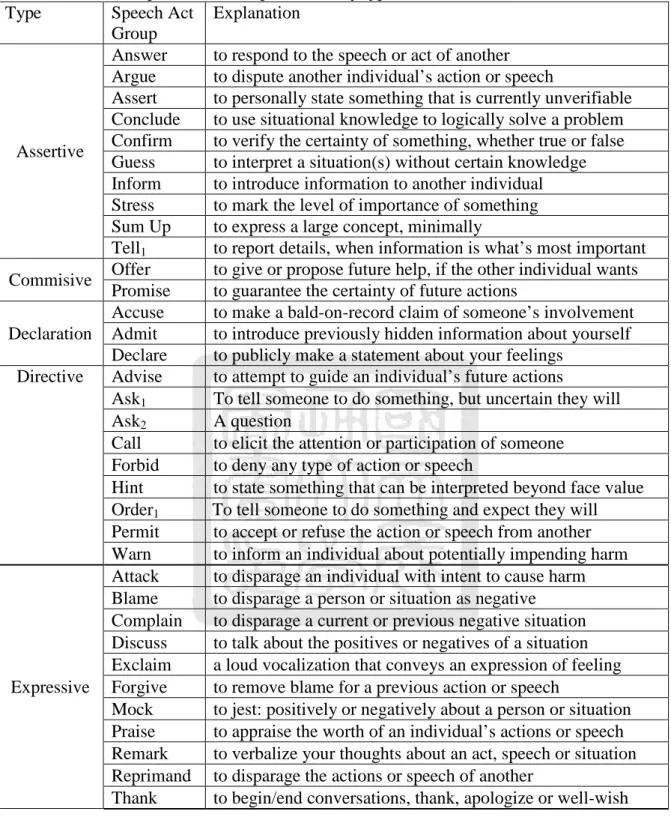
(37) from Goddard (2011). Goddard (2011) pointed out several problems with the ‘Searlean approach’ not only evinced in Searle’s original approach, but also in the research by popular speech act researchers Bach and Harnish (1979). Goddard blames this on the “descriptive metalanguage employed”. He states Searle’s definition of an action of promise fails due to its ambiguity. Goddard also questions explicitly what obligation would be relevant to suit this description and what modus operandi would be necessary to suit the criteria for asserting it. Goddard recommends Wierzbicka’s (1987) English Speech Acts Verbs: A Semantic Dictionary for several reasons. The rationale for his choosing Wierzbicka is that it constitutes 250 separate speech-act verbs, “comprising reductive paraphrases of each, using more simpler and more systematic paraphrasing metalanguage”, which can help us explore friendship and rivalry elements in depth without concern of a limited taxonomy as most researcher only look at small groups of speech acts in isolation (Goddard, 2011, p. 49). In agreement with Goddard (2011) speech acts within this research will also use the taxonomy from Wierzbicka’s (1987), and then Searle’s (1975) overall classification to group them according to speech act group types. Table 3 categorizes the speech acts from Wierzbicka (1987) according to their placement within Searle’s (1975) taxonomy, along with a short explanation for each group.. 36.
(38) Table 3. Speech Act Groups situated by type (Wierzicka, 1987; Searle,1975) Type Speech Act Explanation Group Answer to respond to the speech or act of another Argue to dispute another individual’s action or speech Assert to personally state something that is currently unverifiable Conclude to use situational knowledge to logically solve a problem Confirm to verify the certainty of something, whether true or false Assertive Guess to interpret a situation(s) without certain knowledge Inform to introduce information to another individual Stress to mark the level of importance of something Sum Up to express a large concept, minimally Tell1 to report details, when information is what’s most important Offer to give or propose future help, if the other individual wants Commisive Promise to guarantee the certainty of future actions Accuse to make a bald-on-record claim of someone’s involvement Declaration Admit to introduce previously hidden information about yourself Declare to publicly make a statement about your feelings Directive Advise to attempt to guide an individual’s future actions Ask1 To tell someone to do something, but uncertain they will Ask2 A question Call to elicit the attention or participation of someone Forbid to deny any type of action or speech Hint to state something that can be interpreted beyond face value Order1 To tell someone to do something and expect they will Permit to accept or refuse the action or speech from another Warn to inform an individual about potentially impending harm Attack to disparage an individual with intent to cause harm Blame to disparage a person or situation as negative Complain to disparage a current or previous negative situation Discuss to talk about the positives or negatives of a situation Exclaim a loud vocalization that conveys an expression of feeling Expressive Forgive to remove blame for a previous action or speech Mock to jest: positively or negatively about a person or situation Praise to appraise the worth of an individual’s actions or speech Remark to verbalize your thoughts about an act, speech or situation Reprimand to disparage the actions or speech of another Thank to begin/end conversations, thank, apologize or well-wish In order to explicate Table 3, we will look at a few examples within interactional exchanges representative of friendship and rivalry evinced within the two novels that follow the five categories: assertives, commisives, declarations, directives, and expressives. The first group we will explore is the assertive group. Those speech acts falling into the. 37.
(39) assertive group exhibit an assertion by the speaker as to a perceived knowledge about the constitution of a target topic. Two speech act groups from the assertive category: assert and guess can be seen in Excerpt (i) taken from Paper Towns. The assert appears within Margo’s statement that the target subject is not known for her personality or generosity of spirit [1], and the guess follows after the comma, it’s probably because she’s hot [1-2]. Excerpt (i) 1 Margo 2. Well, she’s not known for her personality or generosity of spirit, so it’s probably because she’s hot.”. Excerpt (ii) depicts the commisive and expressive speech act group types. Commissives are speech act groups that either a) offer a service, or b) guarantee future service. These are expected to occur in friendship building relations. Expressives, on the other hand, express the speaker’s emotional state to their interlocutor, which can be positive to the interlocutor or contrarily judgmental. It is our opinion that expressives will most likely occur within rivalry relations. In the following example we can see one speech act group from the commissive category, offer, and one from the expressive category, praise. These type of speech acts are expected to occur within friendship building rapport orientations: specifically rapport enhancement. The example of Praise begins the dialogue as thanks for your hard work and dedication on this remarkable evening [1-2]. The offer in this example I would like to give you a small gift. [2]. Excerpt (ii) 1 Margo 2 3 4. Hey, speaking of tomorrow, as thanks for your hard work and dedication on this remarkable evening, I would like to give you a small gift. [Margo dug around beneath her feet and then produced the digital camera] Take it, and use the Power of the Tiny Winky wisely.. The fourth group we will explore in Excerpt (iii) is the declaration group type. Speech act groups from the declaration group publicly declare the speaker’s thoughts on a particular topic. An example of declaration speech act group: accuse is visible throughout. 38.
(40) the entirety of the example’s discourse Excerpt (iii) 1 Jacqueline 2. You want me to come to Thanksgiving lunch and pretend we’re all fine, just so you don’t have to tell your parents we broke up?. The final speech act group type that we will look at in Excerpt (iv) is in the form of directives. Directives define those speech act groups that show a speaker attempting to direct the action of their interlocutor. An example of three directives, permit, advise, and ask2 will be shown in the following example. The permit is evinced by Erin’s opening line Okay. We’ll make Landon Plan B [1], and the advise shows up after the non-verbal display of suspicion by Erin, What do you really know about this Landon guy? [2-3]. It may not be apparent why this would be an advise type, but as each group is constituted of several speech acts, we can further analyze this advise to determine the advise is a SUGGESTION that Jacqueline may not know Landon as well as she thinks. Excerpt (iv) 1 Erin 2 3 4 Jacqueline. Okay. We’ll make Landon Plan B. [Erin eyed Jacqueline, wearing her conspiracytheory expression—eyes narrowed, lips puckered] What do you really know about this Landon guy? [Jacqueline laughed]. The illocutionary domain in Section 3.2.1 situates itself as a major key to our friendship and rivalry research. As such the illocutionary domain can be thought of as an independent analysis in answering research question 2: effectively trying to identify which speech acts are most commonly associated with friendship and likewise rivalry. The first research question will use the illocutionary domain in combination with the other four domains; looking specifically at what interactional patterns occur throughout positive and negative rapport encounters, and how empathetic disclosures are attenuated to within the two novels across the rapport types. Research question 3 will look at all the domains in terms of how interlocutors respond to empathetic disclosures which belong to the stylistic domain.. 39.
數據
+6
相關文件
make a big stink about refusing to put it on their tim esheet, just letting the feature they were working on slip, because they refuse to pad their estimates which were
make a big stink about refusing to put it on their tim esheet, just letting the feature they were working on slip, because they refuse to pad their estimates which were
It is hereby certified all the goods were produced in Taiwan and that they comply with the origin requirements specified for those goods in the generalized system of
During these two years of secondment, problems arose when devising the examples of STEM learning and teaching activities from central mathematics curriculum that supported
These findings suggest that when teaching small classes many teachers were still experimenting with different approaches, even after three years, while in normal classes there
The physicists proposed that these six dimensions were curled up into a miniscule space, which they called Calabi-Yau space — part of the same family of spaces, which Calabi
Manufacturers often provide retailers with aids that they can use in their advertising, publicity, and public relations. They might use one or more of the following
Notice that if the dx in the notation for an integral were to be interpreted as a differential, then the differential 2xdx would occur in (1) and so, formally, without justifying our
