Literature Review
This chapter reviews literature in both services marketing and interpretation studies.
It begins in the first section with the distinction between goods and services, composition of a service product, and features of professional services. The second section categorizes various interpretation activities, introduces interpretation services as a package comprised of more than on-site interpretation, and determines whether conference interpreting counts as a professional service. The third section provides definitions of quality and customer satisfaction by marketing scholars and two of their assessment tools—CIT (the critical incident technique) and script methodology. The last section of this chapter portrays the landscape of an interpretation event by identifying its various stakeholders, and reviews studies on concerns of each stakeholder pertaining to interpreting quality.
2. 1 From Services to Professional Services
This section consists of three portions: the distinction between goods and services, composition of a service product, and features of professional services.
2. 1. 1 Distinction between goods and services
An abundance of literature in marketing has been devoted to drawing a line of distinction between goods and services. Scholars have agreed on four generic differences—intangibility, inseparability, variability, and perishability (Parasuraman, Zeithaml & Berry, 1985; Edgett & Parkinson, 1993), which are explained in the following paragraphs.
The first feature of service is intangibility. Products inherent with intangibility cannot be touched, tasted, smelled, seen, or owned (Edgett & Parkinson, 1993; Lovelock,
2001). Marketing academics (e.g. Edgett & Parkinson, 1993; Klein & Lewis, 1985) suggest that for a business activity or product to be categorized as a service intangibility is an indispensable element.
The second feature is variability, also referred to as nonstandardization or
heterogeneity, means inconsistency in the service performance and customers’ perceived quality (Alford, 1993). For example, a theatrical performance cannot be staged twice in exactly the same manner with exactly the same effect on the audience.
The third feature is inseparability of service production from consumption. The consumer’s absence or lack of participation in service production may result in disruption or failure of a service operation (Bateson, 2002). As the haircut experience demonstrates (Hubbert, Sehorn, & Brown, 1995), both the barber and the patron have to be meeting in the same place and at the same time for the haircut service to be completed.
The fourth feature is perishability. It means that services, unlike goods, cannot be stored for use at a later date and therefore must be consumed when produced (Edgett &
Parkinson, 1993). For example, a hotel cannot store an empty room.
The presence of these four features in a product—intangibility, variability, inseparability of service production from consumption, and perishability—may help to determine whether it is provided by the manufacturing sector as a good or by the service sector as a service. The service sector further branches into a wide variety of industries, which differ from one another in the composition of the service product.
2. 1. 2 Composition of a service product
A service product consists of a bundle, including the core product that the customer buys and the set of supplementary services that often accompany that product. For example, a seat on the flight is the core product of the airline industry, and it may provide
supplementary services, such as meals, audio-visual entertainment, etc. Lovelock (2001) suggests services are traditionally grouped by industry depending on the core product a business offers. Determined by the purposes for which they are created, supplementary services, are divided into two categories. One is to facilitate use of the core service; the other is to enhance the appeal of the core service (Eiglier and Langeard, 1977). Several scholars have elaborated on the relationship between core and supplementary services.
Shostack (1977) puts forth a molecular model, in which a good or service is compared to a molecule with the core benefit in the middle and the other components of the service event surrounding it, and suggests the nature of the molecule is bound to alter in the event of change in any of its elements. Focusing on the analysis of supplementary services, Grönroos (1990) proposes they are either facilitating or supporting. In addition to demonstrating similar ideas by likening the service items on the peripherals to petals of a flower, the Flower of Service concept (Lovelock, 2001) illustrates major functions that a wide array of supplementary services share and embodies the temporal dimension of a service process. Lovelock argues even though supplementary services in various forms in fact fall into eight categories—information, consultation, order taking, hospitality, caretaking, exceptions, billing, and payment, which surround the core service like petals around the pistil in the sequence in which consumers may encounter. He goes on
maintaining that how well supplementary services fit into a particular service offering along with the core product determines customer satisfaction.
It may be assumed that only when the core product and the supplementary elements are closely-knit in a service package can a provider rest assured that it will lead to
customer satisfaction. A satisfactory service comprises not merely the service provider’s acceptable performance but also the presence of the facilitating services as well as the innovative and distinctive supporting ones, as evidenced by a probe into the contributing
factors of flight passengers’ satisfaction and dissatisfaction (Naumann and Jackson, 1999;
as cited in Lovelock, 2001). A list of twenty-two essential needs in air travel was first drawn up in a survey of an airline’s 2,500 passengers. Subsequently, participants of a series of focus groups identified from list the factor whose failure might upset them and the one whose success might please them. Of the twenty-two factors, fourteen had been classified as hygiene factors, service elements that are supposed by customers to be in place; the others as enhancing factors, supplementary services that differentiate a service business and maximizes its appeal. Taking good care of the hygiene factors reduces the odds of complaints from customers, but does not optimize their experiences. Great satisfaction stems from the delivery of enhancing factors which outperforms general expectations under the premise of effective performance of the core service. It is
important to note, nevertheless, the label of an element in a service package may not be as fixed as imagined. An enhancing factor may end up a hygiene factor as the reputation of a service provider’s innovative design spreads far and wide and eventually breeds a bunch of copycats in the industry (Lovelock, 2001).
The first two portions have stated the four features that distinguish services from goods, and further describe how the core product and supplementary services are put together as a service offering. The next portion will discuss an alternative method with which scholars determine whether a product in question is a good or service.
2. 1. 3 Professional services
Scholars determine whether a product is a good or service not only by examining the presences of the four essential features but also by the level of difficulty in evaluating its quality prior to consumption. Zeithaml (as cited in Lovelock, 2001) constructed a continuum spanning from “easy to evaluate” on the far left to “difficult to evaluate” on
the far right upon which both goods and services can be placed or located according to their proportions of three distinctive groups of attributes: search, experience and credence.
Goods, high in search attributes, such as the taste of fried chicken and the image clarity of an LCD TV, are clustered to the left; on the other hand, services are located towards the right, richer in experience and credence attributes. Vacationers usually cannot decide how satisfying a travel package is until the journey is over, which exemplifies experience attributes. Still buyers of some services, such as dentistry, mutual funds, and legal advice, cannot arrive at a conclusion about quality with confidence even after consumption, for these are predominantly composed of credence attributes. Namely, customers have no better choice but to trust the service provider for delivering or having delivered the desired benefits since they do not possess adequate knowledge or expertise to evaluate or judge (Lovelock, 2001). Furthermore, the distinction between experience and credence attributes separates professional services from generic ones (Hill & Neeley, 1988; Thakor
& Kumar, 2000).
Scholars did not take their curiosity about professional services a step further until the late 1970s. Gummesson (1978) laid down the corner stone for subsequent
investigations by proposing the following definition:
The service should be provided by qualified personnel, be advisory, and focus on problem solving; the professional should have an identity, i.e., be known in the market for his specialties and under a specific name such as ‘architect’; the service should be an assignment from the buyer to the seller; and the professional should be independent of suppliers of other services or goods. (p. 90)
Two years later, it was modified with the addition of “[the professionals] are regulated by traditions and codes of ethics” (p. 108) Fundamental as the definition is, the mystery regarding “qualified personnel” persists. As if spelling out Gummesson’s concept,
Hill and Neely (1988) added, “professionals possess higher educational preparation and exercise expert judgment in delivering the service…historically have not perceived themselves to be sales or market oriented” (p. 18). Lovelock (2001) has further elucidated by positing that “professionals such as doctors, architects, and lawyers often display their degrees and other certifications…[for] customers to see the credentials that qualify them to provide expert service” (p. 119). These remarks all suggest that trust in service providers is integral to the professional service, and to earn it from customers, they usually have to be qualified through formal schooling, rigorous training, or stringent testing (Hausman, 2003, p. 227).
While professional services in general are credence-based for consumers’
incapability of discerning the best candidate in advance and afterwards determining the service quality, it does not stop them from doing so. Hill and Neely (1988) suspect that the pre-consumption inability results from rare purchase of a particular professional service, and ascribe post-purchase evaluation difficulty to the following factors: First, consumers cannot make sure if their problems are solved or their needs met with correct procedures. Second, consequences of malpractice do not surface immediately. The last, which is actually a ramification of poor service quality even though listed as a cause, is no remedy for a service failure is desirable, if there is any. Despite the lack of required knowledge to make an effective judgment on technical quality—performance of the core service, customers are able to do so on functional quality—the manner in which the core service is delivered. They assume a professional’s apparent knowledge, credentials, and perceived experience are reliable indicators of his/her competence (Grönroos, 1990;
Hausman, 2003; Lee, Delene, Bunda & Kim, 2001). In addition to different difficulty in evaluation, professional services differ from generic ones in the consumer’s decision process.
Zooming in on the decision process, Hill and Neely (1988) have managed to magnify the fine line between generic and professional services. First, in terms of problem recognition, a patron of a laundry store whose white shirt has got an ink stain does not need the clerk to help identify the spot and advise him to remove it; however, a patient with a common symptom such as a fever relies on a doctor to diagnose him/her with a specific disease and prescribe a potent medication. Second, during the search process, given the high financial stake in seeking for professional assistance, consumers are willing to expend tremendous effort acquiring information on proper evaluative criteria, available alternatives and the qualifications of practitioners. They depend to a great extent on referrals and personal recommendations. Third, clients of professional services may not be as privileged as their generic counterparts to shop around. For example, if a passenger does not like services on the train, s/he may take a bus instead.
However, a patient can avoid a certain dentist but cannot seek out a plastic surgeon for root canal treatment despite his distrust in or traumatic experiences with dentists.
Moreover, a patient might need more than one canal treatment in the past to establish his own evaluative criteria and screen for the best dentist. Even after the choice is made, the outcome is not guaranteed to be exactly as expected. Finally, unintended consequences in a professional service encounter are normally perceived by the consumer to be graver than in a generic one. They are usually irreversible, and undesirable even if otherwise.
More recent researches investigated the relationship between the price factor and professionalism, and argued that consumers may be less sensitive about prices of services they perceive as professional and thus intending to verify extant propositions regarding constituents of professionalism. Thakor and Kumar (2000) looked into American and Canadian consumers’ perceptions of the professionalism of fourty-two services, and discovered the following:
Perceptions of service providers’ professionalism are significantly correlated…with perceptions of the expertise of the service, the extent to which the service is
perceived to have credence qualities, the extent to which it is perceived to be critical, the extent to which recommendations are considered important in selecting a
provider, and with a lack of clarity regarding the service needed from such providers. (p. 71)
Of the six problems identified by Bloom and Dalpe (1993) which confront marketers of professional services, four of them bear high relevance to the confirming process of what differentiates professional services from generic ones or what constitutes professionalism. First, purchase of a professional service is credence buying. Second, most patrons’ demand is sporadic, infrequent, emergent, unpredictable. However, “buyers tend to remain loyal to old vendors because they don’t want to risk making a credence purchase by trying someone new”. It must be recognized that “the opportunities for attracting new clients may be few and far between; they cannot count on achieving a steady flow of new customers at any time in the future ” (p. 26). Third, to enable a profession to thrive, professionals must not only undergo a usually lengthy and demanding education or a complicated certification process, but also adhere to strong codes of ethics. However, formidable challenges or survival threats arise when a different group of competitors start to play by different rules and norms, e.g. architects vs.
designers, physicians vs. chiropractors. Fourth, clients of professional services feel more comfortable about the purchase when they have the opportunity to know the service provider in person, whereas a majority of professionals opt to save their own time and energy and instead free ride on colleagues’ marketing efforts.
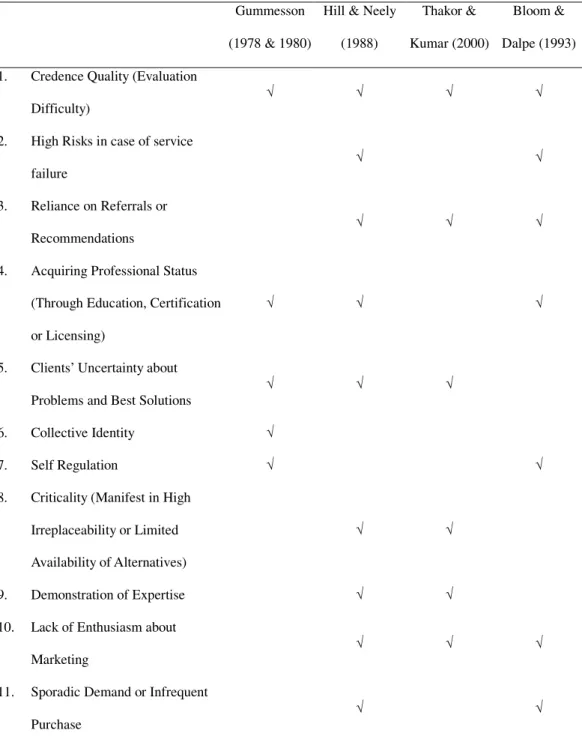
All the aforementioned propositions and discoveries have shed light on knowledge of professional services and are organized into Table 2.1.
Table 2. 1 A Comparison of Propositions Regarding Professional Services
Gummesson (1978 & 1980)
Hill & Neely (1988)
Thakor &
Kumar (2000)
Bloom &
Dalpe (1993) 1. Credence Quality (Evaluation
Difficulty)
2. High Risks in case of service failure
3. Reliance on Referrals or Recommendations
4. Acquiring Professional Status (Through Education, Certification or Licensing)
5. Clients’ Uncertainty about Problems and Best Solutions 6. Collective Identity
7. Self Regulation
8. Criticality (Manifest in High Irreplaceability or Limited Availability of Alternatives) 9. Demonstration of Expertise 10. Lack of Enthusiasm about
Marketing
11. Sporadic Demand or Infrequent Purchase
2. 2 Conference Interpreting as a Professional Service
It requires understandings of interpretation itself, working contexts of the service,
and its consumer and provider to set the stage for the quest of the causes leading to employers’ satisfaction and dissatisfaction with interpretation service.
2. 2. 1 Introduction to interpreting services
Prior to addressing any issues regarding interpretation service, some explanations ought to be provided to avoid a potential confusion over the use of interpreting or interpretation. As defined by Riccardi (2002), interpretation refers to “interlinguistic mediated communication” and interpreting is “understood as the mental process and communicative act of reproducing orally in a target language what a speaker is expressing in a source language” (p. 75). Some scholars may argue for significant differences in nuance or pragmatic use between interpretation and interpreting; however, they are both essential ingredients in the recipe of service, with which interpreters provide their employers. Be the emphasis placed upon communication or reproduction of messages, almost no dispute would arise over the use of these two terms in the service context.
Therefore, they are used interchangeably throughout the thesis.
Interpretation, according to the very last definition of the word by Random House Webster’s Dictionary, means oral translation, which may suggest a good majority of the public lacks the awareness of the distinction between translation and interpretation.
Simply put, translators produce written translations while interpreters provide spoken interpretations (Phelan, 2001). Interpretation in most cases is understood as an act of explaining an intricate or obscure work in an explicit manner. Communicating a speaker’s messages to a listener or more of another language may at times arguably entail
unraveling the original intent and rendering it in plain and understandable language.
However, interpretation throughout this study restrictively refers to a means of
communication taking the form of spoken language between or among people of different
languages and cultures (Seleskovitch, 1978).
Researchers of interpretation studies have proposed several ways of categorizing various interpreting activities. As interpreters started to join the interpreting research community in the 1970s, Seleskovitch (1978) simply divided interpretation into two types—consecutive and simultaneous, and throughout her book focused her discussions on conference interpretation. In the ensuing decades, many other forms of interpreting activity have come into being or the notice of academics. Yang (2000) has based her classification scheme on the job descriptions of various employment offers proposed to interpreters. Included in the scheme are escort interpreting, in-house interpreting, court interpreting, conference interpreting, and broadcast interpreting. The scope of interpreting research has certainly broadened to take into account the significance of environments in which interpreters are working; however, interpreting unequivocally extends far beyond the boundaries imposed by these classifications. Phelan (2001) claims that there are three types of interpreting: bilateral or liaison, consecutive, and simultaneous; however, to the descriptions of these three types she adds conference interpreting, whispered
interpreting—a.k.a. chuchotage, sight translation, telephone interpreting, sign language interpreting, television interpreting, videoconference interpreting, and wiretapping and tape transcription. No explanation is available with regard to the confusion resulting from the inconsistency between her claim and classification. Riccardi (2002) has succinctly mentioned four forms of interpreting—liaison interpreting, consecutive interpretation (CI), simultaneous interpretation (SI), and media and remote interpreting. When outlining the feature of liaison interpreting, she suggests that “community interpreting and court interpreting present similar conditions and objectives but are used in different social environments” (p. 75). Referring to media and remote interpreting as a derivative from simultaneous in the era of modern technology, she posits the prototype allows interpreters
to stay physically closer to the communicative event and contact more with the
participants. Except Yang, the above researchers have neglected to justify their ways of categorization. Moreover, whereas Seleskovitch may have enlightened her readers on the two major formats in which assorted interpreters work at the expense of overlooking interpreting outside the conference room of international organizations, Phelan and Riccardi could have perplexingly mixed up how interpreters work and where they work.
Hsieh (2003) has managed to prevent confusing categorization by drawing a line of distinction in advance. This line lies between how interpreters work and where they work, respectively denoted by mode and type. Modes of interpretation include SI and CI, and types of interpretation conference, court, television, etc.
2. 2. 1. 1 Modes of interpretation
Interpretation is carried out in three most common modes—consecutive
interpretation, consecutive interpretation, and whispering. Each is distinctive from one another, and adopted in accordance with the employer’s needs after he or she takes into account their pros and cons, as described in the following paragraphs (Ru, 1996; Zhou &
Chen, 1995).
2. 2. 1. 1. 1 Consecutive interpretation
Consecutive interpretation is considered the most primitive and prevalent mode (Zhou & Chen, 1995). Interpreting activity can probably date back as early as human beings of different tongues started to realize the need to improve ineffectiveness and inefficiency of communication among themselves (Niska, 2002; Seleskovitch, 1978). In the West, French had been the language of choice or of designation on formal occasions until representatives of the great powers were gathered in the peace talks in the aftermath
of the WWI. Some of them did not speak French, and “consecutive interpreting was the order of the day” (Phelan, 2001, p. 2) Despite the term’s inherent obscurity, the bell immediately rings in people’s minds on mention of the man or woman captured on TV news, sitting between two heads of state as they engage in formal talks (Zhou & Chen, 1995). The interpreter does not start informing the intended audience of the speaker’s words until they are finished. While the speaker is vocalizing his or her ideas, the
interpreter must listen attentively and store them up in minds. He or she begins to give an account of the story by drawing on the memory or notes when a cue emerges or an opportunity presents itself for him or her to take over the floor from the speaker. The cue or opportunity could be a longer pause in the speech or a transition in ideas. Simple and spontaneous though it appears on the part of the interpreter, the work throughout the alternate deliveries of the speaker and interpreter involves one recurring complicated cognitive process, as clearly depicted in the following model.
1. Auditory perception of a linguistic utterance which carries meaning.
Apprehension of the language and comprehension of the message through a process of analysis and exegesis.
2. Immediate and deliberate discarding of the wording and retention of the mental representation of the message (concepts, ideas, etc.).
3. Production of a new utterance in the target language which must meet a dual requirement: it must express the original message in its entirety, and it must be geared to the recipient. (Seleskovitch, 1978, p. 9)
It may be inferred from several publications that while CI has managed to retain a seat in history of human communication for some favorable reasons, it may start to take a back seat in modern times against the backdrop of globalization and ever-accelerating advances in communications technology for its drawbacks (e.g. Ru, 1996; Seleskovitch,
1978; Shi, 2004; Zhou & Chen, 1995). Event organizers in favor of this mode consider it cost-effective since a single occasion requires only one interpreter, as is the common practice in Taiwan—with the same interpreter translating back and forth between two languages, and basically involves no interpreting paraphernalia. Its modest requirement greatly reduces their spending on interpretation and frees up financial resources for the other functions of an event. Speakers may prefer CI because it allows them to organize their subsequent instructions in a workshop, mull over appropriate responses to pointed questions from the press, ponder upon the terms proposed by their negotiating
counterparts, or take a break now and then during a big day while interpreters are doing their jobs (Shi, 2004; Zhou & Chen, 1995). However, Seleskovitch (1978) has proposed that the nature of CI limits its applicability to bilingual conferences, as suggested by AIIC in its Practical Guide for Professional Conference Interpreters (2004), for increasingly frequent exchanges among countries in the world and convenient transportation have fostered the growth in the number of multilingual conferences. In addition, even bilingual occasions are witnessing reductions in the use of CI for its time-consuming attribute. The time budgeted for each speaker doubles, prolongs the rental duration of the venue, and as a result drives up the cost. Members in the audience who understand the original language may grow impatient, and sometimes even speakers may accuse interpretation of
interrupting their flow of ideas or find it agonizingly long and obstructing their attendance to the next engagement.
2. 2. 1. 1. 2 Simultaneous interpretation
Many a document has recorded the popularity of SI and analyzed its complexity (e.g. Moser-Mercer, Lambert, Darò & Williams, 1997; Phelan, 2001; Seleskovitch, 1978;
Weber, 1984). Seleskovitch (1978) has testified in her book that the frequency of CI has
dwindled, citing statistics that “only 10% of interpretation is still done in consecutive” (p.
3). Weber (1984) has even further affirmed that 99% of interpretation is simultaneous according to AIIC’s statistics. However, Zhou and Chen (1995) seemingly contradicted the observation of a downward trend in the use of CI by claiming that it has been the most widely adopted form of interpreting. These claims all ought to be taken with a grain of salt. With the broad definition of interpretation as “communication, i.e. analysis of the original message and its conversion into a form accessible to the listener” (Seleskovitch, 1978, p. 9), interpretation can take place in all kinds of contexts, ranging from
high-profile conferences to private clinics (Niska, 2002). Given the prohibitive cost of simultaneous interpreting equipment and strenuous training of the mind for the skill (Bao, 1998), SI could not possibly have overwhelmingly replaced CI in all sorts of professional domains. Nevertheless, the claims of Seleskovitch and Weber may hold true in a
conference context and even more so in international organizations (Phelan, 2001). In addition to the apparently complicated required installation of interpreting facilities, SI entails much more complexity on the part of the interpreter. Seleskovitch’s model (1978) applies to SI as well. The interpreter listens to the original message, comprehends, stores in mind and reproduces it in the receivers’ language. The only difference between consecutive and simultaneous is all of theses elements—comprehension, retention, reproduction must function at the same instant once the speaker opens her/his mouth.
Daniel Gile in 1995 postulated “Effort Model”, to which he introduced the concept of coordinating the three tasks. The cognitive process of SI can be summarized in one formula: SI = L + M + P +C. L= listening and analyzing. M=short-term memory. P=speech production. C=Coordination. (as cited in Ru, 1996, p. 25) Coordination is “to find the right balance between the different tasks they [interpreters] have to accomplish” and considered “the most striking for the lay person” (Riccardi, 2002, p.76). Demanding
multitasking as such requires full concentration and drains the interpreter’s energy at an alarming rate; consequently, “meaning errors in simultaneous interpretation rise
considerably if interpreters work for long uninterrupted periods” (Mackintosh, 2002). In pursuit of optimal accuracy in simultaneous interpretation, two or three interpreters work alongside in the same language booth. Each renders incoming messages, ideally, for no more than half an hour at a time with the assistance of his/her partners in challenging tasks such as a string of figures or proper names (Phelan, 2001).
The emerging presence of SI on the marketplace is evident, and understandable for its favorable features in comparison with CI. Demand of SI has been projected to rise over time (Yang, 2000). Findings of a research project commissioned by Taiwan’s Government Information Office, through which it hopes to establish the picture of the local industry of translation and interpretation, have indicated simultaneous interpretation has become the staple income source for professional conference interpreters. SI allows a speaker to go uninterrupted, and hence the conference may be perceived to proceed in a more time-efficient manner. Moreover, it can achieve what CI is incapable of—to constantly inform different delegations separately with their preferred tongues almost at the same time as listeners of the original language receive the information. (Zhou & Chen, 1995) SI may also stand out as a form more conducive to a well-done interpreting job from the views of the minimalist school, who believes the best performance is when the least presence of the interpreter is detected (Riccardi, 2002; Snelling et al., 1997), since interpreters are placed in their booths and only acoustically present. While employers of interpretation service may find themselves in favor of SI for the above reasons, its growth of popularity is sometimes faced with the following constraints (Zhou & Chen, 1995).
First, interpreting facilities are expensive to construct and maintain, and still so to rent.
However, they are indispensable if a group of people needs SI service at a conference.
Second, interpreters of some language combination in Taiwan, such as Mandarin and Spanish (Lu, Lü, & Yan, 2002) are hard to come by, not to mention those who can interpret simultaneously. Third, the wording of the interpreted messages may not exactly conform to the expectations of the speaker. In the case of consecutive interpretation, speakers may request clarifications or corrections when they find such discrepancies provided they have adequate knowledge of the target language. Nevertheless, speakers normally are oblivious of interpretation when it is done concurrently.
2. 2. 1. 1. 3 Whispering
Like CI and SI, the advantages and disadvantages of whispering or chuchotage, determine its popularity. The interpreter does not work in a booth but right next to the one or two listeners who do not speak the source language. S/he interprets simultaneously without a colleague to fill in after half an hour and without any equipment. This form of interpretation enables the event organizer to save time and money; however, it does not work as the number of interpretation listeners increases (Zhou & Chen, 1995). In addition, major interpreting training institutes do not recommend aspiring interpreters to engage in whispered interpreting, for they believe the quality of interpretation deteriorates without adequate facilities and reasonable working time (Ru, 1996).
2. 2. 1. 2 Types of interpretation
Interpreting activities can first be broken down to two categories—CI and SI—
based on the interpreting mode, and then further categorized on the basis of the setting, according to Hsieh’s classification (2003). Despite its convenience for the discussions in this thesis, it may have resulted in ambiguity for the adoption of the blanket term—liaison interpreting. In Hsieh’s view, when classified by their settings, interpreting events are
either conference interpreting or liaison interpreting, and many other types of interpreting, including business, court, diplomatic, medical, telephone interpreting, etc., can be
considered the subcategories of liaison interpreting. Her categorization may seem too broad relative to some popular classifying schemes. There are at least three major
divisions: conference interpreting, court interpreting and community interpreting. Roberts (2002), while contending that in consideration of interpreters’ survival issues it does not make much sense to distinguish types of interpreting on the basis of settings, insists that it remains necessary to do so since these three kinds of interpreting are “at very different stages of professionalization”, and merging them into one may well lead to rejections of one another (p. 173). Convincingly as Roberts has argued, the author of the thesis has decided to stick to Hsieh’s categorization for its higher relevance to the research subject.
Roberts has proposed several characteristics of community-based interpreting that may enable its practitioners to forge a unified and unique identity, which may lend itself to the illustrations of not only liaison interpreting but also conference interpreting (2002, p. 161-162). First, interpreters at a conference render their interpretations to participants who “enjoy similar status and power” so that they can freely communicate without speaking one another’s languages whereas their liaison counterparts mediate between two parties of disparate power and status to help “those who do not speak the official
language of a country to have full and equal access to public services.” Second, the role of the conference interpreter is more or less restricted to mediation in language; on the other hand, the liaison interpreter more actively engages in the bilingual communication.
Third, monologues dominate the discourse at conferences, while dialogues, especially questions and answers, constitute the majority of the work in liaison interpreting. Last but not least, liaison interpreting primarily takes the form of short consecutive (in which interpreters may discard the crutch of note-taking because they do not have to wait as
long to interpret); however, conferences usually proceed with the assistance in simultaneous or long consecutive interpretation. It is interesting to note that some scholars have included interpreting in both language directions as a key attribute of liaison interpreting (e.g. Phelan, 2001; Roberts, 2002; Wadensjö, 1998), but in Taiwan even at conferences interpreters have to work into two languages.
2. 2. 2 The core and supplementary services in an interpreting event
Interpretation professional associations are usually entrusted with a two-fold mission—to assure its members’ quality practice by regulating professional behavior, and to acquaint clients with appropriate expectations by negotiating working conditions.
Therefore, some associations have displayed on their websites documents guiding both professional interpreters and conference organizers towards the completion of a
successful event. The websites from which this study collected data include those of the International Association of Conference Interpreters (AIIC), the American Association of Language Specialists (TAALS) and the American Translators Association (ATA). All of them include guidelines, different in form, for interpreters to follow step by step
throughout the course of contact with their clients or prospects. AIIC has taken almost all the stakeholders in an interpreting event into consideration, providing the most detailed materials among the three, including the Checklist for Conference Organizers, Practical Guide for Professional Conference Interpreters and Guidelines for Speakers. The other two have incorporated other service elements into the code of professional conduct and business practices. The editor of the Practical Guide arranges AIIC’s advice in a logical and chronological order: first, on how to negotiate with business prospects and commit both parties to the binding force of a legal contract; second, on how to prepare in the run-up to the conference, such as requesting background materials, setting up a briefing
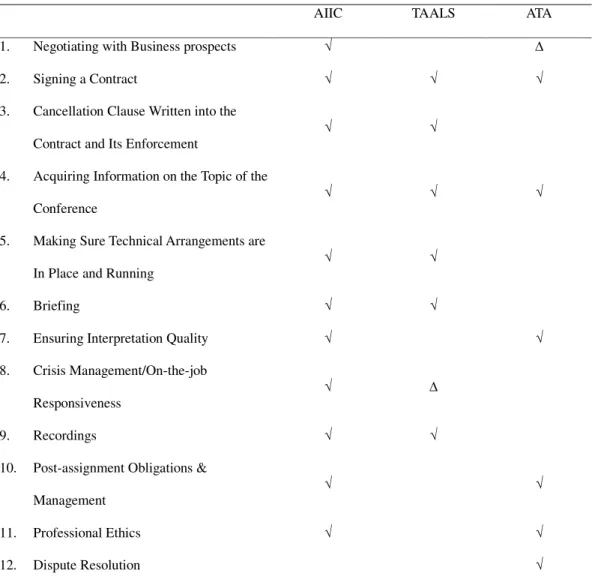
session with the speaker, etc.; third, on how to honor one’s guarantee of performance quality in action, such as arriving punctually, testing equipment, responding appropriately to the unexpected, and so on; fourth, on post-assignment obligations and management, for example, returning confidential documents, expressing gratitude and bidding farewell to conference organizers and other stakeholders, billing the customer, etc. To top it off, the Checklist, in conformance to inseparability of production and consumption in a service, states clearly the responsibilities on the part of the organizer to ensure interpretation of optimal quality, such as providing background materials as well as documents to be distributed at the conference venue, update interpreters with the latest papers, asking them to check that the interpreting equipment is functioning, handling the payment with the chief interpreter, etc. The documents of these three associations are compared as shown in Table 2.2 and what they have addressed in common is signing a contract and acquiring information on the topic of the conference. Among the three associations, AIIC has provided the most detailed procedures that interpreters and clients can follow. In chronological order, these procedures are as follow: 1) interpreters negotiating the upcoming assignment with prospective clients 2) signing a contract 3) requesting background materials 4) making sure interpreting equipment is functioning 5) briefing with the speaker 5) being mindful of on-going interpretation 6) responding to problems while interpreting 7) managing customer relations. The results of the research into interpreters’ current practices in this study will be checked against these procedures to determine whether interpreters need to add or take out some tasks from their routine agenda.
Table 2. 2 Issues Addressed on the Websites of the Three Professional Associations
AIIC TAALS ATA
1. Negotiating with Business prospects 2. Signing a Contract
3. Cancellation Clause Written into the Contract and Its Enforcement
4. Acquiring Information on the Topic of the Conference
5. Making Sure Technical Arrangements are In Place and Running
6. Briefing
7. Ensuring Interpretation Quality 8. Crisis Management/On-the-job
Responsiveness 9. Recordings
10. Post-assignment Obligations &
Management 11. Professional Ethics 12. Dispute Resolution
Notes: “ ” denotes explicit descriptions in the document, and “ ” implicit mentions.
2. 2. 3 Interpretation as a Profession
Before applying to the analysis of interpretation any instruments crafted for
marketing research into the professional service, the author of this thesis feels obligated to examine the development of interpretation’s professionalism in a local and realistic social context from the perspectives of both practitioners and clients. Tseng (1992) pioneered a study on the sociological evolution of conference interpreting from a novel vocation to a maturing profession. He suggested an established profession, such as the medical doctor in the United States, first starts off in a market chaos, undergoes a series of consolidations, and eventually reaches its goal of being protected by laws and regulations. His Model of Professionalization illustrates the progress and direction of the professional development of interpreting. It has four phases. In the first phase, the market is characterized by sharp discrepancies in price, practitioners’ competence, and their competition strategies. Clients are believed to have scant knowledge about and little confidence in the emerging
occupation, and be more price-sensitive. As competition intensifies, reformists will rise among the divergent crowd and intend to build order on the market by establishing rigorous education programs. As trainees graduate, especially those from universities, opinions regarding the occupation’s positive development start to converge, which begins the second phase. Visionaries of the same mind gradually rally behind a untied front in negotiations with employers on working conditions, job descriptions, and remunerations.
They also impose standards of quality on their works, lay down ground rules governing their professional behavior, and even attempt to screen entrants to the market. Together, they command respect from the public for the profession. The establishment of a
professional association optimizes all these collective actions and characterizes the third phase. In the fourth phase, the association strives to safeguard the interests of both its members and clients, which shall culminate in earning legislative support and protection.
Contrary to general expectation of this model to be in linear movement, it actually has a reinforcing loop between phase three and four and thus enables a profession to continue flourishing. Roberts (2002) warns that while using this model, researchers must bear in mind a given profession may be at different stages of professional development. She provides an example, “both conference interpreting and court interpreting have certainly reached Phase III…while community-based interpreting is still at Phase I…” (p. 174).
One may argue that the former two and the latter differ from each other in job
descriptions and could be regarded as separate professions, so understandably develop at different rates. However, comparing Taiwanese interpreters’ working conditions with those of their American and European counterparts, Tseng (1992) concluded conference interpreting in Taiwan only reached the second phase and urged for the establishment of a local professional associations to improve unfavorable conditions (p.148-149). A decade has passed since the publication of Tseng’s study, no interpreting professional association has yet been founded in Taiwan, and only two conference interpreters based in Taiwan are members of AIIC. Juvenile as conference interpreting in Taiwan may seem as a
profession, but it is undeniably a profession.
Credence attributes have been identified in marketing literature as the hallmark of the professional service. Namely, a service to be deemed professional must prove difficult for consumers to evaluate at any point in time as of which the need for it arises (Lovelock, 2001). Conventional wisdom believes it requires no more than comprehension of both source and target languages to gauge an interpreter’s performance, but as Seleskovitch (1978) rebutted, “if a multilingual participant were to look for evidence of the quality of simultaneous interpretation by checking up on specifics, he would have a very hard job on his hands” (p. 121). She continued by pointing out “only a professional interpreter can listen to two languages at the same time and accurately judge whether the arguments
developed in the interpretation are the same as those of the original speech” (p. 122).
Listeners of interpretation may have differentiation capabilities confined to judging the coherence, intelligibility, use of terminology and logicality (Seleskovitch; 1978; Tseng, 1992). Even in the case of consecutive interpretation, while many practitioners and researchers have acknowledged little difficulty on the part of bilingual employers in recognizing interpretation of inferior quality, they inevitably need to draw on their memory to pinpoint any omission, distortion, or dilution. However, a world of difference exists between interpretation and well-established professions, such as medicine and law,
“very few clients would confess that they can not tell the quality of the services they receive”(Tseng, 1992, p. 74). Even those who concede their inability to discern
interpretation’s unfaithfulness to the original do not hesitate to evaluate an interpreter’s performance based on synchronicity, rhetorical skills, voice quality, spontaneity, fluency, accent, use of terminology, etc. (Kurz, 2001; Moser, 1995; Ru, 1996) This study suspects that interpreters’ endeavors in establishment of a professional status in society resemble fighting an uphill battle because interpretation per se may possess more experience attributes(communication elements such as coherence and clarity) than credence ones (multitasking ability and enduring memory). It remains highly debatable whether faithfulness outweighs other attributes by a margin wide enough for conference
interpreting to be perceived by consumers as a credence-based service. However, as Ru’s surveys of conference participants’ ratings on the importance of seven major facets to interpretation reveal, a good majority would give the first priority to faithfulness, which provides the rationale for interpretation services to be studied under the research framework of professional services.
2. 3 Service Quality, Customer Satisfaction and Their Assessment Tools
The research conducted for the thesis is ultimately aimed at contributing to continual improvement in the quality of interpreting service. In order to achieve this purpose, it is necessary to review how quality has been defined and evaluated in the broader context of the service industry as a whole. When Parasuraman, Zeithaml, and Berry first attempted to propose a conceptual model of service quality, which they hope that future empirical research can be conducted under (1985), it had come to their notice that scholars seemed to have agreed that improved quality could bring about advantages for the producer as well, such as expanding market share and increasing return on investment (Anderson & Zeithaml, 1984; Phillips, Chang, & Buzzell, 1983). Zeithaml, Berry and Parasuraman (1996) have concurred by stating that the effort to perfect one’s service offerings not only prevents unfavorable intentions but also invites favorable ones of the consumer. Endeavors for progress, though may reward the service supplier with customer loyalty and positive word of mouth, must be made with meticulous calculation of potential costs to avoid unintended consequences (Rust, Zahonik & Keiningham, 1995;
Zeithaml et al., 1996).
2. 3. 1 Service Quality
Dedication to quality improvement came into vogue in the 1980s (Lovelock, 2001) and a myriad of investigations have been published on quality and its significance to service providers since then (e.g. Boulding, Karla, Staelin, & Zeithaml, 1993; Rust et al., 1995; Zeithaml et al., 1996). Bearing witness to the neglect or inadequate attention of the academic community to the concept of quality in service, Parasuraman et al. (1985) have strived to build a model of service quality through interviews with consumers and
executives in four distinctive and representative service categories while admitting
“quality is an elusive and indistinct construct” (p. 41). Their model encapsulates ten
“service quality determinants”—access, communication, competence, courtesy, reliability, responsiveness, security, tangibles, and understanding/knowing the customer, based on which consumers compare expected service with perceived service. The result of their comparison is the service quality in their perception. Lovelock (2001) has paraphrased Garvin’s remarks (1988; as cited in Lovelock, 2001) for arguing quality may be
interpreted from different points of view, including “the transcendent view, product-based approach, user-based definitions, manufacturing-based approach, and value-based
definitions”. Most research on quality of interpreting service seems to have been
conducted in accordance with user-based definitions (e.g. Kurz, 1993; Moser, 1995; Ru, 1996), which thereby highlights their relevance to the discussion in this thesis. Aptly summarized in Gale’s statement, quality is “however the customer defines it, offered at a right price.” (1994, p. 26).
Parasuraman et al. (1985) launched their first investigation into service quality under the premise that services differ from goods due to the four well-acknowledged generic features at the beginning of this literature review, and findings in studies of goods quality should not dictate the improvement of quality in service. They have concluded that a combined evaluation of both the outcome of a service and the process of service delivery determines the consumer’s perception of quality. Expanding on this conclusion, Grönroos (1990) has distinguished output of the service and the process of service delivery by coining two separate terms—respectively “technical quality” and “functional quality”—for two different sets of consumers’ perceptions. In monitoring quality of interpreting service, the focus is appropriately placed upon the process of creating benefits for the customer. In her doctoral dissertation, which is highly relevant to this
thesis for adoption of similar methodologies, Ling (2000) defines service quality as “the consumer’s subjective judgment of a product or service with regard to its degree of excellence [relative to competitors’]”. Based on all the above, this study adapts Ling’s definition of service quality (2000) to better fit the description and discussion of the interpreting industry as such: “the conference organizer’s perception of superiority or inferiority of the contracted interpreting service over other service offerings available on the interpreting marketplace at an right price.”
2. 3. 2 Customer satisfaction
In the literature of both interpreting and service marketing, satisfaction frequently appears in conjunction with quality, and their authors often imply they equate to each other (e.g. Kurz, 2001; Pöchhacker, 2001; Shi, 2004; Wenger, 1981). One cannot help but wonder whether the interchangeable use of these two terms is appropriate or even
legitimate. Kotler and Armstrong (1994) propose that “quality must begin with customer needs and end with customer perception” (p. 568), implicitly drawing a parallel between these two concepts, or rather one concept manifested in two terms. While encouraging perpetual pursuit of superior interpreting quality along the line of empirical studies on user expectations, Kurz (2001), in agreement with the aforementioned statement, defines quality as user satisfaction. Despite the widely-perceived equation mark between quality and satisfaction, some scholars have cautioned us of significant consequences derived from imprecise usage. In the portrayal by Zeithaml and Bitner (2000), service quality is among the many components of the broader concept—customer satisfaction. In addition, given the definition of satisfaction by Churchill and Suprenant (1982) as the conclusion consumers draw from a “comparison of the rewards and costs of a purchase in relation to the anticipated consequences” (p.493), it may be inferred that superb quality at a
prohibitive price may still give rise to dissatisfaction. Moreover, basing his/her judgment of quality on customer satisfaction may mislead a service provider. Lovelock (2001) has clearly stated the hidden danger.
There are some risks, however, to defining service quality primarily in terms of customers’ satisfaction with outcomes relative to their prior expectations. If
customers’ expectations are low and actual service delivery proves to be marginally better than the dismal level that had been expected, we can hardly claim that customers are receiving good-quality service! (p. 367)
The disconfirmation model systematically explains why and how consumers feel satisfied or otherwise (Churchill & Suprenant, 1982). Prior to the purchase, consumers expect a service to be performed at a certain level. After the consumption, they compare their expectation with their experience. If the latter is better than the former, customers are satisfied and the result of their comparison is dubbed positive disconfirmation; on the other hand, if it is the other way around, customers are dissatisfied and the result is labeled negative disconfirmation. If they experience exactly what was expected, they will be satisfied and the result is simply called confirmation.
Lovelock (2001) attempts to prove customer satisfaction is worth endeavoring for with a list of potential advantages for the service provider. First, it reinforces customer loyalty. Competitors are bound to fight an uphill battle for trying to lure away a provider’s s delighted customers. Second, these people may spread positive word of mouth far and wide, which allows the supplier to cut back on investments of capital and time on self-promotion and focus on his/her commitment to enhancement of quality. This
advantage on the seller’s part may well turn out to benefit buyers as well. Services high in credence attributes, such as accounting, legal consultation, and healthcare, are inherent with greater risk since customers have very few clues, if any, to evaluate quality prior to
purchase. A satisfied customer’s recommendation reduces such risk. Third, as Lovelock’s witty metaphor depicts, “high satisfaction acts like an insurance policy against the impact of a single failure” (p. 122). Satisfaction is in the beholder’s eye, and pleased customers voluntarily excuse away or write off a service failure.
2. 3. 3 Service encounters
Now that quality and customer satisfaction have been defined and their implications discussed, the next area to look into ought to be when the customer’s assessment of quality arises and where his/her satisfaction stems from. Bitner, Booms, and Mohr (1994), suggested, “the most immediate evidence of service occurs in the service encounter or the ‘moment of truth’.” The service encounter may be defined broadly by Shostack (1985) as “a period of time during which a consumer directly interacts with a service” (as cited in Bitner, Boom & Tetreault, 1990, p. 72), including its personnel, physical facilities, and other visible elements, or specifically as “the dyadic interaction between a customer and service provider” (Surprenant & Solomon, 1987, p.
87). During the interaction, an opportunity arises for customers to evaluate and judge a received service; meanwhile, service providers can exploit the opportunity to manage and influence the perceived service quality (Ling, 2000).
2. 3. 4 Critical incident technique (CIT)
Having located the point in time when the client’s perception of service quality takes shape, scholars have developed methods (e.g. SERVQUAL by Parasuraman et al. in 1988, including tangibles, reliability, responsiveness, assurance and empathy) to advance the pursuit of optimal quality by tracking down the sources of customer satisfaction or dissatisfaction. Among them the critical incident technique (CIT) adopted by Bitner et al.
(1990) has gained acknowledgement for its validity and reliability (Ling, 2000).
CIT, the critical incident technique, was initially developed for industry use (Flanagan, 1954; as cited in Bitner et al., 1990). It enables researchers to collect
observations of human behavior and categorize them by means of content analysis. Bitner et al. (1990) applied it to study the consequential events or behaviors of contact
employees in three service industries—hotels, restaurants, and airlines—as a result of which customers determine whether they have had a delightful or resentful consumption experience. Responses were collected through interviews with customers of these three industries to the following questions:
Think of a time when, as a customer, you had a particularly satisfying
(dissatisfying) interaction with an employee of an airline, hotel or restaurant.
When did the incident happen?
What specific circumstances led up to this situation?
Exactly what did the employee say or do?
What resulted that made you feel the interaction was satisfying (dissatisfying)?
(Bitner et al., 1990, p. 97)
Researchers then repeatedly read all the collected data in a careful manner until they were able to place all of them in distinct groups and categories. In the end, each account is more similar to the others in its own category than any one else in other categories. Bitner et al. (1990) have managed to identify three groups of generic events and behaviors—core service failure, customer needs and requests, and provider’s voluntary actions—and twelve categories of them across service industries. These could be considered the underlying causes of satisfactory and dissatisfactory encounters from the perspective of customers. The second undertaking by Bitner et al. (1994), a replicate of the first one, solicited responses from employees of the same industries. Another group, problematic
customer behavior, came into being to accommodate the incidents that did not fit the predetermined ones. These two studies, as claimed by Bitner et al. (1994) have lent themselves to proving the classification scheme conceptually robust regardless of respondents. Moreover, as cited by Bitner et al. (1994), the three major groups of behaviors first identified in 1990 are also found in a retail context (Kelley, Hoffman, &
Davis 1993) and a study of 16 consumer services (Gremler & Bitner 1992). Ling (2000) conducted a similar study on the dental and hairstyling services in Taiwan, and isolated gestalt evaluation from the third group, unprompted and unsolicited employee actions, making it the first group.
In the CIT study by Bitner et al. (1994), attribution theory is applied to interpret similarities and differences in the end results of their sorting scheme. This theory basically states that people tend to take credit for success—a self-enhancing bias, and shirk responsibility for failure—a self-protecting bias, and such attribution bias is more obvious in failure than in success situations. The study concludes: for dissatisfactory incidents, the service provider is very unlikely to portray customer dissatisfaction as being caused by their own predispositions, attitudes, or spontaneous behaviors, and likewise, the customer is likely to blame the service provider rather than claim responsibility for his/her own dissatisfaction; for satisfactory incidents, the service provider is more likely to ascribe satisfaction to his/her own response to customer needs and requests, while the customer is more likely to derive his/her satisfaction from the service provider’s unprompted and unsolicited actions.
2. 3. 5 Service theater
CIT is a technique for data collection. Researchers can develop their own sorting schemes for content analysis. Ling (2003) has developed service theater classification
scheme when in her operationalization of the conceptual work of Grove and Fisk (1983).
They compared service encounters to theatrical experiences. Applying dramaturgical conceptualizations to services marketing, they postulated four major elements in a service exchange could easily be understood with the aid of the theater metaphor. The place where a service-consumption experience takes place is the setting, consisting of the décor, furnishings, and physical layout. The service provider and the client are the actor and audience. The service experience is the performance, which reflects a service team’s concerted efforts to meet the client’s expectations. Ling (2003) put the conceptual work of Grove and Fisk to an empirical test by operationalizing attribution of satisfactory and dissatisfactory dining experiences from the perspectives of both the service provider and the customer at restaurants in Taiwan.
2. 3. 6 Script theory
Marketing management literature has numerous postulations or even evidence that expectations are a major determinant of customer satisfaction (Churchill & Suprenant, 1982), and the interpreting research community has also attempted to better satisfy interpretation clients’ needs by investigating users’ expectations (Moser, 1995; Ru, 1996).
However, one cannot help but wonder exactly what expectations are that researchers have keenly hoped to identify and how they are formed. The term “expectations” has stirred up much confusion, for it may represent the following conceptualizations—ideal “can be”, normative “should be”, and predictive “will be”, but consensus has been reached that predictive “will be” expectations represent what the consumer envisions will take place in the next interaction with the service provider (Boulding et al., 1993; Spreng & Dixon, 1992; as cited in Hubbert, Sehorn, & Brown, 1995). Expectations are born out of “their [customers’] own prior experience as customers—with a particular service providers,
with competing services in the same industry, or with related services in different industries” or a derivative from “word-of-mouth comments, news stories, or the firm’s marketing efforts” in the absence of such experience (Lovelock, 2001, p. 114) Complacence did not grow out of establishing the relationship between
expectations and customer satisfaction; instead scholars pressed ahead with attempts to operationalize expectations. Hubbert et al. (1995) have empirically proven that scripts help to succeed in such attempts. A script is “a predetermined, stereotyped sequence of actions that define a well-known situation”, as defined by Schank and Abelson (1977, p.
41). These actions are goal-directed, temporally and causally related to one another (Smith & Houston, 1985; Alford, 1998). For example, when a person has taken pictures with a disposable camera, and intends to have the film developed, he will follow through the procedures in his mind. He has to bring it to a photo shop first, states clearly his intension to the clerk, and signs his name on the back of a big envelope which will enclose his photos. The clerk extracts the film, hands him a pick-up slip, and tells him the estimated time when the pictures will be ready. Each action is taken to attain a goal, and one leads to another, such as signing one’s name on the back of a big envelope to retrieve the developed film, telling a customer roughly when he can pick up his photos to
complete the transaction. Throughout an individual’s lifetime, he is bound to develop, enact, modify, and retain numerous scripts for a wide array of events either by
participation or observation (Alford, 1998). Scholars (e.g. Alford, 1998; Hubbert et al., 1995; Ling, 2000) have empirically verified the presence of scripts in the context of service encounters.
When analyzing service encounter with script methodology, marketing scholars specified their interest in one particular type of script instead of all kinds of scripts.
Psychologists recognize two types of scripts: cognitive and behavioral. A cognitive script
is defined by Gioia and Poole as “a mental representation of…behavior sequences appropriate for given contexts” and a behavioral script as “the performance of the observable stream of behavior retained in an activated cognitive script” (as cited in Shoemaker, 1996, p. 44). Simply put, a cognitive script frames a given process inside one’s mind while a behavioral script arises from actually acting it out, which may not be exactly as scripted. Each of the two types has three subscripts—situational, personal, and instrumental (Schank and Abelson, 1977). Shoemaker (1996) explained each of them clearly. The situational script (e.g. film developing), of particular interest to marketing researchers, involves more than one person, and they have “interlocking roles” to follow, knowing what will happen next. The personal script remains inaccessible to no one but its author until the moment it is acted out step by step (e.g. bank robbery). The major
distinction between a situational script and a personal script is that the former is enacted to conform the needs of other involved parties whereas the latter is performed merely to meet one’s ends. An instrumental script usually involves one person, rigidly prescribing each action, such as swimming and biking. A script is developed from a weak one to a strong one, when the temporal sequence of causally-related events or actions becomes fixed (Alford, 1998).
Scholars have posited that script methodology adequately evaluates service
encounters and provides clues to the customer’s perception of quality or satisfaction (e.g.
Smith & Houston, 1983; as cited in Alford, 1998). Some (e.g. Alford, 1998; Ling, 2000) have even confirmed its value in their empirical studies. Given the description of scripts as “expectation bundle[s]” (Abelson, 1981; as cited in Hubbert et al., 1995, p. 7) and the proven connection between expectations and satisfaction, service satisfaction is measured as “the degree (to which) the script-defined expectations were met (by the service
provider)” (Smith & Houston, 1983, p. 60; as cited in Alford, 1998, p. 79). Agreeing with
Smith and Houston that script congruence between the provider and the customer results in satisfaction, Alford (1998) also discovered that positive deviations from the consumer’s script on the part of the provider induce favorable judgments. For example, after lining up all day for a ticket to Steven Chow’s latest comedy, a moviegoer unexpectedly gets an autographed poster as the 1000th viewer. S/he will be very likely to feel satisfied with this consumption experience thanks to this pleasant script discrepancy. However, service providers are advised to take such actions sparingly; otherwise, customers might incorporate them into their scripts and make service expectations harder to meet. In addition, Ling (2000) applied script methodology to the studies of the dental and hairstyling services in Taiwan, and concluded that script congruency influences a customer’s impression of the service practitioner, evaluation of his/her performance, satisfaction with the service, and repeat patronage intention. A more detailed review of relevant literature reveals that incongruence in scripts may arise from script activation at different points in time and their difference in elaborateness. Hubbert et al. (1995) and Ling (2000) both found the customer’s script begins earlier and the provider’s is more elaborate. Hubbert et al. recommend that the management enhance satisfaction by starting to attending to customers the moment their scripts come into play, and called for future research to determine the connection between script elaborateness and consumer satisfaction.
Script methodology is chosen to complete the research of this thesis because its is found not only practical for scholars to operationalize service expectations but also optimal to evaluate professional services like interpreting. Alford (1998) argued,
“professional services are process oriented and may not have tangible attributes from which the consumer may develop expectations” (p. 86), and after his investigation he ascertained that professional service providers are furnished with script methodology to
“assess and improve the process of delivering their services” (p. 97).
2. 4 Interpretation Studies
2. 4. 1 Stakeholders in an interpreting event
Since the late 1980s when interpretation studies started to extend beyond the conceptual framework and incorporate empirical undertakings in an attempt to increase understanding on formations of quality criteria in conference interpreting, researchers have gradually shifted their focus on interpreters (e.g. Bühler, 1986) to many other roles (Pöchhacker, 2001). The outreach to multiple perspectives might have derived from a common recognition that an interpreting event involves more than interpreters.
Any one that has a role to play in an industry is its stakeholder, responsible for or susceptible to both its success and failure. Bühler (1984; as cited in Ru, 1996) suggested judges on the interpreter’s performance include instructors at interpretation training institutes, certifying agencies, veteran interpreters, clients and conference delegates. Gile (1991) conceived of a model of “communication configuration”, including the interpreter, speaker, listener, and client, each of whom is a potential assessor of interpreting quality.
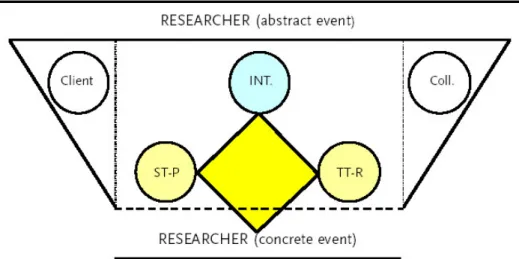
According to Pöchhacker (2001, p. 411), she (1994) and Moser-Mercer (1996) have added to the list “the interpreter’s colleague(s), associates or representatives of the client or users as well as persons with an analytical or research interest,” as depicted in Figure 2.1.
Figure 2. 1 Perspectives on quality in interpreting
Source: Pöchhacker, F. (2001).
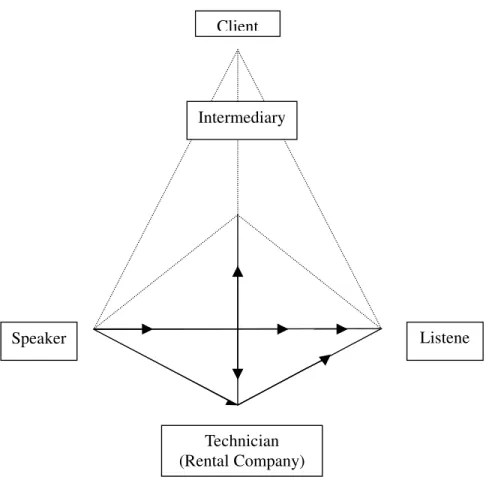
Ru (1996) identified three critical characters—speakers, audience, and conference organizers in consideration of whom interpreters serve. All the aforementioned roles can be viewed as stakeholders of interpreting services. However, this study is market-oriented, and to avoid blurring the focus, it is necessary to confine the discussion to an interpreting event’s immediate stakeholders rather than extended ones. The immediate stakeholders are seen at the conference venue—interpreters, speakers, audience, conference organizers or employers, and interpreting equipment technicians or the equipment rental company.
This study deems it necessary to incorporate the last one into any configuration model for interpretation because interpreters, however competent, can hardly work without
functioning equipment, especially so when interpreting simultaneously. On the other hand, even state-of-the-art equipment would seem useless in the absence of qualified
interpreters. Therefore, a model as in Figure 2.2 has been constructed to illustrate the relationships among the immediate stakeholders of an interpreting event. In the model,