.
118 • Soundless Music Po-Han Yang interplay of spatiality and musicality deserves a special place in thetraini月 and learning of Chinese Calligraphy.In the fourth essay of Anatomy of Criticism: Four Essays, Northrop Frye employs a
diagrammatic framework to illustrate the division of
“
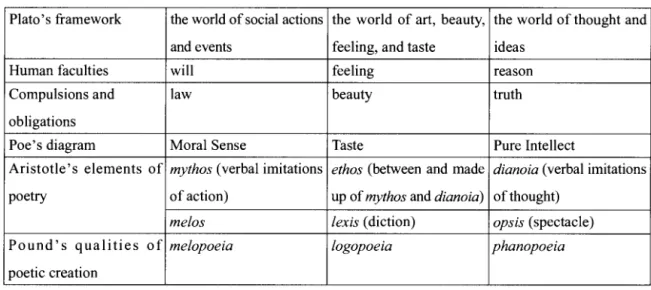
the good" into three areas: the world of art,Introduction
beauty,feeling,and taste as the central one; the world of social actions and events and the world of
individual thought and ideas as the other two. Frye maintains that the middle world may not simply
be one of the three but a trinity containing them all,and he finds the conception of this framework
useful. His observation may be summarized by the following table:1
Table 1 Triad ofthe Good
Plato's framework the world of social actions the world of art,beauty, the world of thought and
and events feeling,and taste ideas
Human faculties will feeling reason
Compulsions and law beauty truth
obligations
Poe's diagram Moral Sense Taste Pure Intellect
Aristotle' s elements of mythos (verbal imitations ethos (between and made dianoia (verbal imitations
poetry ofaction) up of mythos and dianoia) ofthought)
melos lexis(diction) opsis(spectacle)
Pound's qualities of melopoeia logopoeia phanopoeia
poetic creatIOn
Frye notes that the world of social action and events, the world of time and process,has a
close association with the ear; and the world of individual thought and ideas has a close association
with the eye. Employing the framework, Frye reasons why the musical and pictorial terms and
wording are often used in literary criticism (1957: 243-244). Following Frye's and Ezra Pound's
ideas,Andrew Welsh as well concludes that there are three main organizing powers in the language
ofpoetry: “melopoei丸"the making of music,“phanopoeia,"the making of the bright image,and
“
logopoeia,"the making ofthe resonant word(1978: 16). In other words,the three domains ofpoetryare power of temporal musicality,power of spatial image/imagery,and power of the literary word.
1This framework is intriguing for it seems to group the world of individual thought and ideas with phanopoeia
rather than logopoeia; while contemporary western philosophers and thinkers such as Derrida, may deal with the
problems concerning logos(logocentricism) or logopoeia mostly. This problem of grouping,however,is not the focus
something related to all four statements一“the cultural cultivation (文化內涵與修養)."What he means by cultivation is not so much the education or cultivation of literature as the understanding of calligraphy as an abstract visual art under the historical context of Calligraphy (Chen 1994: 677-86). The logopoeia or meaning of calligraphy then differs or is purloined in different contexts.
A Visible Lyric
Since the meaning of a work of calligraphy should be contextualized and may require much time and space to discuss,this present paper explores only the calligraphy workitself一thespatiality and musicality of calligraphy. To begin with, in The Chinese Written Character as a Mediumιfor Poetη,Ernest Fenollosa sees preserved in the Chinese character all the powers ofphanopoeia. Using Chinese characters as the vehicle of expression,calligraphy then obviously occupies a visual basis. Fenollosa explains that the visual basis works with juxtapositions that unite seeing and knowing at the rock-bottom level ofthe word(1964: 7-8).
Fenollosa's observation mayexempli身 F句e's grouping of the traits of phanopoeia. Moreover,
Fenollosa finds the Chinese characters encompass the power of action as well. As he puts it:
Chinese poetry has the unique advantage of combining both elements. It speaks at once with the vividness of painting, and with the mobility of sounds. It芯, in some sense,more objective than either,more dramatic. In reading Chinese we do not seem to be juggling mental counters but to be watching things work out their own fate. (Fenollosa 1957: 9,italics original)
The Chinese characters then encompass time and action, forces and movements,within an essentially spatial form. Calligraphy is certainly an art full of the powers of spatiality. Basically,the concern over the different script forms-kai (楷)(standard script),xing(行)(running script),Ii(隸)
.
122 • Soundless Music Po-Han YangAesthetics of Calligraphy,Jin Xuezhi (金學智)as well mentions that the description “soundless
music(無聲之音)"is closet。“theessence of calligraphy" and
“
it seizes the musicality permeated inthe art of calligraphy" (2008: 63).But he then shifts his focus to its lyrical powers ofrepresentation
and of presentation,which may affect and express people's emotions and feelings (63-73). Jin
states that
“
the brush and ink are controlled by emotions; the lines of calligraphy should representthe trace of emotions" (73).2 His observation,however,leads to a possible logopoeia or function of
calligraphy.
Compared with the discussion on the functions, meanings and forms/spatiality of calligraphy,
the power of musicality seems less discussed and more difficult for people to explain. Nevertheless,
people have noticed the power of musicality of calligraphy. In the history of Chinese Calligraphy,“the
singing and dancing of the brush and ink (筆歌墨舞)"is a technical term,orclich忌, to describe the
movement of the art of calligraphy (Xu and Shao2006: 8). Some famous contempora可 calligraphers
as well name their work collections with titles related to musicality. For example, Lin Rong-sen
(林榮森)names his work as Cantos of Dots andLin臼(點線的樂章);and Chien Ming-shan(簡銘
山) Cantos of Wildness and Latency (狂野與沈潛的樂章).These works both imply the intimate relationship between calligraphy and musicality. But how are these cantos of calligraphy written or
composed? Is there any pattern of the
“
singing and dancing of the brush and ink?"Spatial Musicality
In his
“
Talks on Calligraphy,"Wang Ji月廿li (王靜芝)proposes that comparing calligraphy todancing would be easier for us to understand the movement of calligraphy,or the movement of the
brush. He makes a musical as well as pictorial description. As he describes the movement of different
types of script:
Kai scripts are slow dances which steps with various gestures of elegant movements; xing
scripts are mid-fast dances which swing,whirl,and tum lightly; and cao scripts are fast
dances which evolve, gallop, and fly vigorously with the wind. (Wang 2000: 192, my
translation) (楷書是慢步的舞,擺出端平美麗的姿態,移步緩動,風姿萬種。行書是半
快動作的舞,翩蹲搖曳,衫柚飄轉,肢體迴旋,裙飄帶繞。草書則是快動作舞,縱橫
騰躍,彩帶飛揚,龍翔鳳舞,風動花飛。)
2To some degree Jin's observation is correct,but in practice the emotions may be constrainedorin日uencedby
brush and ink as well.Forexample,a writer of calligraphy may have to stop his or her writing ifthe brush runs out of
It is convenient to make this comparison because the dots and lines in a work of calligraphy are similar to dance steps.3 The rhythm created by the dots and lines in a work of calligraphy can then be the calligraphers' prior and initial concern. A calligrapher can compose the rhythm only
through the dots and lines. Wang's comparison,however,may lead to several questions. Generally
speaking,the writing of standard script is much slower than that of cursive script; but Yu Youren's
(于右任)cursive script would not necessarily be faster than Chu Shuilia嗯 's (褚遂良)standard
script or Wang Xizhi's (王羲之)running script in
“
Preface to the Gathering at the Orchid Pavilion"(蘭亭集序).Also,appreciating a work of calligraphy is not like listening to music or watching a
dance performance. While appreciating an accomplished work of calligraphy,the audience may not
see the writing process of the calligrapher directly.4 Although the rhythm of the creative process
may to some degree be preserved in the work of calligraphy,the rhythm of a work of calligraphy
is nevertheless discerned or felt not so much from the creating/writing process, as from the
accomplished/written script on the work of calligraphy itself.Itis a melodyrevivedfrom the written
to writings,from the said to varied sayings.
So how is the sense of rhythm being felt by the audience from the work itself? I shall begin
with the radical elements of calligraphy-the dots and lines-the moving steps. Sun Guo-ting(孫過
庭),a famous calligrapher and calligraphy theorist of the Tang dynasty(唐朝),asserts that:
In standardscri阱,dots and lines are the form and substance,and movements and turnings are
the disposition and essence; in cursive script,dots and lines are the disposition and essence,
movements and turnings its form and substance. (Sun 1984: 114,my translation)(真以點畫
為形質,使轉為情性;草以點畫為情性,使轉為形質。)
If we juxtapose Sun Guo-ting's argument with Wang Jing-zhi's,we may tentatively propose
that dots and lines may give the appreciators a sense of slowness,while the movements and turnings
a sense of rapidness. A dot then may be thought of as a beat,a tempo,or a rest, the rhythm of a
Chinese character then is created by/between the dots. A work of calligraphy is therefore a rhythmic constructIOn.
In addition, if a work of calligraphy can be compared to a dance,then how are the dots and
3Although Wang Jing-zhi compares calligraphy to dancing,the facet Wang describes here is more like an image
he pictures rather the musicality of the dance steps.
4Itwould be a different story if the audience had the opportunity to witness a calligrapher creating a piece of
work. In this case,the audience might share in the calligrapher's rhythm more directly. This paragraph primarily
• 124 • Soundless Music Po-Han Yang lines arranged/constructed to encompass the sense of speed? The dancer and writer Lin Hwai-min
(林懷民)also uses Chang Xu's (張旭)Du-tong-tie(肚痛帖)and Huai-su's('懷素)Autobiographical
Presentation ( 自敘帖) as examples to illustrate how calligraphy and dancing are merged together. Lin explains:
Although dancing cannot represent the three characters
“
hu (suddenly),du (stomach),tong (ache),"but [dancing may capture] the weight and fluidity of the characters and the space they occupy. This work begins from strokes with heavy weight,then the stroke flows gracefully,and the stroke weighs heavy again. This is exactly the structure of music. And Huai-su'sAutobiographical Presentation is a symphony,which is a complete composition. The balance and correspondence between the characters and lines is important inspiration for my choreography. (qtd. in Xu and Shao 2006: 9,my translation) (雖然舞蹈不能表現「忽肚 痛」三個字,但字的重量感、流動性,以及在空間裡佔據的位置。整個帖,從這麼重
開始,到忽然間流暢起來的秀麗,然後,又重了出來。這根本就是音樂的結構。而懷
素的《自敘帖》是交響樂,是很完整的曲式構成,字裡行間的平衡與呼應對我的編舞
來說,是很重要的社示。)
When it comes to the composition of a work of calligraphy,like a symphony,“the balance and correspondence between the characters and lines" is important. The arrangement of the characters and lines is termedzhangfa (章法) (structure or disposition of the work) in traditional theories of calligraphy. In
“
The Composition of Zhangfa"(章法的構成),a contemporary calligraphy scholar Qiu Zhen-zhong (邱振中)applies the use of trunk axes (軸線tto analyze the composition ofzhangfa.ForQ凹,zhangfa is composed step bystep-企omdots and strokes,to the structure of a character,and to the connection of characters,and then correspondence between lines. Qiu suggests that there are mainly three types of connection between the axes: (a) an unusual connection ofaxes: a character may have two or more than two axes, one of them connecting the character with the character it follows or the character following it; (b) a double connection ofaxes: one character have two crossing axes,
each of them connecting with the proceeding character and the following character; and (c) a grouped connection ofaxes: the characters of one line may be grouped by axes into several chunks (Qiu 1995: 81-98).These three types of connection ofaxes are illustrated as the following:
5Atrunk axis is the central line which divides a character or part of a character into two balanced parts.A
(a) unusual connection (b) double connection (c) grouped connection
The contribution of the analyses ofaxes is that it clearly displays the hard-to-describe concept
hangqi (行氣)(breath of lines) of traditional calligraphy theories,and it presents the rhythm of a
work of calligraphy. If the trunk axes are linked connective旬, then the breath of the lyric would be
smooth; and if the connection is abrupt,then it creates the jumping rhythm of the line. The more
abrupt the connection is,the faster the rhythm is felt. Lin Rong-sen (2004: 295-296) further points
out that the analyses ofaxes are not sufficient enough-the contours of the lines may affect the
aesthetics of hangqi as well. He finds in Xu Wei's (徐滑)works of calligraphy the contours of lines
full ofvariation (AStu砂 ofXu 恥i's Calligraphy). The analyses ofaxes andcontours 臼rthersuggest
that rhythm of calligraphy can be discerned not so much from the continuous conjuncture between
axes, as from the unusual or unexpected connection between the jumping axes; and the irregular
contour of one line may correspondence with the contour next to it. Lin Hwai-min's
“
a completecompositiot
1"
and“
the balance and correspondence between the characters and lines" then may bebest represented by the grouped composition ofaxes,contours of a line,and the lines (see Xu and
Shao2006).
Auditory Space of Calligraphy
Based on Victor Zukerkandl's (1969) finding of
“
Auditory Space" in Sound and Symbol,Yu-kung Kao in
“
The Influence of Chinese Language and Characters on Poetry" reemphasizes thespatiality of music (Kao 1989: 20-21). To begin with,rhythm is the principal manifestation of time
in music; it creates
“
a symbolic potency" which exists in the world of time and movement(20).As for calligraphy,the analyses ofaxes and contours of lines may be used to reveal the concept shi
(勢)6 in traditional calligraphy criticism as well.Also in his
“
Chinese Lyric Aesthetics,"Kao notes6Generally speaking,there are a least three usages for the character for shi in criticism of calligraphy: qishi
.
126 • Soundless Music DAOHany到凶nobthat in the traditional criticism of calligraphy,xing(形)refers to the static form and shi refers to
“
the potential interaction between forms (80)." When movement is understood as an indispensible part of calligraphy,the controlled shi is then the“
configuration." Kao further offers the translation“
potency" for shi:When finally movement is seen as propulsion,shih [shi] is the force itself with all its potential momentum ready to be released,for which I offer the translation
“
potency." Thispower臼1 concept of potency is present ineve可 scriptform,but it is most fully realized in the form of cursive script. Itis not too much of an exaggeration to claim that T'ang [Tang] criticism focused on the problem of realizing this potency,aware that it could be meaningful only within the symbolic framework of the underlying inner force. (Kao 1991: 80,italics added)
The
“
potency" of the inner force,together with the analyses ofaxes,exists in the world of time and movement as well. This characteristic can be exemplified by the act of copying or imitating a calligrapher's work. Copying or imitating other people's works (usually fine works done by famous calligraphers) is considered to be an important training or practice. Kao observes that a calligrapher is a performer of another person's score when he copies the other's masterpieces (Kao 1991: 76). This process of representation is to some degree a revivification,a realization,of another person's score-from the written score to a writing performance. The calligrapher brings the spatial scripts to the world of time and movement by realizing the potency.Zukerkandl also suggests that music,latently or patently,has a spatial meaning(1969: 267). For Zukerandl,the chord can best represent the spatial meaning:
[T]he chord,the connection of several tones sounding simultaneously. If simultaneously sounding tones coalesced into a mixed one as colors simultaneously projected upon a surface coalesce into a mixed color,then the chord would simply be another tone,as blue-green is another color.... But the tones that make up a chord do not disappear in it; each remains in existence as a separate component of the chord and,in simple cases,can easily be heard in the chord even by the untrained ear. (Zukerandl 1969: 268)
calligraphy may not use one s仕oke to create a simultaneous separate stroke (with the exception of some special techniques such as 戶ibai (飛白)); however,it does not mean that there is no space in the musicality of calligraphy. Zukerandl as well finds that
“
[t]he chord is the fruit not of the simultaneous existence of tones but of their mutual relation (301)." Therefore,two sounds in movement may create a chord,the auditory space as well. Thus the dots and lines,strokes in a work of calligraphy,may also open up an auditory space. In addition,compared with the symbols used in musical notations,the dots and lines of calligraphy not only can record the mutual relation between the strokes but also remain the depth of the strokes. For example,the trace made by ti' an (提按) (lifting and pressing the brush)7 preserves the forte and piano of the brush movement.s This makesthe audit。可 space of calligraphy a three dimensional one. Together with the variation of light and heavy(輕重),dense and pale(濃淡),dry and wet(乾溼),and open and closed(開合),the musicality of calligraphy thus contains colorful rhythm,tone,and tune at the same time.
The Interplay of Spatiality and Musicality
This auditory space in calligraphy is closely related to the spatiality of calligraphy but still different. The musicality of different styles of calligraphy may be distinctive. That is the reason why
cao style usually
“
looks" faster than zhuan stlye or kai style. In addition,Chen Qin-zhong(陳欽忠)further suggests that in the late Ming Dynasty (晚明), the extremely long frame of the paper may have helped calligraphers:
Wild cursive uses extremely simple lines to represent
“
the wonder of image." Late Ming cursive well presents“
new textures and different gestures" with a more complicated form of word structures. By making functional strokes content, it creates dense and exaggerated forms of characters. And the long vertical scroll allows the lines to go on and on, and it strengthens the explosive power ofthe work. (Chen 1997: 1 肘,my translation)(狂草是以極簡約的線條,作為表現「意象之奇」的高度概括,晚明草書則是在較繁複的字形結構 中,以表現「新理異態」為能事。這種以草寫快寫複雜筆畫的方式,筆畫問映帶的虛 筆坐實為實筆,將不可避免地造成繁密誇張的字形,如此連級成行而成篇,在縱長的
紙幅中盤好而下,一氣呵成,與人一種墨花崩藏的爆發力感。)
.
128 • Soundless Music Po-Han Yang on and on. If we compare Huai-su's and Wang Duo's (王鐸)cursive works,we can find that Wang Duo's lines are much longer. The lyric would then be different.The frame ofthe concrete paper is the visible space for a calligrapher. The structures and forms of the characters present in the spatiality of calligraphy whereas the stream of the lines flows in the musicality of calligraphy. The appreciators' eyes see the presence of the content(實) or functional (虛)strokes while they sense the lyric flows when they follow the lines downwards.On the other hand,the frame of the paper may sometimes structure the auditory space of a work of calligraphy. Kao contends that the evolution of the rules of regulated verse (律詩),making use of the
“
character-form" ofthe language,has emphasized the“
poetic space" of the poem. He insightfully points out that“
[t]he change from an open form to a closed form is an extremely significant step" because“
[t]he predictable closure of regulated verse gives poets a sense of poetic space (Kao 1991: 71-72)." When it comes to the rhythm of a closed form poem,there are two significances: on the one hand,a beat is a repetition of the proceeded beat,so there is constant "retrospect;" on the other hand,a beat reinforces the former beat,and it functions as“
enhancement."Therefore,on the level of rhythm,there are retrospective closed circles and proceeding open waves (Kao 1989: 23).Similar topoet可,the production of calligraphy as well utilizes an open form or a closed form writing on bamboo strips or on horizontal scrolls is more similar to open forms while writing on a fixed rectangular or fan-shaped frame of paper represents a closed form. 9 Contemporary works of calligraphy usually adopt paper or wood with a certain fixed frame or space and thus exercise a closed form. This predictable closure also gives calligraphers a sense of poetic space which encompasses the force ofre仕ospectand of enhancement.From Kao's point of view,the poetic space of a poem is then not so much the linear flow of the lines,as a mental blueprint of spatiality. As Kao puts it:
The primary goal is to construct amodular spacethrough rules that govern the placement of equivalent (or opposite) qualities (of tone and of sense) in each character position.... The first principle in this modular version is to achieve symmet可 Phonicsymmetry is based upon obtaining a maximum contrast between level and oblique (or
“
lax" and“
tense") tones9The poetic idea of“retrospect" and "enhancement" may open additional room for the discussion of the musicality of calligraphy. For instance,if we regard a seal script character as a closed form,while writing seal scripts
zhuan ( 筆), psychologically a stroke may be considered to be a retrospect of the stroke it follows,which makes an
Po-Han Yang Soundless Music
.
129 • The phonic design therefore does not have acontinuous repeating rhythm but substitutes forrepetition a perfectly complementary modular pattern. This weakens greatly the linear flow of the lines,but it establishesα structural symmet.ηwhichaccommodates a variety of sound modules,comparable toa mental blueprint ofspatialil)λ(Kao1991: 72,italics added) This mental blueprint of spatiality is important: in the first place it requires the principle of symmetry and secondly it values contrasts. In his
“
The Influence of Chinese Language and Characters on Poet旬," Kao further suggests that this poetic space formed by characters not only presents the texture of semantics and syntax,but also symbolizes the direction of mental movement.And it is in the art of calligraphy that the mental space is best represented (Kao 1989: 27). Take Wang Duo's works for instance, a
“
continuous repeating rhythm" can easily be found, but Wang as a calligrapher consciously creates contrasts in the space. The photo below shows how Wang adjusts the continuous repeating rhythm of the first two lines of his work: two upper right-lower left strokes in the second (middle) line are extended longer or the strokes would be a repeating rhythm of the strokes in the first (right) line. Especially when the last stroke of the charactershu (數) in the second line is a repetition of the last stroke of the characterwu (無)in the first line,Wang enhances the pa由rn to make a contrast. By prolonging the strokes,Wang not only gives the lyric a different expression but also exhibits his awareness of spatiality and his mental movement. Itmakes a variation of repetition.(Though Calligraphy and Painting Express One's Emotion Scroll «書畫雖遣懷軸» pa計划.)
.
130 • Soundless Music Po-Han Yang 江舟中詩). The frame ofthe paper,a wide handscroll,structures the presentation ofthiswork一thereare juxtaposing lines towards the left and four characters at most in each line,which reconstructs the
pattern of the work. Picture (1) is the first pa口 ofthe work,(2) the second,(3) the third,and (4) the
whole picture. In picture (1),the first four lines of the work of calligraphy (not the poetry's lines)
have created a pair of heavy-light (or wet-dry,thick and thin) couplets; each line with a potency to
the lower left. The first is a four-character couplet and the second a three-character one. Itestablishes
a structural symmetry which accommodates a variety of expressions. Following the pattern,Mi
makes another heavy-light couplet; but he 吋 usts the potency of the fifth line downward and the
potency of the sixth first to the lower left,then downward. Then M i makes a three-character couplet
and a four-character couplet,with an emphasis on the contrast between the characters. The first ten
lines form another structural symmetry. Following the four-character couplet are two lines of four
and three characters,a continuum as well as variation. Then he puts a stress by the one-character line
ju (車)(a chariot) which may function as afo巾,a rest or a variation. What follows is a fast allegro
with a lot ofturni月 lines.10The characterzhan (戰) (war) which occupies two lines in picture (2)
may share a similar function asju,but stronger of course. After such a powerful expression,the lyric
flows to a more peaceful minuet gradually as shown in pic仙re(3).11Though the connections ofaxes
are still jumpy,there are less turning movements and more dots and short lines. Along with the finale
signature part,Mi Fu's Poem Composed in a Boat on the Wu Riverthen can be
“
seen/regarded"as a piece of small spatial symphony which is composed of four movements,and this work is a
completed composition.他 Togetherwith the variation of light and heavy,dense and pale,dry and
wet,the musicality of calligraphy thus contains colorful rhythm,tone,and tune.
(1) (Poem ~仟ittenin a Boat on the Wu Riverpartial)
10Amusical tempo means quick and lively
旬 1A minuet is originally a social dance of the French,usually in 3/4time. Italso becomes a standard third
movement in the four-movement classical symphony.
但Amovement is one of the main parts of a piece of classical music that is separated from the otherpa此swith
Po-Han Yang Soundless Music. 131
.
enJf
zv?d
dbAav
(2) (Poem Written in a Boat on the 的IRiverpartial)
TfkY
USAM
抄志于
何蛇神
rdp
雌川
.
• 咎, ntawwm
會哼傳?
很忌,
LZ
(3) (Poem Ii仲ittenin a Boat on the Wu Riverpartial)
:$233iir 曹
(4) (Poem Written in a Boat on the Wu RiverHandscroll; 31.1 x 557 cm)
Representation vs. Expression
Wang Duo's and Mi Fu's adjustment oftheir strokes is a linchpin,which exemplifies the covert principles and further enters the realm of aesthetics. In
t油ha羽t ‘“‘'[a吋]es叫thetics cent紀ers on the individua叫I's experience ofc盯r閃ea訓ti廿vity, whereas a theory of art is concerned with the study of the nature of art" (1991: 48). Wang Duo or Mi Fu of course is not the first one to make such an adjustment. For instance,the works of Wang's model calligrapher,Wang Xizhi,have shown this kind of adjustment as well. Wang Duo himself also imitated and reproduced many of Wang Xizhi's works. In the Chinese calligraphy tradition, copying the works of others
.
132 • Soundless Music Po-Han Yang Within the scope of art theory,the usually opposed interpretations of art as representation and art as expression can be seen as two sides of the same coin: they are premised on the same distinction between the artist and his work; and thus self-expression can be treated as a special kind of representation, in which the artist's inner states are the objects of his observation. (Kao 1991: 48)A calligrapher is a performer of another calligrapher's score when he or she copies the other's literary works. This doubleness as well creates an intimate space among the calligrapher's inner states and his works. A calligrapher perceives the lyric of another calligrapher and (re)produces his own nearly at the same time; thus there is a chord of doubleness. And for an appreciator,he sees the calligrapher's writing and thinks ofthe original work,and the chord ofthese two lyrics may resonate with his own,plucking his heartstrings.
Sometimes it may be difficult for a beginning student of calligraphy to imitate a calligrapher's work well,especially a work of the xing style or of the cao style,even though the visual presence of the work is vivid,overt,and explicit. Sometimes it is due to the problem of technique,but most of the time it might be because the student does not get the rhythm of the writing or does not re-perform the lyric properly. Therefore the learner may need a teacher to revive the lyrical rhythm for him. On the contrary,even though the imitation of a calligrapher's work is not similar to the original in appearance (Wang Duo's imitation of Wang Xizhi is often criticized),the calligrapher's work can still be appreciated once it demonstrates a recognizable musicality一企om aesthetics of xingsi (形
似) (similar in form and shape) to aesthetics of shensi(神似) (similar in spirit),which bridges the musicality of calligraphy and the possible logopoeia of calligraphy. It is an evocative power of the lyric of calligraphy. And even though the appreciator has not composed a work of calligraphy,he may express his feelings and undergo an experience of catharsis. Perhaps it can be viewed as what Shih-Hsiang Chen suggests:
The Chinese classical tradition,focusing on the lyric,draws attention to discrete, distilled fine particles of the poetic art,the all-evocative powers of sound and imagery,harmonized throughout an integrated piece of word-music,intuited by the subjective and empathy (Chen
1972: 22).
Reading the musicality of calligraphy along with the literary work's content and form,
• 134 • Soundless Music
Bibliography
Po-Han Yang
Chen,Qin-Zhong. A Study ofFrames of Calligraphy andS,妙的 ofCalligraphy (Taipei: HuaCher嗯,
1997).
【陳欽忠。《法書格式與時代書風之研究~ (臺北市:華正書局, 199 7)。】
Chen, Shih-Hsiang.
“
On Chinese Lyrical Tradition," Tamkang Review,II, 2 & III, 1 (October 1971-April1972): 17-24.Chen,Zhen-Lian,ed. Calligraphy. Vol. 1& Vol. 2 (Taipei: Chien Hong,1994).
【陳振濟(主編) 0 <書法學~ (臺北市:建宏出版社, 1994) 。】
Chien,Ming-Shan. Cantos of Wildness and Latency: Chien Ming-shan's Calligraphy (Taichung: Cultural Affairs Bureau,Taichung City,2007).
【簡銘山。《狂野與沉潛的樂章 簡銘山書法集~ (臺中市:畫中市政府文化局,
2007)。】
Fenol1osa, Ernest. in The Chinese 所itten Character as a Medium for Poet吵,ed. Ezra Pound (San Francisco: City Lights,1964).
Fy間, Northrop.Anatomy ofCriticism: Four Essays (Princeton,NJ: Princeton UP, 1957). Jin, Xue-Zhi. On the Aesthetics ofCalligraphy (Taipei: HuaChe時, 2008).
【金學智。《書法美學談~ (臺北市:華正書局, 2008) 。】
Kao,Yu-Kung.
“
Chinese Lyric Aesthetics,"in Words and Images: ChinesePoetl步~ Calligraphy,and Painting,eds. Alfreda Murck and WenC.Fong (Princeton: Princetion UP,1991),47-90.-“
The Influence of Chinese Language and Characters on Poetry,"Chung Wai Literary Quarterly18.5 (October 1989): 4-38
【高友工。〈中國語言文字對詩歌的影響> ' <中外文學~ ,的卷5期 (1989) : 4-38 。】
Lin,Rong-Sen. Cantos of Dots and Lines: Lin Rong-sen's Calligraphy (Taichung: Zhenyixuan,
1998).
【林榮森。〈點線的樂章 林榮森書法作品集~ (臺中縣:甄宜軒, 1998) 。】 一-.AStu砂 ofXu Wei's Calligraphy (Taipei: Lapen,2004).
【林榮森。《徐j胃書法藝術之研究~ (臺北市:文史哲出版社, 2004) 。】
扎伍, Fu. Poem Written in a Boat on the Wu River (AD 1100, inThe 卸letropo1rtan Museum of Art,
NewYork).
【【宋】米帝: <吳江舟中詩~ (西元 1100 '現存於大都會藝術博物館,紐約市。)】
Zhen-.
Zhong Qiu (Taipei: Asiapac,1995),63-100.
【邱振中。〈章法的構成) ,載於《書法藝術與鑑賞〉﹒邱振中(臺北市:亞太圖書出版 社, 1995) , 63-100 0 ]
Sun,Guo-Ting.
“
Treatise on Calligraphy," in Selected Essays on Calligraphy,ed. Zheng-Ren Hua (Taipei: Hua Cheng,1984).【孫過庭。〈書譜) ,載於《歷代書法論文選} ,華正人(臺北市:華正書局, 1984) 。】
Wang, Duo. Though Calligraphy and Painting Express One's Emotion Scroll. Capital Museum. Wang Duo's Calligraphy (Shanxi: Shanxi Renmin,2002).
【王鐸。〈書畫雖遣懷軸} , <王鐸書法} (山西省:山西人民出版社, 2002) 。】
Wang,Jing-Chi.Talks on Calligraphy (Taipei: Taiwan Bookstore,2000).
【王靜芝。《書法漫談} (臺北市:臺灣書局, 2000) 。】
Welsh,Andrew. Roots of Lyric: Primitive Poetry and Modern Poetics (Princeton NJ: Princeton UP,
1978).
Xu,Jian-Rong and Jie Shao. The Relationship Between Calligraphy and Other Arts (Taipei:
Rock-publishing,2006).
【徐建融、邵捷。《書法與其他藝術的關係} (臺北市:石頭出版社, 2006) 。】
•
136 • Soundless Music Po-Han Yang..
無聲之音
中國書法空間性與音樂性的交互遊戲"
楊博涵 英語研究所 國立臺灣師範大學 研究生 摘要西方文藝批評家,諸如弗萊 (Northrop Frye) 、龐德(Ezra Pound) 、魏爾許 (Andrew